


ISO 14484:2020
(Main)Performance guidelines for design of concrete structures using fibre-reinforced polymer (FRP) materials
Performance guidelines for design of concrete structures using fibre-reinforced polymer (FRP) materials
This document provides general principles for the verification and assessment of the performance of concrete structures with the applications of different fibre-reinforced polymer (FRP) systems varying from internal FRP reinforcements/tendons, external FRP tendons, externally bonded FRP sheets/plates, to near-surface mounted FRP reinforcement. It can be used for the international harmonization of the design of un-reinforced, conventionally reinforced, and pre-stressed concrete structures with the use of the above-mentioned FRP systems.
Lignes directrices de performance pour la conception des structures en béton utilisant des polymères renforcés de fibres (PRF)
General Information
Relations
Overview
ISO 14484:2020 - Performance guidelines for design of concrete structures using fibre‑reinforced polymer (FRP) materials - is an international, performance‑based guidance document for using FRP systems in concrete design and retrofit. It covers a wide range of FRP applications (internal FRP reinforcement/tendons, external FRP tendons, externally bonded FRP sheets/plates, and near‑surface mounted FRP) and supports harmonized design for un‑reinforced, conventionally reinforced and pre‑stressed concrete structures. The standard emphasizes quantitative performance verification at serviceability and ultimate limit states, and complements regional prescriptive codes.
Key topics and technical requirements
- Design basics and methodology
- Performance‑based, quantitative evaluation of limit states (SLS and ULS).
- Use of rational analysis methods and sound engineering judgement.
- Material properties
- Requirements for concrete, steel and FRP properties; compatibility with exposure/environment.
- Recognition of FRP geometries: bars, grids, plates, sheets, strands.
- Consideration of bond behaviour and linear elastic FRP properties in design.
- Structural analysis
- Procedures for stress/strain calculation, cracking, deflection and serviceability control.
- Serviceability limit states (SLS)
- Crack width control, tension/flexural cracking, shear/torsion cracking, deflection checks.
- Ultimate limit states (ULS)
- Axial, flexural and shear capacity (including punching shear and torsion).
- Consideration of creep‑rupture and fatigue behaviour of FRP materials.
- Detailing and connections
- Anchors, splices, bent configurations for FRP reinforcements/tendons.
- Anchorage and splicing for externally bonded sheets/plates and near‑surface mounted systems.
- Groove dimensions and bonding/adhesive provisions for NSM FRP.
- Scope extensions in the 2020 edition
- Includes combined use of FRP with steel reinforcement and allows FRP compressive strength to be used in design.
Practical applications and users
ISO 14484:2020 is intended for:
- Structural engineers and designers developing new concrete elements with FRP or specifying strengthening schemes.
- Asset owners and facility managers planning FRP retrofits for corrosion mitigation or load upgrades.
- Contractors and manufacturers implementing FRP systems (bars, sheets, NSM) and producing compatible resins/adhesives.
- Code developers and researchers seeking harmonized, performance‑based criteria for international use.
Typical applications:
- Strengthening beams, slabs and columns with externally bonded or near‑surface mounted FRP.
- Using FRP tendons for pre‑stressing or external prestressing.
- Replacing or supplementing steel reinforcement in corrosive environments.
Related standards
- ISO 2394 - General principles on reliability for structures
- ISO 10406‑1 / ISO 10406‑2 - FRP reinforcement test methods (bars, grids, sheets)
- ISO 19338 - Performance and assessment requirements for design standards on structural concrete
ISO 14484:2020 serves as an umbrella, performance‑oriented reference to harmonize regional FRP design rules and support robust, durable concrete structures using FRP materials.
Standards Content (Sample)
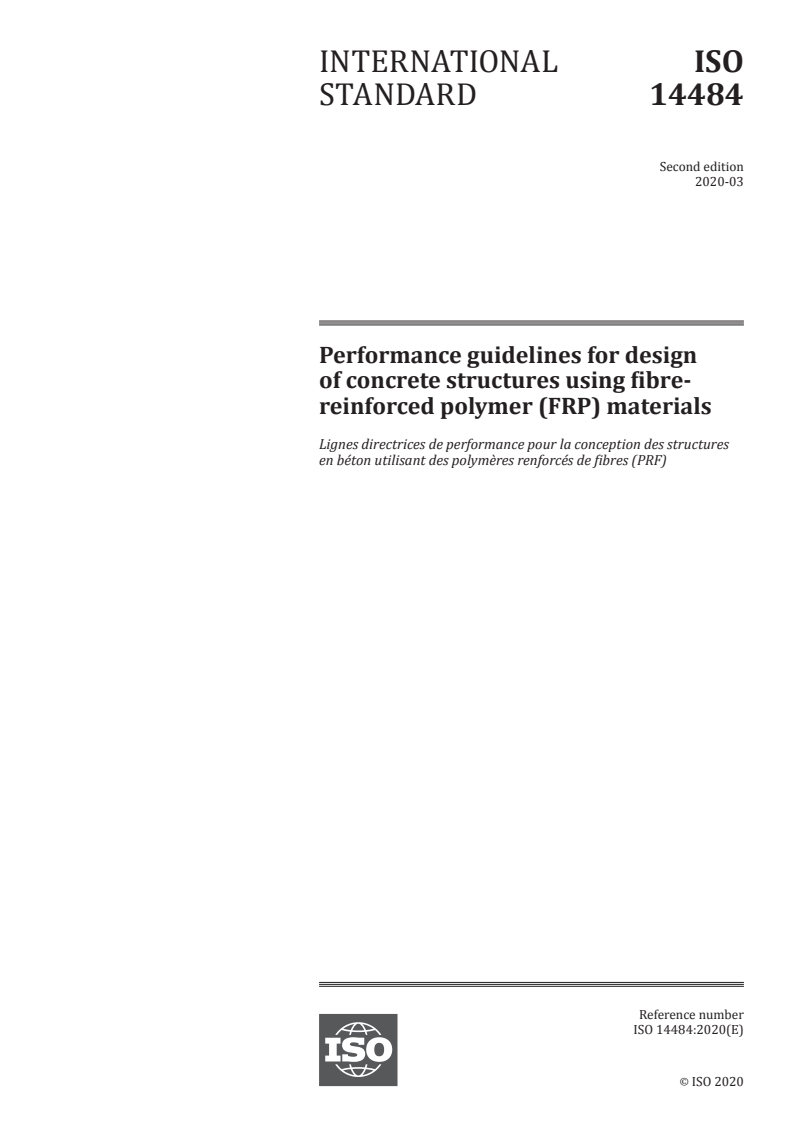
INTERNATIONAL ISO
STANDARD 14484
Second edition
2020-03
Performance guidelines for design
of concrete structures using fibre-
reinforced polymer (FRP) materials
Lignes directrices de performance pour la conception des structures
en béton utilisant des polymères renforcés de fibres (PRF)
Reference number
©
ISO 2020
© ISO 2020
All rights reserved. Unless otherwise specified, or required in the context of its implementation, no part of this publication may
be reproduced or utilized otherwise in any form or by any means, electronic or mechanical, including photocopying, or posting
on the internet or an intranet, without prior written permission. Permission can be requested from either ISO at the address
below or ISO’s member body in the country of the requester.
ISO copyright office
CP 401 • Ch. de Blandonnet 8
CH-1214 Vernier, Geneva
Phone: +41 22 749 01 11
Fax: +41 22 749 09 47
Email: copyright@iso.org
Website: www.iso.org
Published in Switzerland
ii © ISO 2020 – All rights reserved
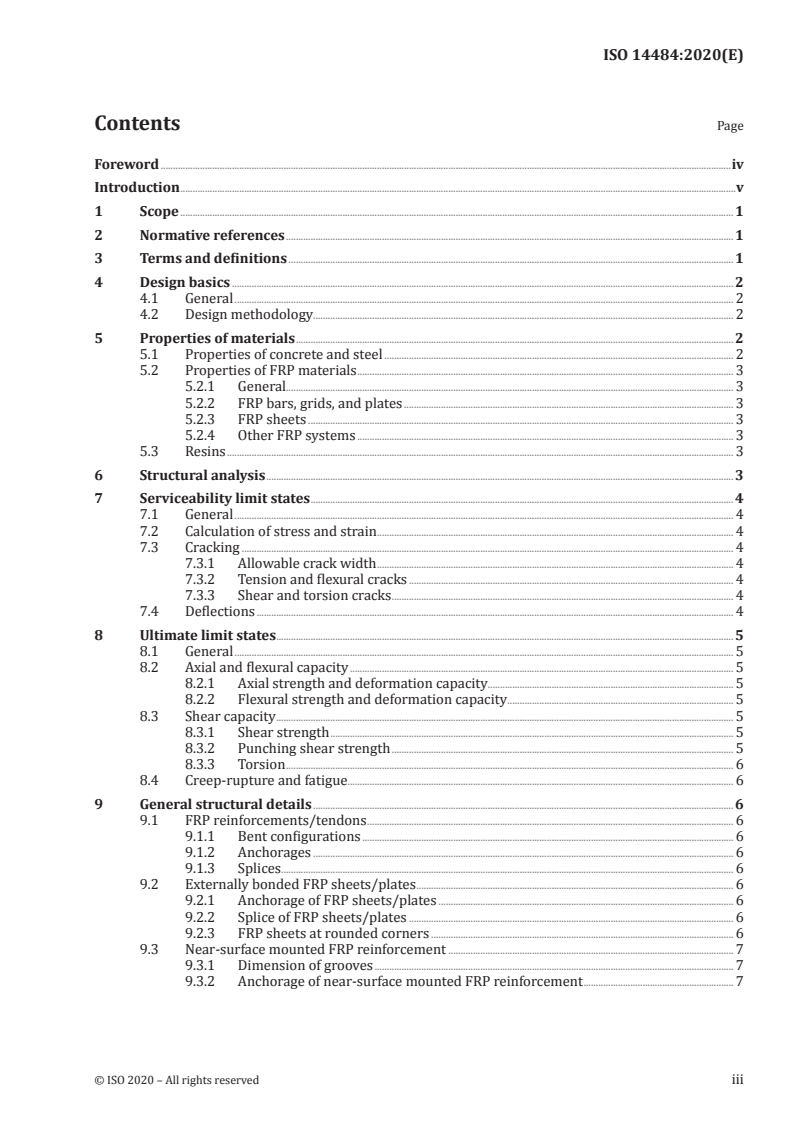
Contents Page
Foreword .iv
Introduction .v
1 Scope . 1
2 Normative references . 1
3 Terms and definitions . 1
4 Design basics . 2
4.1 General . 2
4.2 Design methodology. 2
5 Properties of materials . 2
5.1 Properties of concrete and steel . 2
5.2 Properties of FRP materials . 3
5.2.1 General. 3
5.2.2 FRP bars, grids, and plates . 3
5.2.3 FRP sheets . 3
5.2.4 Other FRP systems . 3
5.3 Resins . 3
6 Structural analysis . 3
7 Serviceability limit states . 4
7.1 General . 4
7.2 Calculation of stress and strain . 4
7.3 Cracking . 4
7.3.1 Allowable crack width . 4
7.3.2 Tension and flexural cracks . 4
7.3.3 Shear and torsion cracks . 4
7.4 Deflections . 4
8 Ultimate limit states . 5
8.1 General . 5
8.2 Axial and flexural capacity . 5
8.2.1 Axial strength and deformation capacity. 5
8.2.2 Flexural strength and deformation capacity . 5
8.3 Shear capacity . 5
8.3.1 Shear strength . 5
8.3.2 Punching shear strength . 5
8.3.3 Torsion . 6
8.4 Creep-rupture and fatigue . 6
9 General structural details . 6
9.1 FRP reinforcements/tendons . 6
9.1.1 Bent configurations . 6
9.1.2 Anchorages . 6
9.1.3 Splices. 6
9.2 Externally bonded FRP sheets/plates . 6
9.2.1 Anchorage of FRP sheets/plates . 6
9.2.2 Splice of FRP sheets/plates . 6
9.2.3 FRP sheets at rounded corners . 6
9.3 Near-surface mounted FRP reinforcement . 7
9.3.1 Dimension of grooves . 7
9.3.2 Anchorage of near-surface mounted FRP reinforcement . 7
Foreword
ISO (the International Organization for Standardization) is a worldwide federation of national standards
bodies (ISO member bodies). The work of preparing International Standards is normally carried out
through ISO technical committees. Each member body interested in a subject for which a technical
committee has been established has the right to be represented on that committee. International
organizations, governmental and non-governmental, in liaison with ISO, also take part in the work.
ISO collaborates closely with the International Electrotechnical Commission (IEC) on all matters of
electrotechnical standardization.
The procedures used to develop this document and those intended for its further maintenance are
described in the ISO/IEC Directives, Part 1. In particular, the different approval criteria needed for the
different types of ISO documents should be noted. This document was drafted in accordance with the
editorial rules of the ISO/IEC Directives, Part 2 (see www .iso .org/ directives).
Attention is drawn to the possibility that some of the elements of this document may be the subject of
patent rights. ISO shall not be held responsible for identifying any or all such patent rights. Details of
any patent rights identified during the development of the document will be in the Introduction and/or
on the ISO list of patent declarations received (see www .iso .org/ patents).
Any trade name used in this document is information given for the convenience of users and does not
constitute an endorsement.
For an explanation of the voluntary nature of standards, the meaning of ISO specific terms and
expressions related to conformity assessment, as well as information about ISO's adherence to the
World Trade Organization (WTO) principles in the Technical Barriers to Trade (TBT) see www .iso .org/
iso/ foreword .html.
This document was prepared by Technical Committee ISO/TC 71, Concrete, reinforced concrete and pre-
stressed concrete, Subcommittee SC 6, Non-traditional reinforcing materials for concrete structures.
Any feedback or questions on this document should be directed to the user’s national standards body. A
complete listing of these bodies can be found at www .iso .org/ members .html.
This second edition cancels and replaces the first edition (ISO 14484:2013), which has been technically
revised. The main changes compared to the previous edition are as follows:
— the scope of the document now extends from concrete structures with the sole use of FRP materials
to those with the combined use of FRP materials and steel reinforcement;
— the compressive strength of FRP materials is now allowed to be accounted for in design; and
— the creep-rupture and fatigue limit states of FRP materials have been specified.
iv © ISO 2020 – All rights reserved
Introduction
Continuous fibre-reinforced polymer (FRP) materials are widely applied to concrete structures. FRP
materials have many advantages, such as a high strength/weight ratio and immunity to corrosion. FRP
materials are available in a variety of geometries, including rod, grid, plate, sheet, strand, etc.
This document describes the general performance requirements for concrete structures with the use
of FRP materials. This document is an umbrella document with general provisions and guidelines and
lists the regional consensus guidelines/standards that are deemed to satisfy this document. Regional
guidelines/standards are generally more prescriptive in nature and vary somewhat from region to region.
This document is intended to provide wide latitude in terms of general requirements for performance
verification and assessment of concrete structures with the use of FRP materials. It is meant to be used
in conjunction with sound engineering judgment.
INTERNATIONAL STANDARD ISO 14484:2020(E)
Performance guidelines for design of concrete structures
using fibre-reinforced polymer (FRP) materials
1 Scope
This document provides general principles for the verification and assessment of the performance of
concrete structures with the applications of different fibre-reinforced polymer (FRP) systems varying
from internal FRP reinforcements/tendons, external FRP tendons, externally bonded FRP sheets/
plates, to near-surface mounted FRP reinforcement. It can be used for the international harmonization
of the design of un-reinforced, conventionally reinforced, and pre-stressed concrete structures with
the use of the above-mentioned FRP systems.
2 Normative references
The following documents are referred to in the text in such a way that some or all of their content
constitutes requirements of this document. For dated references, only the edition cited applies. For
undated references, the latest edition of the referenced document (including any amendments) applies.
ISO 2394, General principles on reliability for structures
ISO 10406-1, Fibre-reinforced polymer (FRP) reinforcement of concrete — Test methods — Part 1: FRP
bars and grids
ISO 10406-2,
...
Frequently Asked Questions
ISO 14484:2020 is a standard published by the International Organization for Standardization (ISO). Its full title is "Performance guidelines for design of concrete structures using fibre-reinforced polymer (FRP) materials". This standard covers: This document provides general principles for the verification and assessment of the performance of concrete structures with the applications of different fibre-reinforced polymer (FRP) systems varying from internal FRP reinforcements/tendons, external FRP tendons, externally bonded FRP sheets/plates, to near-surface mounted FRP reinforcement. It can be used for the international harmonization of the design of un-reinforced, conventionally reinforced, and pre-stressed concrete structures with the use of the above-mentioned FRP systems.
This document provides general principles for the verification and assessment of the performance of concrete structures with the applications of different fibre-reinforced polymer (FRP) systems varying from internal FRP reinforcements/tendons, external FRP tendons, externally bonded FRP sheets/plates, to near-surface mounted FRP reinforcement. It can be used for the international harmonization of the design of un-reinforced, conventionally reinforced, and pre-stressed concrete structures with the use of the above-mentioned FRP systems.
ISO 14484:2020 is classified under the following ICS (International Classification for Standards) categories: 83.120 - Reinforced plastics; 91.080.40 - Concrete structures; 91.100.30 - Concrete and concrete products. The ICS classification helps identify the subject area and facilitates finding related standards.
ISO 14484:2020 has the following relationships with other standards: It is inter standard links to ISO 14484:2013. Understanding these relationships helps ensure you are using the most current and applicable version of the standard.
You can purchase ISO 14484:2020 directly from iTeh Standards. The document is available in PDF format and is delivered instantly after payment. Add the standard to your cart and complete the secure checkout process. iTeh Standards is an authorized distributor of ISO standards.
The article discusses ISO 14484:2020, which provides guidelines for the design of concrete structures using fibre-reinforced polymer (FRP) materials. These guidelines cover various FRP systems, including internal and external reinforcements, externally bonded sheets/plates, and near-surface mounted reinforcements. The document aims to harmonize the design of un-reinforced, conventionally reinforced, and pre-stressed concrete structures using these FRP systems internationally.
Questions, Comments and Discussion
Ask us and Technical Secretary will try to provide an answer. You can facilitate discussion about the standard in here.
Loading comments...