

ISO 2248:1985
(Main)Packaging — Complete, filled transport packages — Vertical impact test by dropping
General Information
- Abstract
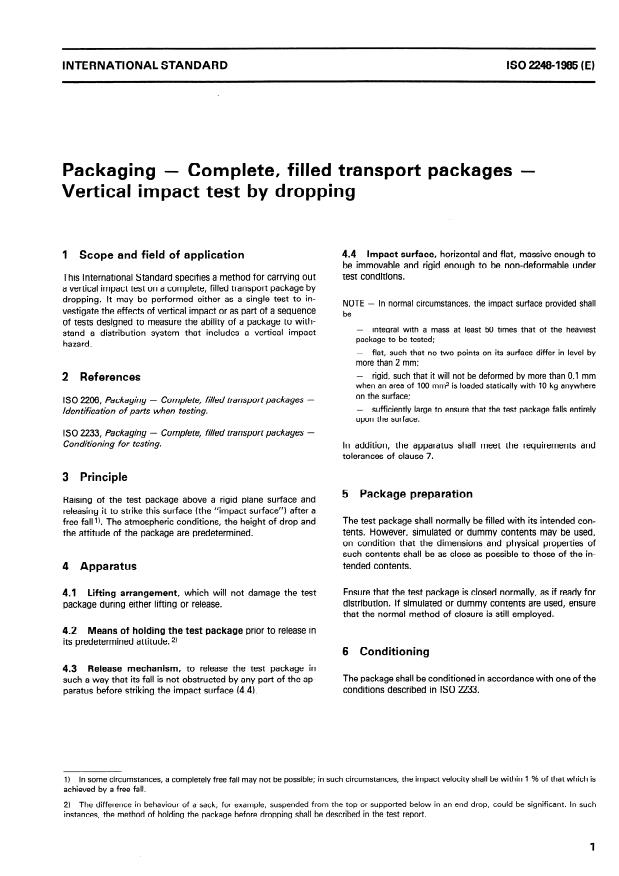
Principle: Raising of the test package above a rigid plane surface and releasing it to strike this surface (the "impact surface") after a free fall. The atmospheric conditions, the height of drop and the attitude of the package are predetermined. An annex gives the predetermined attitude of the test package.
- Status
- Published
- Publication Date
- 18-Dec-1985
- Current Stage
- 9093 - International Standard confirmed
- Start Date
- 04-Apr-2022
- Completion Date
- 29-Aug-2026
Buy Documents

ISO 2248:1985 - Packaging -- Complete, filled transport packages -- Vertical impact test by dropping
ISO 2248:1985 - Packaging — Complete, filled transport packages — Vertical impact test by dropping/19/1985
ISO 2248:1985 - Emballages -- Emballages d'expédition complets et pleins -- Essai de choc vertical par chute libre
ISO 2248:1985 - Emballages -- Emballages d'expédition complets et pleins -- Essai de choc vertical par chute libre
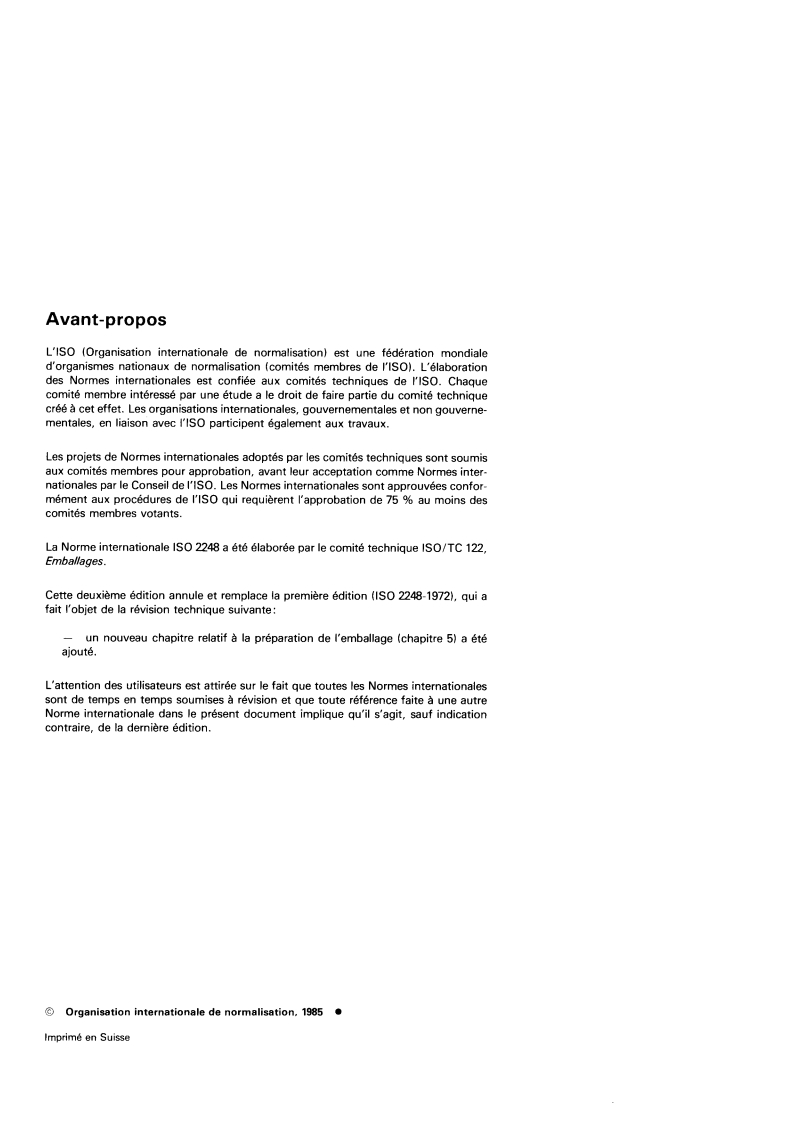
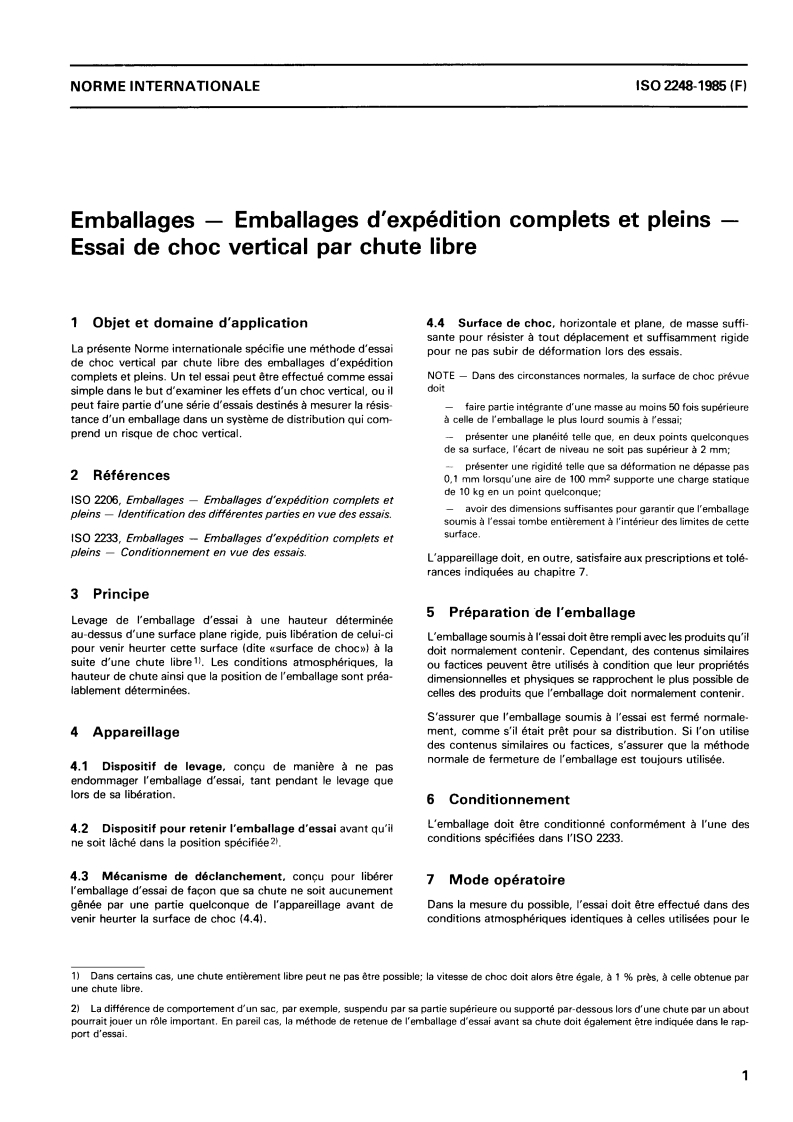
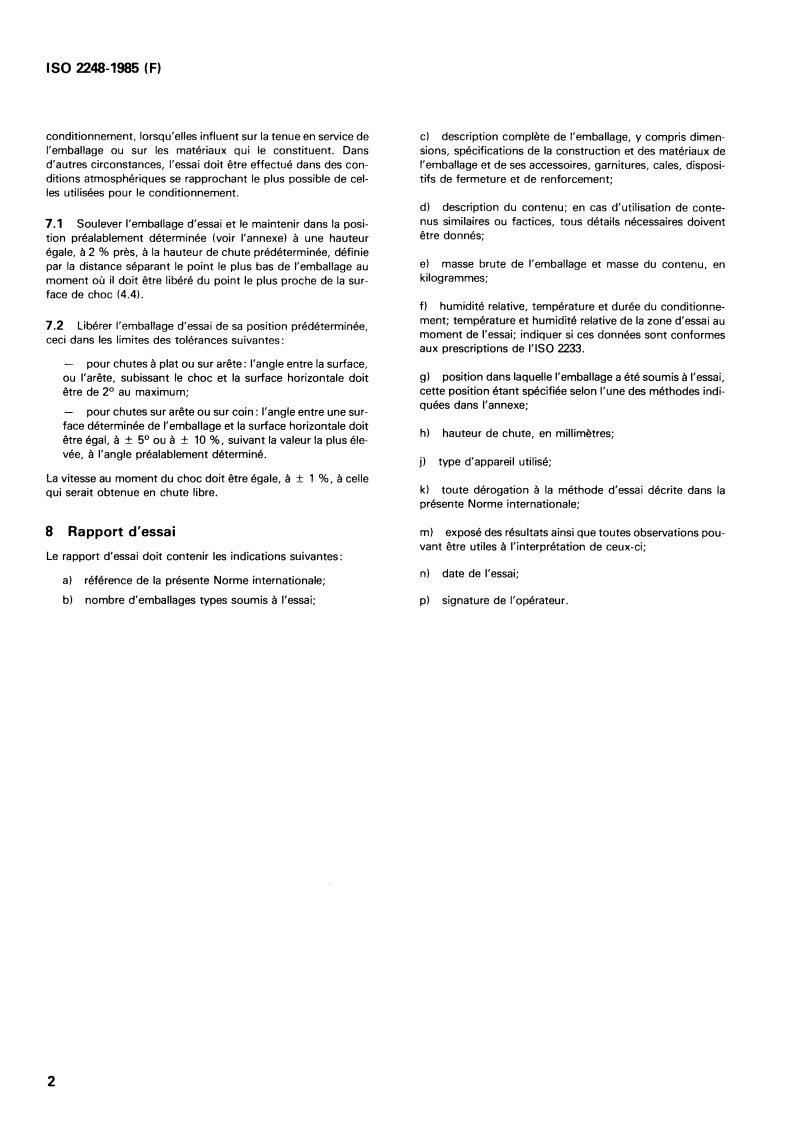
ISO 2248:1985 - Emballages — Emballages d'expédition complets et pleins — Essai de choc vertical par chute libre/19/1985
ISO 2248:1985 - Emballages — Emballages d'expédition complets et pleins — Essai de choc vertical par chute libre/19/1985
Overview
ISO 2248:1985 is an international standard published by the International Organization for Standardization (ISO) that specifies a method for conducting vertical impact tests on complete, filled transport packages. The testing process involves dropping the package from a predetermined height onto a rigid, flat surface to evaluate its ability to withstand vertical impacts during transportation. This standard is crucial for assessing the durability and integrity of packaging under real-world handling and distribution conditions.
The methodology ensures that factors such as atmospheric conditions, drop height, and package orientation (attitude) are controlled and consistent. This helps manufacturers, packers, and logistics providers guarantee the safety and reliability of packaged goods throughout the supply chain.
Key Topics
Test Principle
The vertical impact test is performed by lifting the filled transport package to a specified height and releasing it to drop freely onto a rigid, non-deformable impact surface. The test simulates vertical shocks experienced during handling or transit.Apparatus Requirements
- Lifting mechanism that avoids damage to the package
- Holding device to maintain the package in the predetermined drop orientation
- Release mechanism to ensure an unobstructed fall
- Impact surface that is flat, rigid, and large enough to receive the entire package impact without deformation
Package Preparation
Packages must be filled with their normal contents or closely simulated materials and sealed using the usual closure methods to reflect actual transport conditions.Testing Conditions
The test should ideally occur under atmospheric conditions consistent with package conditioning requirements specified in ISO 2233 for valid and reproducible results.Predetermined Package Attitude
The orientation of the package upon impact is standardized according to package shape, such as parallelepipedal, cylindrical, or sacks, with specific points, edges, or faces identified for dropping. The package’s center of gravity is aligned vertically above the impact point for consistency.Test Procedure
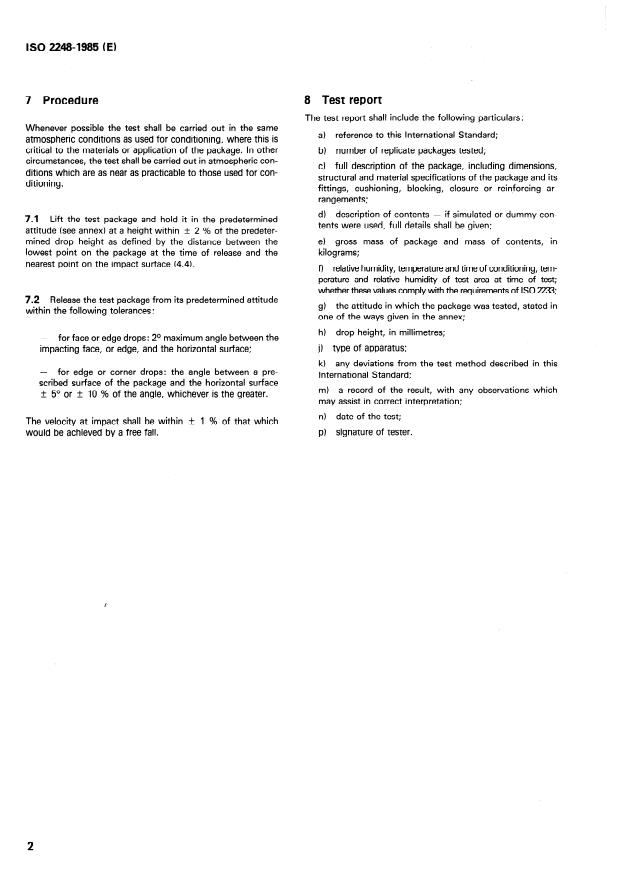
The package is raised, held at the designated height and attitude, then released to impact the surface. The drop height, impact angles, and free-fall velocity are strictly controlled to meet the standard’s tolerances.Test Reporting
Detailed documentation is required including package description, number of replicates, environmental conditions, drop height, test apparatus, deviations, and test results to ensure transparency and traceability.
Applications
ISO 2248:1985 is extensively used in industries where packaging integrity is critical during shipment and handling. Typical applications include:
Logistics and Supply Chain Management
Ensuring packages can resist vertical shocks during loading, unloading, and transportation.Manufacturing and Packaging Design
Validating packaging designs to meet safety and durability standards before market release.Quality Control and Compliance
Monitoring batch consistency and compliance with international packaging performance requirements.Research and Development
Investigating effects of package materials and cushioning systems on impact resistance.
By applying this standard, organizations can minimize damages, reduce returns, and improve customer satisfaction by ensuring transported products reach destinations intact.
Related Standards
- ISO 2206:1972 – Packaging - Identification of Parts of Packages
- ISO 2233:1975 – Packaging - Conditioning for Testing
- ISO 2266 – Packaging - Coding of Package Types for Identification Purposes
These related standards complement ISO 2248 by providing additional guidelines on package identification, environmental conditioning, and classification to support consistent packaging testing and evaluation.
Keywords: ISO 2248, vertical impact test, transport packaging, packaging standards, drop test, filled transport packages, packaging durability, packaging quality control, impact resistance, packaging testing methods.
Relations
- Effective Date
- 25-Aug-2026
- Effective Date
- 25-Aug-2026
- Effective Date
- 25-Aug-2026
- Effective Date
- 25-Aug-2026
- Effective Date
- 03-Jun-2026
Buy Documents
ISO 2248:1985 - Packaging -- Complete, filled transport packages -- Vertical impact test by dropping
ISO 2248:1985 - Packaging — Complete, filled transport packages — Vertical impact test by dropping/19/1985
ISO 2248:1985 - Emballages -- Emballages d'expédition complets et pleins -- Essai de choc vertical par chute libre
ISO 2248:1985 - Emballages -- Emballages d'expédition complets et pleins -- Essai de choc vertical par chute libre
ISO 2248:1985 - Emballages — Emballages d'expédition complets et pleins — Essai de choc vertical par chute libre/19/1985
ISO 2248:1985 - Emballages — Emballages d'expédition complets et pleins — Essai de choc vertical par chute libre/19/1985
Get Certified
Connect with accredited certification bodies for this standard

BRCGS (Brand Reputation Compliance Global Standards)
Global food safety and quality standards owner.
Sponsored listings
Frequently Asked Questions
ISO 2248:1985 is a standard published by the International Organization for Standardization (ISO). Its full title is "Packaging — Complete, filled transport packages — Vertical impact test by dropping". This standard covers: Principle: Raising of the test package above a rigid plane surface and releasing it to strike this surface (the "impact surface") after a free fall. The atmospheric conditions, the height of drop and the attitude of the package are predetermined. An annex gives the predetermined attitude of the test package.
Principle: Raising of the test package above a rigid plane surface and releasing it to strike this surface (the "impact surface") after a free fall. The atmospheric conditions, the height of drop and the attitude of the package are predetermined. An annex gives the predetermined attitude of the test package.
ISO 2248:1985 is classified under the following ICS (International Classification for Standards) categories: 55.180.40 - Complete, filled transport packages. The ICS classification helps identify the subject area and facilitates finding related standards.
ISO 2248:1985 has the following relationships with other standards: It is inter standard links to EN ISO 11140-4:2007, EN ISO 11140-3:2009, EN ISO 16495:2013, EN ISO 16495:2022, EN ISO 4180:2010. Understanding these relationships helps ensure you are using the most current and applicable version of the standard.
ISO 2248:1985 is associated with the following European legislation: EU Directives/Regulations: TRRTP121. When a standard is cited in the Official Journal of the European Union, products manufactured in conformity with it benefit from a presumption of conformity with the essential requirements of the corresponding EU directive or regulation.
ISO 2248:1985 is available in PDF format for immediate download after purchase. The document can be added to your cart and obtained through the secure checkout process. Digital delivery ensures instant access to the complete standard document.
Standards Content (Sample)
2003-01.Slovenski inštitut za standardizacijo. Razmnoževanje celote ali delov tega standarda ni dovoljeno.Emballages -- Emballages d'expédition complets et pleins -- Essai de choc vertical par chute librePackaging -- Complete, filled transport packages -- Vertical impact test by dropping55.180.40Celovita, napolnjena transportna embalažaComplete, filled transport packagesICS:Ta slovenski standard je istoveten z:ISO 2248:1985SIST ISO 2248:1996en01-marec-1996SIST ISO 2248:1996SLOVENSKI
STANDARD
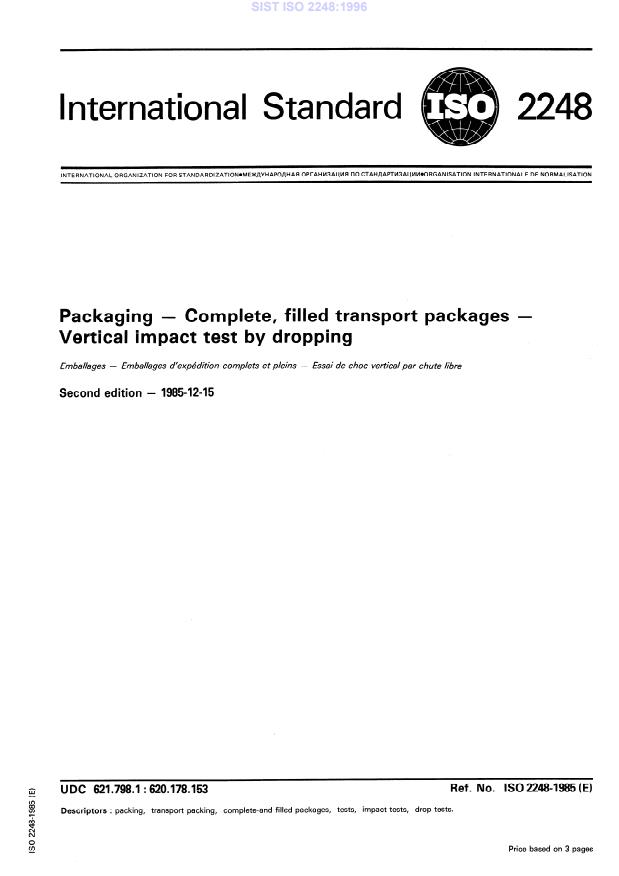
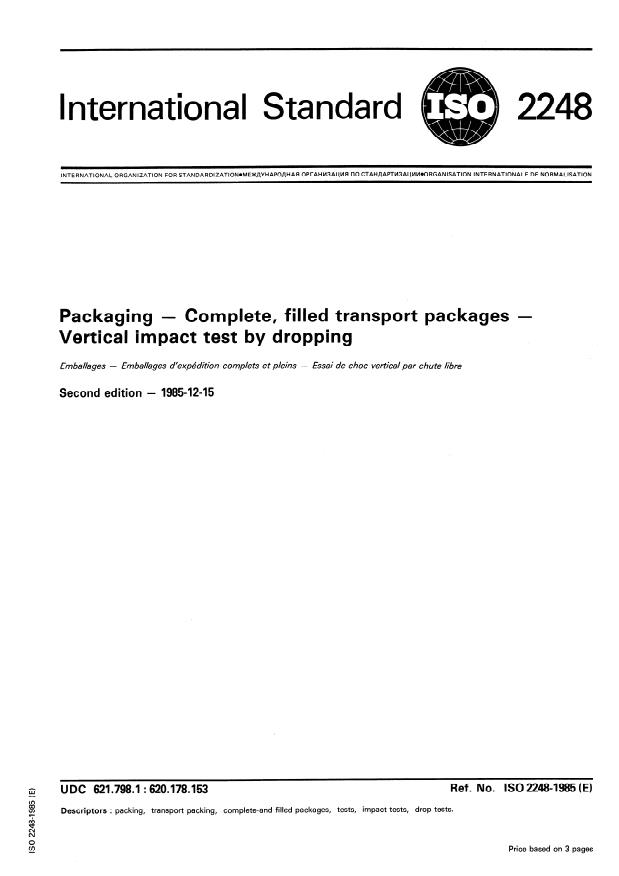
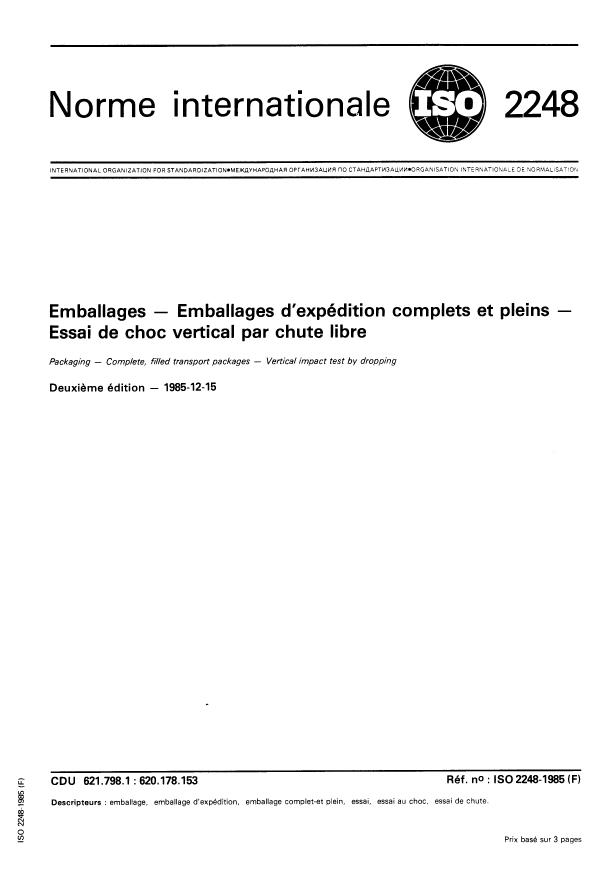
w - International Standard INTERNATIONAL ORGANIZATION FOR STANDARDIZATION.MEIK~YHAPO~HAR OPrAHM3AUMR l-l0 CTAHLIAPTM3AW’lM~ORGANISATlON INTERNATIONALE DE NORMALISATION Packaging - Complete, filled transport packages - Vertical impact test by dropping Emballages - Emballages d’expkdition complets et pleins - Essai de choc vertical par chute libre Second edition - 1985-12-15 UDC 621.798.1 : 620.178.153 Ref. No. ISO 22484985 (E) Descriptors : packing, transport packing, complete-and filled packages, tests, impact tests, drop tests. Price based on 3 pages SIST ISO 2248:1996
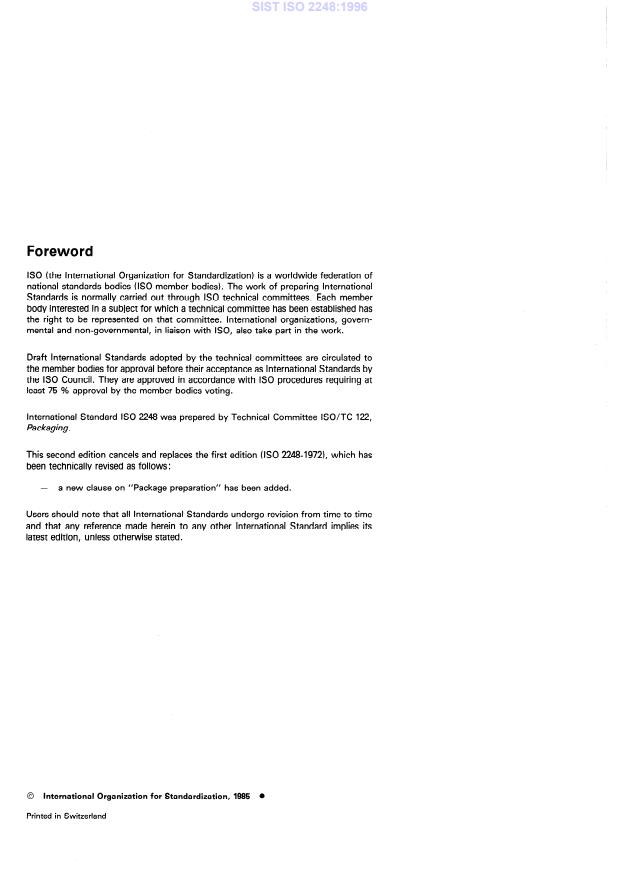
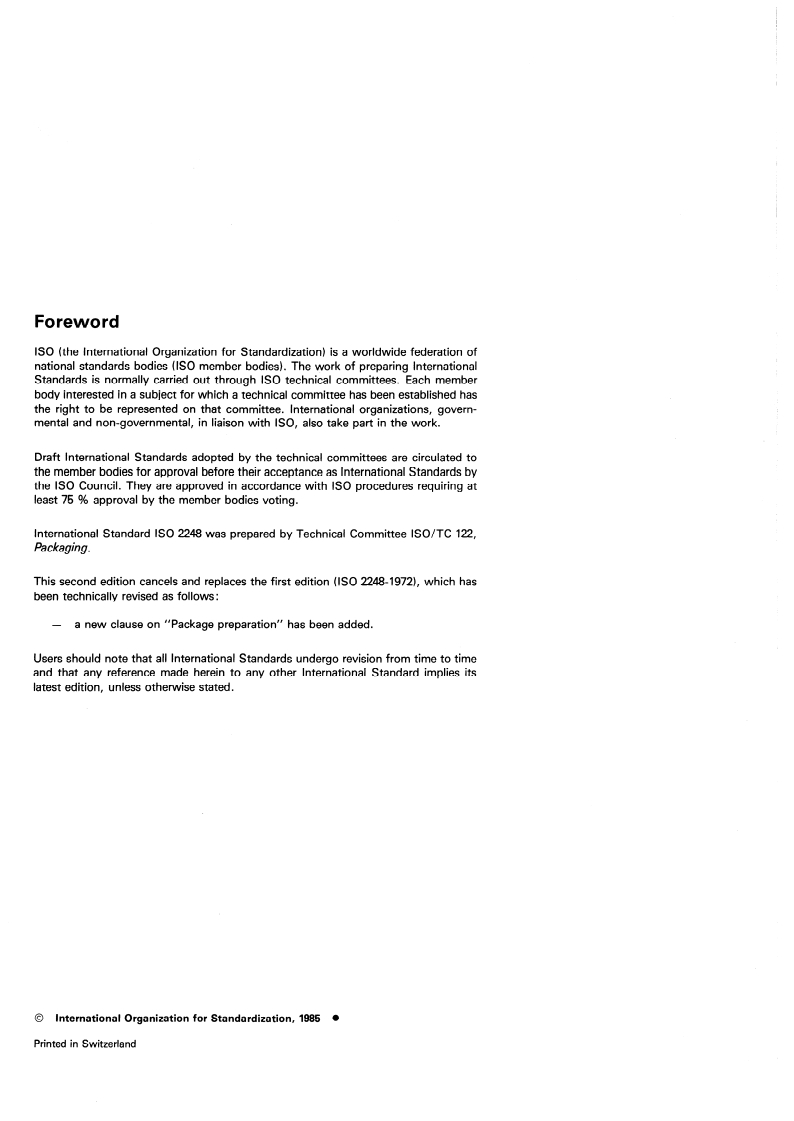
Foreword ISO (the International Organization for Standardization) is a worldwide federation of national Standards bodies (ISO member bodies). The work of preparing International Standards is normally carried out through ISO technical committees. Esch member body interested in a subject for which a technical committee has been established has the right to be represented on that committee. International organizations, govern- mental and non-governmental, in liaison with ISO, also take patt in the work. Draft International Standards adopted by the technical committees are circulated to the member bodies for approval before their acceptance as International Standards by the ISO Council. They are approved in accordance with ISO procedures requiring at least 75 % approval by the member bodies voting. International Standard ISO 2248 was prepared by Technical Committee ISO/TC 122, Packaging. This second edition cancels and replaces the first edition (ISO 2248-19721, which has been technically revised as follows: - a new clause on “Package preparation” has been added. Users should note that all International Standards undergo revision from time to time and that any reference made herein to any other International Standard implies its Jatest edition, unless otherwise stated. 0 International Organkation for Standardkation, 1985 Printed in Switzerland SIST ISO 2248:1996
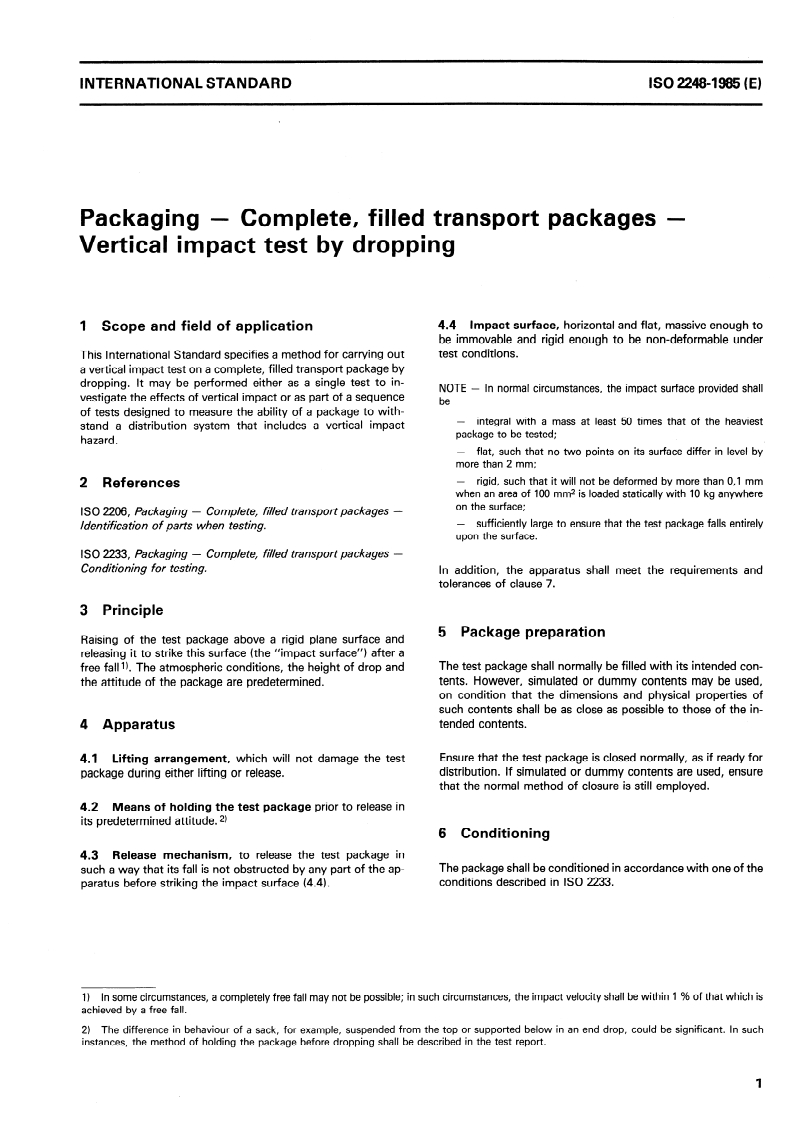
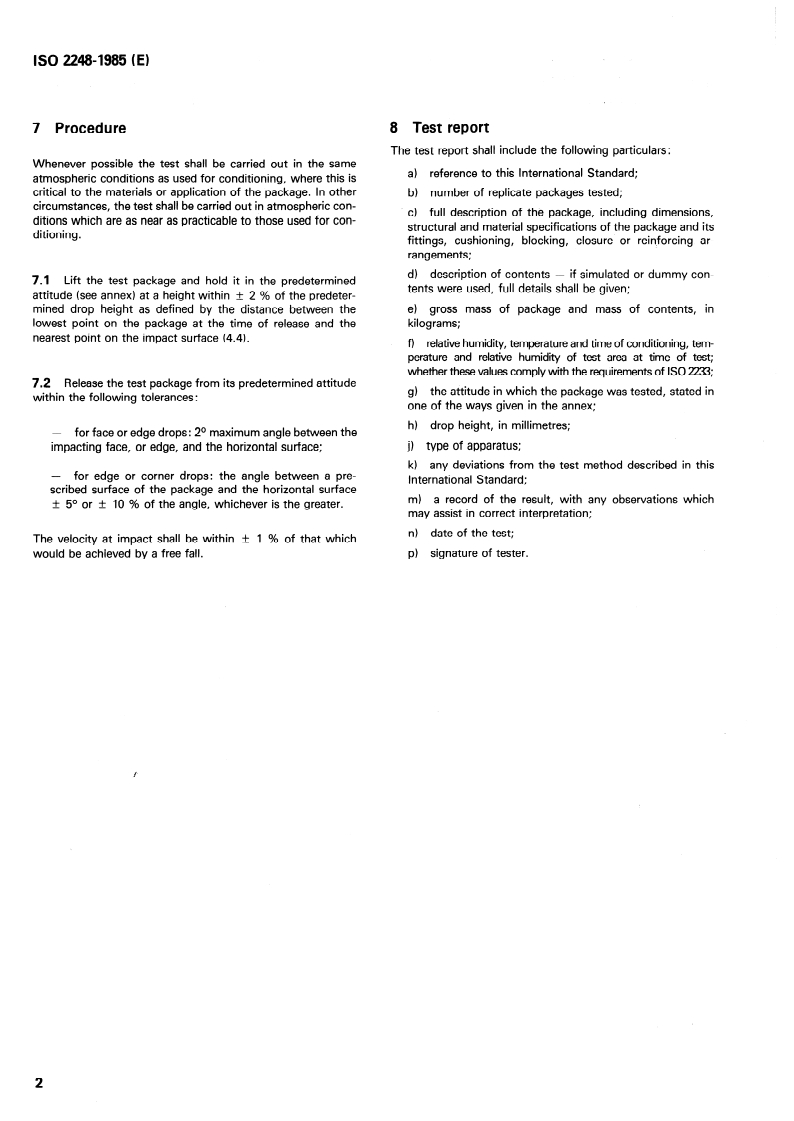
INTERNATIONAL STANDARD ISO 22484985 (E) Packaging - Complete, filled transport packages - Vertical impact test by dropping 1 Scope and field of application This International Standard specifies a method for carrying out a vertical impact test on a complete, filled transport package by dropping. lt may be performed either as a Single test to in- vestigate the effects of vertical impact or as part of a sequence of tests designed to measure the ability of a package to with- stand a distribution System that includes a vertical impact hazard. 2 References ISO 2206, Packaging - Complete, filled transport packages - ldentification of Parts when testing. ISO 2233, Packaging - Complete, filled transport packages - Conditioning for testing. 3 Principle Raising of the test package above a rigid plane sur-face and releasing it to Strike this surface (the “impact surface”) after a free falll). The atmospheric conditions, the height of drop and the attitude of the package are predetermined. 4 Apparatus 4.1 Lifting arrangement, which will not darnage the test package during either lifting or release. 4.4 Impact surface, horizontal and flat, massive enough to be immovable and rigid enough to be non-deformable under test conditions. NOTE - In normal circumstances, the impact sur-face provided shall be - integral with a mass at least 50 times that of the heaviest package to be tested; - flat, such that no two Points on its sut-face differ in level by more than 2 mm; - rigid, such that it will not be deformed by more than 0,l mm when an area of 100 mm* is loaded statically with 10 kg anywhere on the surface; - sufficiently large to ensure that the test package falls entirely upon the surface. In addition, the apparatus shall meet the requirements and tolerantes of clause 7. 5 Package preparation The test package shall normally be filled with its intended con- tents. However, simulated or dummy contents may be used, on condition that the dimensions and physical proper-Ges of such contents shall be as close as possible to those of the in- tended contents. Ensure that the test package is closed normally, as if ready for distribution. If simulated or dummy contents are used, ensure that the normal method of closure is still employed. 4.2 Means of holding the test package Prior to releas
...
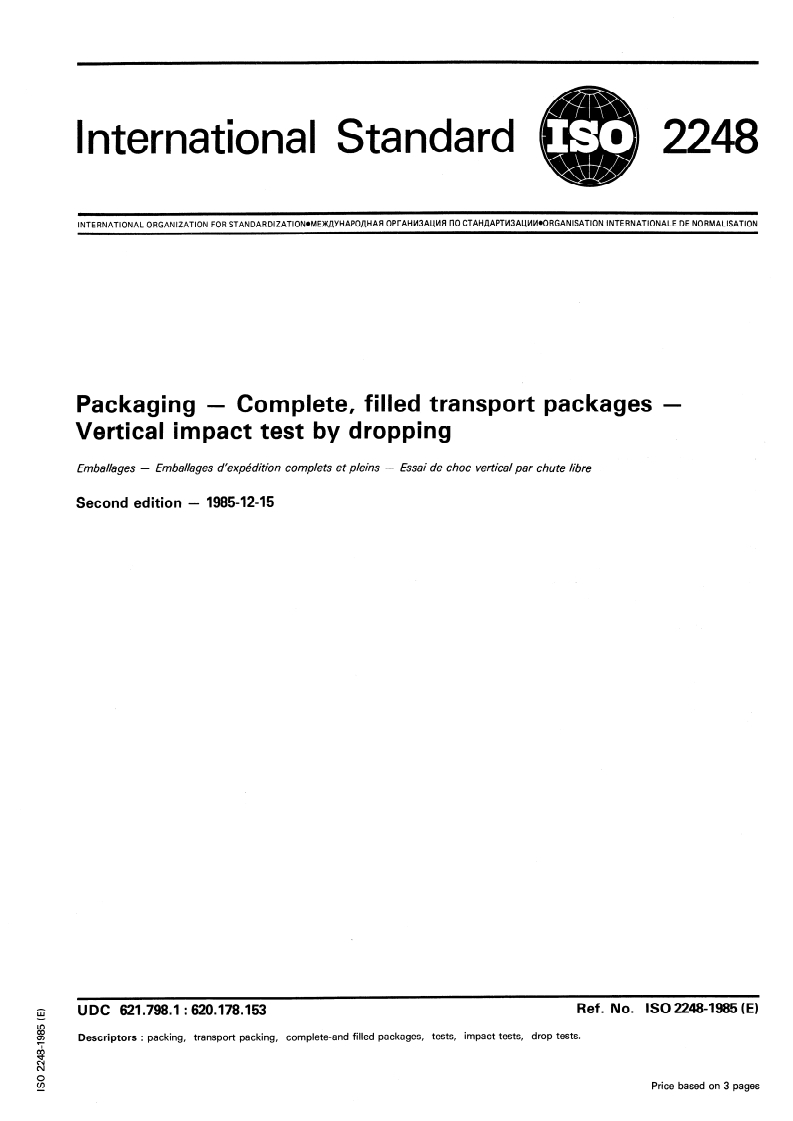
International Standard
INTERNATIONAL ORGANIZATION FOR STANDARDIZATION.MEIK~YHAPO~HAR OPrAHM3AUMR l-l0 CTAHLIAPTM3AW’lM~ORGANISATlON INTERNATIONALE DE NORMALISATION
Packaging - Complete, filled transport packages -
Vertical impact test by dropping
Emballages d’expkdition complets et pleins - Essai de choc vertical par chute libre
Emballages -
Second edition - 1985-12-15
Ref. No. ISO 22484985 (E)
UDC 621.798.1 : 620.178.153
w
-
Descriptors : packing, transport packing, complete-and filled packages, tests, impact tests, drop tests.
Price based on 3 pages
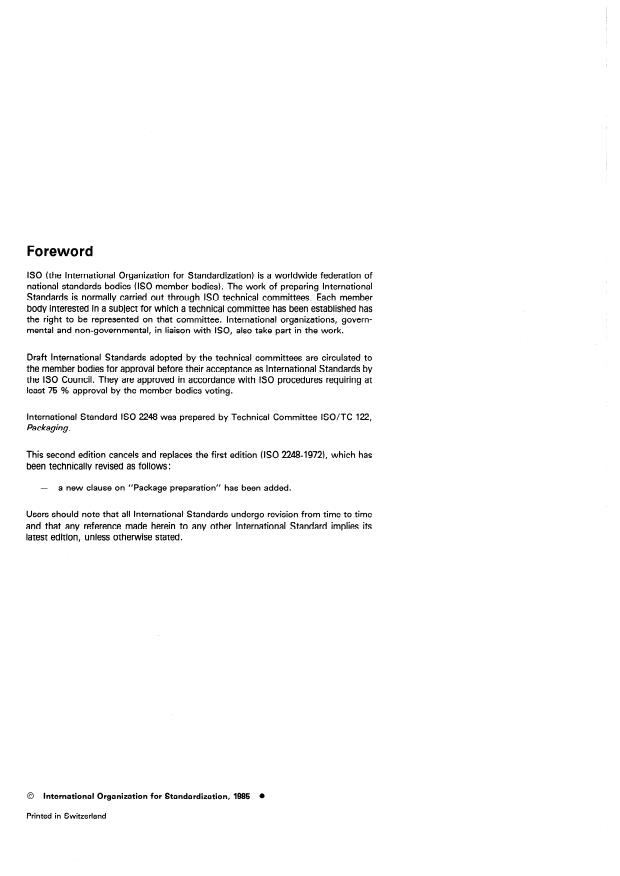
Foreword
ISO (the International Organization for Standardization) is a worldwide federation of
national Standards bodies (ISO member bodies). The work of preparing International
Standards is normally carried out through ISO technical committees. Esch member
body interested in a subject for which a technical committee has been established has
the right to be represented on that committee. International organizations, govern-
mental and non-governmental, in liaison with ISO, also take patt in the work.
Draft International Standards adopted by the technical committees are circulated to
the member bodies for approval before their acceptance as International Standards by
the ISO Council. They are approved in accordance with ISO procedures requiring at
least 75 % approval by the member bodies voting.
International Standard ISO 2248 was prepared by Technical Committee ISO/TC 122,
Packaging.
This second edition cancels and replaces the first edition (ISO 2248-19721, which has
been technically revised as follows:
-
a new clause on “Package preparation” has been added.
Users should note that all International Standards undergo revision from time to time
and that any reference made herein to any other International Standard implies its
Jatest edition, unless otherwise stated.
0 International Organkation for Standardkation, 1985
Printed in Switzerland
INTERNATIONAL STANDARD ISO 22484985 (E)
Packaging - Complete, filled transport packages -
Vertical impact test by dropping
4.4 Impact surface, horizontal and flat, massive enough to
1 Scope and field of application
be immovable and rigid enough to be non-deformable under
test conditions.
This International Standard specifies a method for carrying out
a vertical impact test on a complete, filled transport package by
dropping. lt may be performed either as a Single test to in-
NOTE - In normal circumstances, the impact sur-face provided shall
vestigate the effects of vertical impact or as part of a sequence
be
of tests designed to measure the ability of a package to with-
-
integral with a mass at least 50 times that of the heaviest
stand a distribution System that includes a vertical impact
package to be tested;
hazard.
- flat, such that no two Points on its sut-face differ in level by
more than 2 mm;
-
rigid, such that it will not be deformed by more than 0,l mm
2 References
when an area of 100 mm* is loaded statically with 10 kg anywhere
on the surface;
ISO 2206, Packaging - Complete, filled transport packages -
-
sufficiently large to ensure that the test package falls entirely
ldentification of Parts when testing.
upon the surface.
Complete, filled transport packages -
ISO 2233, Packaging -
Conditioning for testing.
In addition, the apparatus shall meet the requirements and
tolerantes of clause 7.
3 Principle
5 Package preparation
Raising of the test package above a rigid plane sur-face and
releasing it to Strike this surface (the “impact surface”) after a
The test package shall normally be filled with its intended con-
free falll). The atmospheric conditions, the height of drop and
tents. However, simulated or dummy contents may be used,
the attitude of the package are predetermined.
on condition that the dimensions and physical proper-Ges of
such contents shall be as close as possible to those of the in-
tended contents.
4 Apparatus
Ensure that the test package is closed normally, as if ready for
4.1 Lifting arrangement, which will not darnage the test
distribution. If simulated or dummy contents are used, ensure
package during either lifting or release.
that the normal method of closure is still employed.
4.2 Means of holding the test package Prior to release in
its predetermined attitude. 2)
6 Conditioning
4.3 Release mechanism, to release the test package in
The package shall be conditioned in accordance with one of the
such a way that its fall is not obstructed by any part of the ap-
conditions described in ISO 2233.
paratus before striking the impact surface (4.4).
1) In some circumstances, a completely free fall may not be possible; in such circumstances, the impact velo
...
International Standard
INTERNATIONAL ORGANIZATION FOR STANDARDIZATION.MEIK~YHAPO~HAR OPrAHM3AUMR l-l0 CTAHLIAPTM3AW’lM~ORGANISATlON INTERNATIONALE DE NORMALISATION
Packaging - Complete, filled transport packages -
Vertical impact test by dropping
Emballages d’expkdition complets et pleins - Essai de choc vertical par chute libre
Emballages -
Second edition - 1985-12-15
Ref. No. ISO 22484985 (E)
UDC 621.798.1 : 620.178.153
w
-
Descriptors : packing, transport packing, complete-and filled packages, tests, impact tests, drop tests.
Price based on 3 pages
Foreword
ISO (the International Organization for Standardization) is a worldwide federation of
national Standards bodies (ISO member bodies). The work of preparing International
Standards is normally carried out through ISO technical committees. Esch member
body interested in a subject for which a technical committee has been established has
the right to be represented on that committee. International organizations, govern-
mental and non-governmental, in liaison with ISO, also take patt in the work.
Draft International Standards adopted by the technical committees are circulated to
the member bodies for approval before their acceptance as International Standards by
the ISO Council. They are approved in accordance with ISO procedures requiring at
least 75 % approval by the member bodies voting.
International Standard ISO 2248 was prepared by Technical Committee ISO/TC 122,
Packaging.
This second edition cancels and replaces the first edition (ISO 2248-19721, which has
been technically revised as follows:
-
a new clause on “Package preparation” has been added.
Users should note that all International Standards undergo revision from time to time
and that any reference made herein to any other International Standard implies its
Jatest edition, unless otherwise stated.
0 International Organkation for Standardkation, 1985
Printed in Switzerland
INTERNATIONAL STANDARD ISO 22484985 (E)
Packaging - Complete, filled transport packages -
Vertical impact test by dropping
4.4 Impact surface, horizontal and flat, massive enough to
1 Scope and field of application
be immovable and rigid enough to be non-deformable under
test conditions.
This International Standard specifies a method for carrying out
a vertical impact test on a complete, filled transport package by
dropping. lt may be performed either as a Single test to in-
NOTE - In normal circumstances, the impact sur-face provided shall
vestigate the effects of vertical impact or as part of a sequence
be
of tests designed to measure the ability of a package to with-
-
integral with a mass at least 50 times that of the heaviest
stand a distribution System that includes a vertical impact
package to be tested;
hazard.
- flat, such that no two Points on its sut-face differ in level by
more than 2 mm;
-
rigid, such that it will not be deformed by more than 0,l mm
2 References
when an area of 100 mm* is loaded statically with 10 kg anywhere
on the surface;
ISO 2206, Packaging - Complete, filled transport packages -
-
sufficiently large to ensure that the test package falls entirely
ldentification of Parts when testing.
upon the surface.
Complete, filled transport packages -
ISO 2233, Packaging -
Conditioning for testing.
In addition, the apparatus shall meet the requirements and
tolerantes of clause 7.
3 Principle
5 Package preparation
Raising of the test package above a rigid plane sur-face and
releasing it to Strike this surface (the “impact surface”) after a
The test package shall normally be filled with its intended con-
free falll). The atmospheric conditions, the height of drop and
tents. However, simulated or dummy contents may be used,
the attitude of the package are predetermined.
on condition that the dimensions and physical proper-Ges of
such contents shall be as close as possible to those of the in-
tended contents.
4 Apparatus
Ensure that the test package is closed normally, as if ready for
4.1 Lifting arrangement, which will not darnage the test
distribution. If simulated or dummy contents are used, ensure
package during either lifting or release.
that the normal method of closure is still employed.
4.2 Means of holding the test package Prior to release in
its predetermined attitude. 2)
6 Conditioning
4.3 Release mechanism, to release the test package in
The package shall be conditioned in accordance with one of the
such a way that its fall is not obstructed by any part of the ap-
conditions described in ISO 2233.
paratus before striking the impact surface (4.4).
1) In some circumstances, a completely free fall may not be possible; in such circumstances, the impact velo
...
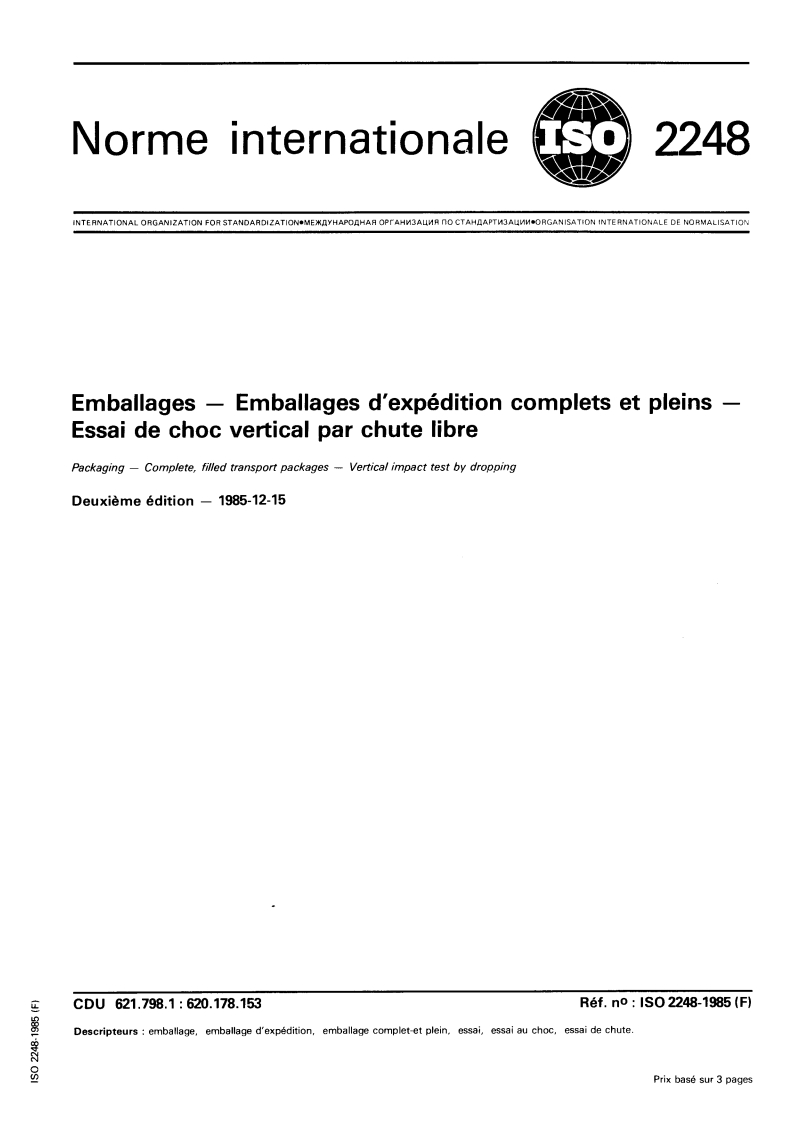
Norme internationale @ 2248
INTERNATIONAL ORGANIZATION FOR STANDARDIZATION*MEXPYHAPOPHAR OPTAHMBAULIR fl0 CTAH~APTM3AUL4LI*ORGANlSATlON INTERNATIONALE DE NORMALlSATlOh
Emballages - Emballages d'expédition complets et pleins -
Essai de choc vertical par chute libre
Packaging - Complete, filled transport packages - Vertical impact test by dropping
Deuxième ddition - 1985-12-15
CDU 621.798.1 : 620.178.153 Réf. no : IS0 2248-1985 (FI
Descripteurs : emballage, emballage d'expbdition, emballage complet-et plein, essai, essai au choc, essai de chute.
$
M
U
v,
Prix basé sur 3 pages
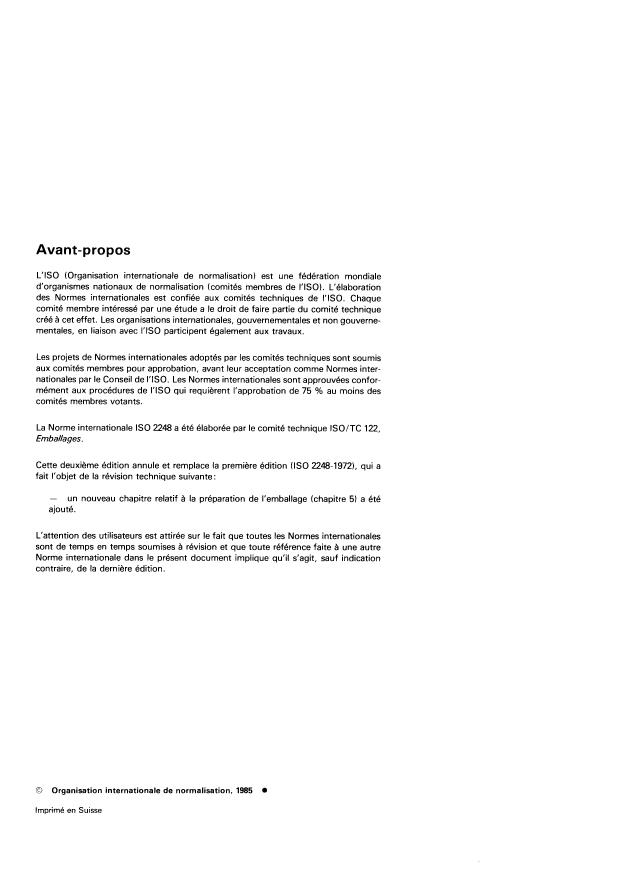
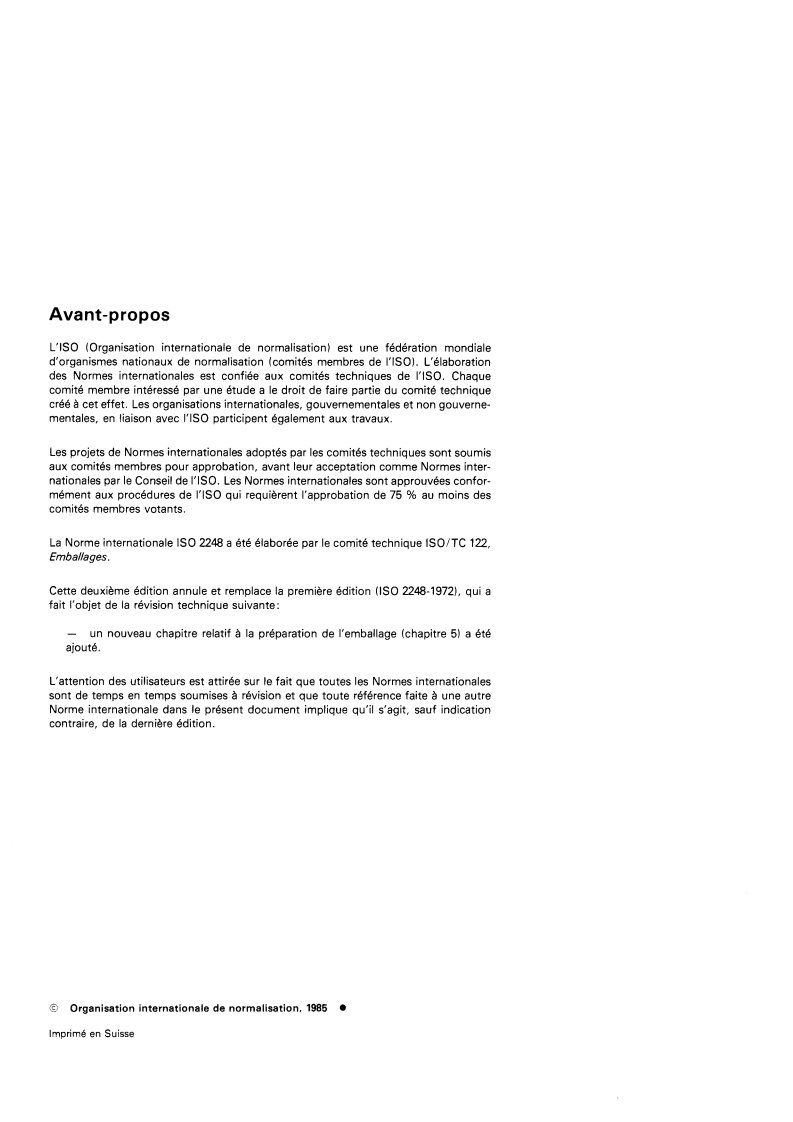
Avant-propos
L’ISO (Organisation internationale de normalisation) est une fédération mondiale
d’organismes nationaux de normalisation (comités membres de I’ISO). L‘élaboration
des Normes internationales est confiée aux comités techniques de I’ISO. Chaque
comité membre intéressé par une étude a le droit de faire partie du comité technique
créé à cet effet. Les organisations internationales, gouvernementales et non gouverne-
mentales, en liaison avec I‘ISO participent également aux travaux.
Les projets de Normes internationales adoptés par les comités techniques sont soumis
aux comités membres pour approbation, avant leur acceptation comme Normes inter-
nationales par le Conseil de I’ISO. Les Normes internationales sont approuvées confor-
mément aux procédures de I‘ISO qui requièrent l’approbation de 75 % au moins des
comités membres votants.
La Norme internationale IS0 2248 a été élaborée par le comité technique ISO/TC 122,
Emballages.
Cette deuxihe édition annule et remplace la première édition (IS0 2248-19721, qui a
fait l’objet de la révision technique suivante:
-
un nouveau chapitre relatif à la préparation de l’emballage (chapitre 5) a été
ajouté.
L‘attention des utilisateurs est attirée sur le fait que toutes les Normes internationales
sont de temps en temps soumises à révision et que toute référence faite à une autre
Norme internationale dans le présent document implique qu‘il s’agit, sauf indication
contraire, de la dernihre édition.
O Organisation internationale de normalisation, 1985 0
Imprim6 en Suisse
IS0 2248-1985 (F)
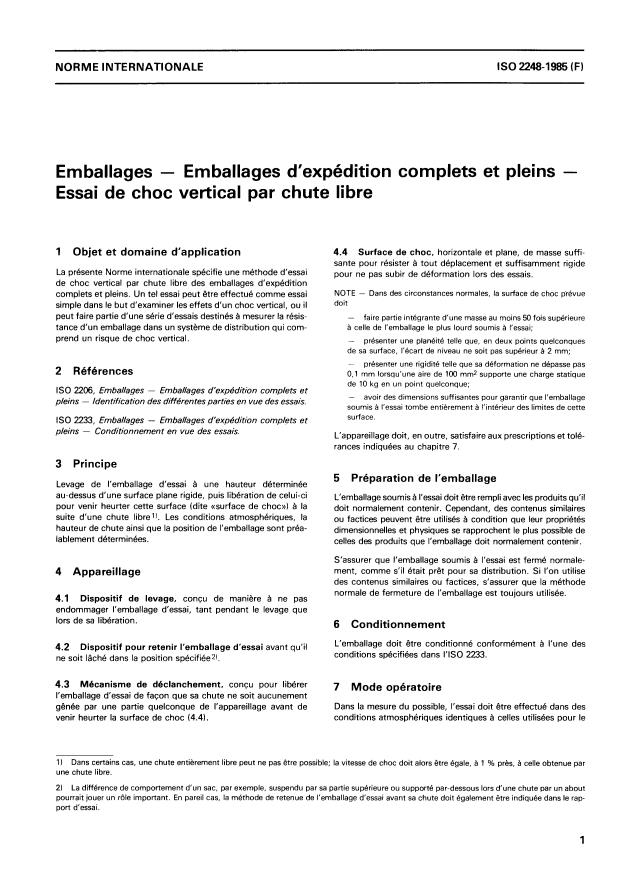
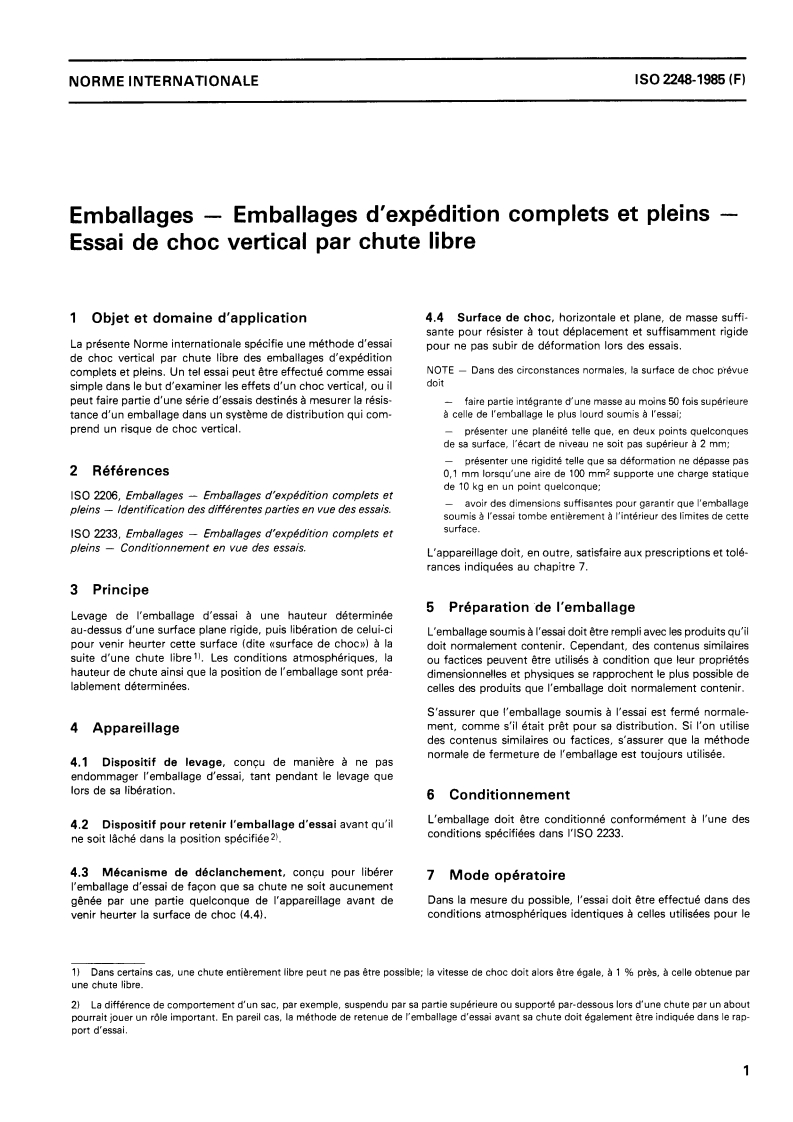
NORM E I NTE RN AT1 ON ALE
Emballages - Emballages d'expédition complets et pleins -
Essai de choc vertical par chute libre
4.4 Surface de choc, horizontale et plane, de masse suffi-
1 Objet et domaine d'application
sante pour résister à tout déplacement et suffisamment rigide
La présente Norme internationale spécifie une méthode d'essai
pour ne pas subir de déformation lors des essais.
de choc vertical par chute libre des emballages d'expédition
NOTE - Dans des circonstances normales, la surface de choc p'révue
complets et pleins. Un tel essai peut être effectué comme essai
doit
simple dans le but d'examiner les effets d'un choc vertical, ou il
peut faire partie d'une série d'essais destinés à mesurer la résis- - faire partie intégrante d'une masse au moins 50 fois supérieure
à celle de l'emballage le plus lourd soumis à l'essai:
tance d'un emballage dans un système de distribution qui com-
prend un risque de choc vertical.
- présenter une planéité telle que, en deux points quelconques
de sa surface, I'écart de niveau ne soit pas supérieurà 2 mm:
- présenter une rigidit6 telle que sa déformation ne dépasse pas
2 Références
0,l mm lorsqu'une aire de 100 mm* supporte une charge statique
de 10 kg en un point quelconque:
IS0 2206, Emballages - Emballages d'expédition complets et
- avoir des dimensions suffisantes pour garantir que l'emballage
pleins - Identification des différentes parties en vue des essais.
à l'essai tombe entièrement à l'intérieur des limites de cette
soumis
surface.
IS0 2233, Emballages - Emballages d'expédition complets et
pleins - Conditionnement en vue des essais.
L'appareillage doit, en outre, satisfaire aux prescriptions et tolé-
rances indiquées au chapitre 7.
3 Principe
5 Préparation .de l'emballage
Levage de l'emballage d'essai à une hauteur déterminée
au-dessus d'une surface plane rigide, puis libération de celui-ci
L'emballage soumisà l'essai doit être rempli avec les produits qu'il
pour venir heurter cette surface (dite ((surface de choc))) à la
doit normalement contenir. Cependant, des contenus similaires
suite d'une chute libre 1). Les conditions atmosphériques, la
ou factices peuvent être utilisés à condition que leur propriétés
hauteur de chute ainsi que la position de l'emballage sont préa-
dimensionnelles et physiques se rapprochent le plus possible de
lablement déterminées.
celles des produits que l'emballage doit normalement contenir.
S'assurer que l'emballage soumis à l'essai est fermé normale-
ment, comme s'il était prêt pour sa distribution. Si l'on utilise
4 Appareillage
des contenus similaires ou factices, s'assurer que la méthode
normale de fermeture de l'emballage est toujours utilisée.
4.1 Dispositif de levage, concu de manière à ne pas
endommager l'emballage d'essai, tant pendant le levage que
lors de sa libération.
6 Conditionnement
L'emballage doit être conditionné conformément à l'une des
4.2 Dispositif pour retenir l'emballage d'essai avant qu'il
conditions spécifiées dans I'ISO 2233.
ne soit lâché dans la position spécifiée2).
4.3 MBcanisme de déclanchement, concu pour libérer
7 Mode opératoire
l'emballage d'essai de facon que sa chute ne soit aucunement
Dans la mesure du possible,
...
Norme internationale @ 2248
INTERNATIONAL ORGANIZATION FOR STANDARDIZATION*MEX~YHAPOfiHAR OPrAHM3AUMR no CTAHfiAPTM3AUMM*ORGANlSATlON INTERNATIONALE DE NORMALISATION
Emballages - Emballages d‘expédition complets et pleins -
Essai de choc vertical par chute libre
Packaging - Complete, filled transport packages - Vertical impact test by dropping
Deuxième édition - 1985-12-15
: 620.178.153 Réf. no : ISO2248-1985 (FI
CDU 621.798.1
Descripteurs : emballage, emballage d’expbdition. emballage complet-et plein, essai, essai au choc, essai de chute.
Prix basé sur 3 pages
Avant-propos
L’ISO (Organisation internationale de normalisation) est une fédération mondiale
d’organismes nationaux de normalisation (comités membres de I’ISO). L‘élaboration
des Normes internationales est confiée aux comités techniques de I’ISO. Chaque
comité membre intéressé par une étude a le droit de faire partie du comité technique
créé à cet effet. Les organisations internationales, gouvernementales et non gouverne-
mentales, en liaison avec I’ISO participent également aux travaux.
Les projets de Normes internationales adoptés par les comités techniques sont soumis
aux comités membres pour approbation, avant leur acceptation comme Normes inter-
nationales par le Conseil de I‘ISO. Les Normes internationales sont approuvées confor-
mément aux procédures de I’ISO qui requièrent l‘approbation de 75 ?‘O au moins des
comités membres votants.
La Norme internationale IS0 2248 a été élaborée par le comité technique ISO/TC 122,
Emballages.
Cette deuxième édition annule et remplace la première édition (IS0 2248.19721, qui a
fait l‘objet de la révision technique suivante:
-
un nouveau chapitre relatif à la préparation de l‘emballage (chapitre 5) a été
ajouté.
L’attention des utilisateurs est attirée sur le fait que toutes les Normes internationales
sont de temps en temps soumises à révision et que toute référence faite à une autre
Norme internationale dans le présent document implique qu‘il s’agit, sauf indication
contraire, de la dernihre édition.
O Organisation internationale de normalisation, 1985 O
Imprimé en Suisse
NORM E I NTE R N AT1 O NA LE IS0 2248-1985 (FI
Emballages - Emballages d'expédition complets et pleins -
Essai de choc vertical par chute libre
1 Objet et domaine d'application 4.4 Surface de choc, horizontale et plane, de masse suffi-
à tout déplacement et suffisamment rigide
sante pour résister
La présente Norme internationale spécifie une méthode d'essai
pour ne pas subir de déformation lors des essais.
de choc vertical par chute libre des emballages d'expédition
NOTE - Dans des circonstances normales, la surface de choc prévue
complets et pleins. Un tel essai peut être effectué comme essai
doit
simple dans le but d'examiner les effets d'un choc vertical, ou il
peut faire partie d'une série d'essais destinés à mesurer la résis-
- faire partie intégrante d'une masse au moins 50 fois supérieure
tance d'un emballage dans un système de distribution qui com- à celle de l'emballage le plus lourd soumis à l'essai;
prend un risque de choc vertical.
- présenter une planéité telle que, en deux points quelconques
de sa surface, I'écart de niveau ne soit pas supérieurà 2 mm;
- présenter une rigidité telle que sa déformation ne dépasse pas
2 Références
0.1 mm lorsqu'une aire de 100 mm2 supporte une charge statique
de 10 kg en un point quelconque;
IS0 2206, Emballages - Emballages d'expédition complets et
- avoir des dimensions suffisantes pour garantir que l'emballage
pleins - Identification des différentes parties en vue des essais.
soumis à l'essai tombe entièrement à l'intérieur des limites de cette
surfa ce.
IS0 2233, Emballages - Emballages d'expédition complets et
pleins - Conditionnement en vue des essais.
L'appareillage doit, en outre, satisfaire aux prescriptions et tolé-
7.
rances indiquées au chapitre
3 Principe
5 Préparation -de l'emballage
Levage de l'emballage d'essai à une hauteur déterminée
au-dessus d'une surface plane rigide, puis libération de celui-ci
L'emballage soumisà l'essai doit être rempli avec les produits qu'il
pour venir heurter cette surface (dite ((surface de choc))) à la
doit normalement contenir. Cependant, des contenus similaires
suite d'une chute libre 1). Les conditions atmosphériques, la
ou factices peuvent être utilisés à condition que leur propriétés
hauteur de chute ainsi que la position de l'emballage sont préa-
dimensionnelles et physiques se rapprochent le plus possible de
lablement déterminées.
celles des produits que l'emballage doit normalement contenir.
S'assurer que l'emballage soumis à l'essai est fermé normale-
ment, comme s'il était prêt pour sa distribution. Si l'on utilise
4 Appareillage
des contenus similaires ou factices, s'assurer que la méthode
normale de fermeture de l'emballage est toujours utilisée.
4.1 Dispositif de levage, concu de manière à ne pas
endommager l'emballage d'essai, tant pendant le levage que
lors de sa libération.
6 Conditionnement
L'emballage doit être conditionné conformément à l'une des
4.2 Dispositif pour retenir l'emballage d'essai avant qu'il
conditions spécifiées dans I'ISO 2233.
ne soit lâché dans la position spécifiée2).
4.3 MBcanisme de d6clanchement. concu pour libérer
7 Mode opératoire
l'emballage d'essai de facon que sa chute ne soit aucunement
gênée par une partie quelconque d
...
Norme internationale @ 2248
INTERNATIONAL ORGANIZATION FOR STANDARDIZATION*MEX~YHAPOfiHAR OPrAHM3AUMR no CTAHfiAPTM3AUMM*ORGANlSATlON INTERNATIONALE DE NORMALISATION
Emballages - Emballages d‘expédition complets et pleins -
Essai de choc vertical par chute libre
Packaging - Complete, filled transport packages - Vertical impact test by dropping
Deuxième édition - 1985-12-15
: 620.178.153 Réf. no : ISO2248-1985 (FI
CDU 621.798.1
Descripteurs : emballage, emballage d’expbdition. emballage complet-et plein, essai, essai au choc, essai de chute.
Prix basé sur 3 pages
Avant-propos
L’ISO (Organisation internationale de normalisation) est une fédération mondiale
d’organismes nationaux de normalisation (comités membres de I’ISO). L‘élaboration
des Normes internationales est confiée aux comités techniques de I’ISO. Chaque
comité membre intéressé par une étude a le droit de faire partie du comité technique
créé à cet effet. Les organisations internationales, gouvernementales et non gouverne-
mentales, en liaison avec I’ISO participent également aux travaux.
Les projets de Normes internationales adoptés par les comités techniques sont soumis
aux comités membres pour approbation, avant leur acceptation comme Normes inter-
nationales par le Conseil de I‘ISO. Les Normes internationales sont approuvées confor-
mément aux procédures de I’ISO qui requièrent l‘approbation de 75 ?‘O au moins des
comités membres votants.
La Norme internationale IS0 2248 a été élaborée par le comité technique ISO/TC 122,
Emballages.
Cette deuxième édition annule et remplace la première édition (IS0 2248.19721, qui a
fait l‘objet de la révision technique suivante:
-
un nouveau chapitre relatif à la préparation de l‘emballage (chapitre 5) a été
ajouté.
L’attention des utilisateurs est attirée sur le fait que toutes les Normes internationales
sont de temps en temps soumises à révision et que toute référence faite à une autre
Norme internationale dans le présent document implique qu‘il s’agit, sauf indication
contraire, de la dernihre édition.
O Organisation internationale de normalisation, 1985 O
Imprimé en Suisse
NORM E I NTE R N AT1 O NA LE IS0 2248-1985 (FI
Emballages - Emballages d'expédition complets et pleins -
Essai de choc vertical par chute libre
1 Objet et domaine d'application 4.4 Surface de choc, horizontale et plane, de masse suffi-
à tout déplacement et suffisamment rigide
sante pour résister
La présente Norme internationale spécifie une méthode d'essai
pour ne pas subir de déformation lors des essais.
de choc vertical par chute libre des emballages d'expédition
NOTE - Dans des circonstances normales, la surface de choc prévue
complets et pleins. Un tel essai peut être effectué comme essai
doit
simple dans le but d'examiner les effets d'un choc vertical, ou il
peut faire partie d'une série d'essais destinés à mesurer la résis-
- faire partie intégrante d'une masse au moins 50 fois supérieure
tance d'un emballage dans un système de distribution qui com- à celle de l'emballage le plus lourd soumis à l'essai;
prend un risque de choc vertical.
- présenter une planéité telle que, en deux points quelconques
de sa surface, I'écart de niveau ne soit pas supérieurà 2 mm;
- présenter une rigidité telle que sa déformation ne dépasse pas
2 Références
0.1 mm lorsqu'une aire de 100 mm2 supporte une charge statique
de 10 kg en un point quelconque;
IS0 2206, Emballages - Emballages d'expédition complets et
- avoir des dimensions suffisantes pour garantir que l'emballage
pleins - Identification des différentes parties en vue des essais.
soumis à l'essai tombe entièrement à l'intérieur des limites de cette
surfa ce.
IS0 2233, Emballages - Emballages d'expédition complets et
pleins - Conditionnement en vue des essais.
L'appareillage doit, en outre, satisfaire aux prescriptions et tolé-
7.
rances indiquées au chapitre
3 Principe
5 Préparation -de l'emballage
Levage de l'emballage d'essai à une hauteur déterminée
au-dessus d'une surface plane rigide, puis libération de celui-ci
L'emballage soumisà l'essai doit être rempli avec les produits qu'il
pour venir heurter cette surface (dite ((surface de choc))) à la
doit normalement contenir. Cependant, des contenus similaires
suite d'une chute libre 1). Les conditions atmosphériques, la
ou factices peuvent être utilisés à condition que leur propriétés
hauteur de chute ainsi que la position de l'emballage sont préa-
dimensionnelles et physiques se rapprochent le plus possible de
lablement déterminées.
celles des produits que l'emballage doit normalement contenir.
S'assurer que l'emballage soumis à l'essai est fermé normale-
ment, comme s'il était prêt pour sa distribution. Si l'on utilise
4 Appareillage
des contenus similaires ou factices, s'assurer que la méthode
normale de fermeture de l'emballage est toujours utilisée.
4.1 Dispositif de levage, concu de manière à ne pas
endommager l'emballage d'essai, tant pendant le levage que
lors de sa libération.
6 Conditionnement
L'emballage doit être conditionné conformément à l'une des
4.2 Dispositif pour retenir l'emballage d'essai avant qu'il
conditions spécifiées dans I'ISO 2233.
ne soit lâché dans la position spécifiée2).
4.3 MBcanisme de d6clanchement. concu pour libérer
7 Mode opératoire
l'emballage d'essai de facon que sa chute ne soit aucunement
gênée par une partie quelconque d
...
Norme internationale @ 2248
INTERNATIONAL ORGANIZATION FOR STANDARDIZATION*MEXPYHAPOPHAR OPTAHMBAULIR fl0 CTAH~APTM3AUL4LI*ORGANlSATlON INTERNATIONALE DE NORMALlSATlOh
Emballages - Emballages d'expédition complets et pleins -
Essai de choc vertical par chute libre
Packaging - Complete, filled transport packages - Vertical impact test by dropping
Deuxième ddition - 1985-12-15
CDU 621.798.1 : 620.178.153 Réf. no : IS0 2248-1985 (FI
Descripteurs : emballage, emballage d'expbdition, emballage complet-et plein, essai, essai au choc, essai de chute.
$
M
U
v,
Prix basé sur 3 pages
Avant-propos
L’ISO (Organisation internationale de normalisation) est une fédération mondiale
d’organismes nationaux de normalisation (comités membres de I’ISO). L‘élaboration
des Normes internationales est confiée aux comités techniques de I’ISO. Chaque
comité membre intéressé par une étude a le droit de faire partie du comité technique
créé à cet effet. Les organisations internationales, gouvernementales et non gouverne-
mentales, en liaison avec I‘ISO participent également aux travaux.
Les projets de Normes internationales adoptés par les comités techniques sont soumis
aux comités membres pour approbation, avant leur acceptation comme Normes inter-
nationales par le Conseil de I’ISO. Les Normes internationales sont approuvées confor-
mément aux procédures de I‘ISO qui requièrent l’approbation de 75 % au moins des
comités membres votants.
La Norme internationale IS0 2248 a été élaborée par le comité technique ISO/TC 122,
Emballages.
Cette deuxihe édition annule et remplace la première édition (IS0 2248-19721, qui a
fait l’objet de la révision technique suivante:
-
un nouveau chapitre relatif à la préparation de l’emballage (chapitre 5) a été
ajouté.
L‘attention des utilisateurs est attirée sur le fait que toutes les Normes internationales
sont de temps en temps soumises à révision et que toute référence faite à une autre
Norme internationale dans le présent document implique qu‘il s’agit, sauf indication
contraire, de la dernihre édition.
O Organisation internationale de normalisation, 1985 0
Imprim6 en Suisse
IS0 2248-1985 (F)
NORM E I NTE RN AT1 ON ALE
Emballages - Emballages d'expédition complets et pleins -
Essai de choc vertical par chute libre
4.4 Surface de choc, horizontale et plane, de masse suffi-
1 Objet et domaine d'application
sante pour résister à tout déplacement et suffisamment rigide
La présente Norme internationale spécifie une méthode d'essai
pour ne pas subir de déformation lors des essais.
de choc vertical par chute libre des emballages d'expédition
NOTE - Dans des circonstances normales, la surface de choc p'révue
complets et pleins. Un tel essai peut être effectué comme essai
doit
simple dans le but d'examiner les effets d'un choc vertical, ou il
peut faire partie d'une série d'essais destinés à mesurer la résis- - faire partie intégrante d'une masse au moins 50 fois supérieure
à celle de l'emballage le plus lourd soumis à l'essai:
tance d'un emballage dans un système de distribution qui com-
prend un risque de choc vertical.
- présenter une planéité telle que, en deux points quelconques
de sa surface, I'écart de niveau ne soit pas supérieurà 2 mm:
- présenter une rigidit6 telle que sa déformation ne dépasse pas
2 Références
0,l mm lorsqu'une aire de 100 mm* supporte une charge statique
de 10 kg en un point quelconque:
IS0 2206, Emballages - Emballages d'expédition complets et
- avoir des dimensions suffisantes pour garantir que l'emballage
pleins - Identification des différentes parties en vue des essais.
à l'essai tombe entièrement à l'intérieur des limites de cette
soumis
surface.
IS0 2233, Emballages - Emballages d'expédition complets et
pleins - Conditionnement en vue des essais.
L'appareillage doit, en outre, satisfaire aux prescriptions et tolé-
rances indiquées au chapitre 7.
3 Principe
5 Préparation .de l'emballage
Levage de l'emballage d'essai à une hauteur déterminée
au-dessus d'une surface plane rigide, puis libération de celui-ci
L'emballage soumisà l'essai doit être rempli avec les produits qu'il
pour venir heurter cette surface (dite ((surface de choc))) à la
doit normalement contenir. Cependant, des contenus similaires
suite d'une chute libre 1). Les conditions atmosphériques, la
ou factices peuvent être utilisés à condition que leur propriétés
hauteur de chute ainsi que la position de l'emballage sont préa-
dimensionnelles et physiques se rapprochent le plus possible de
lablement déterminées.
celles des produits que l'emballage doit normalement contenir.
S'assurer que l'emballage soumis à l'essai est fermé normale-
ment, comme s'il était prêt pour sa distribution. Si l'on utilise
4 Appareillage
des contenus similaires ou factices, s'assurer que la méthode
normale de fermeture de l'emballage est toujours utilisée.
4.1 Dispositif de levage, concu de manière à ne pas
endommager l'emballage d'essai, tant pendant le levage que
lors de sa libération.
6 Conditionnement
L'emballage doit être conditionné conformément à l'une des
4.2 Dispositif pour retenir l'emballage d'essai avant qu'il
conditions spécifiées dans I'ISO 2233.
ne soit lâché dans la position spécifiée2).
4.3 MBcanisme de déclanchement, concu pour libérer
7 Mode opératoire
l'emballage d'essai de facon que sa chute ne soit aucunement
Dans la mesure du possible,
...