

ISO 11334-4:2024
(Main)Assistive products for walking, manipulated by one arm — Requirements and test methods — Part 4: Walking sticks with three or more legs
General Information
- Abstract
This document specifies requirements and test methods of walking sticks with three or more legs used as assistive products for walking, manipulated by one arm, without accessories, unless specified in the particular test procedure. This document also gives requirements related to safety, ergonomics, performance and information supplied by the manufacturer, including marking and labelling. The requirements and tests are based on every-day use of walking sticks with three or more legs as assistive products for walking for a maximum user mass as specified by the manufacturer. This document is for walking sticks with three or more legs specified for a user mass of no less than 35 kg. This document is not applicable to walking sticks with three or more legs with underarm or forearm support or with moving parts such as a universal joint.
- Status
- Published
- Publication Date
- 10-Oct-2024
- Technical Committee
- ISO/TC 173 - Assistive products
- Drafting Committee
- ISO/TC 173 - Assistive products
- Current Stage
- 6060 - International Standard published
- Start Date
- 11-Oct-2024
- Due Date
- 25-Feb-2025
- Completion Date
- 11-Oct-2024
Buy Documents
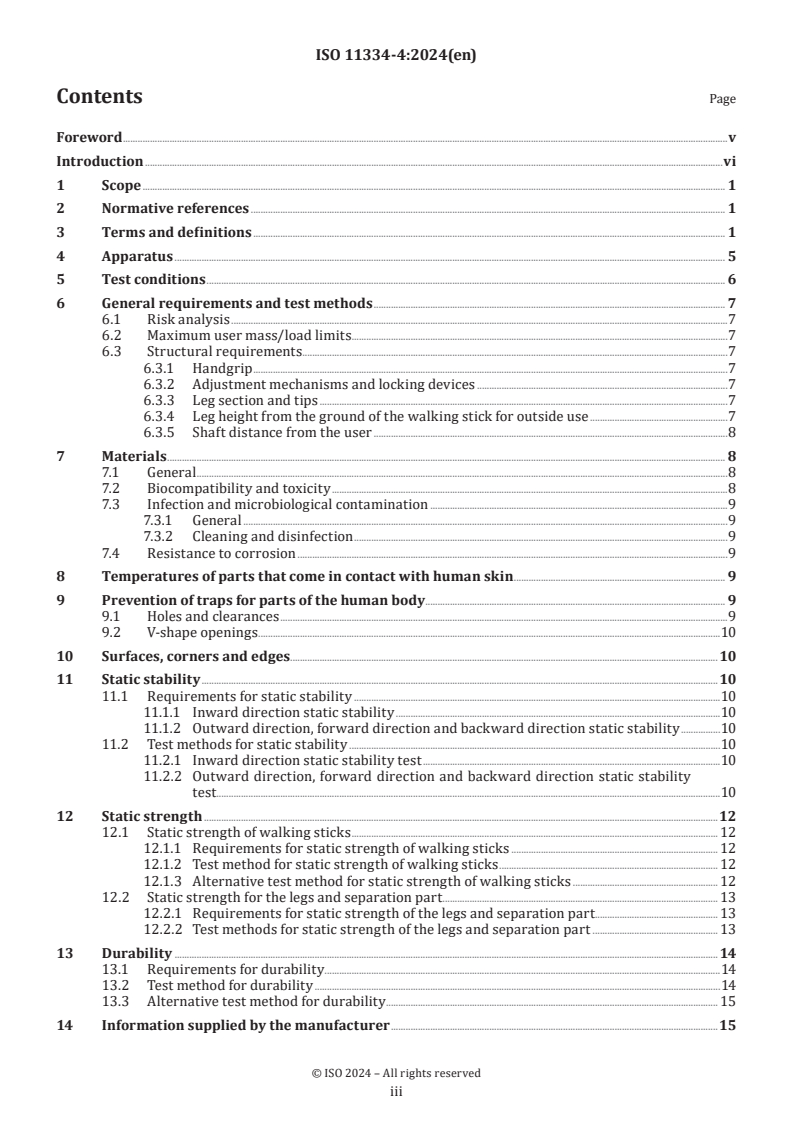
ISO 11334-4:2024 - Assistive products for walking, manipulated by one arm — Requirements and test methods — Part 4: Walking sticks with three or more legs Released:11. 10. 2024
ISO 11334-4:2024 - Produits d'assistance a la marche manipulés avec un bras — Exigences et méthodes d'essai — Partie 4: Cannes a trois pieds ou plus Released:11. 10. 2024
Overview
ISO 11334-4:2024 - Assistive products for walking, manipulated by one arm - Requirements and test methods - Part 4: Walking sticks with three or more legs specifies safety, ergonomics, performance and information requirements for multi‑leg walking sticks (tripods and quads). It defines the test methods and manufacturer information needed to support safe everyday use for a maximum user mass declared by the manufacturer (minimum applicability: users ≥ 35 kg). The standard applies to walking sticks manipulated by one arm without underarm/forearm support or moving joints (e.g., universal joints).
Key topics and technical requirements
The standard addresses design, testing and labelling topics that are critical for product safety and performance:
- Risk analysis and user mass limits: requirements for defining maximum user mass and managing identified risks (Clause 6).
- Structural and ergonomic requirements: handgrip design (including anatomic grips), handle, shaft and leg geometry, and shaft distance from the user (Clauses 6 & 11).
- Adjustment mechanisms and locking devices: performance and locking reliability under load (Clause 6.3.2).
- Legs and tip performance: strength, separation part integrity, and tip friction considerations (Clauses 6.3.3; ISO 24415-1 referenced).
- Materials, biocompatibility and cleaning: material selection, cytotoxicity considerations and guidance for cleaning/disinfection (Clause 7; ISO 10993 references).
- Thermal safety and entrapment prevention: limits on temperatures of parts touching skin and avoidance of body‑part traps (Clauses 8–9).
- Static stability and static strength tests: defined test methods for inward/outward/forward/backward stability and for static strength of entire device and legs (Clauses 11–12).
- Durability testing: endurance tests and alternative methods to demonstrate long‑term performance (Clause 13).
- Information supplied by manufacturer: marking, labelling, instructions for use and test reports (Clause 14).
Practical applications and who uses the standard
ISO 11334-4:2024 is used by:
- Manufacturers and product designers to guide safe design, material selection and to validate adjustment and leg mechanisms.
- Test laboratories and conformity assessors for performing standardized static strength, stability and durability testing.
- Procurement teams and healthcare organizations to set purchase specifications and evaluate assistive walking aids.
- Regulators and certification bodies when assessing compliance with medical‑device‑related safety and information requirements.
- Healthcare professionals and therapists seeking objective performance data for recommending multi‑leg walking sticks.
Related standards
This part is one in the ISO 11334 series and references relevant standards including:
- ISO 24415-1 (tips for assistive products for walking - friction)
- ISO 10993‑1 / ISO 10993‑5 (biological evaluation)
- ISO 14971 (risk management)
- ISO 15223‑1 and ISO 20417 (medical device symbols and manufacturer information)
- ISO 7000 (graphical symbols)
Keywords: ISO 11334-4:2024, walking sticks with three or more legs, assistive products for walking, requirements and test methods, static stability, static strength, durability, manufacturer information, safety and ergonomics.
Relations
- Effective Date
- 12-Feb-2026
- Effective Date
- 06-Jun-2022
- Effective Date
- 06-Jun-2022
Buy Documents
ISO 11334-4:2024 - Assistive products for walking, manipulated by one arm — Requirements and test methods — Part 4: Walking sticks with three or more legs Released:11. 10. 2024
ISO 11334-4:2024 - Produits d'assistance a la marche manipulés avec un bras — Exigences et méthodes d'essai — Partie 4: Cannes a trois pieds ou plus Released:11. 10. 2024
Get Certified
Connect with accredited certification bodies for this standard

BSI Group
BSI (British Standards Institution) is the business standards company that helps organizations make excellence a habit.

TÜV Rheinland
TÜV Rheinland is a leading international provider of technical services.

TÜV SÜD
TÜV SÜD is a trusted partner of choice for safety, security and sustainability solutions.
Sponsored listings
Frequently Asked Questions
ISO 11334-4:2024 is a standard published by the International Organization for Standardization (ISO). Its full title is "Assistive products for walking, manipulated by one arm — Requirements and test methods — Part 4: Walking sticks with three or more legs". This standard covers: This document specifies requirements and test methods of walking sticks with three or more legs used as assistive products for walking, manipulated by one arm, without accessories, unless specified in the particular test procedure. This document also gives requirements related to safety, ergonomics, performance and information supplied by the manufacturer, including marking and labelling. The requirements and tests are based on every-day use of walking sticks with three or more legs as assistive products for walking for a maximum user mass as specified by the manufacturer. This document is for walking sticks with three or more legs specified for a user mass of no less than 35 kg. This document is not applicable to walking sticks with three or more legs with underarm or forearm support or with moving parts such as a universal joint.
This document specifies requirements and test methods of walking sticks with three or more legs used as assistive products for walking, manipulated by one arm, without accessories, unless specified in the particular test procedure. This document also gives requirements related to safety, ergonomics, performance and information supplied by the manufacturer, including marking and labelling. The requirements and tests are based on every-day use of walking sticks with three or more legs as assistive products for walking for a maximum user mass as specified by the manufacturer. This document is for walking sticks with three or more legs specified for a user mass of no less than 35 kg. This document is not applicable to walking sticks with three or more legs with underarm or forearm support or with moving parts such as a universal joint.
ISO 11334-4:2024 is classified under the following ICS (International Classification for Standards) categories: 11.180.10 - Aids and adaptation for moving. The ICS classification helps identify the subject area and facilitates finding related standards.
ISO 11334-4:2024 has the following relationships with other standards: It is inter standard links to EN ISO 11334-4:2024, ISO 23504-1:2020, ISO 11334-4:1999. Understanding these relationships helps ensure you are using the most current and applicable version of the standard.
ISO 11334-4:2024 is available in PDF format for immediate download after purchase. The document can be added to your cart and obtained through the secure checkout process. Digital delivery ensures instant access to the complete standard document.
Standards Content (Sample)
International
Standard
ISO 11334-4
Second edition
Assistive products for walking,
2024-10
manipulated by one arm —
Requirements and test methods —
Part 4:
Walking sticks with three or
more legs
Produits d'assistance à la marche manipulés avec un bras —
Exigences et méthodes d'essai —
Partie 4: Cannes à trois pieds ou plus
Reference number
© ISO 2024
All rights reserved. Unless otherwise specified, or required in the context of its implementation, no part of this publication may
be reproduced or utilized otherwise in any form or by any means, electronic or mechanical, including photocopying, or posting on
the internet or an intranet, without prior written permission. Permission can be requested from either ISO at the address below
or ISO’s member body in the country of the requester.
ISO copyright office
CP 401 • Ch. de Blandonnet 8
CH-1214 Vernier, Geneva
Phone: +41 22 749 01 11
Email: copyright@iso.org
Website: www.iso.org
Published in Switzerland
ii
Contents Page
Foreword .v
Introduction .vi
1 Scope . 1
2 Normative references . 1
3 Terms and definitions . 1
4 Apparatus . 5
5 Test conditions . 6
6 General requirements and test methods . 7
6.1 Risk analysis .7
6.2 Maximum user mass/load limits . . .7
6.3 Structural requirements . .7
6.3.1 Handgrip .7
6.3.2 Adjustment mechanisms and locking devices .7
6.3.3 Leg section and tips .7
6.3.4 Leg height from the ground of the walking stick for outside use .7
6.3.5 Shaft distance from the user .8
7 Materials . 8
7.1 General .8
7.2 Biocompatibility and toxicity .8
7.3 Infection and microbiological contamination .9
7.3.1 General .9
7.3.2 Cleaning and disinfection .9
7.4 Resistance to corrosion .9
8 Temperatures of parts that come in contact with human skin . 9
9 Prevention of traps for parts of the human body . 9
9.1 Holes and clearances .9
9.2 V-shape openings .10
10 Surfaces, corners and edges. 10
11 Static stability . 10
11.1 Requirements for static stability .10
11.1.1 Inward direction static stability .10
11.1.2 Outward direction, forward direction and backward direction static stability .10
11.2 Test methods for static stability .10
11.2.1 Inward direction static stability test .10
11.2.2 Outward direction, forward direction and backward direction static stability
test.10
12 Static strength .12
12.1 Static strength of walking sticks . 12
12.1.1 Requirements for static strength of walking sticks . 12
12.1.2 Test method for static strength of walking sticks . 12
12.1.3 Alternative test method for static strength of walking sticks . 12
12.2 Static strength for the legs and separation part . 13
12.2.1 Requirements for static strength of the legs and separation part . . 13
12.2.2 Test methods for static strength of the legs and separation part . 13
13 Durability . 14
13.1 Requirements for durability .14
13.2 Test method for durability .14
13.3 Alternative test method for durability . 15
14 Information supplied by the manufacturer .15
iii
14.1 General . 15
14.2 Information marked on the product . 15
14.3 Instructions for use .16
14.4 Test report .16
Bibliography .18
iv
Foreword
ISO (the International Organization for Standardization) is a worldwide federation of national standards
bodies (ISO member bodies). The work of preparing International Standards is normally carried out through
ISO technical committees. Each member body interested in a subject for which a technical committee
has been established has the right to be represented on that committee. International organizations,
governmental and non-governmental, in liaison with ISO, also take part in the work. ISO collaborates closely
with the International Electrotechnical Commission (IEC) on all matters of electrotechnical standardization.
The procedures used to develop this document and those intended for its further maintenance are described
in the ISO/IEC Directives, Part 1. In particular, the different approval criteria needed for the different types
of ISO document should be noted. This document was drafted in accordance with the editorial rules of the
ISO/IEC Directives, Part 2 (see www.iso.org/directives).
ISO draws attention to the possibility that the implementation of this document may involve the use of (a)
patent(s). ISO takes no position concerning the evidence, validity or applicability of any claimed patent
rights in respect thereof. As of the date of publication of this document, ISO had not received notice of (a)
patent(s) which may be required to implement this document. However, implementers are cautioned that
this may not represent the latest information, which may be obtained from the patent database available at
www.iso.org/patents. ISO shall not be held responsible for identifying any or all such patent rights.
Any trade name used in this document is information given for the convenience of users and does not
constitute an endorsement.
For an explanation of the voluntary nature of standards, the meaning of ISO specific terms and expressions
related to conformity assessment, as well as information about ISO's adherence to the World Trade
Organization (WTO) principles in the Technical Barriers to Trade (TBT), see www.iso.org/iso/foreword.html.
This document was prepared by Technical Committee ISO/TC 173, Assistive products, in collaboration with
the European Committee for Standardization (CEN) Technical Committee CEN/TC 293, Assistive products
and accessibility, in accordance with the Agreement on technical cooperation between ISO and CEN (Vienna
Agreement).
This second edition cancels and replaces the first edition (ISO 11334-4:1999), which has been technically
revised.
The main changes are as follows:
— the minimum requirements for stability have been removed and are replaced by requirements on
disclosure of the stability performance level for the specified direction;
— the static strength test for the legs and separation part was added;
— Clause 6 on general requirements for assistive products for walking was added.
A list of all parts in the ISO 11334 series can be found on the ISO website.
Any feedback or questions on this document should be directed to the user’s national standards body. A
complete listing of these bodies can be found at www.iso.org/members.html.
v
Introduction
A walking stick with three or more legs can be used when a person needs assistance for walking. It provides
more stability when walking and standing compared with other types of sticks and canes manipulated by
one arm and can thus reduce the risk of falling.
vi
International Standard ISO 11334-4:2024(en)
Assistive products for walking, manipulated by one arm —
Requirements and test methods —
Part 4:
Walking sticks with three or more legs
1 Scope
This document specifies requirements and test methods of walking sticks with three or more legs used
as assistive products for walking, manipulated by one arm, without accessories, unless specified in the
particular test procedure. This document also gives requirements related to safety, ergonomics, performance
and information supplied by the manufacturer, including marking and labelling.
The requirements and tests are based on every-day use of walking sticks with three or more legs as assistive
products for walking for a maximum user mass as specified by the manufacturer. This document is for
walking sticks with three or more legs specified for a user mass of no less than 35 kg.
This document is not applicable to walking sticks with three or more legs with underarm or forearm support
or with moving parts such as a universal joint.
2 Normative references
The following documents are referred to in the text in such a way that some or all of their content constitutes
requirements of this document. For dated references, only the edition cited applies. For undated references,
the latest edition of the referenced document (including any amendments) applies.
ISO 7000, Graphical symbols for use on equipment — Registered symbols
ISO 10993-1, Biological evaluation of medical devices — Part 1: Evaluation and testing within a risk
management process
ISO 10993-5, Biological evaluation of medical devices — Part 5: Tests for in vitro cytotoxicity
ISO 14971, Medical devices — Application of risk management to medical devices
ISO 15223-1, Medical devices — Symbols to be used with information to be supplied by the manufacturer —
Part 1: General requirements
ISO 20417, Medical devices — Information to be supplied by the manufacturer
ISO 24415-1, Tips for assistive products for walking — Requirements and test methods — Part 1: Friction of tips
3 Terms and definitions
For the purposes of this document, the following terms and definitions apply.
ISO and IEC maintain terminology databases for use in standardization at the following addresses:
— ISO Online browsing platform: available at https:// www .iso .org/ obp
— IEC Electropedia: available at https:// www .electropedia .org/
3.1
anatomic handgrip
handgrip (3.2) that is shaped in a way to match the shape of the hand
Note 1 to entry: Anatomic handgrips exist in right-hand and left-hand types.
3.2
handgrip
part of the walking stick which is normally held in the hand when the walking stick is in use
3.3
handgrip length
dimension of the handgrip (3.2) measured longitudinally where the hand rests
Note 1 to entry: See Figure 1, key 1.
Note 2 to entry: Where the front end or the rear end of the handgrip is not clear, the full length of the handgrip that can
support the weight of the user is defined as the handgrip length.
Key
1 handgrip length
2 handgrip width
Figure 1 — Detail of handle and handgrip
3.4
handgrip loading pad
device capable of applying the test force to the handgrip (3.2)
Note 1 to entry: See Figure 2, key 2.
Note 2 to entry: For some anatomically shaped handgrips, it can be necessary to design a custom loading pad.
Key
F force 2 handgrip loading pad
1 loading surface 3 tilt angle
Figure 2 — Handgrip loading pad
3.5
handgrip reference point
crossing point of vertical line through centre of shaft (3.11) and handgrip (3.2)
3.6
handgrip width
dimension of the handgrip (3.2) measured length cross-sectionally to longitudinal direction where the
hand rests
Note 1 to entry: See Figure 1, key 2.
3.7
handle
part of walking stick to which the handgrip (3.2) is attached
Note 1 to entry: On most devices, the handgrip and the handle are part of the same piece.
3.8
leg
frame or rod separated from the shaft (3.11), which contacts the ground
3.9
locking device
part of a walking stick that provides locking of the height and/or other adjustment mechanisms
Note 1 to entry: See Figure 4, key 7.
3.10
separation part
part of a shaft (3.11) to which separated legs (3.8) are attached
Note 1 to entry: See Figure 9, key 1.
3.11
shaft
prop section of the walking stick
Note 1 to entry: In most types of walking sticks, the shaft is made of two telescopic tubes used for height adjustment.
3.12
tip
part of a walking stick leg(s) (3.8) which contacts the ground
Note 1 to entry: see Figure 4, key 10.
3.13
maximum user mass
greatest permissible mass of the person using the product
Note 1 to entry: It is measured in kilograms (kg).
[SOURCE: ISO 21856:2022, 3.16.1]
3.14
walking-stick height
vertical distance from the highest point on the handgrip (3.2) to the ground where the tips (3.12) of the
walking stick rest
Note 1 to entry: See Figure 3, key 4.
3.15
walking-stick depth
maximum outside dimension of a walking stick measured horizontally in the direction of movement
Note 1 to entry: See Figure 3, key 3.
Key
1 handgrip length 3 walking-stick depth
2 walking-stick width 4 walking-stick height
Figure 3 — Measurements of a walking sticks with three or more legs
3.16
height adjustment device
device for adjusting the height of the walking stick
EXAMPLE Button type, plug-in clips.
Note 1 to entry: See Figure 4, key 5.
3.17
walking-stick width
maximum outside dimension of a walking stick measured horizontally at right angles to the direction of
movement
Note 1 to entry: See Figure 3, key 2.
3.18
walking stick with three or more legs
walking device providing support and balance which has a handgrip (3.2), shaft (3.11) and three or more legs
(3.8) with tips (3.12)
Note 1 to entry: Throughout this document the term walking stick refers to a walking stick with three or more legs.
[SOURCE: ISO 9999:2022, 5.3, 12 03 16]
Key
1 forward direction 9 base
2 handgrip 10 tip
3 rearward direction 11 inside front leg
4 shaft (upper) 12 inside rear leg
5 height adjustment device 13 outside front leg
6 height adjustment hole 14 outside rear leg
7 locking device 15 outside leg
8 shaft (lower)
Figure 4 — Identification of parts of walking sticks with three or more legs
4 Apparatus
4.1 Means to apply a force with an accuracy of ±5 % and with a rate of application less than 1 N/s.
4.2 Means to measure force with an accuracy of ±5 % in increments of 1 N.
4.3 Means to measure distance in the range of 0 m to 3 m with an accuracy of ±5 mm or ±2 %, whichever
is greater.
4.4 Means to measure grade of the test plane to an accuracy of ±0,5°.
4.5 A test plane of sufficient size and stiffness to support the walking stick during testing, such that the
whole surface is contained between two imaginary parallel planes 5 mm a part.
The test plane shall have a stopper and shall be able to be tilted from the horizontal with the centreline of
the hinges paralleled to the line joining the axis of the two legs being tested.
NOTE A wooden or steel frame with a plywood surface can be used.
4.6 Stoppers, devices of sufficient height to prevent the walking stick from moving during testing, without
interfering with the test or the walking stick.
5 Test conditions
The following conditions shall be applied:
a) The tests shall be performed at an ambient temperature of 21 °C ± 5 °C.
b) Adjustable parts of the walking stick shall be adjusted to the most adverse position according to
manufacturer’s instruction unless otherwise specified in the test procedure. The most adverse condition
includes that the height of the handgrip shall be set at maximum.
c) All abnormalities such as breakage or permanent deformation in each test shall be recorded and be
distinguished from the abnormalities in the subsequent tests.
d) During the stability tests, the walking stick shall be prevented from sliding before tilting occurs. The
results of the tests shall not be influenced by the means used.
e) If the device has alternative handle fittings as accessory equipment, all alternatives shall be taken into
consideration to define the least favourable configuration (e.g. extended handles).
f) Before testing, the walki
...
Norme
internationale
ISO 11334-4
Deuxième édition
Produits d'assistance à la marche
2024-10
manipulés avec un bras —
Exigences et méthodes d'essai —
Partie 4:
Cannes à trois pieds ou plus
Assistive products for walking, manipulated by one arm —
Requirements and test methods —
Part 4: Walking sticks with three or more legs
Numéro de référence
DOCUMENT PROTÉGÉ PAR COPYRIGHT
© ISO 2024
Tous droits réservés. Sauf prescription différente ou nécessité dans le contexte de sa mise en œuvre, aucune partie de cette
publication ne peut être reproduite ni utilisée sous quelque forme que ce soit et par aucun procédé, électronique ou mécanique,
y compris la photocopie, ou la diffusion sur l’internet ou sur un intranet, sans autorisation écrite préalable. Une autorisation peut
être demandée à l’ISO à l’adresse ci-après ou au comité membre de l’ISO dans le pays du demandeur.
ISO copyright office
Case postale 401 • Ch. de Blandonnet 8
CH-1214 Vernier, Genève
Tél.: +41 22 749 01 11
E-mail: copyright@iso.org
Web: www.iso.org
Publié en Suisse
ii
Sommaire Page
Avant-propos .v
Introduction .vi
1 Domaine d'application . 1
2 Références normatives . 1
3 Termes et définitions . 1
4 Appareillage . 6
5 Conditions d'essai . 7
6 Exigences générales et méthodes d'essai . 7
6.1 Analyse du risque .7
6.2 Masse maximale de l'utilisateur/Limites de charge .7
6.3 Exigences structurelles .8
6.3.1 Poignée .8
6.3.2 Mécanisme de réglage et dispositifs de verrouillage .8
6.3.3 Section inférieure et embouts .8
6.3.4 Hauteur entre le pied de la canne et le sol pour un usage extérieur .8
6.3.5 Distance entre le fût et l'utilisateur .8
7 Matériaux . 9
7.1 Généralités .9
7.2 Biocompatibilité et toxicité .9
7.3 Infection et contamination microbiologique .9
7.3.1 Généralités .9
7.3.2 Nettoyage et désinfection .9
7.4 Résistance à la corrosion .10
8 Températures des parties en contact avec la peau humaine .10
9 Prévention du pincement pour certaines parties du corps humain .10
9.1 Trous et espaces .10
9.2 Ouvertures en V .10
10 Surfaces, coins et bords . 10
11 Stabilité statique .11
11.1 Exigences relatives à la stabilité statique .11
11.1.1 Stabilité statique vers l'intérieur .11
11.1.2 Stabilité statique vers l'extérieur, vers l'avant et vers l'arrière .11
11.2 Méthodes d'essai relatives à la stabilité statique .11
11.2.1 Essai de stabilité statique vers l'intérieur .11
11.2.2 Essai de stabilité statique vers l'extérieur, vers l'avant et vers l'arrière .11
12 Résistance statique .12
12.1 Résistance statique des cannes . 12
12.1.1 Exigences relatives à la résistance statique des cannes . 12
12.1.2 Méthode d'essai relative à la résistance statique des cannes . 13
12.1.3 Autre méthode d'essai relative à la résistance statique des cannes . 13
12.2 Essai de résistance statique des pieds et de la partie de séparation .14
12.2.1 Exigences relatives à la résistance statique des pieds et de la partie de séparation .14
12.2.2 Méthodes d'essai relatives à la résistance statique des pieds et de la partie de
séparation .14
13 Durabilité . .15
13.1 Exigences relatives à la durabilité . 15
13.2 Méthodes d'essai relatives à la durabilité. 15
13.3 Autre méthode d'essai relative à la durabilité .16
14 Informations fournies par le fabricant .16
iii
14.1 Généralités .16
14.2 Informations marquées sur le produit .17
14.3 Instructions d'utilisation.17
14.4 Rapport d'essai .18
Bibliographie . 19
iv
Avant-propos
L'ISO (Organisation internationale de normalisation) est une fédération mondiale d'organismes nationaux
de normalisation (comités membres de l'ISO). L'élaboration des Normes internationales est en général
confiée aux comités techniques de l'ISO. Chaque comité membre intéressé par une étude a le droit de faire
partie du comité technique créé à cet effet. Les organisations internationales, gouvernementales et non
gouvernementales, en liaison avec l'ISO participent également aux travaux. L'ISO collabore étroitement avec
la Commission électrotechnique internationale (IEC) en ce qui concerne la normalisation électrotechnique.
Les procédures utilisées pour élaborer le présent document et celles destinées à sa mise à jour sont
décrites dans les Directives ISO/IEC, Partie 1. Il convient, en particulier, de prendre note des différents
critères d'approbation requis pour les différents types de documents ISO. Le présent document
a été rédigé conformément aux règles de rédaction données dans les Directives ISO/IEC, Partie 2
(voir www.iso.org/directives).
L'ISO attire l'attention sur le fait que la mise en application du présent document peut entraîner l'utilisation
d'un ou de plusieurs brevets. L'ISO ne prend pas position quant à la preuve, à la validité et à l'applicabilité de
tout droit de propriété revendiqué à cet égard. À la date de publication du présent document, l'ISO n'avait pas
reçu notification qu'un ou plusieurs brevets pouvaient être nécessaires à sa mise en application. Toutefois,
il y a lieu d'avertir les responsables de la mise en application du présent document que des informations
plus récentes sont susceptibles de figurer dans la base de données de brevets, disponible à l'adresse
www.iso.org/brevets. L'ISO ne saurait être tenue pour responsable de ne pas avoir identifié tout ou partie de
tels droits de brevet.
Les appellations commerciales éventuellement mentionnées dans le présent document sont données pour
information, par souci de commodité, à l'intention des utilisateurs et ne sauraient constituer un engagement.
Pour une explication de la nature volontaire des normes, la signification des termes et expressions
spécifiques de l'ISO liés à l'évaluation de la conformité, ou pour toute information au sujet de l'adhésion de
l'ISO aux principes de l'Organisation mondiale du commerce (OMC) concernant les obstacles techniques au
commerce (OTC), voir www.iso.org/avant-propos.
Le présent document a été élaboré par le comité technique ISO/TC 173, Produits d'assistance, en collaboration
avec le comité technique CEN/TC 293, Produits d'assistance et accessibilité, du Comité européen de
normalisation (CEN), conformément à l'Accord de coopération technique entre l'ISO et le CEN (Accord de
Vienne).
Cette seconde édition annule et remplace la première édition (ISO 11334-4:1999), qui a fait l'objet d'une
révision technique.
Les principales modifications sont les suivantes :
— suppression des exigences minimales de stabilité et remplacement par des exigences sur la divulgation
du niveau de performance de stabilité pour la direction spécifiée ;
— ajout de l'essai de résistance statique pour les pieds et la partie de séparation ;
— ajout de l'Article 6 sur les exigences générales relatives aux produits d'assistance à la marche.
Une liste de toutes les parties de la série ISO 11334 se trouve sur le site web de l'ISO.
Il convient que l'utilisateur adresse tout retour d'information ou toute question concernant le présent
document à l'organisme national de normalisation de son pays. Une liste exhaustive desdits organismes se
trouve à l'adresse www.iso.org/fr/members.html.
v
Introduction
Une canne de marche à trois pieds ou plus peut être utilisée lorsqu'une personne a besoin d'une assistance
à la marche. Elle offre une meilleure stabilité que les autres types de cannes manipulés avec un bras et peut
ainsi réduire le risque de chute.
vi
Norme internationale ISO 11334-4:2024(fr)
Produits d'assistance à la marche manipulés avec un bras —
Exigences et méthodes d'essai —
Partie 4:
Cannes à trois pieds ou plus
1 Domaine d'application
Le présent document spécifie les exigences et les méthodes d'essai relatives aux cannes à trois pieds ou
plus, utilisées comme produits d'assistance à la marche manipulés avec un bras, sans accessoires, sauf
spécification dans le mode opératoire d'essai particulier. Le présent document donne également les
exigences en matière de sécurité, d'ergonomie, de performances et les informations fournies par le fabricant,
notamment le marquage et l'étiquetage.
Les exigences et les essais reposent sur un usage quotidien des cannes à trois pieds ou plus comme produits
d'assistance à la marche pour un utilisateur ayant une masse maximale telle que spécifiée par le fabricant.
Le présent document est applicable aux cannes à trois pieds ou plus conçues pour un utilisateur ayant une
masse minimale de 35 kg.
Le présent document n'est pas applicable aux cannes à trois pieds ou plus avec appui d'avant-bras ou appui
axillaire ou avec des pièces mobiles telles qu'un joint de cardan.
2 Références normatives
Les documents suivants sont cités dans le texte de sorte qu'ils constituent, pour tout ou partie de leur
contenu, des exigences du présent document. Pour les références datées, seule l'édition citée s'applique. Pour
les références non datées, la dernière édition du document de référence s'applique (y compris les éventuels
amendements).
ISO 7000, Symboles graphiques utilisables sur le matériel — Symboles enregistrés
ISO 10993-1, Évaluation biologique des dispositifs médicaux — Partie 1 : Évaluation et essais au sein d’un
processus de gestion du risque
ISO 10993-5, Évaluation biologique des dispositifs médicaux — Partie 5: Essais concernant la cytotoxicité in vitro
ISO 14971, Dispositifs médicaux — Application de la gestion des risques aux dispositifs médicaux
ISO 15223-1, Dispositifs médicaux — Symboles à utiliser avec les informations à fournir par le fabricant —
Partie 1: Exigences générales
ISO 20417, Dispositifs médicaux — Informations à fournir par le fabricant
ISO 24415-1, Embouts pour produits d'assistance à la marche — Exigences et méthodes d'essai — Partie 1:
Frottement des embouts
3 Termes et définitions
Pour les besoins du présent document, les termes et définitions suivants s'appliquent.
L'ISO et l'IEC tiennent à jour des bases de données terminologiques destinées à être utilisées en normalisation,
consultables aux adresses suivantes :
— ISO Online browsing platform : disponible à l'adresse https:// www .iso .org/ obp
— IEC Electropedia : disponible à l'adresse https:// www .electropedia .org/
3.1
poignée anatomique
poignée (3.2) dont la forme correspond à celle de la main
Note 1 à l'article: Il existe deux modèles de poignée anatomique : pour droitiers et pour gauchers.
3.2
poignée
partie de la canne qui, en cours d'utilisation de celle-ci, est en principe tenue à la main
3.3
longueur de la poignée
dimension de la poignée (3.2) mesurée dans le sens longitudinal à l'emplacement où repose la main
Note 1 à l'article: Voir Figure 1, légende 1.
Note 2 à l'article: Lorsque l'avant ou l'arrière de la poignée ne sont pas définis, la longueur totale de la poignée
supportant la masse de l'utilisateur doit être considérée comme étant la longueur de la poignée.
Légende
1 longueur de la poignée
2 largeur de la poignée
Figure 1 — Vue détaillée d'un manche et d'une poignée
3.4
disque de mise en charge de la poignée
dispositif capable d'appliquer la force d'essai à la poignée (3.2)
Note 1 à l'article: Voir Figure 2, légende 2.
Note 2 à l'article: Pour certaines poignées anatomiques, il peut être nécessaire de concevoir un disque de mise en
charge sur mesure.
Légende
F Force 2 disque de mise en charge de la poignée
1 surface de mise en charge 3 angle de basculement
Figure 2 — Disque de mise en charge de la poignée
3.5
point de référence de la poignée
point d'intersection de la ligne verticale passant par le centre du fût (3.11) et de la poignée (3.2)
3.6
largeur de la poignée
dimension de la poignée (3.2) mesurée transversalement au sens longitudinal où repose la main
Note 1 à l'article: Voir Figure 1, légende 2.
3.7
manche
partie de la canne à laquelle est fixée la poignée (3.2)
Note 1 à l'article: Sur la plupart des dispositifs, la poignée et le manche sont d'un seul tenant.
3.8
pied
cadre ou tige séparé du fût (3.11) en contact avec le sol
3.9
dispositif de verrouillage
partie de la canne permettant le verrouillage du dispositif de réglage de la hauteur et/ou d'autres mécanismes
de réglage
Note 1 à l'article: Voir Figure 4, légende 7.
3.10
partie de séparation
partie d'un fût (3.11) à laquelle des pieds (3.8) séparés sont fixés
Note 1 à l'article: Voir Figure 9, légende 1.
3.11
fût
section d'appui de la canne
Note 1 à l'article: Dans la plupart des types de cannes, le fût est constitué de deux tubes télescopiques utilisés pour le
réglage en hauteur.
3.12
embout
partie du ou des pieds (3.8) de la canne en contact avec le sol
Note 1 à l'article: Voir Figure 4, légende 10.
3.13
masse maximale de l'utilisateur
masse la plus élevée autorisée de la personne utilisant le produit
Note 1 à l'article: Elle est mesurée en kilogrammes (kg).
[SOURCE: : ISO 21856:2022, 3.16.1]
3.14
hauteur de la canne
distance verticale mesurée entre la partie supérieure de la poignée (3.2) et l'endroit au sol où reposent les
embouts (3.12) de la canne
Note 1 à l'article: Voir Figure 3, légende 4.
3.15
profondeur de la canne
dimension extérieure maximale de la canne, mesurée horizontalement dans le sens du mouvement
Note 1 à l'article: Voir Figure 3, légende 3.
Légende
1 longueur de la poignée 3 profondeur de la canne de marche
2 largeur de la canne 4 hauteur de la canne
Figure 3 — Mesures des dimensions d'une canne à trois pieds ou plus
3.16
dispositif de réglage en hauteur
dispositif permettant de régler la hauteur de la canne
EXEMPLE Boutons ou clips enfichables.
Note 1 à l'article: Voir Figure 4, légende 5.
3.17
largeur de la canne
dimension extérieure maximale de la canne, mesurée sur le plan horizontal, perpendiculairement au sens du
mouvement
Note 1 à l'article: Voir Figure 3, légende 2.
3.18
canne à trois pieds ou plus
dispositif de marche assurant support et équilibre et muni d'une poignée (3.2), d'un fût (3.11) et de trois
pieds (3.8) ou plus avec embouts (3.12)
Note 1 à l'article: Dans le présent document, le terme « canne » se rapporte à une canne à trois pieds ou plus.
[SOURCE: : ISO 9999:2022, 5.3, 12 03 16]
Légende
1 sens avant 9 base
2 Poignée 10 embout
3 sens arrière 11 pied avant intérieur
4 fût (supérieur) 12 pied arrière intérieur
5 dispositif de réglage en hauteur 13 pied avant extérieur
6 trou de réglage en hauteur 14 pied arrière extérieur
7 dispositif de verrouillage 15 pied extérieur
8 fût (inférieur)
Figure 4 — Identification des parties des cannes à trois pieds ou plus
4 Appareillage
4.1 Dispositif d'application d'une force avec une exactitude de ±5 % et avec une vitesse d'application
inférieure à 1 N/s.
4.2 Dispositif de mesure de la force avec une exactitude de ±5 % par paliers de 1 N.
4.3 Dispositif de mesure de la distance dans la plage de 0 m à 3 m avec une exactitude de ±5 mm ou de
±2 %, suivant la valeur la plus grande.
4.4 Dispositif de mesure du plan d'essai avec une exactitude de ±0,5°.
4.5 Plan d'essai de taille et de rigidité suffisantes pour supporter la canne pendant les essais, de sorte
que toute sa surface est comprise entre deux plans parallèles imaginaires espacés de 5 mm.
Le plan d'essai doit avoir une butée et doit pouvoir être incliné par rapport au plan horizontal, l'axe des
charnières étant parallèle à la ligne qui rejoint l'axe des deux pieds soumis à essai.
NOTE Un cadre en bois ou en acier recouvert de contreplaqué peut être utilisé.
4.6 Butées de hauteur suffisante pour empêcher la canne de bouger pendant les essais, sans interférer
avec l'essai ou la canne.
5 Conditions d'essai
Les conditions suivantes doivent être appliquées :
a) Les essais doivent être effectués à une température ambiante de 21 °C ± 5 °C.
b) Les parties réglables de la canne doivent être ajustées à la position la plus défavorable selon les
instructions du fabricant, sauf spécification contraire dans le mode opératoire d'essai. La condition la
plus défavorable s'entend lorsque la hauteur de la poignée doit être réglée au maximum.
c) Toutes les anomalies telles qu'une cassure ou une déformation permanente lors de chaque essai doivent
être consignées et différenciées des anomalies survenues lors des essais ultérieurs.
d) Pendant les essais de stabilité, la canne ne doit pas pouvoir glisser avant le basculement. Les résultats
des essais ne doivent pas être influencés par les dispositifs utilisés.
e) Si le dispositif dispose d'autres accessoires pour poignée tels que des éléments annexes, tous ces
accessoires doivent être pris en compte pour définir la configuration la moins favorable (par exemple,
poignées déployées).
f) Avant les essais, la canne doit être contrôlée. Tout défaut visible doit être consigné afin qu'il ne soit pas
rapporté plus tard comme ayant été provoqué par les essais.
g) Une canne doit être soumise à essai dans l'ordre suivant :
— mesures ;
— stabilité ;
— résistance statique de la canne ;
— résistance statique des pieds et de la partie de séparation ;
— durabilité ;
— mécanisme de réglage et dispositifs de verrouillage.
L'essai de résistance statique des pieds et de la partie de séparation doit être effectué sans l'embout de
pied. L'embout de rechange doit être installé sur le pied pour l'essai de durabilité.
6 Exigences générales et méthodes d'essai
6.1 A
...