

ISO/FDIS 25396
(Main)Operating procedures of duck slaughtering
- Abstract
This proposal specifies slaughtering requirements of duck, including pre-slaughter requirements, slaughtering process, and storage of duck products. This proposal is applicable to the slaughtering operations of duck slaughter slaughterhouses.
- Status
- Not Published
- Technical Committee
- ISO/TC 34/SC 6 - Meat, poultry, fish, eggs and their products
- Drafting Committee
- ISO/TC 34/SC 6/WG 20 - Operating procedures of slaughtering
- Current Stage
- 5020 - FDIS ballot initiated: 2 months. Proof sent to secretariat
- Start Date
- 12-Nov-2026
- Completion Date
- 12-Nov-2026
Buy Documents
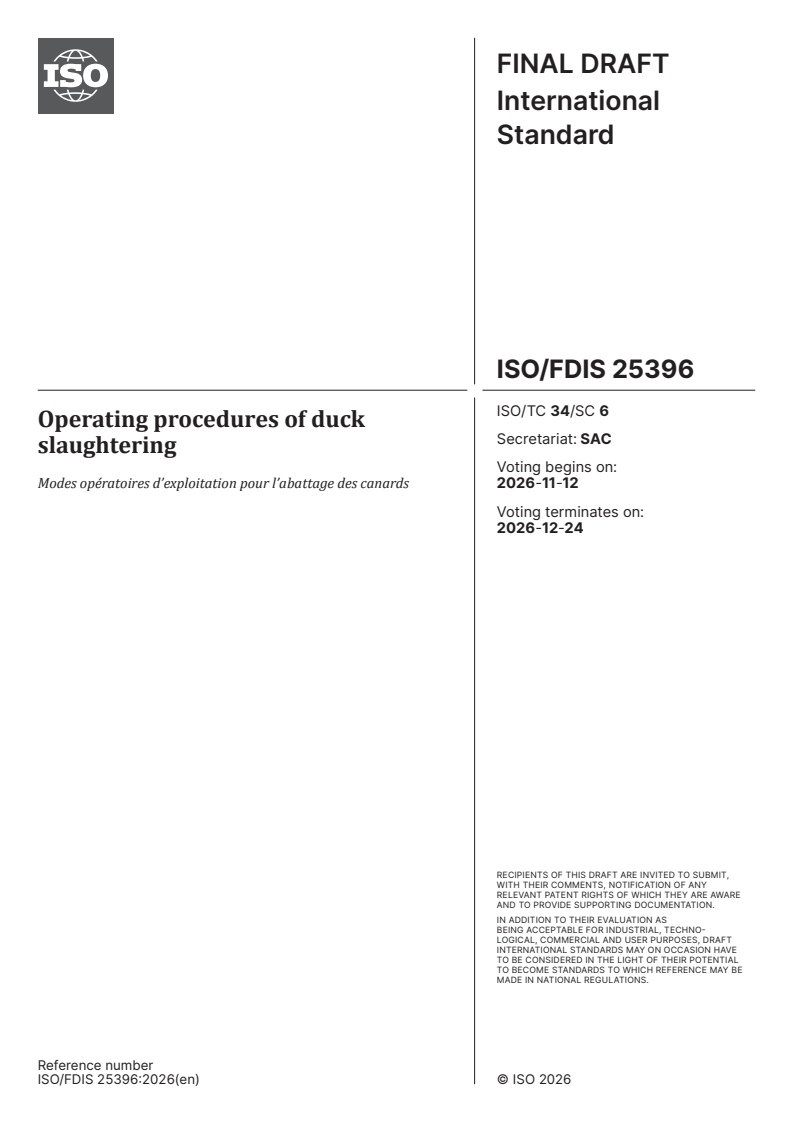
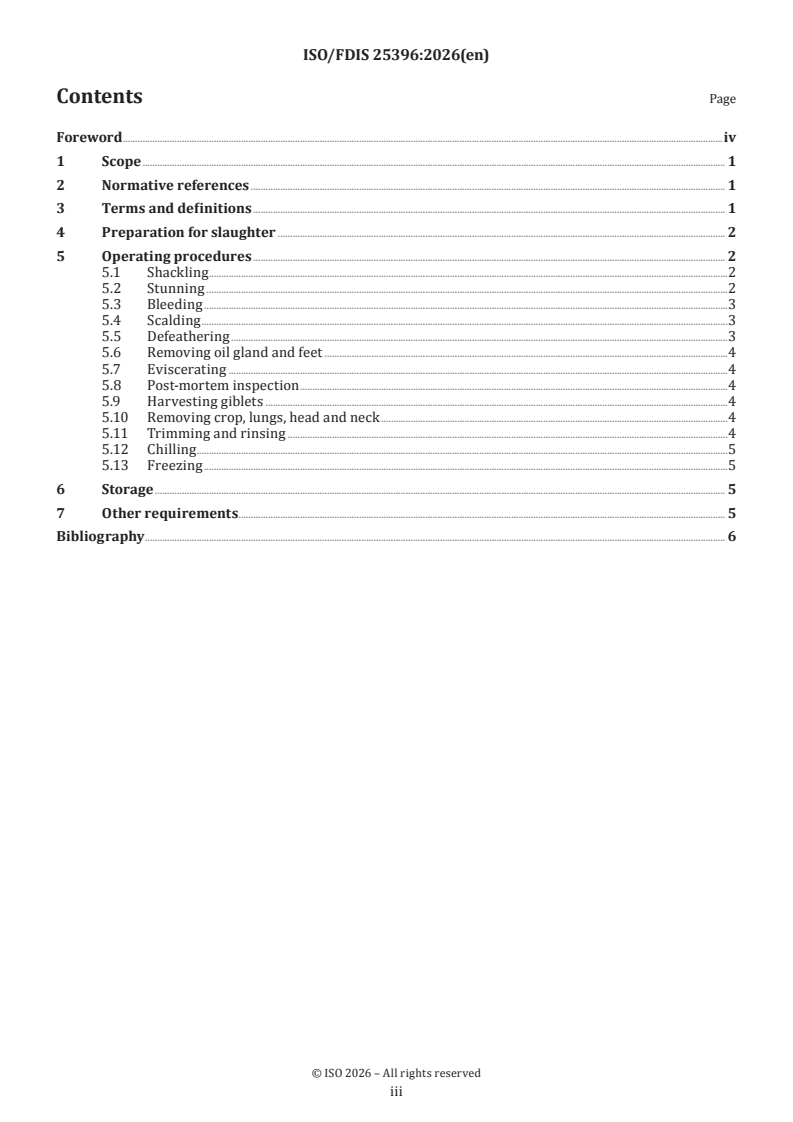
ISO/FDIS 25396 - Operating procedures of duck slaughtering
REDLINE ISO/FDIS 25396 - Operating procedures of duck slaughtering
ISO/FDIS 25396 is an ISO draft standard for the operating procedures of duck slaughtering. It specifies preparations, slaughtering process requirements, and storage conditions for commercial meat ducks in slaughterhouses. The document is meant for slaughterhouse operators, quality and food safety managers, and inspectors who need a clear process for handling ducks from arrival through chilled or frozen storage.
What does ISO/FDIS 25396 specify?
ISO/FDIS 25396 specifies the preparations, operating procedures, and storage requirements for slaughtering commercial meat ducks transported from farms to abattoirs. It applies to slaughtering operations in duck slaughterhouses and excludes abattoirs located on small farms.
The document is organized into seven clauses:
- Clause 1 Scope
- Clause 2 Normative references
- Clause 3 Terms and definitions
- Clause 4 Preparation for slaughter
- Clause 5 Operating procedures
- Clause 6 Storage
- Clause 7 Other requirements
Clause 5 is the core of the document and covers the full process from shackling to freezing. Clause 7 links slaughter operations to hygiene, inspection, traceability, and pest control.
What are the key requirements of ISO/FDIS 25396?
ISO/FDIS 25396 focuses on animal welfare, sanitary handling, and product safety across the slaughter line. In practice, it tells a slaughterhouse what to control, document, and verify at each stage so that birds are handled consistently and carcasses remain fit for the food chain.
Preparation and animal welfare
Clause 4 requires an animal welfare plan to guide the operating procedures. The plan must align with ISO/TS 34700 and WOAH TAHC:2025, and it must document, justify, and monitor the maximum durations for catching, loading, transport, unloading, and pre-slaughter handling.
The document also requires ducks to be handled to reduce stress and injury, including bruising and internal haemorrhage. This means staff need trained handling methods, suitable equipment, and records when planned time limits are exceeded.
Shackling, stunning, and bleeding
Clause 5.1 requires shackle size and line speed to be controlled so hanging does not cause unnecessary pain or distress. Where possible, ducks should be unconscious before shackling, and conscious ducks must be handled in low-noise, dim-light conditions.
Clause 5.2 requires stunning to maintain unconsciousness until death, and bleeding may only start after the duck is confirmed unconscious. Clause 5.3 sets the timing and severing of blood vessels for effective bleeding. In practice, this section is about preventing recovery after stunning and ensuring the bleeding step is both humane and effective.
Scalding, defeathering, and carcass dressing
Clause 5.4 covers scalding, which must loosen feathers without damaging the skin. Clause 5.5 requires defeathering in two stages: primary feather removal and secondary pinfeather removal, with a wax bath process for the second stage. Clause 5.6 to 5.10 cover removal of the oil gland, feet, viscera, giblets, crop, lungs, head, and neck.
These steps matter because they control carcass cleanliness, contamination risk, and product appearance. They also define where manual or mechanical processing is acceptable.
Chilling, freezing, and storage
Clause 5.12 and Clause 5.13 require chilling by water or air methods and freezing to a defined thermal-centre temperature before frozen storage. Clause 6 then requires temperature monitoring in cold storage and sets storage ranges for chilled and frozen duck products.
For operators, this means refrigeration performance must be monitored and documented, not assumed. Temperature control is central to shelf life, food safety, and distribution.
Hygiene, inspection, and traceability
Clause 7 requires documented hazard control measures and points readers toward a HACCP/OPRP plan under ISO 22000. It also requires knife disinfection, official inspection certification for passed product, segregation of failed product, traceability and recall records, and rodent and pest control.
This section links the slaughter line to food safety management. It shows that slaughter is not only a process problem but also a records, inspection, and segregation problem.
What terms does ISO/FDIS 25396 define?
- Duck carcass - the complete duck after slaughtering.
- Wax bath - a wax or paraffin treatment used after initial plucking to remove residual feathers and improve skin finish.
- Official inspection certification - an official stamp, mark, or label showing that duck meat has passed official inspection and meets applicable food safety requirements.
- Duck - in this document, duck means commercial meat ducks.
- Animal welfare plan - the documented plan used to guide slaughter operations so handling and process times are controlled for welfare.
Who uses ISO/FDIS 25396?
ISO/FDIS 25396 is used by duck slaughterhouses, poultry processors, and operators who manage the slaughter line. It is also relevant to quality managers, food safety managers, animal welfare staff, and official inspectors who check handling, inspection, hygiene, and traceability.
The document is especially useful where production must balance welfare, sanitary practice, and product handling in a controlled slaughter operation. Buyers and auditors can also use it to understand what process controls and records a duck slaughterhouse should maintain.
Which standards are used with ISO/FDIS 25396?
- ISO/TS 34700, Animal welfare management - General requirements and guidance for organizations in the food supply chain - provides the animal welfare management framework used in preparation for slaughter.
- CXC 1-1969, General Principles of Food Hygiene - supports hygiene, traceability and recall, and pest control requirements.
- CXC 58-2005, Code of Hygienic Practice for Meat - supports ante-mortem inspection, post-mortem inspection, and food hygiene practice for meat processing.
- WOAH TAHC:2025, World Organisation for Animal Health, Terrestrial Animal Health Code - supports welfare and stunning-related requirements, including the referenced chapters in the preparation stage.
- ISO 22000, Food safety management systems - Requirements for any organization in the food chain - is named for the hazard control plan (HACCP/OPRP plan) in Clause 7.
What does the ISO/FDIS 25396 document contain?
ISO/FDIS 25396 contains a full process description for duck slaughter, from pre-slaughter handling to storage. It sets out operating methods for shackling, stunning, bleeding, scalding, defeathering, evisceration, inspection, chilling, freezing, and cold storage.
The document also describes how to control welfare, hygiene, and contamination risks at each stage. It includes process conditions such as timing limits, temperature control, line handling, and storage monitoring, which are used for routine operation, internal control, and audit checks.
Buy Documents
ISO/FDIS 25396 - Operating procedures of duck slaughtering
REDLINE ISO/FDIS 25396 - Operating procedures of duck slaughtering
Get Certified
Connect with accredited certification bodies for this standard

Control Union Certifications
Global certification for agriculture and sustainability.

ECOCERT
Organic and sustainability certification.

FSC International
Forest Stewardship Council certification.
Sponsored listings
Frequently Asked Questions
ISO/FDIS 25396 is a draft published by the International Organization for Standardization (ISO). Its full title is "Operating procedures of duck slaughtering". This standard covers: This proposal specifies slaughtering requirements of duck, including pre-slaughter requirements, slaughtering process, and storage of duck products. This proposal is applicable to the slaughtering operations of duck slaughter slaughterhouses.
This proposal specifies slaughtering requirements of duck, including pre-slaughter requirements, slaughtering process, and storage of duck products. This proposal is applicable to the slaughtering operations of duck slaughter slaughterhouses.
ISO/FDIS 25396 is classified under the following ICS (International Classification for Standards) categories: 65.020.30 - Animal husbandry and breeding. The ICS classification helps identify the subject area and facilitates finding related standards.
ISO/FDIS 25396 is available in PDF format for immediate download after purchase. The document can be added to your cart and obtained through the secure checkout process. Digital delivery ensures instant access to the complete standard document.
Standards Content (Sample)
FINAL DRAFT
International
Standard
ISO/TC 34/SC 6
Operating procedures of duck
Secretariat: SAC
slaughtering
Voting begins on:
Modes opératoires d’exploitation pour l’abattage des canards 2026-11-12
Voting terminates on:
2026-12-24
RECIPIENTS OF THIS DRAFT ARE INVITED TO SUBMIT,
WITH THEIR COMMENTS, NOTIFICATION OF ANY
RELEVANT PATENT RIGHTS OF WHICH THEY ARE AWARE
AND TO PROVIDE SUPPOR TING DOCUMENTATION.
IN ADDITION TO THEIR EVALUATION AS
BEING ACCEPTABLE FOR INDUSTRIAL, TECHNO
LOGICAL, COMMERCIAL AND USER PURPOSES, DRAFT
INTERNATIONAL STANDARDS MAY ON OCCASION HAVE
TO BE CONSIDERED IN THE LIGHT OF THEIR POTENTIAL
TO BECOME STAN DARDS TO WHICH REFERENCE MAY BE
MADE IN NATIONAL REGULATIONS.
Reference number
FINAL DRAFT
International
Standard
ISO/TC 34/SC 6
Operating procedures of duck
Secretariat: SAC
slaughtering
Voting begins on:
Modes opératoires d’exploitation pour l’abattage des canards
Voting terminates on:
© ISO 2026
All rights reserved.
RECIPIENTS OF THIS DRAFT ARE INVITED TO SUBMIT,
WITH THEIR COMMENTS, NOTIFICATION OF ANY
This ISO publication is protected by copyright and is owned by ISO and/or its licensors.
RELEVANT PATENT RIGHTS OF WHICH THEY ARE AWARE
The content of this ISO publication is provided under licence, not sold. Use is subject to the applicable licence terms issued by ISO,
AND TO PROVIDE SUPPOR TING DOCUMENTATION.
an ISO member body, or an authorized third-party distributor.
IN ADDITION TO THEIR EVALUATION AS
BEING ACCEPTABLE FOR INDUSTRIAL, TECHNO
Except as required for implementation or expressly permitted by a separate licence, no part of this ISO publication may be
LOGICAL, COMMERCIAL AND USER PURPOSES, DRAFT
reproduced, distributed, modified, used, or made available in any form or by any means – electronic or mechanical, including
INTERNATIONAL STANDARDS MAY ON OCCASION HAVE
photocopying, scanning, recording, or posting on internal or external digital platforms. TO BE CONSIDERED IN THE LIGHT OF THEIR POTENTIAL
TO BECOME STAN DARDS TO WHICH REFERENCE MAY BE
Any use beyond the scope of the granted rights is prohibited and may result in legal action.
MADE IN NATIONAL REGULATIONS.
ISO copyright office
CP 401 • CH-1214 Vernier, Geneva
Phone: +41 22 749 01 11
Email: copyright@iso.org
Website: www.iso.org
Published in Switzerland
Reference number
ii
Contents Page
Foreword .iv
1 Scope . 1
2 Normative references . 1
3 Terms and definitions . 1
4 Preparation for slaughter . 2
5 Operating procedures . 2
5.1 Shackling .2
5.2 Stunning .2
5.3 Bleeding .3
5.4 Scalding .3
5.5 Defeathering .3
5.6 Removing oil gland and feet .4
5.7 Eviscerating .4
5.8 Post-mortem inspection .4
5.9 Harvesting giblets .4
5.10 Removing crop, lungs, head and neck .4
5.11 Trimming and rinsing .4
5.12 Chilling .5
5.13 Freezing .5
6 Storage . 5
7 Other requirements . . 5
Bibliography . 6
iii
Foreword
ISO (the International Organization for Standardization) is a worldwide federation of national standards
bodies (ISO member bodies). The work of preparing International Standards is normally carried out through
ISO technical committees. Each member body interested in a subject for which a technical committee
has been established has the right to be represented on that committee. International organizations,
governmental and non-governmental, in liaison with ISO, also take part in the work. ISO collaborates closely
with the International Electrotechnical Commission (IEC) on all matters of electrotechnical standardization.
The procedures used to develop this document and those intended for its further maintenance are described
in the ISO/IEC Directives, Part 1. In particular, the different approval criteria needed for the different types
of ISO document should be noted. This document was drafted in accordance with the editorial rules of the
ISO/IEC Directives, Part 2 (see www.iso.org/directives).
ISO draws attention to the possibility that the implementation of this document may involve the use of (a)
patent(s). ISO takes no position concerning the evidence, validity or applicability of any claimed patent
rights in respect thereof. As of the date of publication of this document, ISO had not received notice of (a)
patent(s) which may be required to implement this document. However, implementers are cautioned that
this may not represent the latest information, which may be obtained from the patent database available at
www.iso.org/patents. ISO shall not be held responsible for identifying any or all such patent rights.
Any trade name used in this document is information given for the convenience of users and does not
constitute an endorsement.
For an explanation of the voluntary nature of standards, the meaning of ISO specific terms and expressions
related to conformity assessment, as well as information about ISO’s adherence to the World Trade
Organization (WTO) principles in the Technical Barriers to Trade (TBT), see www.iso.org/iso/foreword.html.
This document was prepared by Technical Committee ISO/TC 34, Food products, Subcommittee SC 6, Meat,
poultry, fish, eggs and their products.
Any feedback or questions on this document should be directed to the user’s national standards body. A
complete listing of these bodies can be found at www.iso.org/members.html.
iv
FINAL DRAFT International Standard ISO/FDIS 25396:2026(en)
Operating procedures of duck slaughtering
1 Scope
This document specifies the preparations, operating procedures and requirements for the slaughtering of
commercial meat ducks transported from farms to abattoirs.
This document does not apply to abattoirs located on small farms.
In this document, the term “duck” refers to commercial meat ducks.
2 Normative references
The following documents are referred to in the text in such a way that some or all of their content constitutes
requirements of this document. For dated references, only the edition cited applies. For undated references,
the latest edition of the referenced document (including any amendments) applies.
ISO/TS 34700, Animal welfare management — General requirements and guidance for organizations in the food
supply chain
CXC 1-1969, General Principles of Food Hygiene
CXC 58-2005, Code of Hygienic Practice for Meat
WOA H TA HC: 2025, World Organisation for Animal Health, Terrestrial Animal Health Code
3 Terms and definitions
For the purposes of this document, the following terms and definitions apply.
ISO and IEC maintain terminology databases for use in standardization at the following addresses:
— ISO Online browsing platform: available at https:// www .iso .org/ obp
— IEC Electropedia: available at https:// www .electropedia .org/
3.1
duck carcass
complete duck after slaughtering
3.2
wax bath
process of using specialized duck wax or paraffin wax to remove residu
...
ISO/DISFDIS 25396
ISO/TC 34/SC 6
Secretariat: SAC
Date: 2026-09-1810-28
Operating procedures of duck slaughtering
Modes opératoires d’exploitation pour l’abattage des canards
DISFDIS stage
All rights reserved.
This ISO publication is protected by copyright and is owned by ISO and/or its licensors.
The content of this ISO publication is provided under licence, not sold. Use is subject to the applicable licence terms issued
by ISO, an ISO member body, or an authorized third-party distributor.
Except as required for implementation or expressly permitted by a separate licence, no part of this ISO publication may
be reproduced, distributed, modified, used, or made available in any form or by any means – electronic or mechanical,
including photocopying, scanning, recording, or posting on internal or external digital platforms.
Any use beyond the scope of the granted rights is prohibited and may result in legal action.
ISO copyright office
CP 401 • CH-1214 Vernier, Geneva
Phone: + 41 22 749 01 11
Email: copyright@iso.org
Website: www.iso.org
Published in Switzerland
ii
Contents
Foreword . iv
1 Scope . 1
2 Normative references . 1
3 Terms and definitions . 1
4 Preparation for slaughter . 2
5 Operating procedures . 2
5.1 Shackling . 2
5.2 Stunning . 2
5.3 Bleeding . 3
5.4 Scalding . 3
5.5 Defeathering . 3
5.6 Removing oil gland and feet . 4
5.7 Eviscerating. 4
5.8 Post-mortem inspection . 4
5.9 Harvesting giblets . 4
5.10 Removing crop, lungs, head and neck . 4
5.11 Trimming and rinsing . 4
5.12 Chilling . 4
5.13 Freezing . 5
6 Storage . 5
7 Other requirements . 5
Bibliography . 6
iii
Foreword
ISO (the International Organization for Standardization) is a worldwide federation of national standards
bodies (ISO member bodies). The work of preparing International Standards is normally carried out through
ISO technical committees. Each member body interested in a subject for which a technical committee has been
established has the right to be represented on that committee. International organizations, governmental and
non-governmental, in liaison with ISO, also take part in the work. ISO collaborates closely with the
International Electrotechnical Commission (IEC) on all matters of electrotechnical standardization.
The procedures used to develop this document and those intended for its further maintenance are described
in the ISO/IEC Directives, Part 1. In particular, the different approval criteria needed for the different types of
ISO document should be noted. This document was drafted in accordance with the editorial rules of the
ISO/IEC Directives, Part 2 (see www.iso.org/directives).
ISO draws attention to the possibility that the implementation of this document may involve the use of (a)
patent(s). ISO takes no position concerning the evidence, validity or applicability of any claimed patent rights
in respect thereof. As of the date of publication of this document, ISO had not received notice of (a) patent(s)
which may be required to implement this document. However, implementers are cautioned that this may not
represent the latest information, which may be obtained from the patent database available at
www.iso.org/patents. ISO shall not be held responsible for identifying any or all such patent rights.
Any trade name used in this document is information given for the convenience of users and does not
constitute an endorsement.
For an explanation of the voluntary nature of standards, the meaning of ISO specific terms and expressions
related to conformity assessment, as well as information about ISO’s adherence to the World Trade
Organization (WTO) principles in the Technical Barriers to Trade (TBT), see www.iso.org/iso/foreword.html.
This document was prepared by Technical Committee ISO/TC 34, Food products, Subcommittee SC 6, Meat,
poultry, fish, eggs and their products.
Any feedback or questions on this document should be directed to the user’s national standards body. A
complete listing of these bodies can be found at www.iso.org/members.html.
iv
Operating procedures of duck slaughtering
1 Scope
This document specifies the preparations, operating procedures and requirements for the slaughtering of
commercial meat ducks transported from farms to abattoirs. Abattoirs located on small farms are excluded
from the scope of this document.
This document does not apply to abattoirs located on small farms.
In this document, the term “duck” refers to commercial meat ducks.
2 Normative references
The following documents are referred to in the text in such a way that some or all of their content constitutes
requirements of this document. For dated references, only the edition cited applies. For undated references,
the latest edition of the referenced document (including any amendments) applies.
ISO/TS 34700, Animal welfare management — General requirements and guidance for organizations in the food
supply chain
CXC 1-1969, General Principles of Food Hygiene
CXC 58-2005, Code of Hygienic Practice for Meat
WOAH TAHC:2025, World Organisation for Animal Health, Terrestrial Animal Health Code
3 Terms and definitions
For the purposes of this document, the following terms and definitions apply.
ISO and IEC maintain terminology databases for use in standardization at the following addresses:
— ISO Online browsing platform: available at https://www.iso.org/obp
— IEC Electropedia: available at https://www.electropedia.org/
3.1
duck carcass
complete duck after slaughtering
3.2
wax bath
process of using specialized duck wax or paraffin wax to remove residual feathers after initial plucking to
ensure a clean and presentable skin
3.3
official inspection certification
official stamp, mark or label signifying that duck meat has undergone official inspection and meets applicable
food safety requirements
Note 1 to entry: The official inspection certification on duck meat provides consumers with assurance that applicable
safety and regulatory requirements have been met within the food supply chain. It does not constitute a mark of
conformity with this document.
Note 2 to entry: Key aspects of official inspection certification for duck slaughter include an indication that the duck was
inspected and found to be from healthy birds, handled under sanitary conditions and correctly labelled, and confirmation
that the product meets applicable regulations, including requirements prohibiting the sale of duck carcasses (3.1) or parts
showing signs of disease.
4 Preparation for slaughter
4.1 An animal welfare plan should be developed to guide all operating procedures. The operating
procedures shall be in accordance with ISO/TS 34700 and WOAH TAHC:2025, Chapters 7.1 and 7.5.
4.2 The total duration from initial catching, through loading, transportation an
...