

ISO 5390:1977
(Main)Compressors — Classification
General Information
- Abstract
Gives a classification of various types of compressors and some definitions. a list of equivalent English and French terms relating to some of the types is given in an annex, together with explanatory diagramms. Applies to compressors defined as machines for the displacement and compression of gaseous media for any pressure values, with the exeption of fans and vacuum pumps.
- Status
- Published
- Publication Date
- 30-Apr-1977
- Technical Committee
- ISO/TC 118/SC 6 - Air compressors and compressed air systems
- Drafting Committee
- ISO/TC 118/SC 6 - Air compressors and compressed air systems
- Current Stage
- 9092 - International Standard to be revised
- Start Date
- 27-Aug-2026
- Completion Date
- 05-Sep-2026

Overview
ISO 5390:1977 is an international standard developed by the International Organization for Standardization (ISO) that provides a comprehensive classification of compressors. This standard covers various types of compressors used for the displacement and compression of gaseous media across all pressure ranges, except for fans and vacuum pumps. It includes essential definitions, classifications, and a bilingual glossary of English and French terms alongside illustrative diagrams to support better understanding.
The standard serves as a crucial reference for manufacturers, engineers, and technical professionals involved in the design, selection, and application of compressors across multiple industries. By providing a universally accepted classification system, ISO 5390:1977 facilitates clearer communication, specification, and education within the field of pneumatic machinery and related technologies.
Key Topics
Compressor Types and Classifications: The standard divides compressors into two principal categories:
- Displacement (Volumetric) Compressors: Machines that achieve pressure increase by admitting successive volumes of gas into a closed chamber and displacing it via a moving element. Subtypes include:
- Reciprocating compressors driven by a rotating shaft, using straightforward alternating motion.
- Rotary compressors utilizing rotors, vanes, or meshing elements for displacement.
- Dynamic Compressors: Devices where pressure increase is achieved through kinetic energy transformation with continuous gas flow. Variants include:
- Turbocompressors (with rotating blades or impellers), further classified into axial flow, radial (centrifugal) flow, and mixed flow types.
- Ejectors, which perform compression without moving parts by harnessing the kinetic energy of an auxiliary fluid.
- Displacement (Volumetric) Compressors: Machines that achieve pressure increase by admitting successive volumes of gas into a closed chamber and displacing it via a moving element. Subtypes include:
Detailed Definitions: Comprehensive explanations for technical terms ensure consistency, covering aspects like shaft-driven reciprocating compressors, diaphragm compressors, lubrication types, cooling methods, and compressor configurations.
Bilingual Glossary and Diagrams: Annexed lists provide equivalent terminology in English and French, accompanied by explanatory visual aids illustrating different compressor mechanisms and configurations such as piston types, mounting styles, and flow orientations.
Applications
ISO 5390:1977 is widely applicable in fields that rely on gas compression technology, including:
Industrial Process Engineering: Facilitates specification of compressor types for chemical, petroleum, and manufacturing processes requiring precise gas displacement and pressure control.
HVAC Systems and Pneumatics: Assists HVAC designers and pneumatic tool manufacturers in selecting appropriate compressor technologies for air compression applications.
Energy Sector: Guides turbine and compressor manufacturers in classifying turbomachinery used in power generation and gas transport.
Academic and R&D: Provides a foundation for educational programs and research work in mechanical engineering disciplines concerned with fluid dynamics and machine design.
By using this standard, organizations can ensure alignment with international nomenclature and classification schemes, aiding interoperability, procurement agreements, and technical documentation.
Related Standards
ISO 5390:1977 complements and aligns with several other relevant standards in the field of compressors and pneumatic machinery, such as:
ISO 1217: Specifies performance testing methods for displacement compressors.
ISO 8573: Defines air quality classes for compressed air systems.
ISO 13373: Provides guidelines for machinery condition monitoring, relevant to compressor maintenance.
ISO 10816: Outlines vibration severity assessment for rotating machinery including compressors.
Adherence to ISO 5390’s classification enhances integration with these standards by providing a clear framework and common language for compressor types and terminology.
Keywords: ISO 5390:1977, compressor classification, displacement compressor, dynamic compressor, turbocompressor, reciprocating compressor, rotary compressor, pneumatic machinery standards, gas compression technology, international compressor terminology, compressor glossary, mechanical engineering standards.
Relations
- Effective Date
- 25-Apr-2020
- Effective Date
- 15-Apr-2008
Get Certified
Connect with accredited certification bodies for this standard

Institut za varilstvo d.o.o. (Welding Institute)
Slovenia's leading welding institute since 1952. ISO 3834, EN 1090, pressure equipment certification, NDT personnel, welder qualification. Only IIW Au
Sponsored listings
Frequently Asked Questions
ISO 5390:1977 is a standard published by the International Organization for Standardization (ISO). Its full title is "Compressors — Classification". This standard covers: Gives a classification of various types of compressors and some definitions. a list of equivalent English and French terms relating to some of the types is given in an annex, together with explanatory diagramms. Applies to compressors defined as machines for the displacement and compression of gaseous media for any pressure values, with the exeption of fans and vacuum pumps.
Gives a classification of various types of compressors and some definitions. a list of equivalent English and French terms relating to some of the types is given in an annex, together with explanatory diagramms. Applies to compressors defined as machines for the displacement and compression of gaseous media for any pressure values, with the exeption of fans and vacuum pumps.
ISO 5390:1977 is classified under the following ICS (International Classification for Standards) categories: 23.140 - Compressors and pneumatic machines. The ICS classification helps identify the subject area and facilitates finding related standards.
ISO 5390:1977 has the following relationships with other standards: It is inter standard links to ISO 5390:1977/Amd 1:2017, ISO/TR 12942:2012. Understanding these relationships helps ensure you are using the most current and applicable version of the standard.
ISO 5390:1977 is available in PDF format for immediate download after purchase. The document can be added to your cart and obtained through the secure checkout process. Digital delivery ensures instant access to the complete standard document.
Standards Content (Sample)
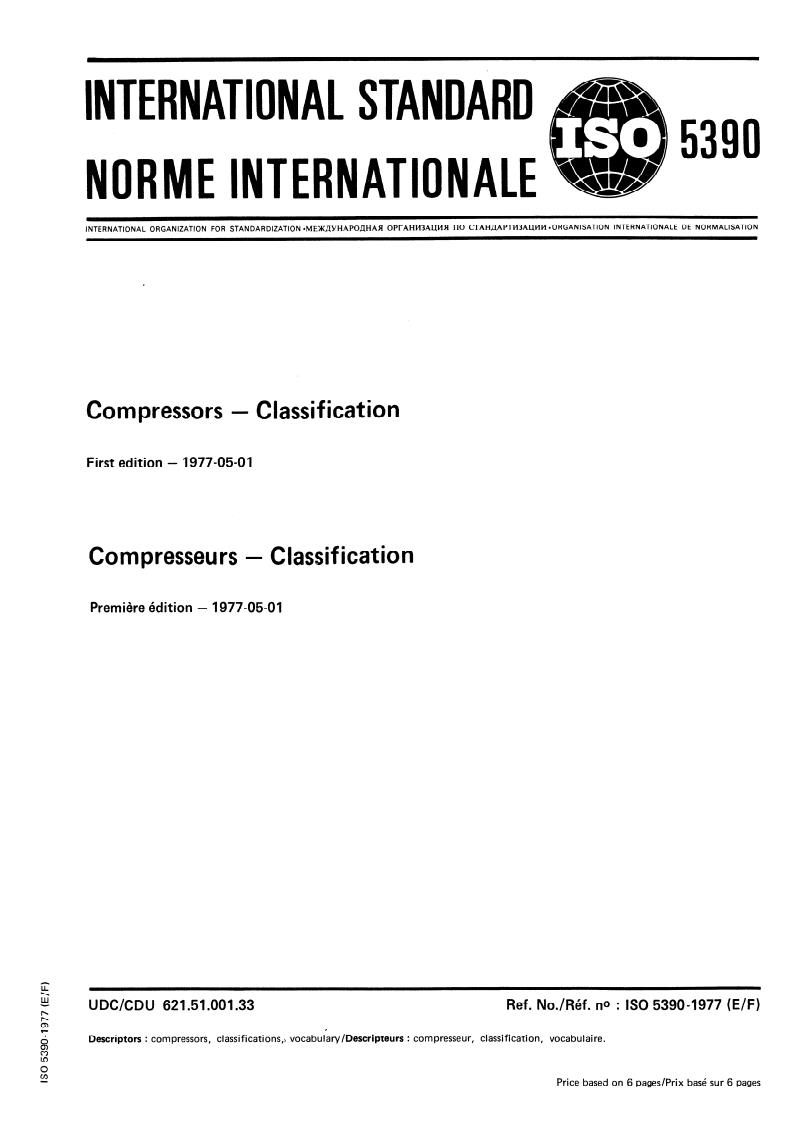
INTERNATIONAL STANDARD
NORME INTERNATIONALE
INTERNATIONAL ORGANIZATION FOR STANDARDIZATION l MEXflYHAPOAHAII OPl-AHM3ALU-W n0 CTAHAAPTM3ALWi .ORGANISATION INTERNATIONALE DE NORMALISATION
Compressors - Classif ication
First edition - 1977-05-01
Compresseurs - Classif ication
Premiere Edition - 1977-05-01
ii
\
W
-
UDC/CDU 621.51 .001.33
Ref. No./Rbf. no : ISO 53904977 (E/F)
Descriptors : compressors, classifications,, vocabulary/Descripteurs : compresseur, classification, vocabulaire.
Price based on 6 pages/Prix base sur 6 pages
FOREWORD
ISO (the International Organization for Standardization) is a worldwide federation
of national Standards institutes (ISO member bodies). The work of developing
International Standards is carried out through ISO technical committees. Every
member body interested in a subject for which a technical committee has been set
up has the right to be represented on that committee. International organizations,
governmental and non-governmental, in liaison with ISO, also take part in the work.
Draft International Standards adopted by the technical committees are circulated
to the member bodies for approval before their acceptance as International
Standards by the ISO Council.
International Standard ISO 5390 was developed by Technical Committee
ISOKC 118, Compressors, pneumatic tools and pneumatic macbines, and was
circuiated to the member bodies in February 1976.
lt has been approved by the member bodies of the following countries :
Germany South Africa, Rep. of
Austral ia
Austria Hungary Spain
Belgium India Sweden
Korea, Rep. of
Bu Igaria Switzerland
Czechoslovakia Wlexico Turkey
Egypt, Arab Rep. of Netherlands United Kingdom
Finland Poland U .S.A.
France Romania Yugoslavia
No member body expressed disapproval of the document.
0 International Organization for Standardkation, 1977 l
Printed in Switzerland
ii
AVANT-PROPOS
L’ISO (Organisation internationale de normaiisation) est une federation mondiaie
d’organismes nationaux de normaiisation (comites membresde I’ISO). L’elaboration
des Normes internationales est confiee aux comites techniques de I’ISO. Chaque
comite membre interesse par une etude a ie droit de faire Partie du comite technique
Les organisations internationales, gouvernementales et non
correspondant.
gouvernementales, en iiaison avec I’ISO, participent egaiement aux travaux.
Les projets de Normes internationales adoptks par ies comites techniques sont
soumis aux comites membres pour approbation, avant ieur acceptation comme
Normes internationales par ie Conseii de I’ISO.
La Norme internationale ISO 5390 a etc eiaboree par ie comite technique
ISO/TC 118, Compresseurs, outils et machines pneumatiques, et a etc soumise aux
comites membres en fevrier 1976.
Les comites membres des pays suivants i’ont approuvee :
Roumanie
Afrique du Sud, Rep. d’ Espagne
Royaume-Uni
Allemagne Finiande
Sukde
Austraiie France
Hongrie Suisse
Autriche
Tchecosiovaquie
Beigique Inde
Turquie
Buigarie Mexique
Corde, Rep. de Pays-Bas U .S.A.
Yougosiavie
Poiogne
Egypte, Rep. arabe d’
Aucun comite membre ne i’a desapprouvee.
0 Organisation internationale de normalisation, 1977 l
Imprimk en Suisse
. . .
Ill
This page intentionally left blank
INTERNATIONAL STANDARD
ISO 53904977 (E/F)
NORME INTERNATIONALE
Compresseurs - Classif ication
Compressors - Classif ication
1 SCOPE AND FIELD OF APPLICATION 1 OBJET ET DOMAINE D’APPLICATION
La presente Norme internationale donne une ciassif ication
This International Standard gives a ciassification of various
des divers types de compresseurs et quelques definitions.
types of compressors and some definitions. A iist of equiva-
Une liste de termes equivaients francais-anglais et des
lent English and French terms relating to some of the types
f igures expl icatives sont egalement ’ presentees, dans
is given in an annex, together with expianatory diagrams.
i’annexe, en ce qui concerne queiques-uns de ces types.
La presente Norme internationale s’applique aux compres-
This International Standard appiies to compressors def ined
seurs en tant que machines effectuant ie deplacement et Ia
as machines for the dispiacement and compression of
compression des fluides gazeux, quelle que soit Ia Valeur de
gaseous media for any pressure values, with the exception
Ia Pression, 5 i’exclusion, toutefois, des ventiiateurs et des
of fans and vacuum Pumps.
pompes a vide.
2 GENERAL CLASSIFICATION 2 CLASSIFICATION GENERALE
The general classification of compressors is given on page 2. La ciassification generaie des compresseurs est donnee a Ia
page 2.
ISO 5390-1977 (E/F) 1
$r
tJ+
-uu
CL, Ul
.- -9
w+Ll
.- Ha
---->m
iü 0
$-rd-J
2 1
Lf
OP,
zz
K?!
FE’
s-2i .-
O-
Zr
- ‘E +3
v)
a --
a,Q
La
c
EI
FD
E -
’ 2
mE -
fj,a
4-J
S
E
a
-8
.-
.-
s
S
u
.-
cn-
= 23
- ‘Z
m
- ; ‘f
SZ+
. 0.z
g ;zj
ZQ
ca
ISO 53904977 (E/F)
3 DEFINITIONS
3 DEFINITIONS
3.1 compresseur volumetrique : Machine dans laquelle une
3.1 displacement compressor : A machine where a static
augmentation de Ia Pression statique est obtenue en admet-
pressure rise is obtained by allowing successive volumes of
tant des volumes successifs de gaz dans une chambre fermee
gas to be aspired into and exhausted out of a closed space
et en les refoulant au moyen du deplacement d’un element
by means of the displacement of a moving member.
mobile.
NOTE - Compression may be internal or not; if it is internal, the
pressure ratio may be constant or variable.
NOTE - La compression peut etre interne ou non et, si Ia compres-
sion est interne, Ie rapport de Pression peut etre fixe ou variable.
3.1.1 shaft driven reciprocating compressor : A displace- 3.1 .l compresseur alternatif entraine mecaniquement :
ment compressor in which gas intake and compression Compresseur volumetrique dans lequel I’aspiration et Ia
are achieved by the straightforward alternating movement compression du gaz sont realisees par Ie deplacement recti-
of a moving element in a space constituting a compression ligne de va-et-vient d’un element mobile dans une enceinte
chamber due to a shaft rotation. formant chambre de compression. Ce mouvement est realise
par Ia rot
...