

ISO 29783-2:2015
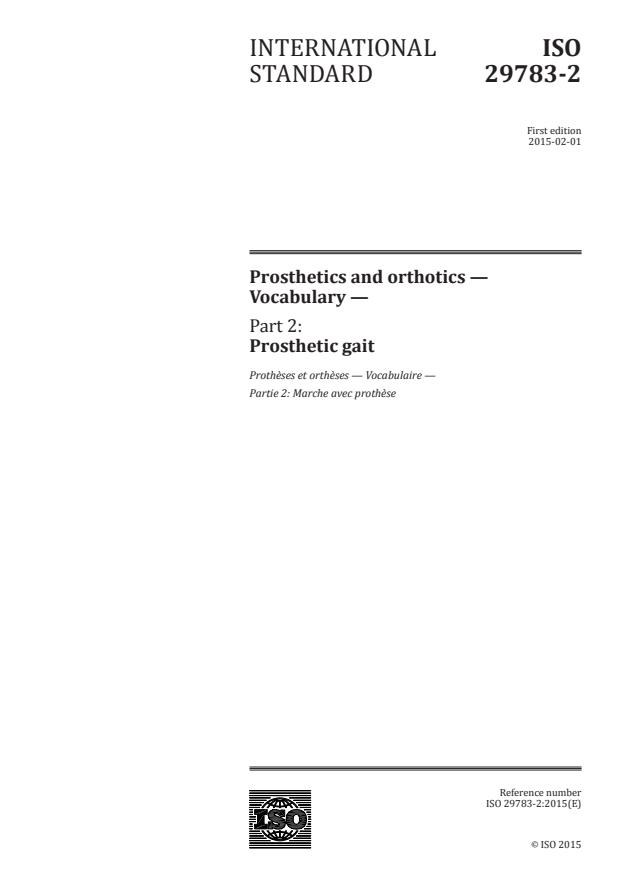
(Main)Prosthetics and orthotics — Vocabulary — Part 2: Prosthetic gait
General Information
- Abstract
ISO 27983-2:2015 specifies a vocabulary for the description of prosthetic gait.
- Status
- Published
- Publication Date
- 19-Jan-2015
- Technical Committee
- ISO/TC 168 - Prosthetics and orthotics
- Drafting Committee
- ISO/TC 168/WG 1 - Nomenclature and classification
- Current Stage
- 9060 - Close of review
- Completion Date
- 02-Dec-2030
Buy Documents
ISO 29783-2:2015 - Prosthetics and orthotics -- Vocabulary
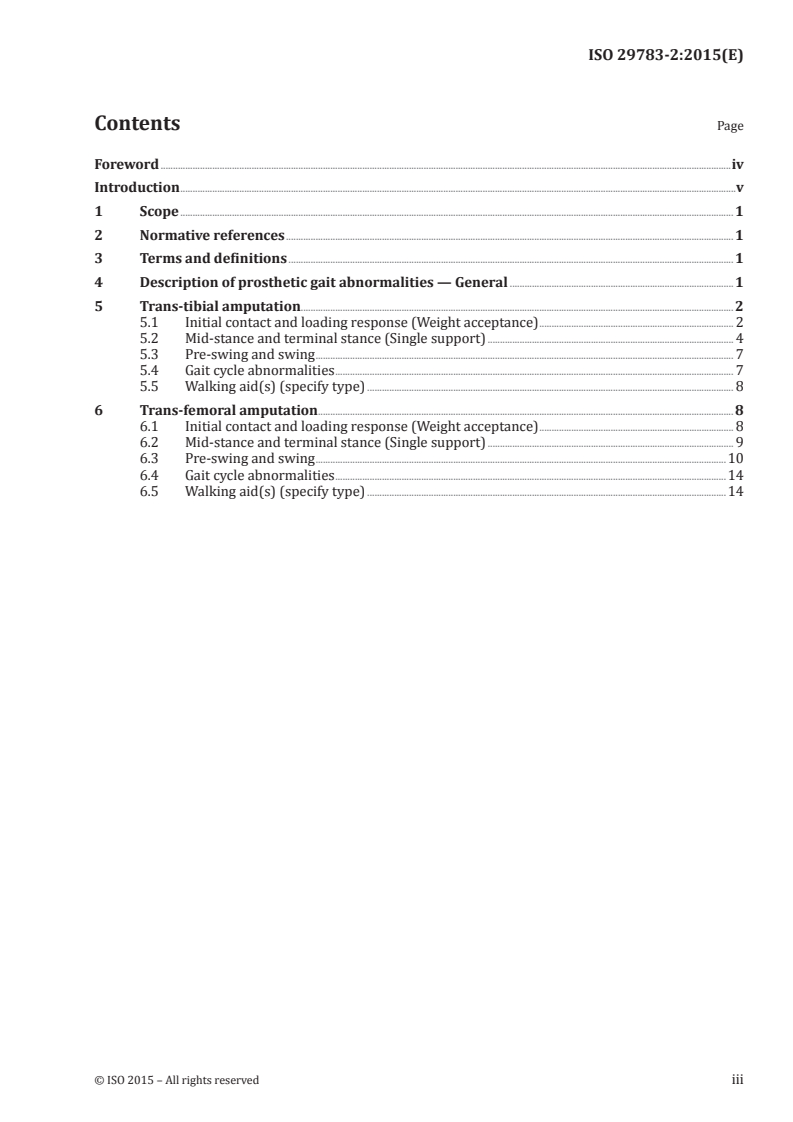
ISO 29783-2:2015 - Prosthetics and orthotics — Vocabulary — Part 2: Prosthetic gait/20/2015
ISO 29783-2:2015 - Protheses et ortheses -- Vocabulaire
ISO 29783-2:2015 - Prothèses et orthèses — Vocabulaire — Partie 2: Marche avec prothèse/20/2015
Overview
ISO 29783-2:2015, titled Prosthetics and orthotics - Vocabulary - Part 2: Prosthetic gait, is an international standard published by ISO that specifies a standardized vocabulary for describing the gait patterns of individuals with unilateral lower limb amputations using prosthetic limbs. This standard builds on ISO 29783-1, which covers normal gait, to provide clear, consistent terminology dedicated specifically to prosthetic gait abnormalities.
The absence of a globally accepted vocabulary for prosthetic gait has historically led to inconsistent communication among healthcare professionals, prosthetists, and rehabilitation teams across different countries. ISO 29783-2 addresses this gap by defining terms related to the gait cycle phases and typical deviations observed in trans-tibial and trans-femoral amputees during prosthetic use.
Key Topics
Gait Cycle Sub-phases: The standard categorizes prosthetic gait into phases such as initial contact, loading response (weight acceptance), mid-stance, terminal stance (single support), pre-swing, and swing. Each phase is analyzed for typical abnormalities.
Terminology for Gait Deviations: It defines abnormal joint movements and timing abnormalities, providing related terms such as:
- Circumduction: Abnormal lateral swing of the prosthetic limb.
- Hip hiking: Elevated pelvic movement during swing phase.
- Vaulting: Increased plantarflexion of the contralateral ankle to aid clearance.
- Whip: Medial or lateral deviation of the foot path during swing.
Trans-tibial Amputation Gait: The vocabulary includes abnormal knee and hip joint behaviors at different gait sub-phases, such as knee hyperextension or increased flexion at initial contact, premature heel-off, and walking base variations.
Trans-femoral Amputation Gait: The standard covers unique prosthetic gait characteristics such as knee unit instability, absent knee flexion during pre-swing, increased lumbar lordosis, and deviations in trunk and pelvic movements.
Usage of Walking Aids: The document also defines terms to describe gait when enhanced by walking aids, specifying contralateral, prosthetic, or bilateral use.
Gait Cycle Abnormalities: Unequal step length and timing, as well as narrow or wide walking base, are standardized to aid in systematic gait description.
Applications
ISO 29783-2:2015 is essential for:
Clinical Prosthetics and Orthotics Teams: Facilitates consistent assessment and documentation of prosthetic gait patterns, improving communication across multidisciplinary teams.
Rehabilitation Specialists: Helps physical therapists and clinicians identify specific gait abnormalities, enabling targeted interventions and monitoring progress.
Research and Development: Provides a foundation for comparing prosthetic gait data internationally, supporting innovation in prosthetic design and fitting procedures.
Education and Training: Offers a reference vocabulary for training practitioners in prosthetic gait analysis and care.
Regulatory and Quality Assurance: Supports standardization in clinical reporting and prosthetic service delivery worldwide.
Related Standards
ISO 29783-1:2015 - Prosthetics and orthotics - Vocabulary - Part 1: Normal gait
Defines terminology for normal human gait, serving as the basis for understanding deviations detailed in Part 2.ISO 29783-3 - Prosthetics and orthotics - Vocabulary - Part 3: Pathological gait (planned)
Expected to cover terminology related to pathological gait patterns beyond prosthetic use.ISO/IEC Directives
Guidelines for the development and maintenance of ISO standards, ensuring consistency and quality.
By adopting ISO 29783-2:2015, healthcare providers and prosthetic experts globally can achieve improved clarity and precision in gait descriptions, ultimately enhancing the quality of care for lower limb amputees and supporting innovation in prosthetic technologies. Keywords: prosthetic gait vocabulary, lower limb amputation gait, trans-tibial amputation, trans-femoral amputation, prosthetic gait analysis, gait abnormalities, ISO prosthetics standards.
Relations
- Consolidated By
ISO 25110:2017 - Electronic fee collection — Interface definition for on-board account using integrated circuit card (ICC) - Effective Date
- 06-Jun-2022
Buy Documents
ISO 29783-2:2015 - Prosthetics and orthotics -- Vocabulary
ISO 29783-2:2015 - Prosthetics and orthotics — Vocabulary — Part 2: Prosthetic gait/20/2015
ISO 29783-2:2015 - Protheses et ortheses -- Vocabulaire
ISO 29783-2:2015 - Prothèses et orthèses — Vocabulaire — Partie 2: Marche avec prothèse/20/2015
Get Certified
Connect with accredited certification bodies for this standard

BSI Group
BSI (British Standards Institution) is the business standards company that helps organizations make excellence a habit.

TÜV Rheinland
TÜV Rheinland is a leading international provider of technical services.

TÜV SÜD
TÜV SÜD is a trusted partner of choice for safety, security and sustainability solutions.
Sponsored listings
Frequently Asked Questions
ISO 29783-2:2015 is a standard published by the International Organization for Standardization (ISO). Its full title is "Prosthetics and orthotics — Vocabulary — Part 2: Prosthetic gait". This standard covers: ISO 27983-2:2015 specifies a vocabulary for the description of prosthetic gait.
ISO 27983-2:2015 specifies a vocabulary for the description of prosthetic gait.
ISO 29783-2:2015 is classified under the following ICS (International Classification for Standards) categories: 01.040.11 - Health care technology (Vocabularies); 11.040.40 - Implants for surgery, prosthetics and orthotics. The ICS classification helps identify the subject area and facilitates finding related standards.
ISO 29783-2:2015 has the following relationships with other standards: It is inter standard links to ISO 25110:2017. Understanding these relationships helps ensure you are using the most current and applicable version of the standard.
ISO 29783-2:2015 is available in PDF format for immediate download after purchase. The document can be added to your cart and obtained through the secure checkout process. Digital delivery ensures instant access to the complete standard document.
Standards Content (Sample)
INTERNATIONAL ISO
STANDARD 29783-2
First edition
2015-02-01
Prosthetics and orthotics —
Vocabulary —
Part 2:
Prosthetic gait
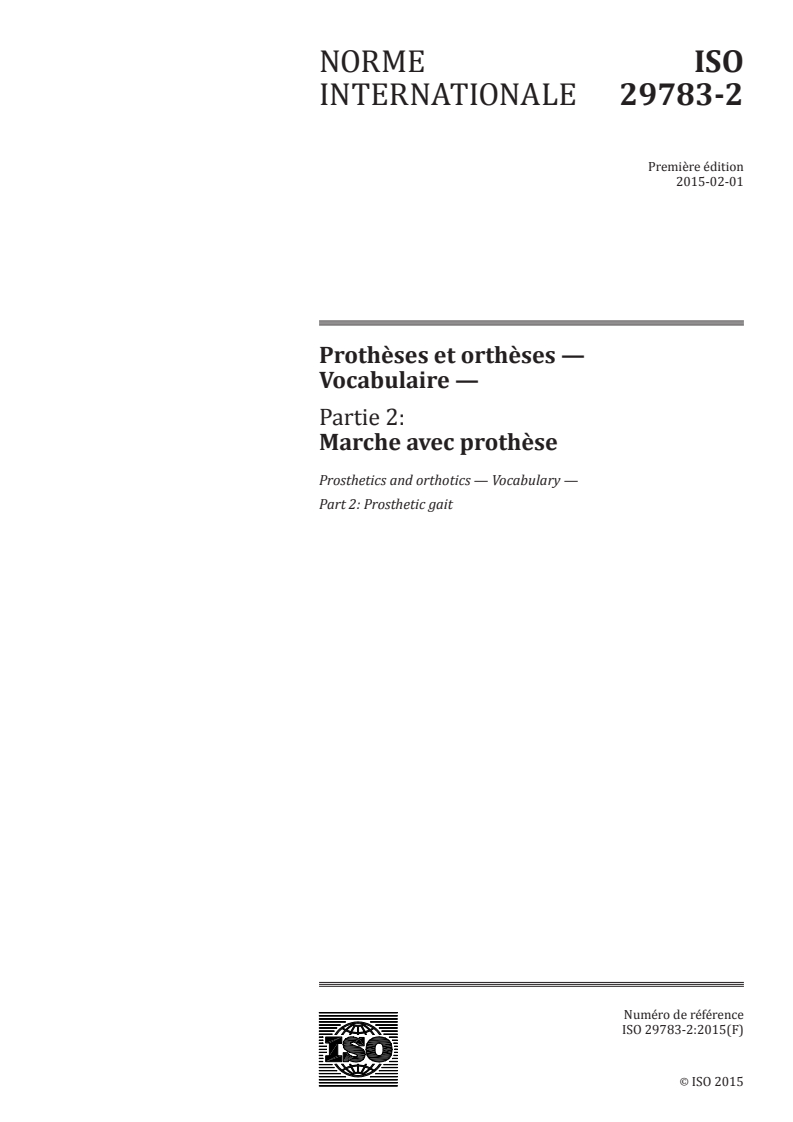
Prothèses et orthèses — Vocabulaire —
Partie 2: Marche avec prothèse
Reference number
©
ISO 2015
© ISO 2015
All rights reserved. Unless otherwise specified, no part of this publication may be reproduced or utilized otherwise in any form
or by any means, electronic or mechanical, including photocopying, or posting on the internet or an intranet, without prior
written permission. Permission can be requested from either ISO at the address below or ISO’s member body in the country of
the requester.
ISO copyright office
Case postale 56 • CH-1211 Geneva 20
Tel. + 41 22 749 01 11
Fax + 41 22 749 09 47
E-mail copyright@iso.org
Web www.iso.org
Published in Switzerland
ii © ISO 2015 – All rights reserved
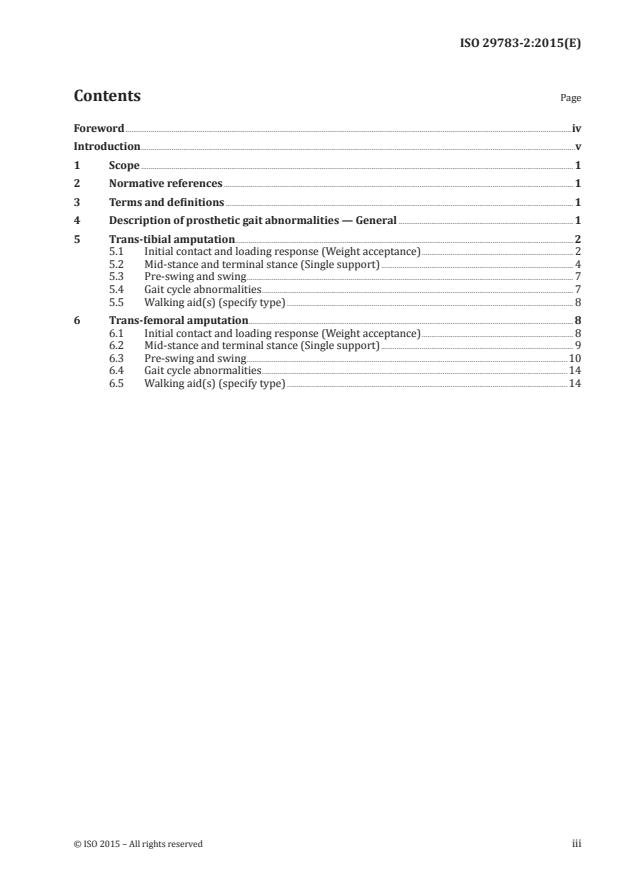
Contents Page
Foreword .iv
Introduction .v
1 Scope . 1
2 Normative references . 1
3 Terms and definitions . 1
4 Description of prosthetic gait abnormalities — General . 1
5 Trans-tibial amputation. 2
5.1 Initial contact and loading response (Weight acceptance) . 2
5.2 Mid-stance and terminal stance (Single support) . 4
5.3 Pre-swing and swing . 7
5.4 Gait cycle abnormalities . 7
5.5 Walking aid(s) (specify type) . 8
6 Trans-femoral amputation. 8
6.1 Initial contact and loading response (Weight acceptance) . 8
6.2 Mid-stance and terminal stance (Single support) . 9
6.3 Pre-swing and swing .10
6.4 Gait cycle abnormalities .14
6.5 Walking aid(s) (specify type) .14
Foreword
ISO (the International Organization for Standardization) is a worldwide federation of national standards
bodies (ISO member bodies). The work of preparing International Standards is normally carried out
through ISO technical committees. Each member body interested in a subject for which a technical
committee has been established has the right to be represented on that committee. International
organizations, governmental and non-governmental, in liaison with ISO, also take part in the work.
ISO collaborates closely with the International Electrotechnical Commission (IEC) on all matters of
electrotechnical standardization.
The procedures used to develop this document and those intended for its further maintenance are
described in the ISO/IEC Directives, Part 1. In particular the different approval criteria needed for the
different types of ISO documents should be noted. This document was drafted in accordance with the
editorial rules of the ISO/IEC Directives, Part 2 (see www.iso.org/directives).
Attention is drawn to the possibility that some of the elements of this document may be the subject of
patent rights. ISO shall not be held responsible for identifying any or all such patent rights. Details of
any patent rights identified during the development of the document will be in the Introduction and/or
on the ISO list of patent declarations received (see www.iso.org/patents).
Any trade name used in this document is information given for the convenience of users and does not
constitute an endorsement.
For an explanation on the meaning of ISO specific terms and expressions related to conformity
assessment, as well as information about ISO’s adherence to the WTO principles in the Technical Barriers
to Trade (TBT) see the following URL: Foreword - Supplementary information.
The committee responsible for this document is ISO/TC 168, Prostheses and orthoses
ISO 29783 consists of the following parts, under the general title Prosthetics and orthotics — Vocabulary:
— Part 1: Normal gait
— Part 2: Prosthetic gait
— Part 3: Pathological gait
iv © ISO 2015 – All rights reserved
Introduction
No internationally accepted vocabulary of terms is available to describe the gait patterns of persons
who have had a unilateral lower limb amputation.
As a consequence the members of the different professions and the clinic teams in different countries
have developed and adopted their own terminology to meet their own needs.
This part of ISO 29783 provides a terminology for the description of the gait of persons who have had a
unilateral lower limb amputation by identifying the departures from the normal pattern of gait which
they exhibit. This is achieved by reference to the sub- phase of the gait cycle in which they occur and the
nature of the abnormality.
It will enable practitioners to systematically describe the gait of the persons for whom they are providing
prosthetic treatment and facilitate comparisons with the experience of other practitioners.
INTERNATIONAL STANDARD ISO 29783-2:2015(E)
Prosthetics and orthotics — Vocabulary —
Part 2:
Prosthetic gait
1 Scope
This part of ISO 27983 specifies a vocabulary for the description of prosthetic gait.
2 Normative references
The following documents, in whole or in part, are normatively referenced in this document and are
indispensable for its application. For dated references, only the edition cited applies. For undated
references, the latest edition of the referenced document (including any amendments) applies.
ISO 29783-1, Prosthetics and orthotics — Vocabulary — Part 1: Normal gait
3 Terms and definitions
For the purposes of this document, the terms and definitions given in ISO 29783-1 and the following apply.
3.1
circumduction
abnormal trajectory of the lower limb during swing phase comprising increased abduction of the hip
commencing at toe off and returning to neutral at initial contact
3.2
hip hiking
upwards movement of the pelvis during swing phase
3.3
vaulting
planta
...
INTERNATIONAL ISO
STANDARD 29783-2
First edition
2015-02-01
Prosthetics and orthotics —
Vocabulary —
Part 2:
Prosthetic gait
Prothèses et orthèses — Vocabulaire —
Partie 2: Marche avec prothèse
Reference number
©
ISO 2015
© ISO 2015
All rights reserved. Unless otherwise specified, no part of this publication may be reproduced or utilized otherwise in any form
or by any means, electronic or mechanical, including photocopying, or posting on the internet or an intranet, without prior
written permission. Permission can be requested from either ISO at the address below or ISO’s member body in the country of
the requester.
ISO copyright office
Case postale 56 • CH-1211 Geneva 20
Tel. + 41 22 749 01 11
Fax + 41 22 749 09 47
E-mail copyright@iso.org
Web www.iso.org
Published in Switzerland
ii © ISO 2015 – All rights reserved
Contents Page
Foreword .iv
Introduction .v
1 Scope . 1
2 Normative references . 1
3 Terms and definitions . 1
4 Description of prosthetic gait abnormalities — General . 1
5 Trans-tibial amputation. 2
5.1 Initial contact and loading response (Weight acceptance) . 2
5.2 Mid-stance and terminal stance (Single support) . 4
5.3 Pre-swing and swing . 7
5.4 Gait cycle abnormalities . 7
5.5 Walking aid(s) (specify type) . 8
6 Trans-femoral amputation. 8
6.1 Initial contact and loading response (Weight acceptance) . 8
6.2 Mid-stance and terminal stance (Single support) . 9
6.3 Pre-swing and swing .10
6.4 Gait cycle abnormalities .14
6.5 Walking aid(s) (specify type) .14
Foreword
ISO (the International Organization for Standardization) is a worldwide federation of national standards
bodies (ISO member bodies). The work of preparing International Standards is normally carried out
through ISO technical committees. Each member body interested in a subject for which a technical
committee has been established has the right to be represented on that committee. International
organizations, governmental and non-governmental, in liaison with ISO, also take part in the work.
ISO collaborates closely with the International Electrotechnical Commission (IEC) on all matters of
electrotechnical standardization.
The procedures used to develop this document and those intended for its further maintenance are
described in the ISO/IEC Directives, Part 1. In particular the different approval criteria needed for the
different types of ISO documents should be noted. This document was drafted in accordance with the
editorial rules of the ISO/IEC Directives, Part 2 (see www.iso.org/directives).
Attention is drawn to the possibility that some of the elements of this document may be the subject of
patent rights. ISO shall not be held responsible for identifying any or all such patent rights. Details of
any patent rights identified during the development of the document will be in the Introduction and/or
on the ISO list of patent declarations received (see www.iso.org/patents).
Any trade name used in this document is information given for the convenience of users and does not
constitute an endorsement.
For an explanation on the meaning of ISO specific terms and expressions related to conformity
assessment, as well as information about ISO’s adherence to the WTO principles in the Technical Barriers
to Trade (TBT) see the following URL: Foreword - Supplementary information.
The committee responsible for this document is ISO/TC 168, Prostheses and orthoses
ISO 29783 consists of the following parts, under the general title Prosthetics and orthotics — Vocabulary:
— Part 1: Normal gait
— Part 2: Prosthetic gait
— Part 3: Pathological gait
iv © ISO 2015 – All rights reserved
Introduction
No internationally accepted vocabulary of terms is available to describe the gait patterns of persons
who have had a unilateral lower limb amputation.
As a consequence the members of the different professions and the clinic teams in different countries
have developed and adopted their own terminology to meet their own needs.
This part of ISO 29783 provides a terminology for the description of the gait of persons who have had a
unilateral lower limb amputation by identifying the departures from the normal pattern of gait which
they exhibit. This is achieved by reference to the sub- phase of the gait cycle in which they occur and the
nature of the abnormality.
It will enable practitioners to systematically describe the gait of the persons for whom they are providing
prosthetic treatment and facilitate comparisons with the experience of other practitioners.
INTERNATIONAL STANDARD ISO 29783-2:2015(E)
Prosthetics and orthotics — Vocabulary —
Part 2:
Prosthetic gait
1 Scope
This part of ISO 27983 specifies a vocabulary for the description of prosthetic gait.
2 Normative references
The following documents, in whole or in part, are normatively referenced in this document and are
indispensable for its application. For dated references, only the edition cited applies. For undated
references, the latest edition of the referenced document (including any amendments) applies.
ISO 29783-1, Prosthetics and orthotics — Vocabulary — Part 1: Normal gait
3 Terms and definitions
For the purposes of this document, the terms and definitions given in ISO 29783-1 and the following apply.
3.1
circumduction
abnormal trajectory of the lower limb during swing phase comprising increased abduction of the hip
commencing at toe off and returning to neutral at initial contact
3.2
hip hiking
upwards movement of the pelvis during swing phase
3.3
vaulting
planta
...
NORME ISO
INTERNATIONALE 29783-2
Première édition
2015-02-01
Prothèses et orthèses —
Vocabulaire —
Partie 2:
Marche avec prothèse
Prosthetics and orthotics — Vocabulary —
Part 2: Prosthetic gait
Numéro de référence
©
ISO 2015
DOCUMENT PROTÉGÉ PAR COPYRIGHT
© ISO 2015
Droits de reproduction réservés. Sauf indication contraire, aucune partie de cette publication ne peut être reproduite ni utilisée
sous quelque forme que ce soit et par aucun procédé, électronique ou mécanique, y compris la photocopie, l’affichage sur
l’internet ou sur un Intranet, sans autorisation écrite préalable. Les demandes d’autorisation peuvent être adressées à l’ISO à
l’adresse ci-après ou au comité membre de l’ISO dans le pays du demandeur.
ISO copyright office
Case postale 56 • CH-1211 Geneva 20
Tel. + 41 22 749 01 11
Fax + 41 22 749 09 47
E-mail copyright@iso.org
Web www.iso.org
Publié en Suisse
ii © ISO 2015 – Tous droits réservés
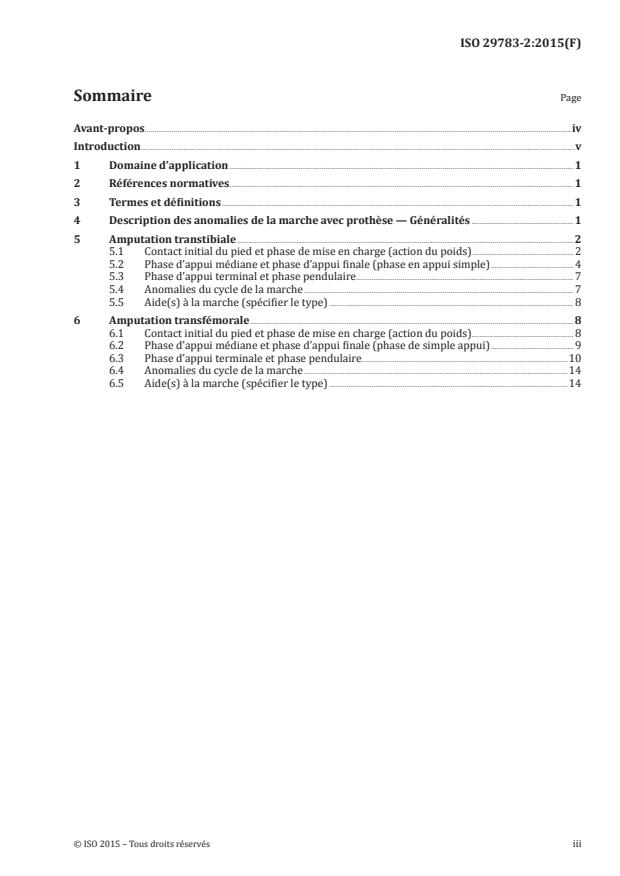
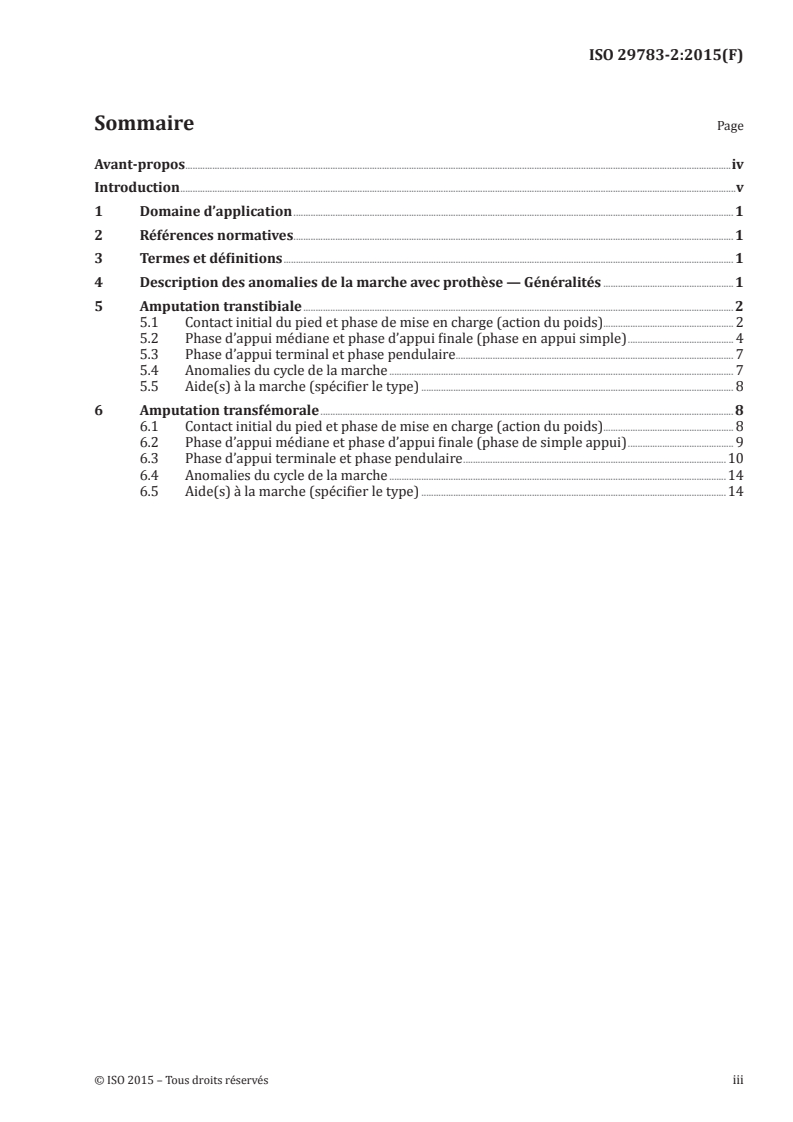
Sommaire Page
Avant-propos .iv
Introduction .v
1 Domaine d’application . 1
2 Références normatives . 1
3 Termes et définitions . 1
4 Description des anomalies de la marche avec prothèse — Généralités .1
5 Amputation transtibiale . 2
5.1 Contact initial du pied et phase de mise en charge (action du poids). 2
5.2 Phase d’appui médiane et phase d’appui finale (phase en appui simple) . 4
5.3 Phase d’appui terminal et phase pendulaire . 7
5.4 Anomalies du cycle de la marche . 7
5.5 Aide(s) à la marche (spécifier le type) . 8
6 Amputation transfémorale . 8
6.1 Contact initial du pied et phase de mise en charge (action du poids). 8
6.2 Phase d’appui médiane et phase d’appui finale (phase de simple appui) . 9
6.3 Phase d’appui terminale et phase pendulaire .10
6.4 Anomalies du cycle de la marche .14
6.5 Aide(s) à la marche (spécifier le type) .14
Avant-propos
L’ISO (Organisation internationale de normalisation) est une fédération mondiale d’organismes
nationaux de normalisation (comités membres de l’ISO). L’élaboration des Normes internationales est
en général confiée aux comités techniques de l’ISO. Chaque comité membre intéressé par une étude
a le droit de faire partie du comité technique créé à cet effet. Les organisations internationales,
gouvernementales et non gouvernementales, en liaison avec l’ISO participent également aux travaux.
L’ISO collabore étroitement avec la Commission électrotechnique internationale (IEC) en ce qui concerne
la normalisation électrotechnique.
Les procédures utilisées pour élaborer le présent document et celles destinées à sa mise à jour sont
décrites dans les Directives ISO/IEC, Partie 1. Il convient, en particulier de prendre note des différents
critères d’approbation requis pour les différents types de documents ISO. Le présent document a été
rédigé conformément aux règles de rédaction données dans les Directives ISO/IEC, Partie 2 (voir www.
iso.org/directives).
L’attention est appelée sur le fait que certains des éléments du présent document peuvent faire l’objet de
droits de propriété intellectuelle ou de droits analogues. L’ISO ne saurait être tenue pour responsable
de ne pas avoir identifié de tels droits de propriété et averti de leur existence. Les détails concernant les
références aux droits de propriété intellectuelle ou autres droits analogues identifiés lors de l’élaboration
du document sont indiqués dans l’Introduction et/ou dans la liste des déclarations de brevets reçues par
l’ISO (voir www.iso.org/brevets).
Les appellations commerciales éventuellement mentionnées dans le présent document sont données pour
information, par souci de commodité, à l’intention des utilisateurs et ne sauraient constituer un engagement.
Pour une explication de la signification des termes et expressions spécifiques de l’ISO liés à l’évaluation de
la conformité, ou pour toute information au sujet de l’adhésion de l’ISO aux principes de l’OMC concernant
les obstacles techniques au commerce (OTC), voir le lien suivant: Avant-propos — Informations
supplémentaires.
Le comité chargé de l’élaboration du présent document est l’ISO/TC 168, Prothèses et orthèses.
L’ISO 29783 comprend les parties suivantes, présentées sous le titre général Prothèses et orthèses —
Vocabulaire:
— Partie 1: Démarche normale
— Partie 2: Marche avec prothèse
— Partie 3: Marche pathologique
iv © ISO 2015 – Tous droits réservés
Introduction
Il n’existe aucune terminologie reconnue au niveau international pour décrire les types de marches de
personnes amputées d’un membre inférieur unilatéral.
Par conséquent, les membres des différentes professions et des équipes cliniques de plusieurs pays ont
développé et adopté leur propre terminologie pour répondre à leurs besoins spécifiques.
La présente partie de l’ISO 29783 fournit une terminologie pour la description de la marche de personnes
amputées d’un membre inférieur unilatéral en identifiant les différences qu’ils présentent par rapport à
la marche normale. Il faut pour cela se référer à la sous-phase du cycle de marche au cours duquel elles
se produisent ainsi qu’à la nature de l’anomalie.
Cela permettra aux praticiens de décrire systématiquement la marche de personnes pour lesquelles
ils mettent en place un traitement prothétique et de faciliter les comparaisons avec les expériences
d’autres praticiens.
NORME INTERNATIONALE ISO 29783-2:2015(F)
Prothèses et orthèses — Vocabulaire —
Partie 2:
Marche avec prothèse
1 Domaine d’application
La présente partie de l’ISO 27983 spécifie un vocabulaire pour la description de la marche avec prothèse.
2 Références normatives
Les documents suivants, en totalité ou en partie, sont référencés de manière normative dans le présent
document et sont indispensables pour son application. Pour les références datées, seule l’édition citée
s’applique. Pour les références non datées, la dernière édition du document de référence s’applique (y
compris les éventuels amendements).
ISO 29783-1, Prothèses et orthèses — Vocabulaire — Partie 1: Démarche normale
3 Termes et définitions
Pour les besoins du présent document, les termes et définitions suivants et ceux donnés dans
l’ISO 29783-1 s’appliquent.
3.1
fauchage
trajectoire anormale du membre inférieur pendant la phase d’oscillation comprenant l’abduction accrue de la
hanche commençant lors du décollage des orteils et retournant en position neutre au contact initial du pied
3.2
élévation de la hanche
mouvement vers le haut du bassin en phase d’oscillation
3.3
vaulting
flexion plantaire de l’articulation de cheville controlatérale (non prothétique) en phase d’appui médiane
offrant une plus grande liberté de mouvement du pied prothétique en phase d’oscillation
3.4
fouetté
mouvement médian ou latéral soudain du pied commençant lors du décollage des orteils et retournant
en position neutre au contact initial du pied
4 Description des anomalies de la marche avec prothèse — Généralités
Les anomalies de la marche généralement constatées chez une personne ayant subi une amputation
unilatérale sont décrites en référence à la sous-phase du cycle de marche normale au cours duquel ils se
produisent ainsi qu’à la nature de l’anomalie.
Les angles articulaires anormaux qui se trouvent dans la même direction que la normale sont dits
augmentés lorsqu’ils sont supérieurs à la normale ou réduits lorsqu’ils sont inférie
...
NORME ISO
INTERNATIONALE 29783-2
Première édition
2015-02-01
Prothèses et orthèses —
Vocabulaire —
Partie 2:
Marche avec prothèse
Prosthetics and orthotics — Vocabulary —
Part 2: Prosthetic gait
Numéro de référence
©
ISO 2015
DOCUMENT PROTÉGÉ PAR COPYRIGHT
© ISO 2015
Droits de reproduction réservés. Sauf indication contraire, aucune partie de cette publication ne peut être reproduite ni utilisée
sous quelque forme que ce soit et par aucun procédé, électronique ou mécanique, y compris la photocopie, l’affichage sur
l’internet ou sur un Intranet, sans autorisation écrite préalable. Les demandes d’autorisation peuvent être adressées à l’ISO à
l’adresse ci-après ou au comité membre de l’ISO dans le pays du demandeur.
ISO copyright office
Case postale 56 • CH-1211 Geneva 20
Tel. + 41 22 749 01 11
Fax + 41 22 749 09 47
E-mail copyright@iso.org
Web www.iso.org
Publié en Suisse
ii © ISO 2015 – Tous droits réservés
Sommaire Page
Avant-propos .iv
Introduction .v
1 Domaine d’application . 1
2 Références normatives . 1
3 Termes et définitions . 1
4 Description des anomalies de la marche avec prothèse — Généralités .1
5 Amputation transtibiale . 2
5.1 Contact initial du pied et phase de mise en charge (action du poids). 2
5.2 Phase d’appui médiane et phase d’appui finale (phase en appui simple) . 4
5.3 Phase d’appui terminal et phase pendulaire . 7
5.4 Anomalies du cycle de la marche . 7
5.5 Aide(s) à la marche (spécifier le type) . 8
6 Amputation transfémorale . 8
6.1 Contact initial du pied et phase de mise en charge (action du poids). 8
6.2 Phase d’appui médiane et phase d’appui finale (phase de simple appui) . 9
6.3 Phase d’appui terminale et phase pendulaire .10
6.4 Anomalies du cycle de la marche .14
6.5 Aide(s) à la marche (spécifier le type) .14
Avant-propos
L’ISO (Organisation internationale de normalisation) est une fédération mondiale d’organismes
nationaux de normalisation (comités membres de l’ISO). L’élaboration des Normes internationales est
en général confiée aux comités techniques de l’ISO. Chaque comité membre intéressé par une étude
a le droit de faire partie du comité technique créé à cet effet. Les organisations internationales,
gouvernementales et non gouvernementales, en liaison avec l’ISO participent également aux travaux.
L’ISO collabore étroitement avec la Commission électrotechnique internationale (IEC) en ce qui concerne
la normalisation électrotechnique.
Les procédures utilisées pour élaborer le présent document et celles destinées à sa mise à jour sont
décrites dans les Directives ISO/IEC, Partie 1. Il convient, en particulier de prendre note des différents
critères d’approbation requis pour les différents types de documents ISO. Le présent document a été
rédigé conformément aux règles de rédaction données dans les Directives ISO/IEC, Partie 2 (voir www.
iso.org/directives).
L’attention est appelée sur le fait que certains des éléments du présent document peuvent faire l’objet de
droits de propriété intellectuelle ou de droits analogues. L’ISO ne saurait être tenue pour responsable
de ne pas avoir identifié de tels droits de propriété et averti de leur existence. Les détails concernant les
références aux droits de propriété intellectuelle ou autres droits analogues identifiés lors de l’élaboration
du document sont indiqués dans l’Introduction et/ou dans la liste des déclarations de brevets reçues par
l’ISO (voir www.iso.org/brevets).
Les appellations commerciales éventuellement mentionnées dans le présent document sont données pour
information, par souci de commodité, à l’intention des utilisateurs et ne sauraient constituer un engagement.
Pour une explication de la signification des termes et expressions spécifiques de l’ISO liés à l’évaluation de
la conformité, ou pour toute information au sujet de l’adhésion de l’ISO aux principes de l’OMC concernant
les obstacles techniques au commerce (OTC), voir le lien suivant: Avant-propos — Informations
supplémentaires.
Le comité chargé de l’élaboration du présent document est l’ISO/TC 168, Prothèses et orthèses.
L’ISO 29783 comprend les parties suivantes, présentées sous le titre général Prothèses et orthèses —
Vocabulaire:
— Partie 1: Démarche normale
— Partie 2: Marche avec prothèse
— Partie 3: Marche pathologique
iv © ISO 2015 – Tous droits réservés
Introduction
Il n’existe aucune terminologie reconnue au niveau international pour décrire les types de marches de
personnes amputées d’un membre inférieur unilatéral.
Par conséquent, les membres des différentes professions et des équipes cliniques de plusieurs pays ont
développé et adopté leur propre terminologie pour répondre à leurs besoins spécifiques.
La présente partie de l’ISO 29783 fournit une terminologie pour la description de la marche de personnes
amputées d’un membre inférieur unilatéral en identifiant les différences qu’ils présentent par rapport à
la marche normale. Il faut pour cela se référer à la sous-phase du cycle de marche au cours duquel elles
se produisent ainsi qu’à la nature de l’anomalie.
Cela permettra aux praticiens de décrire systématiquement la marche de personnes pour lesquelles
ils mettent en place un traitement prothétique et de faciliter les comparaisons avec les expériences
d’autres praticiens.
NORME INTERNATIONALE ISO 29783-2:2015(F)
Prothèses et orthèses — Vocabulaire —
Partie 2:
Marche avec prothèse
1 Domaine d’application
La présente partie de l’ISO 27983 spécifie un vocabulaire pour la description de la marche avec prothèse.
2 Références normatives
Les documents suivants, en totalité ou en partie, sont référencés de manière normative dans le présent
document et sont indispensables pour son application. Pour les références datées, seule l’édition citée
s’applique. Pour les références non datées, la dernière édition du document de référence s’applique (y
compris les éventuels amendements).
ISO 29783-1, Prothèses et orthèses — Vocabulaire — Partie 1: Démarche normale
3 Termes et définitions
Pour les besoins du présent document, les termes et définitions suivants et ceux donnés dans
l’ISO 29783-1 s’appliquent.
3.1
fauchage
trajectoire anormale du membre inférieur pendant la phase d’oscillation comprenant l’abduction accrue de la
hanche commençant lors du décollage des orteils et retournant en position neutre au contact initial du pied
3.2
élévation de la hanche
mouvement vers le haut du bassin en phase d’oscillation
3.3
vaulting
flexion plantaire de l’articulation de cheville controlatérale (non prothétique) en phase d’appui médiane
offrant une plus grande liberté de mouvement du pied prothétique en phase d’oscillation
3.4
fouetté
mouvement médian ou latéral soudain du pied commençant lors du décollage des orteils et retournant
en position neutre au contact initial du pied
4 Description des anomalies de la marche avec prothèse — Généralités
Les anomalies de la marche généralement constatées chez une personne ayant subi une amputation
unilatérale sont décrites en référence à la sous-phase du cycle de marche normale au cours duquel ils se
produisent ainsi qu’à la nature de l’anomalie.
Les angles articulaires anormaux qui se trouvent dans la même direction que la normale sont dits
augmentés lorsqu’ils sont supérieurs à la normale ou réduits lorsqu’ils sont inférie
...