

ISO 1532:1973
(Main)Fishing nets — Cutting knotted netting to shape ("tapering")
General Information
- Abstract
Depending on the desired final shape of netting, tapering cuts must be made in suitable ways. The various cutting rates are obtained by combining different lengths of cuts. Examples of tapering are given in the annex. - Replaces ISO Recommendation R 1532-1970.
- Status
- Published
- Publication Date
- 30-Jun-1973
- Technical Committee
- ISO/TC 38 - Textiles
- Drafting Committee
- ISO/TC 38 - Textiles
- Current Stage
- 9093 - International Standard confirmed
- Start Date
- 18-Sep-2026
- Completion Date
- 26-Sep-2026
Buy Documents
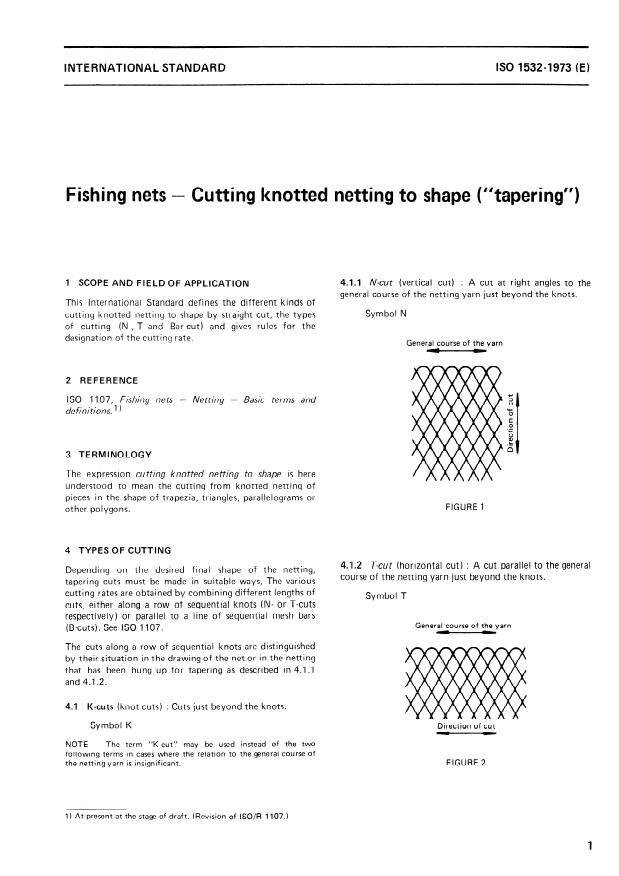
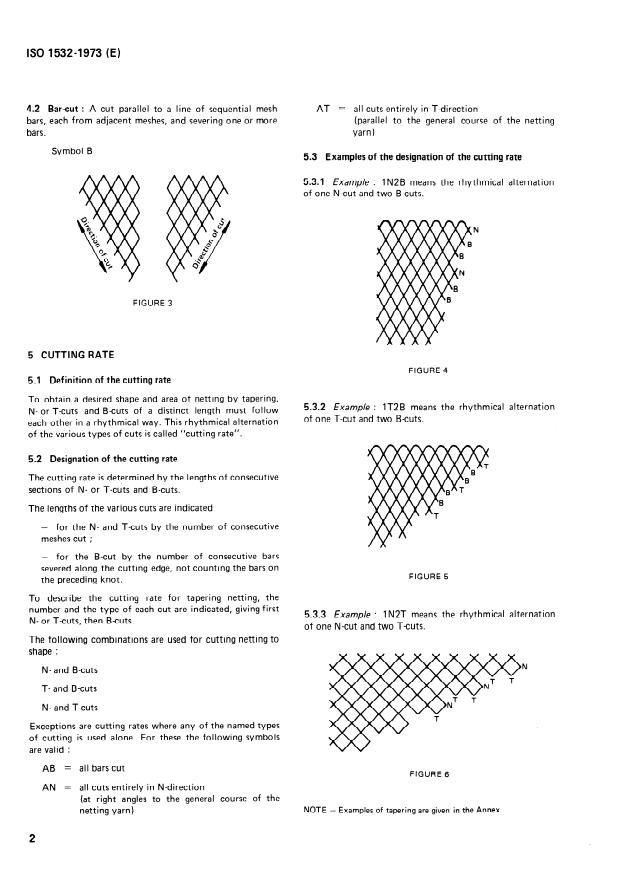
ISO 1532:1973 - Fishing nets -- Cutting knotted netting to shape ("tapering")
ISO 1532:1973 - Fishing nets — Cutting knotted netting to shape ("tapering")/1/1973
ISO 1532:1973 - Filets de peche -- Coupe des nappes de filet nouées
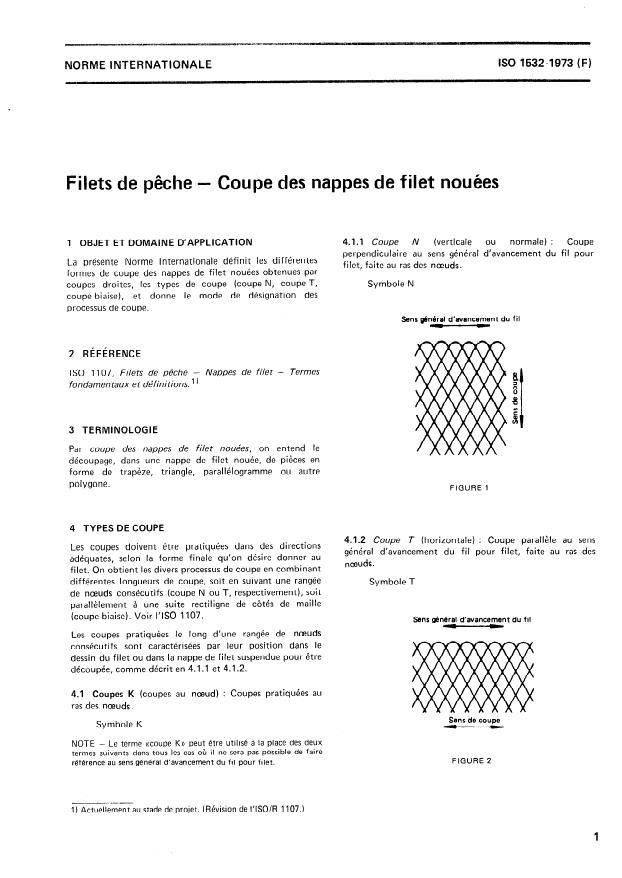
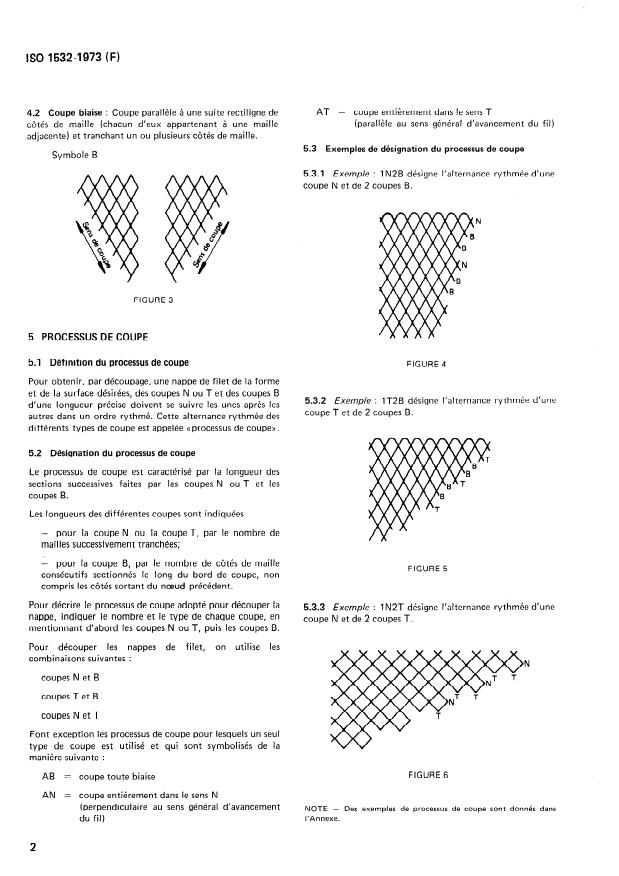
ISO 1532:1973 - Filets de peche -- Coupe des nappes de filet nouées
ISO 1532:1973 - Filets de pêche — Coupe des nappes de filet nouées/1/1973
ISO 1532:1973 - Filets de pêche — Coupe des nappes de filet nouées/1/1973
Overview
ISO 1532:1973 is an international standard developed by the International Organization for Standardization (ISO) that specifies methods for cutting knotted fishing netting into specific shapes, a process known as "tapering." This standard details the proper techniques to achieve various tapered shapes by making precise cuts in the netting. It replaces the earlier ISO Recommendation R 1532-1970 and is instrumental for ensuring uniformity and quality in fishing net production.
The document establishes terminology, cutting types, and designation rules to assist manufacturers and users in shaping netting efficiently and consistently according to desired final geometries.
Key Topics
Cutting Types
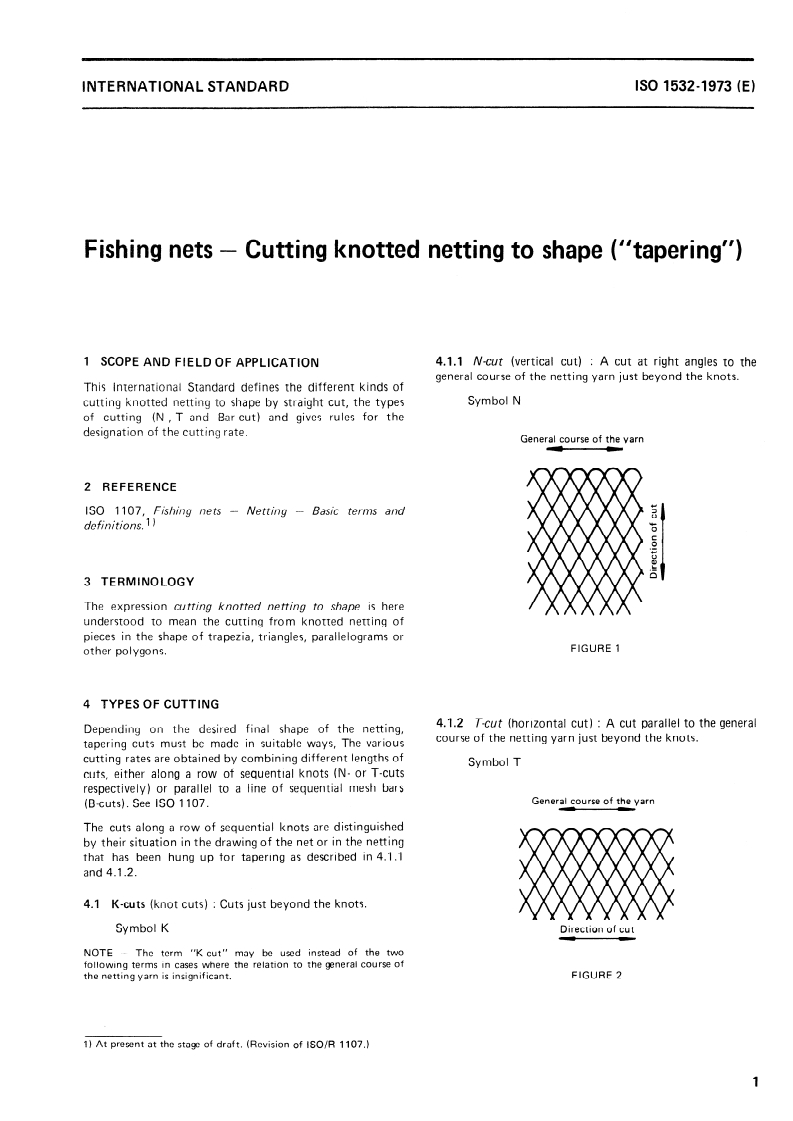
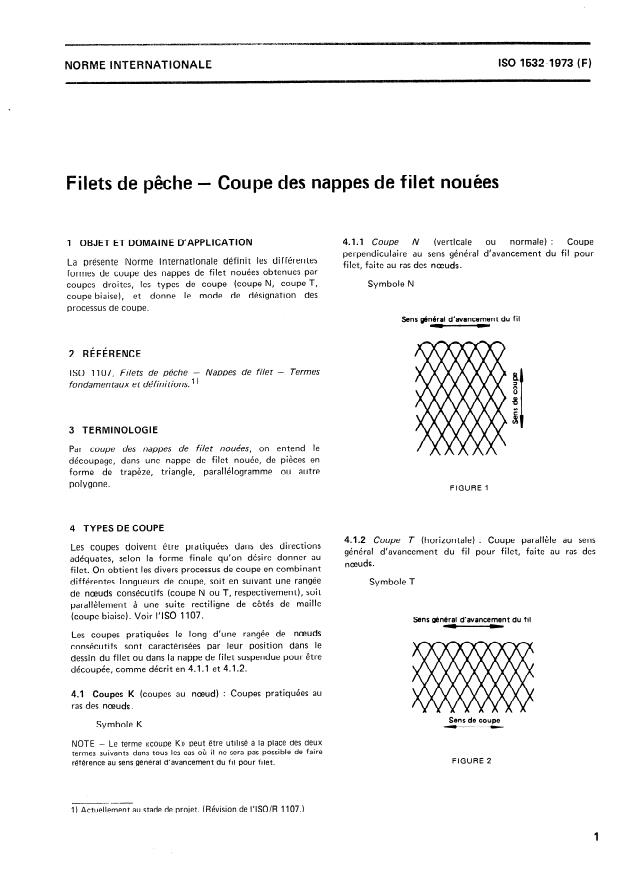
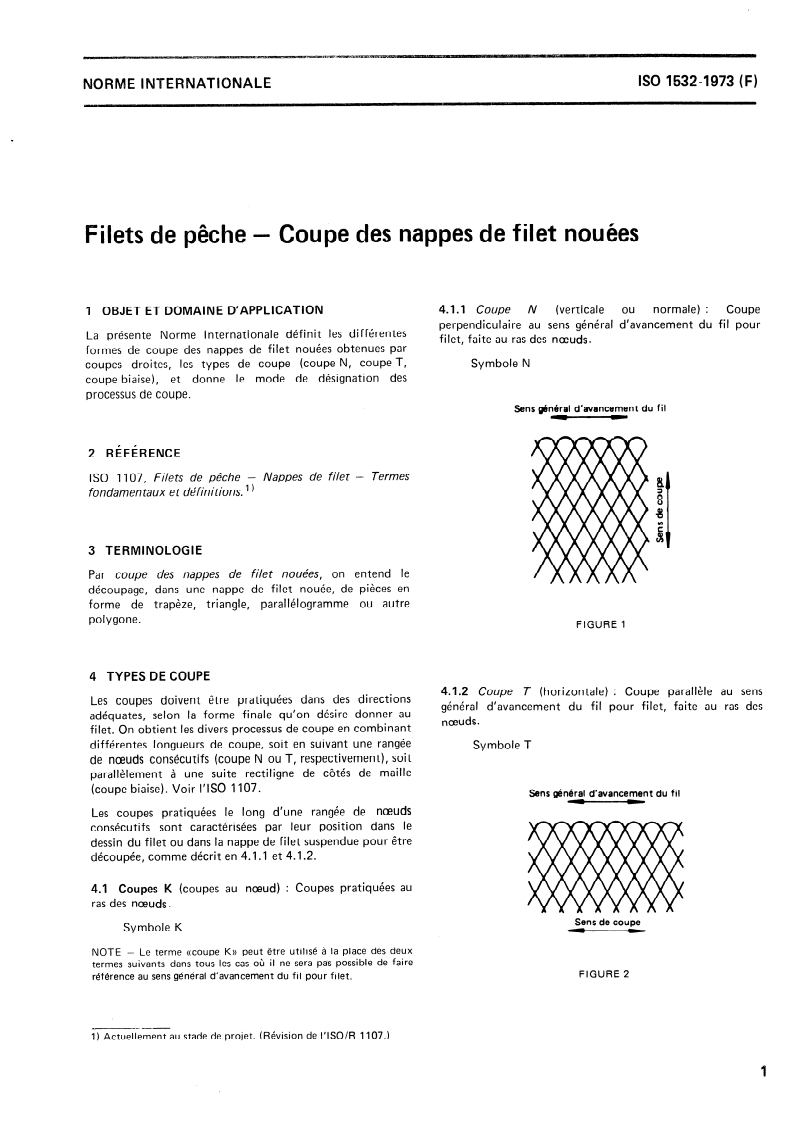
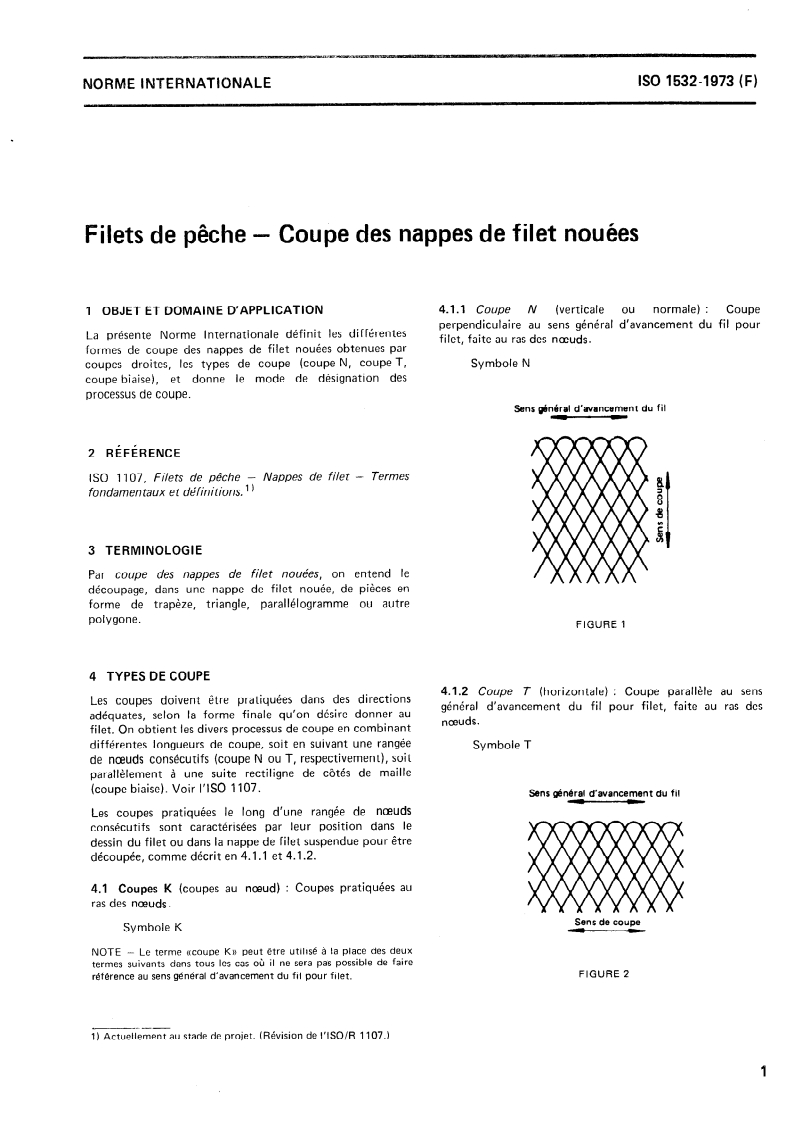
- N-cut (Vertical cut): A cut at right angles to the general direction of the netting yarn, performed just beyond the knots.
- T-cut (Horizontal cut): A cut parallel to the general yarn course, also just beyond the knots.
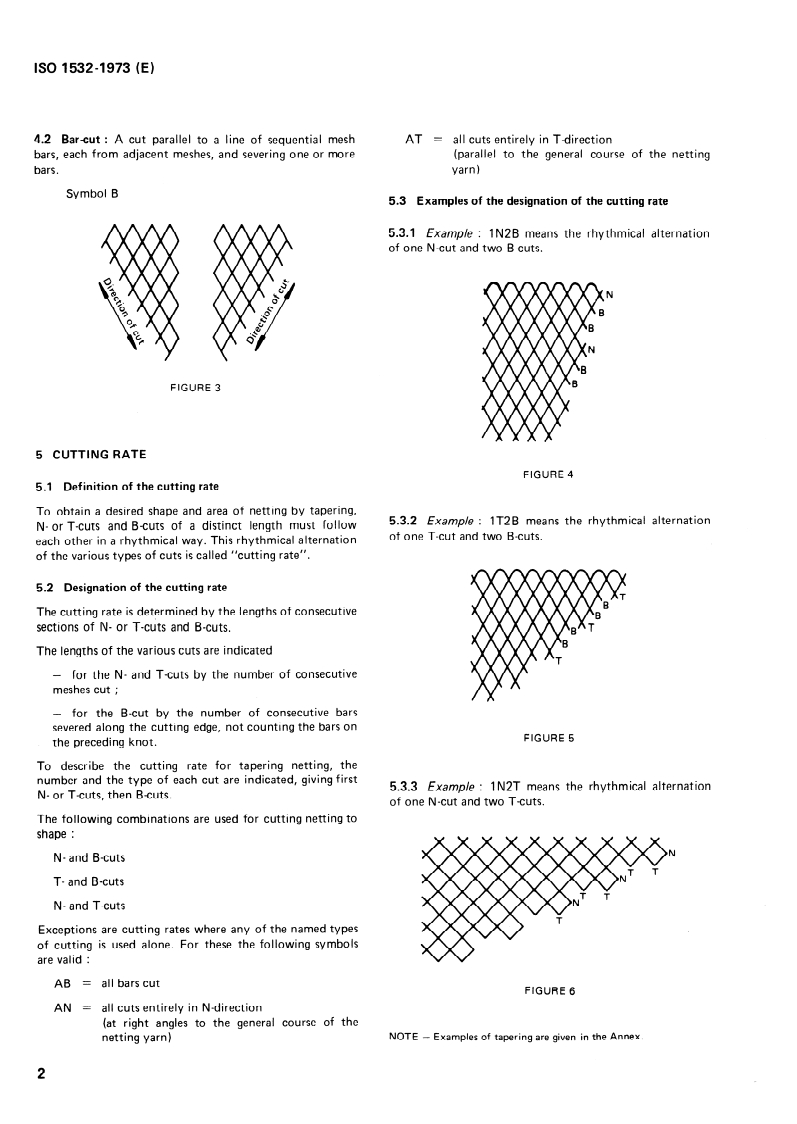
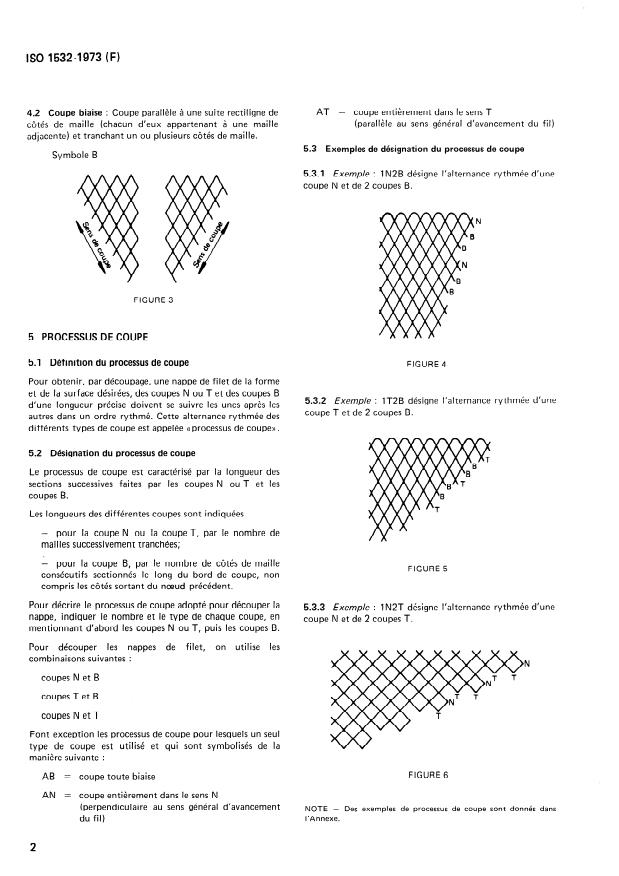
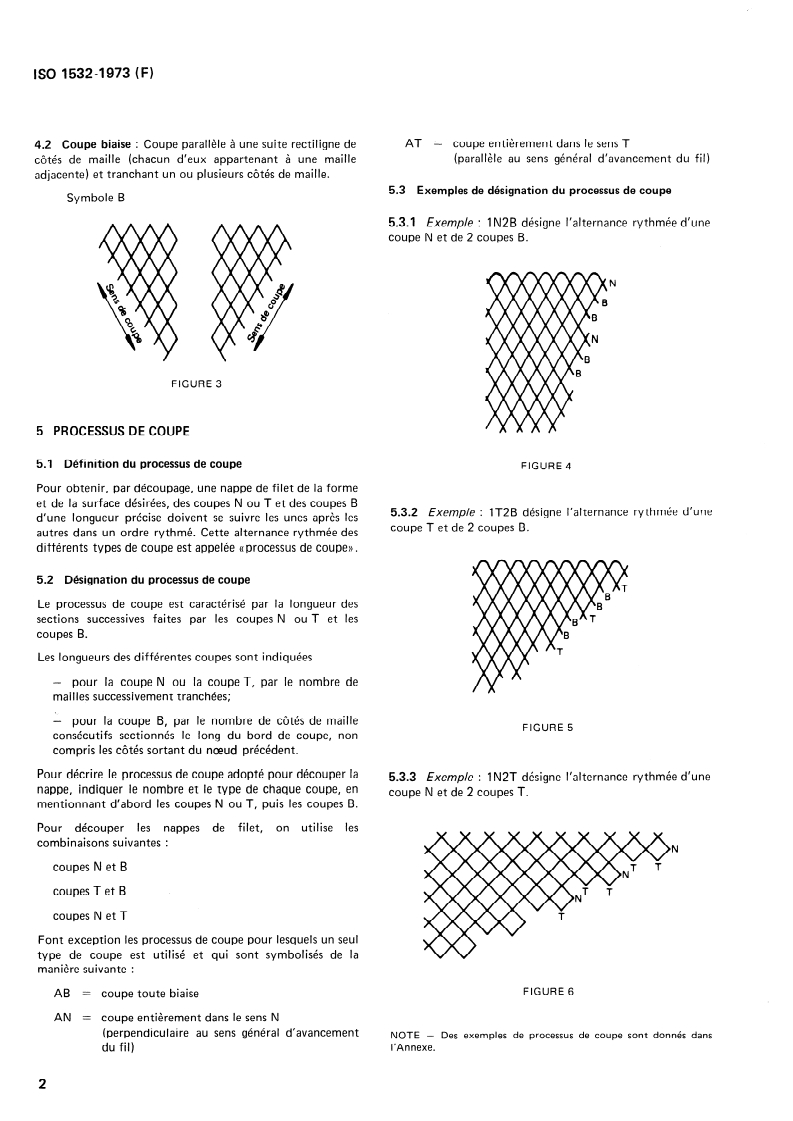
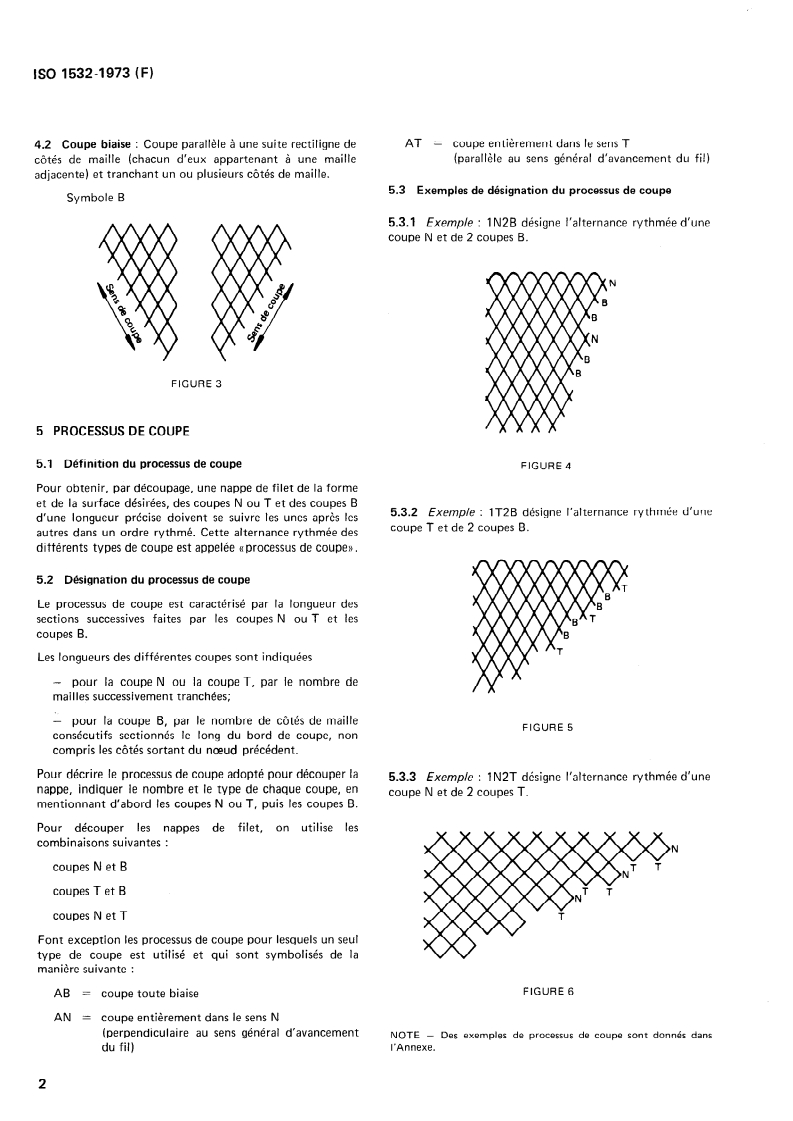
- B-cut (Bar-cut): A cut parallel to a line of sequential mesh bars. This cut severs one or more mesh bars along the cutting edge.
- K-cut (Knot cut): Cuts made close to the knots, sometimes used interchangeably with N- or T-cuts when the yarn direction is less significant.
Cutting Rate
- The rhythmical alternation of N-, T-, and B-cuts, determining the tapering pattern required to produce the shape of the netting piece.
- Designated by combinations like "1N2B" (one N-cut followed by two B-cuts) or "1T2B" (one T-cut followed by two B-cuts).
- Cutting rates help control the final shape by specifying how many meshes or bars are cut consecutively.
Tapering Shapes
- The standard supports creating trapezia, triangles, parallelograms, and other polygons.
- By tapering one or two edges of the net, shapes such as right-angled trapezia, isosceles trapezia, isosceles triangles, and asymmetrical trapezia can be formed.
- Guidelines include how to combine cuts on opposite edges to create parallelograms or join cuts from different edges for more complex shapes.
Applications
ISO 1532:1973 is essential for professionals involved in the design, manufacture, and repair of fishing nets. Its applications include:
- Fishing Net Production: Enabling precise shaping of knotted netting adapted to various fishing conditions and vessel requirements.
- Net Repair Work: Providing a standard method to taper and fit replacement net sections seamlessly.
- Quality Control: Assuring consistency in tapered net shapes across different manufacturers through standardized cutting rates and methods.
- Custom Net Fabrication: Facilitating custom net shapes tailored to specific fisheries or environmental regulations.
By following these standardized cutting procedures and designations, net manufacturers can minimize waste, improve the structural integrity of nets, and optimize fishing efficiency.
Related Standards
- ISO 1107: Fishing nets - Netting - Basic terms and definitions, which provides foundational terminology referenced in ISO 1532.
- Other ISO standards developed by Technical Committee ISO/TC 38 (Textiles), which address fishing net materials, properties, and testing methods.
Integrating ISO 1532 with these complementary standards ensures comprehensive harmonization across fishing net production and application processes.
Keywords: ISO 1532, fishing nets, knotted netting, tapering, net cutting, N-cut, T-cut, B-cut, cutting rate, fishing net shapes, net manufacturing standard, fishing net repair, ISO fishing net standards.
Buy Documents
ISO 1532:1973 - Fishing nets -- Cutting knotted netting to shape ("tapering")
ISO 1532:1973 - Fishing nets — Cutting knotted netting to shape ("tapering")/1/1973
ISO 1532:1973 - Filets de peche -- Coupe des nappes de filet nouées
ISO 1532:1973 - Filets de peche -- Coupe des nappes de filet nouées
ISO 1532:1973 - Filets de pêche — Coupe des nappes de filet nouées/1/1973
ISO 1532:1973 - Filets de pêche — Coupe des nappes de filet nouées/1/1973
Get Certified
Connect with accredited certification bodies for this standard

Control Union Certifications
Global certification for agriculture and sustainability.

ECOCERT
Organic and sustainability certification.

FSC International
Forest Stewardship Council certification.
Sponsored listings
Frequently Asked Questions
ISO 1532:1973 is a standard published by the International Organization for Standardization (ISO). Its full title is "Fishing nets — Cutting knotted netting to shape ("tapering")". This standard covers: Depending on the desired final shape of netting, tapering cuts must be made in suitable ways. The various cutting rates are obtained by combining different lengths of cuts. Examples of tapering are given in the annex. - Replaces ISO Recommendation R 1532-1970.
Depending on the desired final shape of netting, tapering cuts must be made in suitable ways. The various cutting rates are obtained by combining different lengths of cuts. Examples of tapering are given in the annex. - Replaces ISO Recommendation R 1532-1970.
ISO 1532:1973 is classified under the following ICS (International Classification for Standards) categories: 65.150 - Fishing and fish breeding. The ICS classification helps identify the subject area and facilitates finding related standards.
ISO 1532:1973 is available in PDF format for immediate download after purchase. The document can be added to your cart and obtained through the secure checkout process. Digital delivery ensures instant access to the complete standard document.
Standards Content (Sample)
FOREWORD
IS0 (the International Organization for Standardization) is a worldwide federation
of national standards institutes (IS0 Member Bodies). The work of developing
International Standards is carried out through IS0 Technical Committees. Every
Member Body interested in a subject for which a Technical Committee has been set
up has the right to be represented on that Committee. International organizations,
governmental and non-governmental, in liaison with ISO, also take part in the work.
Draft International Standards adopted by the Technical Committees are circulated
to the Member Bodies for approval before their acceptance as International
Standards by the IS0 Council.
Prior to 1972, the results of the work of the Technical Committees were published
as IS0 Recommendations; these documents are now in the process of being
transformed into International Standards. As part of this process, International
Standard IS0 1532 replaces IS0 Recommendation R 1532-1970 drawn up by
Technical Committee ISO/TC 38, Text/Yes.
The Member Bodies of the following countries approved the Recommendation :
Australia India Romania
Belgium South Africa, Rep. of
Iran
Spain
Brazil Israel
Czechoslovakia Sweden
Italy
Denmark Switzerland
Japan
Netherlands Turkey
Egypt, Arab Rep. of
France Norway United Kingdom
Germany Peru U.S.S.R.
Greece Poland
Hungary Portugal
No Member Body expressed disapproval of the Recommendation.
0 International Organization for Standardization, 1973 l
Printed in Switzerland
INTERNATIONAL STANDARD IS0 1532-1973 (E)
Fishing nets - Cutting knotted netting to shape (“tapering”)
4.1.1 N-cut (vertical cut) : A cut at right angles to the
1 SCOPE AND FIELD OF APPLICATION
general course of the netting yarn just beyond the knots.
This International Standard defines the different kinds of
Symbol N
cutting knotted netting to shape by straight cut, the types
of cutting (N-, T- and Bar-cut) and gives rules for the
designation of the cutting rate.
General course of the yarn
2 REFERENCE
CI
ISO 1107, Fishing nets - Netting - Basic terms and
z
definitions. 1 )
%
.-
w
ii
.-
3 TERMINOLOGY
The expression cutting knotted netting to shape is here
understood to mean the cutting from knotted netting of
pieces in the shape of trapezia, triangles, parallelograms or
FIGURE 1
other polygons.
4 TYPES OF CUTTING
4.1.2 T-cut (horizontal cut) : A cut parallel to the general
Depending on the desired final shape of the netting,
course of the netting yarn just beyond the knots.
tapering cuts must be made in suitable ways, The various
cutting rates are obtained by combining different lengths of
Symbol T
cuts, either along a row of sequential knots (N- or T-cuts
respectively) or parallel to a line of sequential mesh bars
General course of the yarn
(B-cuts). See IS0 1107.
The cuts along a row of sequential knots are distinguished
by their situation in the drawing of the net or in the netting
that has been hung up for tapering as described in 4.1 .I
and 4.1.2.
4.1 M-cuts (knot cuts) : Cuts just beyond the knots.
Symbol K Direction of cut
NOTE -- The term “K-cut” may be used instead of the two
following terms in cases where the relation to the general course of
the netting yarn is insignificant. FIGURE 2
1) At present at the stage of draft. (Revision of I
...
FOREWORD
IS0 (the International Organization for Standardization) is a worldwide federation
of national standards institutes (IS0 Member Bodies). The work of developing
International Standards is carried out through IS0 Technical Committees. Every
Member Body interested in a subject for which a Technical Committee has been set
up has the right to be represented on that Committee. International organizations,
governmental and non-governmental, in liaison with ISO, also take part in the work.
Draft International Standards adopted by the Technical Committees are circulated
to the Member Bodies for approval before their acceptance as International
Standards by the IS0 Council.
Prior to 1972, the results of the work of the Technical Committees were published
as IS0 Recommendations; these documents are now in the process of being
transformed into International Standards. As part of this process, International
Standard IS0 1532 replaces IS0 Recommendation R 1532-1970 drawn up by
Technical Committee ISO/TC 38, Text/Yes.
The Member Bodies of the following countries approved the Recommendation :
Australia India Romania
Belgium South Africa, Rep. of
Iran
Spain
Brazil Israel
Czechoslovakia Sweden
Italy
Denmark Switzerland
Japan
Netherlands Turkey
Egypt, Arab Rep. of
France Norway United Kingdom
Germany Peru U.S.S.R.
Greece Poland
Hungary Portugal
No Member Body expressed disapproval of the Recommendation.
0 International Organization for Standardization, 1973 l
Printed in Switzerland
INTERNATIONAL STANDARD IS0 1532-1973 (E)
Fishing nets - Cutting knotted netting to shape (“tapering”)
4.1.1 N-cut (vertical cut) : A cut at right angles to the
1 SCOPE AND FIELD OF APPLICATION
general course of the netting yarn just beyond the knots.
This International Standard defines the different kinds of
Symbol N
cutting knotted netting to shape by straight cut, the types
of cutting (N-, T- and Bar-cut) and gives rules for the
designation of the cutting rate.
General course of the yarn
2 REFERENCE
CI
ISO 1107, Fishing nets - Netting - Basic terms and
z
definitions. 1 )
%
.-
w
ii
.-
3 TERMINOLOGY
The expression cutting knotted netting to shape is here
understood to mean the cutting from knotted netting of
pieces in the shape of trapezia, triangles, parallelograms or
FIGURE 1
other polygons.
4 TYPES OF CUTTING
4.1.2 T-cut (horizontal cut) : A cut parallel to the general
Depending on the desired final shape of the netting,
course of the netting yarn just beyond the knots.
tapering cuts must be made in suitable ways, The various
cutting rates are obtained by combining different lengths of
Symbol T
cuts, either along a row of sequential knots (N- or T-cuts
respectively) or parallel to a line of sequential mesh bars
General course of the yarn
(B-cuts). See IS0 1107.
The cuts along a row of sequential knots are distinguished
by their situation in the drawing of the net or in the netting
that has been hung up for tapering as described in 4.1 .I
and 4.1.2.
4.1 M-cuts (knot cuts) : Cuts just beyond the knots.
Symbol K Direction of cut
NOTE -- The term “K-cut” may be used instead of the two
following terms in cases where the relation to the general course of
the netting yarn is insignificant. FIGURE 2
1) At present at the stage of draft. (Revision of I
...
NORME INTERNATIONALE
INTERNATIONAL ORGANIZATION FOR STANDARDIZATION l MEXfiYHAPOAHAX OPrAHM3AUWR l-l0 CTAHAAPTM3ALWiM[~ORGANISATION INTERNATIONALE DE NORMALISATION
Coupe des nappes de filet nouées
Filets de pêche -
Première édition - 1973 -07 -01
îî
Y Réf. No : ISO 1532-1973 (F)
CDU 677.64 : 639.2.081 .ll
: textile, filet, filet de pêche, coupe, désignation, description.
Descripteurs
- Prix basé sur 5 pages
AVANT-PROPOS
ISO (Organisation Internationale de Normalisation) est une fédération mondiale
d’organismes nationaux de normalisation (Comités Membres KO). L’élaboration de
Normes Internationales est confiée aux Comités Techniques ISO. Chaque Comité
Membre intéressé par une étude a le droit de faire partie du Comité Technique
correspondant. Les organisations internationales, gouvernementales et non
gouvernementales, en liaison avec I’ISO, participent également aux travaux.
Les Projets de Normes Internationales adoptés par les Comités Techniques sont
soumis aux Comités Membres pour approbation, avant leur acceptation comme
Normes Internationales par le Conseil de I’ISO.
Avant 1972, les résultats des travaux des Comités Techniques étaient publiés
comme Recommandations ISO; maintenant, ces documents sont en cours de
transformation en Normes Internationales. Compte tenu de cette procédure, la
Norme Internationale ISO 1532 remplace la Recommandation lSO/R 15324970
établie par le Comité Technique lSO/TC 38, Textiles
Les Comités Membres des pays suivants avaient approuvé la Recommandation :
Afrique du Sud, Rép. d’ Hongrie Portugal
Allemagne . Inde Roumanie
Australie Iran Royaume-Uni
Belgique Israël Suède
Brésil Italie
Suisse
Danemark Tchécoslovaquie
Japon
Norvège Turquie
Egypte, Rép. arabe d’
Espagne U.R.S.S.
Pays-Bas
France
Pérou
Grèce
Pologne
Aucun Comité Membre n’avait désapprouvé la Recommandation.
0 Organisation Internationale de Normalisation, 1973 l
Imprimé en Suisse
NORME INTERNATIONALE ISO 15324973 (F)
Filets de pêche - Coupe des nappes de filet nouées
1 OBJET ET DOMAINE D’APPLICATION 4.1.1 Coupe N (verticale ou normale) :
Coupe
perpendiculaire au sens général d’avancement du fil pour
La présente Norme Internationale définit les différentes
filet, faite au ras des noeuds.
formes de coupe des nappes de filet nouées obtenues par
les types de coupe (coupe N, coupe T,
coupes droites, Symbole N
et donne le mode de désignation des
coupe biaise),
processus de coupe.
Sens ghhl d’avancement du fil
2 RÉFÉRENCE
ISO 1107, Filets de pêche - Nappes de fîiet - Termes
fondamen taux et défînîtîons. ’ )
3 TERMINOLOGIE
Par coupe des nappes de filet nouées, on entend le
découpage, dans une nappe de filet nouée, de pièces en
forme de trapèze, triangle, parallélogramme ou autre
polygone.
FIGURE 1
4 TYPES DE COUPE
4.1.2 Coupe T (horizontale) : Coupe parallèle au sens
Les coupes doivent être pratiquées dans des directions
général d’avancement du fil pour filet, faite au ras des
adéquates, selon la forme finale qu’on désire donner au
noeuds.
filet. On obtient les divers processus de coupe en combinant
différentes longueurs de coupe, soit en suivant une rangée
Symbole T
de noeuds consécutifs (coupe N ou T, respectivement), soit
parallèlement à une suite rectiligne de côtés de maille
(coupe biaise). Voir I’ISO 1107.
Sens gén6ral d’avancement du fil
Les coupes pratiquées le long d’une rangée de noeuds
consécutifs sont caractérisées par leur position dans le
dessin du filet ou dans la nappe de filet suspendue pour être
découpée, comme décrit en 4.1.1 et 4.1.2.
4.1 Coupes K (coupes au noeud) : Coupes pratiquées au
ras des noeuds.
zns de COUJ
Symbole K
NOTE - Le terme «coupe K» peut être utilisé à la place des deux
termes suivants dans tous les cas où il ne sera pas possible de faire
FIGURE 2
référence au sens général d’avancement du fil pour filet.
-.--- --
1) Actuellement au stad
...
NORME INTERNATIONALE
INTERNATIONAL ORGANIZATION FOR STANDARDIZATION l MEXfiYHAPOAHAX OPrAHM3AUWR l-l0 CTAHAAPTM3ALWiM[~ORGANISATION INTERNATIONALE DE NORMALISATION
Coupe des nappes de filet nouées
Filets de pêche -
Première édition - 1973 -07 -01
îî
Y Réf. No : ISO 1532-1973 (F)
CDU 677.64 : 639.2.081 .ll
: textile, filet, filet de pêche, coupe, désignation, description.
Descripteurs
- Prix basé sur 5 pages
AVANT-PROPOS
ISO (Organisation Internationale de Normalisation) est une fédération mondiale
d’organismes nationaux de normalisation (Comités Membres KO). L’élaboration de
Normes Internationales est confiée aux Comités Techniques ISO. Chaque Comité
Membre intéressé par une étude a le droit de faire partie du Comité Technique
correspondant. Les organisations internationales, gouvernementales et non
gouvernementales, en liaison avec I’ISO, participent également aux travaux.
Les Projets de Normes Internationales adoptés par les Comités Techniques sont
soumis aux Comités Membres pour approbation, avant leur acceptation comme
Normes Internationales par le Conseil de I’ISO.
Avant 1972, les résultats des travaux des Comités Techniques étaient publiés
comme Recommandations ISO; maintenant, ces documents sont en cours de
transformation en Normes Internationales. Compte tenu de cette procédure, la
Norme Internationale ISO 1532 remplace la Recommandation lSO/R 15324970
établie par le Comité Technique lSO/TC 38, Textiles
Les Comités Membres des pays suivants avaient approuvé la Recommandation :
Afrique du Sud, Rép. d’ Hongrie Portugal
Allemagne . Inde Roumanie
Australie Iran Royaume-Uni
Belgique Israël Suède
Brésil Italie
Suisse
Danemark Tchécoslovaquie
Japon
Norvège Turquie
Egypte, Rép. arabe d’
Espagne U.R.S.S.
Pays-Bas
France
Pérou
Grèce
Pologne
Aucun Comité Membre n’avait désapprouvé la Recommandation.
0 Organisation Internationale de Normalisation, 1973 l
Imprimé en Suisse
NORME INTERNATIONALE ISO 15324973 (F)
Filets de pêche - Coupe des nappes de filet nouées
1 OBJET ET DOMAINE D’APPLICATION 4.1.1 Coupe N (verticale ou normale) :
Coupe
perpendiculaire au sens général d’avancement du fil pour
La présente Norme Internationale définit les différentes
filet, faite au ras des noeuds.
formes de coupe des nappes de filet nouées obtenues par
les types de coupe (coupe N, coupe T,
coupes droites, Symbole N
et donne le mode de désignation des
coupe biaise),
processus de coupe.
Sens ghhl d’avancement du fil
2 RÉFÉRENCE
ISO 1107, Filets de pêche - Nappes de fîiet - Termes
fondamen taux et défînîtîons. ’ )
3 TERMINOLOGIE
Par coupe des nappes de filet nouées, on entend le
découpage, dans une nappe de filet nouée, de pièces en
forme de trapèze, triangle, parallélogramme ou autre
polygone.
FIGURE 1
4 TYPES DE COUPE
4.1.2 Coupe T (horizontale) : Coupe parallèle au sens
Les coupes doivent être pratiquées dans des directions
général d’avancement du fil pour filet, faite au ras des
adéquates, selon la forme finale qu’on désire donner au
noeuds.
filet. On obtient les divers processus de coupe en combinant
différentes longueurs de coupe, soit en suivant une rangée
Symbole T
de noeuds consécutifs (coupe N ou T, respectivement), soit
parallèlement à une suite rectiligne de côtés de maille
(coupe biaise). Voir I’ISO 1107.
Sens gén6ral d’avancement du fil
Les coupes pratiquées le long d’une rangée de noeuds
consécutifs sont caractérisées par leur position dans le
dessin du filet ou dans la nappe de filet suspendue pour être
découpée, comme décrit en 4.1.1 et 4.1.2.
4.1 Coupes K (coupes au noeud) : Coupes pratiquées au
ras des noeuds.
zns de COUJ
Symbole K
NOTE - Le terme «coupe K» peut être utilisé à la place des deux
termes suivants dans tous les cas où il ne sera pas possible de faire
FIGURE 2
référence au sens général d’avancement du fil pour filet.
-.--- --
1) Actuellement au stad
...
NORME INTERNATIONALE
INTERNATIONAL ORGANIZATION FOR STANDARDIZATION l MEXfiYHAPOAHAX OPrAHM3AUWR l-l0 CTAHAAPTM3ALWiM[~ORGANISATION INTERNATIONALE DE NORMALISATION
Coupe des nappes de filet nouées
Filets de pêche -
Première édition - 1973 -07 -01
îî
Y Réf. No : ISO 1532-1973 (F)
CDU 677.64 : 639.2.081 .ll
: textile, filet, filet de pêche, coupe, désignation, description.
Descripteurs
- Prix basé sur 5 pages
AVANT-PROPOS
ISO (Organisation Internationale de Normalisation) est une fédération mondiale
d’organismes nationaux de normalisation (Comités Membres KO). L’élaboration de
Normes Internationales est confiée aux Comités Techniques ISO. Chaque Comité
Membre intéressé par une étude a le droit de faire partie du Comité Technique
correspondant. Les organisations internationales, gouvernementales et non
gouvernementales, en liaison avec I’ISO, participent également aux travaux.
Les Projets de Normes Internationales adoptés par les Comités Techniques sont
soumis aux Comités Membres pour approbation, avant leur acceptation comme
Normes Internationales par le Conseil de I’ISO.
Avant 1972, les résultats des travaux des Comités Techniques étaient publiés
comme Recommandations ISO; maintenant, ces documents sont en cours de
transformation en Normes Internationales. Compte tenu de cette procédure, la
Norme Internationale ISO 1532 remplace la Recommandation lSO/R 15324970
établie par le Comité Technique lSO/TC 38, Textiles
Les Comités Membres des pays suivants avaient approuvé la Recommandation :
Afrique du Sud, Rép. d’ Hongrie Portugal
Allemagne . Inde Roumanie
Australie Iran Royaume-Uni
Belgique Israël Suède
Brésil Italie
Suisse
Danemark Tchécoslovaquie
Japon
Norvège Turquie
Egypte, Rép. arabe d’
Espagne U.R.S.S.
Pays-Bas
France
Pérou
Grèce
Pologne
Aucun Comité Membre n’avait désapprouvé la Recommandation.
0 Organisation Internationale de Normalisation, 1973 l
Imprimé en Suisse
NORME INTERNATIONALE ISO 15324973 (F)
Filets de pêche - Coupe des nappes de filet nouées
1 OBJET ET DOMAINE D’APPLICATION 4.1.1 Coupe N (verticale ou normale) :
Coupe
perpendiculaire au sens général d’avancement du fil pour
La présente Norme Internationale définit les différentes
filet, faite au ras des noeuds.
formes de coupe des nappes de filet nouées obtenues par
les types de coupe (coupe N, coupe T,
coupes droites, Symbole N
et donne le mode de désignation des
coupe biaise),
processus de coupe.
Sens ghhl d’avancement du fil
2 RÉFÉRENCE
ISO 1107, Filets de pêche - Nappes de fîiet - Termes
fondamen taux et défînîtîons. ’ )
3 TERMINOLOGIE
Par coupe des nappes de filet nouées, on entend le
découpage, dans une nappe de filet nouée, de pièces en
forme de trapèze, triangle, parallélogramme ou autre
polygone.
FIGURE 1
4 TYPES DE COUPE
4.1.2 Coupe T (horizontale) : Coupe parallèle au sens
Les coupes doivent être pratiquées dans des directions
général d’avancement du fil pour filet, faite au ras des
adéquates, selon la forme finale qu’on désire donner au
noeuds.
filet. On obtient les divers processus de coupe en combinant
différentes longueurs de coupe, soit en suivant une rangée
Symbole T
de noeuds consécutifs (coupe N ou T, respectivement), soit
parallèlement à une suite rectiligne de côtés de maille
(coupe biaise). Voir I’ISO 1107.
Sens gén6ral d’avancement du fil
Les coupes pratiquées le long d’une rangée de noeuds
consécutifs sont caractérisées par leur position dans le
dessin du filet ou dans la nappe de filet suspendue pour être
découpée, comme décrit en 4.1.1 et 4.1.2.
4.1 Coupes K (coupes au noeud) : Coupes pratiquées au
ras des noeuds.
zns de COUJ
Symbole K
NOTE - Le terme «coupe K» peut être utilisé à la place des deux
termes suivants dans tous les cas où il ne sera pas possible de faire
FIGURE 2
référence au sens général d’avancement du fil pour filet.
-.--- --
1) Actuellement au stad
...
NORME INTERNATIONALE
INTERNATIONAL ORGANIZATION FOR STANDARDIZATION l MEXfiYHAPOAHAX OPrAHM3AUWR l-l0 CTAHAAPTM3ALWiM[~ORGANISATION INTERNATIONALE DE NORMALISATION
Coupe des nappes de filet nouées
Filets de pêche -
Première édition - 1973 -07 -01
îî
Y Réf. No : ISO 1532-1973 (F)
CDU 677.64 : 639.2.081 .ll
: textile, filet, filet de pêche, coupe, désignation, description.
Descripteurs
- Prix basé sur 5 pages
AVANT-PROPOS
ISO (Organisation Internationale de Normalisation) est une fédération mondiale
d’organismes nationaux de normalisation (Comités Membres KO). L’élaboration de
Normes Internationales est confiée aux Comités Techniques ISO. Chaque Comité
Membre intéressé par une étude a le droit de faire partie du Comité Technique
correspondant. Les organisations internationales, gouvernementales et non
gouvernementales, en liaison avec I’ISO, participent également aux travaux.
Les Projets de Normes Internationales adoptés par les Comités Techniques sont
soumis aux Comités Membres pour approbation, avant leur acceptation comme
Normes Internationales par le Conseil de I’ISO.
Avant 1972, les résultats des travaux des Comités Techniques étaient publiés
comme Recommandations ISO; maintenant, ces documents sont en cours de
transformation en Normes Internationales. Compte tenu de cette procédure, la
Norme Internationale ISO 1532 remplace la Recommandation lSO/R 15324970
établie par le Comité Technique lSO/TC 38, Textiles
Les Comités Membres des pays suivants avaient approuvé la Recommandation :
Afrique du Sud, Rép. d’ Hongrie Portugal
Allemagne . Inde Roumanie
Australie Iran Royaume-Uni
Belgique Israël Suède
Brésil Italie
Suisse
Danemark Tchécoslovaquie
Japon
Norvège Turquie
Egypte, Rép. arabe d’
Espagne U.R.S.S.
Pays-Bas
France
Pérou
Grèce
Pologne
Aucun Comité Membre n’avait désapprouvé la Recommandation.
0 Organisation Internationale de Normalisation, 1973 l
Imprimé en Suisse
NORME INTERNATIONALE ISO 15324973 (F)
Filets de pêche - Coupe des nappes de filet nouées
1 OBJET ET DOMAINE D’APPLICATION 4.1.1 Coupe N (verticale ou normale) :
Coupe
perpendiculaire au sens général d’avancement du fil pour
La présente Norme Internationale définit les différentes
filet, faite au ras des noeuds.
formes de coupe des nappes de filet nouées obtenues par
les types de coupe (coupe N, coupe T,
coupes droites, Symbole N
et donne le mode de désignation des
coupe biaise),
processus de coupe.
Sens ghhl d’avancement du fil
2 RÉFÉRENCE
ISO 1107, Filets de pêche - Nappes de fîiet - Termes
fondamen taux et défînîtîons. ’ )
3 TERMINOLOGIE
Par coupe des nappes de filet nouées, on entend le
découpage, dans une nappe de filet nouée, de pièces en
forme de trapèze, triangle, parallélogramme ou autre
polygone.
FIGURE 1
4 TYPES DE COUPE
4.1.2 Coupe T (horizontale) : Coupe parallèle au sens
Les coupes doivent être pratiquées dans des directions
général d’avancement du fil pour filet, faite au ras des
adéquates, selon la forme finale qu’on désire donner au
noeuds.
filet. On obtient les divers processus de coupe en combinant
différentes longueurs de coupe, soit en suivant une rangée
Symbole T
de noeuds consécutifs (coupe N ou T, respectivement), soit
parallèlement à une suite rectiligne de côtés de maille
(coupe biaise). Voir I’ISO 1107.
Sens gén6ral d’avancement du fil
Les coupes pratiquées le long d’une rangée de noeuds
consécutifs sont caractérisées par leur position dans le
dessin du filet ou dans la nappe de filet suspendue pour être
découpée, comme décrit en 4.1.1 et 4.1.2.
4.1 Coupes K (coupes au noeud) : Coupes pratiquées au
ras des noeuds.
zns de COUJ
Symbole K
NOTE - Le terme «coupe K» peut être utilisé à la place des deux
termes suivants dans tous les cas où il ne sera pas possible de faire
FIGURE 2
référence au sens général d’avancement du fil pour filet.
-.--- --
1) Actuellement au stad
...