


ISO 4990:2015
(Main)Steel castings — General technical delivery requirements
Steel castings — General technical delivery requirements
ISO 4990:2015 specifies the general technical delivery requirements for the supply of steel, nickel, and cobalt alloy castings, including the requirements for the selection and preparation of samples and test pieces. When a material or product standard differ from this delivery specification, the material or product standard shall apply. In the case of investment castings, ISO 16468 will apply. This International Standard also specifies a group of supplementary requirements which may be applied to steel, nickel, and cobalt alloy castings. These requirements are provided for use when additional testing or inspection is desired and apply only when individually specified by the purchaser.
Pièces moulées en acier — Conditions techniques générales de fourniture
General Information
- Status
- Withdrawn
- Publication Date
- 07-Sep-2015
- Technical Committee
- ISO/TC 17/SC 11 - Steel castings
- Drafting Committee
- ISO/TC 17/SC 11 - Steel castings
- Current Stage
- 9599 - Withdrawal of International Standard
- Start Date
- 09-Nov-2023
- Completion Date
- 14-Feb-2026
Relations
- Consolidated By
ISO 16140-4:2020 - Microbiology of the food chain — Method validation — Part 4: Protocol for method validation in a single laboratory - Effective Date
- 06-Jun-2022
- Effective Date
- 06-Jun-2022
- Effective Date
- 12-Feb-2011
Get Certified
Connect with accredited certification bodies for this standard

Element Materials Technology
Materials testing and product certification.

Inštitut za kovinske materiale in tehnologije
Institute of Metals and Technology. Materials testing, metallurgical analysis, NDT.
Sponsored listings
Frequently Asked Questions
ISO 4990:2015 is a standard published by the International Organization for Standardization (ISO). Its full title is "Steel castings — General technical delivery requirements". This standard covers: ISO 4990:2015 specifies the general technical delivery requirements for the supply of steel, nickel, and cobalt alloy castings, including the requirements for the selection and preparation of samples and test pieces. When a material or product standard differ from this delivery specification, the material or product standard shall apply. In the case of investment castings, ISO 16468 will apply. This International Standard also specifies a group of supplementary requirements which may be applied to steel, nickel, and cobalt alloy castings. These requirements are provided for use when additional testing or inspection is desired and apply only when individually specified by the purchaser.
ISO 4990:2015 specifies the general technical delivery requirements for the supply of steel, nickel, and cobalt alloy castings, including the requirements for the selection and preparation of samples and test pieces. When a material or product standard differ from this delivery specification, the material or product standard shall apply. In the case of investment castings, ISO 16468 will apply. This International Standard also specifies a group of supplementary requirements which may be applied to steel, nickel, and cobalt alloy castings. These requirements are provided for use when additional testing or inspection is desired and apply only when individually specified by the purchaser.
ISO 4990:2015 is classified under the following ICS (International Classification for Standards) categories: 77.140.80 - Iron and steel castings. The ICS classification helps identify the subject area and facilitates finding related standards.
ISO 4990:2015 has the following relationships with other standards: It is inter standard links to ISO 16140-4:2020, ISO 4990:2023, ISO 4990:2003. Understanding these relationships helps ensure you are using the most current and applicable version of the standard.
ISO 4990:2015 is available in PDF format for immediate download after purchase. The document can be added to your cart and obtained through the secure checkout process. Digital delivery ensures instant access to the complete standard document.
Standards Content (Sample)
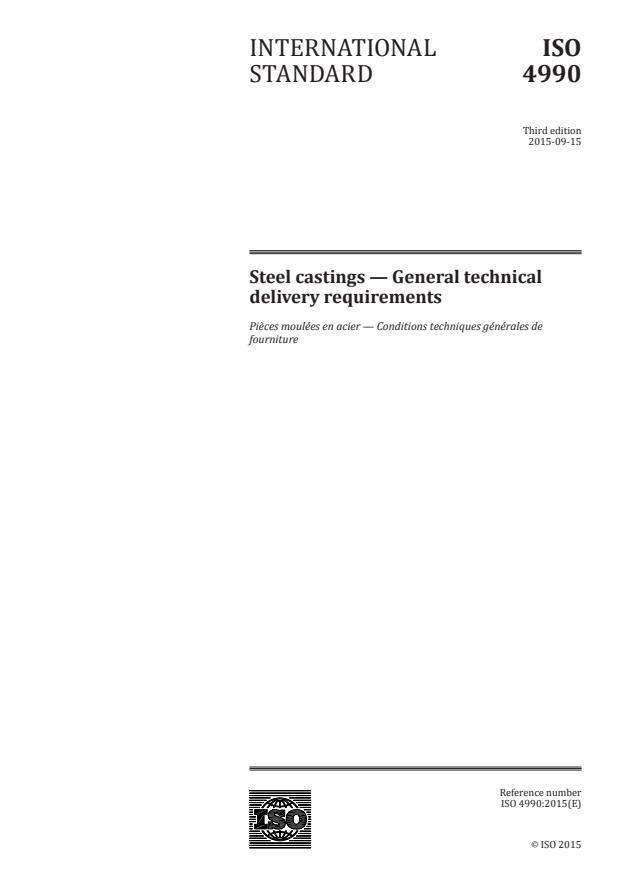
INTERNATIONAL ISO
STANDARD 4990
Third edition
2015-09-15
Steel castings — General technical
delivery requirements
Pièces moulées en acier — Conditions techniques générales de
fourniture
Reference number
©
ISO 2015
© ISO 2015, Published in Switzerland
All rights reserved. Unless otherwise specified, no part of this publication may be reproduced or utilized otherwise in any form
or by any means, electronic or mechanical, including photocopying, or posting on the internet or an intranet, without prior
written permission. Permission can be requested from either ISO at the address below or ISO’s member body in the country of
the requester.
ISO copyright office
Ch. de Blandonnet 8 • CP 401
CH-1214 Vernier, Geneva, Switzerland
Tel. +41 22 749 01 11
Fax +41 22 749 09 47
copyright@iso.org
www.iso.org
ii © ISO 2015 – All rights reserved
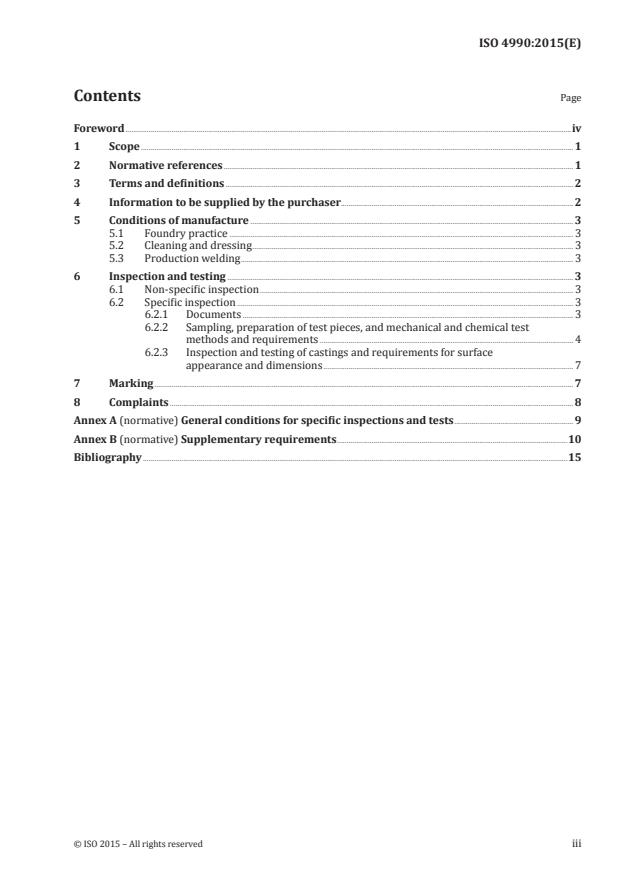
Contents Page
Foreword .iv
1 Scope . 1
2 Normative references . 1
3 Terms and definitions . 2
4 Information to be supplied by the purchaser. 2
5 Conditions of manufacture . 3
5.1 Foundry practice . 3
5.2 Cleaning and dressing . 3
5.3 Production welding . 3
6 Inspection and testing . 3
6.1 Non-specific inspection . 3
6.2 Specific inspection . 3
6.2.1 Documents . 3
6.2.2 Sampling, preparation of test pieces, and mechanical and chemical test
methods and requirements . 4
6.2.3 Inspection and testing of castings and requirements for surface
appearance and dimensions . 7
7 Marking . 7
8 Complaints . 8
Annex A (normative) General conditions for specific inspections and tests .9
Annex B (normative) Supplementary requirements .10
Bibliography .15
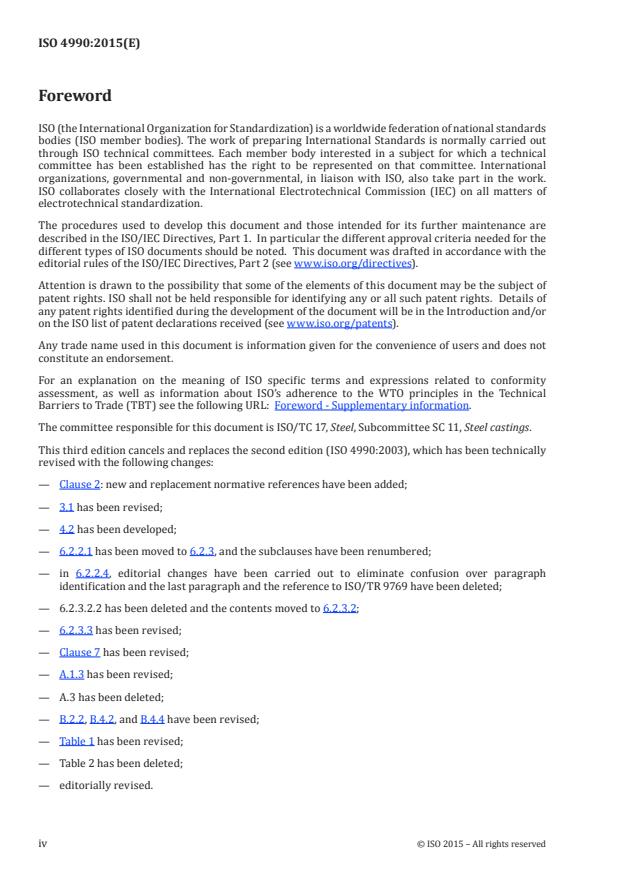
Foreword
ISO (the International Organization for Standardization) is a worldwide federation of national standards
bodies (ISO member bodies). The work of preparing International Standards is normally carried out
through ISO technical committees. Each member body interested in a subject for which a technical
committee has been established has the right to be represented on that committee. International
organizations, governmental and non-governmental, in liaison with ISO, also take part in the work.
ISO collaborates closely with the International Electrotechnical Commission (IEC) on all matters of
electrotechnical standardization.
The procedures used to develop this document and those intended for its further maintenance are
described in the ISO/IEC Directives, Part 1. In particular the different approval criteria needed for the
different types of ISO documents should be noted. This document was drafted in accordance with the
editorial rules of the ISO/IEC Directives, Part 2 (see www.iso.org/directives).
Attention is drawn to the possibility that some of the elements of this document may be the subject of
patent rights. ISO shall not be held responsible for identifying any or all such patent rights. Details of
any patent rights identified during the development of the document will be in the Introduction and/or
on the ISO list of patent declarations received (see www.iso.org/patents).
Any trade name used in this document is information given for the convenience of users and does not
constitute an endorsement.
For an explanation on the meaning of ISO specific terms and expressions related to conformity
assessment, as well as information about ISO’s adherence to the WTO principles in the Technical
Barriers to Trade (TBT) see the following URL: Foreword - Supplementary information.
The committee responsible for this document is ISO/TC 17, Steel, Subcommittee SC 11, Steel castings.
This third edition cancels and replaces the second edition (ISO 4990:2003), which has been technically
revised with the following changes:
— Clause 2: new and replacement normative references have been added;
— 3.1 has been revised;
— 4.2 has been developed;
— 6.2.2.1 has been moved to 6.2.3, and the subclauses have been renumbered;
— in 6.2.2.4, editorial changes have been carried out to eliminate confusion over paragraph
identification and the last paragraph and the reference to ISO/TR 9769 have been deleted;
— 6.2.3.2.2 has been deleted and the contents moved to 6.2.3.2;
— 6.2.3.3 has been revised;
— Clause 7 has been revised;
— A.1.3 has been revised;
— A.3 has been deleted;
— B.2.2, B.4.2, and B.4.4 have been revised;
— Table 1 has been revised;
— Table 2 has been deleted;
— editorially revised.
iv © ISO 2015 – All rights reserved
INTERNATIONAL STANDARD ISO 4990:2015(E)
Steel castings — General technical delivery requirements
1 Scope
This International Standard specifies the general technical delivery requirements for the supply of
steel, nickel, and cobalt alloy castings, including the requirements for the selection and preparation of
samples and test pieces.
When a material or product standard differ from this delivery specification, the material or product
standard shall apply. In the case of investment castings, ISO 16468 will apply.
This International Standard also specifies a group of supplementary requirements which may be
applied to steel, nickel, and cobalt alloy castings. These requirements are provided for use when
additional testing or inspection is desired and apply only when individually specified by the purchaser.
2 Normative references
The following documents, in whole or in part, are normatively referenced in this document and are
indispensable for its application. For dated references, only the edition cited applies. For undated
references, the latest edition of the referenced document (including any amendments) applies.
ISO 148-1, Metallic materials — Charpy pendulum impact test — Part 1: Test method
ISO 404:2013, Steel and steel products — General technical delivery requirements
ISO 3651-2, Determination of resistance to intergranular corrosion of stainless steels — Part 2: Ferritic,
austenitic and ferritic-austenitic (duplex) stainless steels — Corrosion test in media containing sulfuric acid
ISO 4948-1, Steels — Classification — Part 1: Classification of steels into unalloyed and alloy steels based
on chemical composition
ISO 4986, Steel castings — Magnetic particle inspection
ISO 4987, Steel castings — Liquid penetrant inspection
ISO 4992-1, Steel castings — Ultrasonic examination — Part 1: Steel castings for general purposes
ISO 4992-2, Steel castings — Ultrasonic examination — Part 2: Steel castings for highly stressed components
ISO 4993, Steel and iron castings — Radiographic inspection
ISO 6506-1, Metallic materials — Brinell hardness test — Part 1: Test method
ISO 6892-1, Metallic materials — Tensile testing — Part 1: Method of test at room temperature
ISO 6892-2, Metallic materials — Tensile testing — Part 2: Method of test at elevated temperature
ISO 6929:2013, Steel products — Vocabulary
ISO 10474, Steel and steel products — Inspection documents
ISO 11970, Specification and approval of welding procedures for production welding of steel castings
ISO 11971, Steel and iron castings — Visual examination of surface quality
ISO 14284, Steel and iron — Sampling and preparation of samples for the determination of chemical
composition
ISO 18265, Metallic materials — Conversion of hardness values
3 Terms and definitions
For the purposes of this document, the terms and definitions given in ISO 404, ISO 4948-1, ISO 6929:2013,
Clause 9, ISO 11970, and the following apply. In case of dispute, the terms and definitions in ISO 4990
apply.
3.1
cast (heat)
all the molten metal poured from a single furnace or all the molten metal from two or more furnaces
poured into a single ladle or casting
Note 1 to entry: The following are some examples [the words in boldface are the criteria for determining the
cast (heat) definition]:
a) all the molten metal from one or more furnaces poured into a single ladle or casting;
b) all the molten metal in one melt in a single furnace.
4 Information to be supplied by the purchaser
4.1 The enquiry and order should include the information as specified in 4.1.1 and 4.1.2.
4.1.1 A description of the casting(s) by pattern number and/or drawing. When a pattern is supplied, a
complete list of the pattern equipment should be included. When a drawing is not supplied, the casting is
purchased on the basis of the pattern. In that case, the foundry shall not be responsible for the dimensions
of the part.
NOTE Machining allowances, dimensional tolerances, and geometrical tolerances can be selected from
ISO 8062-3.
All modifications to be made to the drawing, for the technical requirements of the manufacturer, shall
form the subject of an agreement between the manufacturer and the purchaser.
4.1.2 The material standard, delivery condition, and grade of steel, nickel, or cobalt alloy.
4.2 Where appropriate, the enquiry and order should include additional information, e.g.:
a) any supplementary requirements in accordance with Annex B;
b) non-destructive testing procedures to be used, extent of the non-destructive testing, and
acceptance criteria;
c) type of inspection document to be provided at the time of supply;
d) size of a test lot, see 6.2.3.1;
e) procedures for marking (in accordance with Clause 7), machining, protection, packaging, loading,
dispatching, and the destination;
f) submission of sample castings for approval before production quantities are produced, see A.1.3;
g) methods of statistical control to be used.
Inspection and testing procedures shall conform to Annex A, including the place of inspection and
testing for the purchaser, if the inspection or testing cannot be performed at the manufacturer’s works.
2 © ISO 2015 – All rights reserved
5 Conditions of manufacture
5.1 Foundry practice
Unless otherwise agreed upon at the time of enquiry and order or specified in the material standard,
the selection of the method of melting, moulding, heat treatment, etc., is left to the discretion of the
manufacturer.
5.2 Cleaning and dressing
All the castings shall be cleaned and dressed sufficiently to determine compliance with the requirements
of 6.2.3. Additional dressing may be agreed to at the time of the enquiry and order.
5.3 Production welding
Unless specified at the time of the enquiry and order, the casting(s) may be subjected to production
welding without the prior approval of the purchaser. Weld procedures for production welding shall be
in accordance with ISO 11970.
For a supplement specifying major finishing welds, see B.8.1 and B.8.2.
6 Inspection and testing
6.1 Non-specific inspection
This inspection shall be arranged by the manufacturer and drawn up to ensure that the specified
requirements are complied with.
At the request of the purchaser at the time of the enquiry and ordering, the manufacturer shall supply a
statement of compliance or test report on the basis of these non-specific inspections or tests.
6.2 Specific inspection
6.2.1 Documents
Inspection documents shall be agreed upon at the time of the enquiry and order and shall be in
accordance with ISO 10474.
If one of the documents for specific inspection and testing from ISO 10474 is ordered, the inspections
and tests are to be carried out in accordance with 6.2.2, 6.2.3, and Annex A.
The inspection document shall contain the results of the chemical analysis and mechanical tests,
including the results of any other tests required by the specification and by the purchaser. It shall
include a statement that castings were manufactured in accordance with the requirements of the
specification.
The inspection document shall be signed by an authorised agent of the manufacturer.
Electronic data interchange (EDI): the manufacturer’s certification printed from or used in electronic
form shall be regarded as having the same validity as a counterpart printed in the certifier’s facility
provided that it conforms to any existing agreement between the purchaser and the supplier.
The inspection document shall provide the required traceability to the castings.
6.2.2 Sampling, preparation of test pieces, and mechanical and chemical test methods and
requirements
6.2.2.1 Test blocks
The test blocks may be cast separately, attached to the castings or cast integrally on the castings. When
more than one ladle is used, the test block shall be cast integrally. They shall be produced from the
same cast (heat) of steel and shall be heat treated in the production furnaces to the same procedure as
the casting(s) they represent.
Unless otherwise specified, the test block shall be 28 mm minimum and the test pieces used for the
mechanical tests shall be taken from test blocks with their axes at least 7 mm from the surface. See
B.6.1.2 and B.6.1.3.
The test results represent the material from which the castings have been poured. They do not
necessarily represent the properties of the castings. These can be affected by solidification conditions
and the rate of cooling during heat treatment, which are in turn influenced by casting thickness, size,
and shape.
6.2.2.2 Mechanical tests
6.2.2.2.1 Tensile tests at room temperature
One tensile test shall be carried out per test lot (see 6.2.3.1). The shape, dimensions, and method shall
comply with ISO 6892-1. The test results shall comply with the specification for the grade of material
ordered.
6.2.2.2.2 Impact test
When the test is specified, it shall be carried out in accordance with ISO 148-1. Three Charpy test pieces
with V-notches shall be prepared. The test temperature shall be as shown in the material specification.
The average value of absorbed energy from the three test pieces shall not be less than the value indicated
in the material specification for the grade specified. Only one of the three values may be below but not
less than 70 % of the minimum specified value.
6.2.2.3 Retests
6.2.2.3.1 Test results not in compliance with the specification are not valid when due to any one of the
following conditions:
— defective assembly of the test piece or abnormal functioning of the test machine;
— defective manufacture of the test pieces;
— break in the tensile-test piece outside the reference marks;
— anomalies shown in the test piece.
In all cases, a new test piece shall be taken from the same test block or from another test block belonging
to the same test lot and the results obtained can be substituted for those corresponding to the defective
piece.
6.2.2.3.2 Except as provided, when the results of the test do not comply with the requirements of the
material standard, the manufacturer shall, unless otherwise agreed upon at the time of enquiry and
order, adopt one of the procedures specified below.
a) Repeat the test which failed on two additional test pieces. If any of the two new test pieces do not
give the specification requirements, the manufacturer may follow the procedure specified in c).
4 © ISO 2015 – All rights reserved
b) In the case of impact tests, if the average value obtained from the three tests does not reach the
minimum specified value or if one of the individual values does not reach the specified minimum
(i.e. 70 % of the minimum specified value), the manufacturer may test three additional test pieces.
The additional test pieces shall be selected from the same test block or from another block from
the sam
...
Questions, Comments and Discussion
Ask us and Technical Secretary will try to provide an answer. You can facilitate discussion about the standard in here.
Loading comments...