

ISO 3297:2022
(Main)Information and documentation — International standard serial number (ISSN)
General Information
- Abstract
This document defines and promotes the use of a standard code (ISSN) for the unique identification of serials and other continuing resources. Each International Standard Serial Number (ISSN) is a unique identifier for a serial or other continuing resource in a defined medium whether print or electronic. This document also allows for grouping related continuing resources into clusters identified by a separately-prefixed ISSN as defined in this document. ISSNs are applicable to serials and to other continuing resources, whatever the business model or modes of distribution (e.g. free, open access, on subscription, etc.) and irrespective of whether the serial is currently in publication, has ceased publication, or publication is planned for the foreseeable future. Continuing resources include whatever the medium of production (print or electronic): — serials, such as newspapers, periodicals, journals, magazines, blogs, conference proceedings, monographic series with no predetermined conclusion, annual or other periodic reports, and — ongoing integrating resources that are updated, such as loose-leaf publications, updating websites, institutional repositories, directories and databases. Monographs, sound and video recordings, notated music publications, audiovisual works, textual works and musical works have their own standard identifiers and are not specifically mentioned in this document. Such items can carry an ISSN in addition to their appropriate identifiers when they are part of a continuing resource. NOTE This document does not contain any operational guidance for its practical implementation.
- Status
- Published
- Publication Date
- 16-Jun-2022
- Technical Committee
- ISO/TC 46/SC 9 - Identification and description
- Drafting Committee
- ISO/TC 46/SC 9 - Identification and description
- Current Stage
- 6060 - International Standard published
- Start Date
- 17-Jun-2022
- Due Date
- 30-May-2023
- Completion Date
- 17-Jun-2022
Buy Documents




ISO 3297:2022 - Information and documentation — International standard serial number (ISSN) Released:17. 06. 2022
ISO 3297:2022 - Information and documentation — International standard serial number (ISSN) Released:17. 06. 2022
Overview
ISO 3297:2022 - Information and documentation - International standard serial number (ISSN) defines the ISSN as the internationally recognized, numeric identifier for serials and other continuing resources in any medium (print or electronic). The seventh edition clarifies ISSN construction, metadata, clustering of related resources, and administration by the ISSN network and Registration Authority. It establishes that ISSNs are opaque identifiers (no intrinsic meaning) and are applicable regardless of business model or publication status.
Note: ISO 3297:2022 does not include operational implementation procedures.
Key topics and technical requirements
- Scope of resources: serials (journals, magazines, newspapers, conference proceedings, monographic series) and ongoing integrating resources (updating websites, loose‑leafs, institutional repositories, directories, databases).
- ISSN construction: rules for forming the eight‑character ISSN (including a check digit - Annex A) and for machine legibility.
- Cluster ISSN: mechanism to group related continuing resources (e.g., multiple medium versions or language editions) with a separately‑prefixed cluster ISSN (see 3.4.1 and clause 7).
- Key title and abbreviated key title: establishment of a unique key title linked to an ISSN and use of ISO 4 abbreviations for abbreviated key titles.
- ISSN metadata and Register: required descriptive metadata elements for assignment and a central ISSN Register maintained by the Registration Authority (Annex C).
- Linking ISSN (ISSN‑L): support for linking different medium versions of the same continuing resource (Annex B).
- Administration: role of the ISSN network, Registration Authority and delegated Registration Agencies in assignment and maintenance (clause 11 and Annex D).
- Interoperability & machine readability: metadata profiles and guidance for machine legibility and systems interoperability (Annexes C and E).
Practical applications
- Cataloguing & discovery: enables unique identification of serials across library catalogs, aggregators and discovery services.
- Metadata exchange: standard metadata and ISSN Register support reliable data exchange between publishers, libraries, indexers, and aggregators.
- Resource linking: ISSN‑L and cluster ISSNs facilitate linking across print/electronic versions and related editions.
- Content management: useful for institutional repositories, databases, and publishing platforms to track and manage continuing resources.
- Rights, subscription and distribution systems: consistent identifiers simplify subscription management, content licensing and supply chains.
Who should use ISO 3297:2022?
- Libraries and cataloguers
- Publishers and content platforms
- ISSN Registration Agencies and metadata managers
- Indexing/abstracting services, discovery service providers
- Institutional repositories and digital library systems
Related standards and references
- ISO 4 (title word abbreviations) - used for abbreviated key titles
- ISO 5127 - terminology for information and documentation (referenced for definitions)
- Annexes in ISO 3297:2022 (A–E) cover check digit, ISSN‑L, metadata profile, administration and interoperability
ISO 3297:2022 is essential for consistent, international identification of serial and continuing resources - improving discoverability, metadata quality and interoperability across publishing and library ecosystems. Keywords: ISO 3297:2022, ISSN, International Standard Serial Number, cluster ISSN, ISSN metadata, ISSN‑L, ISSN Register.
Relations
- Effective Date
- 06-Jun-2022
Buy Documents
ISO 3297:2022 - Information and documentation — International standard serial number (ISSN) Released:17. 06. 2022
ISO 3297:2022 - Information and documentation — International standard serial number (ISSN) Released:17. 06. 2022
Frequently Asked Questions
ISO 3297:2022 is a standard published by the International Organization for Standardization (ISO). Its full title is "Information and documentation — International standard serial number (ISSN)". This standard covers: This document defines and promotes the use of a standard code (ISSN) for the unique identification of serials and other continuing resources. Each International Standard Serial Number (ISSN) is a unique identifier for a serial or other continuing resource in a defined medium whether print or electronic. This document also allows for grouping related continuing resources into clusters identified by a separately-prefixed ISSN as defined in this document. ISSNs are applicable to serials and to other continuing resources, whatever the business model or modes of distribution (e.g. free, open access, on subscription, etc.) and irrespective of whether the serial is currently in publication, has ceased publication, or publication is planned for the foreseeable future. Continuing resources include whatever the medium of production (print or electronic): — serials, such as newspapers, periodicals, journals, magazines, blogs, conference proceedings, monographic series with no predetermined conclusion, annual or other periodic reports, and — ongoing integrating resources that are updated, such as loose-leaf publications, updating websites, institutional repositories, directories and databases. Monographs, sound and video recordings, notated music publications, audiovisual works, textual works and musical works have their own standard identifiers and are not specifically mentioned in this document. Such items can carry an ISSN in addition to their appropriate identifiers when they are part of a continuing resource. NOTE This document does not contain any operational guidance for its practical implementation.
This document defines and promotes the use of a standard code (ISSN) for the unique identification of serials and other continuing resources. Each International Standard Serial Number (ISSN) is a unique identifier for a serial or other continuing resource in a defined medium whether print or electronic. This document also allows for grouping related continuing resources into clusters identified by a separately-prefixed ISSN as defined in this document. ISSNs are applicable to serials and to other continuing resources, whatever the business model or modes of distribution (e.g. free, open access, on subscription, etc.) and irrespective of whether the serial is currently in publication, has ceased publication, or publication is planned for the foreseeable future. Continuing resources include whatever the medium of production (print or electronic): — serials, such as newspapers, periodicals, journals, magazines, blogs, conference proceedings, monographic series with no predetermined conclusion, annual or other periodic reports, and — ongoing integrating resources that are updated, such as loose-leaf publications, updating websites, institutional repositories, directories and databases. Monographs, sound and video recordings, notated music publications, audiovisual works, textual works and musical works have their own standard identifiers and are not specifically mentioned in this document. Such items can carry an ISSN in addition to their appropriate identifiers when they are part of a continuing resource. NOTE This document does not contain any operational guidance for its practical implementation.
ISO 3297:2022 is classified under the following ICS (International Classification for Standards) categories: 01.140.20 - Information sciences. The ICS classification helps identify the subject area and facilitates finding related standards.
ISO 3297:2022 has the following relationships with other standards: It is inter standard links to ISO 3297:2020. Understanding these relationships helps ensure you are using the most current and applicable version of the standard.
ISO 3297:2022 is available in PDF format for immediate download after purchase. The document can be added to your cart and obtained through the secure checkout process. Digital delivery ensures instant access to the complete standard document.
Standards Content (Sample)
SLOVENSKI STANDARD
01-oktober-2024
Nadomešča:
SIST ISO 3297:2021
Informatika in dokumentacija - Mednarodna standardna številka serijske
publikacije (ISSN)
Information and documentation — International standard serial number (ISSN)
Information et documentation — Numéro international normalisé des publications en
série (ISSN)
Ta slovenski standard je istoveten z: ISO 3297:2022
ICS:
01.140.20 Informacijske vede Information sciences
2003-01.Slovenski inštitut za standardizacijo. Razmnoževanje celote ali delov tega standarda ni dovoljeno.
INTERNATIONAL ISO
STANDARD 3297
Seventh edition
2022-06
Information and documentation —
International standard serial number
(ISSN)
Information et documentation — Numéro international normalisé
des publications en série (ISSN)
Reference number
© ISO 2022
All rights reserved. Unless otherwise specified, or required in the context of its implementation, no part of this publication may
be reproduced or utilized otherwise in any form or by any means, electronic or mechanical, including photocopying, or posting on
the internet or an intranet, without prior written permission. Permission can be requested from either ISO at the address below
or ISO’s member body in the country of the requester.
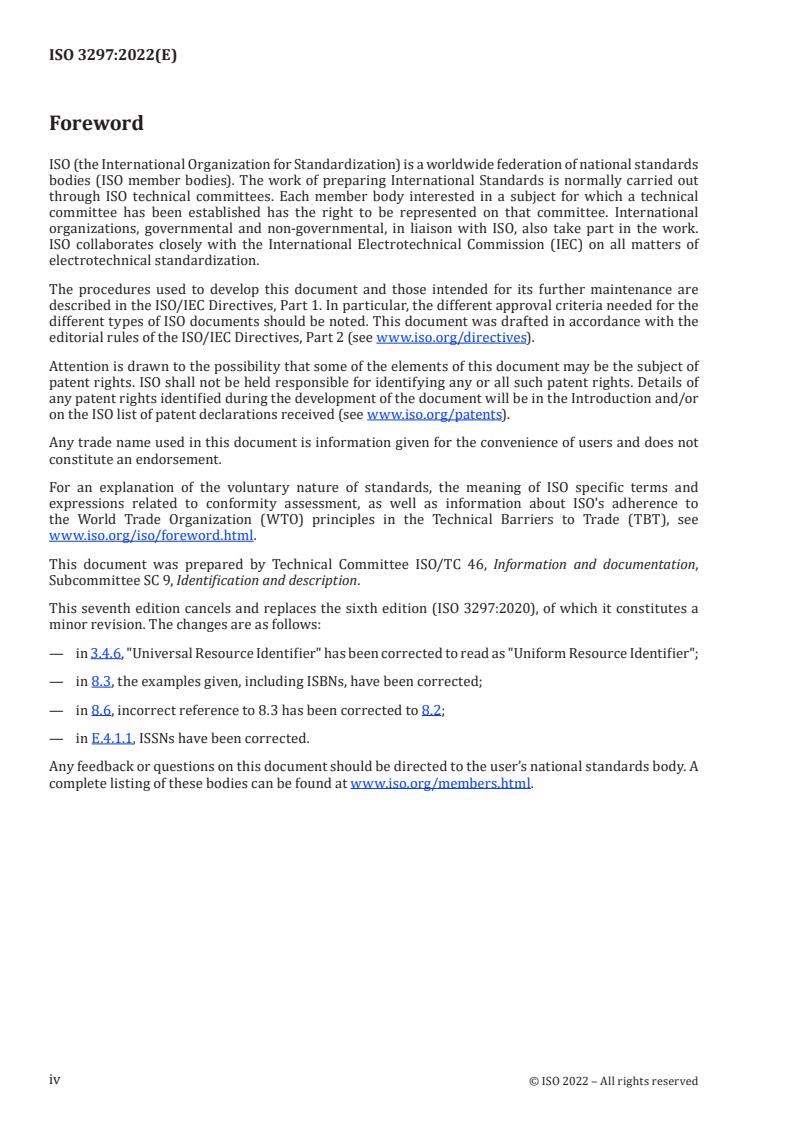
ISO copyright office
CP 401 • Ch. de Blandonnet 8
CH-1214 Vernier, Geneva
Phone: +41 22 749 01 11
Email: copyright@iso.org
Website: www.iso.org
Published in Switzerland
ii
Contents Page
Foreword .iv
Introduction .v
1 Scope . 1
2 Normative references . 1
3 Terms and definitions . 1
3.1 Metadata . 1
3.2 Stakeholders . 2
3.3 Resources identified . 3
3.4 Identifiers and locators . 4
4 Construction of ISSN and cluster ISSN . 5
5 Assignment of ISSN — Principles . 6
6 Establishment of the key title and the abbreviated key title . 6
7 Continuing resource clusters identified with cluster ISSN . 7
[17]
8 Display of ISSN and cluster ISSN . 7
9 ISSN Machine legibility . 9
10 ISSN Metadata .11
11 Administration of the ISSN network .11
Annex A (normative) Check digit for ISSN .12
Annex B (normative) Linking ISSN (ISSN-L) . .13
Annex C (normative) ISSN Metadata profile .14
Annex D (normative) Administration of the ISSN network .17
Annex E (informative) Interoperability of ISSN .19
Bibliography .25
iii
Foreword
ISO (the International Organization for Standardization) is a worldwide federation of national standards
bodies (ISO member bodies). The work of preparing International Standards is normally carried out
through ISO technical committees. Each member body interested in a subject for which a technical
committee has been established has the right to be represented on that committee. International
organizations, governmental and non-governmental, in liaison with ISO, also take part in the work.
ISO collaborates closely with the International Electrotechnical Commission (IEC) on all matters of
electrotechnical standardization.
The procedures used to develop this document and those intended for its further maintenance are
described in the ISO/IEC Directives, Part 1. In particular, the different approval criteria needed for the
different types of ISO documents should be noted. This document was drafted in accordance with the
editorial rules of the ISO/IEC Directives, Part 2 (see www.iso.org/directives).
Attention is drawn to the possibility that some of the elements of this document may be the subject of
patent rights. ISO shall not be held responsible for identifying any or all such patent rights. Details of
any patent rights identified during the development of the document will be in the Introduction and/or
on the ISO list of patent declarations received (see www.iso.org/patents).
Any trade name used in this document is information given for the convenience of users and does not
constitute an endorsement.
For an explanation of the voluntary nature of standards, the meaning of ISO specific terms and
expressions related to conformity assessment, as well as information about ISO's adherence to
the World Trade Organization (WTO) principles in the Technical Barriers to Trade (TBT), see
www.iso.org/iso/foreword.html.
This document was prepared by Technical Committee ISO/TC 46, Information and documentation,
Subcommittee SC 9, Identification and description.
This seventh edition cancels and replaces the sixth edition (ISO 3297:2020), of which it constitutes a
minor revision. The changes are as follows:
— in 3.4.6, "Universal Resource Identifier" has been corrected to read as "Uniform Resource Identifier";
— in 8.3, the examples given, including ISBNs, have been corrected;
— in 8.6, incorrect reference to 8.3 has been corrected to 8.2;
— in E.4.1.1, ISSNs have been corrected.
Any feedback or questions on this document should be directed to the user’s national standards body. A
complete listing of these bodies can be found at www.iso.org/members.html.
iv
Introduction
The need for a brief, unique and unambiguous identification code for serials and other continuing
resources is internationally recognized. The exchange of information among libraries, abstracting
services and other content users, system suppliers, distributors and other intermediaries, and
publishers and other content producers justifies the requirement for a standard code. Communication
between the different organizations transcends national boundaries and therefore requires an
international code which is numeric, since no single alphabet is used by the majority of producers and
users of serials. In response to these requirements, the International Standard Serial Number (ISSN)
has been established as the identification code for serials. The ISSN is an opaque identifier where no
meaning is to be inferred from the code itself.
The International Serials Data System (ISDS) was established as an inter-governmental organization
within the framework of the UNESCO/UNISIST program to be the designated authority for controlling
the assignment of ISSN. In 1993, the ISDS became the ISSN network which is the inter-governmental
organization comprising ISO 3297 Registration Authority and ISO 3297 Registration Agencies to which
some Registration services have been delegated, including ISSN assignment.
The first three editions of this document pertained only to serials. However, in 2002 a new category of
resources, "continuing resources", was defined by the library community to encompass new kinds of
resources, such as updating databases. The scope of the fourth edition was broadened to cover serials
and other continuing resources. The fifth edition removed any reference to the business model from
the standard. This sixth edition responded to sector requests by establishing the ability to group and
identify related continuing resources into new types of clusters. Furthermore, the sixth edition specified
richer metadata elements to allow the communication of additional characteristics of a resource.
v
INTERNATIONAL STANDARD ISO 3297:2022(E)
Information and documentation — International standard
serial number (ISSN)
1 Scope
This document defines and promotes the use of a standard code (ISSN) for the unique identification of
serials and other continuing resources.
Each International Standard Serial Number (ISSN) is a unique identifier for a serial or other continuing
resource in a defined medium whether print or electronic.
This document also allows for grouping related continuing resources into clusters identified by a
separately-prefixed ISSN as defined in this document.
ISSNs are applicable to serials and to other continuing resources, whatever the business model or modes
of distribution (e.g. free, open access, on subscription, etc.) and irrespective of whether the serial is
currently in publication, has ceased publication, or publication is planned for the foreseeable future.
Continuing resources include whatever the medium of production (print or electronic):
— serials, such as newspapers, periodicals, journals, magazines, blogs, conference proceedings,
monographic series with no predetermined conclusion, annual or other periodic reports, and
— ongoing integrating resources that are updated, such as loose-leaf publications, updating websites,
institutional repositories, directories and databases.
Monographs, sound and video recordings, notated music publications, audiovisual works, textual
works and musical works have their own standard identifiers and are not specifically mentioned in this
document. Such items can carry an ISSN in addition to their appropriate identifiers when they are part
of a continuing resource.
NOTE This document does not contain any operational guidance for its practical implementation.
2 Normative references
There are no normative references in this document.
3 Terms and definitions
For the purposes of this document, the following terms and definitions apply.
ISO and IEC maintain terminological databases for use in standardization at the following addresses:
— ISO Online browsing platform: available at https:// www .iso .org/ obp
— IEC Electropedia: available at https:// www .electropedia .org/
3.1 Metadata
3.1.1
abbreviated key title
specific title established by the ISSN network by replacing each significant word of a key title with
the corresponding abbreviation from the List of Title Word Abbreviations managed by the ISO 3297
Registration Authority for ISO 4
Note 1 to entry: See Reference [2] for the List of Title Word Abbreviations.
[3]
Note 2 to entry: Abbreviations are based on ISO 4 .
3.1.2
ISSN metadata
descriptive data recorded as part of the ISSN assignment process that provides elements by which the
continuing resource is identified and distinguished from other continuing resources
Note 1 to entry: It is updated by the ISSN network when needed.
3.1.3
ISSN Register
official registration database managed by the ISO 3297 Registration Authority containing all ISSN and
associated metadata records for those ISSN that have been assigned to date
Note 1 to entry: The database is made available in the ISSN Portal.
3.1.4
key title
unique name established by the ISSN network for a continuing resource, and inseparably linked with its
ISSN
Note 1 to entry: The key title can be the same as the title proper of the resource (refer to 3.1.5); or, in order to
achieve uniqueness, it can be constructed by the addition of parenthetical identifying and/or qualifying elements
to the title proper such as name of issuing body, place of publication, edition statement, etc.
3.1.5
title proper
chief name of a continuing resource as it appears on the title page or title page equivalent or other
relevant part of the continuing resource
3.2 Stakeholders
3.2.1
applicant
organization or individual that has requested an ISSN to identify a continuing resource under the aegis
of, and according to the rules specified by the Registration Authority
3.2.2
Internet Assigned Numbers Authority
IANA
nonprofit private corporation that oversees global IP address allocation, autonomous system number
allocation, root zone management in the Domain Name System (DNS), media types, and other Internet
Protocol-related symbols and Internet numbers
3.2.3
Internet Engineering Task Force
IETF
open standards organization which develops and promotes voluntary Internet standards, including the
standards that comprise the Internet protocol suite (TCP/IP)
Note 1 to entry: The Internet Engineering Task Force (IETF) issues Requests for Comments (RFC) which are
formal documents drafted by committees and subsequently reviewed by interested parties.
3.2.4
ISSN network
inter-governmental association comprising ISO 3297 Registration Authority and ISO 3297 Registration
Agencies to which some registration services have been delegated, including ISSN assignment
3.2.5
publisher
organization or individual whose activity is to commission, create, collect, validate, host and distribute
information in printed and/or in electronic form
[SOURCE: ISO 5127:2017, 3.2.3.15, modified — Notes to entry have been omitted.]
3.3 Resources identified
3.3.1
continuing resource
publication, in any medium, that is issued over time with no predetermined conclusion and made
available to the public
[SOURCE: ISO 5127:2017, 3.4.1.05]
Note 1 to entry: Continuing resources include serials and ongoing integrating resources.
Note 2 to entry: An electronic continuing resource is either a resource available on a tangible medium (e.g. disc,
flash drive) or a resource accessed by connection to a communication network and by means of hardware and
software connections (e.g. online).
Note 3 to entry: Electronic continuing resources can originate in digital form or be retrospectively digitised.
3.3.2
continuing resource edition
distinct continuing resource issued simultaneously or not simultaneously with one or many editions of
that resource, usually with the same title proper
Note 1 to entry: Each edition is intended for a specific audience or use; examples include language, geographic,
frequency editions.
3.3.3
integrating resource
publication, either finite or with no predetermined conclusion, that is added to or changed by updates
that do not remain discrete and are integrated into the whole, and made available to the public in any
medium version
[SOURCE: ISO 5127:2017, 3.4.1.06, modified — The example has been omitted.]
Note 1 to entry: Only integrating resources with no predetermined conclusion (i.e. ongoing) are continuing
resources eligible for ISSN assignment.
3.3.4
journal
periodical in any medium version devoted to disseminating original research and commentary on
current developments in a specific discipline, sub-discipline, field of study or profession, published over
a period of time, or article by article online
3.3.5
medium version
means used to convey the information or content
Note 1 to entry: The medium can be tangible (e.g. print, CD-ROM, DVD-ROM, tapes, flash drives) or intangible (e.g.
websites, online databases, downloadable files).
3.3.6
monographic series
group of separate books related to one another by the fact that each book bears, in addition to its own
title proper, a collective title applying to the group as a whole
Note 1 to entry: The individual book may or may not be numbered in the series.
Note 2 to entry: Monographic series are not to be confused with multipart monographs which are complete in
two or more volumes or series intended to be completed within a finite number of parts/volumes and therefore
not eligible for an ISSN.
[SOURCE: ISO 5127:2017, 3.4.1.27.02]
3.3.7
periodical
serial generally characterized by variety of contents and contributors, both within one issue of the
publication and from one issue to another
Note 1 to entry: Each issue is usually composed of more than one intellectual contribution (article, essay, review,
note, etc.).
Note 2 to entry: A periodical has no predetermined conclusion.
[SOURCE: ISO 5127:2017, 3.4.1.28.02]
3.3.8
serial
publication in any medium version, issued in successive parts, usually having numerical or chronological
designations, and intended to be continued indefinitely, whatever its frequency of publication
Note 1 to entry: Publications of limited duration (e.g. newsletter for a one-time event) that have some
characteristics of serials such as successive issues and/or numbering can be considered as serials.
[SOURCE: ISO 5127:2017, 3.4.1.28.01]
3.4 Identifiers and locators
3.4.1
cluster ISSN
ISSN assigned to group continuing resources related to each other
EXAMPLE Titles available in print and electronic medium versions, titles available in several language
editions.
3.4.2
Global Trade Item Number
GTIN
unique number from a standard code used internationally to identify products and packaging units
[SOURCE: ISO 5127:2017, 3.2.5.12 — Notes to entry have been omitted.]
3.4.3
ISSN
International Standard Serial Number
standard code assigned by the ISSN network for the unique identification of serials and other continuing
resources in a defined medium version
Note 1 to entry: The term ISSNs can be used to refer to more than one ISSN.
[SOURCE: ISO 5127:2017, 3.2.5.03, modified — Notes to entry have been edited.]
3.4.4
ISSN-L
Linking ISSN
cluster ISSN designated by the ISO 3297 Registration Authority to enable collocation or linking among
the different medium versions of a continuing resource
3.4.5
PID
Persistent Identifier
unique identifier that ensures permanent access for a digital object by providing access to it
independently of its physical location or current ownership
[SOURCE: ISO 5127:2017, 3.2.5.25]
3.4.6
URI
Uniform Resource Identifier
compact sequence of characters that identifies an abstract or physical resource
[SOURCE: ISO 5127:2017, 3.1.9.20]
3.4.7
URN
Uniform Resource Name
persistent, location-independent, resource identifier used for recognition of, and access to,
characteristics of the resource or the resource itself
[SOURCE: ISO 5127:2017, 3.1.9.22]
4 Construction of ISSN and cluster ISSN
The characters that comprise an ISSN, whatever the prefix, are defined as code points from
ISO/IEC 10646.
NOTE The code points referenced above can be represented without ambiguity in all commonly used
character sets.
An ISSN shall consist of eight characters as follows:
Position 1 2 3 4 5 6 7 8
Character N N N N N N N C
where:
— N is a digit from the code points in the range U+0030 to U+0039 (the Arabic numerals 0 to 9), and
— C is a check digit being either a digit from the code points in the range U+0030 to U+0039 or the
Latin capital letter X (code point U+0058).
The check digit shall be calculated from the other seven digits on a modulus 11 basis with weights 8 to
2, using X in lieu of 10 where 10 occurs as a check digit, as calculated in Annex A.
EXAMPLE
Since ISSNs are likely to be used in the same context as codes designed for other purposes, when an ISSN
is presented for human perception, it should, to avoid confusion, be preceded by the prefix including
ISSN (U+0049, U+0053, U+0053, U+004E) and a space (U+0020) and divided into two groups of four
characters, separated by a hyphen (U+002D).
EXAMPLE
ISSN 1792-4219
ISSN 2336-1956
ISSN 0268-540X
ISSN-L 2397–1754
5 Assignment of ISSN — Principles
5.1 An ISSN shall be assigned only by a member of the ISSN network upon request from an applicant
or as part of internal library processing such as legal deposit and digitization projects.
5.2 A request for an ISSN may be made to the ISSN network by any individual or organization that
needs to identify serials and other continuing resources, such as a publisher or their representative, a
library, a content provider, a preservation organization.
5.3 A request for an ISSN shall be accompanied by a copy of or access to the earliest issue of serials or
the current iteration of integrating resources.
5.4 A request for an ISSN shall be accompanied by metadata about the continuing resource to which
an ISSN is to be assigned. Metadata supplied by applicants should be accurate and verifiable.
5.5 At the time of registration by the ISSN network, each continuing resource is assigned a unique
key title that links permanently to the ISSN.
5.6 Each distinct continuing resource in a particular medium version should be assigned only one
ISSN.
5.7 When a continuing resource is published in different editions or medium versions, a unique ISSN
and key title should be assigned to each edition or medium version whether or not they have the same
title proper.
5.8 A new ISSN should be assigned, and a corresponding new key title should be established when
the continuing resource undergoes a major change in title or other major changes. The ISO 3297
Registration Authority shall determine, the rules which specify when a new ISSN is required following
changes to a continuing resource. In formulating these rules, the ISO 3297 Registration Authority shall
take into consideration other relevant bibliographic standards regarding continuing resources.
5.9 Once an ISSN has been assigned to a continuing resource, it should not be altered, replaced or
reused for another publication.
5.10 The assignment of an ISSN to a continuing resource shall not imply any meaning or legal evidence
with regard to the ownership of rights to that publication or its contents. The ISSN itself is not owned
by the applicant and is not changed solely because of a change of publisher or place of publication.
5.11 The assignment of an ISSN to a continuing resource does not imply the ISSN network endorses the
content of this continuing resource, nor does it imply any mark of quality about the continuing resource.
6 Establishment of the key title and the abbreviated key title
6.1 The key title is established or authenticated by the ISSN network.
6.2 The key title is based on the title proper. For serials, the issue used to establish the key title is the
first issue or earliest available issue at the time of registration. For integrating resources, the key title
is based on information appearing on the current iteration. The title proper of the resource becomes
the key title if this title is unique in the ISSN Register at the time of registration. If this title proper is not
unique, the key title is the title of the resource, to which a parenthetical qualifying term is added (such
as name of issuing body, place and/or date of publication, edition statement or medium statement), in
order to make the resulting key title unique.
6.3 All key titles should be listed in the ISSN Register together with their ISSN. Key titles shall be
Romanized, preferably according to International Standards. The ISO 3297 Registration Authority shall
[5] to [16]
publish references to Romanization standards and guidelines.
6.4 The abbreviated key title should be assigned by the ISSN network as indicated in conjunction
with the key title for scientific continuing resources so as to provide an abbreviated form of the key title
for purposes of indexing and citations.
7 Continuing resource clusters identified with cluster ISSN
The ISO 3297 Registration Authority shall be responsible for determining the need to identify clusters
of continuing resources. This shall be done by assigning a new ISSN and a prefix whose syntax will
be ISSN-X where X identifies the type of cluster. Examples of clusters are all earlier, later and current
titles of a resource or all language editions of a resource. The ISO 3297 Registration Authority shall
publish definitions of cluster types and document the processes by which cluster ISSNs are created and
disseminated.
By exception, the cluster identified by the Linking ISSN (ISSN-L) uses an existing ISSN. The Linking
ISSN shall be defined according to Annex B. ISSN-L provides collocation or linking among the different
medium versions of a continuing resource. The ISSN-L duplicates the ISSN assigned to the first medium
version to have received an ISSN for a continuing resource that is part of the cluster and is distinguished
only by the prefix ISSN-L.
EXAMPLE
ISSN 2095-2686 identifies the print version of International Journal of Mining Science and Technology.
ISSN 2589-062X identifies the online version of the same journal.
ISSN-L 2095–2686 is designated by the Registration Authority as the linking ISSN.
ISSN 2365-807X identifies the electronic version of Kultur- und Sozialgeschichte Osteuropas.
ISSN 2365-8061 identifies the print version of the same journal.
ISSN-L 2365–807X is designated by the Registration Authority as the linking ISSN.
ISSN 2651-057X identifies the online-only journal Warasan Sangkhomwitthaya Manutsayawitthaya
ISSN-L 2651–057X is designated by the ISO 3297 Registration Authority as the linking ISSN.
[17]
8 Display of ISSN and cluster ISSN
8.1 To ensure that the ISSN’s eight characters can be easily recognized as an ISSN, any ISSN shall
be consistently displayed as two groups of four digits separated by a hyphen and preceded by the
appropriate prefix and a space.
EXAMPLE
ISSN 0540-4614
ISSN-L 8755–5108
8.2 The ISSN and related medium version ISSNs should be displayed in a prominent position on or in:
— the first issue and each subsequent issue of serials,
— each subsequent iteration of ongoing integrating resources.
Relevant cluster ISSNs should be displayed in addition to the other medium version ISSN(s).
8.2.1 For printed continuing resources, the ISSN and related medium version ISSNs should be
displayed in a prominent position on each issue in the following order of preference: top-right hand
corner of the front cover, title page, caption, masthead, back cover, colophon or editorial pages.
[18]
The ISSN should be displayed on the continuing resource even when it is also included in the bar code
of the Global Trade Item Number (GTIN) (see E.6).
EXAMPLE
The journal Anthropology Today has two medium versions, print and online. Both medium versions display the
two ISSNs as shown below:
— ISSN 0268-540X (Print)
— ISSN 1467-8322 (Online)
8.2.2 For electronic continuing resources whether tangible or intangible (e.g. compact disc, online
serial), the ISSN and related medium versions ISSNs should be displayed prominently on the title screen
or the main menu (e.g. the initial screen displayed when the content is first accessed and/or the screen
that carries the copyright notice, i.e. information about the copyright, licensing and publishing rights
usually provided in a text box or sidebar).
8.2.2.1 In addition to displaying the ISSN and related medium versions ISSNs as described in 8.2.2,
if the publication is issued in a container that is an integral part of the publication (e.g. a compact disc,
cassette, or diskette), the ISSN should be displayed on any labels included with that container. If it is
not possible to display the ISSN on the container or its label, then the ISSN should be displayed at the
bottom of the back of any permanent packaging for that container (e.g. the box, sleeve, or frame).
8.2.2.2 For electronic serials, the ISSN and related medium versions ISSNs should also be displayed at
the article level with the journal information.
8.2.3 On a continuing resource published on microfiche, the ISSN and related medium versions ISSNs
should be entered in the identification area of the header of the microfiche and/or the labels.
8.3 If a continuing resource bears an ISSN as well as another standard identifier, such as an ISBN
for a monograph within a series with no predetermined conclusion, the two identifiers should appear
together each with the related title they identify. Each identifier shall include its own prefix such as
"ISSN" and "ISBN" or the prefix associated with another standard identifier.
EXAMPLE
The printed monographic series Ashgate Historical Keyboard Series has been assigned ISSN 2578-0182.
The monograph Studies in English Organ Music, a volume in the Ashgate Historical Keyboard Series, has been
assigned ISBN 978-1-138-05913-9.
On the publication, these identifiers should appear as follows:
— Studies in English Organ Music ISBN 978-1-138-05913-9
— Ashgate Historical Keyboard Series ISSN 2578-0182.
8.4 When a single continuing resource bears more than one ISSN in relation to different continuing
resource titles, for example the titles of a main monographic series and its subseries, each ISSN should
appear on the continuing resource and each should be distinguished by either adding the full or
abbreviated title proper in parentheses after the relevant identifier, or by printing each ISSN as close as
possible to the relevant title proper.
8.5 When a continuing resource contains another continuing resource as an insert with a separate
title page, the ISSN for the insert shall be printed on its title page, or in some other appropriate place on
the insert.
8.6 When the same serial or other continuing resource is produced in different medium versions for
which different ISSNs and key titles are assigned, then the ISSNs of all medium versions should appear
together on each version and in one of the prominent locations mentioned in 8.2, each with appropriate
distinguishing information.
EXAMPLE
ISSN 1562-6865 (Online)
ISSN 1063-7710 (Print)
ISSN-L 1063–7710
OR
Online version: ISSN 1562-6865
Print version: ISSN 1063-7710
ISSN-L 1063–7710
9 ISSN Machine legibility
9.1 Online electronic continuing resources should contain embedded metadata in a standard
format such as Dublin Core, Schema.org, MODS or MARCXML in order to improve discovery of these
resources on the Internet. The ISSN should be included as the identifier in the appropriate element of
the embedded metadata record, to allow for greater search accuracy, and to help navigating between
resources. Relevant cluster ISSN should also be included if the format makes it possible to distinguish
them from the ISSN. This also applies to the ISSN-L even when the ISSN-L is the same as the ISSN of the
resource.
9.2 Content providers and publishers of serials and other continuing resources should record three
types of elements within their systems:
— the ISSN itself, using a dedicated metadata field. Precise data elements should be used whenever
possible. If there is no ISSN element in the metadata format (e.g. unqualified Dublin Core), an
identifier element or equivalent may be used. In the machine-readable presentation, the prefix
"ISSN" and space shall not be used. However, when ISSN digits are exchanged between systems, the
hyphen should be included, since some applications may expect ISSN strings to contain it;
— Cluster ISSNs as appropriate, using a dedicated metadata field;
— the URI of the ISSN or cluster ISSNs linking to the metadata about the continuing resource or the
cluster in the ISSN Register.
EXAMPLE (XML fragments)
Schema.org
For a reference to the ISSN:
< http:// example .org/ Sociologyofreligion > < http:// schema .org/ issn > “1759-8818”
< http:// example .org/ Sociologyofreligion > < http:// schema .org/ sameAs >
< http:// portal .issn .org/ resource/ ISSN/ 1759 -8818 >
For a reference to the ISSN-L:
< http:// example .org/ Sociologyofreligion > < http:// schema .org/ sameAs >
< http:// portal .issn .org/ resource/ ISSNL/ 1069 -4404 >
Dublin Core
< dc.identifier type = “issn” > 1799–3911
< http:// portal .issn .org/ resource/ ISSN/ 1799 -3911 >
< dc.identifier type = “issnl” > 1799–3903
< http:// portal .issn .org/ resource/ ISSNL/ 1799 -3903 >
MODS
< identifier type = “issn” > 0376–4583
< identifier type = “issn-l” > 0376–4583
< identifier type = “uri” > http:// portal .issn .org/ resource/ ISSN/ 0376 -4583
< identifier type = “uri” > http:// portal .issn .org/ resource/ ISSN -L/ 0376 -4583
MARCXML (on a MARC21 basis)
MARC 21
022 ## $a 0376–4583 $l 0376–4583
856 42 $3 ISSN metadata $u http:// portal .issn .org/ resource/ ISSN/ 0376 -4583
856 42 $3 ISSN-L metadata $u http:// portal .issn .org/ resource/ ISSN -L/ 0376 -4583
The ISSN field in MARC 21 (022) is not currently structured to accommodate a URI. Until such a change occurs or
until there is an alternate mechanism for representing the URI of the ISSN in MARC 21, the example below can be
followed.
MARCXML
< datafield tag = "022" ind1 = "" ind2 = "" > < subfield code = "a"> 0376–4583 < subfield
code = "l" > 0376–4583
< datafield tag = "856" ind1 = "4" ind2 = "2" > < subfield code = "3" > ISSN metadata
< subfield code = “u” > http:// portal .issn .org/ resource/ ISSN/ 0376 -4583
< datafield tag = "856" ind1 = "4" ind2 = "2" > < subfield code = "3" > ISSN-L metadata
< subfield code = “u” > http:// portal .issn .org/ resource/ ISSN -L/ 0376 -4583
9.3 Metadata may be embedded in online resources in various ways depending on the format
used. For HTML resources, metadata may be located in the header of the document, or directly in the
[20] [21] [22]
document using RDF/A or microdata. For resources in PDF format, it may be recorded in
[23] [24] [25]
the associated XMP metadata. Container formats such as EPUB or OOXML provide specific
guidelines for embedded metadata but allow also external metadata via Internet linking.
More information on the recording of digital identification metadata may be found on the website of the
1)
ISO 3297 Registration Authority .
9.4 When ISSN digits are processed within the same application, the hyphen may be omitted since
it has no semantic content. For example, the URN Namespace Registration for ISSN and ISSN-L defined
by the Internet Assigned Numbers Authority (IANA) states that hyphen can be ignored when lexical
equivalence of two ISSN strings is analysed.
10 ISSN Metadata
10.1 In addition to copies of or access to continuing resources, some metadata are required from
applicants for the assignment of ISSN (see C.1 for full list).
10.2 The ISSN network verifies metadata provided by applicants and adds specific metadata such as
the ISSN and the key title, in accordance with Annex C. Each ISSN is represented in the ISSN Register
made available by the ISO 3297 Registration Authority by a record that contains metadata that is
maintained by the ISSN network.
11 Administration of the ISSN network
The name and contact information of the ISO 3297 Registration Authority for this document can be
found at https:// www .iso .org/ mara.
The ISSN network shall be supervised, coordinated and administered by ISO 3297 Registration
Authority whose tasks and services are outlined in Annex D.
1) Available at: https:// www .issn .org.
Annex A
(normative)
Check digit for ISSN
The check digit helps guard against errors resulting from improper data transcription. The check digit
used in the ISSN is calculated on a Modulus 11 basis using weights 8 to 2, as indicated in Table A.1.
Table A.1 — Procedure for calculating the ISSN check digit
Procedure Example
Step 1 Take the first seven digits of the ISSN (the 0 3 1 7 8 4 7
check digit is the eighth and last digit).
Step 2 Associate the following constant weighting 8 7 6 5 4 3 2
factors (8 to 2) to each digit.
Step 3 Apply each constant weighting factor by 0 3 1 7 8 4 7
multiplying each digit by its associated
× 8 7 6 5 4 3 2
weighting factor
= 0 21 6 35 32 12 14
(e.g. 0 × 8; 3 × 7; 1 × 6; etc.).
Step 4 Sum the products of these multiplications. 0 + 21 + 6 + 35 + 32 + 12 + 14 = 120
Step 5 Divide this sum by the modulus 11 to find 120 ÷ 11 = 10 and a remainder of 10
the remainder.
Step 6 Subtract the remainder from 11 to generate 11 − 10 = 1 Check digit = 1
the required check digit.
If the check digit is 10, generate a check digit
of X.
If there is no remainder, generate a check digit
of 0 (zero).
Step 7 Place the check digit at the end of the first ISSN 0317-8471
seven digits to create the eight-digit
International Standard Serial Number (ISSN).
Annex B
(normative)
Linking ISSN (ISSN-L)
B.1 The linking ISSN (ISSN-L) is the specific ISSN designated by ISO 3297 Registration Authority to
enable collocation or linking among the different medium versions of a continuing resource. An ISSN-L
is assigned automatically to each title even when there is only one medium version available at the time
of assignment. The 8-character string is identical to the first ISSN validated in the ISSN Register of any
medium version of a continuing resource.
B.2 The prefix ISSN-L is used for human legibility. A specific data field should be created in systems to
store the prefix and the identifier.
EXAMPLE
ISSN 1091-613X for the print version of Anthropology, a journal initially published in Guilford, Connecticut, USA
ISSN 2162-3546 for the online version of the same journal.
ISSN-L 1091–613X is designated as the linking ISSN by the ISO 3297 Registration Authority.
B.3 The linking ISSN should be included as a separate data element in the metadata available in the
ISSN Register. Each record in the ISSN Register therefore carries the medium version ISSN assigned to
the resource described in the record and the designated linking ISSN as separate data elements.
B.4 A linking ISSN should be designated for each continuing resource identified in the ISSN Register,
even if the continuing resource exists in only one medium.
B.5 Only one linking ISSN should be designated regardless of how many different medium versions of
a continuing resource exist.
B.6 When a continuing resource to which an ISSN has been assigned undergoes a major change and
is therefore assigned a new ISSN, the relevant linking ISSN should be designated and recorded in the
metadata that was created with the new ISSN assignment.
B.7 The linking ISSN can be used as a component in other global identifiers and mechanisms (see
examples in Annex E). In such cases, specific syntax requirements may apply for the display of the
linking ISSN within the syntax of such other identifiers or mechanisms.
Annex C
(normative)
ISSN Metadata profile
C.1 Metadata required from an applicant for ISSN assignment
Metadata provided by applicants is not standardised. The ISSN network reviews and formats according
to current bibliographic standards and practices.
ISSN assignment and registration are primarily based on the first or earliest issue of serials or on the
current iteration of ongoing integrating resources.
Copies or surrogates of the resources are mandatory for ISSN assignment in addition to the metadata
shown in Table C.1. Metadata should be supplied using ISO/IEC 10646. Based on the metadata as
described in Table C.1, the ISSN network creates a record in the ISSN Registry encompassing the
metadata as described in Table C.2.
Table C.1 — Metadata to be supplied by applicants where applicable
Required data elements
Main title as displayed on the publication (in original script and in Roman script)
Other titles as displayed on the publication (e.g. subtitles, titles in other languages, etc.)
Country of publication as displayed on the publication
City(ies) of publication as displayed on the publication (in original script and in Roman script)
Medium of publication (e.g. print, online, other tangible medium)
Language(s) of publication (generally represented in the publication)
Name of publishing company, organization or individual acting as publisher as displayed on the
publication (in original script and in Roman script)
Country where publishing company, organization or individual acting as publisher is located if
different from Country of publication
...
INTERNATIONAL ISO
STANDARD 3297
Seventh edition
2022-06
Information and documentation —
International standard serial number
(ISSN)
Information et documentation — Numéro international normalisé
des publications en série (ISSN)
Reference number
© ISO 2022
All rights reserved. Unless otherwise specified, or required in the context of its implementation, no part of this publication may
be reproduced or utilized otherwise in any form or by any means, electronic or mechanical, including photocopying, or posting on
the internet or an intranet, without prior written permission. Permission can be requested from either ISO at the address below
or ISO’s member body in the country of the requester.
ISO copyright office
CP 401 • Ch. de Blandonnet 8
CH-1214 Vernier, Geneva
Phone: +41 22 749 01 11
Email: copyright@iso.org
Website: www.iso.org
Published in Switzerland
ii
Contents Page
Foreword .iv
Introduction .v
1 Scope . 1
2 Normative references . 1
3 Terms and definitions . 1
3.1 Metadata . 1
3.2 Stakeholders . 2
3.3 Resources identified . 3
3.4 Identifiers and locators . 4
4 Construction of ISSN and cluster ISSN . 5
5 Assignment of ISSN — Principles . 6
6 Establishment of the key title and the abbreviated key title . 6
7 Continuing resource clusters identified with cluster ISSN . 7
[17]
8 Display of ISSN and cluster ISSN . 7
9 ISSN Machine legibility . 9
10 ISSN Metadata .11
11 Administration of the ISSN network .11
Annex A (normative) Check digit for ISSN .12
Annex B (normative) Linking ISSN (ISSN-L) . .13
Annex C (normative) ISSN Metadata profile .14
Annex D (normative) Administration of the ISSN network .17
Annex E (informative) Interoperability of ISSN .19
Bibliography .25
iii
Foreword
ISO (the International Organization for Standardization) is a worldwide federation of national standards
bodies (ISO member bodies). The work of preparing International Standards is normally carried out
through ISO technical committees. Each member body interested in a subject for which a technical
committee has been established has the right to be represented on that committee. International
organizations, governmental and non-governmental, in liaison with ISO, also take part in the work.
ISO collaborates closely with the International Electrotechnical Commission (IEC) on all matters of
electrotechnical standardization.
The procedures used to develop this document and those intended for its further maintenance are
described in the ISO/IEC Directives, Part 1. In particular, the different approval criteria needed for the
different types of ISO documents should be noted. This document was drafted in accordance with the
editorial rules of the ISO/IEC Directives, Part 2 (see www.iso.org/directives).
Attention is drawn to the possibility that some of the elements of this document may be the subject of
patent rights. ISO shall not be held responsible for identifying any or all such patent rights. Details of
any patent rights identified during the development of the document will be in the Introduction and/or
on the ISO list of patent declarations received (see www.iso.org/patents).
Any trade name used in this document is information given for the convenience of users and does not
constitute an endorsement.
For an explanation of the voluntary nature of standards, the meaning of ISO specific terms and
expressions related to conformity assessment, as well as information about ISO's adherence to
the World Trade Organization (WTO) principles in the Technical Barriers to Trade (TBT), see
www.iso.org/iso/foreword.html.
This document was prepared by Technical Committee ISO/TC 46, Information and documentation,
Subcommittee SC 9, Identification and description.
This seventh edition cancels and replaces the sixth edition (ISO 3297:2020), of which it constitutes a
minor revision. The changes are as follows:
— in 3.4.6, "Universal Resource Identifier" has been corrected to read as "Uniform Resource Identifier";
— in 8.3, the examples given, including ISBNs, have been corrected;
— in 8.6, incorrect reference to 8.3 has been corrected to 8.2;
— in E.4.1.1, ISSNs have been corrected.
Any feedback or questions on this document should be directed to the user’s national standards body. A
complete listing of these bodies can be found at www.iso.org/members.html.
iv
Introduction
The need for a brief, unique and unambiguous identification code for serials and other continuing
resources is internationally recognized. The exchange of information among libraries, abstracting
services and other content users, system suppliers, distributors and other intermediaries, and
publishers and other content producers justifies the requirement for a standard code. Communication
between the different organizations transcends national boundaries and therefore requires an
international code which is numeric, since no single alphabet is used by the majority of producers and
users of serials. In response to these requirements, the International Standard Serial Number (ISSN)
has been established as the identification code for serials. The ISSN is an opaque identifier where no
meaning is to be inferred from the code itself.
The International Serials Data System (ISDS) was established as an inter-governmental organization
within the framework of the UNESCO/UNISIST program to be the designated authority for controlling
the assignment of ISSN. In 1993, the ISDS became the ISSN network which is the inter-governmental
organization comprising ISO 3297 Registration Authority and ISO 3297 Registration Agencies to which
some Registration services have been delegated, including ISSN assignment.
The first three editions of this document pertained only to serials. However, in 2002 a new category of
resources, "continuing resources", was defined by the library community to encompass new kinds of
resources, such as updating databases. The scope of the fourth edition was broadened to cover serials
and other continuing resources. The fifth edition removed any reference to the business model from
the standard. This sixth edition responded to sector requests by establishing the ability to group and
identify related continuing resources into new types of clusters. Furthermore, the sixth edition specified
richer metadata elements to allow the communication of additional characteristics of a resource.
v
INTERNATIONAL STANDARD ISO 3297:2022(E)
Information and documentation — International standard
serial number (ISSN)
1 Scope
This document defines and promotes the use of a standard code (ISSN) for the unique identification of
serials and other continuing resources.
Each International Standard Serial Number (ISSN) is a unique identifier for a serial or other continuing
resource in a defined medium whether print or electronic.
This document also allows for grouping related continuing resources into clusters identified by a
separately-prefixed ISSN as defined in this document.
ISSNs are applicable to serials and to other continuing resources, whatever the business model or modes
of distribution (e.g. free, open access, on subscription, etc.) and irrespective of whether the serial is
currently in publication, has ceased publication, or publication is planned for the foreseeable future.
Continuing resources include whatever the medium of production (print or electronic):
— serials, such as newspapers, periodicals, journals, magazines, blogs, conference proceedings,
monographic series with no predetermined conclusion, annual or other periodic reports, and
— ongoing integrating resources that are updated, such as loose-leaf publications, updating websites,
institutional repositories, directories and databases.
Monographs, sound and video recordings, notated music publications, audiovisual works, textual
works and musical works have their own standard identifiers and are not specifically mentioned in this
document. Such items can carry an ISSN in addition to their appropriate identifiers when they are part
of a continuing resource.
NOTE This document does not contain any operational guidance for its practical implementation.
2 Normative references
There are no normative references in this document.
3 Terms and definitions
For the purposes of this document, the following terms and definitions apply.
ISO and IEC maintain terminological databases for use in standardization at the following addresses:
— ISO Online browsing platform: available at https:// www .iso .org/ obp
— IEC Electropedia: available at https:// www .electropedia .org/
3.1 Metadata
3.1.1
abbreviated key title
specific title established by the ISSN network by replacing each significant word of a key title with
the corresponding abbreviation from the List of Title Word Abbreviations managed by the ISO 3297
Registration Authority for ISO 4
Note 1 to entry: See Reference [2] for the List of Title Word Abbreviations.
[3]
Note 2 to entry: Abbreviations are based on ISO 4 .
3.1.2
ISSN metadata
descriptive data recorded as part of the ISSN assignment process that provides elements by which the
continuing resource is identified and distinguished from other continuing resources
Note 1 to entry: It is updated by the ISSN network when needed.
3.1.3
ISSN Register
official registration database managed by the ISO 3297 Registration Authority containing all ISSN and
associated metadata records for those ISSN that have been assigned to date
Note 1 to entry: The database is made available in the ISSN Portal.
3.1.4
key title
unique name established by the ISSN network for a continuing resource, and inseparably linked with its
ISSN
Note 1 to entry: The key title can be the same as the title proper of the resource (refer to 3.1.5); or, in order to
achieve uniqueness, it can be constructed by the addition of parenthetical identifying and/or qualifying elements
to the title proper such as name of issuing body, place of publication, edition statement, etc.
3.1.5
title proper
chief name of a continuing resource as it appears on the title page or title page equivalent or other
relevant part of the continuing resource
3.2 Stakeholders
3.2.1
applicant
organization or individual that has requested an ISSN to identify a continuing resource under the aegis
of, and according to the rules specified by the Registration Authority
3.2.2
Internet Assigned Numbers Authority
IANA
nonprofit private corporation that oversees global IP address allocation, autonomous system number
allocation, root zone management in the Domain Name System (DNS), media types, and other Internet
Protocol-related symbols and Internet numbers
3.2.3
Internet Engineering Task Force
IETF
open standards organization which develops and promotes voluntary Internet standards, including the
standards that comprise the Internet protocol suite (TCP/IP)
Note 1 to entry: The Internet Engineering Task Force (IETF) issues Requests for Comments (RFC) which are
formal documents drafted by committees and subsequently reviewed by interested parties.
3.2.4
ISSN network
inter-governmental association comprising ISO 3297 Registration Authority and ISO 3297 Registration
Agencies to which some registration services have been delegated, including ISSN assignment
3.2.5
publisher
organization or individual whose activity is to commission, create, collect, validate, host and distribute
information in printed and/or in electronic form
[SOURCE: ISO 5127:2017, 3.2.3.15, modified — Notes to entry have been omitted.]
3.3 Resources identified
3.3.1
continuing resource
publication, in any medium, that is issued over time with no predetermined conclusion and made
available to the public
[SOURCE: ISO 5127:2017, 3.4.1.05]
Note 1 to entry: Continuing resources include serials and ongoing integrating resources.
Note 2 to entry: An electronic continuing resource is either a resource available on a tangible medium (e.g. disc,
flash drive) or a resource accessed by connection to a communication network and by means of hardware and
software connections (e.g. online).
Note 3 to entry: Electronic continuing resources can originate in digital form or be retrospectively digitised.
3.3.2
continuing resource edition
distinct continuing resource issued simultaneously or not simultaneously with one or many editions of
that resource, usually with the same title proper
Note 1 to entry: Each edition is intended for a specific audience or use; examples include language, geographic,
frequency editions.
3.3.3
integrating resource
publication, either finite or with no predetermined conclusion, that is added to or changed by updates
that do not remain discrete and are integrated into the whole, and made available to the public in any
medium version
[SOURCE: ISO 5127:2017, 3.4.1.06, modified — The example has been omitted.]
Note 1 to entry: Only integrating resources with no predetermined conclusion (i.e. ongoing) are continuing
resources eligible for ISSN assignment.
3.3.4
journal
periodical in any medium version devoted to disseminating original research and commentary on
current developments in a specific discipline, sub-discipline, field of study or profession, published over
a period of time, or article by article online
3.3.5
medium version
means used to convey the information or content
Note 1 to entry: The medium can be tangible (e.g. print, CD-ROM, DVD-ROM, tapes, flash drives) or intangible (e.g.
websites, online databases, downloadable files).
3.3.6
monographic series
group of separate books related to one another by the fact that each book bears, in addition to its own
title proper, a collective title applying to the group as a whole
Note 1 to entry: The individual book may or may not be numbered in the series.
Note 2 to entry: Monographic series are not to be confused with multipart monographs which are complete in
two or more volumes or series intended to be completed within a finite number of parts/volumes and therefore
not eligible for an ISSN.
[SOURCE: ISO 5127:2017, 3.4.1.27.02]
3.3.7
periodical
serial generally characterized by variety of contents and contributors, both within one issue of the
publication and from one issue to another
Note 1 to entry: Each issue is usually composed of more than one intellectual contribution (article, essay, review,
note, etc.).
Note 2 to entry: A periodical has no predetermined conclusion.
[SOURCE: ISO 5127:2017, 3.4.1.28.02]
3.3.8
serial
publication in any medium version, issued in successive parts, usually having numerical or chronological
designations, and intended to be continued indefinitely, whatever its frequency of publication
Note 1 to entry: Publications of limited duration (e.g. newsletter for a one-time event) that have some
characteristics of serials such as successive issues and/or numbering can be considered as serials.
[SOURCE: ISO 5127:2017, 3.4.1.28.01]
3.4 Identifiers and locators
3.4.1
cluster ISSN
ISSN assigned to group continuing resources related to each other
EXAMPLE Titles available in print and electronic medium versions, titles available in several language
editions.
3.4.2
Global Trade Item Number
GTIN
unique number from a standard code used internationally to identify products and packaging units
[SOURCE: ISO 5127:2017, 3.2.5.12 — Notes to entry have been omitted.]
3.4.3
ISSN
International Standard Serial Number
standard code assigned by the ISSN network for the unique identification of serials and other continuing
resources in a defined medium version
Note 1 to entry: The term ISSNs can be used to refer to more than one ISSN.
[SOURCE: ISO 5127:2017, 3.2.5.03, modified — Notes to entry have been edited.]
3.4.4
ISSN-L
Linking ISSN
cluster ISSN designated by the ISO 3297 Registration Authority to enable collocation or linking among
the different medium versions of a continuing resource
3.4.5
PID
Persistent Identifier
unique identifier that ensures permanent access for a digital object by providing access to it
independently of its physical location or current ownership
[SOURCE: ISO 5127:2017, 3.2.5.25]
3.4.6
URI
Uniform Resource Identifier
compact sequence of characters that identifies an abstract or physical resource
[SOURCE: ISO 5127:2017, 3.1.9.20]
3.4.7
URN
Uniform Resource Name
persistent, location-independent, resource identifier used for recognition of, and access to,
characteristics of the resource or the resource itself
[SOURCE: ISO 5127:2017, 3.1.9.22]
4 Construction of ISSN and cluster ISSN
The characters that comprise an ISSN, whatever the prefix, are defined as code points from
ISO/IEC 10646.
NOTE The code points referenced above can be represented without ambiguity in all commonly used
character sets.
An ISSN shall consist of eight characters as follows:
Position 1 2 3 4 5 6 7 8
Character N N N N N N N C
where:
— N is a digit from the code points in the range U+0030 to U+0039 (the Arabic numerals 0 to 9), and
— C is a check digit being either a digit from the code points in the range U+0030 to U+0039 or the
Latin capital letter X (code point U+0058).
The check digit shall be calculated from the other seven digits on a modulus 11 basis with weights 8 to
2, using X in lieu of 10 where 10 occurs as a check digit, as calculated in Annex A.
EXAMPLE
Since ISSNs are likely to be used in the same context as codes designed for other purposes, when an ISSN
is presented for human perception, it should, to avoid confusion, be preceded by the prefix including
ISSN (U+0049, U+0053, U+0053, U+004E) and a space (U+0020) and divided into two groups of four
characters, separated by a hyphen (U+002D).
EXAMPLE
ISSN 1792-4219
ISSN 2336-1956
ISSN 0268-540X
ISSN-L 2397–1754
5 Assignment of ISSN — Principles
5.1 An ISSN shall be assigned only by a member of the ISSN network upon request from an applicant
or as part of internal library processing such as legal deposit and digitization projects.
5.2 A request for an ISSN may be made to the ISSN network by any individual or organization that
needs to identify serials and other continuing resources, such as a publisher or their representative, a
library, a content provider, a preservation organization.
5.3 A request for an ISSN shall be accompanied by a copy of or access to the earliest issue of serials or
the current iteration of integrating resources.
5.4 A request for an ISSN shall be accompanied by metadata about the continuing resource to which
an ISSN is to be assigned. Metadata supplied by applicants should be accurate and verifiable.
5.5 At the time of registration by the ISSN network, each continuing resource is assigned a unique
key title that links permanently to the ISSN.
5.6 Each distinct continuing resource in a particular medium version should be assigned only one
ISSN.
5.7 When a continuing resource is published in different editions or medium versions, a unique ISSN
and key title should be assigned to each edition or medium version whether or not they have the same
title proper.
5.8 A new ISSN should be assigned, and a corresponding new key title should be established when
the continuing resource undergoes a major change in title or other major changes. The ISO 3297
Registration Authority shall determine, the rules which specify when a new ISSN is required following
changes to a continuing resource. In formulating these rules, the ISO 3297 Registration Authority shall
take into consideration other relevant bibliographic standards regarding continuing resources.
5.9 Once an ISSN has been assigned to a continuing resource, it should not be altered, replaced or
reused for another publication.
5.10 The assignment of an ISSN to a continuing resource shall not imply any meaning or legal evidence
with regard to the ownership of rights to that publication or its contents. The ISSN itself is not owned
by the applicant and is not changed solely because of a change of publisher or place of publication.
5.11 The assignment of an ISSN to a continuing resource does not imply the ISSN network endorses the
content of this continuing resource, nor does it imply any mark of quality about the continuing resource.
6 Establishment of the key title and the abbreviated key title
6.1 The key title is established or authenticated by the ISSN network.
6.2 The key title is based on the title proper. For serials, the issue used to establish the key title is the
first issue or earliest available issue at the time of registration. For integrating resources, the key title
is based on information appearing on the current iteration. The title proper of the resource becomes
the key title if this title is unique in the ISSN Register at the time of registration. If this title proper is not
unique, the key title is the title of the resource, to which a parenthetical qualifying term is added (such
as name of issuing body, place and/or date of publication, edition statement or medium statement), in
order to make the resulting key title unique.
6.3 All key titles should be listed in the ISSN Register together with their ISSN. Key titles shall be
Romanized, preferably according to International Standards. The ISO 3297 Registration Authority shall
[5] to [16]
publish references to Romanization standards and guidelines.
6.4 The abbreviated key title should be assigned by the ISSN network as indicated in conjunction
with the key title for scientific continuing resources so as to provide an abbreviated form of the key title
for purposes of indexing and citations.
7 Continuing resource clusters identified with cluster ISSN
The ISO 3297 Registration Authority shall be responsible for determining the need to identify clusters
of continuing resources. This shall be done by assigning a new ISSN and a prefix whose syntax will
be ISSN-X where X identifies the type of cluster. Examples of clusters are all earlier, later and current
titles of a resource or all language editions of a resource. The ISO 3297 Registration Authority shall
publish definitions of cluster types and document the processes by which cluster ISSNs are created and
disseminated.
By exception, the cluster identified by the Linking ISSN (ISSN-L) uses an existing ISSN. The Linking
ISSN shall be defined according to Annex B. ISSN-L provides collocation or linking among the different
medium versions of a continuing resource. The ISSN-L duplicates the ISSN assigned to the first medium
version to have received an ISSN for a continuing resource that is part of the cluster and is distinguished
only by the prefix ISSN-L.
EXAMPLE
ISSN 2095-2686 identifies the print version of International Journal of Mining Science and Technology.
ISSN 2589-062X identifies the online version of the same journal.
ISSN-L 2095–2686 is designated by the Registration Authority as the linking ISSN.
ISSN 2365-807X identifies the electronic version of Kultur- und Sozialgeschichte Osteuropas.
ISSN 2365-8061 identifies the print version of the same journal.
ISSN-L 2365–807X is designated by the Registration Authority as the linking ISSN.
ISSN 2651-057X identifies the online-only journal Warasan Sangkhomwitthaya Manutsayawitthaya
ISSN-L 2651–057X is designated by the ISO 3297 Registration Authority as the linking ISSN.
[17]
8 Display of ISSN and cluster ISSN
8.1 To ensure that the ISSN’s eight characters can be easily recognized as an ISSN, any ISSN shall
be consistently displayed as two groups of four digits separated by a hyphen and preceded by the
appropriate prefix and a space.
EXAMPLE
ISSN 0540-4614
ISSN-L 8755–5108
8.2 The ISSN and related medium version ISSNs should be displayed in a prominent position on or in:
— the first issue and each subsequent issue of serials,
— each subsequent iteration of ongoing integrating resources.
Relevant cluster ISSNs should be displayed in addition to the other medium version ISSN(s).
8.2.1 For printed continuing resources, the ISSN and related medium version ISSNs should be
displayed in a prominent position on each issue in the following order of preference: top-right hand
corner of the front cover, title page, caption, masthead, back cover, colophon or editorial pages.
[18]
The ISSN should be displayed on the continuing resource even when it is also included in the bar code
of the Global Trade Item Number (GTIN) (see E.6).
EXAMPLE
The journal Anthropology Today has two medium versions, print and online. Both medium versions display the
two ISSNs as shown below:
— ISSN 0268-540X (Print)
— ISSN 1467-8322 (Online)
8.2.2 For electronic continuing resources whether tangible or intangible (e.g. compact disc, online
serial), the ISSN and related medium versions ISSNs should be displayed prominently on the title screen
or the main menu (e.g. the initial screen displayed when the content is first accessed and/or the screen
that carries the copyright notice, i.e. information about the copyright, licensing and publishing rights
usually provided in a text box or sidebar).
8.2.2.1 In addition to displaying the ISSN and related medium versions ISSNs as described in 8.2.2,
if the publication is issued in a container that is an integral part of the publication (e.g. a compact disc,
cassette, or diskette), the ISSN should be displayed on any labels included with that container. If it is
not possible to display the ISSN on the container or its label, then the ISSN should be displayed at the
bottom of the back of any permanent packaging for that container (e.g. the box, sleeve, or frame).
8.2.2.2 For electronic serials, the ISSN and related medium versions ISSNs should also be displayed at
the article level with the journal information.
8.2.3 On a continuing resource published on microfiche, the ISSN and related medium versions ISSNs
should be entered in the identification area of the header of the microfiche and/or the labels.
8.3 If a continuing resource bears an ISSN as well as another standard identifier, such as an ISBN
for a monograph within a series with no predetermined conclusion, the two identifiers should appear
together each with the related title they identify. Each identifier shall include its own prefix such as
"ISSN" and "ISBN" or the prefix associated with another standard identifier.
EXAMPLE
The printed monographic series Ashgate Historical Keyboard Series has been assigned ISSN 2578-0182.
The monograph Studies in English Organ Music, a volume in the Ashgate Historical Keyboard Series, has been
assigned ISBN 978-1-138-05913-9.
On the publication, these identifiers should appear as follows:
— Studies in English Organ Music ISBN 978-1-138-05913-9
— Ashgate Historical Keyboard Series ISSN 2578-0182.
8.4 When a single continuing resource bears more than one ISSN in relation to different continuing
resource titles, for example the titles of a main monographic series and its subseries, each ISSN should
appear on the continuing resource and each should be distinguished by either adding the full or
abbreviated title proper in parentheses after the relevant identifier, or by printing each ISSN as close as
possible to the relevant title proper.
8.5 When a continuing resource contains another continuing resource as an insert with a separate
title page, the ISSN for the insert shall be printed on its title page, or in some other appropriate place on
the insert.
8.6 When the same serial or other continuing resource is produced in different medium versions for
which different ISSNs and key titles are assigned, then the ISSNs of all medium versions should appear
together on each version and in one of the prominent locations mentioned in 8.2, each with appropriate
distinguishing information.
EXAMPLE
ISSN 1562-6865 (Online)
ISSN 1063-7710 (Print)
ISSN-L 1063–7710
OR
Online version: ISSN 1562-6865
Print version: ISSN 1063-7710
ISSN-L 1063–7710
9 ISSN Machine legibility
9.1 Online electronic continuing resources should contain embedded metadata in a standard
format such as Dublin Core, Schema.org, MODS or MARCXML in order to improve discovery of these
resources on the Internet. The ISSN should be included as the identifier in the appropriate element of
the embedded metadata record, to allow for greater search accuracy, and to help navigating between
resources. Relevant cluster ISSN should also be included if the format makes it possible to distinguish
them from the ISSN. This also applies to the ISSN-L even when the ISSN-L is the same as the ISSN of the
resource.
9.2 Content providers and publishers of serials and other continuing resources should record three
types of elements within their systems:
— the ISSN itself, using a dedicated metadata field. Precise data elements should be used whenever
possible. If there is no ISSN element in the metadata format (e.g. unqualified Dublin Core), an
identifier element or equivalent may be used. In the machine-readable presentation, the prefix
"ISSN" and space shall not be used. However, when ISSN digits are exchanged between systems, the
hyphen should be included, since some applications may expect ISSN strings to contain it;
— Cluster ISSNs as appropriate, using a dedicated metadata field;
— the URI of the ISSN or cluster ISSNs linking to the metadata about the continuing resource or the
cluster in the ISSN Register.
EXAMPLE (XML fragments)
Schema.org
For a reference to the ISSN:
< http:// example .org/ Sociologyofreligion > < http:// schema .org/ issn > “1759-8818”
< http:// example .org/ Sociologyofreligion > < http:// schema .org/ sameAs >
< http:// portal .issn .org/ resource/ ISSN/ 1759 -8818 >
For a reference to the ISSN-L:
< http:// example .org/ Sociologyofreligion > < http:// schema .org/ sameAs >
< http:// portal .issn .org/ resource/ ISSNL/ 1069 -4404 >
Dublin Core
< dc.identifier type = “issn” > 1799–3911
< http:// portal .issn .org/ resource/ ISSN/ 1799 -3911 >
< dc.identifier type = “issnl” > 1799–3903
< http:// portal .issn .org/ resource/ ISSNL/ 1799 -3903 >
MODS
< identifier type = “issn” > 0376–4583
< identifier type = “issn-l” > 0376–4583
< identifier type = “uri” > http:// portal .issn .org/ resource/ ISSN/ 0376 -4583
< identifier type = “uri” > http:// portal .issn .org/ resource/ ISSN -L/ 0376 -4583
MARCXML (on a MARC21 basis)
MARC 21
022 ## $a 0376–4583 $l 0376–4583
856 42 $3 ISSN metadata $u http:// portal .issn .org/ resource/ ISSN/ 0376 -4583
856 42 $3 ISSN-L metadata $u http:// portal .issn .org/ resource/ ISSN -L/ 0376 -4583
The ISSN field in MARC 21 (022) is not currently structured to accommodate a URI. Until such a change occurs or
until there is an alternate mechanism for representing the URI of the ISSN in MARC 21, the example below can be
followed.
MARCXML
< datafield tag = "022" ind1 = "" ind2 = "" > < subfield code = "a"> 0376–4583 < subfield
code = "l" > 0376–4583
< datafield tag = "856" ind1 = "4" ind2 = "2" > < subfield code = "3" > ISSN metadata
< subfield code = “u” > http:// portal .issn .org/ resource/ ISSN/ 0376 -4583
< datafield tag = "856" ind1 = "4" ind2 = "2" > < subfield code = "3" > ISSN-L metadata
< subfield code = “u” > http:// portal .issn .org/ resource/ ISSN -L/ 0376 -4583
9.3 Metadata may be embedded in online resources in various ways depending on the format
used. For HTML resources, metadata may be located in the header of the document, or directly in the
[20] [21] [22]
document using RDF/A or microdata. For resources in PDF format, it may be recorded in
[23] [24] [25]
the associated XMP metadata. Container formats such as EPUB or OOXML provide specific
guidelines for embedded metadata but allow also external metadata via Internet linking.
More information on the recording of digital identification metadata may be found on the website of the
1)
ISO 3297 Registration Authority .
9.4 When ISSN digits are processed within the same application, the hyphen may be omitted since
it has no semantic content. For example, the URN Namespace Registration for ISSN and ISSN-L defined
by the Internet Assigned Numbers Authority (IANA) states that hyphen can be ignored when lexical
equivalence of two ISSN strings is analysed.
10 ISSN Metadata
10.1 In addition to copies of or access to continuing resources, some metadata are required from
applicants for the assignment of ISSN (see C.1 for full list).
10.2 The ISSN network verifies metadata provided by applicants and adds specific metadata such as
the ISSN and the key title, in accordance with Annex C. Each ISSN is represented in the ISSN Register
made available by the ISO 3297 Registration Authority by a record that contains metadata that is
maintained by the ISSN network.
11 Administration of the ISSN network
The name and contact information of the ISO 3297 Registration Authority for this document can be
found at https:// www .iso .org/ mara.
The ISSN network shall be supervised, coordinated and administered by ISO 3297 Registration
Authority whose tasks and services are outlined in Annex D.
1) Available at: https:// www .issn .org.
Annex A
(normative)
Check digit for ISSN
The check digit helps guard against errors resulting from improper data transcription. The check digit
used in the ISSN is calculated on a Modulus 11 basis using weights 8 to 2, as indicated in Table A.1.
Table A.1 — Procedure for calculating the ISSN check digit
Procedure Example
Step 1 Take the first seven digits of the ISSN (the 0 3 1 7 8 4 7
check digit is the eighth and last digit).
Step 2 Associate the following constant weighting 8 7 6 5 4 3 2
factors (8 to 2) to each digit.
Step 3 Apply each constant weighting factor by 0 3 1 7 8 4 7
multiplying each digit by its associated
× 8 7 6 5 4 3 2
weighting factor
= 0 21 6 35 32 12 14
(e.g. 0 × 8; 3 × 7; 1 × 6; etc.).
Step 4 Sum the products of these multiplications. 0 + 21 + 6 + 35 + 32 + 12 + 14 = 120
Step 5 Divide this sum by the modulus 11 to find 120 ÷ 11 = 10 and a remainder of 10
the remainder.
Step 6 Subtract the remainder from 11 to generate 11 − 10 = 1 Check digit = 1
the required check digit.
If the check digit is 10, generate a check digit
of X.
If there is no remainder, generate a check digit
of 0 (zero).
Step 7 Place the check digit at the end of the first ISSN 0317-8471
seven digits to create the eight-digit
International Standard Serial Number (ISSN).
Annex B
(normative)
Linking ISSN (ISSN-L)
B.1 The linking ISSN (ISSN-L) is the specific ISSN designated by ISO 3297 Registration Authority to
enable collocation or linking among the different medium versions of a continuing resource. An ISSN-L
is assigned automatically to each title even when there is only one medium version available at the time
of assignment. The 8-character string is identical to the first ISSN validated in the ISSN Register of any
medium version of a continuing resource.
B.2 The prefix ISSN-L is used for human legibility. A specific data field should be created in systems to
store the prefix and the identifier.
EXAMPLE
ISSN 1091-613X for the print version of Anthropology, a journal initially published in Guilford, Connecticut, USA
ISSN 2162-3546 for the online version of the same journal.
ISSN-L 1091–613X is designated as the linking ISSN by the ISO 3297 Registration Authority.
B.3 The linking ISSN should be included as a separate data element in the metadata available in the
ISSN Register. Each record in the ISSN Register therefore carries the medium version ISSN assigned to
the resource described in the record and the designated linking ISSN as separate data elements.
B.4 A linking ISSN should be designated for each continuing resource identified in the ISSN Register,
even if the continuing resource exists in only one medium.
B.5 Only one linking ISSN should be designated regardless of how many different medium versions of
a continuing resource exist.
B.6 When a continuing resource to which an ISSN has been assigned undergoes a major change and
is therefore assigned a new ISSN, the relevant linking ISSN should be designated and recorded in the
metadata that was created with the new ISSN assignment.
B.7 The linking ISSN can be used as a component in other global identifiers and mechanisms (see
examples in Annex E). In such cases, specific syntax requirements may apply for the display of the
linking ISSN within the syntax of such other identifiers or mechanisms.
Annex C
(normative)
ISSN Metadata profile
C.1 Metadata required from an applicant for ISSN assignment
Metadata provided by applicants is not standardised. The ISSN network reviews and formats according
to current bibliographic standards and practices.
ISSN assignment and registration are primarily based on the first or earliest issue of serials or on the
current iteration of ongoing integrating resources.
Copies or surrogates of the resources are mandatory for ISSN assignment in addition to the metadata
shown in Table C.1. Metadata should be supplied using ISO/IEC 10646. Based on the metadata as
described in Table C.1, the ISSN network creates a record in the ISSN Registry encompassing the
metadata as described in Table C.2.
Table C.1 — Metadata to be supplied by applicants where applicable
Required data elements
Main title as displayed on the publication (in original script and in Roman script)
Other titles as displayed on the publication (e.g. subtitles, titles in other languages, etc.)
Country of publication as displayed on the publication
City(ies) of publication as displayed on the publication (in original script and in Roman script)
Medium of publication (e.g. print, online, other tangible medium)
Language(s) of publication (generally represented in the publication)
Name of publishing company, organization or individual acting as publisher as displayed on the
publication (in original script and in Roman script)
Country where publishing company, organization or individual acting as publisher is located if
different from Country of publication
Name of publishing company, other organization or individual acting as co-publisher (in original
script and in Roman script)
Country of publishing company, other organization or individual acting as co-publisher (if different
from Country of publication)
Publication status (e.g. to be published, currently published, discontinued, unknown)
Projected or actual date(s) of publication (year/month of the first issue and, if applicable, year/month
of the final issue)
Frequency of publication
Electronic location and access (i.e. URL, mandatory for online resources)
Type of electronic format
Former title and ISSN if assigned
Succeeding title and ISSN if assigned (when the title for which the ISSN is requested has been
discontinued and been continued by another title)
Title(s) of additional medium version(s) and ISSN(s) if assigned [e.g. print, tangible digital media (e.g. CD-ROM),
intangible digital media (e.g. online journal)]
Type of publication (e.g. newspaper, periodical, updating database, updating website, book series with
no predetermined conclusion, updating loose-leaf)
...
NORME ISO
INTERNATIONALE 3297
Septième édition
2022-06
Information et documentation —
Numéro international normalisé des
publications en série (ISSN)
Information and documentation — International standard serial
number (ISSN)
Numéro de référence
DOCUMENT PROTÉGÉ PAR COPYRIGHT
© ISO 2022
Tous droits réservés. Sauf prescription différente ou nécessité dans le contexte de sa mise en œuvre, aucune partie de cette
publication ne peut être reproduite ni utilisée sous quelque forme que ce soit et par aucun procédé, électronique ou mécanique,
y compris la photocopie, ou la diffusion sur l’internet ou sur un intranet, sans autorisation écrite préalable. Une autorisation peut
être demandée à l’ISO à l’adresse ci-après ou au comité membre de l’ISO dans le pays du demandeur.
ISO copyright office
Case postale 401 • Ch. de Blandonnet 8
CH-1214 Vernier, Genève
Tél.: +41 22 749 01 11
E-mail: copyright@iso.org
Web: www.iso.org
Publié en Suisse
ii
Sommaire Page
Avant-propos .iv
Introduction .v
1 Domaine d'application .1
2 Références normatives .1
3 Termes et définitions . 1
3.1 Métadonnées . 2
3.2 Parties prenantes . 2
3.3 Ressources identifiées . 3
3.4 Identifiants et localisateurs . 4
4 Structure de l'ISSN et de l'ISSN de regroupement . 5
5 Attribution de l'ISSN — Principes . .6
6 Établissement du titre clé et du titre clé abrégé . 7
7 Regroupements de ressources continues identifiés par un ISSN de regroupement .7
[17]
8 Affichage de l'ISSN et de l'ISSN de regroupement. 8
9 Lisibilité électronique d'un ISSN . .10
10 Métadonnées de l'ISSN .12
11 Administration du réseau ISSN .12
Annexe A (normative) Caractère de contrôle de l'ISSN .13
Annexe B (normative) ISSN de liaison (ISSN-L) .14
Annexe C (normative) Profil des métadonnées de l'ISSN .15
Annexe D (normative) Administration du réseau ISSN .18
Annexe E (informative) Interopérabilité de l'ISSN .20
Bibliographie .26
iii
Avant-propos
L'ISO (Organisation internationale de normalisation) est une fédération mondiale d'organismes
nationaux de normalisation (comités membres de l'ISO). L'élaboration des Normes internationales est
en général confiée aux comités techniques de l'ISO. Chaque comité membre intéressé par une étude
a le droit de faire partie du comité technique créé à cet effet. Les organisations internationales,
gouvernementales et non gouvernementales, en liaison avec l'ISO participent également aux travaux.
L'ISO collabore étroitement avec la Commission électrotechnique internationale (IEC) en ce qui
concerne la normalisation électrotechnique.
Les procédures utilisées pour élaborer le présent document et celles destinées à sa mise à jour sont
décrites dans les Directives ISO/IEC, Partie 1. Il convient, en particulier, de prendre note des différents
critères d'approbation requis pour les différents types de documents ISO. Le présent document a
été rédigé conformément aux règles de rédaction données dans les Directives ISO/IEC, Partie 2 (voir
www.iso.org/directives).
L'attention est attirée sur le fait que certains des éléments du présent document peuvent faire l'objet de
droits de propriété intellectuelle ou de droits analogues. L'ISO ne saurait être tenue pour responsable
de ne pas avoir identifié de tels droits de propriété et averti de leur existence. Les détails concernant
les références aux droits de propriété intellectuelle ou autres droits analogues identifiés lors de
l'élaboration du document sont indiqués dans l'Introduction et/ou dans la liste des déclarations de
brevets reçues par l'ISO (voir www.iso.org/brevets).
Les appellations commerciales éventuellement mentionnées dans le présent document sont données
pour information, par souci de commodité, à l’intention des utilisateurs et ne sauraient constituer un
engagement.
Pour une explication de la nature volontaire des normes, la signification des termes et expressions
spécifiques de l'ISO liés à l'évaluation de la conformité, ou pour toute information au sujet de l'adhésion
de l'ISO aux principes de l’Organisation mondiale du commerce (OMC) concernant les obstacles
techniques au commerce (OTC), voir www.iso.org/avant-propos.
Le présent document a été élaboré par le comité technique ISO/TC 46, Information et documentation,
sous-comité SC 9, Identification et description.
Cette septième édition annule et remplace la sixième édition (ISO 3297:2020), dont elle constitue une
révision mineure. Les modifications sont les suivantes:
— en 3.4.6, «Universal Resource Identifier» a été corrigé en «Uniform Resource Identifier»;
— en 8.3, les exemples donnés, y compris les ISBN, ont été corrigés;
— en 8.6, la référence erronée à 8.3 a été corrigée en 8.2;
— en E.4.1.1, les ISSN ont été corrigés.
Il convient que l’utilisateur adresse tout retour d’information ou toute question concernant le présent
document à l’organisme national de normalisation de son pays. Une liste exhaustive desdits organismes
se trouve à l’adresse www.iso.org/fr/members.html.
iv
Introduction
Le besoin d'un code d'identification bref, unique et univoque pour les publications en série et les autres
ressources continues a fait l'objet d'une reconnaissance internationale. L'échange d'informations entre
les bibliographiethèques, les services de fourniture de résumés et les autres utilisateurs de contenu,
les fournisseurs de systèmes logiciels, les distributeurs et d'autres intermédiaires, les éditeurs et les
autres producteurs de contenu, justifie la nécessité de recourir à un code normalisé. La communication
entre les différents organismes dépasse les frontières nationales et requiert par conséquent un code
international qui soit numérique, puisque la plupart des producteurs et des utilisateurs de publications
en série n'utilisent pas un alphabet unique. En réponse à ces besoins, le Numéro international normalisé
des publications en série (ISSN) a été conçu comme le code d'identification des publications en série.
L'ISSN est un identifiant opaque dont le code ne doit pas permettre de déduire une signification
quelconque.
Le Système international de données sur les publications en série (ISDS, International Serials Data
System), organisation intergouvernementale établie dans le cadre du programme UNISIST/UNESCO, a
été désigné pour mettre en place et gérer l'attribution des ISSN. En 1993, l'ISDS est devenu le réseau ISSN,
organisation intergouvernementale composée de l'autorité d'enregistrement de l'ISO 3297 et des
agences d'enregistrement de l'ISO 3297 auxquelles un certain nombre de services d'enregistrement ont
été délégués, y compris l'attribution de numéros ISSN.
Les trois premières éditions du présent document s'appliquaient uniquement aux publications en
série. Toutefois, une nouvelle classe de ressources, les «ressources continues», a été définie en 2002
par la communauté des bibliographiethèques pour englober de nouveaux types de ressources, telles
que les bases de données à mise à jour. Le domaine d'application de la quatrième édition a été étendu
aux publications en série et autres ressources continues. La cinquième édition a éliminé de la norme
toute référence au modèle économique. En réponse aux demandes du secteur, la présente sixième
édition prévoit la possibilité de regrouper et d'identifier des ressources continues en relation au sein
de nouveaux types de regroupements. En outre, le présent document s'enrichit de nouveaux éléments
de métadonnées pour permettre la communication de caractéristiques supplémentaires propres à une
ressource.
v
NORME INTERNATIONALE ISO 3297:2022(F)
Information et documentation — Numéro international
normalisé des publications en série (ISSN)
1 Domaine d'application
Le présent document définit et encourage l'emploi d'un code normalisé (ISSN), destiné à l'identification
unique des publications en série et des autres ressources continues.
Chaque Numéro international normalisé des publications en série (ISSN) est l'identifiant unique d'une
publication en série ou d'une autre ressource continue sur un support déterminé, que celui-ci soit
imprimé ou électronique.
Le présent document permet aussi de regrouper des ressources continues en relation au sein de
regroupements identifiés par un ISSN précédé d'un préfixe distinct tel que défini dans le présent
document.
L'ISSN s'applique aux publications en série et autres ressources continues, quel que soit le modèle
économique ou les modes de distribution (gratuité, accès libre ou par abonnement, etc.) et
indépendamment du fait que la publication soit morte, en cours ou à paraître dans un avenir prévisible.
Les ressources continues comprennent, quel que soit leur support de production (imprimé ou
électronique):
— les publications en série telles que les journaux, les revues, les périodiques, les magazines, les actes
de congrès, les collections de monographies sans fin de parution programmée, les rapports annuels
ou autres rapports périodiques; et
— les ressources intégratrices qui font l'objet de mises à jour permanentes telles que les publications à
feuillets mobiles, et les sites Web, blogues, dépôts institutionnels, répertoires et bases de données à
mise à jour.
Les monographies, les enregistrements sonores et visuels, les publications de musique notée, les
œuvres textuelles et les œuvres musicales ont leur propre identifiant normalisé et ne sont donc pas
explicitement visés par le présent document. Ces documents peuvent porter un ISSN en complément de
leur identifiant dédié lorsqu'ils font partie d'une publication en série ou d'une ressource continue.
NOTE Le présent document ne contient pas de recommandations pour sa mise en pratique.
2 Références normatives
Le présent document ne contient aucune référence normative.
3 Termes et définitions
Pour les besoins du présent document, les termes et définitions suivants s’appliquent.
L’ISO et l’IEC tiennent à jour des bases de données terminologiques destinées à être utilisées en
normalisation, consultables aux adresses suivantes:
— ISO Online browsing platform: disponible à l’adresse https:// www .iso .org/ obp
— IEC Electropedia: disponible à l’adresse https:// www .electropedia .org/
3.1 Métadonnées
3.1.1
titre clé abrégé
titre établi par le réseau ISSN où chaque mot significatif du titre clé est remplacé par l'abréviation
correspondante dans la Liste d'abréviations de mots de titres gérée par l'autorité d'enregistrement de
l'ISO 3297 dans le cadre de l'ISO 4
Note 1 à l'article: Voir la Référence [2] pour accéder à la Liste d'abréviations de mots de titres.
[3]
Note 2 à l'article: Les abréviations sont basées sur la norme ISO 4 .
3.1.2
métadonnées de l'ISSN
données descriptives dont l'enregistrement fait partie du processus d'attribution d'ISSN et qui
apportent les éléments permettant d'identifier la ressource continue et de la distinguer d'autres
ressources continues
Note 1 à l'article: Elles sont, si besoin, mises à jour par le réseau ISSN.
3.1.3
Registre de l'ISSN
base de données d'enregistrement officielle gérée par l'autorité d'enregistrement de l'ISO 3297 qui
contient les enregistrements de tous les ISSN déjà attribués et des métadonnées qui leur sont associées
Note 1 à l'article: La base de données est mise à disposition sur le portail de l'ISSN.
3.1.4
titre clé
nom unique d'une ressource continue, établi par le réseau ISSN et inséparablement lié à son ISSN
Note 1 à l'article: Le titre clé peut être identique au titre propre de la ressource (voir 3.1.5); ou, dans un but
d'unicité, être construit en ajoutant, à la suite du titre propre et entre parenthèses, des éléments d'identification
et/ou de qualification tels que le nom de la collectivité éditrice, le lieu de publication, une mention d'édition, etc.
3.1.5
titre propre
nom principal d'une ressource continue tel qu'il se présente sur la page de titre ou l'équivalent de la
page de titre ou une autre partie prescrite de la ressource continue
3.2 Parties prenantes
3.2.1
déclarant
personne ou organisation qui a sollicité un ISSN pour identifier une ressource continue sous l'égide de
et selon les règles spécifiées par l'autorité d'enregistrement
3.2.2
Internet Assigned Numbers Authority
IANA
société privée à but non lucratif qui supervise à l'échelle internationale l'attribution d'adresses IP,
l'attribution des numéros de systèmes autonomes, la gestion de la zone racine dans le système de noms
de domaines (DNS), les types de supports et autres symboles et numéros Internet liés au protocole
Internet
3.2.3
Internet Engineering Task Force
IETF
organisation promouvant des normes ouvertes qui élabore et promeut des normes Internet d'adoption
volontaire, y compris les normes qui composent la suite de protocoles Internet (TCP/IP)
Note 1 à l'article: L'Internet Engineering Task Force (IETF) émet des Requests for Comments (RFC) qui sont des
documents formels rédigés par des comités et ensuite examinés par des parties intéressées.
3.2.4
réseau ISSN
association intergouvernementale composée de l'autorité d'enregistrement de l'ISO 3297 et des agences
d'enregistrement de l'ISO 3297 auxquelles un certain nombre de services d'enregistrement ont été
délégués, y compris l'attribution de numéros ISSN
3.2.5
éditeur
organisation ou personne dont l'activité consiste à commander, élaborer, regrouper, valider, héberger et
diffuser des informations sous forme imprimée et/ou électronique
[SOURCE: ISO 5127:2017, 3.2.3.15, modifié — Les Notes à l'article ont été omises.]
3.3 Ressources identifiées
3.3.1
ressource continue
ressource sur tout support dont la publication se poursuit au cours du temps sans que la fin en soit
prédéterminée et qui est mise à la disposition du public
[SOURCE: ISO 5127:2017, 3.4.1.05]
Note 1 à l'article: Les ressources continues comprennent les publications en série et les ressources intégratrices
à mises à jour permanentes.
Note 2 à l'article: Une ressource continue électronique est une ressource disponible sur un support physique (par
exemple, un disque, une clé USB) ou une ressource consultée via une connexion à un réseau de télécommunications
et au moyen de connexions matérielles et logicielles (par exemple, en ligne).
Note 3 à l'article: Une ressource continue électronique dématérialisée peut être nativement numérique ou avoir
été numérisée rétrospectivement.
3.3.2
édition de ressource continue
ressource continue distincte qui partage une période de parution avec une ou plusieurs autres éditions
de cette ressource, généralement sous un titre propre identique
Note 1 à l'article: Chaque édition vise un public ou une utilisation spécifiques, par exemple, des éditions
linguistiques, des éditions géographiques, des éditions qui se distinguent l'une de l'autre par leur fréquence de
parution.
3.3.3
ressource intégratrice
publication dont la fin de parution est ou non programmée à l'avance, qui est augmentée ou modifiée
par des mises à jour qui ne restent pas distinctes, mais qui sont intégrées à l'ensemble de la ressource et
mise à disposition du public en n'importe quelle version sur support
[SOURCE: ISO 5127:2017, 3.4.1.06, modifié — L'exemple a été omis.]
Note 1 à l'article: Seules les ressources intégratrices sans fin prédéterminée (c'est-à-dire, à mises à jour
permanentes) constituent des ressources continues éligibles à l'attribution d'un ISSN.
3.3.4
revue
périodique, quelle que soit sa version sur support, ayant pour objectif de diffuser des travaux de
recherche originaux et des commentaires sur l'actualité de la recherche dans une discipline particulière,
dans un sous-domaine disciplinaire, un champ d'étude ou un champ professionnel, publié sur une
certaine durée, ou article par article, en ligne
3.3.5
version sur support
moyen utilisé pour véhiculer les informations ou le contenu
Note 1 à l'article: Le support peut être physique (par exemple, imprimé, cédérom, DVD-ROM, bandes magnétiques,
clés USB) ou dématérialisé (par exemple, sites Web, bases de données en ligne, fichiers téléchargeables).
3.3.6
collection de monographies
série de livres distincts, reliés entre eux par le fait que chacun porte, outre son titre propre particulier,
le titre collectif de la série
Note 1 à l'article: Le livre, pris individuellement, peut ou non porter une numérotation dans la série.
Note 2 à l'article: Les collections de monographies ne doivent pas être confondues avec les monographies multi-
volumes qui sont complètes au bout de deux ouvrages ou plus ni avec des séries dont l'arrêt de parution est prévu
après un nombre fini de fascicules/volumes, et qui ne sont donc pas éligibles à l'attribution d'un ISSN.
[SOURCE: ISO 5127:2017, 3.4.1.27.02]
3.3.7
périodique
publication en série qui se distingue généralement par la diversité de ses contenus et de ses
contributeurs, soit à l'intérieur d'une même livraison, soit d'une livraison à l'autre
Note 1 à l'article: Chaque livraison est généralement composée de plus d'une contribution intellectuelle (article,
essai, critique, note, etc.).
Note 2 à l'article: Un périodique est sans fin prédéterminée.
[SOURCE: ISO 5127:2017, 3.4.1.28.02]
3.3.8
publication en série
version d'une publication sur un support déterminé quel qu'il soit, qui paraît en fascicules ou volumes
successifs, portant généralement des désignations numériques ou chronologiques, sans limite prévue
dans la durée, quelle que soit la fréquence de la publication
Note 1 à l'article: Les publications limitées dans le temps (par exemple, une lettre d'actualité relative à un
événement ponctuel) qui possèdent certaines caractéristiques propres aux publications en série, telles que des
livraisons successives et/ou numérotées, peuvent être considérées comme des publications en série.
[SOURCE: ISO 5127:2017, 3.4.1.28.01]
3.4 Identifiants et localisateurs
3.4.1
ISSN de regroupement
ISSN attribué pour regrouper des ressources continues liées entre elles
EXEMPLE Titres disponibles en version imprimée et en version électronique, titres disponibles en plusieurs
éditions linguistiques.
3.4.2
Global Trade Item Number
GTIN
numéro unique issu d'un code normalisé international utilisé pour identifier des produits et des unités
d'emballage
[SOURCE: ISO 5127:2017, 3.2.5.12 — Les Notes à l'article ont été omises.]
3.4.3
ISSN
Numéro international normalisé des publications en série
code normalisé attribué par le réseau ISSN pour l'identification unique des publications en série et
autres ressources continues dans une version sur un support défini
Note 1 à l'article: Le terme ISSNs peut être utilisé pour faire référence à plus d'un ISSN.
[SOURCE: ISO 5127:2017, 3.2.5.03, modifié — Les Notes à l'article ont été modifiées.]
3.4.4
ISSN-L
ISSN de liaison
ISSN de regroupement désigné par l'autorité d'enregistrement de l'ISO 3297 pour permettre de
regrouper ou de lier les versions d'une ressource continue sur des supports distincts
3.4.5
PID
Persistent Identifier
identifiant unique qui garantit un accès permanent à un objet numérique en décorrélant celui-ci de son
emplacement physique ou de son détenteur actuel
[SOURCE: ISO 5127:2017, 3.2.5.25]
3.4.6
URI
Identifiant uniforme de ressource (Uniform Resource Identifier)
séquence compacte de caractères qui identifie une ressource abstraite ou physique
[SOURCE: ISO 5127:2017, 3.1.9.20]
3.4.7
URN
Nom uniforme de ressource (Uniform Resource Name)
identifiant d'une ressource, pérenne, indépendant de l'emplacement, utilisé pour la reconnaissance et
l'accès aux caractéristiques de la ressource ou à la ressource elle-même
[SOURCE: ISO 5127:2017, 3.1.9.22]
4 Structure de l'ISSN et de l'ISSN de regroupement
Les caractères qui composent un ISSN, quel que soit le préfixe, sont définis en tant que points de code
selon les termes de l'ISO/IEC 10646.
NOTE Les points de code indiqués ci-dessus peuvent être représentés sans ambiguïté dans tous les jeux de
caractères communément en usage.
Un ISSN doit être composé de huit caractères comme indiqué ci-dessous:
Emplacement 1 2 3 4 5 6 7 8
Caractère N N N N N N N C
où:
— N est un chiffre issu des points de code de U+0030 à U+0039 (chiffres arabes de 0 à 9); et
— C est un caractère de contrôle qui est soit un chiffre issu des points de code de U+0030 à U+0039, soit
la lettre X en majuscule (point de code U+0058).
Le caractère de contrôle doit être établi à partir des sept autres chiffres par un calcul utilisant le
modulo 11, avec les facteurs de pondération 8 à 2, en prenant X au lieu de 10 si 10 est le caractère de
contrôle, tel que calculé à l'Annexe A.
EXEMPLES
Les ISSN sont susceptibles d'être utilisés dans le même contexte que des codes conçus pour d'autres
usages. Par conséquent, il convient de les faire précéder du préfixe ISSN (U+0049, U+0053, U+0053,
U+004E) et d'un espace (U+0020) et de les diviser en deux groupes de quatre caractères, séparés par
un tiret, pour éviter toute confusion lorsqu'un ISSN est destiné à être lu par un œil humain (U+002D).
EXEMPLES
ISSN 1792-4219
ISSN 2336-1956
ISSN 0268-540X
ISSN-L 2397–1754
5 Attribution de l'ISSN — Principes
5.1 Un ISSN doit être attribué uniquement par un membre du réseau ISSN à la demande d'un déclarant
ou dans le cadre d'un traitement interne de bibliographiethèque tel que le dépôt légal et les projets de
numérisation.
5.2 Une demande d'ISSN peut être déposée auprès du réseau ISSN par n'importe quelle personne ou
organisation ayant besoin d'identifier une publication en série ou quelque autre ressource continue,
telle qu'un éditeur ou son représentant, une bibliographiethèque, un fournisseur de contenu, une agence
de préservation.
5.3 Une demande d'ISSN doit être accompagnée d'un exemplaire de la plus ancienne livraison, ou d'un
accès à cette dernière si elle porte sur une publication en série, ou d'une image ou d'un accès à l'itération
en cours si elle porte sur une ressource intégratrice.
5.4 Une demande d'ISSN doit être accompagnée des métadonnées concernant la ressource continue
à laquelle un ISSN doit être attribué. Il convient que les métadonnées fournies par les déclarants soient
exactes et vérifiables.
5.5 Au moment de l'enregistrement par le réseau ISSN, chaque ressource continue se voit attribuer un
titre clé unique qui est lié de façon permanente à son ISSN.
5.6 Il convient d'attribuer un seul ISSN à chaque version sur un support déterminé d'une ressource
continue distincte.
5.7 Lorsqu'une ressource continue est publiée en plusieurs éditions ou en plusieurs versions sur
support, il convient d'attribuer un ISSN et un titre clé unique à chacune des éditions ou versions sur
support, que celles-ci portent ou non un titre propre identique.
5.8 Il convient d'attribuer un nouvel ISSN et d'établir un nouveau titre clé correspondant lorsque
la ressource continue subit un changement majeur de titre ou d'autres modifications majeures.
L'autorité d'enregistrement de l'ISO 3297 doit déterminer les règles précisant quels sont parmi les
changements intervenus ceux qui requièrent l'attribution d'un nouvel ISSN. Lors de l'élaboration
de ces règles, l'autorité d'enregistrement de l'ISO 3297 doit prendre en compte les autres normes
bibliographiegraphiques applicables aux ressources continues.
5.9 Une fois qu'un ISSN a été attribué à une ressource continue, il convient de ne pas le modifier, le
remplacer ou le réutiliser pour une autre publication.
5.10 L'attribution d'un ISSN à une ressource continue ne doit justifier aucune interprétation ni servir
de preuve juridique en ce qui concerne les droits qui s'attachent à la publication ou à son contenu. L'ISSN
n'est pas en soi la propriété du déclarant et un simple changement d'éditeur ou de lieu de publication
n'entraîne pas un changement d'ISSN.
5.11 L'attribution d'un ISSN à une ressource continue ne signifie pas que le réseau ISSN entérine le
contenu de ladite ressource continue ni ne constitue un gage de qualité de cette dernière.
6 Établissement du titre clé et du titre clé abrégé
6.1 Le titre clé est établi ou authentifié par le réseau ISSN.
6.2 Le titre clé est basé sur le titre propre. Pour les publications en série, le titre clé est établi à
partir de la première ou plus ancienne livraison disponible au moment de l'enregistrement. Pour les
ressources intégratrices, le titre clé est établi à partir des informations figurant sur l'itération en cours.
Le titre clé est identique au titre propre si ce titre est unique dans le Registre de l'ISSN au moment de
l'enregistrement. Si ce titre propre n'est pas unique, le titre clé est construit en faisant suivre le titre
propre d'un élément additionnel entre parenthèses (tel que le nom de la collectivité éditrice, le lieu et/
ou la date de publication, une mention d'édition ou de support), afin de garantir l'unicité du titre ainsi
construit
6.3 Il convient que tous les titres clés soient répertoriés dans le Registre de l'ISSN avec les ISSN
auxquels ils correspondent. Les titres clés doivent être romanisés, de préférence selon les normes
internationales. L'autorité d'enregistrement de l'ISO 3297 doit publier les références aux normes de
[5] à [16]
romanisation ainsi qu'aux directives d'application qui s'y rapportent.
6.4 Il convient qu'un titre clé abrégé soit attribué par le réseau ISSN tel qu'indiqué, conjointement
au titre clé lorsque la ressource continue est à caractère scientifique, de manière à fournir une forme
abrégée du titre clé qui en facilite l'indexation et la citation.
7 Regroupements de ressources continues identifiés par un ISSN
de regroupement
Il incombe à l'autorité d'enregistrement de l'ISO 3297 de déterminer la nécessité d'identifier tel
ou tel regroupement de ressources continues. Il doit par suite être attribué à chaque regroupement
un nouvel ISSN avec un préfixe dont la syntaxe sera ISSN-X (où X identifiera le type particulier de
regroupement). À titre d'exemples, on peut citer le regroupement formé par les titres successifs d'une
ressource (du plus ancien au plus récent) ou celui formé par les différentes éditions linguistiques d'une
même publication. L'autorité d'enregistrement de l'ISO 3297 doit publier les définitions des types de
regroupement et documenter les processus de création et de diffusion des ISSN de regroupement.
Le regroupement identifié par l'ISSN de liaison (ISSN-L) fait exception en ce qu'il utilise un ISSN existant.
L'ISSN de liaison doit être défini conformément à l'Annexe B. L'ISSN-L permet de regrouper ou de lier les
versions sur des supports distincts d'une même ressource continue. L'ISSN-L d'une ressource continue
membre d'un regroupement est identique à l'ISSN de la première version sur support ayant reçu un
ISSN et s'en différencie uniquement par le préfixe ISSN-L.
EXEMPLES
L'ISSN 2095-2686 identifie la version imprimée de la revue International Journal of Mining Science et Technology.
L'ISSN 2589-062X identifie la version en ligne de cette même revue.
L'ISSN-L 2095-2686 est l'ISSN de liaison désigné par l'autorité d'enregistrement.
L'ISSN 2365-807X identifie la version électronique de la revue Kultur- und Sozialgeschichte Osteuropas.
L'ISSN 2365-8061 identifie la version imprimée de cette même revue.
L'ISSN-L 2365–807X est l'ISSN de liaison désigné par l'autorité d'enregistrement.
L'ISSN 2651-057X identifie la revue éditée uniquement en ligne Warasan Sangkhomwitthaya Manutsayawitthaya.
L'ISSN-L 2651–057X est l'ISSN de liaison attribué par l'autorité d'enregistrement de l'ISO 3297.
[17]
8 Affichage de l'ISSN et de l'ISSN de regroupement
8.1 Pour que les huit caractères des ISSN puissent être facilement reconnus comme formant un ISSN,
celui-ci doit être systématiquement présenté sous la forme de deux groupes de quatre chiffres séparés
par un tiret et précédés du préfixe ISSN adéquat ainsi que d'un espace.
EXEMPLES
ISSN 0540-4614
ISSN-L 8755–5108
8.2 Il convient que l'ISSN et, le cas échéant, celui ou ceux de ses versions en relation sur un autre
support soient mis visiblement en évidence sur ou dans:
— la première livraison et chaque livraison suivante d'une publication en série;
— chaque itération d'une ressource intégratrice à mises à jour permanentes.
Outre l'ISSN de chaque version sur un autre support, il convient également de faire figurer tout ISSN de
regroupement pertinent.
8.2.1 Pour les ressources continues imprimées, il convient que l'ISSN de la ressource et les ISSN des
versions en relation sur un autre support figurent en évidence sur chaque livraison, de préférence
dans l'ordre suivant: coin supérieur droit de la première de couverture, page de titre, manchette, ours,
quatrième de couverture, achevé d'imprimer ou pages éditoriales.
Il convient que l'ISSN soit mentionné sur la ressource continue y compris lorsqu'il est déjà inclus dans le
[18]
code à barres du Global Trade Item Number (GTIN) (voir E.6).
EXEMPLE
La revue Anthropology Today dispose de deux versions chacune sur un support distinct, l'une imprimée et l'autre
en ligne. Chaque version porte à la fois son propre ISSN et celui de l'autre version, comme suit:
— ISSN 0268-540X (Imprimé);
— ISSN 1467-8322 (En ligne).
8.2.2 Pour les ressources continues électroniques, qu'elles soient sur support matériel (par exemple,
disques compact) ou dématérialisées (par exemple, publications en série en ligne), il convient que l'ISSN
de la version électronique et, le cas échéant, l'ISSN identifiant chacune de ses versions en relation sur
un autre support soient bien visibles sur l'écran-titre ou dans le menu principal (par exemple, l'écran
d'accueil qui s'affiche lors d'un premier accès au contenu et/ou l'écran affichant la mention des droits
d'auteur, c'est-à-dire les informations relatives aux droits d'auteur, de licence et d'édition généralement
contenues dans une zone de texte ou un encadré).
8.2.2.1 En plus de l'affichage de l'ISSN et de celui de chaque version en relation décrits en 8.2.2, si la
publication est solidaire d'un conteneur qui fait partie intégrante de la publication (par exemple, disque
compact, cassette ou disquette), il convient que l'ISSN soit affiché sur toutes les étiquettes présentes
avec ledit conteneur. S'il n'est pas possible d'afficher l'ISSN sur le conteneur ou son étiquette, il convient
de l'afficher sur la partie basse au dos de tout conditionnement pérenne prévu pour ce conteneur (par
exemple, la boîte, la pochette ou le cadre).
8.2.2.2 Pour les publications en série électroniques, il convient d'afficher l'ISSN et les ISSN des versions
en relation sur un autre support, au niveau de l'article avec les informations relatives à la revue.
8.2.3 Dans le cas d'une ressource continue publiée sur microfiche, il convient que l'ISSN et les ISSN
des versions en relation sur un autre support soient localisés dans la zone d'identification de l'en-tête de
la microfiche et/ou sur les étiquettes.
8.3 Si une ressource continue possède un ISSN ainsi qu'un autre identifiant normalisé, tel qu'un ISBN
attribué à une monographie au sein d'une collection éditoriale sans fin prédéterminée, il convient que
les deux identifiants figurent côte à côte, chacun accompagné du titre qu'il identifie. Chaque identifiant
doit inclure son préfixe tel que «ISSN», «ISBN» ou le préfixe associé à un autre identifiant normalisé.
EXEMPLES
L'ISSN 2578-0182 a été attribué à la collection de monographies Ashgate Historical Keyboard Series.
L'ISBN 978-1-138-05913-9 a été attribué à la monographie Studies in English Organ Music, qui est un volume de
Ashgate Historical Keyboard Series.
Sur la publication, il convient que ces identifiants apparaissent comme suit:
— Studies in English organ music ISBN 978-1-138-05913-9;
— Ashgate historical keyboard series ISSN 2578-0182.
8.4 Lorsqu'une même ressource continue possède plusieurs ISSN associés à différents titres de
ressource continue (les titres d'une collection principale et de ses sous-collections, par exemple), il
convient que chaque ISSN figure sur la ressource continue et que chacun d'eux soit distingué des autres,
soit en le faisant suivre entre parenthèses du titre propre complet ou abrégé auquel il s'applique, soit en
l'imprimant le plus près possible du titre propre auquel il s'applique.
8.5 Lorsqu'une ressource continue contient une autre ressource continue, telle qu'un encart avec une
page de titre séparée, l'ISSN relatif à l'encart doit être imprimé sur la page de titre de l'encart ou à un
autre emplacement approprié de celui-ci.
8.6 Lorsqu'une même publication en série ou ressource continue est publiée dans des versions sur
autre support auxquelles ont été attribués des ISSN et des titres clés distincts, il convient que les ISSN
de toutes les versions sur les différents supports figurent côte à côte sur chacune des versions et en
un des endroits bien visibles mentionnés en 8.2, chacun d'eux étant accompagné d'une information
distinctive appropriée.
EXEMPLES
ISSN 1562-6865 (En ligne)
ISSN 1063-7710 (Imprimé)
ISSN-L 1063–7710
OU
Version en ligne: ISSN 1562-6865
Version imprimée: ISSN 1063-7710
ISSN-L 1063–7710
9 Lisibilité électronique d'un ISSN
9.1 Il convient que les ressources continues électroniques en ligne contiennent des métadonnées
encapsulées dans un format normalisé de type Dublin Core, Schema.org, MODS ou MARCXML, en
vue d'améliorer le repérage de ces ressources sur Internet. Il convient que l'ISSN soit inclus en tant
qu'identifiant dans l'élément approprié du fichier de métadonnées encapsulées pour permettre des
recherches mieux ciblées et faciliter la navigation entre les ressources. Il convient aussi d'y inclure
tout ISSN de regroupement relatif à la ressource si le format permet de le distinguer de l'ISSN. Cela
s'applique également à l'ISSN-L même lorsque celui-ci est identique à l'ISSN de la ressource.
9.2 Il convient que les fournisseurs de contenus et les éditeurs de publications en série et autres
ressources continues enregistrent trois types d'éléments dans leurs systèmes:
— l'ISSN lui-même, en utilisant un champ de métadonnées dédié. Il convient d'utiliser le plus possible
des éléments de données précis. S'il n'existe aucun élément ISSN dans le format de métadonnées
(en Dublin Core non qualifié, par exemple), il est admis d'utiliser un élément Identifiant ou son
équivalent. Dans une présentation lisible électroniquement, le préfixe «ISSN» et l'espace ne doivent
pas être utilisés. En revanche, lorsque les ISSN sont échangés entre systèmes sous forme de chiffres,
il convient d'inclure le tiret car il se peut que certaines applications comptent sur sa présence;
— les ISSN de regroupement qui s'appliquent, en utilisant un champ de métadonnées dédié;
— l'URI de l'ISSN ou des ISSN de regroupement pointant vers les métadonnées relatives à la ressource
continue ou aux regroupements dans le Registre de l'ISSN.
EXEMPLES (fragments XML)
Schema.org
Pour une référence à l'ISSN:
< http:// example .org/ Sociologyofreligion > < http:// schema .org/ issn > “1759-8818”
< http:// example .org/ Sociologyofreligion > < http:// schema .org/ sameAs >
< http:// portal .issn .org/ resource/ ISSN/ 1759 -8818 >
Pour une référence à l'ISSN-L:
< http:// example .org/ Sociologyofreligion > < http:// schema .org/ sameAs >
< http:// portal .issn .org/ resource/ ISSNL/ 1069 -4404 >
Dublin Core
< dc.identifier type = “issn” > 1799–3911
< http:// portal .issn .org/ resource/ ISSN/ 1799 -3911 >
< dc.identifier type = “issnl” > 1799–3903
< http:// portal .issn .org/ resource/ ISSNL/ 1799 -3903 >
MODS
< identifier type = “issn” > 0376–4583
< identifier type = “issn-l” > 0376–4583
< identifier type = “uri” > http:// portal .issn .org/ resource/ ISSN/ 0376 -4583
< identifier type = “uri” > http:// portal .issn .org/ resource/ ISSN -L/ 0376 -4583
MARCXML (sur une base MARC21)
MARC 21
022 ## $a 0376–4583 $l 0376–4583
856 42 $3 ISSN metadata $u http:// portal .issn .org/ resource/ ISSN/ 0376 -4583
856 42 $3 ISSN-L metadata $u http:// portal .issn .org/ resource/ ISSN -L/ 0376 -4583
Le champ ISSN du format MARC 21 (022) n'est pas actuellement structuré pour prendre en charge un URI. Tant
que cela n'est pas le cas ou qu'il n'existe pas d'autre mécanisme pour représenter l'URI d'un ISSN en MARC 21,
l'exemple suivant peut être utilisé.
MARCXML
< datafield tag = “022” ind1 = “" ind2 = “" > < subfield code = “a” > 0376–4583 < subfield
code = “l” > 0376–4583
< datafield tag = “856” ind1 = “4” ind2 = “2” > < subfield code = “3” > ISSN metadata
< subfield code = “u” > http:// portal .issn .org/ resource/ ISSN/ 0376 -4583
< datafield tag = “856” ind1 = “4” ind2 = “2” > < subfield code = “3” > ISSN-L metadata
< subfield code = “u” > http:// portal .issn .org/ resource/ ISSN -L/ 0376 -4583
9.3 Les métadonnées peuvent être encapsulées dans des ressources en ligne de diverses façons
en fonction du format utilisé. Pour des ressources au format HTML, les métadonnées peuvent être
[20]
placées dans l'en-tête du document, ou directement dans le document en utilisant RDF/A ou des
[21] [22]
microdonnées . Pour des ressources au format PDF , elles peuvent être enregistrées dans les
[23] [24] [25]
métadonnées XMP associées. Les formats conteneur de type EPUB ou OOXML fournissent des
directives spécifiques pour les métadonnées encapsulées, mais autorisent également les métadonnées
externes via un lien Internet.
Consulter le site Web de l'autorité d'enregistrement de l'ISO 3297 pour obtenir davantage d'informations
1)
sur l'enregistrement de métadonnées numériques d'identification .
9.4 Lorsque des ISSN sont traités sous forme de chiffres (sans préfixe) au sein d'une même
application, le tiret peut être omis, car il est dépourvu de contenu sémantique. Il est indiqué dans les
règles d'enregistrement d'espaces de noms URN pour l'ISSN ou l'ISSN-L édictées par l'IANA que l'analyse
lexicale de deux chaînes ISSN peut ne pas tenir compte du tiret.
1) Disponible à l'adresse : https:// www .issn .org.
10 Métadonnées de l'ISSN
10.1 En plus des exemplaires ou de l'accès aux ressources continues, les déclarants ont l'obligation de
fournir un certain nombre de métadonnées pour l'attribution d'un ISSN (voir liste complète en C.1).
10.2 Le réseau ISSN vérifie les métadonnées fournies par les déclarants et ajoute des métadonnées
spécifiques telles que l'ISSN et le titre clé, conformément à l'Annexe C. Chaque ISSN est associé dans le
Registre de l'ISSN mis à disposition par l'autorité d'enregistrement de l'ISO 3297 à un enregistrement
contenant des métadonnées gérées par le réseau ISSN.
11 Administration du réseau ISSN
Le lien https:// www .iso .org/ mara fournit le nom et les coordonnées de l'autorité d'enregistrement de
l'ISO 3297 pour ce document.
Le pilotage, la coordination et l'administration du réseau ISSN doivent être assurés par l'autorité
d'enregistrement de l'ISO 3297 dont les tâches et services sont décrits dans l'Annexe D.
Annexe A
(normative)
Caractère de contrôle de l'ISSN
Le caractère de contrôle sert à éviter les erreurs causées par la transcription incorrecte d'un ISSN.
Le caractère de contrôle utilisé dans l'ISSN est calculé en utilisant le modulo 11, avec les facteurs de
pondération 8 à 2, comme indiqué dans le Tableau A.1.
Tableau A.1 — Mode opératoire de calcul du caractère de contrôle
Mode opératoire Exemple
Étape 1 Prendre les sept premiers chiffres de l'ISSN (le 0 3 1 7 8 4 7
caractère de contrôle est le huitième et dernier
chiffre).
Étape 2 Associer les facteurs de pondération constants 8 7 6 5 4 3 2
suivants (8 à 2) à chaque chiffre.
Étape 3 Multip
...