

ISO/IEC 23773-1:2024
(Main)Information technology — User interfaces for automatic simultaneous interpretation systems — Part 1: General
General Information
- Abstract
This document provides the general description of real-time automatic simultaneous interpretation systems designed to interoperate among different natural languages for spontaneous speech. While traditional speech to speech machine translation addresses the functional equivalent of consecutive interpretation, this document focuses on the functional equivalent of simultaneous interpretation. This document does not cover sign language interpretation.
- Status
- Published
- Publication Date
- 15-Jul-2024
- Technical Committee
- ISO/IEC JTC 1/SC 35 - User interfaces
- Drafting Committee
- ISO/IEC JTC 1/SC 35 - User interfaces
- Current Stage
- 6060 - International Standard published
- Start Date
- 16-Jul-2024
- Due Date
- 11-Jun-2024
- Completion Date
- 16-Jul-2024
Overview
ISO/IEC 23773-1:2024 defines the general description and user-interface context for real-time automatic simultaneous interpretation systems that interoperate among natural languages for spontaneous speech. It clarifies scope, terminology (e.g., interpretation unit, incremental knowledge learning), typical service flows and use-case situations (live lectures, video calls, meetings, phone calls, chat), and the high-level functional components needed to deliver continuous, in‑flight interpretation. This part is a general, non‑normative foundation; detailed UI requirements and system architecture are covered in Parts 2 and 3 of the series.
Key topics and technical focus
- Service situations and scenarios: classification of UIs by context - public speeches, bi-directional video talks, multi‑party meetings, phone calls, and text/chat scenarios.
- Service flow: typical real‑time process from speech input → continuous speech recognition → machine translation (server) → text output → optional TTS for audio output.
- Functional components:
- Simultaneous interpretation application (top‑level UI layer)
- Continuous speech recognition (real‑time ASR)
- Interpretation unit extraction (segmenting speech into units for interpretation)
- Real‑time simultaneous interpretation (incremental translation while speaking)
- Incremental knowledge learning (building speech/translation/user/domain knowledge databases)
- Presentation of translation results (text, speech, gestures; presentation control)
- Deployment modes: components (ASR, TTS, translation server) may operate locally or remotely depending on device and service type.
- Exclusions: this document does not cover sign language interpretation.
Applications and practical value
ISO/IEC 23773-1 is applicable to designers and implementers of real‑time multilingual communication solutions where low latency and continuous interpretation are required:
- Live lecture translation, conference and event interpretation
- Video conferencing and remote meetings with multilingual participants
- Phone-based bilingual communication services
- Travel and wearable translator devices for on‑the‑go conversation
- Multilingual chatbots and text‑based interpreting services
Benefits include consistent UI expectations across platforms, clearer integration points for ASR/MT/TTS, and guidance for incremental learning to improve domain and user personalization.
Who should use this standard
- UI/UX designers and product managers for interpretation systems
- System architects and software developers of ASR/MT/TTS services
- Vendors of wearable translators, conferencing platforms, and telephony interpreters
- Event organizers, accessibility coordinators, and localization teams
- Standards and compliance officers planning interoperable interpretation services
Related standards
- ISO/IEC 23773-2 - UI requirements and functional description
- ISO/IEC 23773-3 - Reference architecture and module interfaces
Keywords: ISO/IEC 23773-1, automatic simultaneous interpretation, real-time interpretation, user interface, continuous speech recognition, interpretation unit, incremental knowledge learning, TTS, machine translation.
Get Certified
Connect with accredited certification bodies for this standard

BSI Group
BSI (British Standards Institution) is the business standards company that helps organizations make excellence a habit.

NYCE
Mexican standards and certification body.
Sponsored listings
Frequently Asked Questions
ISO/IEC 23773-1:2024 is a standard published by the International Organization for Standardization (ISO). Its full title is "Information technology — User interfaces for automatic simultaneous interpretation systems — Part 1: General". This standard covers: This document provides the general description of real-time automatic simultaneous interpretation systems designed to interoperate among different natural languages for spontaneous speech. While traditional speech to speech machine translation addresses the functional equivalent of consecutive interpretation, this document focuses on the functional equivalent of simultaneous interpretation. This document does not cover sign language interpretation.
This document provides the general description of real-time automatic simultaneous interpretation systems designed to interoperate among different natural languages for spontaneous speech. While traditional speech to speech machine translation addresses the functional equivalent of consecutive interpretation, this document focuses on the functional equivalent of simultaneous interpretation. This document does not cover sign language interpretation.
ISO/IEC 23773-1:2024 is classified under the following ICS (International Classification for Standards) categories: 35.240.30 - IT applications in information, documentation and publishing. The ICS classification helps identify the subject area and facilitates finding related standards.
ISO/IEC 23773-1:2024 is available in PDF format for immediate download after purchase. The document can be added to your cart and obtained through the secure checkout process. Digital delivery ensures instant access to the complete standard document.
Standards Content (Sample)
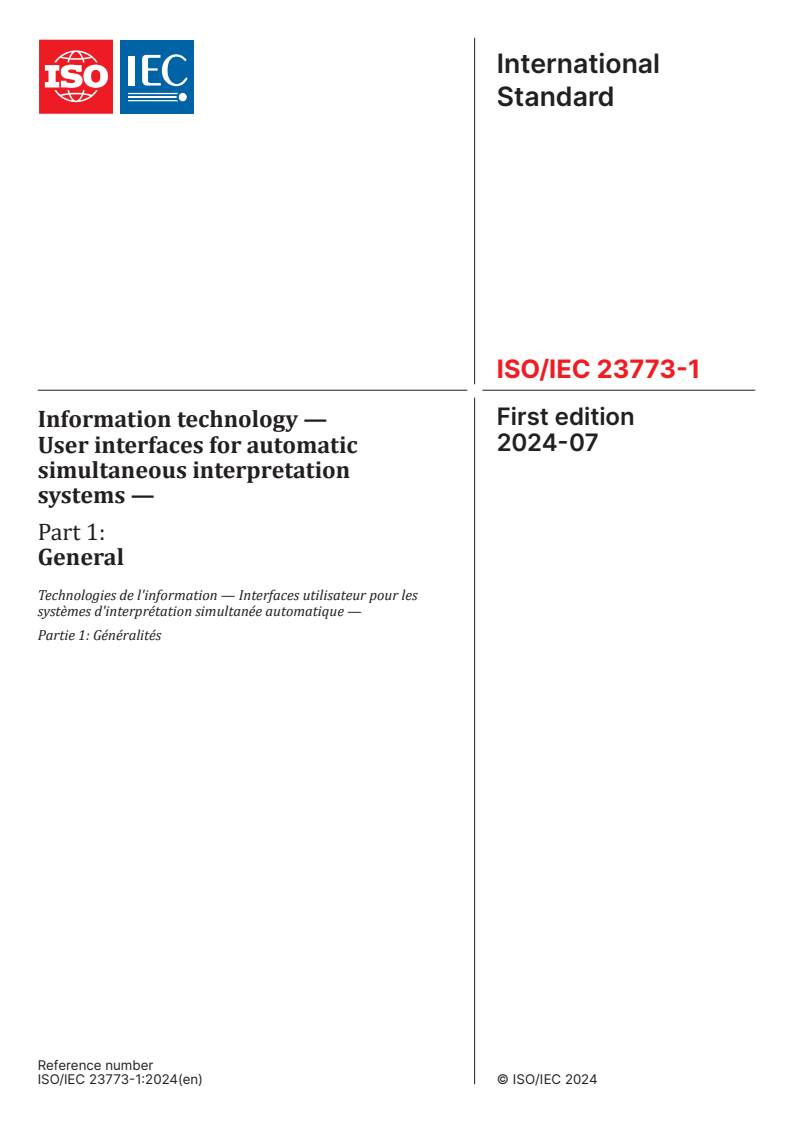
International
Standard
ISO/IEC 23773-1
First edition
Information technology —
2024-07
User interfaces for automatic
simultaneous interpretation
systems —
Part 1:
General
Technologies de l'information — Interfaces utilisateur pour les
systèmes d'interprétation simultanée automatique —
Partie 1: Généralités
Reference number
© ISO/IEC 2024
All rights reserved. Unless otherwise specified, or required in the context of its implementation, no part of this publication may
be reproduced or utilized otherwise in any form or by any means, electronic or mechanical, including photocopying, or posting on
the internet or an intranet, without prior written permission. Permission can be requested from either ISO at the address below
or ISO’s member body in the country of the requester.
ISO copyright office
CP 401 • Ch. de Blandonnet 8
CH-1214 Vernier, Geneva
Phone: +41 22 749 01 11
Email: copyright@iso.org
Website: www.iso.org
Published in Switzerland
© ISO/IEC 2024 – All rights reserved
ii
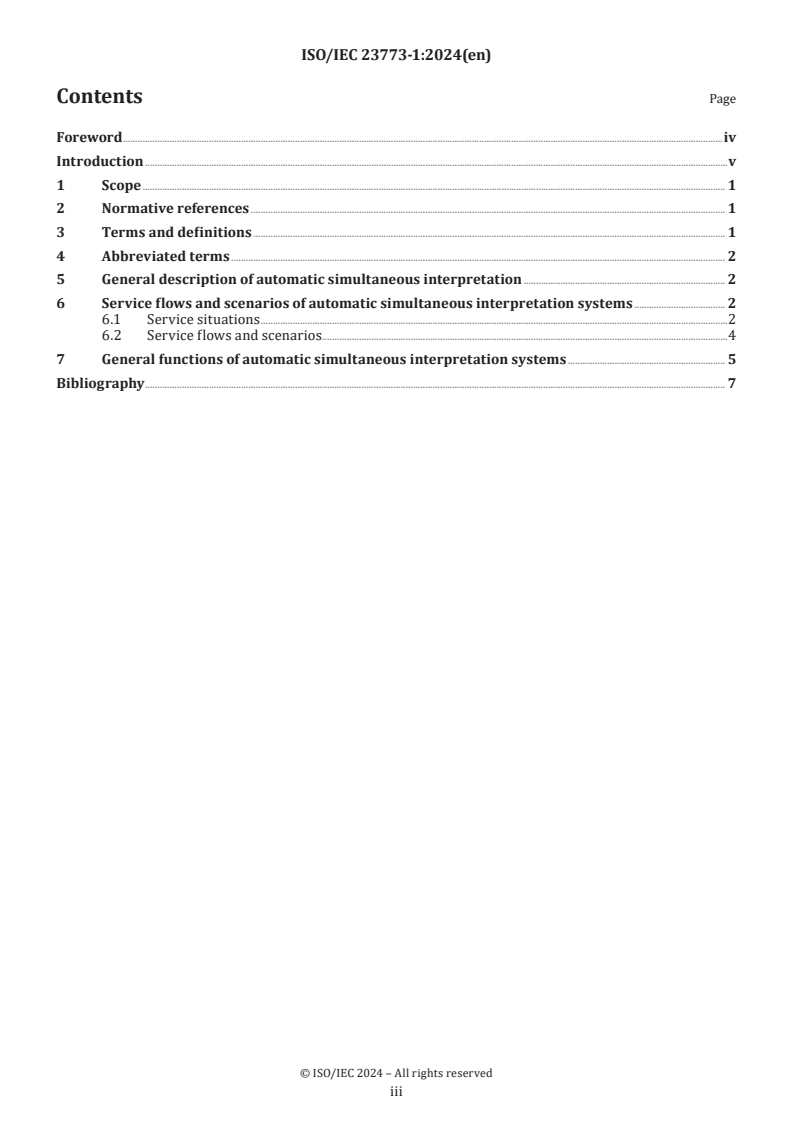
Contents Page
Foreword .iv
Introduction .v
1 Scope . 1
2 Normative references . 1
3 Terms and definitions . 1
4 Abbreviated terms . 2
5 General description of automatic simultaneous interpretation . 2
6 Service flows and scenarios of automatic simultaneous interpretation systems . 2
6.1 Service situations .2
6.2 Service flows and scenarios .4
7 General functions of automatic simultaneous interpretation systems . 5
Bibliography . 7
© ISO/IEC 2024 – All rights reserved
iii
Foreword
ISO (the International Organization for Standardization) and IEC (the International Electrotechnical
Commission) form the specialized system for worldwide standardization. National bodies that are
members of ISO or IEC participate in the development of International Standards through technical
committees established by the respective organization to deal with particular fields of technical activity.
ISO and IEC technical committees collaborate in fields of mutual interest. Other international organizations,
governmental and non-governmental, in liaison with ISO and IEC, also take part in the work.
The procedures used to develop this document and those intended for its further maintenance are described
in the ISO/IEC Directives, Part 1. In particular, the different approval criteria needed for the different types
of document should be noted. This document was drafted in accordance with the editorial rules of the ISO/
IEC Directives, Part 2 (see www.iso.org/directives or www.iec.ch/members_experts/refdocs).
ISO and IEC draw attention to the possibility that the implementation of this document may involve the
use of (a) patent(s). ISO and IEC take no position concerning the evidence, validity or applicability of any
claimed patent rights in respect thereof. As of the date of publication of this document, ISO and IEC had not
received notice of (a) patent(s) which may be required to implement this document. However, implementers
are cautioned that this may not represent the latest information, which may be obtained from the patent
database available at www.iso.org/patents and https://patents.iec.ch. ISO and IEC shall not be held
responsible for identifying any or all such patent rights.
Any trade name used in this document is information given for the convenience of users and does not
constitute an endorsement.
For an explanation of the voluntary nature of standards, the meaning of ISO specific terms and expressions
related to conformity assessment, as well as information about ISO's adherence to the World Trade
Organization (WTO) principles in the Technical Barriers to Trade (TBT) see www.iso.org/iso/foreword.html.
In the IEC, see www.iec.ch/understanding-standards.
This document was prepared by Joint Technical Committee ISO/IEC JTC 1, Information technology,
Subcommittee SC 35, User interfaces.
A list of all parts in the ISO/IEC 23773 series can be found on the ISO and IEC websites.
Any feedback or questions on this document should be directed to the user’s national standards
body. A complete listing of these bodies can be found at www.iso.org/members.html and
www.iec.ch/national-committees.
© ISO/IEC 2024 – All rights reserved
iv
Introduction
Communication between users of different languages is a global trend that is increasing. Real-time, automatic
simultaneous interpretation is needed for different applications such as video calls, live lecture translation
and wearable translation devices. Market demands for real-time automatic simultaneous interpretation
of free-style continuous utterances in the travel sector, global event management, phone calls, lectures or
meetings are also increasing. A standardized user interface (UI) for automatic simultaneous interpretation
systems fulfils these different needs for communication.
The ISO/IEC 23773 series consists of the following parts:
ISO/IEC 23773-1 (this document) provides a general description of automatic simultaneous interpretation
systems designed to interoperate among different natural languages for spontaneous speech and texts.
ISO/IEC 23773-2 provides the requirements and functional components for the UI of automatic simultaneous
interpretation systems.
ISO/IEC 23773-3 provides a reference architecture for automatic simultaneous interpretation systems
including functional modules and communication interfaces in a high-level approach.
© ISO/IEC 2024 – All rights reserved
v
International Standard ISO/IEC 23773-1:2024(en)
Information technology — User interfaces for automatic
simultaneous interpretation systems —
Part 1:
General
1 Scope
This document provides the general description of real-time automatic simultaneous interpretation systems
designed to interoperate among different natural languages for spontaneous speech.
While traditional speech to speech machine translation addresses the functional equivalent of consecutive
interpretation, this document focuses on the functional equivalent of simultaneous interpretation.
This document does not cover sign language interpr
...