

ISO/TS 4640
(Main)Dentistry — Test methods for tensile bond strength to tooth structure
- Abstract
This document gives guidance on substrate selection, storage and handling as well as essential characteristics of tensile bond strength test methods for quality testing of the adhesive bond between restorative dental materials and tooth structure, i.e. enamel and dentine. Some specific test methods for tensile bond strength measurements are given in Annex A. This document does not include requirements for components of adhesive materials and their performance.
- Status
- Not Published
- Technical Committee
- ISO/TC 106/SC 1 - Filling and restorative materials
- Drafting Committee
- ISO/TC 106/SC 1/WG 11 - Adhesion test methods
- Current Stage
- 6000 - International Standard under publication - 60 Publication
- Start Date
- 23-Oct-2026
Buy Documents
ISO/DTS 4640 - Dentistry — Test methods for tensile bond strength to tooth structure
REDLINE ISO/DTS 4640 - Dentistry — Test methods for tensile bond strength to tooth structure
ISO/TS 4640 is an ISO Technical Specification from the International Organization for Standardization on dentistry test methods for tensile bond strength to tooth structure. It covers how to select, store and handle tooth substrates and how to run laboratory tests for the adhesive bond between restorative dental materials and enamel or dentine. Annex A gives examples of specific published tensile bond strength methods for use in quality testing and comparative laboratory work.
What does ISO/TS 4640 specify?
ISO/TS 4640 specifies the substrate selection, storage and handling needed for tensile bond strength testing, together with the essential features of the test methods themselves. The focus is the laboratory measurement of the adhesive bond between restorative dental materials and tooth structure, not the formulation or performance of adhesive material components.
The document is organized into:
- Scope
- Normative references
- Terms and definitions
- Sampling
- Test methods
- Informative Annex A with example test methods
- Bibliography
Annex A gives examples of published tensile bond strength methods rather than a single mandatory apparatus or geometry. That matters in practice because laboratories can compare results using a controlled framework while still choosing an appropriate published setup for their materials and equipment.
What are the key requirements of ISO/TS 4640?
ISO/TS 4640 puts most of its practical control points in Clause 5, because tensile bond strength results are very sensitive to specimen preparation, alignment and bonded area. The standard is built around keeping those variables under control so that the measured force can be converted into a meaningful stress value.
Sampling and specimen set-up
- Clause 4 requires enough test material for all planned tests, and the samples shall come from the same batch. In practice, this reduces batch-to-batch variation when comparing adhesives or test conditions.
- Clause 5.4.1 requires at least 10 specimens, and the procedures shall be done at (23 ± 2) °C and (50 ± 10) % relative humidity. That gives a minimum data set and a controlled laboratory environment for repeatable results.
Tooth substrate selection and storage
- Clause 5.2 allows human permanent premolars/molars or bovine mandibular incisors, with bovine donors not more than five years old. For human dentine, buccal superficial dentine close to enamel is recommended to reduce variation.
- Teeth should ideally be tested immediately after extraction, and teeth used within six months after extraction are acceptable. The practical point is to limit post-extraction changes that can alter bond strength.
- Clean extracted teeth promptly, then store prepared teeth in distilled water of grade 3 or in chloramine-T trihydrate solution for a limited time before transfer to refrigerated distilled water. No other chemical agents shall be used, because they can change tooth behaviour.
Surface preparation and bonding area control
- Clause 5.3 requires a reproducible flat surface, and the tooth shall stay wet during preparation. Dentine is especially sensitive to dehydration, so drying can distort the test outcome.
- For bovine teeth, the pulp chamber shall be blocked to prevent resin penetration, and the tooth shall be mounted rigidly to control planing angle and surface geometry.
- The surface is prepared by planing with abrasive paper finished with P600 under running water, then checking that the surface is even, smooth and free of cracks or perforations. This standardizes the surface before bonding.
Adhesive application and curing
- Clause 5.4 requires preconditioning of the prepared surface according to the manufacturer’s instructions, or otherwise rinsing and gently removing visible water immediately before application.
- The bonded area shall be limited, because tensile bond strength increases as the bonded surface gets smaller. This is important because bonded area changes can strongly affect the measured value.
- If a holder is used, it must align the specimen, limit the bonded area and, for light-curing materials, allow enough light through. If the manufacturer specifies a restorative material for use with the adhesive, the same restorative material shall be used for all tests of that adhesive.
Storage, ageing and test conditions
- Clause 5.5 specifies storage in water at (37 ± 2) °C before testing. A 24 h water storage is the short-term condition, thermocycling between 5 °C and 55 °C is an accelerated ageing option, and long-term storage is six months in water.
- For thermocycling, the document gives 500 cycles, with defined bath and transfer times. After any water treatment, the specimen shall be tested immediately.
- Clause 5.6 requires apparatus that can mount the specimen without adding tensile, bending, shear or torsional load, with a rigid construction and correct alignment.
- The tensile force shall be applied at 90° to the planed substrate surface, using a universal joint, chain or wire as the connecting device.
- Clause 5.8 gives the standard crosshead speed as (0.75 ± 0.30) mm/min. That speed controls how fast the bond is pulled apart and helps make results comparable.
Results and reporting
- Clause 5.9 requires recording the maximum force before failure and converting it to stress using the bonding area. If debonding happens before the tensile test, the result is treated as 0.0 MPa unless the cause is clearly mishandling.
- The bond strength results shall be statistically analysed because they commonly show large variation. If the coefficient of variation is above 50 %, the whole procedure should be checked.
- Clause 5.10 requires reporting the method used, the substrate, preservation and storage conditions, adhesive and adherend details, curing conditions, individual values, sample size, mean, standard deviation, deviations, unusual features, laboratory identity and dates. In practice, this is the information needed to judge whether two test series are truly comparable.
What terms does ISO/TS 4640 define?
- adhere - to be in a state of adhesion.
- adherend - the body held, or intended to be held, to another body by an adhesive.
- adhesion - the state in which two surfaces are held together by chemical, physical, or both kinds of force with the aid of an adhesive.
- adhesive - a substance capable of holding materials together.
- bond strength - the force per unit area needed to break a bonded assembly, with failure occurring in or near the adhesive or adherend interface.
- substrate - the material on whose surface an adhesive is spread for bonding or coating.
Who uses ISO/TS 4640?
ISO/TS 4640 is used by dental materials laboratories, adhesive manufacturers, and quality control teams that need to compare restorative dental materials under laboratory conditions. It is also useful for researchers studying enamel and dentine bonding, and for test laboratories that prepare specimens, run tensile tests and report bond strength data.
In practice, users apply it to:
- substrate selection and storage
- specimen preparation and alignment
- durability screening by water storage or thermocycling
- comparative testing of adhesive systems
- reporting laboratory bond strength results for internal quality work
What changed in ISO/TS 4640 from the previous edition?
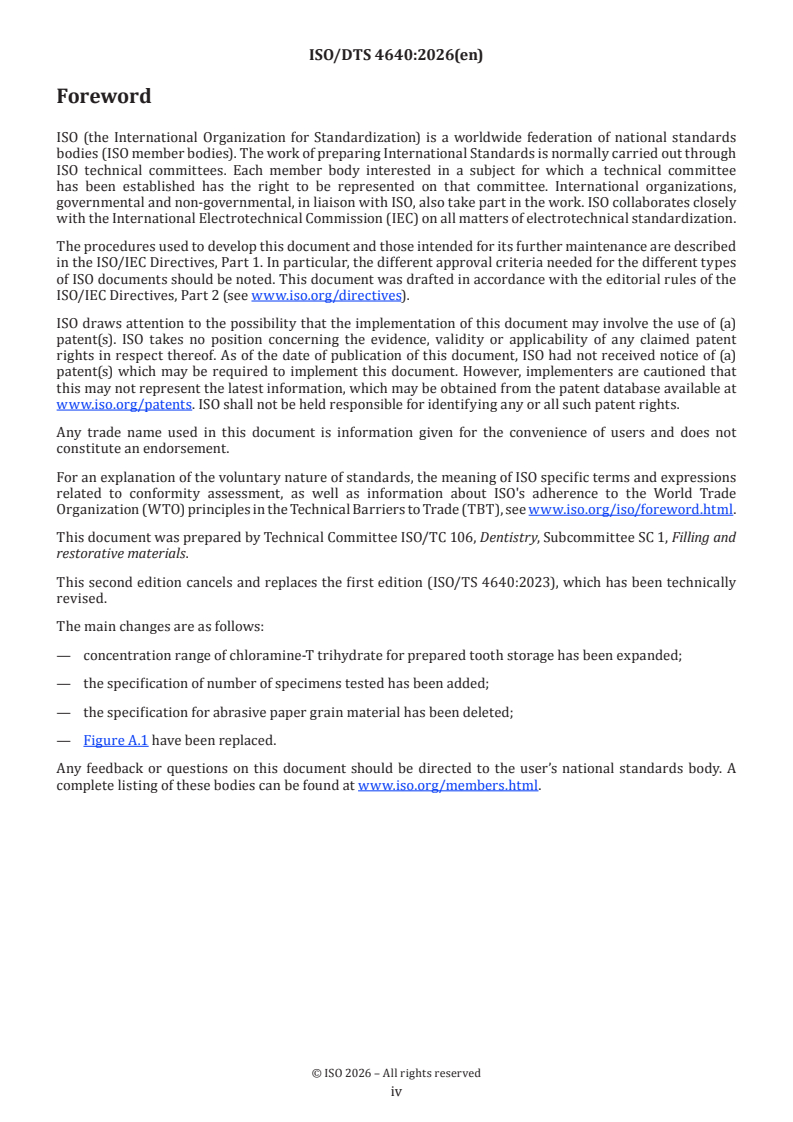
ISO/TS 4640:2026 cancels and replaces ISO/TS 4640:2023 and is technically revised. The stated changes are:
- the concentration range of chloramine-T trihydrate for prepared tooth storage has been expanded
- the number of specimens tested has been specified
- the specification for abrasive paper grain material has been deleted
- the photographs of Figure A.1 have been replaced
Which standards are used with ISO/TS 4640?
ISO/TS 4640 cites these standards in its normative references:
- ISO 1942, Dentistry - Vocabulary - provides the general dentistry terminology used with the document’s defined terms.
- ISO 3696, Water for analytical laboratory use - Specification and test methods - provides the water quality required for tooth storage.
- ISO 6344-3, Coated abrasives - Determination and designation of grain size distribution - Part 3: Microgrit sizes P240 to P5000 - defines the abrasive paper grading used for surface preparation.
The introduction also points readers to ISO 29022 for the notched-edge shear bond strength test, which helps users place this tensile method alongside a shear-bond method when comparing dental adhesion test approaches.
What does the ISO/TS 4640 document contain?
ISO/TS 4640 contains the full laboratory workflow for tensile bond strength testing: sampling, tooth preparation, surface planing, adhesive application, specimen storage, apparatus alignment, tensile loading, result calculation and reporting. It also contains the key formula for converting maximum force into bond strength and the reporting items needed to document a test series.
Annex A contains four illustrated example methods:
- Kemper and Killian’s test method
- Bencor’s test method
- Dumbbell test
- Micro-tensile test
The annex includes figures and stepwise specimen-preparation descriptions for these methods, which are useful when setting up equipment, designing fixtures or choosing a test geometry for a particular adhesive system.
Relations
- Effective Date
- 07-Jan-2025
Buy Documents
ISO/DTS 4640 - Dentistry — Test methods for tensile bond strength to tooth structure
REDLINE ISO/DTS 4640 - Dentistry — Test methods for tensile bond strength to tooth structure
Get Certified
Connect with accredited certification bodies for this standard

BSI Group
BSI (British Standards Institution) is the business standards company that helps organizations make excellence a habit.

TÜV Rheinland
TÜV Rheinland is a leading international provider of technical services.

TÜV SÜD
TÜV SÜD is a trusted partner of choice for safety, security and sustainability solutions.
Sponsored listings
Frequently Asked Questions
ISO/TS 4640 is a draft published by the International Organization for Standardization (ISO). Its full title is "Dentistry — Test methods for tensile bond strength to tooth structure". This standard covers: This document gives guidance on substrate selection, storage and handling as well as essential characteristics of tensile bond strength test methods for quality testing of the adhesive bond between restorative dental materials and tooth structure, i.e. enamel and dentine. Some specific test methods for tensile bond strength measurements are given in Annex A. This document does not include requirements for components of adhesive materials and their performance.
This document gives guidance on substrate selection, storage and handling as well as essential characteristics of tensile bond strength test methods for quality testing of the adhesive bond between restorative dental materials and tooth structure, i.e. enamel and dentine. Some specific test methods for tensile bond strength measurements are given in Annex A. This document does not include requirements for components of adhesive materials and their performance.
ISO/TS 4640 is classified under the following ICS (International Classification for Standards) categories: 11.060.10 - Dental materials. The ICS classification helps identify the subject area and facilitates finding related standards.
ISO/TS 4640 has the following relationships with other standards: It is inter standard links to ISO/TS 4640:2023. Understanding these relationships helps ensure you are using the most current and applicable version of the standard.
ISO/TS 4640 is available in PDF format for immediate download after purchase. The document can be added to your cart and obtained through the secure checkout process. Digital delivery ensures instant access to the complete standard document.
Standards Content (Sample)
Contents
- Introduction
- 1 Scope
- 2 Normative references
- 3 Terms and definitions
- 3.1 adhere
- 3.2 adherend
- 3.3 adhesion
- 3.4 adhesive
- 3.5 bond strength
- 3.6 substrate
- 4 Sampling
- 5 Test methods
- 5.1 General
- 5.2 Tooth substrate and storage
- 5.3 Tooth surface preparation
- 5.4 Application of adhesive
- 5.5 Storage of test specimens
- 5.6 Apparatus
- 5.7 Tensile loading
- 5.8 Test
- 5.9 Recording, treatment and analysis of results
- 5.10 Test report
- Annex A
- Bibliography
Introduction
Adhesion in restorative dentistry is an important topic. This document intends to describe various laboratory procedures of tensile bond strength tests whereby the effect or quality of a bond between a dental material and tooth structure can be substantiated.
Adhesive materials are used in many types of restorative and preventive treatments. Even if the stress on the bond in most circumstances can be defined as either tensile, shear or a combination of these, there are no specific laboratory tests which can be valid for all the various clinical applications of adhesive materials. The relative performance of materials that are claimed to bond to tooth structure is usually evaluated by laboratory assessment of bond strengths. While bond strengths are unable to predict clinical behaviour or performance, they are useful for comparing adhesive materials. [1] ISO 29022 prescribes the notched-edge shear bond strength test. Annex A lists several published laboratory methods for tensile bond strength measurement. Tensile bond strength testing is also common in general materials science. See Reference [2] for a list of many test methods.
FINAL DRAFT Technical Specification ISO/DTS 4640:2026(en) Dentistry — Test methods for tensile bond strength to tooth structure
1 Scope
This document specifies substrate selection, storage and handling as well as essential characteristics of tensile bond strength test methods for quality testing of the adhesive bond between restorative dental materials and tooth structure, i.e. enamel and dentine. Specific test methods for tensile bond strength measurements are given in Annex A.
This document does not include requirements for components of adhesive materials and their performance.
2 Normative references
The following documents are referred to in the text in such a way that some or all of their content constitutes requirements of this document. For dated references, only the edition cited applies. For undated references, the latest edition of the referenced document (including any amendments) applies. ISO 1942, Dentistry — Vocabulary ISO 3696, Water for analytical laboratory use — Specification and test methods ISO 6344-3, Coated abrasives — Determination and designation of grain size distribution — Part 3: Microgrit sizes P240 to P5000
3 Terms and definitions
For the purposes of this document, the terms and definitions given in ISO 1942 and the following apply. ISO and IEC maintain terminology databases for use in standardization at the following addresses:
- ISO Online browsing platform: available at https:// www .iso .org/ obp
- IEC Electropedia: available at https:// www .electropedia .org/
3.1 adhere
be in a state of adhesion (3.3)
3.2 adherend
body that is held or intended to be held to another body by an adhesive (3.4)
3.3 adhesion
state in which two surfaces are held together by either chemical or physical or both forces with the aid of an adhesive (3.4)
3.4 adhesive
substance capable of holding materials together
ISO/DTS 4640:2026(en)
3.5 bond strength
force per unit area required to break a bonded assembly with failure occurring in or near the adhesive (3.4) or adherend (3.2) interface
3.6 substrate
material upon the surface of which an adhesive (3.4) is spread for any purpose, such as bonding or coating
4 Sampling
The amount of test material shall be sufficient for all planned tests. The samples shall be from the same batch.
5 Test methods
5.1 General
Adhesive materials are used for many different purposes in the oral cavity. This document describes tensile bond strength tests. When bond strength is measured, the raw data are in unit of force (N). This shall be converted into a stress unit, i.e. force per unit area (MPa). Hence, it is important to control the area and roughness of the surface when applying the adhesive material.
The following two critical variables or factors shall be incorporated when designing test equipment and preparing specimens for tensile testing of bond strength:
a) alignment of the tensile forces acting on the specimen; b) limitation of the bonding area.
5.2 Tooth substrate and storage
5.2.1 Substrate
5.2.1.1 Types of the substrate
Use either human permanent premolars/molars or bovine mandibular incisors for the measurement of bond strength. The donor bovine shall not be more than five years old.
5.2.1.2 Characteristics of the substrate
When measuring bond strength to human dentine, it is recommended to use the buccal superficial dentine that is as close to the enamel as possible in order to reduce variations. Third permanent molars from 16- to 40-year-old individuals should be used.
5.2.2 Time after extraction
There is increasing evidence that changes in dentine occur after extraction that can influence bond strength measurements. The effect can vary with different types of bonding materials. Ideally, bond strengths should be measured immediately post-extraction.
NOTE Teeth within six months after extraction can be used. Teeth extracted more than six months prior to use undergo degenerative changes in dentinal proteins.
ISO/DTS 4640:2026(en)
5.2.3 Condition of teeth
5.2.3.1 History on clinical treatment (of human teeth)
Human teeth used for bond strength measurement shall be caries-free and preferably unrestored. However, small and superficial restorations not in the adhesion test area are permitted. Root-filled teeth shall not be used.
5.2.3.2 Site of the dentition and life-history of the donating patient (of human teeth)
There is some evidence to suggest that different teeth in the dentition can give different results with bonding to dentine and enamel. It is impossible to have complete control of variables (e.g. age of the donating patient, ethnicity, dietary history and state of health) or to standardize the composition and structure of the teeth.
5.2.4 Preparation and storage of teeth
5.2.4.1 Preparation of extracted teeth
Immediately after extraction, human teeth shall be thoroughly washed in running water. All blood and adherent tissue shall be removed using sharp hand instruments. Bovine teeth shall be cleaned as soon as possible after extraction. The soft tissue in the pulp chamber shall be removed in a similar fashion.
5.2.4.2 Storage of prepared teeth
Prepared teeth shall be placed in distilled water of grade 3 in accordance with ISO 3696 or in a 0,5 % to 1)
1,0 % chloramine-T trihydrate (CAS Registry Number 7080-50-4) bacteriostatic/bacteriocidal solution for a maximum of one week and thereafter stored in distilled water grade 3 in a refrigerator, i.e. nominal 4 °C. To minimize deterioration, the storage medium shall be replaced at least once every two months. No other chemical agents shall be used, as they can be absorbed by tooth substance and alter its behaviour. For prevention of viral infections, 2,0 % to 4,0 % chloramine-T trihydrate can be used. NOTE 1 Chloramine-T trihydrate is a strong oxidant and can oxidise polymerisation initiators, particularly reducing agents in chemical polymerisation initiator systems. The oxidation reaction affects the chemical polymerisation by [3] redox reaction between the oxidising agent and reducing agent and can reduce bond strength . NOTE 2 Information on hazardous properties of chloramine-T trihydrate can be referenced in the safety data sheet provided by the supplier.
5.3 Tooth surface preparation
5.3.1 Requirement for the surface of tooth to be adhered
A reproducible flat surface is required. Tooth surfaces shall be kept wet at all times during preparation. NOTE Exposure of the surface of prepared tooth to the air for several minutes can cause irreversible changes in bonding character. Dentine is especially sensitive to dehydration.
1) Chemical Abstracts Service (CAS) Registry Number is a trademark of the American Chemical Society (ACS). This information is given for the convenience of users of this document and does not constitute an endorsement by ISO of the product named. Equivalent products may be used if they can be shown to lead to the same results.
ISO/DTS 4640:2026(en)
5.3.2 Requirement for the procedure of preparation of tooth surface
5.3.2.1 Blocking of pulp chamber (for bovine teeth)
The pulp chamber of bovine teeth shall be blocked, for example by wax, to prevent penetration of resin into the dentine. Alternatively, use a high viscosity potting medium that does not penetrate the pulp chamber. NOTE This can be verified by preparing a set of potted teeth and examining the pulp chambers for the presence of polymerised resin.
5.3.2.2 Retention form in test tooth
Ensure that the tooth has form (undercuts, holes or retentive pins) that will secure retention in the mounting medium.
5.3.2.3 Mounting the prepared tooth in a holder
To control the planing and the angle of the surface during preparation, the test tooth shall be mounted and immobilised in a rigid holder by means of dental die stone or low exothermal-curing viscous resin. The temperature of the polymerising resin shall not exceed 42 °C.
NOTE The absorption of resin can adversely affect the tooth.
5.3.2.4 Storage of the mounted tooth
Place the mounted tooth in water at (23 ± 2) °C as soon as possible.
5.3.3 Surface preparation of tooth plane for adhesion
5.3.3.1 Procedure of planing
a) A standard surface shall be prepared by planing the exposed surface of the tooth against abrasive paper finally with a grit size of P600 as defined in ISO 6344-3 fixed on a hard and flat plate under running water.
NOTE The "P" prefix by the grit number means this coated abrasive conforms to the Federation of European Producers of Abrasives (FEPA) grading system, see Reference [4]. b) Grind until the surface is even and smooth.
...
Contents
- Introduction
- 2 Normative references
- 3 Terms and definitions
- 4 Sampling
- 5 Test methods
- 5.1 General
- 5.2 Tooth substrate and storage
- 5.3 Tooth surface preparation
- 5.4 Application of adhesive
- 5.5 Storage of test specimens
- 5.6 Apparatus
- 5.7 Tensile loading
- 5.8 Test
- 5.9 Recording, treatment and analysis of results
- 5.10 Test report
- Annex A
- 1 Poly (methyl methacrylate) (PMMA)
- Bibliography
Introduction
Formatted: HeaderCentered, Left, Space After: 0 pt, Line spacing: single Adhesion in restorative dentistry is an important topic. This document intends to describe various laboratory procedures of tensile bond strength tests whereby the effect or quality of a bond between a dental material and tooth structure can be substantiated.
Adhesive materials are used in many types of restorative and preventive treatments. Even if the stress on the bond in most circumstances can be defined as either tensile, shear or a combination of these, there are no specific laboratory tests which can be valid for all the various clinical applications of adhesive materials. The relative performance of materials that are claimed to bond to tooth structure is usually evaluated by laboratory assessment of bond strengths. While bond strengths are unable to predict clinical behaviour or performance, they are useful for comparing adhesive materials. [1] [1] ISO 29022 prescribes the notched-edge shear bond strength test. Annex AAnnex A lists several published laboratory methods for tensile bond strength measurement. [2] [2] Tensile bond strength testing is also common in general materials science. See Reference for a list of many test methods.
Formatted: Font: 10 pt Formatted: Font: 10 pt Formatted: FooterCentered, Left, Line spacing: single Formatted: Font: 11 pt Formatted: FooterPageRomanNumber, Left, Space After: 0 pt, Line spacing: single
ISO/TSDTS 4640:20##(E:(en) Formatted: Font: 11 pt, Bold Formatted: Font: 11 pt, Bold Formatted: Font: 11 pt, Bold Formatted: HeaderCentered, Left, Space After: 0 pt, Dentistry — Test methods for tensile bond strength to tooth structure Line spacing: single 1 Scope Formatted: Left: 1.5 cm, Right: 1.5 cm, Section start:
New page, Header distance from edge: 1.27 cm, Footer distance from edge: 0.5 cm This document specifies substrate selection, storage and handling as well as essential characteristics of tensile bond strength test methods for quality testing of the adhesive bond between restorative dental materials and Formatted: Space Before: 0 pt tooth structure, i.e. enamel and dentine. Specific test methods for tensile bond strength measurements are given in Annex AAnnex A.
This document does not include requirements for components of adhesive materials and their performance.
2 Normative references
Formatted: Space Before: 0 pt The following documents are referred to in the text in such a way that some or all of their content constitutes Formatted: Body Text requirements of this document. For dated references, only the edition cited applies. For undated references, the latest edition of the referenced document (including any amendments) applies. ISO 1942, Dentistry — Vocabulary ISO 3696, Water for analytical laboratory use — Specification and test methods ISO 6344-3, Coated abrasives — Determination and designation of grain size distribution — Part 3: Microgrit sizes P240 to P5000
3 Terms and definitions
Formatted: Space Before: 0 pt Formatted: Font: Font color: Auto For the purposes of this document, the terms and definitions given in ISO 1942 and the following apply. Formatted: Body Text ISO and IEC maintain terminology databases for use in standardization at the following addresses:
Formatted: No underline, Font color: Auto - ISO Online browsing platform: available at https://www.iso.org/obphttps://www.iso.org/obp Formatted: List Continue 1, No bullets or numbering, Don't keep with next - IEC Electropedia: available at https://www.electropedia.org/https://www.electropedia.org/ Formatted: No underline, Font color: Auto Formatted: List Continue 1, Space After: 0 pt, No 3.1 3.1 bullets or numbering, Don't keep with next adhere be in a state of adhesion (3.3(3.3) Formatted: TermNum2 Formatted: Space After: 0 pt 3.2 3.2 Formatted: TermNum2 adherend body that is held or intended to be held to another body by an adhesive (3.4(3.4) Formatted: Space After: 0 pt Formatted: TermNum2 3.3 3.3 Formatted: Space After: 0 pt adhesion state in which two surfaces are held together by either chemical or physical, or both forces with the aid of an Formatted: TermNum2 adhesive (3.4(3.4) Formatted: Space After: 0 pt 3.4 3.4 Formatted: Font: 10 pt adhesive Formatted: Font: 10 pt substance capable of holding materials together Formatted: FooterCentered, Left, Line spacing: single Formatted: Font: 11 pt Formatted: FooterPageNumber, Left, Space After: 0 pt, Line spacing: single
ISO #####-#:####(X/DTS 4640:(en) Formatted: Font: 11 pt, Bold Formatted: Font: 11 pt, Bold Formatted: HeaderCentered, Left, Space After: 0 pt, 3.5 3.5 Line spacing: single bond strength Formatted: TermNum2 force per unit area required to break a bonded assembly with failure occurring in or near the adhesive (3.4)/(3.4) or adherend (3.2(3.2) interface Formatted: Space After: 0 pt 3.6 3.6 Formatted: TermNum2 substrate Formatted: Space After: 0 pt material upon the surface of which an adhesive (3.4(3.4) is spread for any purpose, such as bonding or coating
4 Sampling
Formatted: Space Before: 0 pt, Line spacing: single The amount of test material shall be sufficient for all planned tests and. The samples shall be from the same batch.
5 Test methods
Formatted: Space Before: 0 pt
5.1 General
Formatted: Line spacing: single Adhesive materials are used for many different purposes in the oral cavity. This document describes tensile bond strength tests. When bond strength is measured, the raw data are in unit of force (N). This shall be converted into a stress unit, i.e. force per unit area (MPa). Hence, it is important to control the area and roughness of the surface when applying the adhesive material.
The following two critical variables or factors shall be incorporated when designing test equipment and Formatted: Font color: Auto preparing specimens for tensile testing of bond strength:
a) alignment of the tensile forces acting on the specimen; Formatted: Numbered + Level: 1 + Numbering Style: a, b, c, … + Start at: 1 + Alignment: Left + Aligned at: 0 b) limitation of the bonding area.
cm + Indent at: 0 cm
5.2 Tooth substrate and storage
Formatted: Indent: Left: 0 cm, First line: 0 cm
5.2.1 Substrate
5.2.1.1 Types of the substrate
Formatted: Indent: Left: 0 cm, First line: 0 cm Use either human permanent premolars/molars or bovine mandibular incisors for the measurement of bond strength. The donor bovine shall not be more than five years old.
5.2.1.2 Characteristics of the substrate
Formatted: Indent: Left: 0 cm, First line: 0 cm When measuring bond strength to human dentine, it is recommended to use the buccal superficial dentine that is as close to the enamel as possible in order to reduce variations. Third permanent molars from 16- to 40-year-old individuals should be used.
Formatted: Font color: Auto
5.2.2 Time after extraction
There is increasing evidence that changes in dentine occur after extraction that can influence bond strength measurements. The effect can vary with different types of bonding materials. Ideally, bond strengths should be measured immediately post-extraction.
Formatted: Font: 10 pt NOTE Teeth within six months after extraction can be used. Teeth extracted more than six months prior to use Formatted: Font: 10 pt undergo degenerative changes in dentinal proteins.
Formatted: Font: 11 pt Formatted: FooterPageNumber, Space After: 0 pt, Line spacing: single
ISO/TSDTS 4640:20##(E:(en) Formatted: Font: 11 pt, Bold Formatted: Font: 11 pt, Bold Formatted: Font: 11 pt, Bold
5.2.3 Condition of teeth
Formatted: HeaderCentered, Left, Space After: 0 pt, Line spacing: single
5.2.3.1 History on clinical treatment (of human teeth)
Formatted: Dutch (Netherlands) Human teeth used for bond strength measurement shall be caries-free and preferably unrestored. However, Formatted: Indent: Left: 0 cm, First line: 0 cm small and superficial restorations not in the adhesion test area are permitted. Root-filled teeth shall not be used.
5.2.3.2 Site of the dentition and life-history of the donating patient (of human teeth)
Formatted: Dutch (Netherlands) Formatted: Indent: Left: 0 cm, First line: 0 cm There is some evidence to suggest that different teeth in the dentition can give different results with bonding to dentine and enamel. It is impossible to have complete control of variables (e.g. age of the donating patient, ethnicity, dietary history and state of health) or to standardize the composition and structure of the teeth.
5.2.4 Preparation and storage of teeth
5.2.4.1 Preparation of extracted teeth
Formatted: Indent: Left: 0 cm, First line: 0 cm Immediately after extraction, human teeth shall be thoroughly washed in running water. All blood and adherent tissue shall be removed using sharp hand instruments. Bovine teeth shall be cleaned as soon as possible after extraction. The soft tissue in the pulp chamber shall be removed in a similar fashion.
5.2.4.2 Storage of prepared teeth
Prepared teeth shall be placed in distilled water of grade 3 in accordance with ISO 3696 or in a 0,5 % to 1,0 % Formatted: Line spacing: single ®11) chloramine-T trihydrate (CAS Registry Number 7080-50-4) bacteriostatic/bacteriocidal solution for a Formatted: Footnote Reference, Not Superscript/ maximum of one week and thereafter stored in distilled water grade 3 in a refrigerator, i.e. nominal 4 °C. To Subscript minimize deterioration, the storage medium shall be replaced at least once every two months. Formatted: Not Superscript/ Subscript No other chemical agents shall be used, as they can be absorbed by tooth substance and alter its behaviour. Formatted: Font color: Auto For prevention of viral infections, 2.,0 % to 4.,0 % chloramine-T trihydrate can be used. Formatted: Body Text, Line spacing: single, Tab stops:
Not at 1.75 cm NOTE 1 Chloramine-T trihydrate is a strong oxidant and can oxidise polymerisation initiators, particularly reducing agents in chemical polymerisation initiator systems. The oxidation reaction affects the chemical polymerisation by redox [3] [3] reaction between the oxidising agent and reducing agent and can reduce bond strength. . Formatted: Not Superscript/ Subscript NOTE 2 Information on hazardous properties of chloramine-T trihydrate maycan be referenced in the SDS (Safety Formatted: Font color: Auto Data Sheet)safety data sheet provided by the supplier.
Formatted: Font color: Auto
5.3 Tooth surface preparation
Formatted: Adjust space between Latin and Asian text, Adjust space between Asian text and numbers, Tab
5.3.1 Requirement for the surface of tooth to be adhered
stops: Not at 1.75 cm Formatted: Indent: Left: 0 cm, First line: 0 cm A reproducible flat surface is required. Tooth surfaces shall be kept wet at all times during preparation. Formatted: Dutch (Netherlands) NOTE Exposure of the surface of prepared tooth to the air for several minutes can cause irreversible changes in bonding character. Dentine is especially sensitive to dehydration. Formatted: Font: 10 pt 1) ® Chemical Abstracts Service (CAS) Registry Number is a trademark of the American Chemical Society (ACS). This Formatted: Font: 10 pt information is given for the convenience of users of this document and does not constitute an endorsement by ISO of the product named. Equivalent products may be used if they can be shown to lead to the same results. Formatted: FooterCentered, Left, Line spacing: single 1) ® Chemical Abstracts Service (CAS) Registry Number is a trademark of the American Chemical Society (ACS). This Formatted: Font: 11 pt information is given for the convenience of users of this document and does not constitute an endorsement by ISO of the product named. Equivalent products may be used if they can be shown to lead to the same results. Formatted: FooterPageNumber, Left, Space After: 0 pt,
Line spacing: single
ISO #####-#:####(X/DTS 4640:(en) Formatted: Font: 11 pt, Bold Formatted: Font: 11 pt, Bold Formatted: HeaderCentered, Left, Space After: 0 pt,
5.3.2 Requirement for the procedure of preparation of tooth surface
Line spacing: single Formatted: Dutch (Netherlands)
5.3.2.1 Blocking of pulp chamber (for bovine teeth)
Formatted: Indent: Left: 0 cm, First line: 0 cm The pulp chamber of bovine teeth shall be blocked, for example by wax, to prevent penetration of resin into the dentine. Alternatively, use a high viscosity potting medium that does not penetrate the pulp chamber. NOTE This can be verified by preparing a set of potted teeth and examining the pulp chambers for the presence of polymerised resin.
5.3.2.2 Retention form in test tooth
Formatted: Indent: Left: 0 cm, First line: 0 cm Ensure that the tooth has form (undercuts, holes or retentive pins) that will secure retention in the mounting medium.
5.3.2.3 Mounting the prepared tooth in a holder
Formatted: Dutch (Netherlands) Formatted: Indent: Left: 0 cm, First line: 0 cm To control the planing and the angle of the surface during preparation, the test tooth shall be mounted and immobilised in a rigid holder by means of dental die stone or low exothermal-curing viscous resin. The temperature of the polymerising resin shall not exceed 42 °C.
NOTE The absorption of resin can adversely affect the tooth.
5.3.2.4 Storage of the mounted tooth
Formatted: Indent: Left: 0 cm, First line: 0 cm Place the mounted tooth in water at (23 ± 2) °C as soon as possible.
5.3.3 Surface preparation of tooth plane for adhesion
Formatted: Dutch (Netherlands)
5.3.3.1 Procedure of planing
Formatted: Indent: Left: 0 cm, First line: 0 cm a) A standard surface shall be prepared by planing the exposed surface of the tooth against abrasive paper Formatted: Space After: 0 pt, Numbered + Level: 1 + finally with a grit size of P600 as defined in ISO 6344-3 fixed on a hard and flat plate under running water. Numbering Style: a, b, c, … + Start at: 1 + Alignment:
Left + Aligned at: 0 cm + Indent at: 0 cm NOTE The "P" prefix by the grit number means this coated abrasive conforms to the Federation of European [4] [4] Producers of Abrasives (FEPA) grading system, see Reference. . Formatted: Font: 10 pt, Font color: Auto b) Grind until the surface is even and smooth.
Formatted: Numbered + Level: 1 + Numbering Style: a, b, c, … + Start at: 2 + Alignment: Left + Aligned at: 0
5.3.3.2 Inspection and treatment
cm + Indent at: 0 cm Formatted: Indent: Left: 0 cm, First line: 0 cm a) When inspected visually, the surface shall be even and smooth. Formatted: Numbered + Level: 1 + Numbering Style: a, b, c, … + Start at: 1 + Alignment: Left + Aligned at: 0 b) Discard teeth that have perforations into the pulp chamber. cm + Indent at: 0 cm c) Discard teeth that have craze lines and cracks. Inspection can be carried out under light microscopy and external fibre optic lighting.
Formatted: Indent: Left: 0 cm, First line: 0 cm d) Ensure that the surface is confined to enamel or dentine.
Formatted: Line spacing: single
5.4 Application of adhesive
Formatted: Body Text Formatted: Font: 10 pt
5.4.1 General
Formatted: Font: 10 pt
5.4.1.1 Specimens
Formatted: Font: 11 pt Formatted: FooterPageNumber, Space After: 0 pt, Line Prepare at least 10 specimens. Multiple teeth are used for micro-tensile test. spacing: single
ISO/TSDTS 4640:20##(E:(en) Formatted: Font: 11 pt, Bold Formatted: Font: 11 pt, Bold Formatted: Font: 11 pt, Bold 5.4.1.15.4.1.2 Ambient conditions Formatted: HeaderCentered, Left, Space After: 0 pt, Line spacing: single All of the procedures shall be performed at (23 ± 2) °C and (50 ± 10) % relative humidity. Formatted: Indent: Left: 0 cm, First line: 0 cm 5.4.1.25.4.1.3 Preconditioning of the prepared surface of the tooth Formatted: Dutch (Netherlands) The tooth surface prepared for application of adhesive material shall be preconditioned according to the manufacturer’s instructions. If no instructions are given, rinse with running water for 10 s and remove visible water on the surface with a filter paper or by a light/ or brief stream of oil-free compressed air immediately before application of the adhesive material.
5.4.1.35.4.1.4 Application of the adhesive material Formatted: Indent: Left: 0 cm, First line: 0 cm Mix if necessary. Apply the adhesive material according to the instructions given by the manufacturer.
5.4.2 Adhesive and/or adherend material in bulk
Formatted: Dutch (Netherlands) Formatted: Indent: Left: 0 cm, First line: 0 cm
5.4.2.1 Importance of limitation of the bonding area
Formatted: Font color: Auto Tensile bond strength (TBS) exhibits an inverse relationship with the bonding surface area;: as the bonding Formatted: Font color: Auto [5] [5] area becomes smaller, the tensile strength value becomes significantly greater . . This makes limiting the Formatted: Font color: Auto bonding area an important consideration.
Formatted: Body Text, Space After: 0 pt
...