


ISO 3577:1976
(Main)Animal fats — Determination of Boemer value
Animal fats — Determination of Boemer value
Graisses animales — Détermination de l'indice de Bömer
General Information
- Status
- Withdrawn
- Publication Date
- 31-May-1976
- Withdrawal Date
- 31-May-1976
- Technical Committee
- ISO/TC 34/SC 11 - Animal and vegetable fats and oils
- Drafting Committee
- ISO/TC 34/SC 11 - Animal and vegetable fats and oils
- Current Stage
- 9599 - Withdrawal of International Standard
- Start Date
- 01-Dec-1988
- Completion Date
- 14-Feb-2026
Relations
- Effective Date
- 15-Apr-2008
Get Certified
Connect with accredited certification bodies for this standard

BSI Group
BSI (British Standards Institution) is the business standards company that helps organizations make excellence a habit.

Bureau Veritas
Bureau Veritas is a world leader in laboratory testing, inspection and certification services.

DNV
DNV is an independent assurance and risk management provider.
Sponsored listings
Frequently Asked Questions
ISO 3577:1976 is a standard published by the International Organization for Standardization (ISO). Its full title is "Animal fats — Determination of Boemer value". This standard covers: Animal fats — Determination of Boemer value
Animal fats — Determination of Boemer value
ISO 3577:1976 is classified under the following ICS (International Classification for Standards) categories: 67.200.10 - Animal and vegetable fats and oils. The ICS classification helps identify the subject area and facilitates finding related standards.
ISO 3577:1976 has the following relationships with other standards: It is inter standard links to ISO 3577:1988. Understanding these relationships helps ensure you are using the most current and applicable version of the standard.
ISO 3577:1976 is available in PDF format for immediate download after purchase. The document can be added to your cart and obtained through the secure checkout process. Digital delivery ensures instant access to the complete standard document.
Standards Content (Sample)
INTERNATIONAL STANDARD
INTERNATIONAL ORGANIZATION FOR STANDARDIZATION .MEWYHAPOLIHAR OPrAHMJAUMII Il0 CTAHLIAPTWAUCIH *ORGANISATION INTERNATIONALE DE NORMALISATION
Animal fats - Determination of Borner value
Graisses animales - Détermination de l'indice de Borner
First edition - 1976-06-15
~~
Ref. No. IS0 3577-1976 (E)
UDC 665.222 : 543.85
Descriptors : animal products, animal fats, lard, chemical analysis, determination, Bomer number.
Price based on 4 Pages
FOREWORD
IS0 (the International Organization for Standardization) is a worldwide federation
of national standards institutes (IS0 Member Bodies). The work of developing
International Standards is carried out through IS0 Technical Committees. Every
Member Body interested in a subject for which a Technical Committee has been set
up has the right to be represented on that Committee. International organizations,
governmental and non-governmental, in liaison with ISO, also take part in the work.
Draft International Standards adopted by the Technical Committees are circulated
to the Member Bodies for approval before their acceptance as International
Standards by the IS0 Council.
International Standard IS0 3577 was drawn up by Technical Committee
ISWTC 34, Agricultural food products, and circulated to the Member Bodies in
April 1974.
It has been approved by the Member Bodies of the following countries :
Austria
Ghana Portuga I
Belgium
Hungary Romania
Brazil
India South Africa, Rep. of
Bulgaria
Iran Spain
Chile Ireland Turkey
Egypt, Arab Rep. of Israel United Kingdom
Ethiopia
Mexico Yugoslavia
France Netherlands
Germany Poland
The Member Body of the following country expressed disapproval of the
document on technical grounds :
Australia
O International Organization for Standardization, 1976 0
Printed in Switzerland
INTERNATIONAL STANDARD
IS0 3577-1976 (E)
Animai fats - Determination of Bomer value
of the fatty acids with diethyl ether (method I) or n-hexane
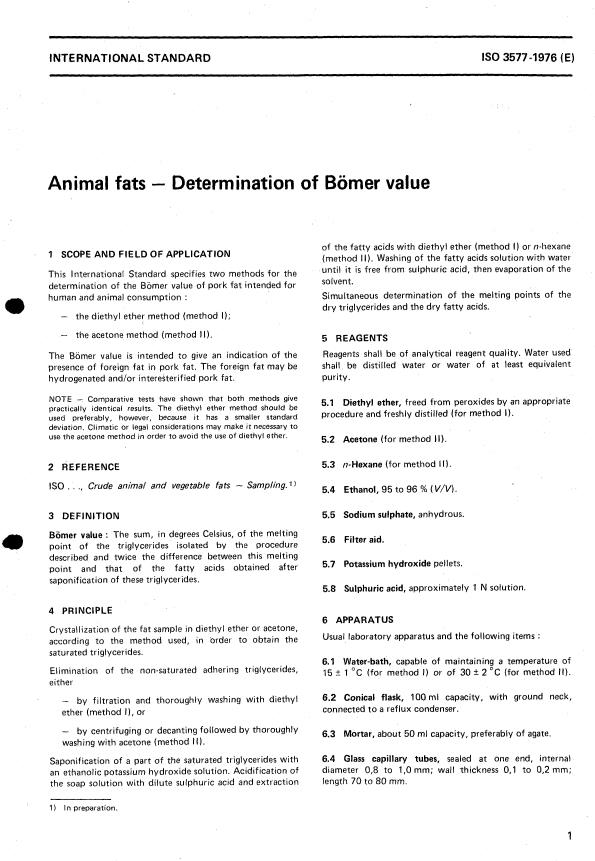
1 SCOPE AND FIELD OF APPLICATION
(method il). Washing of the fatty acids solution with water
until it is free from sulphuric acid, then evaporation of the
This International Standard specifies two methods for the
solvent.
determination of the Bomer value of pork fat intended for
human and animal consumption : Simultaneous determination of the melting points of the
dry triglycerides and the dry fatty acids.
- the diethyl ether method (method I);
- the acetone method (method Il).
5 REAGENTS
Reagents shall be of analytical reagent quality. Water used
The Bomer value is intended to give an indication of the
presence of foreign fat in pork fat. The foreign fat may be shall be distilled water or water of at least equivalent
hydrogenated and/or interesterified pork fat. purity .
NOTE - Comparative tests have shown that both methods give
5.1 Diethyl ether, freed from peroxides by an appropriate
practically identical results. The diethyl ether method should be
procedure and freshly distilled (for method I).
used preferably, however, because it has a smaller standard
legal considerations may make it necessary to
deviation. Climatic or
use. the acetone method in order to avoid the use of diethyl ether.
5.2 Acetone (for method Il).
5.3 n-Hexane (for method I I).
2 REFERENCE
IS0 . , ., Crude animal and vegetable fats - Sampling.1)
5.4 Ethanol, 95 to 96 % ( V/V).
3 DEFINITION 5.5 Sodium sulphate, anhydrous.
Bomer value : The sum, in degrees Celsius, of the melting
5.6 Filter aid.
point of the triglycerides isolated by the procedure
described and twice the difference between this melting
pellets.
5.7 Potassium hydroxide
point and that of the fatty acids obtained after
saponification of these triglycerides.
5.8 Sulphuric acid, approximately 1 N solution.
4 PRINCIPLE
6 APPARATUS
Crystallization of the fat sample in diethyl ether or acetone,
Usual laboratory apparatus and the following items :
according to the method used, in order to obtain the
saturated triglycerides.
6.1 Water-bath, capable of maintaining a temperature of
Elimination of the non-saturated adhering triglycerides,
15 it 1 OC (for method I) or of 30 +- 2 OC (for method Il).
either
6.2 Conical flask, 100 ml capacity, with ground neck,
- by filtration and thoroughly washing with diethyl
connected to a reflux condenser.
ether (method I), or
- by centrifuging or decanting followed by thoroughly
6.3 Mortar, about 50 ml capacity, preferably of agate.
washing with acetone (method Il).
6.4 Glass capillary tubes, sealed at one end, internal
Saponification of a part of the saturated triglycerides with
diameter 0,8 to 1,0 mm; wall thickness 0,l to 0,2 mm;
an ethanolic potassium hydroxide solution. Acidification of
length 70 to 80 mm.
the soap solution with dilute sulphuric acid and extraction
1 ) in preparation.
IS0 3577-1976 (E)
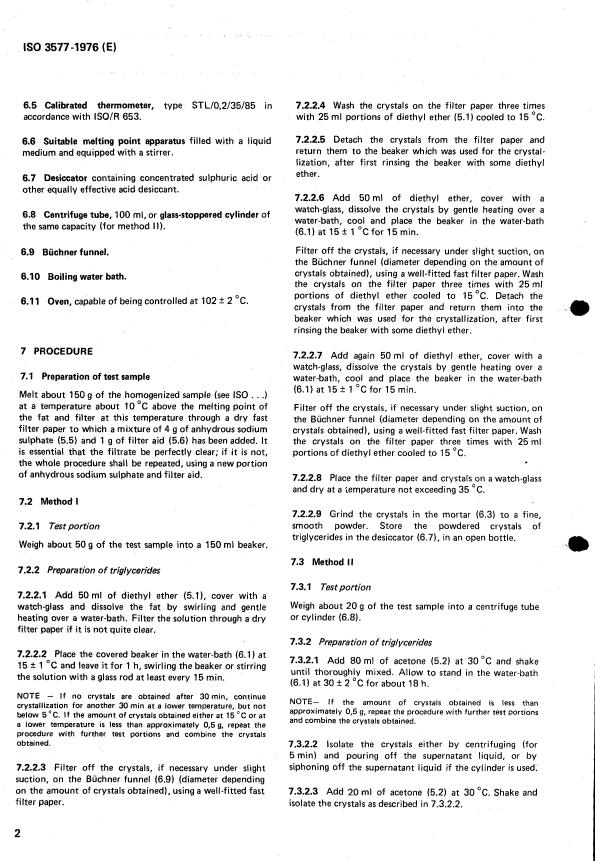
6.5 Calibrated thermometer, type STL/0,2/35/85 in 7.2.2.4 Wash the crystals on the filter paper three times
accordance with ISO/R 653. with 25 ml portions of diethyl ether (5.1) cooled to 15 "C.
7.2.2.5 Detach the crystals from the filter paper and
6.6 Suitable melting point apparatus filled with a liquid
return them to the beaker which was used for the crystal-
medium and equipped with a stirrer.
lization, after first rinsing the beaker with some diethyl
ether.
6.7 Desiccator containing concentrated sulphuric acid or
other equally effective acid desiccant.
7.2.2.6 Add 50 ml of diethyl ether, cover with a
watch-glass, dissolve the crystals by gentle heating over a
6.8 Centrifuge tube, 100 ml, or glass-stoppered cylinder of
water-bath, cool and place the beaker in the water-bath
the same capacity (for method il).
(6.1) at 15 k 1 OC for 15 min.
Filter off the crystals, if necessary under slight suction, on
6.9 Büchner funnel.
the Büchner funnel (diameter depending on the amount of
crystals obtained), using a well-fitted fast filter paper. Wash
6.10 Boiling water bath.
the crystals on the filter paper three times with 25 ml
portions of diethyl ether cooled to 15 OC. Detach the
6.11 Oven, capable of being controlled at 102 f 2 OC.
crystals from the filter paper and return them into the
beaker which was used for the crystallization, after first
rinsing the beaker with some diethyl ether.
7 PROCEDURE
7.2.2.7 Add again 50 ml of diethyl ether, cover with a
watch-glass, dissolve the crystals by gentle heating over a
7.1 Preparation of test sample
water-bath, cool and place the beaker in the water-bath
(6.1) at 15 f 1 "C for 15 min.
Melt about 150 g of the homogenized sample (see IS0 . . .)
at a temperature about 10°C above the melting point of
Filter off the crystals, if necessary under slight suction, on
the fat and filter at this temperature through a dry fast
the Büchner funnel (diameter depending on the amount of
filter paper to which a mixture of 4 g of anhydrous sodium
crystals obtained), using a well-fitted fast filter paper. Wash
sulphate (5.5) and 1 g of filter aid (5.6) has been added. It
the crystals on the filter paper three times with 25 ml
is essential that the filtrate be perfectly clear; if it is not,
portions of diethyl ether cooled to 15 OC.
the whole procedur
...
NORME' INTERNATIONALE 3577
INTERNATIONAL ORGANIZATION FOR STANDAROIZATION 44E)KRYHAPOIIHAII OPiAHMJAUMR Il0 CTAHAAPTRJAUHCI .ORGANISATION INTERNATIONALE DE NORMALISATION
'e' Graisses animales - Détermination de l'indice de Borner
Animal fats - Determination of Bomer value
Première édition - 1976-06-15
- U. CDU 665.222 : 543.85 Réf. no : IS0 3577-1976 (FI
b (D
Descripteurs : produit animal, corps gras animal, graisse de porc, analyse chimique, détermination, indice de Borner.
b
b
Co
M
Prix basé sur 4 pages
AVANT-PROPOS
L'ISO (Organisation Internationale de Normalisation) est une fédération mondiale
d'organismes nationaux de normalisation (Comités Membres ISO). L'élaboration des
Normes Internationales est confiée aux Comités Techniques ISO. Chaque Comité
Membre intéressé par une étude a le droit de faire partie du Comité Technique
correspondant. Les organisations internationales, gouvernementales et non
gouvernementales, en liaison avec I'ISO, participent également aux travaux.
Les Projets de Normes Internationales adoptés par les Comités Techniques sont
soumis aux Comités Membres pour approbation, avant leur acceptation coimme
Normes Internationales par le Conseil de I'ISO.
La Norme Internationale IS0 3577 a été établie par le Comité Technique
ISO/TC 34, Produits agricoles alimentaires, et soumise aux Comités Membres en
avril 1974.
Elle a été approuvée par les Comités Membres des pays suivants :
Afrique du Sud, Rép. d'
Éthiopie
Pays-Bas
Allemagne France
Pologne
Autriche
Ghana
Portugal
Belgique
Hongrie
Roumanie
Brésil
Inde
Royaume-Uni
Bulgarie
Iran
Turquie
Ch il i
Irlande
Y ou god av i e
Egypte, Rép. arabe d'
Israël
Espagne
Mexique
Le Comité Membre du suivant a
désapprouvé le document
pour des raisons
techniques
Australie
O Organisation Internationale de Normalisation, 1976
Imprimé en Suisse
NORME INTERNATIONALE I IS0 3577-1976 (F)
Graisses animales - Détermination de l'indice de Bomer
sulfurique dilué, et extraction des acides gras avec de
1 OBJET ET DOMAINE D'APPLICATION
l'oxyde diéthylique (méthode I) ou du n-hexane
La présente Norme Internationale spécifie deux méthodes
(méthode Il). Lavage de la solution d'acides gras avec de
pour la détermination de l'indice de Bomer d'une graisse de
l'eau jusqu'à élimination complète de l'acide sulfurique,
porc destinée aux consommations humaine et animale :
puis évaporation du solvant.
- méthode à l'oxyde diéthylique (méthode I);
Détermination simultanée des points de fusion des
- méthode à l'acétone (méthode Il). triglycérides et des acides gras séchés.
L'indice de Bomer est destiné à donner une indication sur la
présence de graisse étrangère dans la graisse de porc. Les
5 RÉACTIFS
graisses de porc hydrogénées et/ou transestérifiées sont
comprises dans les graisses étrangères.
Tous les réactifs doivent être de qualité analytique. L'eau
utilisée doit être de l'eau distillée OLJ de l'eau de pureté au
NOTE - Des essais comparatifs ont montré que les deux méthodes
donnaient des résultats pratiquement identiques. Cependant, la moins équivalente.
méthode a l'oxyde diéthylique doit être utilisée de préférence, parce
qu'elle a un plus petit écart type. Des considérations climatiques ou
5.1 Oxyde diéthylique, débarrassé de peroxydes selon un
légales peuvent nécessiter l'utilisation de la méthode a l'acétone, en
procédé approprié et distillé récemment (pour la
vue d'éviter l'usage de l'oxyde diéthylique.
méthode I).
2 RÉFÉRENCE
5.2 Acétone (pour la méthode Il).
IS0 . . ., Graisses brutes animales et végétales - Échantil-
5.3 n-Hexane (pour la méthode II).
lonnage. 1 )
5.4 Éthanol, de 95 à 96 % (V/V).
3 DÉFINITION
5.5 Sulfate de sodium, anhydre.
indice de Bomer : Somme, en degrés Celsius, de la tempé-
rature de fusion des triglycérides isolés suivant le procédé
décrit, et du double de la différence entre cette température 5.6 Adjuvant de filtration.
et celle des acides gras obtenus après saponifica-
de fusion
tion de ces triglycérides.
5.7 Hydroxyde de potassium, en pastilles.
5.8 Acide sulfurique, solution environ 1 N.
4 PRINCIPE
Critallisation de la graisse dans l'oxyde diéthylique ou
l'acétone, selon la méthode utilisée, afin d'obtenir les
6 APPAREILLAGE
triglycérides saturés.
Matériel courant de laboratoire, et notamment :
Élimination des triglycérides non saturés adhérents
Bain d'eau, réglable à 15 f 1 "C (pour la méthode
- soit par filtration et lavage complet à l'oxyde 6.1
ou à 30 * 2 "C (pour la méthode Il).
diéthylique (méthode I),
- soit par centrifugation ou décantation suivie d'un
6.2 Fiole conique, capacité 100 ml, à col rodé, munie d'un
lavage complet à l'acétone (méthode Il).
réfrigérant à reflux adaptable.
Saponification d'une partie des triglycérides saturés avec
une solution éthanolique d'hydroxyde de potassium. 6.3 Mortier, capacité environ 50 ml, de préférence en
Acidification de la solution de savon avec de l'acide
agate.
1) En préparation.
IS0 3577-1976 (F)
7.2.2.3 Filtrer les cristaux, si nécessaire avec une légère
6.4 Tubes semi-capillaires en verre, scellés à une extrémité,
aspiration, sur l'entonnoir de Buchner (6.9) (dont le dia-
de 0,8 à 1,0 mm de diamètre intérieur, de 0,l à 0.2 mm
mètre sera fonction de la quantité des cristaux obtenus), en
d'épaisseur de paroi et de 70 à 80 mm de longueur.
utilisant un papier filtre à filtration rapide bien adapté.
6.5 Thermomètre, type STL/0,2/35/85, conforme à
I'ISO/R 653.
7.2.2.4 Laver les cristaux sur le papier filtre trois fois avec
des portions de 25 ml d'oxyde diéthylique (5.1) refroidi à
6.6 Appareil approprié pour la détermination du point de
15 OC.
fusion, rempli avec un milieu liquide et muni d'un agitateur.
7.2.2.5 Détacher les cristaux du papier filtre et les remet-
6.7 Dessiccateur, contenant de l'acide sulfurique
tre dans le bécher utilisé pour la cristallisation, préalable-
concentré ou un autre acide desséchant d'efficacité
ment rincé avec un peu d'oxyde diéthylique.
équivalente.
7.2.2.6 Ajouter 50 ml d'oxyde diéthylique, recouvrir le
6.8 Tube à centrifugation, de 100 ml ou éprouvette à
bécher avec un verre de montre et dissoudre les cristaux en
bouchon rodé, de la même capacité (pour la méthode il).
chauffant légèrement sur un bain d'eau; refroidir ensuite et
placer le bécher dans le bain d'eau (6.1) à 15 I 1 OC durant
6.9 Entonnoir de Buchner.
15 min.
Filtrer les cristaux, si nécessaire avec une légère aspiration,
6.10 Bain d'eau bouillante.
sur l'entonnoir de Buchner (dont le diamètre sera fonction
de la quantité de cristaux obtenus), en utilisant un papier
6.11 Étuve, réglable à 102 f 2 OC.
filtre à filtration rapide bien adapté. Laver les cristaux sur le
papier filtre trois fois avec des portions de 25 ml d'oxyde
diéthylique refroidi à 15 OC. Détacher les cristaux du papier
et les remettre dans le bécher utilisé pour la cristallisa-
filtre
7 MODE OPÉRATOIRE
tion, préalablement rincé avec un peu d'oxyde diéthylique.
7.1 Préparation de l'échantillon pour essai
7.2.2.7 Ajouter de nouveau 50 ml d'oxyde diéthylique,
recouvrir le bécher avec un verre de montre et dissoudre les
Faire fondre environ 150 g de l'échantillon homogénéisé
cristaux en chauffant légèrement sur un bain d'eau;
(voir IS0 . . .) à environ 10 OC au-dessus de son point de
refroidir ensuite et placer le bécher dans le bain d'eau (6.1)
fusion, et filtrer à cette température à travers un papier
à 15 $: 1 OC durant 15 min.
filtre sec à filtration rapide après avoir ajouté un mélange de
4 g de sulfate de sodium anhydre (5.5) et 1 g d'adjuvant de
Filtrer les cristaux, SI nécessaire avec une légère aspiration,
filtration (5.6). II est essentiel que le filtrat soit parfaite-
sur l'entonnoir de Buchner (dont le diamètre sera fonction
dans le cas contraire, recommencer la totalité
ment limpide;
de la quantité de cristaux obtenus), en utilisant un papier
des opérations précédentes avec une nouvelle portion de
filtre à filtration rapide bien adapté. Laver les cristaux sur le
su
...
Questions, Comments and Discussion
Ask us and Technical Secretary will try to provide an answer. You can facilitate discussion about the standard in here.
Loading comments...