

ISO 6123-3:1985
(Main)Rubber- or plastics-covered rollers — Specifications — Part 3: Dimensional tolerances
General Information
- Abstract
Specifies classes of dimensional tolerances and test methods for the measurement of dimensions. Defines covered rollers as cylindrical cores, generally of metal, with a cover of rubber or plastics for particular use. They are manufactured in a wide variety of sizes and hardness grades depending on the intended use. - Part 1 and 2 of this standard deal with the requirements for hardness, and the surface characteristics.
- Status
- Withdrawn
- Publication Date
- 25-Sep-1985
- Technical Committee
- ISO/TC 45/SC 4 - Products (other than hoses)
- Drafting Committee
- ISO/TC 45/SC 4 - Products (other than hoses)
- Current Stage
- 9599 - Withdrawal of International Standard
- Start Date
- 04-May-2026
- Completion Date
- 29-Aug-2026
Buy Documents
ISO 6123-3:1985 - Rubber- or plastics-covered rollers — Specifications — Part 3: Dimensional tolerances Released:9/26/1985
ISO 6123-3:1985 - Cylindres revetus de caoutchouc ou de plastique — Spécifications — Partie 3: Tolérances dimensionnelles
Overview
ISO 6123-3:1985 is an international standard published by the International Organization for Standardization (ISO) that specifies dimensional tolerances and test methods for rubber- or plastics-covered rollers. These rollers consist of a cylindrical metal core covered with a layer of rubber or plastic designed for various industrial applications. The standard addresses the critical aspects of dimensional accuracy to ensure optimal performance and durability of covered rollers.
This part, Part 3: Dimensional tolerances, complements Parts 1 and 2, which cover hardness requirements and surface characteristics respectively. It defines tolerance classes, measurement methods, and testing protocols to control roller dimensions, including diameter, length, cylindricity, run-out, and crown profiles.
Key Topics
- Scope and application: Specifies dimensional tolerance classes and measurement procedures for covered rollers with rubber or plastic coverings, typically used in various industrial machinery.
- Covered roller definition: Cylindrical metal cores coated with rubber or plastic with varied sizes and hardness grades.
- Tolerance classes: Six classes of dimensional tolerances from very high precision (XXP) down to non-critical (N), depending on roller type, cover hardness, and application needs.
- Measurement conditions:
- Standard testing temperature: 23 ± 2 °C or 27 ± 2 °C to maintain consistency.
- Instruments: Calipers, micrometers, dial gauges, tape measures with specific pressure requirements for accurate measurement regardless of roller hardness.
- Dimensional parameters covered:
- Roller diameter tolerances based on length-to-diameter ratio and rigidity.
- Cover length tolerances adapting to precise or general quality requirements.
- Run-out tolerances controlling radial movement during rotation.
- Cylindricity tolerances maintaining roundness and smooth surface profile.
- Crown tolerances defining allowable deviations in roller curvature, including taper crown and cosine crown types.
- Test methods: Detailed instructions for temperature equilibrium, suitable instruments, and measurement sequences.
- Special notes: Tolerances may vary in positive or negative directions for flexibility; tolerance limits differ for soft versus hard covers.
Applications
ISO 6123-3:1985 is widely applicable in manufacturing and quality control environments where rubber- or plastics-covered rollers are utilized, including:
- Printing industry: Rollers in presses require precise diameters and smooth surfaces for consistent ink distribution.
- Conveyor systems: Ensuring roller dimensional accuracy aids in reliable movement and reduced wear.
- Material handling: Rollers used in packaging or processing machinery demand tight tolerances to avoid product damage.
- Automotive and industrial machinery: Rollers in rollers conveyers, laminators, and compactors benefit from standardized specifications for durability and performance.
- Rubber and plastics manufacturing: Production of custom rollers conforming to exact standards for specialized applications.
By adhering to ISO 6123-3 dimensional tolerances, manufacturers can achieve consistent quality, reduce costly rework, and extend product life.
Related Standards
- ISO 6123-1: Rubber- or plastics-covered rollers - Part 1: Requirements for hardness - Defines hardness criteria essential for roller performance.
- ISO 6123-2: Rubber- or plastics-covered rollers - Part 2: Surface characteristics - Specifies surface finish and texture requirements.
- ISO 471: Rubber - Standard temperatures, humidities, and times for conditioning and testing of test pieces - Provides environmental conditions for accurate measurement.
- ISO 1101: Technical drawings - Geometrical tolerancing - Offers definitions and symbols for geometric dimensions such as cylindricity, run-out, and form tolerances.
- ISO/TR 7621: Rubber or plastics covered rollers - Enquiries and orders - Gives recommendations for technical information to be supplied by purchasers for covered rollers.
Keywords: ISO 6123-3, dimensional tolerances, rubber-covered rollers, plastics-covered rollers, roller specifications, roller measurement methods, cylindricity tolerances, run-out tolerances, crown tolerances, industrial rollers, roller quality standards, ISO roller standards.
Relations
- Effective Date
- 13-Apr-2024
Buy Documents
ISO 6123-3:1985 - Rubber- or plastics-covered rollers — Specifications — Part 3: Dimensional tolerances Released:9/26/1985
ISO 6123-3:1985 - Cylindres revetus de caoutchouc ou de plastique — Spécifications — Partie 3: Tolérances dimensionnelles
Get Certified
Connect with accredited certification bodies for this standard

DIN CERTCO
DIN Group product certification.

Smithers Quality Assessments
US management systems and product certification.
Sponsored listings
Frequently Asked Questions
ISO 6123-3:1985 is a standard published by the International Organization for Standardization (ISO). Its full title is "Rubber- or plastics-covered rollers — Specifications — Part 3: Dimensional tolerances". This standard covers: Specifies classes of dimensional tolerances and test methods for the measurement of dimensions. Defines covered rollers as cylindrical cores, generally of metal, with a cover of rubber or plastics for particular use. They are manufactured in a wide variety of sizes and hardness grades depending on the intended use. - Part 1 and 2 of this standard deal with the requirements for hardness, and the surface characteristics.
Specifies classes of dimensional tolerances and test methods for the measurement of dimensions. Defines covered rollers as cylindrical cores, generally of metal, with a cover of rubber or plastics for particular use. They are manufactured in a wide variety of sizes and hardness grades depending on the intended use. - Part 1 and 2 of this standard deal with the requirements for hardness, and the surface characteristics.
ISO 6123-3:1985 is classified under the following ICS (International Classification for Standards) categories: 83.140.99 - Other rubber and plastics products. The ICS classification helps identify the subject area and facilitates finding related standards.
ISO 6123-3:1985 has the following relationships with other standards: It is inter standard links to ISO 6123-3:2026. Understanding these relationships helps ensure you are using the most current and applicable version of the standard.
ISO 6123-3:1985 is available in PDF format for immediate download after purchase. The document can be added to your cart and obtained through the secure checkout process. Digital delivery ensures instant access to the complete standard document.
Standards Content (Sample)
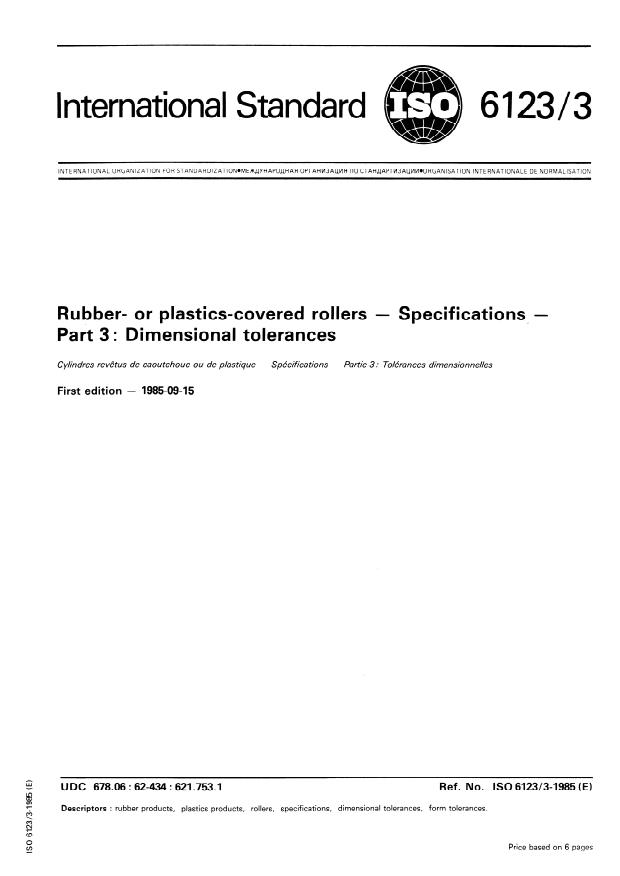
International Standard 612313
INTERNATIONAL ORGANIZATION FOR STANDARDlZATION.MEX~YHAPO,flHAR OPI-AHl43AUMR l-l0 CTAH~APTl43A~MM*ORGANISATION INTERNATIONALE DE NORMALISATION
Rubber- or plastics-covered rollers - Specifications -
,
Part 3: Dimensional tolerantes
Cylindres rev&us de caoutchouc ou de plastigue - Specifications - Partie 3 : Tolkrances dimensionneles
First edition - 1985-09-15
Ref. No. ISO 6123/3-1985 (EI
UDC 678.06 : 62-434 : 621.753.1
Descriptors : rubber products, plastics products, rollers, specifications, dimensional tolerantes, form tolerantes.
Price based on 6 pages
Foreword
ISO (the International Organization for Standardization) is a worldwide federation of
national Standards bodies (ISO member bodies). The work of preparing International
Standards is normally carried out through ISO technical committees. Esch member
body interested in a subject for which a technical committee has been established has
the right to be represented on that committee. International organizations, govern-
mental and non-governmental, in liaison with ISO, also take part in the work.
Draft International Standards adopted by the technical committees are circulated to
the member bodies for approval before their acceptance as International Standards by
the ISO Council. They are approved in accordance with ISO procedures requiring at
least 75 % approval by the member bodies voting.
International Standard ISO 6123/3 was prepared by Technical Committee ISO/TC 45,
Rubber and rubber products.
International Organkation for Standardkation, 1985
Printed in Switzerland
INTERNATIONAL STANDARD ISO 6123/3-1985 (E)
Rubber- or plastics-covered rollers - Specifications -
Part 3: Dimensional tolerantes
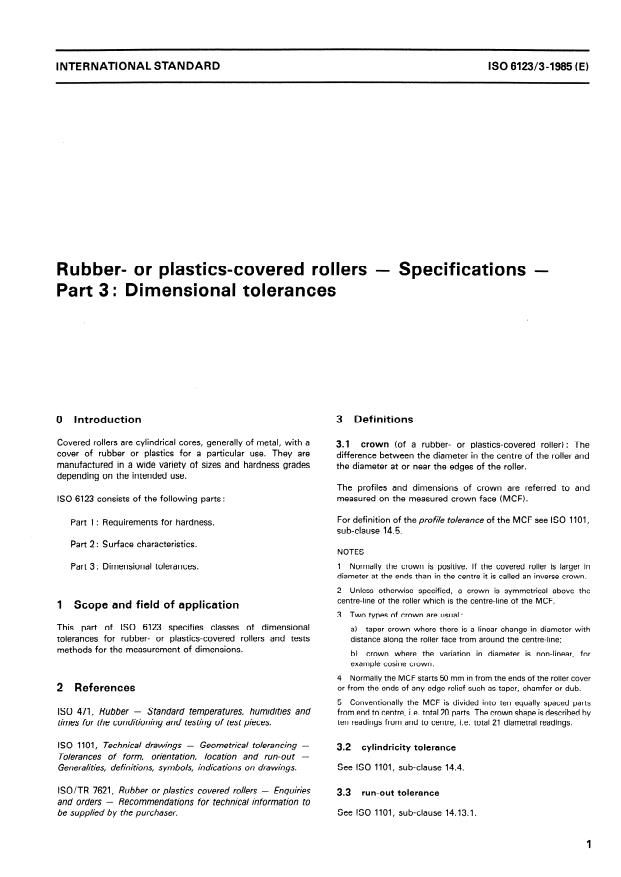
3 Definitions
0 Introduction
Covered rollers are cylindrical cores, generally of metal, with a
3.1 crown (of a rubber- or plastics-covered roller) : The
cover of rubber or plastics for a particular use. They are
differente between the diameter in the centre of the roller and
manufactured in a wide variety of sizes and hardness grades
the diameter at or near the edges of the roller.
depending on the intended use.
The profiles and dimensions of crown are referred to and
measured on the measured crown face (MCF).
ISO 6123 consists of the following park:
For definition of the Profile tolerante of the MCF see
Part 1 : Requirements for hardness.
sub-clause 14.5.
Part 2 : Surface characteristics.
NOTES
1 Normalty the crown is positive. If the covered roller s larger in
Part 3 : Dimensional tolerantes.
diameter at the ends than in the centre it is called an inverse crown.
2 Unless otherwise specified, a crown is symmetrical above the
centre-line of the roller which is the centre-line of the MCF.
1 Scope and field of application
3 Two types of crown are usual :
This patt of ISO 6123 specifies classes of dimensional
a) taper crown where there is a linear Change in diameter with
tolerantes for rubber- or plastics-covered rollers and tests distance along the roller face from around the centre-line;
methods for the measurement of dimensions.
b) crown where the Variation in diameter is non-linear, for
example cosine crown.
4 Normally the MCF Starts 50 mm in from the ends of the roller cover
or from the ends of any edge relief such as taper, chamfer or dub.
2 References
5 Conventionally the MCF is divided into ten equally spaced Parts
ISO 471, Rubber - Standard temperatures, humidities and from end to centre, i.e. total 20 Parts. The crown shape is described by
ten readings from and to centre, i.e. total 21 diametral readings.
times for the conditioning and testing of test pieces.
ISO 1101, Technical drawings - Geometrical tolerancing -
3.2 cylindricity tolerante
Tolerantes of form, orientation, location and run-out -
See ISO 1101, sub-clause
Generalities, de finitions, Symbols, indica tions on drawings.
ISO/TR 7621, Rubber or plastics covered rollers - Enguiries
3.3 run-out tolerante
and orders - Recommenda tions for technical in forma tion to
be supplied by the purchaser. See ISO 1101, sub-clause
ISO 6123/3-1985 (El
lt should be noted (see clauses 6, 8 and 9) that the closest
3.4 Other terms
tolerantes are not applicable to all hardnesses of the cover. In
For cover face length, cover thickness, cover outside diameter general, soft covers need greater tolerantes than harder ones.
(finished diameter), core outside diameter, taper, chamfer, and
Class N tolerantes are to be used when the roller specification
dub, see ISO/TR 7621, figure 1.
does not indicate a required tolerante class.
NOTE - Nominal dimensions in tables 1 to 6 a e based on the R 5
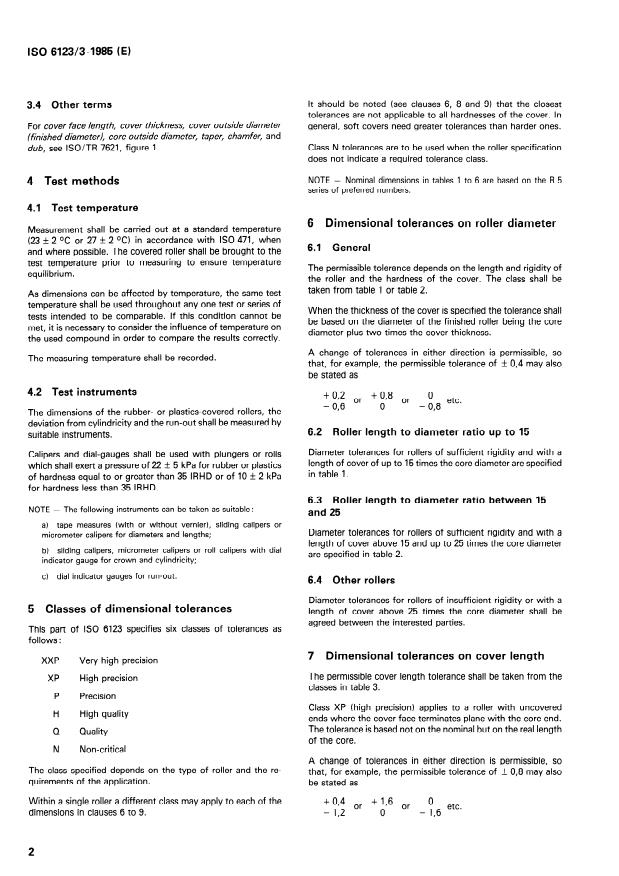
4 Test methods
series of preferred numbers.
4.1 Test temperature
6 Dimensional tolerantes on rol ler diameter
Measurement shall be carried out at a Standard temperature
(23 k 2 OC or 27 + 2 OC) in accordance with ISO 471, when
6.1 General
and where possible. The covered roller shall be brought to the
test temperature Prior to measuring to ensure temperature
The permissible tolerante depends on the length and rigidity of
equilibrium.
the roller and the hardness of the cover. The class shall be
taken from table 1 or table 2.
As dimensions tan be affected by temperature, the same test
temperature shall be used throughout any one test or series of
When the thickness of the cover is specified the tolerante shall
tests intended to be comparable. ‘If this condition cannot be
be based on the diameter of the finished roller being the core
met, it is necessary to consider the influence of temperature on
diameter plus two times the cover thickness.
the used compound in Order to compare the results correctly.
A Change of tolerantes in either direction is permissible, so
The measuring temperature shall be recorded.
that, for example, the permissible tolerante of + 0,4 may also
be stated as
4.2 Test instruments
+ Of2 or + Or8 or
- 0,8 etc*
- 0,6 0
The dimensions of the rubber- or plastics-covered rollers, the
deviation from cylindricity and the run-out shall be measured by
6.2 Roller length to diameter ratio up to 15
suitable instruments.
Diameter tolerantes for rollers of sufficient rigidity and with a
Calipers and dial-gauges shall be used with plungers or rolls
length of cover of up to 15 times the core diameter are specified
which shall exert a pressure of 22 + 5 kPa for rubber or plastics
in table 1.
of hardness equal to or greater than 35
...
Norme internationale 612313
INTERNATIONAL ORGANIZATION FOR STANDARDIZATIONWVlEIKflYHAPOflHAR OPI-AHi43AUklR IlO CTAHAAPTkl3AWlM*ORGANISAilON INTERNATIONALE DE NORMALISATION
Cylindres revêtus de caoutchouc ou de plastique - ,
Spécifications -
Partie 3 : Tolérances dimensionnelles
Rubber- or plastics-covered rolers - Specifications - Part 3: Dimensional tolerances
Première édition - 1985-09-15
z
Réf. no : ISO 6123/3-1985 (FI
CDU 678.06 : 62434 : 621.753.1
;
R
tolérance de dimension, tolérance de forme.
Descripteurs : produit en caoutchouc, produit en matière plastique, galet, spécification,
?h
N
.-
Prix basé sur 6 pages
u!
Avant-propos
L’ISO (Organisation internationale de normalisation) est une fédération mondiale
d’organismes nationaux de normalisation (comités membres de I’ISO). L’élaboration
des Normes internationales est confiée aux comites techniques de I’ISO. Chaque
comité membre interessé par une étude a le droit de faire partie du comité technique
créé a cet effet. Les organisations internationales, gouvernementales et non gouverne-
mentales, en liaison avec I’ISO, participent également aux travaux.
Les projets de Normes internationales adoptés par les comités techniques sont soumis
aux comités membres pour approbation, avant leur acceptation comme Normes inter-
nationales par le Conseil de I’ISO. Les Normes internationales sont approuvées confor-
mément aux procédures de I’ISO qui requiérent l’approbation de 75 % au moins des
comités membres votants.
La Norme internationale ISO 6123/3 a été élaborée par le comité technique ISO/TC 45,
Ejastomères et produits à base d’élastom&res.
0 Organisation internationale de normalisation, 1985 l
Imprimé en Suisse
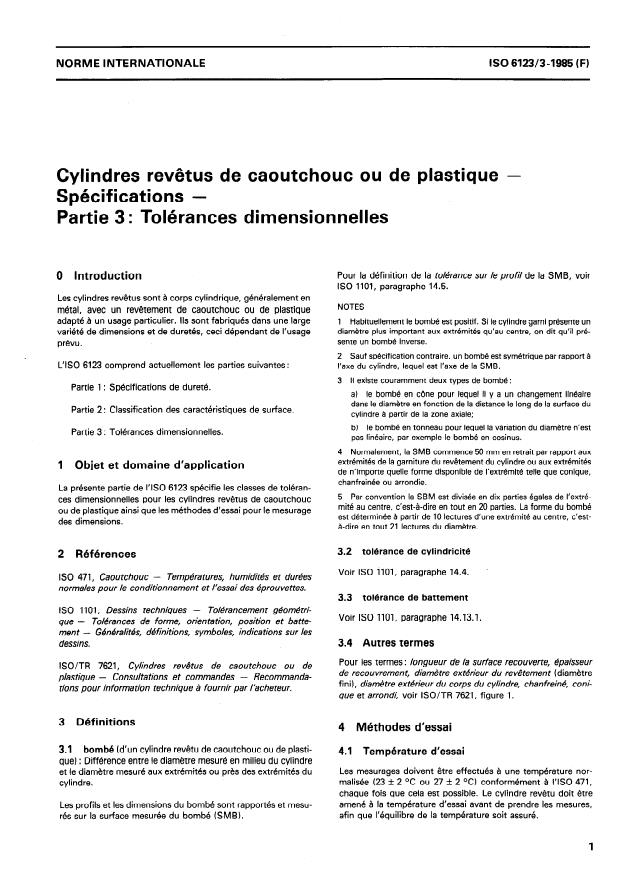
NORME INTERNATIONALE ISO 6123/3-1985 (FI
Cylindres revêtus de caoutchouc ou de plastique -
Spécifications -
Partie 3 : Tolérances dimensionnelles
Pour la définition de la tolérance sur le profil de la SMB, voir
0 Introduction
ISO 1101, paragraphe 14.5.
Les cylindres revêtus sont à corps cylindrique, généralement en
NOTES
métal, avec un revêtement de caoutchouc ou de plastique
adapté.3 un usage particulier. Ils sont fabriqués dans une large 1 Habituellement le bombé est positif. Si le cylindre garni présente un
variété de dimensions et de duretés, ceci dépendant de l’usage diamétre plus important aux extrémités qu’au centre, on dit qu’il pré-
sente un bombé inverse.
prévu.
2 Sauf spécification contraire, un bombé est symétrique par rapport à
L’ISO 6123 comprend actuellement les parties suivantes :
l’axe du cylindre, lequel est l’axe de la SMB.
3 II existe couramment deux types de bombé:
Partie 1 : Spécifications de dureté,
a) le bombé en cône pour lequel il y a un changement linéaire
dans le diamétre en fonction de la distance le long de la surface du
Partie 2 : Classification des caractéristiques de surface.
cylindre à partir de la zone axiale;
b) le bombé en tonneau pour lequel la variation du diamétre n’est
Partie 3 : Tolérances dimensionnelles.
pas linéaire, par exemple le bombé en cosinus.
4 Normalement, la SMB commence 50 mm en retrait par rapport aux
extrémités de la garniture du revêtement du cylindre ou aux extrémités
1 Objet et domaine d’application
de n’importe quelle forme disponible de l’extrémité telle que conique,
chanfreinée ou arrondie.
La présente partie de I’ISO 6123 spécifie les classes de toléran-
5 Par convention la SBM est divisée en dix parties égales de I’extré-
ces dimensionnelles pour les cylindres revêtus de caoutchouc
mité au centre, c’est-à-dire en tout en 20 parties. La forme du bombé
ou de plastique ainsi que les méthodes d’essai pour le mesurage
est déterminée à partir de 10 lectures d’une extrémité au centre, c’est-
des dimensions.
à-dire en tout 21 lectures du diamètre.
3.2 tolérance de cylindricité
2 Références
Voir ISO ilO1, paragraphe 14.4. c
ISO 471, Caoutchouc - Températures, humidites et durées
normales pour le conditionnement et l’essai des éprouvettes.
3.3 tolérance de battement
ISO 1101, Dessins techniques - Tolérancement géométri-
Voir ISO 1101, paragraphe 14.13.1.
Tolérances de forme, orien ta tion, position et batte-
que -
ment - Généralités, définitions, symboles, indications sur les
dessins. 3.4 Autres termes
Pour les termes : longueur de la surface recouverte, épaisseur
ISO/TR 7621, Cylindres revêtus de caoutchouc ou de
de recouvrement, diamètre exterieur du revêtement (diamètre
Consultations et commandes - Recommanda-
plastique -
fini) , diamètre extérieur du corps du cylindre, chanfrein&, coni-
tions pour information technique à fournir par l’acheteur.
que et arrondi voir ISO/TR 7621, figure 1.
3 Définitions
4 Méthodes d’essai
3.1 bombé (d’un cylindre revêtu de caoutchouc ou de plasti-
4.1 Temp,érature d’essai
que) : Différence entre le diamètre mesuré en milieu du cylindre
Les mesurages doivent être effectués à une température nor-
et le diamétre mesuré aux extrémités ou près des extrémités du
malisée (23 + 2 OC ou 27 + 2 OC) conformément à I’ISO 471,
cylindre.
chaque fois que cela est possible. Le cylindre revêtu doit être
amené à la température d’essai avant de prendre les mesures,
Les profils et les dimensions du bombé sont rapportés et mesu-
rés sur la surface mesurée du bombé (SMB). afin que l’équilibre de la température soit assuré.
ISO 6123/3-1985 (FI
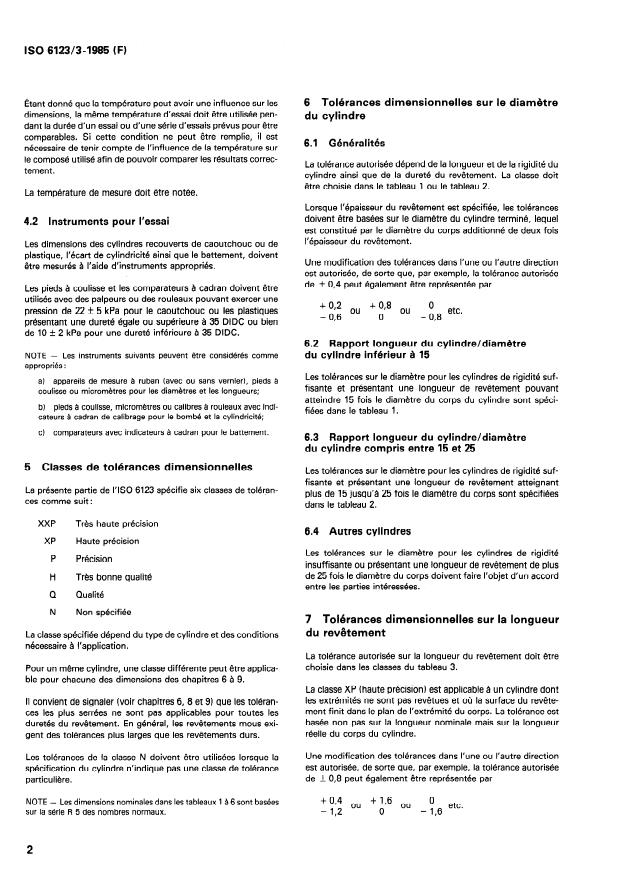
6 Tolérances dimensionnelles sur le diamètre
Étant donné que la température peut avoir une influence sur les
dimensions, la même température d’essai doit être utilisée pen-
du cylindre
dant la durée d’un essai ou d’une série d’essais prévus pour être
comparables. Si cette condition ne peut être remplie, il est
6.1 Généralités
nécessaire de tenir compte de l’influence de la température sur
le composé utilisé afin de pouvoir comparer les résultats correc-
La tolérance autorisée dépend de la longueur et de la rigidité du
tement.
cylindre ainsi que de la dureté du revêtement. La classe doit
être choisie dans le tableau 1 ou le tableau 2.
La température de mesure doit être notée.
Lorsque l’épaisseur du revêtement est spécifiée, les tolérances
doivent être basées sur le diamétre du cylindre terminé, lequel
4.2 Instruments pour l’essai
est constitué par le diamètre du corps additionné de deux fois
l’épaisseur du revêtement.
Les dimensions des cylindres recouverts de caoutchouc ou de
plastique, l’écart de cylindricité ainsi que le battement, doivent
Une modification des tolérances dans l’une ou l’autre direction
être mesurés a l’aide d’instruments appropriés.
est autorisée, de sorte que, par exemple, la tolérance autorisée
de I!Z 0,4 peut également être représentée par
Les pieds à coulisse et les comparateurs à cadran doivent être
utilisés avec des palpeurs ou des rouleaux pouvant exercer une
+ 02 + 018 0
pression de 22 & 5 kPa pour le caoutchouc ou les plastiques
- 0,6 ou 0 ou - 03 etc’
présentant une durete égale ou supérieure à 35 DIDC ou bien
de 10 rt 2 kPa pour une dureté inférieure à 35 DIDC.
6.2 Rapport longueur du cylindre/diamètre
NOTE - Les instruments suivants peuvent être considérés comme du cylindre inférieur à 15
appropriés :
Les tolérances sur le diamétre pour les cylindres de rigidité suf-
a) appareils de mesure à ruban (avec ou sans Vernier), pieds à
fisante et présentant une longueur de revêtement pouvant
coulisse ou micrométres pour les diamétres et les longueurs;
atteindre 15 fois le diamètre du corps du cylindre sont spéci-
...