

ISO 9022-9:2016
(Main)Optics and photonics — Environmental test methods — Part 9: Solar radiation and weathering
General Information
- Abstract
ISO 9022-9:2016 specifies the methods relating to the environmental tests of optical instruments including additional assemblies from other fields (e.g. mechanical, chemical and electronic devices), under equivalent conditions, for their ability to resist the effects of simulated solar radiation or laboratory weathering, which is a combination of simulated solar radiation, heat, and moisture. It is applicable to instruments that may be exposed to sunlight during operation or unsheltered storage on the earth's surface, or in the lower atmosphere. The purpose of testing is to investigate to what extent the optical, climatic, mechanical, chemical and electrical (including electrostatic) performance characteristics of the specimen are affected by solar radiation or weathering (solar radiation, heat, and moisture).
- Status
- Published
- Publication Date
- 22-May-2016
- Technical Committee
- ISO/TC 172/SC 1 - Fundamental standards
- Drafting Committee
- ISO/TC 172/SC 1/WG 3 - Environmental test methods
- Current Stage
- 9060 - Close of review
- Completion Date
- 02-Dec-2031
Buy Documents

ISO 9022-9:2016 - Optics and photonics -- Environmental test methods

ISO 9022-9:2016 - Optics and photonics — Environmental test methods — Part 9: Solar radiation and weathering/23/2016
Overview
ISO 9022-9:2016 - "Optics and photonics - Environmental test methods - Part 9: Solar radiation and weathering" specifies laboratory methods to evaluate how optical instruments and assemblies resist simulated solar radiation and accelerated weathering (combined solar radiation, heat and moisture). It covers instruments exposed to sunlight during operation or unsheltered storage on the earth’s surface or in the lower atmosphere, and defines test intent: to determine effects on optical, climatic, mechanical, chemical and electrical (including electrostatic) performance.
Key topics and technical requirements
- Conditioning methods:
- Method 20 – Solar radiation: controlled irradiance exposure in a heated chamber with specified chamber temperature, air speed and total irradiance (including degrees of severity for different test objectives).
- Method 21 – Laboratory weathering: accelerated weathering using appropriately filtered xenon‑arc lamps to simulate outdoor solar spectra together with cyclic moisture and heat.
- Radiation and spectral control: Test sources and spectral bands are specified; note that wavelengths below 280 nm are not covered by this part. Global‑radiation reference: 1 kW/m² ≈ natural terrestrial global radiation.
- Exposure parameters: Degrees of severity and cycles define irradiance, chamber and black‑standard or black‑panel temperatures, relative humidity, spray cycles and total exposure time (examples in the standard include multi‑thousand hour weathering cycles and quantified UV radiant exposures).
- Instrumentation and calibration: Requirements for irradiance, temperature and humidity measurement and control; sensors must be calibrated and operated per ISO 4892‑1, ISO 4892‑2 and ISO 9370. Ozone generated during exposure must be removed from the chamber.
- Specimen handling: Positioning, mounting, support characteristics and test point locations for measurement are to be specified in the applicable test specification.
Applications - who uses this standard
- Manufacturers and designers of optical instruments, lenses, sensors and photonic assemblies for outdoor or airborne use.
- Environmental test laboratories performing accelerated weathering and solar radiation testing.
- Quality assurance, reliability engineers and procurement teams specifying environmental qualification criteria.
- Regulators or certification bodies verifying that optical equipment maintains specified performance after sunlight and weathering exposure.
Related standards
- ISO 4892‑1 / ISO 4892‑2 (laboratory light sources and xenon‑arc weathering procedures)
- ISO 9370 (radiant exposure measurement guidance)
- IEC 60068‑2‑5 (simulated solar radiation at ground level)
- ISO 9022‑1 (definitions and extent of testing for optics and photonics)
Keywords: optics and photonics, environmental test methods, solar radiation testing, laboratory weathering, xenon‑arc, irradiance, accelerated weathering, UV radiant exposure, optical instrument qualification.
Relations
- Consolidated By
ISO 22751:2020 - Rubber- or plastic-coated fabrics — Physical and mechanical test — Determination of bending force - Effective Date
- 06-Jun-2022
- Effective Date
- 04-Oct-2014
Buy Documents
ISO 9022-9:2016 - Optics and photonics -- Environmental test methods
ISO 9022-9:2016 - Optics and photonics — Environmental test methods — Part 9: Solar radiation and weathering/23/2016
Frequently Asked Questions
ISO 9022-9:2016 is a standard published by the International Organization for Standardization (ISO). Its full title is "Optics and photonics — Environmental test methods — Part 9: Solar radiation and weathering". This standard covers: ISO 9022-9:2016 specifies the methods relating to the environmental tests of optical instruments including additional assemblies from other fields (e.g. mechanical, chemical and electronic devices), under equivalent conditions, for their ability to resist the effects of simulated solar radiation or laboratory weathering, which is a combination of simulated solar radiation, heat, and moisture. It is applicable to instruments that may be exposed to sunlight during operation or unsheltered storage on the earth's surface, or in the lower atmosphere. The purpose of testing is to investigate to what extent the optical, climatic, mechanical, chemical and electrical (including electrostatic) performance characteristics of the specimen are affected by solar radiation or weathering (solar radiation, heat, and moisture).
ISO 9022-9:2016 specifies the methods relating to the environmental tests of optical instruments including additional assemblies from other fields (e.g. mechanical, chemical and electronic devices), under equivalent conditions, for their ability to resist the effects of simulated solar radiation or laboratory weathering, which is a combination of simulated solar radiation, heat, and moisture. It is applicable to instruments that may be exposed to sunlight during operation or unsheltered storage on the earth's surface, or in the lower atmosphere. The purpose of testing is to investigate to what extent the optical, climatic, mechanical, chemical and electrical (including electrostatic) performance characteristics of the specimen are affected by solar radiation or weathering (solar radiation, heat, and moisture).
ISO 9022-9:2016 is classified under the following ICS (International Classification for Standards) categories: 37.020 - Optical equipment. The ICS classification helps identify the subject area and facilitates finding related standards.
ISO 9022-9:2016 has the following relationships with other standards: It is inter standard links to ISO 22751:2020, ISO 9022-9:1994. Understanding these relationships helps ensure you are using the most current and applicable version of the standard.
ISO 9022-9:2016 is available in PDF format for immediate download after purchase. The document can be added to your cart and obtained through the secure checkout process. Digital delivery ensures instant access to the complete standard document.
Standards Content (Sample)
INTERNATIONAL ISO
STANDARD 9022-9
Second edition
2016-05-01
Optics and photonics —
Environmental test methods —
Part 9:
Solar radiation and weathering
Optique et photonique — Méthodes d’essais d’environnement —
Partie 9: Rayonnement solaire et désagrégation
Reference number
©
ISO 2016
© ISO 2016, Published in Switzerland
All rights reserved. Unless otherwise specified, no part of this publication may be reproduced or utilized otherwise in any form
or by any means, electronic or mechanical, including photocopying, or posting on the internet or an intranet, without prior
written permission. Permission can be requested from either ISO at the address below or ISO’s member body in the country of
the requester.
ISO copyright office
Ch. de Blandonnet 8 • CP 401
CH-1214 Vernier, Geneva, Switzerland
Tel. +41 22 749 01 11
Fax +41 22 749 09 47
copyright@iso.org
www.iso.org
ii © ISO 2016 – All rights reserved
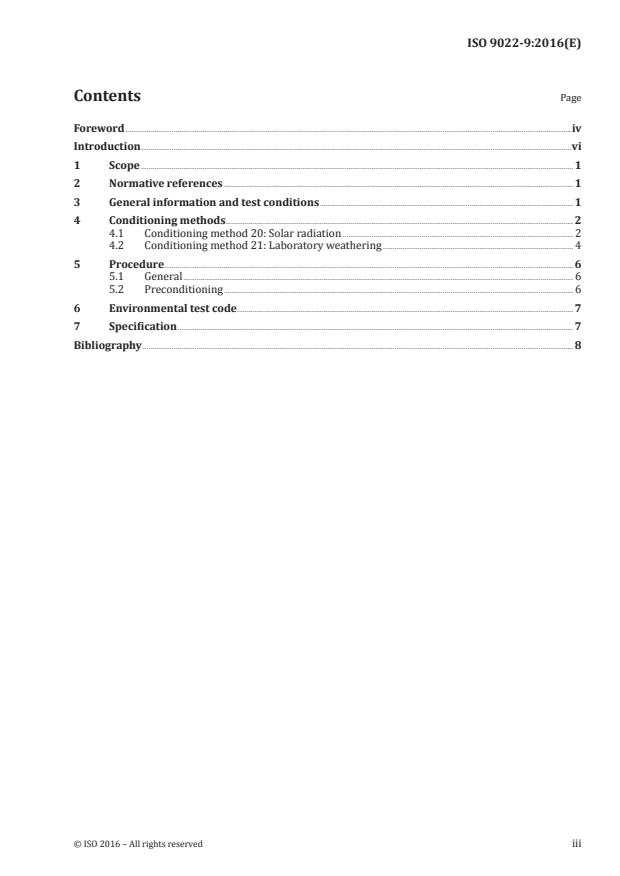
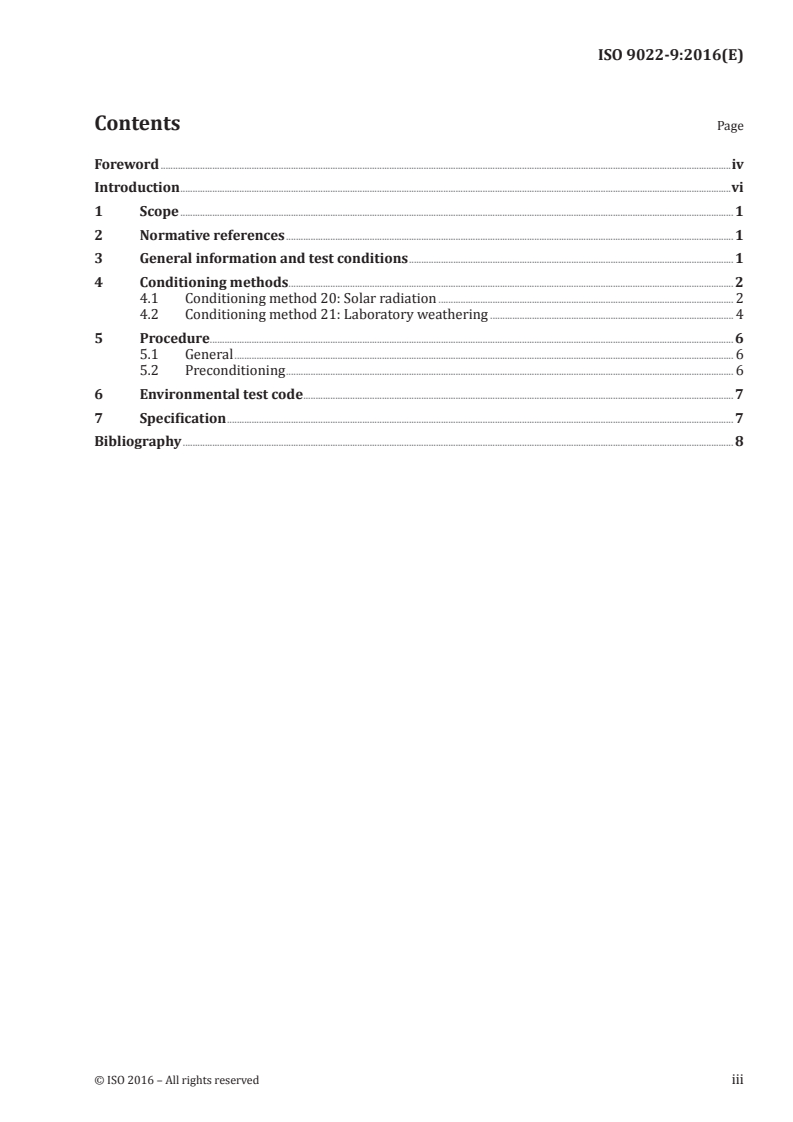
Contents Page
Foreword .iv
Introduction .vi
1 Scope . 1
2 Normative references . 1
3 General information and test conditions . 1
4 Conditioning methods. 2
4.1 Conditioning method 20: Solar radiation . 2
4.2 Conditioning method 21: Laboratory weathering . 4
5 Procedure. 6
5.1 General . 6
5.2 Preconditioning . 6
6 Environmental test code . 7
7 Specification . 7
Bibliography . 8
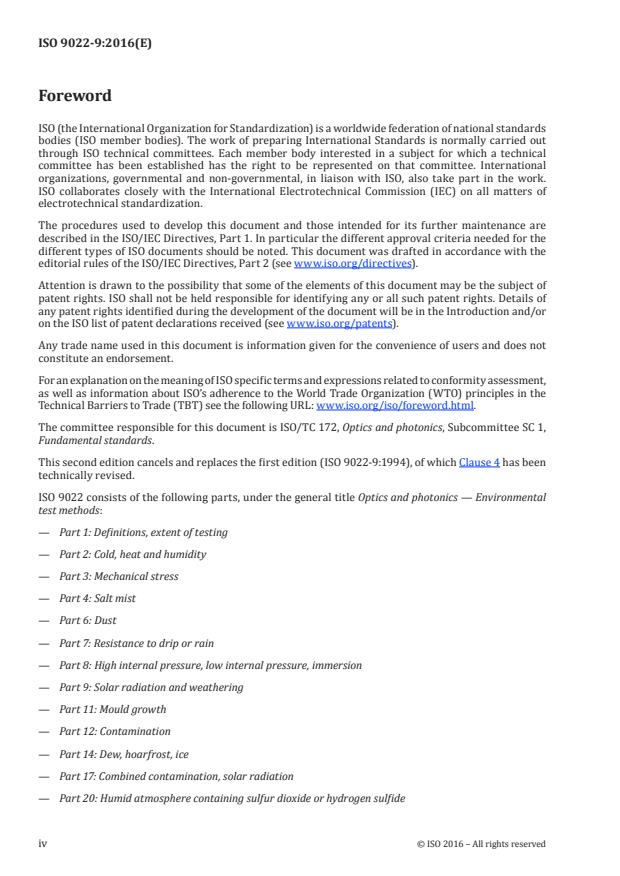
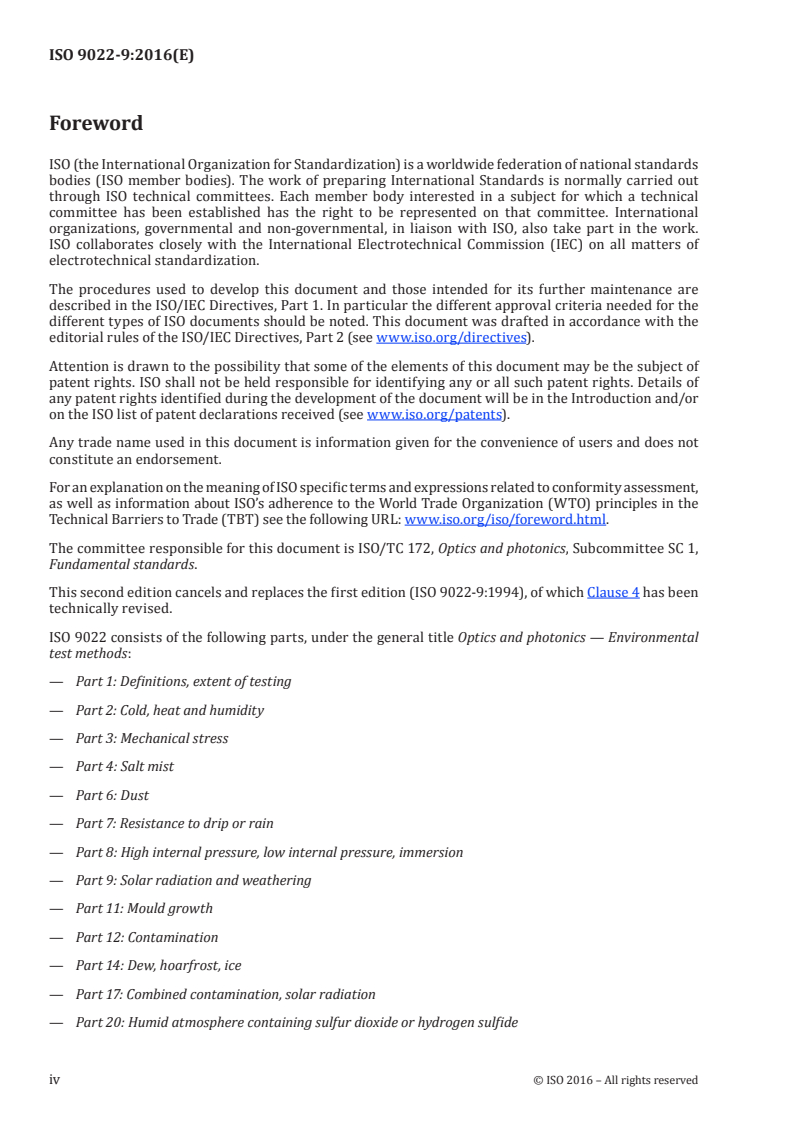
Foreword
ISO (the International Organization for Standardization) is a worldwide federation of national standards
bodies (ISO member bodies). The work of preparing International Standards is normally carried out
through ISO technical committees. Each member body interested in a subject for which a technical
committee has been established has the right to be represented on that committee. International
organizations, governmental and non-governmental, in liaison with ISO, also take part in the work.
ISO collaborates closely with the International Electrotechnical Commission (IEC) on all matters of
electrotechnical standardization.
The procedures used to develop this document and those intended for its further maintenance are
described in the ISO/IEC Directives, Part 1. In particular the different approval criteria needed for the
different types of ISO documents should be noted. This document was drafted in accordance with the
editorial rules of the ISO/IEC Directives, Part 2 (see www.iso.org/directives).
Attention is drawn to the possibility that some of the elements of this document may be the subject of
patent rights. ISO shall not be held responsible for identifying any or all such patent rights. Details of
any patent rights identified during the development of the document will be in the Introduction and/or
on the ISO list of patent declarations received (see www.iso.org/patents).
Any trade name used in this document is information given for the convenience of users and does not
constitute an endorsement.
For an explanation on the meaning of ISO specific terms and expressions related to conformity assessment,
as well as information about ISO’s adherence to the World Trade Organization (WTO) principles in the
Technical Barriers to Trade (TBT) see the following URL: www.iso.org/iso/foreword.html.
The committee responsible for this document is ISO/TC 172, Optics and photonics, Subcommittee SC 1,
Fundamental standards.
This second edition cancels and replaces the first edition (ISO 9022-9:1994), of which Clause 4 has been
technically revised.
ISO 9022 consists of the following parts, under the general title Optics and photonics — Environmental
test methods:
— Part 1: Definitions, extent of testing
— Part 2: Cold, heat and humidity
— Part 3: Mechanical stress
— Part 4: Salt mist
— Part 6: Dust
— Part 7: Resistance to drip or rain
— Part 8: High internal pressure, low internal pressure, immersion
— Part 9: Solar radiation and weathering
— Part 11: Mould growth
— Part 12: Contamination
— Part 14: Dew, hoarfrost, ice
— Part 17: Combined contamination, solar radiation
— Part 20: Humid atmosphere containing sulfur dioxide or hydrogen sulfide
iv © ISO 2016 – All rights reserved
— Part 22: Combined cold, dry heat or temperature change with bump or random vibration
— Part 23: Low pressure combined with cold, ambient temperature and dry and damp heat
Introduction
Optical instruments are affected during their use by a number of different environmental parameters
which they are required to resist without significant reduction in performance and to remain within
defined specifications.
The type and severity of these parameters depend on the conditions of use of the instrument (for
example, in a laboratory or workshop) and on its geographical location. The environmental effects on
optical instrument performance in the tropics and subtropics are totally different from those found
when they are used in arctic regions. Individual parameters cause a variety of different and overlapping
effects on instrument performance.
The manufacturer attempts to ensure, and the user naturally expects, that instruments will resist the
likely rigours of their environment throughout their life. This expectation can be assessed by exposure
of the instrument to a range of simulated environmental parameters under controlled laboratory
conditions. The severity of these conditions is often increased to obtain meaningful results in a
relatively short period of time.
In order to allow assessment and comparison of the response of optical instruments to appropriate
environmental conditions, ISO 9022 contains details of a number of laboratory tests which reliably
simulate a variety of different environments. The tests are based largely on IEC standards, modified
where necessary to take into account features special to optical instruments.
As a result of continuous progress in all fields, optical instruments are no longer only precision-
engineered optical products, but, depending on their range of application, also contain additional
assemblies from other fields. For this reason, the principal function of the instrument is to be assessed to
determine which International Standard should be used for testing. If the optical function is of primary
importance, then ISO 9022 is applicable; but if other functions take precedence, then the appropriate
International Standard in the field concerned should be applied. Cases may arise where application of
both ISO 9022 and other appropriate International Standards will be necessary.
vi © ISO 2016 – All rights reserved
INTERNATIONAL STANDARD ISO 9022-9:2016(E)
Optics and photonics — Environmental test methods —
Part 9:
Solar radiation and weathering
1 Scope
This part of ISO 9022 specifies the methods relating to the environmental tests of optical instruments
including additional assemblies from other fields (e.g. mechanical, chemical and electronic devices),
under equivalent conditions, for their ability to resist the effects of simulated solar radiation or
laboratory weathering, which is a combination of simulated solar radiation, heat, and moisture. It is
applicable to instruments that may be exposed to sunlight during operation or unsheltered storage on
the earth’s surface, or in the lower atmosphere.
The purpose of testing is to investigate to what extent the optical, climatic, mechanical, chemical and
electrical (including electrostatic) performance characteristics of the specimen are affected by solar
radiation or weathering (solar radiation, heat, and moisture).
2 Normative references
The following documents, in whole or in part, are normatively referenced in this document and are
indispensable for its application. For dated references, only the edition cited applies. For undated
references, the latest edition of the referenced document (including any amendments) applies .
ISO 4892-1:1999, Plastics — Methods of exposure to laboratory light sources — Part 1: General guidance
ISO 4892-2:2013, Plastics — Methods of exposure to laboratory light sources — Part 2: Xenon-arc lamps
ISO 9022-1, Optics and photonics — Environmental test methods — Part 1: Definitions, extent of testing
ISO 9370, Plastics — Instrumental determination of radiant exposure in weathering tests — General
guidance and basic test method
IEC 60068-2-5:2010, Environmental testing — Part 2-5: Tests — Test Sa: Simulated solar radiation at
ground level and guidance for solar radiation testing
3 General information and test conditions
A radiation source capable of generating irradiance as specified in Table 1 on the specimen surface or
in a plane specified in the relevant specification is installed in a heated test chamber. The data shall
include any radiation reflected from the test chamber walls but not infrared radiation emitted from the
chamber walls on account of the wall temperature.
Ozone generated during exposure shal
...
INTERNATIONAL ISO
STANDARD 9022-9
Second edition
2016-05-01
Optics and photonics —
Environmental test methods —
Part 9:
Solar radiation and weathering
Optique et photonique — Méthodes d’essais d’environnement —
Partie 9: Rayonnement solaire et désagrégation
Reference number
©
ISO 2016
© ISO 2016, Published in Switzerland
All rights reserved. Unless otherwise specified, no part of this publication may be reproduced or utilized otherwise in any form
or by any means, electronic or mechanical, including photocopying, or posting on the internet or an intranet, without prior
written permission. Permission can be requested from either ISO at the address below or ISO’s member body in the country of
the requester.
ISO copyright office
Ch. de Blandonnet 8 • CP 401
CH-1214 Vernier, Geneva, Switzerland
Tel. +41 22 749 01 11
Fax +41 22 749 09 47
copyright@iso.org
www.iso.org
ii © ISO 2016 – All rights reserved
Contents Page
Foreword .iv
Introduction .vi
1 Scope . 1
2 Normative references . 1
3 General information and test conditions . 1
4 Conditioning methods. 2
4.1 Conditioning method 20: Solar radiation . 2
4.2 Conditioning method 21: Laboratory weathering . 4
5 Procedure. 6
5.1 General . 6
5.2 Preconditioning . 6
6 Environmental test code . 7
7 Specification . 7
Bibliography . 8
Foreword
ISO (the International Organization for Standardization) is a worldwide federation of national standards
bodies (ISO member bodies). The work of preparing International Standards is normally carried out
through ISO technical committees. Each member body interested in a subject for which a technical
committee has been established has the right to be represented on that committee. International
organizations, governmental and non-governmental, in liaison with ISO, also take part in the work.
ISO collaborates closely with the International Electrotechnical Commission (IEC) on all matters of
electrotechnical standardization.
The procedures used to develop this document and those intended for its further maintenance are
described in the ISO/IEC Directives, Part 1. In particular the different approval criteria needed for the
different types of ISO documents should be noted. This document was drafted in accordance with the
editorial rules of the ISO/IEC Directives, Part 2 (see www.iso.org/directives).
Attention is drawn to the possibility that some of the elements of this document may be the subject of
patent rights. ISO shall not be held responsible for identifying any or all such patent rights. Details of
any patent rights identified during the development of the document will be in the Introduction and/or
on the ISO list of patent declarations received (see www.iso.org/patents).
Any trade name used in this document is information given for the convenience of users and does not
constitute an endorsement.
For an explanation on the meaning of ISO specific terms and expressions related to conformity assessment,
as well as information about ISO’s adherence to the World Trade Organization (WTO) principles in the
Technical Barriers to Trade (TBT) see the following URL: www.iso.org/iso/foreword.html.
The committee responsible for this document is ISO/TC 172, Optics and photonics, Subcommittee SC 1,
Fundamental standards.
This second edition cancels and replaces the first edition (ISO 9022-9:1994), of which Clause 4 has been
technically revised.
ISO 9022 consists of the following parts, under the general title Optics and photonics — Environmental
test methods:
— Part 1: Definitions, extent of testing
— Part 2: Cold, heat and humidity
— Part 3: Mechanical stress
— Part 4: Salt mist
— Part 6: Dust
— Part 7: Resistance to drip or rain
— Part 8: High internal pressure, low internal pressure, immersion
— Part 9: Solar radiation and weathering
— Part 11: Mould growth
— Part 12: Contamination
— Part 14: Dew, hoarfrost, ice
— Part 17: Combined contamination, solar radiation
— Part 20: Humid atmosphere containing sulfur dioxide or hydrogen sulfide
iv © ISO 2016 – All rights reserved
— Part 22: Combined cold, dry heat or temperature change with bump or random vibration
— Part 23: Low pressure combined with cold, ambient temperature and dry and damp heat
Introduction
Optical instruments are affected during their use by a number of different environmental parameters
which they are required to resist without significant reduction in performance and to remain within
defined specifications.
The type and severity of these parameters depend on the conditions of use of the instrument (for
example, in a laboratory or workshop) and on its geographical location. The environmental effects on
optical instrument performance in the tropics and subtropics are totally different from those found
when they are used in arctic regions. Individual parameters cause a variety of different and overlapping
effects on instrument performance.
The manufacturer attempts to ensure, and the user naturally expects, that instruments will resist the
likely rigours of their environment throughout their life. This expectation can be assessed by exposure
of the instrument to a range of simulated environmental parameters under controlled laboratory
conditions. The severity of these conditions is often increased to obtain meaningful results in a
relatively short period of time.
In order to allow assessment and comparison of the response of optical instruments to appropriate
environmental conditions, ISO 9022 contains details of a number of laboratory tests which reliably
simulate a variety of different environments. The tests are based largely on IEC standards, modified
where necessary to take into account features special to optical instruments.
As a result of continuous progress in all fields, optical instruments are no longer only precision-
engineered optical products, but, depending on their range of application, also contain additional
assemblies from other fields. For this reason, the principal function of the instrument is to be assessed to
determine which International Standard should be used for testing. If the optical function is of primary
importance, then ISO 9022 is applicable; but if other functions take precedence, then the appropriate
International Standard in the field concerned should be applied. Cases may arise where application of
both ISO 9022 and other appropriate International Standards will be necessary.
vi © ISO 2016 – All rights reserved
INTERNATIONAL STANDARD ISO 9022-9:2016(E)
Optics and photonics — Environmental test methods —
Part 9:
Solar radiation and weathering
1 Scope
This part of ISO 9022 specifies the methods relating to the environmental tests of optical instruments
including additional assemblies from other fields (e.g. mechanical, chemical and electronic devices),
under equivalent conditions, for their ability to resist the effects of simulated solar radiation or
laboratory weathering, which is a combination of simulated solar radiation, heat, and moisture. It is
applicable to instruments that may be exposed to sunlight during operation or unsheltered storage on
the earth’s surface, or in the lower atmosphere.
The purpose of testing is to investigate to what extent the optical, climatic, mechanical, chemical and
electrical (including electrostatic) performance characteristics of the specimen are affected by solar
radiation or weathering (solar radiation, heat, and moisture).
2 Normative references
The following documents, in whole or in part, are normatively referenced in this document and are
indispensable for its application. For dated references, only the edition cited applies. For undated
references, the latest edition of the referenced document (including any amendments) applies .
ISO 4892-1:1999, Plastics — Methods of exposure to laboratory light sources — Part 1: General guidance
ISO 4892-2:2013, Plastics — Methods of exposure to laboratory light sources — Part 2: Xenon-arc lamps
ISO 9022-1, Optics and photonics — Environmental test methods — Part 1: Definitions, extent of testing
ISO 9370, Plastics — Instrumental determination of radiant exposure in weathering tests — General
guidance and basic test method
IEC 60068-2-5:2010, Environmental testing — Part 2-5: Tests — Test Sa: Simulated solar radiation at
ground level and guidance for solar radiation testing
3 General information and test conditions
A radiation source capable of generating irradiance as specified in Table 1 on the specimen surface or
in a plane specified in the relevant specification is installed in a heated test chamber. The data shall
include any radiation reflected from the test chamber walls but not infrared radiation emitted from the
chamber walls on account of the wall temperature.
Ozone generated during exposure shal
...