

ISO 17555:2021
(Main)Plastics — Film and sheeting — Biaxially oriented polypropylene (PP) films
General Information
- Abstract
This document specifies the requirements for biaxially oriented polypropylene (PP) films, which are mainly used for packaging. The film can be used alone or in laminates with other films. This document applies only to films composed of more than 95 % (by mass) of polypropylene.
- Status
- Published
- Publication Date
- 24-Jun-2021
- Technical Committee
- ISO/TC 61/SC 11 - Products
- Drafting Committee
- ISO/TC 61/SC 11/WG 3 - Plastics films and sheeting
- Current Stage
- 9093 - International Standard confirmed
- Start Date
- 04-Sep-2026
- Completion Date
- 12-Sep-2026
Buy Documents

ISO 17555:2021 - Plastics -- Film and sheeting -- Biaxially oriented polypropylene (PP) films
ISO 17555:2021 - Plastics — Film and sheeting — Biaxially oriented polypropylene (PP) films/25/2021
Overview
ISO 17555:2021 specifies requirements and test methods for biaxially oriented polypropylene (BOPP) films used mainly for packaging. It applies to films composed of more than 95% polypropylene (PP) by mass and covers single films and films intended for laminates. The standard defines appearance, dimensional and mechanical property limits, conditioning and test procedures, packaging and marking recommendations.
Key topics and technical requirements
- Scope & classification
- Applies to PP films >95% by mass.
- Two types: Type 1 (surface-treated: corona, flame or plasma) and Type 2 (untreated).
- Appearance
- Films shall be free from flaws, wrinkles, stains or marks that impair serviceability. Splices in rolls should be visibly marked.
- Gloss measured per ISO 2813 when relevant for end-use.
- Dimensions & tolerances
- Width: nominal to +4 mm (examples use 40 mm width steps).
- Roll length: nominal to +1% (table of common roll lengths provided).
- Core inside diameter: preferably 76 mm or 152 mm.
- Thickness: average within ±10% of nominal; measured per ISO 4593 at multiple points depending on film width.
- Mechanical & thermal properties
- Tensile strength at break: ≥ 100 MPa (longitudinal and transverse) - test per ISO 527-3.
- Tensile strain at break: ≤ 270% (longitudinal) and ≤ 150% (transverse).
- Dimensional change on heating: limits of ≤10% (longitudinal) and ≤8% (transverse) after specified heating cycles (120 °C/15 min or 130 °C/5 min).
- Barrier, optical and surface properties
- Water vapour transmission: coefficient requirement (see ISO 15106 series) - film must meet the indicated maximum (table specifies ≤2.0, measured at 40 °C, 90% RH).
- Haze: ≤5.0% for Type 1 (treated) and ≤4.0% for Type 2 (only for transparent films) - per ISO 14782.
- Wetting tension: ≥36 mN/m for Type 1; Type 2 films have lower wetting tension (<35 mN/m) - measured per ISO 8296.
- Conditioning & test environment
- Conditioning at (23 ± 2) °C and (50 ± 5) % RH for tensile, haze and wetting tension tests.
Applications and target users
- Primary application: packaging films (flexible packaging, laminates, labels, wrappers).
- Users who rely on ISO 17555:2021:
- Film manufacturers and converters (quality control, product specification).
- Packaging designers and brand owners specifying film performance.
- Test laboratories performing mechanical, optical and barrier testing.
- Procurement teams comparing films and verifying compliance.
- For food-contact uses, regulatory requirements must also be observed in addition to this standard.
Related standards (normative references)
Key referenced ISO standards include:
- ISO 527-3 (tensile testing for films/sheets)
- ISO 4593 (thickness measurement)
- ISO 2813 (gloss)
- ISO 14782 (haze)
- ISO 8296 (wetting tension)
- ISO 15106‑1 to ISO 15106‑7 (water vapour transmission methods)
Keywords: ISO 17555:2021, biaxially oriented polypropylene, BOPP films, polypropylene (PP) films, packaging film, film thickness, tensile strength, water vapour transmission, haze, wetting tension.
Relations
- Effective Date
- 29-Jun-2024
- Effective Date
- 23-Apr-2020
Buy Documents
ISO 17555:2021 - Plastics -- Film and sheeting -- Biaxially oriented polypropylene (PP) films
ISO 17555:2021 - Plastics — Film and sheeting — Biaxially oriented polypropylene (PP) films/25/2021
Get Certified
Connect with accredited certification bodies for this standard

DIN CERTCO
DIN Group product certification.

Smithers Quality Assessments
US management systems and product certification.
Sponsored listings
Frequently Asked Questions
ISO 17555:2021 is a standard published by the International Organization for Standardization (ISO). Its full title is "Plastics — Film and sheeting — Biaxially oriented polypropylene (PP) films". This standard covers: This document specifies the requirements for biaxially oriented polypropylene (PP) films, which are mainly used for packaging. The film can be used alone or in laminates with other films. This document applies only to films composed of more than 95 % (by mass) of polypropylene.
This document specifies the requirements for biaxially oriented polypropylene (PP) films, which are mainly used for packaging. The film can be used alone or in laminates with other films. This document applies only to films composed of more than 95 % (by mass) of polypropylene.
ISO 17555:2021 is classified under the following ICS (International Classification for Standards) categories: 83.140.10 - Films and sheets. The ICS classification helps identify the subject area and facilitates finding related standards.
ISO 17555:2021 has the following relationships with other standards: It is inter standard links to ISO/FDIS 9697, ISO 17555:2003. Understanding these relationships helps ensure you are using the most current and applicable version of the standard.
ISO 17555:2021 is available in PDF format for immediate download after purchase. The document can be added to your cart and obtained through the secure checkout process. Digital delivery ensures instant access to the complete standard document.
Standards Content (Sample)
INTERNATIONAL ISO
STANDARD 17555
Second edition
2021-06
Plastics — Film and sheeting —
Biaxially oriented polypropylene (PP)
films
Plastiques — Film et feuille — Films en polypropylène (PP) bi-
orientés
Reference number
©
ISO 2021
© ISO 2021
All rights reserved. Unless otherwise specified, or required in the context of its implementation, no part of this publication may
be reproduced or utilized otherwise in any form or by any means, electronic or mechanical, including photocopying, or posting
on the internet or an intranet, without prior written permission. Permission can be requested from either ISO at the address
below or ISO’s member body in the country of the requester.
ISO copyright office
CP 401 • Ch. de Blandonnet 8
CH-1214 Vernier, Geneva
Phone: +41 22 749 01 11
Email: copyright@iso.org
Website: www.iso.org
Published in Switzerland
ii © ISO 2021 – All rights reserved
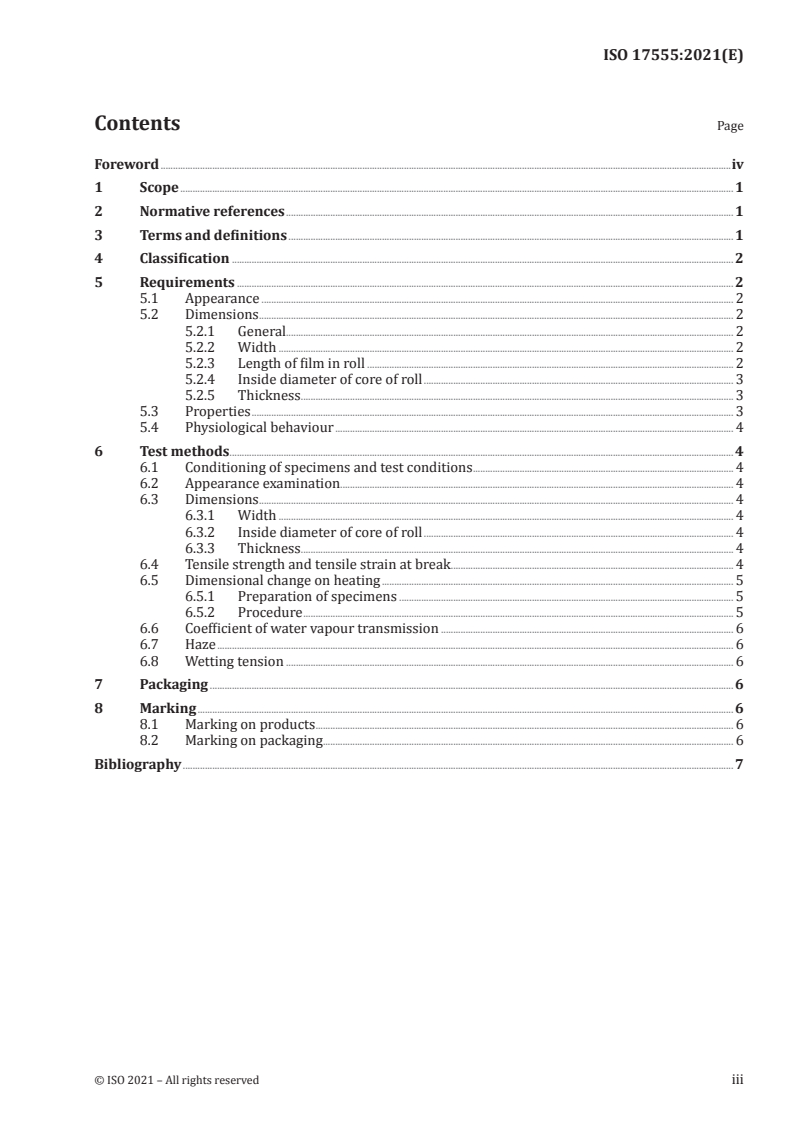
Contents Page
Foreword .iv
1 Scope . 1
2 Normative references . 1
3 Terms and definitions . 1
4 Classification . 2
5 Requirements . 2
5.1 Appearance . 2
5.2 Dimensions . 2
5.2.1 General. 2
5.2.2 Width . 2
5.2.3 Length of film in roll . 2
5.2.4 Inside diameter of core of roll . 3
5.2.5 Thickness . 3
5.3 Properties . 3
5.4 Physiological behaviour . 4
6 Test methods . 4
6.1 Conditioning of specimens and test conditions . 4
6.2 Appearance examination. 4
6.3 Dimensions . 4
6.3.1 Width . 4
6.3.2 Inside diameter of core of roll . 4
6.3.3 Thickness . 4
6.4 Tensile strength and tensile strain at break. 4
6.5 Dimensional change on heating . 5
6.5.1 Preparation of specimens . 5
6.5.2 Procedure . 5
6.6 Coefficient of water vapour transmission . 6
6.7 Haze . 6
6.8 Wetting tension . 6
7 Packaging . 6
8 Marking . 6
8.1 Marking on products . 6
8.2 Marking on packaging . 6
Bibliography . 7
Foreword
ISO (the International Organization for Standardization) is a worldwide federation of national standards
bodies (ISO member bodies). The work of preparing International Standards is normally carried out
through ISO technical committees. Each member body interested in a subject for which a technical
committee has been established has the right to be represented on that committee. International
organizations, governmental and non-governmental, in liaison with ISO, also take part in the work.
ISO collaborates closely with the International Electrotechnical Commission (IEC) on all matters of
electrotechnical standardization.
The procedures used to develop this document and those intended for its further maintenance are
described in the ISO/IEC Directives, Part 1. In particular, the different approval criteria needed for the
different types of ISO documents should be noted. This document was drafted in accordance with the
editorial rules of the ISO/IEC Directives, Part 2 (see www .iso .org/ directives).
Attention is drawn to the possibility that some of the elements of this document may be the subject of
patent rights. ISO shall not be held responsible for identifying any or all such patent rights. Details of
any patent rights identified during the development of the document will be in the Introduction and/or
on the ISO list of patent declarations received (see www .iso .org/ patents).
Any trade name used in this document is information given for the convenience of users and does not
constitute an endorsement.
For an explanation of the voluntary nature of standards, the meaning of ISO specific terms and
expressions related to conformity assessment, as well as information about ISO's adherence to the
World Trade Organization (WTO) principles in the Technical Barriers to Trade (TBT), see www .iso .org/
iso/ foreword .html.
This document was prepared by Technical Committee ISO/TC 61, Plastics, Subcommittee SC 11,
Products.
This second edition cancels and replaces the first edition (ISO 17555:2003), which has been technically
revised.
The main changes compared to the previous edition are as follows:
— the normative references have been updated;
— the gloss and thickness measurement methods have been added;
— further International Standards for measuring water vapour transmission have been added.
Any feedback or questions on this document should be directed to the user’s national standards body. A
complete listing of these bodies can be found at www .iso .org/ members .html.
iv © ISO 2021 – All rights reserved
INTERNATIONAL STANDARD ISO 17555:2021(E)
Plastics — Film and sheeting — Biaxially oriented
polypropylene (PP) films
1 Scope
This document specifies the requirements for biaxially oriented polypropylene (PP) films, which are
mainly used for packaging. The film can be used alone or in laminates with other films.
This document applies only to films composed of more than 95 % (by mass) of polypropylene.
2 Normative references
The following documents are referred to in the text in such a way that some or all of their content
constitutes requirements of this document. For dated references, only the edition cited applies. For
undated references, the latest edition of the referenced document (including any amendments) applies.
ISO 527-3
...
INTERNATIONAL ISO
STANDARD 17555
Second edition
2021-06
Plastics — Film and sheeting —
Biaxially oriented polypropylene (PP)
films
Plastiques — Film et feuille — Films en polypropylène (PP) bi-
orientés
Reference number
©
ISO 2021
© ISO 2021
All rights reserved. Unless otherwise specified, or required in the context of its implementation, no part of this publication may
be reproduced or utilized otherwise in any form or by any means, electronic or mechanical, including photocopying, or posting
on the internet or an intranet, without prior written permission. Permission can be requested from either ISO at the address
below or ISO’s member body in the country of the requester.
ISO copyright office
CP 401 • Ch. de Blandonnet 8
CH-1214 Vernier, Geneva
Phone: +41 22 749 01 11
Email: copyright@iso.org
Website: www.iso.org
Published in Switzerland
ii © ISO 2021 – All rights reserved
Contents Page
Foreword .iv
1 Scope . 1
2 Normative references . 1
3 Terms and definitions . 1
4 Classification . 2
5 Requirements . 2
5.1 Appearance . 2
5.2 Dimensions . 2
5.2.1 General. 2
5.2.2 Width . 2
5.2.3 Length of film in roll . 2
5.2.4 Inside diameter of core of roll . 3
5.2.5 Thickness . 3
5.3 Properties . 3
5.4 Physiological behaviour . 4
6 Test methods . 4
6.1 Conditioning of specimens and test conditions . 4
6.2 Appearance examination. 4
6.3 Dimensions . 4
6.3.1 Width . 4
6.3.2 Inside diameter of core of roll . 4
6.3.3 Thickness . 4
6.4 Tensile strength and tensile strain at break. 4
6.5 Dimensional change on heating . 5
6.5.1 Preparation of specimens . 5
6.5.2 Procedure . 5
6.6 Coefficient of water vapour transmission . 6
6.7 Haze . 6
6.8 Wetting tension . 6
7 Packaging . 6
8 Marking . 6
8.1 Marking on products . 6
8.2 Marking on packaging . 6
Bibliography . 7
Foreword
ISO (the International Organization for Standardization) is a worldwide federation of national standards
bodies (ISO member bodies). The work of preparing International Standards is normally carried out
through ISO technical committees. Each member body interested in a subject for which a technical
committee has been established has the right to be represented on that committee. International
organizations, governmental and non-governmental, in liaison with ISO, also take part in the work.
ISO collaborates closely with the International Electrotechnical Commission (IEC) on all matters of
electrotechnical standardization.
The procedures used to develop this document and those intended for its further maintenance are
described in the ISO/IEC Directives, Part 1. In particular, the different approval criteria needed for the
different types of ISO documents should be noted. This document was drafted in accordance with the
editorial rules of the ISO/IEC Directives, Part 2 (see www .iso .org/ directives).
Attention is drawn to the possibility that some of the elements of this document may be the subject of
patent rights. ISO shall not be held responsible for identifying any or all such patent rights. Details of
any patent rights identified during the development of the document will be in the Introduction and/or
on the ISO list of patent declarations received (see www .iso .org/ patents).
Any trade name used in this document is information given for the convenience of users and does not
constitute an endorsement.
For an explanation of the voluntary nature of standards, the meaning of ISO specific terms and
expressions related to conformity assessment, as well as information about ISO's adherence to the
World Trade Organization (WTO) principles in the Technical Barriers to Trade (TBT), see www .iso .org/
iso/ foreword .html.
This document was prepared by Technical Committee ISO/TC 61, Plastics, Subcommittee SC 11,
Products.
This second edition cancels and replaces the first edition (ISO 17555:2003), which has been technically
revised.
The main changes compared to the previous edition are as follows:
— the normative references have been updated;
— the gloss and thickness measurement methods have been added;
— further International Standards for measuring water vapour transmission have been added.
Any feedback or questions on this document should be directed to the user’s national standards body. A
complete listing of these bodies can be found at www .iso .org/ members .html.
iv © ISO 2021 – All rights reserved
INTERNATIONAL STANDARD ISO 17555:2021(E)
Plastics — Film and sheeting — Biaxially oriented
polypropylene (PP) films
1 Scope
This document specifies the requirements for biaxially oriented polypropylene (PP) films, which are
mainly used for packaging. The film can be used alone or in laminates with other films.
This document applies only to films composed of more than 95 % (by mass) of polypropylene.
2 Normative references
The following documents are referred to in the text in such a way that some or all of their content
constitutes requirements of this document. For dated references, only the edition cited applies. For
undated references, the latest edition of the referenced document (including any amendments) applies.
ISO 527-3
...