

ISO 25136:2026
(Main)Modified starch — Determination of hydroxypropyl content — Spectrophotometric method
- Abstract
This document specifies a spectrophotometric method for the determination of the hydroxypropyl group content of modified starches.
- Status
- Published
- Publication Date
- 16-Aug-2026
- Technical Committee
- ISO/TC 93 - Starch (including derivatives and by-products)
- Drafting Committee
- ISO/TC 93/WG 9 - Modified starches
- Current Stage
- 6060 - International Standard published
- Start Date
- 17-Aug-2026
- Due Date
- 19-Jun-2027
- Completion Date
- 17-Aug-2026
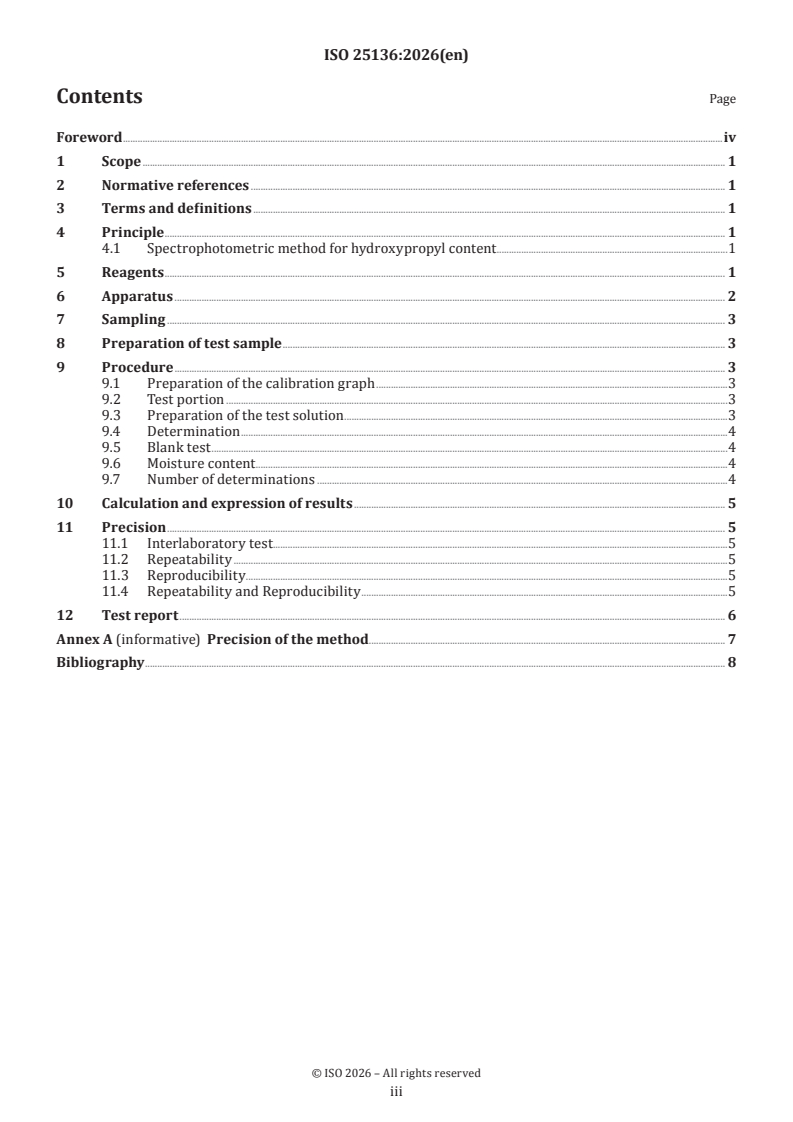
ISO 25136:2026 is an International Standard published by ISO. It specifies a spectrophotometric method for determining the hydroxypropyl group content of modified starches, so it is used when a lab needs a measured value for that substitution level in a starch sample.
What does ISO 25136:2026 specify?
ISO 25136:2026 specifies the analysis method, the reagents and apparatus, the sample preparation steps, the calculation on a dry-mass basis, and the test report items. It is a laboratory method for modified starch, and the sampling note points users to separate sampling guidance rather than building sampling into the method itself.
| Annex | What it covers |
|---|---|
| Annex A | Precision of the method, based on an interlaboratory collaborative trial |
The document is organized into clauses on scope, normative references, terms and definitions, principle, reagents, apparatus, sampling, preparation of the test sample, procedure, calculation and expression of results, precision, and test report.
What are the key requirements of ISO 25136:2026?
Sample preparation and test portion
- Clause 7 expects the laboratory sample to be representative and not altered during transport or storage. In practice, the result is only meaningful if the submitted sample reflects the lot being judged.
- Clause 8 requires the sample to be sieved through 800 µm, ground with a blade mill if needed, and homogenized. This matters because particle size and mixing affect how completely the starch dissolves and reacts.
- Clause 9.2 calls for a test portion of about 0.05 g to 0.10 g weighed to 0.000 1 g. That gives a controlled mass for the color reaction and for the final content calculation.
Measurement principle and calibration
- Clause 4 uses concentrated sulfuric acid and ninhydrin to convert the hydroxypropyl-derived reaction products into a purple complex measured at 590 nm. In practice, the analyst is measuring absorbance, not the starch directly.
- Clause 9.1 requires a calibration graph prepared from 1,2-propanediol standard working solutions. The calibration links absorbance to the amount of response expected from the sample.
- Clause 9.4 repeats the same reaction sequence for the test solution and reads the absorbance against the starch blank. This is how background color or reagent effects are corrected.
Reagents, apparatus, and calculation
- Clause 5 and Clause 6 require analytical-grade reagents, water conforming to ISO 3696 grade 3 or better, pipettes and volumetric flasks in accordance with ISO 648, and a spectrophotometer with 1 cm cells. That means the method depends on accurate volume handling and stable optical measurement.
- Clause 9.6 requires moisture content to be determined in accordance with ISO 1666. The final result is reported on a dry sample basis, so moisture correction is part of the result, not an optional extra.
- Clause 10 uses the calibration result, dilution volume, test portion mass, moisture content, and a conversion factor of 0.776 3 to calculate hydroxypropyl content. The result is rounded to 0.01 % (m/m), and the final value is the arithmetic mean of three determinations if repeatability is satisfied.
Precision and reporting
- Clause 11 gives repeatability and reproducibility criteria and points to Annex A for the collaborative trial behind them. For users, this sets an expectation for how close duplicate results should be within one laboratory and between laboratories.
- Clause 12 requires the report to identify the sample, state the method as ISO 25136:2026, include any optional operating details or incidents, give the result or three results if repeatability was checked, include recovery, and record the date. That supports traceability in quality control, disputes, and supplier-customer checks.
What terms does ISO 25136:2026 define?
- Hydroxypropyl content - the mass of hydroxypropyl groups divided by the mass of the test portion of hydroxypropylated starch, expressed as a fraction or percentage.
- Test portion - the weighed amount of sample taken for the analysis.
- Calibration graph - the graph used to convert measured absorbance into the corresponding 1,2-propanediol response.
- Blank test - the parallel run used as the reference for the absorbance measurement.
- Repeatability - the closeness of results obtained in the same laboratory under the same conditions.
- Reproducibility - the closeness of results obtained in different laboratories under different conditions.
Who uses ISO 25136:2026?
ISO 25136:2026 is used by laboratories that test modified starch, especially quality control and customer laboratories that need a quantitative hydroxypropyl content result. It is also relevant to starch manufacturers, ingredient suppliers, and buyers who check product specification or compare lots using the same measurement basis.
Which standards are used with ISO 25136:2026?
ISO 25136:2026 cites ISO 3696 for analytical-laboratory water, ISO 648 for pipettes and volumetric flasks, and ISO 1666 for moisture content determination. The bibliography also cites ISO 5725-1 and ISO 5725-2 for accuracy, repeatability, and reproducibility concepts, and CAC/GL 50-2004 for sampling guidance.
What does the ISO 25136:2026 document contain?
ISO 25136:2026 contains the full laboratory procedure: reagent preparation, apparatus requirements, sample preparation, calibration graph preparation, the color-forming reaction, absorbance measurement at 590 nm, and the calculation to dry-basis hydroxypropyl content. It also includes the precision summary from an interlaboratory trial in Annex A, together with the reporting requirements needed for traceable results.
Get Certified
Connect with accredited certification bodies for this standard

BSI Group
BSI (British Standards Institution) is the business standards company that helps organizations make excellence a habit.

Bureau Veritas
Bureau Veritas is a world leader in laboratory testing, inspection and certification services.

DNV
DNV is an independent assurance and risk management provider.
Sponsored listings
Frequently Asked Questions
ISO 25136:2026 is a standard published by the International Organization for Standardization (ISO). Its full title is "Modified starch — Determination of hydroxypropyl content — Spectrophotometric method". This standard covers: This document specifies a spectrophotometric method for the determination of the hydroxypropyl group content of modified starches.
This document specifies a spectrophotometric method for the determination of the hydroxypropyl group content of modified starches.
ISO 25136:2026 is classified under the following ICS (International Classification for Standards) categories: 67.180.20 - Starch and derived products. The ICS classification helps identify the subject area and facilitates finding related standards.
ISO 25136:2026 is available in PDF format for immediate download after purchase. The document can be added to your cart and obtained through the secure checkout process. Digital delivery ensures instant access to the complete standard document.
Standards Content (Sample)
International
Standard
ISO 25136
First edition
Modified starch — Determination
2026-08
of hydroxypropyl content —
Spectrophotometric method
Reference number
© ISO 2026
All rights reserved. Unless otherwise specified, or required in the context of its implementation, no part of this publication may
be reproduced or utilized otherwise in any form or by any means, electronic or mechanical, including photocopying, or posting on
the internet or an intranet, without prior written permission. Permission can be requested from either ISO at the address below
or ISO’s member body in the country of the requester.
ISO copyright office
CP 401 • Ch. de Blandonnet 8
CH-1214 Vernier, Geneva
Phone: +41 22 749 01 11
Email: copyright@iso.org
Website: www.iso.org
Published in Switzerland
ii
Contents Page
Foreword .iv
1 Scope . 1
2 Normative references . 1
3 Terms and definitions . 1
4 Principle . 1
4.1 Spectrophotometric method for hydroxypropyl content .1
5 Reagents . 1
6 Apparatus . 2
7 Sampling . 3
8 Preparation of test sample . 3
9 Procedure . 3
9.1 Preparation of the calibration graph .3
9.2 Test portion .3
9.3 Preparation of the test solution .3
9.4 Determination .4
9.5 Blank test .4
9.6 Moisture content .4
9.7 Number of determinations .4
10 Calculation and expression of results . 5
11 Precision . 5
11.1 Interlaboratory test . .5
11.2 Repeatability .5
11.3 Reproducibility .5
11.4 Repeatability and Reproducibility .5
12 Test report . 6
Annex A (informative) Precision of the method.7
Bibliography .8
iii
Foreword
ISO (the International Organization for Standardization) is a worldwide federation of national standards
bodies (ISO member bodies). The work of preparing International Standards is normally carried out through
ISO technical committees. Each member body interested in a subject for which a technical committee
has been established has the right to be represented on that committee. International organizations,
governmental and non-governmental, in liaison with ISO, also take part in the work. ISO collaborates closely
with the International Electrotechnical Commission (IEC) on all matters of electrotechnical standardization.
The procedures used to develop this document and those intended for its further maintenance are described
in the ISO/IEC Directives, Part 1. In particular, the different approval criteria needed for the different types
of ISO document should be noted. This document was drafted in accordance with the editorial rules of the
ISO/IEC Directives, Part 2 (see www.iso.org/directives).
ISO draws attention to the possibility that the implementation of this document may involve the use of (a)
patent(s). ISO takes no position concerning the evidence, validity or applicability of any claimed patent
rights in respect thereof. As of the date of publication of this document, ISO had not received notice of (a)
patent(s) which may be required to implement this document. However, implementers are cautioned that
this may not represent the latest information, which may be obtained from the patent database available at
www.iso.org/patents. ISO shall not be held responsible for identifying any or all such patent rights.
Any trade name used in this document is information given for the convenience of users and does not
constitute an endorsement.
For an explanation of the voluntary nature of standards, the meaning of ISO specific terms and expressions
related to conformity assessment, as well as information about ISO's adherence to the World Trade
Organization (WTO) principles in the Technical Barriers to Trade (TBT), see www.iso.org/iso/foreword.html.
This document was prepared by Technical Committee ISO/TC 93, Starch (including derivatives and by-
products).
Any feedback or questions on this document should be directed to the user’s national standards body. A
complete listing of these bodies can be found at www.iso.org/members.html.
iv
International Standard ISO 25136:2026(en)
Modified starch — Determination of hydroxypropyl content
— Spectrophotometric method
1 Scope
This document specifies a spectrophotometric method for the determination of the hydroxypropyl group
content of modified starches.
2 Normative references
The following documents are referred to in the text in such a way that some or all of their content constitutes
requirements of this document. For dated references, only the edition cited applies. For undated references,
the latest edition of the referenced document (including any amendments) applies.
ISO 3696, Water for analytical laboratory use — Specification and test methods
ISO 648, Laboratory glassware — Single-volume pipettes
ISO 1666, Starch — Determination of moisture content — Oven-drying method
3 Terms and definitions
The following terms and definitions apply to this document.
ISO and IEC maintain terminology databases for use in standardization at the following addresses:
— ISO Online browsing platform: available at https:// www .iso .org/ obp
— IEC Electropedia: available at http:// www .electropedia .org/
3.1
hydroxypropyl content
mass of hydroxypropyl groups divided by the mass of the test portion of hydroxypropylated starch, which
represents the proportion or concentration of hydroxypropyl groups within the starch sample
Note 1 to entry: It is expressed as a fraction or percentage of the total mass of the sample.
4 Principle
4.1 Spectrophotometric method for hydroxypropyl content
In concentrated sulfuric acid, the hydroxypropyl group in modified starches is oxidized to produce propylene
glycol, which is subsequently dehydrated to yield propionaldehyde and propenol. In this acidic medium,
propionaldehyde and propenol react with ninhydrin to form purple-colored complex. The hydroxypropyl
conte
...