

ISO 9170-2:2008
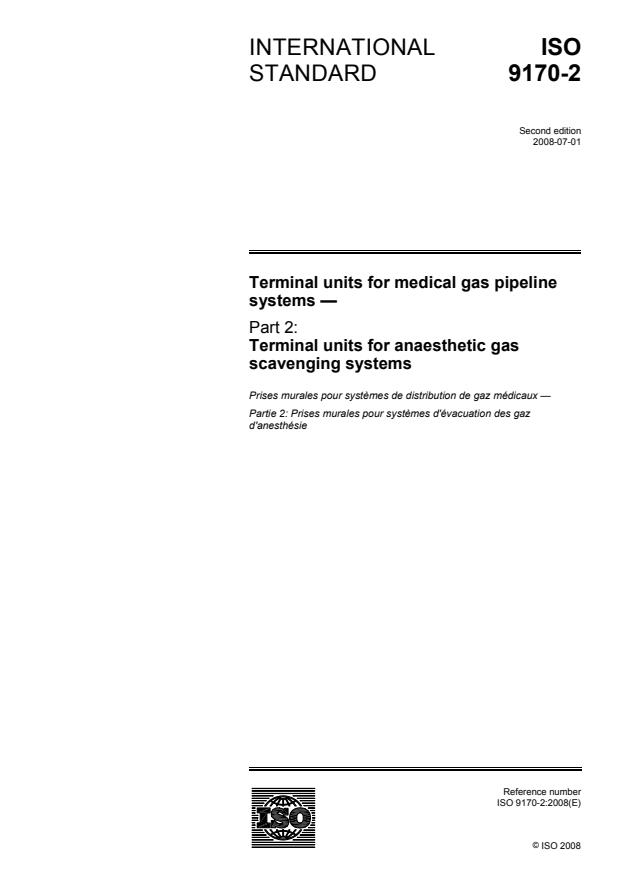
(Main)Terminal units for medical gas pipeline systems — Part 2: Terminal units for anaesthetic gas scavenging systems
General Information
- Abstract
ISO 9170-2:2008 specifies the requirements and dimensions for terminal units intended for use in anaesthetic gas scavenging disposal systems in accordance with ISO 7396-2. ISO 9170-2:2008 specifies two types of terminal unit according to whether the power device is upstream or downstream of the terminal unit. ISO 9170-2:2008 also specifies requirements and dimensions for the mating counterpart (probe) of the type-specific connection point which is part of the terminal unit.
- Status
- Published
- Publication Date
- 15-Jun-2008
- Technical Committee
- ISO/TC 121/SC 6 - Medical gas supply systems
- Drafting Committee
- ISO/TC 121/SC 6 - Medical gas supply systems
- Current Stage
- 9093 - International Standard confirmed
- Start Date
- 19-Sep-2023
- Completion Date
- 29-Aug-2026
Buy Documents
ISO 9170-2:2008 - Terminal units for medical gas pipeline systems — Part 2: Terminal units for anaesthetic gas scavenging systems Released:6/16/2008
ISO 9170-2:2008 - Prises murales pour systemes de distribution de gaz médicaux — Partie 2: Prises murales pour systemes d'évacuation des gaz d'anesthésie Released:6/16/2008
ISO 9170-2:2008 - Terminal units for medical gas pipeline systems — Part 2: Terminal units for anaesthetic gas scavenging systems Released:6/24/2010
Overview
ISO 9170-2:2008 - "Terminal units for medical gas pipeline systems - Part 2: Terminal units for anaesthetic gas scavenging systems" specifies requirements and dimensions for terminal units used in anaesthetic gas scavenging systems (AGSS) in accordance with ISO 7396-2. The standard covers two terminal unit types based on whether the power device is upstream or downstream of the terminal unit and defines the mating counterpart (probe) for type-specific connection points. ISO 9170-2:2008 focuses on safety, type specificity, cleanliness, testing, identification and information to be supplied by the manufacturer.
Key topics and technical requirements
- Scope and types
- Defines two AGSS terminal unit types (Type 1 and Type 2) depending on the position of the power device relative to the terminal unit.
- Clarifies that operating pressure ranges are given in ISO 7396-2.
- Type specificity and dimensions
- Requires type-specific connection points and probes to prevent incorrect connections between AGSS components.
- Specifies dimensional requirements for sockets, probes and interfaces (mating counterparts).
- Materials and construction
- Emphasizes suitability of materials, cleanliness, and construction to meet safety objectives.
- Safety and risk management
- Requires design and documentation consistent with ISO 14971 risk management principles to reduce hazards in normal and single-fault conditions.
- Testing and performance
- Includes test methods for: endurance, pressure drop, connection/disconnection force, mechanical strength, leakage, and type specificity.
- Requires tests for effective connection of probes and durability of markings and colour coding.
- Identification and information
- Specifies marking, colour coding, packaging and manufacturer-supplied information required for installation and testing.
- Interfacing
- Aligns with related standards for transfer/receiving systems (ISO 8835-3) and medical gas pipeline systems (ISO 7396-2).
Applications and who uses this standard
ISO 9170-2:2008 is directly applicable to:
- Medical device and terminal unit manufacturers designing AGSS terminal units, probes and sockets
- Hospital biomedical engineers and facilities teams installing and maintaining medical gas pipeline and anaesthetic gas scavenging systems
- Contractors and installers performing pipeline pressure testing and commissioning under ISO 7396-2
- Regulatory bodies and procurement teams assessing compliance and safety of AGSS components
- Clinical engineers and risk managers applying ISO 14971 for safe system integration
Practical benefits include preventing hazardous cross-connections, ensuring reliable probe/socket mating, simplifying maintenance/testing, and improving patient and staff safety during anaesthetic gas disposal.
Related standards
- ISO 7396-2 - Medical gas pipeline systems: Anaesthetic gas scavenging disposal systems
- ISO 8835-3 - Transfer and receiving systems for active AGSS
- ISO 14971 - Risk management for medical devices
- ISO 15001 - Compatibility with oxygen
- ISO 9170-1 - Terminal units for compressed medical gases and vacuum
Keywords: ISO 9170-2:2008, anaesthetic gas scavenging systems, AGSS terminal units, terminal unit probes, type-specific connection, medical gas pipeline systems, ISO 7396-2, testing and marking.
Relations
- Effective Date
- 09-Feb-2026
- Effective Date
- 09-Feb-2026
- Effective Date
- 09-Feb-2026
- Effective Date
- 09-Feb-2026
- Effective Date
- 12-Feb-2026
- Effective Date
- 15-Apr-2008
Buy Documents
ISO 9170-2:2008 - Terminal units for medical gas pipeline systems — Part 2: Terminal units for anaesthetic gas scavenging systems Released:6/16/2008
ISO 9170-2:2008 - Prises murales pour systemes de distribution de gaz médicaux — Partie 2: Prises murales pour systemes d'évacuation des gaz d'anesthésie Released:6/16/2008
ISO 9170-2:2008 - Terminal units for medical gas pipeline systems — Part 2: Terminal units for anaesthetic gas scavenging systems Released:6/24/2010
Get Certified
Connect with accredited certification bodies for this standard

BSI Group
BSI (British Standards Institution) is the business standards company that helps organizations make excellence a habit.

TÜV Rheinland
TÜV Rheinland is a leading international provider of technical services.

TÜV SÜD
TÜV SÜD is a trusted partner of choice for safety, security and sustainability solutions.
Sponsored listings
Frequently Asked Questions
ISO 9170-2:2008 is a standard published by the International Organization for Standardization (ISO). Its full title is "Terminal units for medical gas pipeline systems — Part 2: Terminal units for anaesthetic gas scavenging systems". This standard covers: ISO 9170-2:2008 specifies the requirements and dimensions for terminal units intended for use in anaesthetic gas scavenging disposal systems in accordance with ISO 7396-2. ISO 9170-2:2008 specifies two types of terminal unit according to whether the power device is upstream or downstream of the terminal unit. ISO 9170-2:2008 also specifies requirements and dimensions for the mating counterpart (probe) of the type-specific connection point which is part of the terminal unit.
ISO 9170-2:2008 specifies the requirements and dimensions for terminal units intended for use in anaesthetic gas scavenging disposal systems in accordance with ISO 7396-2. ISO 9170-2:2008 specifies two types of terminal unit according to whether the power device is upstream or downstream of the terminal unit. ISO 9170-2:2008 also specifies requirements and dimensions for the mating counterpart (probe) of the type-specific connection point which is part of the terminal unit.
ISO 9170-2:2008 is classified under the following ICS (International Classification for Standards) categories: 11.040.10 - Anaesthetic, respiratory and reanimation equipment. The ICS classification helps identify the subject area and facilitates finding related standards.
ISO 9170-2:2008 has the following relationships with other standards: It is inter standard links to EN ISO 11197:2019, EN ISO 80601-2-13:2022, EN ISO 80601-2-13:2012, EN ISO 11197:2016, EN ISO 9170-2:2008, ISO 9170-2:1999. Understanding these relationships helps ensure you are using the most current and applicable version of the standard.
ISO 9170-2:2008 is available in PDF format for immediate download after purchase. The document can be added to your cart and obtained through the secure checkout process. Digital delivery ensures instant access to the complete standard document.
Standards Content (Sample)
INTERNATIONAL ISO
STANDARD 9170-2
Second edition
2008-07-01
Terminal units for medical gas pipeline
systems —
Part 2:
Terminal units for anaesthetic gas
scavenging systems
Prises murales pour systèmes de distribution de gaz médicaux —
Partie 2: Prises murales pour systèmes d'évacuation des gaz
d'anesthésie
Reference number
©
ISO 2008
PDF disclaimer
This PDF file may contain embedded typefaces. In accordance with Adobe's licensing policy, this file may be printed or viewed but
shall not be edited unless the typefaces which are embedded are licensed to and installed on the computer performing the editing. In
downloading this file, parties accept therein the responsibility of not infringing Adobe's licensing policy. The ISO Central Secretariat
accepts no liability in this area.
Adobe is a trademark of Adobe Systems Incorporated.
Details of the software products used to create this PDF file can be found in the General Info relative to the file; the PDF-creation
parameters were optimized for printing. Every care has been taken to ensure that the file is suitable for use by ISO member bodies. In
the unlikely event that a problem relating to it is found, please inform the Central Secretariat at the address given below.
© ISO 2008
All rights reserved. Unless otherwise specified, no part of this publication may be reproduced or utilized in any form or by any means,
electronic or mechanical, including photocopying and microfilm, without permission in writing from either ISO at the address below or
ISO's member body in the country of the requester.
ISO copyright office
Case postale 56 • CH-1211 Geneva 20
Tel. + 41 22 749 01 11
Fax + 41 22 749 09 47
E-mail copyright@iso.org
Web www.iso.org
Published in Switzerland
ii © ISO 2008 – All rights reserved
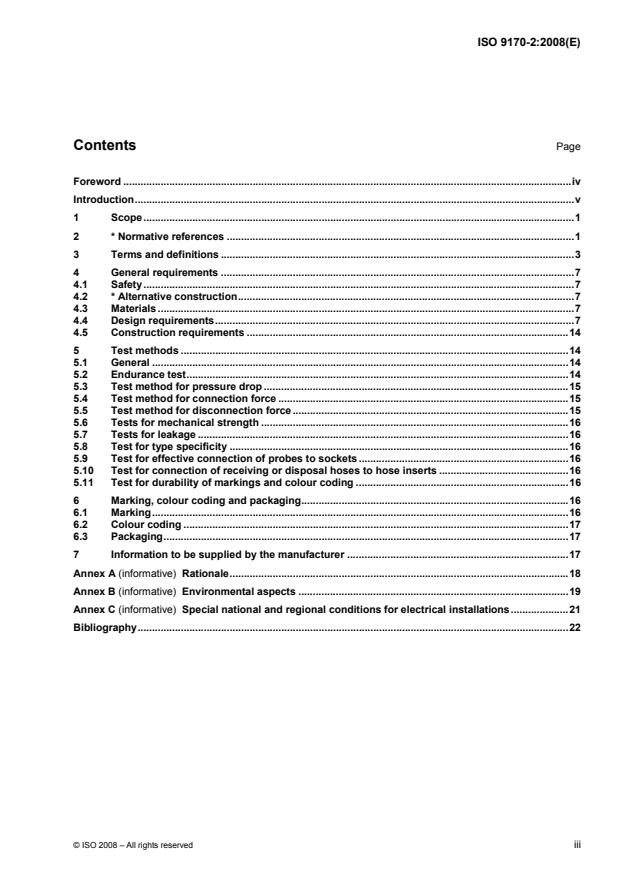
Contents Page
Foreword .iv
Introduction.v
1 Scope.1
2 * Normative references .1
3 Terms and definitions .3
4 General requirements .7
4.1 Safety.7
4.2 * Alternative construction.7
4.3 Materials .7
4.4 Design requirements.7
4.5 Construction requirements .14
5 Test methods .14
5.1 General .14
5.2 Endurance test.14
5.3 Test method for pressure drop .15
5.4 Test method for connection force .15
5.5 Test method for disconnection force .15
5.6 Tests for mechanical strength .16
5.7 Tests for leakage .16
5.8 Test for type specificity .16
5.9 Test for effective connection of probes to sockets .16
5.10 Test for connection of receiving or disposal hoses to hose inserts .16
5.11 Test for durability of markings and colour coding .16
6 Marking, colour coding and packaging.16
6.1 Marking.16
6.2 Colour coding .17
6.3 Packaging.17
7 Information to be supplied by the manufacturer .17
Annex A (informative) Rationale.18
Annex B (informative) Environmental aspects .19
Annex C (informative) Special national and regional conditions for electrical installations.21
Bibliography.22
Foreword
ISO (the International Organization for Standardization) is a worldwide federation of national standards bodies
(ISO member bodies). The work of preparing International Standards is normally carried out through ISO
technical committees. Each member body interested in a subject for which a technical committee has been
established has the right to be represented on that committee. International organizations, governmental and
non-governmental, in liaison with ISO, also take part in the work. ISO collaborates closely with the
International Electrotechnical Commission (IEC) on all matters of electrotechnical standardization.
International Standards are drafted in accordance with the rules given in the ISO/IEC Directives, Part 2.
The main task of technical committees is to prepare International Standards. Draft International Standards
adopted by the technical committees are circulated to the member bodies for voting. Publication as an
International Standard requires approval by at least 75 % of the member bodies casting a vote.
Attention is drawn to the possibility that some of the elements of this document may be the subject of patent
rights. ISO shall not be held responsible for identifying any or all such patent rights.
ISO 9170-2 was prepared by Technical Committee ISO/TC 121, Anaesthetic and respiratory equipment,
Subcommittee SC 6, Medical gas systems.
This second edition cancels and replaces the first edition (ISO 9170-2:1999) which has been technically
revised.
ISO 9170 consists of the following parts, under the general title Terminal units for medical gas pipeline
systems:
⎯ Part 1: Terminal units for use with compressed medical gases and vacuum
⎯ Part 2: Terminal units for anaesthetic gas scavenging systems
iv © ISO 2008 – All rights reserved
Introduction
Anaesthetic gas scavenging system (AGSS) terminal units are the points in an anaesthetic gas scavenging
system where the operator makes connections and disconnections for the disposal of medical gases and
anaesthetic vapours from anaesthetic machines or other items of medical equipment, and where a wrong
connection may create a hazard to the patient. It is important that terminal units and their components be
designed, manufactured, installed and maintained in such a way as to meet the basic requirements specified
in this part of ISO 9170.
This part of ISO 9170 pays particular attention to:
⎯ suitability of materials;
⎯ type specificity;
⎯ dimensions of probes and type-specific connection points;
⎯ cleanliness;
⎯ testing;
⎯ identification;
⎯ information supplied.
This part of ISO 9170 specifies the provision of information for the installation and subsequent testing of
terminal units. Testing of terminal units prior to use is critical to patient safety and it is essential that terminal
units are not used until full testing in accordance with ISO 7396-2 has been completed.
Annex A contains rationale statements for some of the requirements of this part of ISO 9170. The clauses and
subclauses marked with an asterisk (*) after their number have corresponding rationale contained in Annex A,
included to provide additional insight into the reasoning that led to the requirements and recommendations
that have been incorporated in this part of ISO 9170. It is considered that knowledge of the reasons for the
requirements will not only facilitate the proper application of this part of ISO 9170, but will expedite any
subsequent revisions.
INTERNATIONAL STANDARD ISO 9170-2:2008(E)
Terminal units for medical gas pipeline systems —
Part 2:
Terminal units for anaesthetic gas scavenging systems
1 Scope
1.1 This part of ISO 9170 specifies the requirements and dimensions for terminal units intended for use in
anaesthetic gas scavenging disposal systems in accordance with ISO 7396-2.
1.2 This part of ISO 9170 specifies two types of terminal unit according to whether the power device is
upstream or downstream of the terminal unit.
1.3 This part of ISO 9170 also specifies requirements and dimensions for the mating counterpart (probe) of
the type-specific connection point which is part of the terminal unit.
1.4 This part of ISO 9170 does not specify the ranges of nominal operating pressure for terminal units,
which are defined in ISO 7396-2.
1.5 This part of ISO 9170 does not specify requirements for terminal units for use with compressed medical
gases and vacuum, which are covered in ISO 9170-1.
2 * Normative references
The following referenced documents are indispensable for the application of this document. For dated
references, only the edition cited applies. For undated references, the latest edition of the referenced
document (including any amendments) applies.
ISO 6506-1:2005, Metallic materials — Brinell hardness test — Part 1: Test method
ISO 7396-2:2007, Medical gas pipeline systems — Part 2: Anaesthetic gas scavenging disposal systems
ISO 8835-3:2007, Inhalational anaesthesia systems — Part 3: Transfer and receiving systems of active
anaesthetic gas scavenging systems
ISO 14971:2007, Medical devices — Application of risk management to medical devices
ISO 15001:2003, Anaesthetic and respiratory equipment — Compatibility with oxygen
Key
1 type-specific connection
2 hose insert (permanent)
3 point for brazed connection (permanent)
4 terminal unit base block
5 type-specific interface
6 terminal unit check valve (Type 1 only)
7 type-specific connection point
8 socket
9 type-specific probe
Figure 1 — Diagram of a typical AGSS terminal unit
2 © ISO 2008 – All rights reserved
3 Terms and definitions
For the purposes of this document, the following terms and definitions apply.
NOTE A diagram of a typical AGSS terminal unit with an example of terminology is given in Figure 1.
3.1
AGSS Type 1 terminal unit
connection point between the receiving system and disposal system at which the operator makes connections
and disconnections
See Figure 2.
3.2
AGSS Type 1L terminal unit
terminal unit to be used in low-flow disposal systems
3.3
AGSS Type 1H terminal unit
terminal unit to be used in high-flow disposal systems
3.4
AGSS Type 2 terminal unit
connection point between the power device or disposal hose and the remainder of the disposal system at
which the operator makes connections and disconnections
See Figure 2.
3.5
AGSS type-specific
having characteristics which prevent interchangeability and thereby allow assignment to one AGSS type only
3.6
AGSS type-specific connection point
that part of the AGSS socket which is the receptor for an AGSS type-specific probe
3.7
anaesthetic gas scavenging system
AGSS
complete system that is connected to the exhaust port(s) of a breathing system or other equipment for the
purpose of conveying expired and/or excess anaesthetic gases to an appropriate place of discharge
NOTE Functionally, an AGSS comprises three different parts: a transfer system, a receiving system and a disposal
system. These three functionally discrete parts may be either separate or sequentially combined in part or in total. In
addition, one or more parts of an AGSS can be combined with a breathing system or other equipment to include the
transfer system or transfer and receiving systems. See Figure 2.
3.8
terminal unit check valve
valve that remains closed until opened by insertion of an appropriate probe and which then flows in either
direction
3.9
disposal hose
that part of the AGSS which transfers expired and/or excess anaesthetic gases from the power device to the
probe of the AGSS Type 2 terminal unit
4 © ISO 2008 – All rights reserved
Key
1 apparatus including breathing system, integral transfer/receiving system and power device
2 apparatus including breathing system
3 transfer/receiving system and power device
4 apparatus including breathing system and integral transfer/receiving system
5 permanent or proprietary connector
6 receiving hose
7 breathing system or anaesthetic ventilator
8 transfer tube
9 receiving system
10 power device
11 permanent connection
12 discharge
13 flexible hose or pendant
14 disposal hose
15 limit of breathing system
16 limit of transfer system
17 limit of receiving system
18 limit of disposal system
19 proprietary connection (functionally specific)
20 30 mm conical connection
21 type 1 terminal unit probe/socket
22 type 2 terminal unit probe/socket
NOTE 1 Type 1 terminal unit probe/socket is for negative pressure. Type 2 terminal unit probe/socket is for positive
pressure.
NOTE 2 The limit between the receiving system and the disposal system as shown may not coincide with an actual
physical limit such as a wall.
Figure 2 — Schematic diagram of typical anaesthetic gas scavenging systems
3.10
disposal system
means by which expired and/or excess anaesthetic gases are conveyed from the receiving system to an
appropriate place of discharge
NOTE A place of discharge can be, for example, the exterior of a building or a non-recirculating extract ventilation
system.
3.11
high-flow disposal system
disposal system that is intended to operate with a high-flow transfer and receiving system complying with
ISO 8835-3
3.12
low-flow disposal system
disposal system that is intended to operate with a low-flow transfer and receiving system complying with
ISO 8835-3
3.13
maximum test pressure
maximum pressure to which the terminal unit is designed to be subjected during pipeline pressure testing
3.14
operating pressure
pressure at which the AGSS terminal unit is designed to operate
NOTE The operating pressure for a Type 1 AGSS terminal unit is negative; the operating pressure for a Type 2
AGSS terminal unit is positive.
3.15
power device
that part of the AGSS disposal system that provides power for scavenging at specified flows and pressures
3.16
probe
non-interchangeable male component designed for acceptance by, and retention in, a socket
3.17
quick connector
pair of non-threaded type-specific components that can be easily and rapidly joined together by a single action
of one or both hands without the use of tools
3.18
receiving hose
that part of an AGSS which transfers expired and/or excess anaesthetic gases from the receiving system to
the disposal system
3.19
receiving system
that part of an AGSS which provides an interface between a transfer system and a disposal system
3.20
single-fault condition
condition in which a single means for protection against a safety hazard in equipment is defective or a single
external abnormal condition is present
3.21
socket
that female part of a terminal unit which is either integral or attached to the base block by a type-specific
interface and which contains the type-specific connection point
3.22
terminal unit base block
that part of a terminal unit which is attached to the disposal system
3.23
terminal unit check valve
valve that remains closed until opened by the insertion of an appropriate probe and which then permits flow in
either direction
3.24
transfer system
that part of an AGSS which transfers scavenged gases from the exhaust port of a breathing system or other
equipment to a receiving system
3.25
transfer tube
that part of an AGSS that transfers expired and/or excess anaesthetic gases from the breathing system or
other equipment to the receiving system
6 © ISO 2008 – All rights reserved
4 General requirements
4.1 Safety
Terminal units shall, when transported, stored, installed, operated in normal use and maintained according to
the instructions of the manufacturer, present no risks that are not reduced to an acceptable level using
procedures in accordance with ISO 14971 and which are related to their intended application, in normal
conditions and in single-fault condition.
NOTE Maintenance of equipment is considered a normal condition.
4.2 * Alternative construction
Terminal units and components, or parts thereof, that use materials or have forms of construction (except for
dimensions and allocation of probes and type-specific connection points) different from those detailed in this
clause, shall be presumed to be in compliance with the safety objectives of this part of ISO 9170 if it can be
demonstrated that an equivalent degree of safety is obtained (i.e. compliance with requirements presumes
that risks have been mitigated to acceptable levels), and unless objective evidence to the contrary becomes
available.
Evidence of an equivalent degree of safety shall be provided by the manufacturer upon request.
NOTE 1 Objective evidence may be obtained by postmarket surveillance.
NOTE 2 Regional or national regulations might require the provision of evidence to a competent authority or conformity
assessment body (e.g. notified body in the European Economic Area) upon request.
4.3 Materials
4.3.1 The materials in contact with the gas shall be corrosion-resistant and compatible with the medical
gases and anaesthetic vapours in the temperature range specified in 4.3.2.
NOTE Corrosion resistance includes resistance to moisture and surrounding materials.
4.3.2 The materials shall permit the terminal units and their components to meet the requirements of 4.4 in
the temperature range −20 °C to +60 °C.
4.3.3 Terminal units shall be capable of meeting the requirements of 4.4 after being packed, transported
and stored as specified by the manufacturer.
4.3.4 Evidence of conformity with the requirements of 4.3.1, 4.3.2 and 4.3.3 shall be provided by the
manufacturer upon request.
NOTE Regional or national regulations might require the provision of evidence to a competent authority or conformity
assessment body (e.g. notified body in the European Economic Area) upon request.
4.4 Design requirements
4.4.1 Retention of type specificity
If any type-specific component is removed from the terminal unit, the type specificity of the terminal unit shall
be retained, or the terminal unit shall be rendered inoperable. If the terminal unit can be dismantled, it shall not
be possible to reassemble the components in such a way that the fully assembled terminal unit is no longer
type-specific.
4.4.2 Type-specific connection point
Each terminal unit shall include a type-specific connection point that shall accept only the appropriate
type-specific probe. This connection point shall be included in a socket.
4.4.3 Terminal unit check valve
Each Type I terminal unit shall include a check valve that shall open when the probe is connected and shut off
automatically when the probe is
...
NORME ISO
INTERNATIONALE 9170-2
Deuxième édition
2008-07-01
Prises murales pour systèmes
de distribution de gaz médicaux —
Partie 2:
Prises murales pour systèmes
d'évacuation des gaz d'anesthésie
Terminal units for medical gas pipeline systems —
Part 2: Terminal units for anaesthetic gas scavenging systems
Numéro de référence
©
ISO 2008
PDF – Exonération de responsabilité
Le présent fichier PDF peut contenir des polices de caractères intégrées. Conformément aux conditions de licence d'Adobe, ce fichier
peut être imprimé ou visualisé, mais ne doit pas être modifié à moins que l'ordinateur employé à cet effet ne bénéficie d'une licence
autorisant l'utilisation de ces polices et que celles-ci y soient installées. Lors du téléchargement de ce fichier, les parties concernées
acceptent de fait la responsabilité de ne pas enfreindre les conditions de licence d'Adobe. Le Secrétariat central de l'ISO décline toute
responsabilité en la matière.
Adobe est une marque déposée d'Adobe Systems Incorporated.
Les détails relatifs aux produits logiciels utilisés pour la création du présent fichier PDF sont disponibles dans la rubrique General Info
du fichier; les paramètres de création PDF ont été optimisés pour l'impression. Toutes les mesures ont été prises pour garantir
l'exploitation de ce fichier par les comités membres de l'ISO. Dans le cas peu probable où surviendrait un problème d'utilisation,
veuillez en informer le Secrétariat central à l'adresse donnée ci-dessous.
DOCUMENT PROTÉGÉ PAR COPYRIGHT
© ISO 2008
Droits de reproduction réservés. Sauf prescription différente, aucune partie de cette publication ne peut être reproduite ni utilisée sous
quelque forme que ce soit et par aucun procédé, électronique ou mécanique, y compris la photocopie et les microfilms, sans l'accord écrit
de l'ISO à l'adresse ci-après ou du comité membre de l'ISO dans le pays du demandeur.
ISO copyright office
Case postale 56 • CH-1211 Geneva 20
Tel. + 41 22 749 01 11
Fax. + 41 22 749 09 47
E-mail copyright@iso.org
Web www.iso.org
Publié en Suisse
ii © ISO 2008 – Tous droits réservés
Sommaire Page
Avant-propos .iv
Introduction.v
1 Domaine d'application .1
2 *Références normatives.1
3 Termes et définitions .1
4 Exigences générales.7
4.1 Sécurité.7
4.2 *Construction alternative.7
4.3 Matériaux.7
4.4 Exigences relatives à la conception.7
4.5 Exigences relatives à la construction .14
5 Méthodes d'essai.14
5.1 Généralités .14
5.2 Essai d'endurance.14
5.3 Essai de chute de pression .15
5.4 Essai d'application de la force en vue du branchement .15
5.5 Méthode d'essai de la force de débranchement .15
5.6 Essais de résistance mécanique .16
5.7 Essais du débit de fuite .16
5.8 Essai de spécificité de type.16
5.9 Essai de raccordement des embouts aux têtes de prise .16
5.10 Essai de raccordement des tuyaux de réception ou d'évacuation à leurs olives .16
5.11 Essai de durabilité du marquage et du code couleur.16
6 Marquage, code couleur et emballage .17
6.1 Marquage.17
6.2 Code couleur.17
6.3 Emballage.17
7 Informations à fournir par le fabricant .17
Annexe A (informative) Justificatif.18
Annexe B (informative) Aspects environnementaux.19
Annexe C (informative) Conditions nationales et régionales spéciales pour les installations
électriques.21
Bibliographie.22
Avant-propos
L'ISO (Organisation internationale de normalisation) est une fédération mondiale d'organismes nationaux de
normalisation (comités membres de l'ISO). L'élaboration des Normes internationales est en général confiée
aux comités techniques de l'ISO. Chaque comité membre intéressé par une étude a le droit de faire partie du
comité technique créé à cet effet. Les organisations internationales, gouvernementales et non
gouvernementales, en liaison avec l'ISO participent également aux travaux. L'ISO collabore étroitement avec
la Commission électrotechnique internationale (CEI) en ce qui concerne la normalisation électrotechnique.
Les Normes internationales sont rédigées conformément aux règles données dans les Directives ISO/CEI,
Partie 2.
La tâche principale des comités techniques est d'élaborer les Normes internationales. Les projets de Normes
internationales adoptés par les comités techniques sont soumis aux comités membres pour vote. Leur
publication comme Normes internationales requiert l'approbation de 75 % au moins des comités membres
votants.
L'attention est appelée sur le fait que certains des éléments du présent document peuvent faire l'objet de
droits de propriété intellectuelle ou de droits analogues. L'ISO ne saurait être tenue pour responsable de ne
pas avoir identifié de tels droits de propriété et averti de leur existence.
L'ISO 9170-2 a été élaborée par le comité technique ISO/TC 121, Matériel d'anesthésie et de réanimation
respiratoire, sous-comité SC 6, Systèmes pour gaz médicaux.
Cette deuxième édition annule et remplace la première édition (ISO 9170-2:1999), qui a fait l'objet d'une
révision technique.
L'ISO 9170 comprend les parties suivantes, présentées sous le titre général Prises murales pour systèmes de
distribution de gaz médicaux:
⎯ Partie 1: Prises murales pour les gaz médicaux comprimés et le vide
⎯ Partie 2: Prises murales pour systèmes d'évacuation des gaz d'anesthésie
iv © ISO 2008 – Tous droits réservés
Introduction
Les prises murales pour systèmes d'évacuation des gaz d'anesthésie (SEGA) constituent les points dans un
système d'évacuation des gaz d'anesthésie auxquels l'opérateur établit des branchements et des
débranchements pour l'évacuation des gaz médicaux et des vapeurs anesthésiques des appareils
d'anesthésie ou autres éléments d'équipements médicaux et où tout raccordement erroné peut mettre la vie
du patient en danger. Il importe que les prises murales ainsi que leurs éléments soient conçus, fabriqués,
installés et entretenus de manière à pouvoir satisfaire aux exigences essentielles énoncées dans la présente
partie de l'ISO 9170.
La présente partie de l'ISO 9170 traite en particulier des points suivants:
⎯ adéquation des matériaux;
⎯ spécificité de type;
⎯ dimensions des embouts et des points de raccordement de type spécifique;
⎯ propreté;
⎯ essais;
⎯ identification;
⎯ informations fournies.
La présente partie de l'ISO 9170 spécifie les informations à fournir pour l'installation et la réalisation d'essais
des prises murales avant leur utilisation. Les essais réalisés préalablement à l'utilisation des prises murales
présentent une importance cruciale pour la sécurité du patient, il est donc capital de ne pas utiliser les prises
murales avant qu'elles n'aient été soumises à la totalité des essais conformément à l'ISO 7396-2.
L'Annexe A donne un justificatif relatif à certaines exigences de la présente partie de l'ISO 9170. Les articles
et les paragraphes annotés d'un astérisque (*) après le numéro du paragraphe correspondent au justificatif
énoncé dans l'Annexe A, inséré afin de faciliter la compréhension du raisonnement à l'origine des exigences
et des recommandations intégrées dans la présente partie de l'ISO 9170. Il est considéré que la
connaissance de la raison de ces exigences ne facilitera pas uniquement l'application correcte de la présente
partie de l'ISO 9170, mais accélérera également toute révision ultérieure.
NORME INTERNATIONALE ISO 9170-2:2008(F)
Prises murales pour systèmes de distribution de gaz
médicaux —
Partie 2:
Prises murales pour systèmes d'évacuation des gaz
d'anesthésie
1 Domaine d'application
1.1 La présente partie de l'ISO 9170 spécifie les exigences et les dimensions des prises murales destinées
à être utilisées dans les systèmes d'évacuation des gaz d'anesthésie conformément à l'ISO 7396-2.
1.2 La présente partie de l'ISO 9170 spécifie deux types de prises murales pour une utilisation où le
dispositif moteur se trouve soit en amont soit en aval de la prise murale.
1.3 La présente partie de l'ISO 9170 spécifie également les exigences et les dimensions des contreparties
s'y emboîtant (embout) du raccord de type spécifique qui fait partie de la prise murale.
1.4 La présente partie de l'ISO 9170 ne spécifie pas les plages de pression de service nominale des prises
murales, telles que définies dans l'ISO 7396-2.
1.5 La présente partie de l'ISO 9170 ne spécifie pas les exigences applicables aux prises murales
destinées à être utilisées avec des gaz médicaux comprimés et le vide, tels que définis dans l'ISO 9170-1.
2 *Références normatives
Les documents de référence suivants sont indispensables pour l'application du présent document. Pour les
références datées, seule l'édition citée s'applique. Pour les références non datées, la dernière édition du
document de référence s'applique (y compris les éventuels amendements).
ISO 6506-1:2005, Matériaux métalliques — Essai de dureté Brinell — Partie 1: Méthode d'essai
ISO 7396-2:2007, Systèmes de distribution de gaz médicaux — Partie 2: Réseaux d'évacuation de gaz
d'anesthésie non réutilisables
ISO 8835-3:2007, Systèmes d'anesthésie par inhalation — Partie 3: Systèmes de transfert et de réception
des systèmes d'évacuation des gaz d'anesthésie
ISO 14971:2007, Dispositifs médicaux — Application de la gestion des risques aux dispositifs médicaux
ISO 15001:2003, Matériel d'anesthésie et respiratoire — Compatibilité avec l'oxygène
3 Termes et définitions
Pour les besoins du présent document, les termes et définitions suivants s'appliquent.
NOTE Un schéma d'une prise murale SEGA type avec un exemple de terminologie est représenté à la Figure 1.
Légende
1 raccordement de type spécifique
2 olive (permanente)
3 raccordement brasé (permanent)
4 embase de prise murale
5 interface de type spécifique
6 clapet de tête de prise murale (pour type 1 seulement)
7 raccord de type spécifique
8 tête de prise
9 embout de type spécifique
Figure 1 — Schéma d'une prise murale SEGA type
2 © ISO 2008 – Tous droits réservés
3.1
prise murale SEGA de type 1
raccordement entre le système de réception et le système final d'évacuation sur lequel l'opérateur peut
brancher et débrancher des appareils
Voir Figure 2.
3.2
prise murale SEGA de type 1L
prise murale à utiliser dans des systèmes finals d'évacuation à bas débit
3.3
prise murale SEGA de type 1H
prise murale à utiliser dans des systèmes finals d'évacuation à haut débit
3.4
prise murale SEGA de type 2
raccordement entre le dispositif moteur ou le tuyau final d'évacuation et le reste du système final d'évacuation
sur lequel l'utilisateur peut brancher et débrancher des appareils
Voir Figure 2.
3.5
système SEGA de type spécifique
possédant des caractéristiques qui empêchent toute interchangeabilité et permettent par conséquent
d'assigner un seul type de SEGA
3.6
raccord de prise SEGA de type spécifique
partie de la tête de prise SEGA qui est le récepteur d'un embout de SEGA de type spécifique
3.7
système d'évacuation de gaz d'anesthésie
SEGA
système complet qui est raccordé à un ou des orifices de sortie d'un système respiratoire ou autre
équipement afin d'acheminer les gaz d'anesthésie expirés et/ou gaz d'anesthésie en excès vers un endroit
approprié d'évacuation
NOTE Fonctionnellement, un système SEGA comprend trois parties différentes: un système de transfert, un système
de réception et un système final d'évacuation. Ces trois parties distinctes peuvent être soit séparées soit combinées de
façon séquentielle en partie ou dans leur totalité. De plus, une ou plusieurs parties d'un système SEGA peuvent être
combinées avec un système respiratoire ou autre équipement afin d'y inclure le système de transfert ou les systèmes de
transfert et de réception. Voir Figure 2.
3.8
clapet de tête de prise murale
clapet qui reste fermé jusqu’à ce qu’il soit ouvert par un embout approprié et qui permet alors un flux dans une
direction quelconque
3.9
tuyau final d'évacuation
partie du système SEGA qui transfère les gaz expirés et/ou en excès du dispositif moteur vers l'embout de la
prise murale de type 2 d'un système SEGA
3.10
système final d'évacuation
moyens par lesquels les gaz expirés et/ou en excès sont transmis du système de réception vers un lieu
d'évacuation approprié
NOTE Un lieu d'évacuation peut être, par exemple, l'extérieur d'un bâtiment ou l'évacuation d'un système de
ventilation sans recyclage.
4 © ISO 2008 – Tous droits réservés
Légende
1 appareillage comprenant un système respiratoire, un système de transfert/réception intégré et un dispositif moteur
2 appareillage comprenant un système respiratoire
3 système de transfert/réception et dispositif moteur
4 appareillage comprenant un système respiratoire et un système de transfert/réception intégré
5 raccord permanent ou propre au fabricant
6 tuyau de réception
7 système respiratoire ou ventilateur d'anesthésie
8 tube de transfert
9 système de réception
10 dispositif moteur
11 raccord permanent
12 sortie
13 tuyau flexible ou plafonnier
14 tuyau final d'évacuation
15 limite du système respiratoire
16 limite du système de transfert
17 limite du système de réception
18 limite du système d'évacuation
19 raccord propre au fabricant (fonctionnellement spécifique)
20 raccord conique 30 mm
21 embout/tête de prise de prise murale de type 1
22 embout/tête de prise de prise murale de type 2
NOTE 1 L'embout/tête de prise murale de type 1 est pour une pression négative. L'embout/tête de prise murale de
type 2 est pour une pression positive.
NOTE 2 La limite entre le système de réception et le système final d'évacuation telle que présentée peut ne pas
coïncider avec une limite physique réelle telle qu'une paroi.
Figure 2 — Schéma d'un système d'évacuation de gaz d'anesthésie type
3.11
système final d'évacuation haut débit
système final d'évacuation destiné à fonctionner avec un système de transfert et de réception à débit élevé
conforme à l'ISO 8835-3
3.12
système final d'évacuation bas débit
système final d'évacuation destiné à fonctionner avec un système de transfert et de réception à faible débit
conforme à l'ISO 8835-3
3.13
pression d'essai maximale
pression maximale à laquelle une prise murale est conçue pour être soumise lors de l'essai de résistance à la
pression des canalisations
3.14
pression de service
pression à laquelle la prise murale du système SEGA est conçue pour fonctionner
NOTE La pression de service de la prise murale des systèmes SEGA de type 1 est négative; la pression de service
de la prise murale des systèmes SEGA de type 2 est positive.
3.15
dispositif moteur
partie du système final d'évacuation SEGA qui fournit la puissance requise pour l'évacuation des gaz à des
débits et à des pressions spécifiés
3.16
embout
élément mâle non interchangeable conçu pour être compatible avec la tête de prise et pour y être maintenu
3.17
raccord de prise rapide
couple d'éléments non filetés de type spécifique, qui peuvent être rapidement et facilement enclenchés par
simple action d'une ou des deux mains sans utilisation d'outil
3.18
tuyau de réception
partie d'un système SEGA qui transfère des gaz d'anesthésie expirés et/ou en excès du système de réception
au système final d'évacuation
3.19
système de réception
partie d'un système SEGA qui procure une interface entre le système de transfert et le système final
d'évacuation
3.20
condition de premier défaut
condition réalisée lorsqu'un défaut affecte une seule des mesures de protection contre les risques de
l'appareil, ou en présence d'une seule condition anormale extérieure à l'appareil
3.21
tête de prise
partie femelle d'une prise murale incorporée ou fixée à l'embase par une interface de type spécifique et qui
contient le raccord de type spécifique
3.22
embase de prise murale
partie de la prise murale fixée sur le système final d'évacuation
3.23
clapet de tête de prise murale
clapet qui reste fermé jusqu'à l'introduction de l'embout approprié, ce qui permet alors un écoulement dans
l'une ou l'autre direction
3.24
système de transfert
partie d'un système SEGA qui transfère des gaz d'anesthésie expirés et/ou en excès de l'orifice d'évacuation
du système respiratoire ou de tout autre équipement vers le système de réception
3.25
tube de transfert
partie du système SEGA qui transfère des gaz d'anesthésie expirés et/ou en excès du système respiratoire
ou tout autre équipement vers le système de réception
6 © ISO 2008 – Tous droits réservés
4 Exigences générales
4.1 Sécurité
Pendant le transport, le stockage, l'installation, le fonctionnement en utilisation normale et l'entretien effectué
conformément aux instructions du fabricant, les prises murales ne doivent pas représenter un danger
prévisible en utilisant les modes opératoires d'analyse du risque conformes à l'ISO 14971 et liés à l'application
prévue, en condition normale et en condition de premier défaut.
NOTE L'entretien de l'équipement est considéré comme une condition normale.
4.2 *Construction alternative
Les prises murales et les éléments ou parties de ces prises dont les matériaux ou les formes de construction
(à l'exception des dimensions et de l'attribution des embouts et des raccords de type spécifique) sont
différents de ceux détaillés dans le présent article, doivent être présumés conformes aux objectifs de sécurité
de la présente partie de l'ISO 9170, s'il peut être démontré qu'un degré de sécurité équivalent est obtenu
(c'est-à-dire que la conformité aux exigences présume que les risques ont été limités à des niveaux
acceptables) et à moins qu'une preuve objective du contraire ne soit disponible.
Le fabricant doit fournir la preuve d'un degré de sécurité équivalent sur demande.
NOTE 1 Des preuves objectives peuvent être obtenues par matériovigilance.
NOTE 2 Des règlements régionaux ou nationaux peuvent exiger que la preuve soit rapportée, sur demande, auprès
d'une autorité compétente ou d'un organisme d'évaluation de la conformité (par exemple un organisme notifié dans la
Zone Economique Européenne).
4.3 Matériaux
4.3.1 Les matériaux en contact avec le gaz doivent être résistants à la corrosion et compatibles avec les
gaz médicaux et les vapeurs d'anesthésie dans la plage de températures spécifiée en 4.3.2.
NOTE La résistance à la corrosion englobe la résistance à l'humidité et aux matériaux environnants.
4.3.2 Les matériaux doivent permettre aux prises murales et à leurs éléments de satisfaire aux exigences
de 4.4 dans la plage de températures allant de −20 °C à +60 °C.
4.3.3 Lorsqu'elles sont emballées pour le transport et le stockage, les prises murales doivent pouvoir
satisfaire aux exigences de 4.4, tel que spécifié par le fabricant.
4.3.4 Le fabricant doit fournir, sur demande, la preuve de la conformité aux exigences de 4.3.1, 4.3.2 et
4.3.3.
NOTE Des règlements régionaux ou nationaux peuvent exiger que la preuve soit rapportée, sur demande, auprès
d'une autorité compétente ou d'un organisme d'évaluation de la conformité (par exemple un organisme notifié dans la
Zone Economique Européenne).
4.4 Exigences relatives à la conception
4.4.1 Conservation de la spécificité de type
Si tout élément de type spécifique est retiré de la prise murale, la spécificité de type de la prise murale doit
être maintenue ou la prise murale doit être rendue inutilisable. Lorsque la prise murale peut être démontée, il
ne doit pas être possible de réassembler les éléments de manière à ce que la prise murale totalement
assemblée ne soit plus de type spécifique.
4.4.2 Raccord de type spécifique
Chaque prise murale doit comprendre un raccordement de type spécifique uniquement compatible avec
l'embout de type spécifique approprié. Ce raccordement de prise murale doit être intégré dans une tête de
prise.
4.4.3 Clapet de tête de prise murale
Chaque prise murale de type 1 doit comporter un clapet de tête qui doit s'ouvrir lorsque l'embout est branché
et se refermer automatiquement lorsqu'il est débranché.
4.4.4 Raccordement des prises murales au système final d'évacuation
4.4.4.1 L'embase de la prise murale doit être conçue et fabriquée de manière à pouvoir effectuer un
branchement, permanent ou de type spécifique, sur une canali
...
МЕЖДУНАРОДНЫЙ ISO
СТАНДАРТ 9170-2
Второе издание
2008-07-01
Оконечные устройства для
медицинских газопроводов.
Часть 2.
Оконечные устройства для систем
утилизации анестезирующих газов
Terminal units for medical gas pipeline systems —
Part 2: Terminal units for anaesthetic gas scavenging systems
Ответственность за подготовку русской версии несёт GOST R
(Российская Федерация) в соответствии со статьёй 18.1 Устава ISO
Ссылочный номер
©
ISO 2008
Отказ от ответственности при работе в PDF
Настоящий файл PDF может содержать интегрированные шрифты. В соответствии с условиями лицензирования, принятыми
фирмой Adobe, этот файл можно распечатать или смотреть на экране, но его нельзя изменить, пока не будет получена
лицензия на интегрированные шрифты и они не будут установлены на компьютере, на котором ведется редактирование. В
случае загрузки настоящего файла заинтересованные стороны принимают на себя ответственность за соблюдение
лицензионных условий фирмы Adobe. Центральный секретариат ISO не несет никакой ответственности в этом отношении.
Adobe - торговый знак фирмы Adobe Systems Incorporated.
Подробности, относящиеся к программным продуктам, использованные для создания настоящего файла PDF, можно найти в
рубрике General Info файла; параметры создания PDF были оптимизированы для печати. Были приняты во внимание все
меры предосторожности с тем, чтобы обеспечить пригодность настоящего файла для использования комитетами-членами
ISO. В редких случаях возникновения проблемы, связанной со сказанным выше, просьба проинформировать Центральный
секретариат по адресу, приведенному ниже.
ДОКУМЕНТ ЗАЩИЩЕН АВТОРСКИМ ПРАВОМ
Все права сохраняются. Если не указано иное, никакую часть настоящей публикации нельзя копировать или использовать в
какой-либо форме или каким-либо электронным или механическим способом, включая фотокопии и микрофильмы, без
предварительного письменного согласия ISO по адресу ниже или представительства ISO в соответствующей стране.
Бюро авторского права ISO
Почтовый ящик 56 • CH-1211 Женева 20
Тел. + 41 22 749 01 11
Факс + 41 22 749 09 47
E-mail copyright@iso.org
Web www.iso.org
Опубликовано в Швейцарии
ii © ISO 2008 – Все права сохраняются
Содержание Страница
Предисловие .iv
Введение .v
1 Область применения .1
2 * Нормативные ссылки.1
3 Термины и определения .3
4 Основные требования.7
4.1 Безопасность.7
4.2 * Альтернативная конструкция.7
4.3 Материалы .8
4.4 Требования к конструкции.8
4.5 Конструктивные требования.15
5 Методы испытания.15
5.1 Общие положения .15
5.2 Испытания на износостойкость .15
5.3 Метод испытания падения давления .16
5.4 Метод испытания силы соединения .16
5.5 Метод испытания силы разъединения.17
5.6 Испытание на механическую прочность .17
5.7 Испытания на утечку.17
5.8 Испытание на специфичность к типу.17
5.9 Испытание на эффективность подсоединения штырей к гнезду .17
5.10 Испытание на соединение принимающих шлангов или шлангов утилизации с
входом для шланга .18
5.11 Испытания на стойкость маркировки и цветового кодирования.18
6 Маркировка, цветовое кодирование и упаковка.18
6.1 Маркировка .18
6.2 Цветовое кодирование.18
6.3 Упаковка .18
7 Информация, предоставляемая производителем.18
Приложение A (информативное) Обоснование.20
Приложение B (информативное) Аспекты окружающей среды.21
Приложение C (информативное) Специальные национальные и региональные условия для
электрооборудования .23
Библиография.24
Предисловие
Международная организация по стандартизации (ISO) является всемирной федерацией национальных
организаций по стандартизации (комитетов-членов ISO). Разработка международных стандартов
обычно осуществляется техническими комитетами ISO. Каждый комитет-член, заинтересованный в
деятельности, для которой был создан технический комитет, имеет право быть представленным в этом
комитете. Международные правительственные и неправительственные организации, имеющие связи с
ISO, также принимают участие в работах. Что касается стандартизации в области электротехники, то
ISO работает в тесном сотрудничестве с Международной электротехнической комиссией (IEC).
Проекты международных стандартов разрабатываются в соответствии с правилами Директив ISO/IEC,
Часть 2.
Основная задача технических комитетов заключается в подготовке международных стандартов.
Проекты международных стандартов, принятые техническими комитетами, рассылаются комитетам-
членам на голосование. Их опубликование в качестве международных стандартов требует одобрения
не менее 75 % комитетов-членов, принимающих участие в голосовании.
Следует иметь в виду, что некоторые элементы настоящего международного стандарта могут быть
объектом патентных прав. ISO не может нести ответственность за идентификацию какого-либо одного
или всех патентных прав.
ISO 9170-2 был подготовлен техническим комитетом ISO/TC 121, Оборудование для анестезии и
искусственного дыхания, Подкомитетом SC 6, Медицинские системы газоснабжения.
Данное второе издание отменяет и замещает первое издание (ISO 9170-2:1999), которое было
технически пересмотрено.
ISO 9170 состоит из следующих частей под общим заголовком Оконечные устройства для
медицинских газопроводов:
Часть 1. Оконечные устройства для использования со сжатыми медицинскими газами и
вакуумом
Часть 2. Оконечные устройства для систем утилизации анестезирующих газов
iv © ISO 2008 – Все права сохраняются
Введение
Оконечные устройства системы утилизации анестезирующих газов (anaesthetic gas scavenging system,
AGSS) – это точки систем утилизации анестезирующих газов, в которых оператор осуществляет
соединение и отсоединение для удаления медицинских газов и паров анестезирующих веществ из
анестезирующих машин или других единиц медицинского оборудования и неверное соединение в
которых может создать опасность для пациента. Важно, чтобы оконечные устройства и их компоненты
конструировались, производились, устанавливались и обслуживались таким образом, чтобы
соответствовать основным требованиям, определенным в данной части ISO 9170.
В данной части ISO 9170 уделяется особое внимание:
соответствию материалов;
специфичности типов;
размерам штырей и точек соединения, специфичных к типу
чистоте;
испытаниям;
идентификации;
поставляемой информации.
Данная часть ISO 9170 определяет поступление информации по установке и соответствующим
испытаниям оконечных устройств. Испытания оконечных устройств до использования критичны для
безопасности пациента, и очень важно, чтобы эти оконечные устройства не использовались до
завершения всех испытаний на соответствие с ISO 7396-2.
Приложение A содержит обоснование некоторых требований данной части ISO 9170. Разделы и
подразделы, отмеченные звездочкой (*) после их номера имеют соответствующее обоснование,
содержащееся в Приложении A, включая проведение дополнительного анализа причин, приведших к
требованиям и рекомендациям, включенным в данную часть ISO 9170. Предполагается, что знание
причин требований не только будет способствовать соответствующему применению данной части
ISO 9170, но и ускорит любые последующие пересмотры.
МЕЖДУНАРОДНЫЙ СТАНДАРТ ISO 9170-2:2008(R)
Оконечные устройства для медицинских газопроводов.
Часть 2.
Оконечные устройства для систем утилизации
анестезирующих газов
1 Область применения
1.1 В данной части ISO 9170 определяются требования и размеры оконечных устройств,
предназначенных для использования в системах утилизации анестезирующих газов в соответствии с
ISO 7396-2.
1.2 В данной части ISO 9170 определяется два типа оконечных устройств в зависимости от того
находится ли источник питания выше или ниже по потоку относительно оконечного устройства.
1.3 В данной части ISO 9170 также определяются требования и размеры сопряженных элементов
(штырей) для точек соединения, специфичных к типу, которые являются частью оконечных устройств.
1.4 В данной части ISO 9170 не определяются диапазоны номинальных рабочих давлений, которые
определены в ISO 7396-2.
1.5 В данной части ISO 9170 не определяются требования к оконечным устройствам для
использования со сжатыми медицинскими газами и вакуумом, которые покрываются ISO 9170-1.
2 * Нормативные ссылки
Ссылка на следующие документы обязательна при использовании данного документа. Для жестких
ссылок применяются только указанное по тексту издание. Для плавающих ссылок необходимо
использовать самое последнее издание нормативного ссылочного документа (включая любые
изменения).
ISO 6506-1:2005, Металлические материалы. Испытание на твёрдость по Бринеллю. Часть 1.
Метод испытания
ISO 7396-2:2007, Медицинские газопроводы. Часть 2. Системы утилизации анестезирующих газов
ISO 8835-3:2007, Ингаляционные системы анестезии. Часть 3. Системы переноса и удаления
активных систем утилизации анестезирующих газов
ISO 14971:2007, Медицинские изделия. Применение менеджмента риска к медицинским изделиям
ISO 15001:2003, Оборудование для анестезии и искусственного дыхания. Совместимость с
кислородом
Обозначение
1 соединение, специфичное к типу
2 вход для шланга (постоянный)
3 точка для паяного соединения (постоянная)
4 основной блок оконечного устройства
5 интерфейс, специфичный к типу
6 обратный клапан оконечного устройства (только Тип 1)
7 точка соединения, специфичная к типу
8 гнездо
9 штырь, специфичный к типу
Рисунок 1 — Схема типичного AGSS оконечного устройства
2 © ISO 2008 – Все права сохраняются
3 Термины и определения
В рамках данного документа применяются следующие термины и определения.
ПРИМЕЧАНИЕ Схема типичного AGSS оконечного устройства с примерами терминологии приведена на
Рисунке 1.
3.1
AGSS оконечное устройство типа 1
AGSS Type 1 terminal unit
точка соединения между принимающей системой и системой утилизации, в которой оператор
осуществляет соединения и разъединения
См. Рисунок 2.
3.2
AGSS оконечные устройства типа 1L
AGSS Type 1L terminal units
оконечное устройство, которое применяется в системах утилизации со слабым потоком
3.3
AGSS оконечные устройства типа 1H
AGSS Type 1H terminal units
оконечное устройство, которое применяется в системах утилизации с сильным потоком
3.4
AGSS оконечное устройство типа 2
AGSS Type 2 terminal unit
точка соединения между питающим устройством или шлангом утилизации и остальной частью системы
утилизации, в которой оператор осуществляет соединения или разъединения
См. Рисунок 2.
3.5
AGSS, специфичная к типу
AGSS type-specific
имеющая характеристики, которые не допускают взаимозаменяемости, и таким образом допускает
отнесение только к одному типу AGSS
3.6
AGSS точка соединения, специфичная к типу
AGSS type-specific connection point
та часть AGSS гнезда, которая является гнездом для AGSS штыря, специфичного к типу
3.7
система утилизации анестезирующего газа
anaesthetic gas scavenging system
AGSS
законченная система, которая присоединяется к выходному отверстию (отверстиям) дыхательной
системы или другого оборудования с целью транспортировки выдыхаемых и/или избыточных
анестезирующих газов к соответствующему месту выпуска
ПРИМЕЧАНИЕ Функционально AGSS включает в себя три различные части: систему транспортировки,
принимающую систему и систему утилизации. Данные три функционально отдельные части могут быть
отдельными или могут быть последовательно частично или полностью объединены. Кроме того, одна или более
частей AGSS могут быть объединены с дыхательной системой или другим оборудованием для включения
системы транспортировки или системы транспортировки и принимающей системы. См. Рисунок 2.
3.8
обратный клапан оконечного устройства
terminal unit check valve
клапан, который остается закрытым до открытия за счет введения соответствующего штыря и который
затем пропускает поток в любом направлении
3.9
шланг утилизации
disposal hose
та часть AGSS, которая перемещает выдыхаемые и/или избыточные анестезирующие газы из
питающего устройства к штырю AGSS оконечного устройства типа 2
4 © ISO 2008 – Все права сохраняются
Обозначение
1 аппаратура, включающая дыхательную систему, интегральную систему транспортировки/принимающую
систему и питающее устройство
2 аппаратура, включающая дыхательную систему
3 система транспортировки/принимающая система и питающее устройство
4 аппаратура, включающая дыхательную систему и интегральную систему транспортировки/принимающую
систему
5 постоянное или специальное соединение
6 принимающий шланг
7 дыхательная система или анестезирующий респиратор
8 трубка транспортировки
9 принимающая система
10 питающее устройство
11 постоянное соединение
12 точка выпуска
13 гибкий шланг или подвеска
14 шланг утилизации
15 границы дыхательной системы
16 границы системы транспортировки
17 границы принимающей системы
18 граница системы утилизации
19 специальное соединение (функционально определенное)
20 коническое соединение 30 мм
21 штырь/гнездо оконечного устройство типа 1
22 штырь/гнездо оконечного устройство типа 2
ПРИМЕЧАНИЕ 1 Штырь/гнездо оконечного устройства типа 1 рассчитаны на отрицательное давление.
Штырь/гнездо оконечного устройства типа 2 рассчитаны на положительное давление.
ПРИМЕЧАНИЕ 2 Граница между принимающей системой и системой утилизации, как показано, необязательно
совпадает с действительной физической границей, такой как стенка.
Рисунок 2 — Принципиальная схема типичной системы утилизации анестезирующих газов
3.10
система утилизации
disposal system
устройства, помощью которых выдыхаемые и/или избыточные анестезирующие газы перемещаются из
принимающей системы в соответствующее место выпуска
ПРИМЕЧАНИЕ Местом выпуска может быть, например, наружная часть здания или нерециркулирующая
вытяжка вентиляционной системы
3.11
система утилизации с сильным потоком
high-flow disposal system
система утилизации, которая предназначена для работы с системой транспортировки и принимающей
системой с сильным потоком в соответствии с ISO 8835-3
3.12
система утилизации со слабым потоком
low-flow disposal system
система утилизации, которая предназначена для работы с системой транспортировки и принимающей
системой со слабым потоком в соответствии с ISO 8835-3
3.13
максимальное испытательное давление
maximum test pressure
максимальное расчетное давление, которому будут подвергаться оконечные устройства в процессе
испытания трубопровода давлением
3.14
рабочее давление
operating pressure
расчетное рабочее давление AGSS оконечных устройств
ПРИМЕЧАНИЕ Рабочее давление для AGSS оконечных устройств типа 1 отрицательно, рабочее давление для
AGSS оконечных устройств типа 2 положительно.
3.15
питающее устройство
power device
часть системы утилизации AGSS, которая обеспечивает энергию для откачки при определенных
потоках и давлениях
3.16
штырь
probe
не заменяемый мужской компонент, разработанный для вставления и удержания в гнезде
3.17
быстрый соединитель
quick connector
пара не резьбовых компонентов специфичных к типу, которые могут легко и быстро соединены вместе
путем простого действия одной или двумя руками без использования инструментов
3.18
принимающий шланг
receiving hose
та часть AGSS, которая передает выдыхаемые и/или избыточные анестезирующие газы от
принимающей системы к системе утилизации
3.19
принимающая система
receiving system
та часть AGSS, которая обеспечивает взаимодействие между системой транспортировки и системой
утилизации
3.20
условие единичного отказа
single fault condition
условия, при которых не работает один способ защиты от угрозы безопасности оборудования или
присутствует одно ненормальное внешнее условие
6 © ISO 2008 – Все права сохраняются
3.21
гнездо
socket
женская часть оконечного устройства, которая либо встроена, либо прикреплена к основному блоку
оконечного устройства путем интерфейса специфичного к типу и которая содержит точку соединения,
специфичную к типу
3.22
основной блок оконечного устройства
terminal unit base block
та часть оконечного устройства, которая прикрепляется к системе утилизации
3.23
обратный клапан оконечного устройства
terminal unit check valve
клапан, который остается закрытым до открытия за счет введения соответствующего штыря и который
затем пропускает поток в любом направлении
3.24
система транспортировки
transfer system
та часть AGSS, которая перемещает удаляемые газы из выпускного отверстия дыхательной системы
или другого оборудования к принимающей системе
3.25
передаточная трубка
transfer tube
та часть AGSS, которая перемещает выдыхаемые и/или избыточные анестезирующие газы из
дыхательной системы к принимающей системе
4 Основные требования
4.1 Безопасность
Оконечные устройства должны, при транспортировке, хранении, установке, работе при нормальных
условиях и обслуживании в соответствии с инструкциями производителя, не представлять риска,
который не может быть уменьшен до приемлемого уровня, используя процедуры менеджмента риска в
соответствии с ISO 14971, которые связаны с предполагаемым использованием в нормальных
условиях и условиях единичного отказа.
ПРИМЕЧАНИЕ Обслуживание оборудования считается нормальными условиями.
4.2 * Альтернативная конструкция
Оконечные устройства и компоненты или их части, в которых используются материалы или виды
конструкции, отличные от описанных в данном разделе (за исключением размеров и положения
штырей и точек соединения, специфичных к типу), должны считаться соответствующими параметрам
безопасности данной части ISO 9170, если может быть продемонстрировано, что достигается
эквивалентный уровень безопасности (т.е. соответствие требованиям предполагает, что риск
снижается до приемлемого уровня) до тех пор, пока не будут представлены объективные
доказательства обратного.
Доказательства эквивалентной степени безопасности должны предоставляться производителем по
требованию.
ПРИМЕЧАНИЕ 1 Объективные доказательства могут быть получены в результате постпродажного контроля.
ПРИМЕЧАНИЕ 2 В региональных и национальных нормативных документах может требоваться представление
доказательств компетентным органам или соответствующим органам оценки (например, уполномоченным органам
Европейском экономическом пространстве) по требованию.
4.3 Материалы
4.3.1 Материалы, контактирующие с газами должны быть устойчивы к коррозии и совместимы с
медицинскими газами и анестезирующими парами в диапазоне температур, определенном в 4.3.2.
ПРИМЕЧАНИЕ Устойчивость к коррозии включает устойчивость к влажности и окружающим материалам.
4.3.2 Материалы должны позволять оконечным устройствам и их компонентам соответствовать
требованиям 4.4 в диапазоне температур от −20 °C до +60 °C.
4.3.3 Оконечные устройства должны соответствовать требованиям 4.4 после упаковки,
транспортировки и хранения, как определено производителем.
4.3.4 Доказательства соответствия требованиям от 4.3.1, 4.3.2 и 4.3.3 должны предоставляться
производителем по требованию.
ПРИМЕЧАНИЕ В региональных и национальных нормативных документах может требоваться представление
доказательств компетентным органам или соответствующим органам оценки (например, уполномоченным органам
Европейском экономическом пространстве) по требованию.
4.4 Требования к конструкции
4.4.1 Сохранение специфичности к типу
Если любой компонент, специфичный к типу, удаляется из оконечного устройства, специфичность к
типу оконечного устройства должна сохраняться или оконечное устройство должно считаться
нерабочим. Если оконечное устройство может быть разобрано, должно быть невозможно отсоединить
компоненты таким образом, чтобы полностью разобранное оконечное устройство становилось не
специфичным к типу.
4.4.2 Точка соединения, специфичная к типу
Каждое оконечное устройство должно включать точку соединения, специфичную к типу, которая
подходит только для соответствующего штыря, специфичного к типу. Эта точка соединения должна
быть включена в гнездо.
4.4.3 Обратный клапан оконечного устройства
Каждое
...