


ISO 20500-7
(Main)Mobile road construction machinery — Safety — Part 7: Specific requirements for slipform pavers and related machines
Mobile road construction machinery — Safety — Part 7: Specific requirements for slipform pavers and related machines
This document, together with ISO 20500-1:2026, deals with all significant hazards, hazardous situations and events relevant to slipform pavers and related machines when used as intended and under the conditions of misuse which are reasonably foreseeable by the manufacturer (see Annex D) associated with the whole lifetime of the machine as described in ISO 12100:2010, 5.4. The requirements of this document are complementary to the common requirements formulated in ISO 20500-1:2026. This document does not repeat the requirements of ISO 20500-1:2026, but supplements or modifies the requirements for slipform pavers and related machines. Lightning as a significant and relevant hazard is not covered in this document. This document is not applicable to slipform pavers and related machines manufactured before the date of its publication.
Machines mobiles pour la construction de routes — Sécurité — Partie 7: Prescriptions spécifiques pour machines à coffrage glissant et machines associées
General Information
- Status
- Not Published
- Technical Committee
- ISO/TC 195 - Building construction machinery and equipment
- Drafting Committee
- ISO/TC 195/WG 9 - Safety of mobile road construction machinery
- Current Stage
- 6000 - International Standard under publication
- Start Date
- 01-Jan-2026
- Completion Date
- 07-Feb-2026
Relations
- Effective Date
- 06-Jun-2022
Overview
ISO/FDIS 20500-7 is an international standard developed by ISO/TC 195 and SAC, focusing on the safety requirements specific to mobile road construction machinery, particularly slipform pavers and related machines. Scheduled for publication between October 2024 and January 2025, this type-C standard complements the general requirements detailed in ISO 20500-1 and addresses unique safety risks associated with slipform pavers, such as visibility, operator station access, and specific machine components like tie bar inserters and concrete mix distributors.
This standard aims to minimize hazards throughout the machine’s lifecycle based on the principles of ISO 12100:2010, ensuring safer operation and handling of slipform pavers used in tasks such as continuous concrete extrusion for barriers, pavements, and related construction works.
Key Topics
Scope of Application
Applies to slipform pavers and related machines during intended use and foreseeable misuse. It covers all significant hazards but excludes lightning hazards.Visibility Requirements
Specifies visibility performance criteria based on ISO 5006:2017 for operator sightlines, ensuring minimal masking in operator views. Defines test setups and performance thresholds aimed at improving safety during machine operation.Operator Station and Access
Details safety measures for operator stations, including access steps and routes, with provisions to minimize hazards from wheels and tracks near these areas. It permits exceptions for maintenance modes where access frequency is reduced.Safety Protections and Controls
Emphasizes emergency stops for key components like concrete mix distributors, and highlights required interlock mechanisms to prevent hazards during maintenance or jam clearing on dowel bar and tie bar inserters.Warning Signs and Signal Devices
Mandates legible and indelible warning signs on protective devices around hazardous components such as trimmers and concrete mix distributors, aligned with ISO 9244:2008 recommendations.Electro-Magnetic Compatibility (EMC)
Defines the positioning of antennas on machines to reduce interference, specifying left and right side placement parallel to the machine’s longitudinal symmetry and in line with the operator's position.Noise Emission Testing
Relies on Annex A and ISO 3744:2010 and ISO 11201:2010 for noise measurement methodology, focusing on controlling noise from engines and hydraulic components to comply with occupational safety standards.
Applications
ISO/FDIS 20500-7 is essential for:
Manufacturers of Slipform Pavers and Related Machinery
To design and build safer machines with compliance to internationally recognized safety standards covering operational hazards and protective measures.Construction and Road Building Companies
To ensure the machinery used on-site meets prescribed safety guidelines, thereby reducing accidents and improving workplace health and safety.Health and Safety Regulators and Inspectors
To assess machinery compliance, enforce safety requirements, and promote risk reduction practices specific to road construction equipment.Maintenance and Service Providers
To understand safety protocols during servicing operations, especially for equipment components prone to jamming or maintenance hazards.Operators and Employers
To increase awareness of machine-specific risks, operational visibility, ergonomics, and warning systems, fostering safer working environments.
Related Standards
- ISO 20500-1 – Provides common safety requirements for mobile road construction machinery applicable alongside this part.
- ISO 12100:2010 – Outlines general principles for risk assessment and risk reduction in machinery design.
- ISO 5006:2017 – Defines test methods and performance criteria for operator visibility in earth-moving machinery.
- ISO 3744:2010 and ISO 11201:2010 – Set standards for acoustics and noise emission measurement relevant to construction machinery.
- ISO 9244:2008 – Provides standardized safety signs and warning labels used in construction equipment safety communication.
By adhering to ISO/FDIS 20500-7, stakeholders in the road construction machinery sector can significantly enhance safety and efficiency in slipform paving operations, contributing to safer infrastructure development and compliance with international regulatory frameworks.


ISO/FDIS 20500-7 - Mobile road construction machinery — Safety — Part 7: Specific requirements for slipform pavers and related machines Released:22. 10. 2025
REDLINE ISO/FDIS 20500-7 - Mobile road construction machinery — Safety — Part 7: Specific requirements for slipform pavers and related machines Released:22. 10. 2025
Get Certified
Connect with accredited certification bodies for this standard

Zavod za gradbeništvo Slovenije (ZAG) - Inšpekcija
ZAG inspection body for construction products, structures, and materials.
Sponsored listings
Frequently Asked Questions
ISO 20500-7 is a draft published by the International Organization for Standardization (ISO). Its full title is "Mobile road construction machinery — Safety — Part 7: Specific requirements for slipform pavers and related machines". This standard covers: This document, together with ISO 20500-1:2026, deals with all significant hazards, hazardous situations and events relevant to slipform pavers and related machines when used as intended and under the conditions of misuse which are reasonably foreseeable by the manufacturer (see Annex D) associated with the whole lifetime of the machine as described in ISO 12100:2010, 5.4. The requirements of this document are complementary to the common requirements formulated in ISO 20500-1:2026. This document does not repeat the requirements of ISO 20500-1:2026, but supplements or modifies the requirements for slipform pavers and related machines. Lightning as a significant and relevant hazard is not covered in this document. This document is not applicable to slipform pavers and related machines manufactured before the date of its publication.
This document, together with ISO 20500-1:2026, deals with all significant hazards, hazardous situations and events relevant to slipform pavers and related machines when used as intended and under the conditions of misuse which are reasonably foreseeable by the manufacturer (see Annex D) associated with the whole lifetime of the machine as described in ISO 12100:2010, 5.4. The requirements of this document are complementary to the common requirements formulated in ISO 20500-1:2026. This document does not repeat the requirements of ISO 20500-1:2026, but supplements or modifies the requirements for slipform pavers and related machines. Lightning as a significant and relevant hazard is not covered in this document. This document is not applicable to slipform pavers and related machines manufactured before the date of its publication.
ISO 20500-7 is classified under the following ICS (International Classification for Standards) categories: 93.080.10 - Road construction. The ICS classification helps identify the subject area and facilitates finding related standards.
ISO 20500-7 has the following relationships with other standards: It is inter standard links to ISO 20493:2018. Understanding these relationships helps ensure you are using the most current and applicable version of the standard.
ISO 20500-7 is available in PDF format for immediate download after purchase. The document can be added to your cart and obtained through the secure checkout process. Digital delivery ensures instant access to the complete standard document.
Standards Content (Sample)
FINAL DRAFT
International
Standard
ISO/FDIS 20500-7
ISO/TC 195
Mobile road construction
Secretariat: SAC
machinery — Safety —
Voting begins on:
2025-11-05
Part 7:
Specific requirements for slipform
Voting terminates on:
2025-12-31
pavers and related machines
Machines mobiles pour la construction de routes — Sécurité —
Partie 7: Prescriptions spécifiques pour machines à coffrage
glissant et machines associées
RECIPIENTS OF THIS DRAFT ARE INVITED TO SUBMIT,
WITH THEIR COMMENTS, NOTIFICATION OF ANY
RELEVANT PATENT RIGHTS OF WHICH THEY ARE AWARE
AND TO PROVIDE SUPPOR TING DOCUMENTATION.
IN ADDITION TO THEIR EVALUATION AS
BEING ACCEPTABLE FOR INDUSTRIAL, TECHNO-
ISO/CEN PARALLEL PROCESSING LOGICAL, COMMERCIAL AND USER PURPOSES, DRAFT
INTERNATIONAL STANDARDS MAY ON OCCASION HAVE
TO BE CONSIDERED IN THE LIGHT OF THEIR POTENTIAL
TO BECOME STAN DARDS TO WHICH REFERENCE MAY BE
MADE IN NATIONAL REGULATIONS.
Reference number
ISO/FDIS 20500-7:2025(en) © ISO 2025
FINAL DRAFT
ISO/FDIS 20500-7:2025(en)
International
Standard
ISO/FDIS 20500-7
ISO/TC 195
Mobile road construction
Secretariat: SAC
machinery — Safety —
Voting begins on:
Part 7:
Specific requirements for slipform
Voting terminates on:
pavers and related machines
Machines mobiles pour la construction de routes — Sécurité —
Partie 7: Prescriptions spécifiques pour machines à coffrage
glissant et machines associées
RECIPIENTS OF THIS DRAFT ARE INVITED TO SUBMIT,
WITH THEIR COMMENTS, NOTIFICATION OF ANY
RELEVANT PATENT RIGHTS OF WHICH THEY ARE AWARE
AND TO PROVIDE SUPPOR TING DOCUMENTATION.
© ISO 2025
IN ADDITION TO THEIR EVALUATION AS
All rights reserved. Unless otherwise specified, or required in the context of its implementation, no part of this publication may
BEING ACCEPTABLE FOR INDUSTRIAL, TECHNO-
ISO/CEN PARALLEL PROCESSING
LOGICAL, COMMERCIAL AND USER PURPOSES, DRAFT
be reproduced or utilized otherwise in any form or by any means, electronic or mechanical, including photocopying, or posting on
INTERNATIONAL STANDARDS MAY ON OCCASION HAVE
the internet or an intranet, without prior written permission. Permission can be requested from either ISO at the address below
TO BE CONSIDERED IN THE LIGHT OF THEIR POTENTIAL
or ISO’s member body in the country of the requester.
TO BECOME STAN DARDS TO WHICH REFERENCE MAY BE
MADE IN NATIONAL REGULATIONS.
ISO copyright office
CP 401 • Ch. de Blandonnet 8
CH-1214 Vernier, Geneva
Phone: +41 22 749 01 11
Email: copyright@iso.org
Website: www.iso.org
Published in Switzerland Reference number
ISO/FDIS 20500-7:2025(en) © ISO 2025
ii
ISO/FDIS 20500-7:2025(en)
Contents Page
Foreword .iv
Introduction .v
1 Scope . 1
2 Normative references . 1
3 Terms and definitions . 1
4 Safety requirements and/or protective/risk reduction measures . 3
4.1 General .3
4.1.1 Context .3
4.1.2 Specific relation to ISO 20500-1 .3
4.2 Visibility .3
4.2.1 General .3
4.2.2 Visibility performance criteria .3
4.2.3 Visibility performance criteria for the front boundary FB.5
4.3 Operation and handling .5
4.4 Operator's station .5
4.5 Access systems to operator's station and to maintenance points .5
4.6 Protection .5
4.7 Signal devices and warning signs .6
4.8 Electro-magnetic compatibility (EMC) .6
4.9 Noise .6
4.10 Conveyors .6
5 Verification of the safety requirements and/or protective/risk reduction measures . 7
6 Information for use — Operator's manual . 8
Annex A (informative) Noise test code for slipform pavers and related machines . 9
Annex B (informative) Examples of slipform pavers .15
Annex C (informative) Examples of related machines . 17
Annex D (informative) List of significant hazards . 19
Annex ZA (informative) Relationship between this European Standard and the essential
requirements of Directive 2006/42/EC aimed to be covered .22
Bibliography .26
iii
ISO/FDIS 20500-7:2025(en)
Foreword
ISO (the International Organization for Standardization) is a worldwide federation of national standards
bodies (ISO member bodies). The work of preparing International Standards is normally carried out through
ISO technical committees. Each member body interested in a subject for which a technical committee
has been established has the right to be represented on that committee. International organizations,
governmental and non-governmental, in liaison with ISO, also take part in the work. ISO collaborates closely
with the International Electrotechnical Commission (IEC) on all matters of electrotechnical standardization.
The procedures used to develop this document and those intended for its further maintenance are described
in the ISO/IEC Directives, Part 1. In particular, the different approval criteria needed for the different types
of ISO document should be noted. This document was drafted in accordance with the editorial rules of the
ISO/IEC Directives, Part 2 (see www.iso.org/directives).
ISO draws attention to the possibility that the implementation of this document may involve the use of (a)
patent(s). ISO takes no position concerning the evidence, validity or applicability of any claimed patent
rights in respect thereof. As of the date of publication of this document, ISO had not received notice of (a)
patent(s) which may be required to implement this document. However, implementers are cautioned that
this may not represent the latest information, which may be obtained from the patent database available at
www.iso.org/patents. ISO shall not be held responsible for identifying any or all such patent rights.
Any trade name used in this document is information given for the convenience of users and does not
constitute an endorsement.
For an explanation of the voluntary nature of standards, the meaning of ISO specific terms and expressions
related to conformity assessment, as well as information about ISO's adherence to the World Trade
Organization (WTO) principles in the Technical Barriers to Trade (TBT), see www.iso.org/iso/foreword.html.
This document was prepared by Technical Committee ISO/TC 195, Building construction machinery and
equipment, in collaboration with the European Committee for Standardization (CEN) Technical Committee
CEN/TC 151, Construction equipment and building material machines - Safety, in accordance with the
Agreement on technical cooperation between ISO and CEN (Vienna Agreement).
A list of all parts in the ISO 20500 series can be found on the ISO website.
Any feedback or questions on this document should be directed to the user’s national standards body. A
complete listing of these bodies can be found at www.iso.org/members.html.
iv
ISO/FDIS 20500-7:2025(en)
Introduction
This document is a type-C standard as stated in ISO 12100.
This document is of relevance, in particular for the following stakeholder groups representing the market
players with regard to machinery safety:
— machine manufacturers (small, medium and large enterprises);
— health and safety bodies (regulators, accident prevention organisations, market surveillance, etc.).
Others can be affected by the level of machinery safety achieved with the means of the document by the
above-mentioned stakeholder groups:
— machine users/employers (small, medium and large enterprises);
— machine users/employees (e.g. trade unions, organisations for people with special needs);
— service providers, e.g. for maintenance (small, medium and large enterprises);
— consumers (in case of machinery intended for use by consumers).
The above-mentioned stakeholder groups have been given the possibility to participate at the drafting
process of this document.
The machinery concerned and the extent to which hazards, hazardous situations or hazardous events are
covered are indicated in the Scope of this document.
When requirements of this type-C standard are different from those which are stated in type-A or type-B
standards, the requirements of this type-C standard take precedence over the requirements of the other
standards for machines that have been designed and built according to the requirements of this type-C
standard.
v
FINAL DRAFT International Standard ISO/FDIS 20500-7:2025(en)
Mobile road construction machinery — Safety —
Part 7:
Specific requirements for slipform pavers and related
machines
1 Scope
This document, together with ISO 20500-1:—, deals with all significant hazards, hazardous situations and
events relevant to slipform pavers and related machines when used as intended and under the conditions
of misuse which are reasonably foreseeable by the manufacturer (see Annex D) associated with the whole
lifetime of the machine as described in ISO 12100:2010, 5.4.
The requirements of this document are complementary to the common requirements formulated in
ISO 20500-1:—. This document does not repeat the requirements of ISO 20500-1:—, but supplements or
modifies the requirements for slipform pavers and related machines.
Lightning as a significant and relevant hazard is not covered in this document.
This document is not applicable to slipform pavers and related machines manufactured before the date of its
publication.
2 Normative references
The following documents are referred to in the text in such a way that some or all of their content constitutes
requirements of this document. For dated references, only the edition cited applies. For undated references,
the latest edition of the referenced document (including any amendments) applies.
ISO 3744:2010, Acoustics — Determination of sound power levels and sound energy levels of noise sources using
sound pressure — Engineering methods for an essentially free field over a reflecting plane
ISO 5006:2017, Earth-moving machinery — Operator's field of view — Test method and performance criteria
ISO 11201:2010, Acoustics — Noise emitted by machinery and equipment — Determination of emission sound
pressure levels at a work station and at other specified positions in an essentially free field over a reflecting
plane with negligible environmental corrections
ISO 12100:2010, Safety of machinery — General principles for design — Risk assessment and risk reduction
ISO 20500-1:—, Mobile road construction machinery — Safety — Part 1: Common requirements
3 Terms and definitions
For the purposes of this document, the terms and definitions given in ISO 12100:2010, ISO 20500-1:— and
the following apply.
ISO and IEC maintain terminology databases for use in standardization at the following addresses:
— ISO Online browsing platform: available at https:// www .iso .org/ obp
— IEC Electropedia: available at https:// www .electropedia .org/
ISO/FDIS 20500-7:2025(en)
3.1
slipform paver
machine intended to move and to guide a mould that extrudes pre-vibrated concrete to make continuous
works, such as barriers, curb and gutter, parapet, glare-screen, variable height median barrier, pavements,
or canal ditches
Note 1 to entry: See Figures B.1 and B.2.
3.2
texture curing machine
machine that gives freshly laid concrete surfaces the desired surface texture by applying a texturing device
and sprays a dispersion on the concrete surface to prevent premature drying
Note 1 to entry: See Figure C.1.
Note 2 to entry: A texturing device is for example a broom, a jute garment or other foils.
3.3
concrete placer/spreader
self-propelled machine receiving material to place it into a paving lane and spread it at a defined height
Note 1 to entry: See Figure C.2.
3.4
trimmer
power-driven axially symmetrical body on which the trimming tools are fitted and which rotates during the
trimming operation
Note 1 to entry: Trimmers are used to prepare the surface in front of the offset mould.
3.5
concrete mix distributor
spreader auger or diverter plough placed in front of the mould of a slipform paver (3.1) with road mould to
spread concrete mix evenly before it enters the mould
3.6
tie bar inserter
TBI
device which drives the tie bars into the concrete mix during the paving process
Note 1 to entry: See Figure B.3.
Note 2 to entry: There are several locations for tie bar inserters: centreline, edge of pavement and shoulder line.
3.7
dowel bar inserter
DBI
device which places multiple load-transfer dowel bars (transverse contraction joint) in the freshly paved
concrete
Note 1 to entry: See Figure B.3.
Note 2 to entry: This device is located at the rear of the mould, or on the lateral formwork, or in the mould structure itself.
ISO/FDIS 20500-7:2025(en)
4 Safety requirements and/or protective/risk reduction measures
4.1 General
4.1.1 Context
Slipform pavers and related machines shall conform to the safety requirements and/or protective/risk
reduction measures of this clause. In addition, the machines shall be designed according to the principles of
ISO 12100:2010 for relevant but not significant hazards which are not dealt with by this document.
4.1.2 Specific relation to ISO 20500-1
Slipform pavers and related machines shall conform to the requirements of ISO 20500-1:—, as far as not
modified or replaced by the requirements of this document.
4.2 Visibility
4.2.1 General
ISO 20500-1:—, 4.2.1 does not apply.
Slipform pavers and related machines shall meet the following requirements:
— the visibility test shall follow the principles described in ISO 5006:2017;
— for ride-on machines with a standing operator, ISO 20500-1:—, Annex G shall apply additionally.
4.2.2 Visibility performance criteria
The machine meets the requirements of this document if the measurement results when tested using the
setup as shown in Figure 1, show no maskings or maskings smaller than or equal to the performance criteria
with direct or indirect view as specified in 4.2.3.
a) FB (side view) for offset slipform paver b) FB (side view) for inset slipform paver
ISO/FDIS 20500-7:2025(en)
c) FB (top view) for offset slipform paver d) FB (top view) for inset slipform paver
e) FB (side view) for texture curing machines f) FB (side view) for concrete place/spreader
g) FB (top view) for texture curing machines h) FB (side view) for concrete place/spreader
ISO/FDIS 20500-7:2025(en)
Key
1 front boundary (FB)
L gap in the FB under the conveyor or auger (no requirements, width of the conveyor or auger + max. 150 mm on each
side)
L distance from the machine front to the FB (1 m)
L extension of the FB to the side of the machine (1 m on each side)
Figure 1 — Setup of machines
4.2.3 Visibility performance criteria for the front boundary FB
The machine meets the requirements of this document if the measurement results show no maskings or
maskings smaller or equal to 300 mm when evaluated using the eye spacing of 405 mm and using an FB test
object height of 1,5 m.
NOTE The 12 m circle and the rectangular boundary (RB) according to ISO 5006:2017 are not relevant for
slipform pavers and related machines.
4.3 Operation and handling
ISO 20500-1:—, 4.3 applies with the following exception:
ISO 20500-1:—, 4.3.2.2 does not apply for slipform pavers and related machines.
4.4 Operator's station
ISO 20500-1:—, 4.4 applies with the following exception:
ISO 20500-1:—, 4.4.2, first paragraph, does not apply for slipform pavers and related machines.
4.5 Access systems to operator's station and to maintenance points
ISO 20500-1:—, 4.9 applies with the following exception and addition:
— the height of the first step for access to the operator's position can be exceeded in some machine modes
which do not need any access or egress from the operator's station (e.g. in maintenance mode);
— provisions shall be made to minimize hazards if wheels and tracks are in the vicinity of the operator's
station, operator's places and/or in the access areas.
4.6 Protection
ISO 20500-1:—, 4.10 applies with the following addition:
— it shall be possible to stop concrete mix distributors even when they are operated in automatic mode;
— dowel bar inserters shall be equipped with means (e.g. positive interlock mechanisms) to prevent
horizontal and/or vertical movement during clearing dowel bar jams;
— tie bar inserters shall be equipped with means (e.g. positive interlock mechanisms) to prevent movement
during clearing tie bar jams.
NOTE DBI and TBI for slipform pavers with road mould are equipped with a bar feeding mechanism that can be
subject to on-the-fly maintenance operations.
ISO/FDIS 20500-7:2025(en)
4.7 Signal devices and warning signs
ISO 20500-1:—, 4.15 applies with the following addition:
— a legible and indelible warning sign (see e.g. ISO 9244:2008, Figure C.22) shall be applied on the outer
side of the protective devices, located around the trimmer;
— (a) legible and indelible warning sign(s) indicating potential hazards created by the concrete mix
distributor shall be applied at the front of the slipform paver or concrete placer/spreader near the
concrete mix distributors, see e.g. ISO 9244:2008/Amd 1:2016, Figure C.1, Figure C.5 c) or Figure C.26.
4.8 Electro-magnetic compatibility (EMC)
ISO 20500-1:—, 4.18 applies with the following addition:
The antenna shall be located successively on the left- and right-hand sides of the slipform paver or texture
curing machine, with the antenna parallel to the plane of the longitudinal symmetry of the machine and in
line with the operator's position.
4.9 Noise
ISO 20500-1:—, 4.19 applies with the following addition:
For the determination of the noise emission values, Annex A shall apply to slipform pavers and related
machines.
For slipform pavers and related machines, the main sources of noise are the engine, the hydraulic components,
the cooling system, and the working process (e.g. compaction by vibration, spreading operation).
4.10 Conveyors
ISO 20500-1:—, 4.10.2 applies with the following addition:
The screw conveyor hopper shall be guarded
— either according to Table 1, or
— with a mesh width of maximum 260 mm× 220 mm and with an additional distance guard (see Figure B.4).
These distance guards shall provide a distance to the mesh of the hopper guard of 500 mm or more and
h ≥ 180 mm.
NOTE The hopper walls can be considered as distance guards.
The minimum clearance (distance) between the mesh and the auger shall be 50 mm.
Table 1 — Hopper guards
Dimensions in millimetres
Grill-type guard – mesh type Mesh
a c b c
a h b h
70 200 80 × 80 180
35 100 70 × 70 150
40 × 40 90
a
slot width (see Figure 3).
b
mesh width (see Figure 2).
c
minimum distance from guard to pinch point between auger and
hopper wall.
ISO/FDIS 20500-7:2025(en)
Key
b maximum permissible mesh width in mm
Figure 2 — Guard (grill), mesh type
Key
a maximum permissible clearance between rods in mm
Figure 3 — Guard (grill), unidirectional type
ISO 20500-1:—, 4.8.4 applies with the following additions.
— An audible and/or visual signal (e.g. horn, flashlight) shall be activated when the folding conveyor of a
concrete placer/spreader folds in or out.
— The controls for folding the conveyor of a concrete placer/spreader shall be located outside the hazard
zone with visibility to the folding area of the conveyor.
5 Verification of the safety requirements and/or protective/risk reduction measures
Safety requirements and/or protective/risk reduction measures of Clauses 4 and 6 shall be verified
according to Table 2.
Table 2 sets out verification methods which shall be applied for each safety requirement in this document.
Where X(s) is indicated in the table, the corresponding verification method(s) shall be applied.
Table 2 shall be read in conjunction with the corresponding clauses/subclauses.
Table 2 applies in addition to ISO 20500-1:—, Table 3.
Table 2 includes the following verification methods:
a) calculation: to establish that the requirements of this document have been met;
b) visual verification: to establish that something is present (e.g. a guard, a marking, a document);
c) measurement: to show that the required numerical values have been met (e.g. geometric dimensions,
safety distances, resistance of insulation of the electric circuits, results of physical tests);
ISO/FDIS 20500-7:2025(en)
d) functional tests: to show that the adequate signals intended to be forwarded to the main control
system of the complete machine are available and conform to the requirements and the technical
documentation;
e) special verification: by reference to a standard which is mentioned in the corresponding clause/
subclause.
Table 2 — Verification of safety requirements and/or protective/risk reduction measures
Clause/sub Title a) b) c) d) e)
clause num- Cal- Visual Meas- Func- Spe-
ber cula- veri- ure- tional cial
tion fica- ment test veri-
tion fica-
tion
4 Safety requirements and/or protective measures
4.1 General
4.1.1 Context X
4.1.2 Specific relation to ISO 20500-1 X
4.2 Visibility
4.2.1 General X
4.2.2 Visibility performance criteria X
4.2.3 Visibility performance criteria for the front boundary FB X
4.3 Operation and handling X
4.4 Operator's station X X
4.5 Access systems to operator's station and to maintenance points X X X
4.6 Protection X X X
4.7 Signal devices and warning signs X X X
4.8 Electromagnetic compatibility (EMC) X X
4.9 Noise X X
4.10 Conveyors X X X X
6. Information for use – Operator's manual X X
Annex A Noise test code for slipform pavers and related machines X X
Annex B Examples of slipform pavers
Annex C Examples of related machines
6 Information for use — Operator's manual
ISO 20500-1:—, 6.2 applies with the following additions:
— information on the potential hazards associated with cleaning and maintenance operations;
— information about the hazard zones of concrete mix distributors;
— information about the hazard zones of the folding conveyors of concrete placers/spreaders;
— information about safe clearing of dowel bar or tie bar jams;
— information about travelling/transportation configuration and locking concerning moveable
attachments, for example concrete equipment;
— information for concrete equipment approved by the manufacturer.
ISO/FDIS 20500-7:2025(en)
Annex A
(informative)
Noise test code for slipform pavers and related machines
A.1 General
This noise test code specifies all the information necessary to carry out efficiently and under standardized
conditions the determination, declaration and verification of the noise emission characteristics of slipform
pavers and related machines.
Noise emission characteristics include emission sound pressure levels at operator's stations and the sound
power level. The determination of those quantities is necessary for:
— manufacturers to declare the noise emitted;
— comparing the noise emitted by machines in the family concerned;
— purposes of noise control at the source at the design stage;
— users to carry out their risk assessment with the help of sound pressure levels at operator's station.
The use of this noise test code ensures reproducibility of the determination of the noise emission
characteristics within specified limits determined by the grade of
...
ISO/FDIS 20500-7
ISO/TC 195
Secretariat: SAC
Date: 2024-10-302025-01-16
Mobile road construction machinery — Safety —
Part 7:
Specific requirements for slipform pavers and related machines
Machines mobiles pour la construction de routes — Sécurité —
Partie 7: Prescriptions spécifiques pour machines à coffrage glissant et machines associées
FDIS stage
ISO/FDIS 20500-7:2024(E2025(en)
All rights reserved. Unless otherwise specified, or required in the context of its implementation, no part of this publication
may be reproduced or utilized otherwise in any form or by any means, electronic or mechanical, including photocopying,
or posting on the internet or an intranet, without prior written permission. Permission can be requested from either ISO
at the address below or ISO’s member body in the country of the requester.
ISO copyright office
CP 401 • Ch. de Blandonnet 8
CH-1214 Vernier, Geneva
Phone: + 41 22 749 01 11
E-mail: copyright@iso.org
Website: www.iso.org
Published in Switzerland
ii
ISO/FDIS 20500-7:2024(E2025(en)
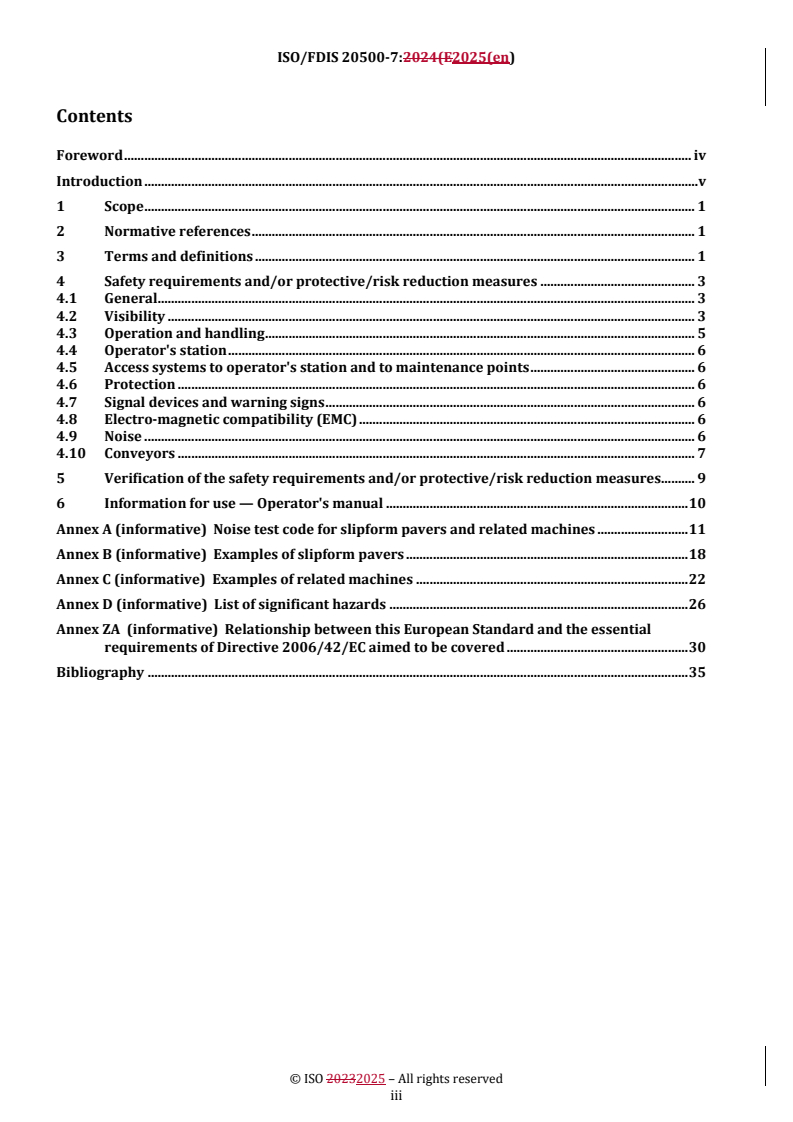
Contents
Foreword . iv
Introduction . v
1 Scope . 1
2 Normative references . 1
3 Terms and definitions . 1
4 Safety requirements and/or protective/risk reduction measures . 3
4.1 General . 3
4.2 Visibility . 3
4.3 Operation and handling . 5
4.4 Operator's station . 6
4.5 Access systems to operator's station and to maintenance points . 6
4.6 Protection . 6
4.7 Signal devices and warning signs . 6
4.8 Electro-magnetic compatibility (EMC) . 6
4.9 Noise . 6
4.10 Conveyors . 7
5 Verification of the safety requirements and/or protective/risk reduction measures . 9
6 Information for use — Operator's manual . 10
Annex A (informative) Noise test code for slipform pavers and related machines . 11
Annex B (informative) Examples of slipform pavers . 18
Annex C (informative) Examples of related machines . 22
Annex D (informative) List of significant hazards . 26
Annex ZA (informative) Relationship between this European Standard and the essential
requirements of Directive 2006/42/EC aimed to be covered . 30
Bibliography . 35
iii
ISO/FDIS 20500-7:2024(E2025(en)
Foreword
ISO (the International Organization for Standardization) is a worldwide federation of national standards
bodies (ISO member bodies). The work of preparing International Standards is normally carried out through
ISO technical committees. Each member body interested in a subject for which a technical committee has been
established has the right to be represented on that committee. International organizations, governmental and
non-governmental, in liaison with ISO, also take part in the work. ISO collaborates closely with the
International Electrotechnical Commission (IEC) on all matters of electrotechnical standardization.
The procedures used to develop this document and those intended for its further maintenance are described
in the ISO/IEC Directives, Part 1. In particular, the different approval criteria needed for the different types of
ISO documentsdocument should be noted. This document was drafted in accordance with the editorial rules
of the ISO/IEC Directives, Part 2 (see www.iso.org/directives).
Attention is drawnISO draws attention to the possibility that some of the elementsimplementation of this
document may beinvolve the subjectuse of (a) patent(s). ISO takes no position concerning the evidence,
validity or applicability of any claimed patent rights in respect thereof. As of the date of publication of this
document, ISO had not received notice of (a) patent(s) which may be required to implement this document.
However, implementers are cautioned that this may not represent the latest information, which may be
obtained from the patent database available at www.iso.org/patents. ISO shall not be held responsible for
identifying any or all such patent rights. Details of any patent rights identified during the development of the
document will be in the Introduction and/or on the ISO list of patent declarations received (see ).
Any trade name used in this document is information given for the convenience of users and does not
constitute an endorsement.
For an explanation of the voluntary nature of standards, the meaning of ISO specific terms and expressions
related to conformity assessment, as well as information about ISO's adherence to the World Trade
Organization (WTO) principles in the Technical Barriers to Trade (TBT), see www.iso.org/iso/foreword.html.
This document was prepared by Technical Committee ISO/TC 195, Building construction machinery and
equipment, in collaboration with the European Committee for Standardization (CEN) Technical Committee
CEN/TC 151, Construction equipment and building material machines - Safety, in accordance with the
Agreement on technical cooperation between ISO and CEN (Vienna Agreement).
A list of all parts in the ISO 20500 series can be found on the ISO website.
Any feedback or questions on this document should be directed to the user’s national standards body. A
complete listing of these bodies can be found at www.iso.org/members.html.
iv
ISO/FDIS 20500-7:2024(E2025(en)
Introduction
This document is a type-C standard as stated in ISO 12100.
This document is of relevance, in particular for the following stakeholder groups representing the market
players with regard to machinery safety:
— machine manufacturers (small, medium and large enterprises);
— health and safety bodies (regulators, accident prevention organisations, market surveillance, etc.).
Others can be affected by the level of machinery safety achieved with the means of the document by the above-
mentioned stakeholder groups:
— machine users/employers (small, medium and large enterprises);
— machine users/employees (e.g. trade unions, organisations for people with special needs);
— service providers, e.g. for maintenance (small, medium and large enterprises);
— consumers (in case of machinery intended for use by consumers).
The above-mentioned stakeholder groups have been given the possibility to participate at the drafting process
of this document.
The machinery concerned and the extent to which hazards, hazardous situations or hazardous events are
covered are indicated in the Scope of this document.
When requirements of this type-C standard are different from those which are stated in type-A or type-B
standards, the requirements of this type-C standard take precedence over the requirements of the other
standards for machines that have been designed and built according to the requirements of this type-C
standard.
v
ISO/FDIS 20500-7:2024(E2025(en)
Mobile road construction machinery — Safety —
Part 7:
Specific requirements for slipform pavers and related machines
1 Scope
This document, together with ISO 20500-1:—, deals with all significant hazards, hazardous situations and
events relevant to slipform pavers and related machines when used as intended and under the conditions of
misuse which are reasonably foreseeable by the manufacturer (see Annex D) associated with the whole
lifetime of the machine as described in ISO 12100:2010, 5.4.
The requirements of this document are complementary to the common requirements formulated in
ISO 20500-1:—. This document does not repeat the requirements of ISO 20500-1:—, but supplements or
modifies the requirements for slipform pavers and related machines.
Lightning as a significant and relevant hazard is not covered in this document.
This document is not applicable to slipform pavers and related machines manufactured before the date of its
publication.
2 Normative references
The following documents are referred to in the text in such a way that some or all of their content constitutes
requirements of this document. For dated references, only the edition cited applies. For undated references,
the latest edition of the referenced document (including any amendments) applies.
ISO 3744:2010, Acoustics — Determination of sound power levels and sound energy levels of noise sources using
sound pressure — Engineering methods for an essentially free field over a reflecting plane
ISO 5006:2017, Earth-moving machinery — Operator's field of view — Test method and performance criteria
ISO 11201:2010, Acoustics — Noise emitted by machinery and equipment — Determination of emission sound
pressure levels at a work station and at other specified positions in an essentially free field over a reflecting plane
with negligible environmental corrections
ISO 12100:2010, Safety of machinery — General principles for design — Risk assessment and risk reduction
ISO 20500-1:—, Mobile road construction machinery — Safety — Part 1: Common requirements
3 Terms and definitions
For the purposes of this document, the terms and definitions given in ISO 12100:2010, ISO 20500-1:— and
the following apply.
ISO and IEC maintain terminology databases for use in standardization at the following addresses:
— ISO Online browsing platform: available at https://www.iso.org/obp
— IEC Electropedia: available at https://www.electropedia.org/
ISO/FDIS 20500-7:2024(E2025(en)
3.1 3.1
slipform paver
machine intended to move and to guide a mould that extrudes pre-vibrated concrete to make continuous
works, such as barriers, curb and gutter, parapet, glare-screen, variable height median barrier, pavements, or
canal ditches
Note 1 to entry: See Figures B.1 and B.2.
3.2 3.2
texture curing machine
machine that gives freshly laid concrete surfaces the desired surface texture by applying a texturing device
and sprays a dispersion on the concrete surface to prevent premature drying
Note 1 to entry: See Figure C.1.
Note 2 to entry: A texturing device is for example a broom, a jute garment or other foils.
3.3 3.3
concrete placer/spreader
self-propelled machine receiving material to place it into a paving lane and spread it at a defined height
Note 1 to entry: See Figure C.2.
3.4 3.4
trimmer
power-driven axially symmetrical body on which the trimming tools are fitted and which rotates during the
trimming operation
Note 1 to entry: Trimmers are used to prepare the surface in front of the offset mould.
3.5 3.5
concrete mix distributor
spreader auger or diverter plough placed in front of the mould of a slipform paver (3.1) with road mould to
spread concrete mix evenly before it enters the mould
3.6 3.6
tie bar inserter
TBI
device which drives the tie bars into the concrete mix during the paving process
Note 1 to entry: See Figure B.3.
Note 2 to entry: There are several locations for tie bar inserters: centreline, edge of pavement and shoulder line.
3.7 3.7
dowel bar inserter
DBI
device which places multiple load-transfer dowel bars (transverse contraction joint) in the freshly paved
concrete
Note 1 to entry: See Figure B.3.
Note 2 to entry: This device is located at the rear of the mould, or on the lateral formwork, or in the mould structure itself.
ISO/FDIS 20500-7:2024(E2025(en)
4 Safety requirements and/or protective/risk reduction measures
4.1 General
4.1.1 Context
Slipform pavers and related machines shall conform to the safety requirements and/or protective/risk
reduction measures of this clause. In addition, the machines shall be designed according to the principles of
ISO 12100:2010 for relevant but not significant hazards which are not dealt with by this document.
4.1.2 Specific relation to ISO 20500-1
Slipform pavers and related machines shall conform to the requirements of ISO 20500-1:—, as far as not
modified or replaced by the requirements of this document.
4.2 Visibility
4.2.1 General
ISO 20500-1:—, 4.2.1 does not apply.
Slipform pavers and related machines shall meet the following requirements:
— the visibility test shall follow the principles described in ISO 5006:2017;
— for ride-on machines with a standing operator, Annex G of ISO 20500-1:xxx:—, Annex G shall apply
additionally.
4.2.2 Visibility performance criteria
The machine meets the requirements of this document if the measurement results when tested using the setup
as shown in Figure 1, show no maskings or maskings smaller than or equal to the performance criteria with
direct or indirect view as specified in 4.2.3.
a) FB (side view) for offset slipform paver b) FB (side view) for inset slipform paver
ISO/FDIS 20500-7:2024(E2025(en)
c) FB (top view) for offset slipform paver d) FB (top view) for inset slipform paver
ISO/FDIS 20500-7:2024(E2025(en)
e) FB (side view) for texture curing machines f) FB (side view) for concrete place/spreader
g) FB (top view) for texture curing machines h) FB (side view) for concrete place/spreader
Key
1 front boundary (FB)
L gap in the FB under the conveyor or auger (no requirements, width of the conveyor or auger + max. 150 mm on each side)
L distance from the machine front to the FB (1 m)
L extension of the FB to the side of the machine (1 m on each side)
Figure 1 — Setup of machines
4.2.3 Visibility performance criteria for the front boundary FB
The machine meets the requirements of this document if the measurement results show no maskings or
maskings smaller or equal to 300 mm when evaluated using the eye spacing of 405 mm and using an FB test
object height of 1,5 m.
NOTE The 12 m circle and the rectangular boundary (RB) according to ISO 5006:2017 are not relevant for slipform
pavers and related machines.
4.3 Operation and handling
ISO 20500-1:—, 4.3 applies with the following exception:
ISO/FDIS 20500-7:2024(E2025(en)
ISO 20500-1:—, 4.3.2.2 does not apply for slipform pavers and related machines.
4.4 Operator's station
ISO 20500-1:—, 4.4 applies with the following exception:
ISO 20500-1:—, 4.4.2, first paragraph, does not apply for slipform pavers and related machines.
4.5 Access systems to operator's station and to maintenance points
ISO 20500-1:—, 4.9 applies with the following exception and addition:
— the height of the first step for access to the operator's position can be exceeded in some machine modes
which do not need any access or egress from the operator's station (e.g. in maintenance mode);
— provisions shall be made to minimize hazards if wheels and tracks are in the vicinity of the operator's
station, operator's places and/or in the access areas.
4.6 Protection
ISO 20500-1:—, 4.10 applies with the following addition:
— it shall be possible to stop concrete mix distributors even when they are operated in automatic mode;
— dowel bar inserters shall be equipped with means (e.g. positive interlock mechanisms) to prevent
horizontal and/or vertical movement during clearing dowel bar jams;
— tie bar inserters shall be equipped with means (e.g. positive interlock mechanisms) to prevent movement
during clearing tie bar jams.
NOTE DBI and TBI for slipform pavers with road mould are equipped with a bar feeding mechanism that can be
subject to on-the-fly maintenance operations.
4.7 Signal devices and warning signs
ISO 20500-1:—, 4.15 applies with the following addition:
— a legible and indelible warning sign (see e.g. ISO 9244:2008, Figure C.22) shall be applied on the outer side
of the protective devices, located around the trimmer;
— (a) legible and indelible warning sign(s) indicating potential hazards created by the concrete mix
distributor shall be applied at the front of the slipform paver or concrete placer/spreader near the
concrete mix distributors, see e.g. ISO 9244:2008/Amd 1:2016, Figure C.1, Figure C.5 c) or Figure C.26.
4.8 Electro-magnetic compatibility (EMC)
ISO 20500-1:—, 4.18 applies with the following addition:
The antenna shall be located successively on the left- and right-hand sides of the slipform paver or texture
curing machine, with the antenna parallel to the plane of the longitudinal symmetry of the machine and in line
with the operator's position.
4.9 Noise
ISO 20500-1:—, 4.19 applies with the following addition:
ISO/FDIS 20500-7:2024(E2025(en)
For the determination of the noise emission values, Annex A shall apply to slipform pavers and related
machines.
For slipform pavers and related machines, the main sources of noise are the engine, the hydraulic components,
the cooling system, and the working process (e.g. compaction by vibration, spreading operation).
For slipform pavers and related machines, the main sources of noise are the engine, the hydraulic components,
the cooling system, and the working process (e.g. compaction by vibration, spreading operation).
4.114.10 Conveyors
ISO 20500-1:—, 4.10.2 applies with the following addition:
The screw conveyor hopper shall be guarded
— either according to Table 1, or
— with a mesh width of maximum 260 mm× 220 mm and with an additional distance guard (see Figure B.4).
These distance guards shall provide a distance to the mesh of the hopper guard of 500 mm or more and
h ≥ 180 mm.
NOTE The hopper walls can be considered as distance guards.
The minimum clearance (distance) between the mesh and the auger shall be 50 mm.
Table 1 — Hopper guards
Dimensions in millimetres
Grill-type guard – mesh type Mesh
a c b c
a h b h
70 200 80 × 80 180
35 100 70 × 70 150
40 × 40 90
a
slot width (see Figure 3figure 3)).
b
mesh width (see Figure 2figure 2)).
c
minimum distance from guard to pinch point between auger and hopper
wall.
ISO/FDIS 20500-7:2024(E2025(en)
Key
b maximum permissible mesh width in mm
b maximum permissible mesh width in mm
Figure 2 — Guard (grill), mesh type
Key
a maximum permissible clearance between rods in mm
a maximum permissible clearance between rods in mm
Figure 3 — Guard (grill), unidirectional type
ISO 20500-1, clause:—, 4.8.4 applies with the following additions:.
— An audible and/or visual signal (e.g. horn, flashlight) shall be activated when the folding conveyor of a
concrete placer/spreader folds in or out.
— The controls for folding the conveyor of a concrete placer/spreader shall be located outside the hazard
zone with visibility to the folding area of the conveyor.
ISO/FDIS 20500-7:2024(E2025(en)
5 Verification of the safety requirements and/or protective/risk reduction
measures
Safety requirements and/or protective/risk reduction measures of Clauses 4 and 6 shall be verified according
to Table 2.
Table 2 sets out verification methods which shall be applied for each safety requirement in this document.
Where X(s) is indicated in the table, the corresponding verification method(s) shall be applied.
Table 2 shall be read in conjunction with the corresponding clauses/subclauses.
Table 2Table 2 applies in addition to ISO 20500-1:—, Table 3 of Part 1.
Table 2 includes the following verification methods:
a) calculation: to establish that the requirements of this document have been met;
b) visual verification: to establish that something is present (e.g. a guard, a marking, a document);
c) measurement: to show that the required numerical values have been met (e.g. geometric dimensions,
safety distances, resistance of insulation of the electric circuits, results of physical tests);
d) functional tests: to show that the adequate signals intended to be forwarded to the main control system
of the complete machine are available and conform to the requirements and the technical documentation;
e) special verification: by reference to a standard which is mentioned in the corresponding clause/subclause.
Table 2 — Verification of safety requirements and/or protective/risk reduction measures
Clause/su Title a) b) c) d) e)
b clause Cal Vis Me Fu Special
number cul ual asu nct verificati
ati ver re ion on
on ific me al
ati nt tes
on t
4 Safety requirements and/or protective measures
4.1 General
4.1.1 Context X
4.1.2 Specific relation to ISO 20500-1 X
4.2 Visibility
4.2.1 General X
4.2.2 Visibility performance criteria X
4.2.3 Visibility performance criteria for the front boundary FB X
4.3 Operation and handling X
4.4 Operator's station X X
4.5 Access systems to operator's station and to maintenance points X X X
4.6 Protection X X X
4.7 Signal devices and warning signs X X X
ISO/FDIS 20500-7:2024(E2025(en)
Clause/su Title a) b) c) d) e)
b clause Cal Vis Me Fu Special
number cul ual asu nct verificati
ati ver re ion on
on ific me al
ati nt tes
on t
4.8 Electromagnetic compatibility (EMC) X X
4.9 Noise X X
4.10 Conveyors X X X X
6. Information for use – Operator's manual X X
Annex A Noise test code for slipform pavers and related machines X X
Annex B Examples of slipform pavers
Annex C Examples of related machines
This table applies in addition to Table 3 of Part 1.
86 Information for use — Operator's manual
ISO 20500-1:—, 6.2 applies with the following additions:
— information on the potential hazards associated with cleaning and maintenance operations;
— information about the hazard zones of concrete mix distributors;
— information about the hazard zones of the folding conveyors of concrete placers/spreaders;
— information about safe clearing of dowel bar or tie bar jams;
— information about travelling/transportation configuration and locking concerning moveable attachments,
for example concrete equipment;
— information for concrete equipment approved by the manufacturer.
ISO/FDIS 20500-7:2024(E2025(en)
Annex A
(informative)
Noise test code for slipform pavers and related machines
A.1 General
This noise test code specifies all the information necessary to carry out efficiently and under standardized
conditions the determination, declaration and verification of the noise emission characteristics of slipform
pavers and related machines.
Noise emission characteristics include emission sound pressure levels at operator's stations and the sound
power level. The determination of those quantities is necessary for:
— manufacturers to declare the noise emitted;
— comparing the noise emitted by machines in the family concerned;
— purposes of noise control at the source at the design stage;
— users to carry out their risk assessment with the help of sound pressure levels at operator's station.
The use of this noise test code ensures reproducibility of the determination of the noise emission
characteristics within specified limits determined by the grade of accuracy of the basic noise-measurement
method used. Noise-measurement methods allowed by this document are engineering methods (grade 2).
A.2 Determination of A-weighted sound power level
A.2.1 General
This Annex specifies additional requirements for the determination of A-weighted sound power level
according to ISO 3744:2010.
A.2.2 Measurement surface
A hemispherical test area shall be used for measurement.
A.2.3 Size of the measurement surface
The radius shall be calculated from the basic length L of the machine (see Figure A.1). The basic length includes
the main body of the machine plus working units, such as screed. The width of the machine shall be the basic
width.
ISO/FDIS 20500-7:2024(E2025(en)
a) Slipform paver with offset mould b) Slipform paver with road mould
c) Texture curing machine d) Concrete placer/spreader
Key
L basic length
Figure A.1 — Basic length of the machine
The radius shall be:
— 4 m when the basic length L of the machine to be tested is less than or equal to 1,5 m;
— 10 m when the basic length L of the machine to be tested is greater than 1,5 m but less than or equal to
4 m;
— 16 m when the basic length L of the machine to be tested is greater than 4 m.
A.2.4 Microphone positions on the hemispherical measurement surface
Six microphone positions (i.e. positions 2, 4, 6, 8, 10 and 12) shall be arranged according to Figure A.2.
ISO/FDIS 20500-7:2024(E2025(en)
Microphone
x/r y/r z
position
2 0,7 0,7 1,5 m
4 −0,7 0,7 1,5 m
6 −0,7 −0,7 1,5 m
8 0,7 −0,7 1,5 m
10 −0,27 0,65 0,71r
12 0,27 −0,65 0,71r
Key
x distance between the microphone position and the Y-axis
y distance between the microphone position and the X-axis
z distanc
...
Questions, Comments and Discussion
Ask us and Technical Secretary will try to provide an answer. You can facilitate discussion about the standard in here.
Loading comments...