

ISO 16311-3:2024
(Main)Maintenance and repair of concrete structures — Part 3: Design of repairs
General Information
- Abstract
This document defines basic considerations and decision-making for the specification of repair remedies, and management strategies for reinforced and unreinforced concrete structures. This document covers only atmospherically exposed structures, and buried or submerged structures, if they can be accessed. This document specifies repair design principles, and strategies for defects and on-going deterioration including, but not limited to: a) mechanical actions, e.g. impact, overloading, movement caused by settlement, blast, vibration and seismic actions; b) chemical and biological actions from environments, e.g. sulfate attack, alkali-aggregate reaction; c) physical actions, e.g. freeze–thaw, thermal cracking, moisture movement, salt crystallization, fire, and erosion; d) reinforcement corrosion; e) original construction defects that remained unaddressed from the time of construction. The execution of maintenance and repairs is covered in ISO 16311-4.
- Status
- Published
- Publication Date
- 20-Mar-2024
- Technical Committee
- ISO/TC 71/SC 7 - Maintenance and repair of concrete structures
- Current Stage
- 6060 - International Standard published
- Start Date
- 21-Mar-2024
- Due Date
- 09-Jun-2025
- Completion Date
- 21-Mar-2024
Overview
ISO 16311-3:2024 - "Maintenance and repair of concrete structures - Part 3: Design of repairs" provides internationally agreed guidance for specifying repair remedies and management strategies for reinforced and unreinforced concrete structures. The standard applies to atmospherically exposed structures and to buried or submerged elements only where they can be accessed. It focuses on repair design principles and decision-making (not on structural design verification or execution, which are covered elsewhere in the ISO 16311 series).
Key topics and technical requirements
- Assessment before design: requirements for initial risk assessment, documentation of materials/systems, visible condition surveys and testing to determine concrete and reinforcement condition.
- Identification of causes: systematic recording and analysis of defects and their root causes (environment, history, loads, construction defects).
- Repair strategies and options: decision framework that includes monitoring, prevention, strengthening/repair, reconstruction or demolition. The standard emphasizes whole-life cost, service-life expectations, availability and acceptable repair cycles.
- Defects and deterioration covered: mechanical actions (impact, overloading, settlement, vibration, seismic), chemical/biological (sulfate attack, alkali–aggregate reaction), physical (freeze–thaw, thermal cracking, moisture movement, salt crystallization, fire, erosion), reinforcement corrosion, and original construction defects.
- Selection of remedies and methods: principles for choosing appropriate repair remedies and product/system properties to meet intended performance.
- Design documentation and compliance: requirements for repair design documentation, health/safety/environmental compliance, and demonstration of personnel competence.
- Guidance: Annex A provides informative background and design guidance; execution of repairs is addressed in ISO 16311-4.
Practical applications and target users
ISO 16311-3 is intended for professionals involved in the lifecycle management of concrete assets:
- Structural and repair engineers - to define repair design principles and select remedies.
- Asset owners and facility managers - to evaluate whole-life strategies, specify repair performance and plan maintenance.
- Inspectors and condition assessment specialists - to feed robust defect-and-cause information into repair decisions.
- Contractors and spec writers - to prepare specifications, select products/systems, and ensure compliance with safety and environmental requirements.
Typical uses include designing remedial strategies for corrosion-damaged elements, specifying materials for freeze–thaw or chemical attack remediation, and defining monitoring or rehabilitation programmes.
Related standards
- ISO 16311-1: General principles for maintenance and repair of concrete structures
- ISO 16311-2: Assessment of existing concrete structures (condition assessment)
- ISO 16311-4: Execution of maintenance and repairs
Keywords: ISO 16311-3:2024, maintenance and repair of concrete structures, design of repairs, reinforcement corrosion, repair strategies, concrete repair specification.
Relations
- Effective Date
- 23-Apr-2020
Get Certified
Connect with accredited certification bodies for this standard

DIBt (Deutsches Institut für Bautechnik)
German Institute for Building Technology.
DIN CERTCO
DIN Group product certification.

Aboma Certification B.V.
Specialized in construction, metal, and transport sectors.
Sponsored listings
Frequently Asked Questions
ISO 16311-3:2024 is a standard published by the International Organization for Standardization (ISO). Its full title is "Maintenance and repair of concrete structures — Part 3: Design of repairs". This standard covers: This document defines basic considerations and decision-making for the specification of repair remedies, and management strategies for reinforced and unreinforced concrete structures. This document covers only atmospherically exposed structures, and buried or submerged structures, if they can be accessed. This document specifies repair design principles, and strategies for defects and on-going deterioration including, but not limited to: a) mechanical actions, e.g. impact, overloading, movement caused by settlement, blast, vibration and seismic actions; b) chemical and biological actions from environments, e.g. sulfate attack, alkali-aggregate reaction; c) physical actions, e.g. freeze–thaw, thermal cracking, moisture movement, salt crystallization, fire, and erosion; d) reinforcement corrosion; e) original construction defects that remained unaddressed from the time of construction. The execution of maintenance and repairs is covered in ISO 16311-4.
This document defines basic considerations and decision-making for the specification of repair remedies, and management strategies for reinforced and unreinforced concrete structures. This document covers only atmospherically exposed structures, and buried or submerged structures, if they can be accessed. This document specifies repair design principles, and strategies for defects and on-going deterioration including, but not limited to: a) mechanical actions, e.g. impact, overloading, movement caused by settlement, blast, vibration and seismic actions; b) chemical and biological actions from environments, e.g. sulfate attack, alkali-aggregate reaction; c) physical actions, e.g. freeze–thaw, thermal cracking, moisture movement, salt crystallization, fire, and erosion; d) reinforcement corrosion; e) original construction defects that remained unaddressed from the time of construction. The execution of maintenance and repairs is covered in ISO 16311-4.
ISO 16311-3:2024 is classified under the following ICS (International Classification for Standards) categories: 91.100.30 - Concrete and concrete products. The ICS classification helps identify the subject area and facilitates finding related standards.
ISO 16311-3:2024 has the following relationships with other standards: It is inter standard links to ISO 16311-3:2014. Understanding these relationships helps ensure you are using the most current and applicable version of the standard.
ISO 16311-3:2024 is available in PDF format for immediate download after purchase. The document can be added to your cart and obtained through the secure checkout process. Digital delivery ensures instant access to the complete standard document.
Standards Content (Sample)
International
Standard
ISO 16311-3
Second edition
Maintenance and repair of concrete
2024-03
structures —
Part 3:
Design of repairs
Entretien et réparation des structures en béton —
Partie 3: Conception des réparations
Reference number
© ISO 2024
All rights reserved. Unless otherwise specified, or required in the context of its implementation, no part of this publication may
be reproduced or utilized otherwise in any form or by any means, electronic or mechanical, including photocopying, or posting on
the internet or an intranet, without prior written permission. Permission can be requested from either ISO at the address below
or ISO’s member body in the country of the requester.
ISO copyright office
CP 401 • Ch. de Blandonnet 8
CH-1214 Vernier, Geneva
Phone: +41 22 749 01 11
Email: copyright@iso.org
Website: www.iso.org
Published in Switzerland
ii
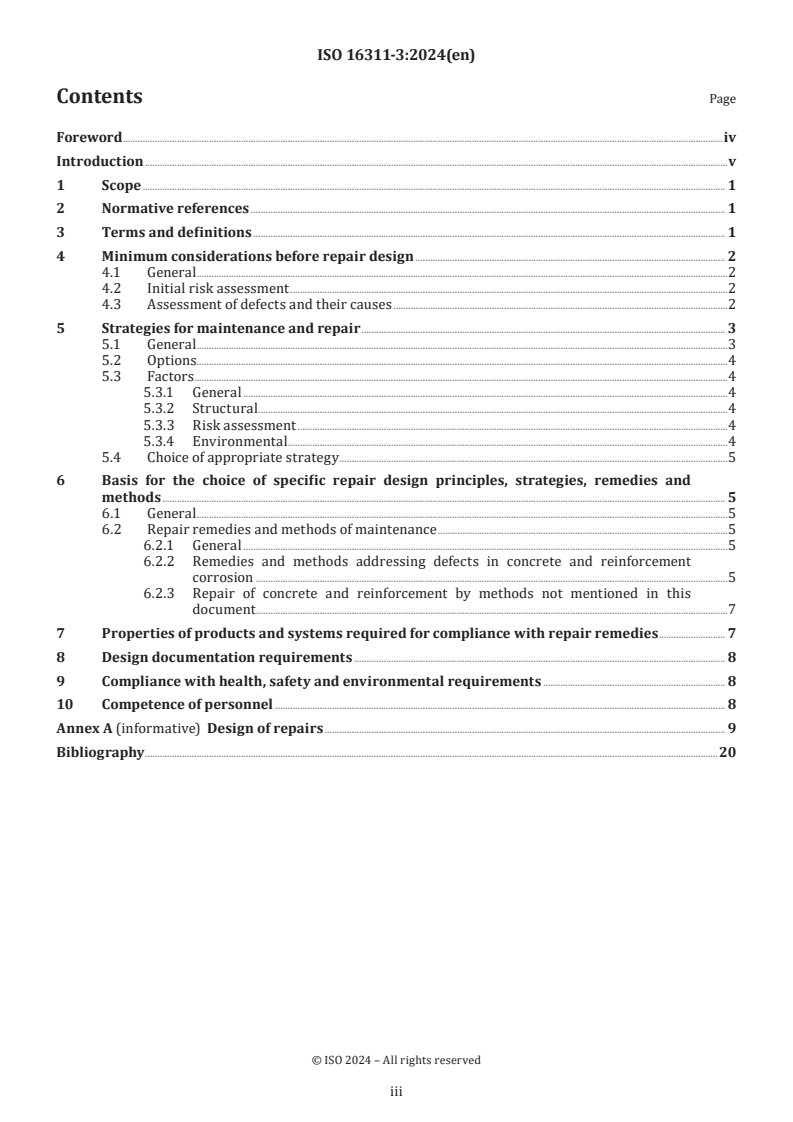
Contents Page
Foreword .iv
Introduction .v
1 Scope . 1
2 Normative references . 1
3 Terms and definitions . 1
4 Minimum considerations before repair design . 2
4.1 General .2
4.2 Initial risk assessment .2
4.3 Assessment of defects and their causes .2
5 Strategies for maintenance and repair . 3
5.1 General .3
5.2 Options.4
5.3 Factors .4
5.3.1 General .4
5.3.2 Structural . .4
5.3.3 Risk assessment .4
5.3.4 Environmental . . .4
5.4 Choice of appropriate strategy .5
6 Basis for the choice of specific repair design principles, strategies, remedies and
methods . 5
6.1 General .5
6.2 Repair remedies and methods of maintenance .5
6.2.1 General .5
6.2.2 Remedies and methods addressing defects in concrete and reinforcement
corrosion .5
6.2.3 Repair of concrete and reinforcement by methods not mentioned in this
document .7
7 Properties of products and systems required for compliance with repair remedies . 7
8 Design documentation requirements . 8
9 Compliance with health, safety and environmental requirements . 8
10 Competence of personnel . 8
Annex A (informative) Design of repairs . 9
Bibliography .20
iii
Foreword
ISO (the International Organization for Standardization) is a worldwide federation of national standards
bodies (ISO member bodies). The work of preparing International Standards is normally carried out through
ISO technical committees. Each member body interested in a subject for which a technical committee
has been established has the right to be represented on that committee. International organizations,
governmental and non-governmental, in liaison with ISO, also take part in the work. ISO collaborates closely
with the International Electrotechnical Commission (IEC) on all matters of electrotechnical standardization.
The procedures used to develop this document and those intended for its further maintenance are described
in the ISO/IEC Directives, Part 1. In particular, the different approval criteria needed for the different types
of ISO document should be noted. This document was drafted in accordance with the editorial rules of the
ISO/IEC Directives, Part 2 (see www.iso.org/directives).
ISO draws attention to the possibility that the implementation of this document may involve the use of (a)
patent(s). ISO takes no position concerning the evidence, validity or applicability of any claimed patent
rights in respect thereof. As of the date of publication of this document, ISO had not received notice of (a)
patent(s) which may be required to implement this document. However, implementers are cautioned that
this may not represent the latest information, which may be obtained from the patent database available at
www.iso.org/patents. ISO shall not be held responsible for identifying any or all such patent rights.
Any trade name used in this document is information given for the convenience of users and does not
constitute an endorsement.
For an explanation of the voluntary nature of standards, the meaning of ISO specific terms and expressions
related to conformity assessment, as well as information about ISO's adherence to the World Trade
Organization (WTO) principles in the Technical Barriers to Trade (TBT), see www.iso.org/iso/foreword.html.
This document was prepared by Technical Committee ISO/TC 71, Concrete, reinforced concrete and pre-
stressed concrete, Subcommittee SC 7, Maintenance and repair of concrete structures.
This second edition cancels and replaces the first edition (ISO 16311-3:2014) which has been technically
revised.
The main changes are as follows:
— the definitions of “repair” has been updated.
A list of all parts in the ISO 16311 series can be found on the ISO website.
Any feedback or questions on this document should be directed to the user’s national standards body. A
complete listing of these bodies can be found at www.iso.org/members.html.
iv
Introduction
The repair of defects and deterioration in concrete structures requires complex design work. This document
defines the design principles, strategies, remedies and methods for the repair of concrete structures
that have suffered or can suffer damage or deterioration. It gives guidance on the choice of repair design
principles, strategies, remedies, methods and selection of products and systems which are appropriate for
the intended use.
This document identifies key stages in the repair process:
— the need for assessment of the condition of the structure;
— the need for identification of the causes of deterioration;
— evaluating the options for repair and decision-making;
— the selection of the appropriate remedies for repair;
— the selection of methods;
— the definition of properties of products and systems;
— the specification of maintenance requirements following repair.
This document does not deal with matters related to structural design and the verification of structural
performance in both deteriorated and repaired condition. The information related to the deteriorated
condition is presented in ISO 16311-2.
This document contains Annex A which provides guidance and background information.
v
International Standard ISO 16311-3:2024(en)
Maintenance and repair of concrete structures —
Part 3:
Design of repairs
1 Scope
This document defines basic considerations and decision-making for the specification of repair remedies,
and management strategies for reinforced and unreinforced concrete structures. This document covers only
atmospherically exposed structures, and buried or submerged structures, if they can be accessed.
This document specifies repair design principles, and strategies for defects and on-going deterioration
including, but not limited to:
a) mechanical actions, e.g. impact, overloading, movement caused by settlement, blast, vibration and
seismic actions;
b) chemical and biological actions from environments, e.g. sulfate attack, alkali-aggregate reaction;
c) physical actions, e.g. freeze–thaw, thermal cracking, moisture movement, salt crystallization, fire, and
erosion;
d) reinforcement corrosion;
e) original construction defects that remained unaddressed from the time of construction.
The execution of maintenance and repairs is covered in ISO 16311-4.
2 Normative references
The following documents are referred to in the text in such a way that some or all of their content constitutes
requirements of this document. For dated references, only the edition cited applies. For undated references,
the latest edition of the referenced document (including any amendments) applies.
ISO 16311-1, Maintenance and repair of concrete structures — Part 1: General principles
ISO 16311-2, Maintenance and repair of concrete structures — Part 2: Assessment of existing concrete structures
3 Terms and definitions
For the purposes of this document, the terms and definitions given in ISO 16311-1 and the following apply.
ISO and IEC maintain terminology databases for use in standardization at the following addresses:
— ISO Online browsing platform: available at https:// www .iso .org/ obp
— IEC Electropedia: available at https:// www .electropedia .org/
3.1
defect
fault or deviation from the intended level of performance of a structure or its parts
[SOURCE: ISO 15686-1:2011]
3.2
maintenance
set of activities undertaken to check, evaluate the performance of a structure and preserve/restore it so as
to satisfy its performance requirements in service
[SOURCE: ISO 13823:2008, 3.15]
3.3
passivity
state in which steel in concrete is protected by a thin film and the corrosion rate is minimized
Note 1 to entry: This film is destabilized or lost when concrete carbonates to the level of the reinforcing steel, when
aggressive salts concentrate and attack the steel, or atypically, when all oxygen is depleted at the surface of the steel
(i.e. submerged concrete members after many years).
3.4
protection
measure that is intended to prevent or reduce the development of defects in the structure
3.5
repair
restoration of a structure or its components to an acceptable condition by the renewal or replacement of
worn, damaged, or deteriorated components including prevention and protection
[SOURCE: ISO 13823:2008, 3.20, modified — "including prevention and protection" has been added.]
4 Minimum considerations before repair design
4.1 General
This clause outlines procedures that shall be undertaken to assess the current condition of a concrete
structure prior to designing repair programs.
General guidance is given in Annex A.
4.2 Initial risk assessment
The risks to health and safety from falling debris or localized structural failure due to removing deteriorated
materials, and the effect of deterioration upon the mechanical stability of the concrete structure shall be
assessed as a pre-repair work, as well as the anticipated loads and forces during repair work.
Where the concrete structure or a portion thereof is considered unsafe, appropriate actions and sequences
shall be specified to make it safe before other repair work is undertaken and while underway, taking
into account any additional risks that can arise from the repair work itself. Such action can include local
repairs, the installation of support or other temporary stabilization measures, or partial or even complete
demolition.
4.3 Assessment of defects and their causes
An assessment shall be made of the defects in the concrete structure, their causes, and of the ability of
the concrete structure to perform its function per the detailed guidance provided in ISO 16311-2. This
information is briefly summarized in the subsequent paragraphs.
The process of assessment of the structure shall include, but not be limited to, the following.
a) Documentation of the materials and systems comprising the structure.
b) The visible condition of the existing concrete structure.
c) Testing to determine the condition of the concrete and reinforcing steel.
d) The original design approach and potential design deficiencies.
e) The environment, including exposure to deleterious species.
f) The history of the concrete structure, including environmental exposure, and previous maintenance
and repair programs.
g) The conditions of use (e.g. loading or other actions).
h) Requirements for future use.
The nature and causes of defects and deficiencies, including combinations of causes, shall be identified and
recorded (see Figure 1).
The approximate extent and likely rate of increase of defects shall then be assessed. An estimate shall be
made of when the concrete member or structure would no longer perform as intended, with no repair
measures (other than maintenance of existing systems) applied.
The results of the completed assessment shall be valid at the time that the repairs are designed and carried
out. If, as a result of passage of time or for any other reason, there are doubts about the validity of the
assessment, a new assessment shall be made.
Figure 1 — Common causes of defects and deterioration
5 Strategies for maintenance and repair
5.1 General
This clause identifies options and factors to be considered when choosing a strategy for the management of
the structure.
5.2 Options
In accordance with ISO 16311-1, the following options shall be taken into account in deciding the appropriate
action to meet the future requirements for the life of the structure.
a) Do nothing for a certain time while monitoring the structure.
b) Re-analyse the structural capacity, possibly leading to a downgrade in function.
c) Prevent or reduce further deterioration.
d) Strengthen or repair all or part of the concrete structure.
e) Reconstruct all or part of the concrete structure.
f) Demolish all or part of the concrete structure.
5.3 Factors
The factors that shall be considered when choosing a management strategy include, but are not limited to
the following categories.
5.3.1 General
a) The intended use and remaining service life of the structure.
b) The required performance of the structure.
NOTE This can include, for example, fire resistance and watertightness.
c) The likely service life of the repair work.
d) The required availability of the structure, permissible interruption to its use and opportunities for
additional repair and monitoring work.
e) The acceptable number and cost of repair cycles during the design life of the concrete structure.
f) The comparative whole life cost of the alternative management strategies, including future inspection
and maintenance or further repair cycles.
g) Properties and possible methods of preparation of the existing substrate.
h) The appearance of the repaired structure.
5.3.2 Structural
a) The actions including during and after implementation of the strategy.
b) The response mechanism against the actions, including during and after implementation of the strategy.
5.3.3 Risk assessment
a) The consequences of structural failure.
b) Health and safety requirements.
c) The effect on occupiers or users of the structure and on adjacent structures and the general public.
5.3.4 Environmental
a) The exposure environment of the structure, member, part and whether it can be changed locally.
NOTE Exposure environment is classified for each member and part. Exposure classes are given in
ISO 22965-1:2007, Annex A.2.
b) The need or opportunity to protect part or all of the concrete structure, from weather, pollution, salt
spray, etc., including protection of the substrate during the repair work.
5.4 Choice of appropriate strategy
The choice of strategy for the structure shall be based on the assessment of the structure, client requirements
and relevant provisions (e.g. safety requirements) valid in the place of execution. All repair work undertaken
as part of a structure management strategy shall comply with this document.
A repair remedy or remedies shall be chosen according to Clause 6, that is:
a) appropriate to the type, cause or combination of causes and to the extent of the defects;
b) appropriate to the future service conditions.
6 Basis for the choice of specific repair design principles, strategies, remedies
and methods
6.1 General
This clause specifies the basic repair strategies and remedies which shall be used, separately or in
combination, to protect, maintain or repair concrete structures. Determining the suitability of these
remedies and methods for a particular condition can only be assessed after a thorough evaluation of the
component or structure according to ISO 16311-2 and reconciling repair design principles that include, but
are not limited to:
a) do no harm to the structure or member;
b) adopt proven techniques and products with a documented record of success in similar projects;
c) harmonize repair and maintenance strategies with budgets and planning.
6.2 Repair remedies and methods of maintenance
6.2.1 General
Maintenance and repair remedies are based on chemical, electrochemical, or physical remedies that can
be used to prevent or stabilize the deterioration of concrete, or corrosion of the steel or other embedded
metals, or to strengthen the concrete structure.
Table 1 contains examples of repair methods which apply the remedies. Only methods which comply with
the remedies shall be selected, taking into account any possible undesirable consequences of applying a
particular method or combination of methods under the specific conditions of the individual repair.
Execution of the repairs is addressed in ISO 16311-4.
6.2.2 Remedies and methods addressing defects in concrete and reinforcement corrosion
Remedies 1 to 6 in Table 1 address defects in the concrete or concrete structures that can be caused by the
following actions, separately or in combination:
a) mechanical: e.g. impact, overloading, movement caused by settlement, vibration, seismic actions and blast;
b) chemical and biological: e.g. sulfate attack, alkali-aggregate reaction;
c) physical: e.g. freeze–thaw action, fire, thermal cracking, moisture movement, salt crystallization, and
erosion.
Remedies 7 to 11 in Table 1 address reinforcement corrosion caused by:
a) physical loss of the protective concrete cover;
b) chemical loss of alkaline pH in the protective concrete cover as a result of reaction with atmospheric
carbon dioxide (carbonation);
c) contamination of the protective concrete cover with corrosive agents (usually chloride ions) which were
incorporated in the concrete when it was mixed, or which have penetrated into the concrete from the
environment;
d) stray electrical currents conducted or induced in the reinforcement from neighbouring electrical
installations;
e) stress corrosion cracking of prestressed members;
f) galvanic corrosion (e.g. dissimilar metals, differential environments).
Where there is existing corrosion of reinforcement or a danger that corrosion will occur in the future, one or
more of remedies of corrosion repair shall be selected.
In addition, the concrete itself shall be repaired, where necessary, according to remedies 1 to 6.
Table 1 — Remedies and methods for repair of concrete structures
Remedy Examples of repair strategies and methods
1. Protection against ingress 1.1 Hydrophobic impregnation
1.2 Impregnation
1.3 Coating
1.4 Surface bandaging of cracks
1.5 Filling of cracks
1.6 Transferring cracks into joints
a
1.7 Erecting external panels
a
1.8 Applying membranes
2. Moisture control 2.1 Hydrophobic impregnation
2.2 Impregnation
2.3 Coating
2.4 Erecting external panels
2.5 Electrochemical treatments
3. Concrete restoration 3.1 Hand-applied, localized patches
3.2 Recasting members with concrete or mortar
3.3 Spraying concrete or mortar
3.4 Replacing members
4. Structural strengthening 4.1 Adding or replacing embedded or external reinforcing bars
4.2 Adding reinforcement anchored in pre-formed or drilled holes
4.3 Bonding plate reinforcement
4.4 Adding mortar or concrete
4.5 Injecting cracks, voids, or interstices
4.6 Filling cracks, voids, or interstices
4.7 Prestressing - (post tensioning) or Fibre Reinforced Plastic (FRP)
strengthening
a
These methods can also be applied to other remedies.
TTaabbllee 11 ((ccoonnttiinnueuedd))
Remedy Examples of repair strategies and methods
5. Increasing physical resistance 5.1 Coating or membranes
5.2 Impregnation
5.3 Adding mortar or concrete
5.4 Applying a membrane
6. Resistance to chemicals 6.1 Coating
6.2 Impregnation
6.3 Adding mortar or concrete
7. Preserving or restoring passivity 7.1 Increasing cover to reinforcement with additional mortar or con-
crete (preservation only) or applying a coating
7.2 Replacing contaminated or carbonated concrete
7.3 Electrochemical realkalisation of carbonated concrete
7.4 Realkalisation of carbonated concrete by diffusion
7.5 Electrochemical chloride extraction
7.6 Applying a membrane (preserving passivity only)
8. Increasing resistivity 8.1 Hydrophobic impregnation
8.2 Impregnation
8.3 Coating
9. Cathodic control 9.1 Limiting oxygen content (at the cathode) by saturation or surface
coating
10. Cathodic protection 10.1 Applying an electrical current to achieve a protective electro-
chemical potential
11. Control of anodic areas 11.1 Active coating of the reinforcement
11.2 Barrier coating of the reinforcement
11.3 Applying corrosion inhibitors in or to the concrete
11.4 Installation of discrete galvanic anodes
a
These methods can also be applied to other remedies.
6.2.3 Repair of concrete and reinforcement by methods not mentioned in this document
The absence from this document of a specific method, or the application of a method to a new situation,
shall not be taken to mean that such a method or application is necessarily unsatisfactory. The application
of methods to situations unforeseen in this document, or the use of methods which do not have a substantial
history of successful performance and are not specified in this document, can be satisfactory in appropriate
circumstances.
7 Properties of products and systems required for compliance with repair remedies
Once the repair approach is determined according to Clause 6, the products and systems to be used shall be
selected in accordance with requirements given in one or more of the following:
a) International standards;
b) regional standards;
c) national standards;
d) national technical approvals;
e) approvals according to project specification.
Descriptions and acceptance values of properties, in relation to specific products and systems, shall be
documented by test methods valid in the place of use and specified in the project specification.
Care shall be taken that products and systems do not undergo adverse physical or chemical reactions with
each other and with the concrete structures.
Repair products that are part of a system for repair shall not normally be tested individually unless one or
more of the repair products are intended to meet particular performance requirements in its own right.
ISO 16311-4 gives details of site application requirements. If on-site application conditions cannot reasonably
be made to fulfil the application conditions specified for the product or system, alternative products (if any)
or alternative repair remedies or methods shall be specified to avoid such a conflict.
8 Design documentation requirements
Unless otherwise agreed, the following shall be provided to the owner of the structure at the conclusion of
the design effort:
a) documentation of the repair design, including any test results pertinent to the design;
b) documentation of any quality control and assurance requirements for the execution of the repair design;
c) instructions for inspection and maintenance to be undertaken during the remaining design service life
of the repaired part of the concrete structure.
9 Compliance with health, safety and environmental requirements
The repair design shall comply with the requirements of relevant health and safety, environmental
protection, and fire regulations valid in the place of use.
Where there is a conflict between the properties of specific products or systems and environmental
protection or fire regulations, use shall be made of alternative repair remedies or methods which avoid such
a conflict.
10 Competence of personnel
This document presupposes that personnel have the necessary skill and adequate equipment and resources
to design, specify and execute the work in accordance with the relevant parts of this document and the
requirements of the project specification.
NOTE In some countries, there are special requirements regarding the level of knowledge, training and experience
of personnel involved in the different tasks.
Annex A
(informative)
Design of repairs
A.1 General
This annex provides guidance and background information for Clauses 4, 5, 6 and 7. Some aspects of the
scope require specialized knowledge and structural design. Examples include structural requirements
of fire-damaged concrete, assessment and repair of pre-stressed concrete, damage due to seismic actions
and increasing structural capacity by replacement or addition of embedded or external reinforcement,
electrochemical and materials concerns.
The scope does not include non-structural construction materials used in conjunction with concrete, such as
floor screeds or render and plaster finishes.
a) The scope of this document does not include detailed guidance on inspection, testing and assessment
before and after repair. This is covered by ISO 16311-2.
b) In well designed and constructed concrete structures built according to standards for design, execution
and materials valid in the place of use, the concrete cover should normally protect reinforcement from
corrosion under conditions of normal exposure in natural environments, including marine environments
and where de-icing salts are used. With older structures, previous standards have not always been
adequate for normal exposure. In particular, “inadequate design, specification or construction or use
of unsuitable construction materials” can lead to a poor-quality cover concrete, poor compaction and
hence reduced durability of reinforced concrete. Other mechanisms can cause premature deterioration,
including fire, m
...