


ISO/DTR 42505
(Main)Sharing economy — Shared manufacturing — Concepts and models
Sharing economy — Shared manufacturing — Concepts and models
Économie du partage — Fabrication partagée — Concepts et modèles
General Information
- Status
- Not Published
- Technical Committee
- ISO/TC 324 - Sharing economy
- Drafting Committee
- ISO/TC 324 - Sharing economy
- Current Stage
- 5020 - FDIS ballot initiated: 2 months. Proof sent to secretariat
- Start Date
- 06-Mar-2026
- Completion Date
- 06-Mar-2026
Overview
ISO/DTR 42505: Sharing economy - Shared manufacturing - Concepts and models is a technical report developed by the International Organization for Standardization (ISO) under Technical Committee ISO/TC 324. This document lays the conceptual foundation for shared manufacturing in the context of the global sharing economy. It defines key vocabulary, outlines characteristics and models for shared manufacturing, and discusses practical approaches for stakeholders interested in more efficient, flexible, and collaborative production processes. As supply chain resilience and manufacturing adaptability grow in importance, shared manufacturing practices support the integration of digital technologies and help industries maximize resource utilization and improve competitiveness.
Key Topics
- Shared Manufacturing Concepts: Offers definitions for terms such as shared manufacturing, collaborative manufacturing, co-manufacturing, and cloud manufacturing, distinguishing the types of collaboration and resource sharing in each model.
- Characteristics of Shared Manufacturing: Highlights the importance of digital platforms, multi-party collaboration, openness, dynamicity, shared usage rights, and efficient resource utilization. Emphasizes concepts such as the separation of ownership and usage rights, enabling flexible access to manufacturing assets.
- Digital Platform Integration: Underlines the essential role of digital technologies, like IoT and AI, in enabling real-time supply-demand matching and creating modular, responsive, and accessible production networks.
- Service and Demand Orientation: Describes a shift from product- or order-centric models to service-oriented, on-demand manufacturing ecosystems that emphasize granularity, flexibility, and scalability in meeting diverse and personalized customer requirements.
- Models of Shared Manufacturing:
- Manufacturing resource sharing
- Manufacturing capability sharing
- Innovation capability sharing
- Service capability sharing
- Intellectual Property (IP) Management: Discusses principles for handling IP in shared manufacturing environments, including ownership, confidentiality, licensing agreements, and dispute resolution.
Applications
Shared manufacturing, as conceptualized in ISO/DTR 42505, delivers practical benefits to a broad spectrum of manufacturing and supply chain participants:
- Small and Medium Enterprises (SMEs): Gain access to advanced equipment, facilities, and expertise without significant capital investment, improving competitiveness and resource utilization.
- Flexible Production Capacity: Corporations can rapidly scale manufacturing output to meet fluctuating demand, minimize idle capacity, and reduce costs through on-demand access to shared resources.
- Supply Chain Resilience: Shared manufacturing platforms enhance supply chain agility, allowing quick adaptation to disruptions, alternative supplier sourcing, and recovery from shocks.
- Collaborative Innovation: Facilitates open collaboration among diverse partners, enabling faster product development and access to a broader pool of technical know-how.
- Sustainability and Efficiency: Promotes lean manufacturing by reducing waste, optimizing asset utilization, and supporting the circular economy.
- Service Diversification: Enables “manufacturing-as-a-service,” allowing companies to source customized processes, maintenance, logistics, and testing on an as-needed basis.
Related Standards
ISO/DTR 42505 references and complements several international standards supporting the sharing economy and manufacturing interoperability:
- ISO 42500:2021, Sharing economy - General principles: Establishes the overall framework and principles for the sharing economy, forming the basis for sector-specific standards like shared manufacturing.
- ISO/TS 42501:2022 (referenced in the document content): Further details components and requirements for sharing economy platforms.
- Relevant terminology databases: ISO Online Browsing Platform and IEC Electropedia support consistent vocabulary across standards.
Adoption of ISO/DTR 42505 fosters best practices and sets a pathway toward harmonized, efficient, and sustainable shared manufacturing worldwide. This standard supports manufacturers, platform providers, and users in navigating the evolving digital and collaborative production landscape.

Get Certified
Connect with accredited certification bodies for this standard

BSI Group
BSI (British Standards Institution) is the business standards company that helps organizations make excellence a habit.

Great Wall Tianjin Quality Assurance Center
Established 1993, first batch to receive national accreditation with IAF recognition.
Hong Kong Quality Assurance Agency (HKQAA)
Hong Kong's leading certification body.
Sponsored listings
Frequently Asked Questions
ISO/DTR 42505 is a draft published by the International Organization for Standardization (ISO). Its full title is "Sharing economy — Shared manufacturing — Concepts and models". This standard covers: Sharing economy — Shared manufacturing — Concepts and models
Sharing economy — Shared manufacturing — Concepts and models
ISO/DTR 42505 is classified under the following ICS (International Classification for Standards) categories: 03.080.01 - Services in general; 35.240.63 - IT applications in trade. The ICS classification helps identify the subject area and facilitates finding related standards.
ISO/DTR 42505 is available in PDF format for immediate download after purchase. The document can be added to your cart and obtained through the secure checkout process. Digital delivery ensures instant access to the complete standard document.
Standards Content (Sample)
FINAL DRAFT
Technical
Report
ISO/TC 324
Sharing economy — Shared
Secretariat: JISC
manufacturing — Concepts and
Voting begins on:
models
2026-03-06
Économie du partage — Fabrication partagée — Concepts et
Voting terminates on:
modèles
2026-05-01
RECIPIENTS OF THIS DRAFT ARE INVITED TO SUBMIT,
WITH THEIR COMMENTS, NOTIFICATION OF ANY
RELEVANT PATENT RIGHTS OF WHICH THEY ARE AWARE
AND TO PROVIDE SUPPOR TING DOCUMENTATION.
IN ADDITION TO THEIR EVALUATION AS
BEING ACCEPTABLE FOR INDUSTRIAL, TECHNO
LOGICAL, COMMERCIAL AND USER PURPOSES, DRAFT
INTERNATIONAL STANDARDS MAY ON OCCASION HAVE
TO BE CONSIDERED IN THE LIGHT OF THEIR POTENTIAL
TO BECOME STAN DARDS TO WHICH REFERENCE MAY BE
MADE IN NATIONAL REGULATIONS.
Reference number
FINAL DRAFT
Technical
Report
ISO/TC 324
Sharing economy — Shared
Secretariat: JISC
manufacturing — Concepts and
Voting begins on:
models
Économie du partage — Fabrication partagée — Concepts et
Voting terminates on:
modèles
RECIPIENTS OF THIS DRAFT ARE INVITED TO SUBMIT,
WITH THEIR COMMENTS, NOTIFICATION OF ANY
RELEVANT PATENT RIGHTS OF WHICH THEY ARE AWARE
AND TO PROVIDE SUPPOR TING DOCUMENTATION.
© ISO 2026
IN ADDITION TO THEIR EVALUATION AS
All rights reserved. Unless otherwise specified, or required in the context of its implementation, no part of this publication may
BEING ACCEPTABLE FOR INDUSTRIAL, TECHNO
LOGICAL, COMMERCIAL AND USER PURPOSES, DRAFT
be reproduced or utilized otherwise in any form or by any means, electronic or mechanical, including photocopying, or posting on
INTERNATIONAL STANDARDS MAY ON OCCASION HAVE
the internet or an intranet, without prior written permission. Permission can be requested from either ISO at the address below
TO BE CONSIDERED IN THE LIGHT OF THEIR POTENTIAL
or ISO’s member body in the country of the requester.
TO BECOME STAN DARDS TO WHICH REFERENCE MAY BE
MADE IN NATIONAL REGULATIONS.
ISO copyright office
CP 401 • Ch. de Blandonnet 8
CH-1214 Vernier, Geneva
Phone: +41 22 749 01 11
Email: copyright@iso.org
Website: www.iso.org
Published in Switzerland Reference number
ii
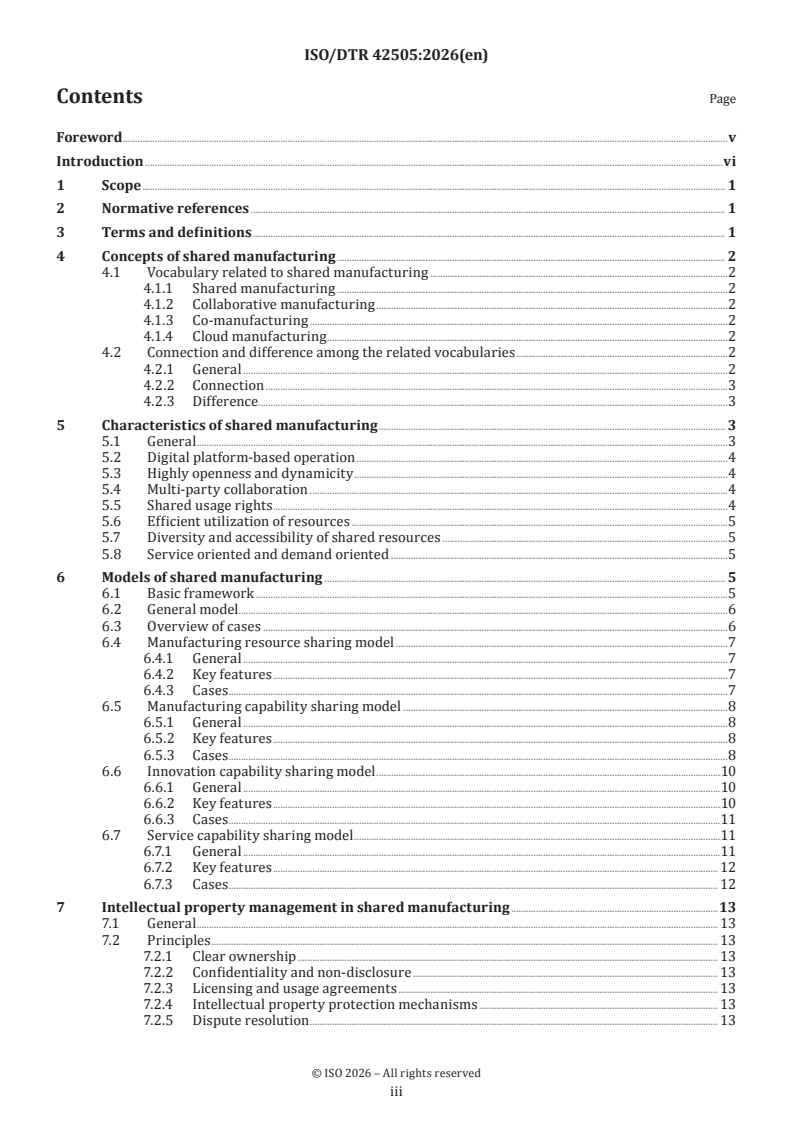
Contents Page
Foreword .v
Introduction .vi
1 Scope . 1
2 Normative references . 1
3 Terms and definitions . 1
4 Concepts of shared manufacturing . 2
4.1 Vocabulary related to shared manufacturing .2
4.1.1 Shared manufacturing .2
4.1.2 Collaborative manufacturing .2
4.1.3 Co-manufacturing .2
4.1.4 Cloud manufacturing .2
4.2 Connection and difference among the related vocabularies .2
4.2.1 General .2
4.2.2 Connection .3
4.2.3 Difference . .3
5 Characteristics of shared manufacturing . 3
5.1 General .3
5.2 Digital platform-based operation .4
5.3 Highly openness and dynamicity .4
5.4 Multi-party collaboration .4
5.5 Shared usage rights . .4
5.6 Efficient utilization of resources .5
5.7 Diversity and accessibility of shared resources .5
5.8 Service oriented and demand oriented .5
6 Models of shared manufacturing . 5
6.1 Basic framework .5
6.2 General model . . .6
6.3 Overview of cases .6
6.4 Manufacturing resource sharing model .7
6.4.1 General .7
6.4.2 Key features .7
6.4.3 Cases .7
6.5 Manufacturing capability sharing model .8
6.5.1 General .8
6.5.2 Key features .8
6.5.3 Cases .8
6.6 Innovation capability sharing model .10
6.6.1 General .10
6.6.2 Key features .10
6.6.3 Cases .11
6.7 Service capability sharing model .11
6.7.1 General .11
6.7.2 Key features . 12
6.7.3 Cases . 12
7 Intellectual property management in shared manufacturing .13
7.1 General . 13
7.2 Principles . 13
7.2.1 Clear ownership . 13
7.2.2 Confidentiality and non-disclosure . 13
7.2.3 Licensing and usage agreements . 13
7.2.4 Intellectual property protection mechanisms . 13
7.2.5 Dispute resolution . 13
iii
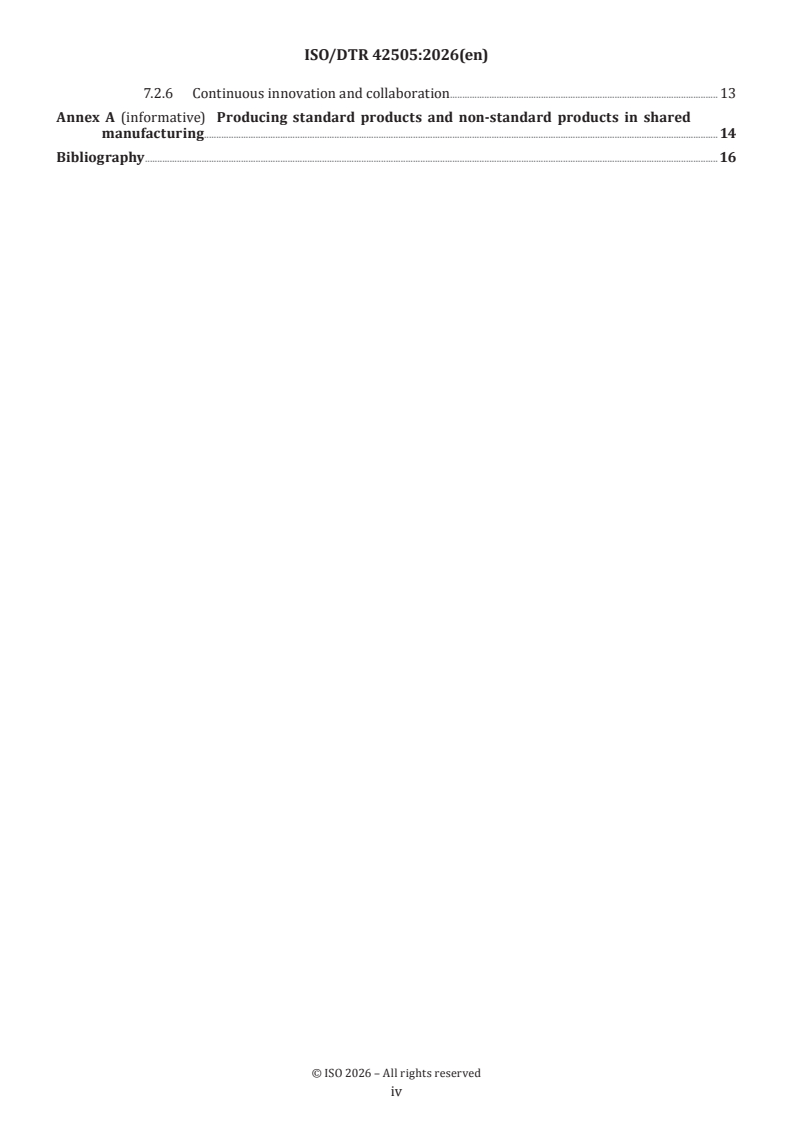
7.2.6 Continuous innovation and collaboration. 13
Annex A (informative) Producing standard products and non-standard products in shared
manufacturing . . 14
Bibliography .16
iv
Foreword
ISO (the International Organization for Standardization) is a worldwide federation of national standards
bodies (ISO member bodies). The work of preparing International Standards is normally carried out through
ISO technical committees. Each member body interested in a subject for which a technical committee
has been established has the right to be represented on that committee. International organizations,
governmental and non-governmental, in liaison with ISO, also take part in the work. ISO collaborates closely
with the International Electrotechnical Commission (IEC) on all matters of electrotechnical standardization.
The procedures used to develop this document and those intended for its further maintenance are described
in the ISO/IEC Directives, Part 1. In particular, the different approval criteria needed for the different types
of ISO document should be noted. This document was drafted in accordance with the editorial rules of the
ISO/IEC Directives, Part 2 (see www.iso.org/directives).
ISO draws attention to the possibility that the implementation of this document may involve the use of (a)
patent(s). ISO takes no position concerning the evidence, validity or applicability of any claimed patent
rights in respect thereof. As of the date of publication of this document, ISO had not received notice of (a)
patent(s) which may be required to implement this document. However, implementers are cautioned that
this may not represent the latest information, which may be obtained from the patent database available at
www.iso.org/patents. ISO shall not be held responsible for identifying any or all such patent rights.
Any trade name used in this document is information given for the convenience of users and does not
constitute an endorsement. For an explanation of the voluntary nature of standards, the meaning of ISO
specific terms and expressions related to conformity assessment, as well as information about ISO's
adherence to the World Trade Organization (WTO) principles in the Technical Barriers to Trade (TBT), see
www.iso.org/iso/foreword.html.
This document was prepared by Technical Committee ISO/TC 324, Sharing economy.
Any feedback or questions on this document should be directed to the user’s national standards body. A
complete listing of these bodies can be found at www.iso.org/members.html.
v
Introduction
Shared manufacturing is an innovation in the application of sharing economy in the field of production
and manufacturing. It is a new business model that uses the concept of sharing to gather scattered and idle
production resources and share them flexibly and dynamically to the demand side around all aspects of
production and manufacturing.
Facing the results of global events disrupting supply chains and driving up costs, the development of shared
manufacturing is an important initiative to optimize resource allocation, improve output efficiency and
promote the high-quality development of manufacturing industry in accordance with the development trend
of integration of new generation information technology and manufacturing industry, as well as reduce risks
and to strengthen the resilience of manufacturing supply chains.
As markets evolve towards more customization, rapid product development and resilient supply chains,
shared manufacturing offers an adaptable and collaborative approach to production. The manufacturing
paradigm has gradually evolved from mass production to mass customization and eventually to a mass
personalized production in order to accommodate the increasingly diverse needs of the consumer market.
The mass personalized production needs large and diversified manufacturing capacity, which is difficult for
individual companies to organize. Therefore, shared manufacturing is necessary. The excessive production
capacity of some industries or enterprises in some countries and even the world and meanwhile the lack of
funds and resources for small and medium-sized enterprises to expand the scale of production highlight the
value of the shared manufacturing platform.
Shared manufacturing enables broader sharing of manufacturing capacities through peer-to-peer (P2P)
collaboration, thereby improving resource utilization, promoting leaner production processes, reducing
costs through economies of scale, supporting small and medium enterprises (SMEs), making the industry
more competitive and promoting fairer competition within the industry. The shortage of skilled workers can
also be countered by sharing expertise and know-how more easily. Digital networking enables companies to
react more quickly and flexibly to market changes.
It is necessary to create a global standard providing practice on the shared manufacturing industry to
promote the development of this industry around the world.
This document aims to:
— propose concepts and models related to shared manufacturing;
— provide good practices related to different types of shared manufacturing;
— promote the orderly and sustainable development of shared manufacturing industry;
— enrich existing standards and promote further standardized activities in the field of shared
manufacturing.
vi
FINAL DRAFT Technical Report ISO/DTR 42505:2026(en)
Sharing economy — Shared manufacturing — Concepts and
models
1 Scope
This document defines the concepts, characteristics and models associated with shared manufacturing. It
identifies models associated with shared manufacturing practices and provides principles of intellectual
property (IP) management in shared manufacturing.
This document is applicable to stakeholders engaged in shared manufacturing.
2 Normative references
The following documents are referred to in the text in such a way that some or all of their content constitutes
requirements of this document. For dated references, only the edition cited applies. For undated references,
the latest edition of the referenced document (including any amendments) applies.
ISO 42500:2021, Sharing economy — General principles
3 Terms and definitions
For the purposes of this document, the terms and definitions given in ISO 42500:2021 and the following
apply.
ISO and IEC maintain terminology databases for use in standardization at the following addresses:
— ISO Online browsing platform: available at http:// www .iso .org/ obp
— IEC Electropedia: available at http:// www .electropedia .org/
3.1
manufacturing resource
physical or logical entity that enables a manufacturing process
Note 1 to entry: Manufacturing resources include (but are not limited to) manufacturing assets such as equipment,
machinery, software, automation units, control devices, instrumentation, tooling and other resources (e.g. operators,
materials, fuels and the physical plant wherein the resources are deployed).
[1]
[SOURCE: ISO 18435-1:2009 , 3.17]
3.2
manufacturing capability
ability to complete the manufacturing process formed by the organic combination of production resources,
organization, business management and technology
EXAMPLE Design ability, simulation ability, production and processing ability, testing ability, product
maintenance ability.
Note 1 to entry: It reflects the ability to allocate and integrate manufacturing resources (3.1) , and reflects the level
of T (development time), Q (quality), C (cost), S (service), E (environmental cleanliness) and K (knowledge content) of
manufacturing enterprises or entities to complete a certain task and expected goals.
3.3
shared manufacturing
SharedMfg
business model within the sharing economy that promotes the efficient allocation and use of manufacturing
resources (3.1) and capability
4 Concepts of shared manufacturing
4.1 Vocabulary related to shared manufacturing
4.1.1 Shared manufacturing
Shared manufacturing is an innovative application of the sharing economy in the field of production and
manufacturing. It revolves around various stages of production, utilizing the concept of sharing to aggregate
dispersed and idle production resources. These resources are then flexibly matched and dynamically shared
[2]
with the demand side, forming a new model and new business format .
4.1.2 Collaborative manufacturing
Collaborative manufacturing refers to co-designing and co-creating products and processes, leveraging
internet technology and information technology. It transforms serial work into parallel engineering, enabling
cooperation in product design, manufacturing, management and business, within and across supply chains.
4.1.3 Co-manufacturing
Co-manufacturing, short for "contract manufacturing", refers to the process where a third-party supplier is
responsible for the production of a specific product, either in its entirety or for a particular part of it.
4.1.4 Cloud manufacturing
Cloud manufacturing is a new manufacturing model that utilizes advanced information technologies such as
cloud computing, the internet of things (IoT) and big data. It integrates manufacturing resources distributed
across different regions (such as equipment, technology and personnel) and provides manufacturing
[3]
services through a network platform .
4.2 Connection and difference among the related vocabularies
4.2.1 General
The comparison of the related vocabularies to shared manufacturing is given in Table 1.
Table 1 — Comparison of the related vocabularies to shared manufacturing
Aspect Shared Collaborative Co-manufacturing Cloud manufacturing
manufacturing manufacturing
Multiple actors share Multiple actors work to- Two or more compa- Manufacturing services
Simple production equipment gether on product devel- nies produce together, delivered via cloud-
definition and facilities opment and production often with shared based platforms
responsibility
High – shared use of Partial – depends on Moderate – shared Virtual – access to
Resource
machines or facilities, agreement production capacity external resources
sharing
etc.
Technology Moderate – shared Advanced – often Varies – depends on High – cloud tech and IoT
use platforms digitally integrated partnership
Typical Cost savings, Innovation, faster Increased capacity, risk Scalability, accessibility
benefits flexibility development sharing
TTabablele 1 1 ((ccoonnttiinnueuedd))
Aspect Shared Collaborative Co-manufacturing Cloud manufacturing
manufacturing manufacturing
Access control, IP sharing, coordination Responsibility alloca- Security, data
Challenges
maintenance tion, quality assurance integration
Shared computer nu- Co-engineering between White-box produc- Platform as a Service
merical control (CNC) original equipment man- tion: A tech company (PaaS): Enables digital
workshop: Start-ups ufacturers (OEMs) and outsources device collaboration across sup-
Example use a common fabrica- suppliers: A car manufac- assembly to a partner ply chains for complex
tion lab to prototype turer and a battery tech using its own IP and products
hardware firm co-develop a new EV specs partners
battery system
4.2.2 Connection
All concepts of the above vocabularies involve collaboration in some form within the manufacturing domain.
The specific connections are as follows:
a) Shared manufacturing involves sharing resources on demand and includes cloud manufacturing, where
cloud services are just one type of resource that can be shared.
b) Collaborative manufacturing involves sharing information within a company or between upstream and
downstream partners.
c) Co-manufacturing involves outsourcing some non-core its entirety or for a particular part of production
processes to a third party.
d) Cloud manufacturing falls under the category of service resource sharing.
4.2.3 Difference
They differ in the nature of collaboration, whether it is sharing physical resources, cooperating in various
aspects of manufacturing, joint production efforts or leveraging digital platforms for remote access to
manufacturing capabilities. Each concept addresses different aspects of collaboration in the manufacturing
ecosystem. The specific differences are as follows:
a) Compared to collaborative manufacturing and co-manufacturing, only shared manufacturing involves
the separation of usage rights and ownership.
b) Compared to shared manufacturing, co-manufacturing and cloud manufacturing, collaborative
manufacturing does not involve the allocation or integration of resources. Instead, it emphasizes
breaking down information silos and enhancing information flow.
c) Shared manufacturing involves enterprises sharing resources from other enterprises and then
performing the manufacturing themselves, while contract manufacturing directly outsources the
manufacturing tasks to other enterprises.
5 Characteristics of shared manufacturing
5.1 General
Shared manufacturing includes the following characteristics:
a) digital platform-based operation;
b) highly openness and dynamicity;
c) multi-party collaboration;
d) separation of ownership and usage rights;
e) diversity and accessibility of shared resources;
f) service oriented and demand oriented;
g) efficient utilization of resources.
5.2 Digital platform-based operation
As a product of the integration of new generation information technology and manufacturing industry, the
application and popularization of shared manufacturing mode cannot be separated from the promotion of
advanced technologies such as industrial IoT, intelligent manufacturing, big data and artificial intelligence
(AI). Digital and intelligent technologies not only provide support for efficient and accurate supply-demand
matching and scheduling of platforms, but also improve the modularity, intensification, digitization and
intelligence level of shared resources, and even enable them to be shared as resources or capabilities with
other entities, provided that appropriate safeguards are in place to protect data security and confidentiality.
The basic characteristic of shared manufacturing integrates is platform-based models based on advanced
digital technologies that enable coordination among users and providers to match supply and demand.
5.3 Highly openness and dynamicity
The high openness and dynamicity of the shared manufacturing model are mainly reflected in two aspects:
the participants and the supply and demand content. The main participants in the sharing economy activities
in the consumer sector (e.g. shared transportation, shared accommodation) are individuals, while the
participants in the shared manufacturing model include various enterprises, organizations and individuals.
Participants are able to release idle resources or capabilities in an informationalized and digitized manner;
Participants can post personalized requirements. In terms of supply and demand, individuals can share
professional knowledge to meet training needs, and a single device can also be connected to the platform to
meet production needs. Even individuals who only require a single product can publish requirements and
call upon relevant resources and capabilities. In the shared manufacturing mode, the participating entities
and supply and demand content can be updated and changed at any time, though such changes can give rise
to operational, governance or regulatory complexities in shared manufacturing that require appropriate
management.
In comparison to traditional manufacturing models, shared manufacturing models have significant social
attributes, characterised by their high level of openness and dynamicity. This leads to a greater variety
in matching methods, including "one to many", "many to one" and "many to many" are more diverse. For
example, in the event that the supplier of core materials is unable to supply, the enterprise can use the
platform to screen multiple suppliers who meet quality requirements and supply efficiency to replenish in a
timely manner.
5.4 Multi-party collaboration
Multi-party collaboration means the inclusion of diverse participants across the value chain, which
involves various participating entities, including large manufacturing enterprises, small and medium-sized
manufacturing factories, service-oriented companies and higher education institutions.
The highly open and dynamic nature, as well as the complex manufacturing process of the shared
manufacturing model allows both supply and demand sides to freely switch identities, and the service-
oriented and demand-oriented characteristics enable all participating parties to achieve cross industry and
cross domain connections in an unprecedented way based on the sharing concept.
5.5 Shared usage rights
Shared usage rights indicate the separation of ownership and usage rights, allowing for swift and flexible
circulation of usage rights.
As an innovative application of the sharing economy in the manufacturing field, shared manufacturing is
characterized by the separation of ownership and usage rights due to its inherent sharing genes. Different
from traditional manufacturing models and general e-commerce, the acquisition and use of resources no
longer require the direct purchase or ownership of production resources, but only the purchase of the value
of resource usage. Based on the sharing of usage rights, it greatly reduces the threshold and cost of research
and development and production for manufacturing enterprises, expands the scope of resource utilization,
and effectively revitalizes idle and dispersed resources
5.6 Efficient utilization of resources
Shared manufacturing enables the efficient utilization of resources by promoting collaboration across
organizations to maximize the use of capital-intensive assets and minimize idle capacity. By aggregating
underutilized or surplus manufacturing resources, companies can dynamically match production
capabilities with real-time demand, enhancing responsiveness and reducing waste. This approach facilitates
on-demand access to diverse manufacturing services, allowing for greater flexibility in fulfilling customized
...
Questions, Comments and Discussion
Ask us and Technical Secretary will try to provide an answer. You can facilitate discussion about the standard in here.
Loading comments...