

ISO 42500:2021
(Main)Sharing economy — General principles
General Information
- Abstract
This document provides general sharing economy principles. It is intended to be used by all types and sizes of organization (e.g. commercial enterprises, government agencies, not-for-profit organizations).
- Status
- Published
- Publication Date
- 29-Nov-2021
- Technical Committee
- ISO/TC 324 - Sharing economy
- Drafting Committee
- ISO/TC 324/WG 1 - Terminology and principles
- Current Stage
- 6060 - International Standard published
- Start Date
- 30-Nov-2021
- Due Date
- 23-Jan-2023
- Completion Date
- 30-Nov-2021
Overview
ISO 42500:2021, titled Sharing Economy - General Principles, is an international standard developed by ISO/TC 324 to provide foundational guidelines for organizations participating in the sharing economy. This standard addresses a wide range of entities-from commercial enterprises and government agencies to non-profit organizations-offering a trustworthy framework for sharing economy platforms, providers, and users.
Driven by advances in technology and internet connectivity, the sharing economy enables peer-to-peer exchanges of underutilized assets and skills. ISO 42500:2021 establishes general principles aimed at fostering transparent, accountable, and inclusive sharing economy transactions across diverse sectors globally.
Key Principles
ISO 42500:2021 highlights six core guiding principles essential for the reliable operation and growth of sharing economy models:
Integrity: All parties should conduct activities in a manner attracting trustworthy and compliant participants, reinforcing confidence in the system.
Transparency: Platforms and providers must offer clear, accurate, and accessible information to help users make informed decisions.
Accountability and Authorization: Sharing economy actors must follow applicable rules and regulations, with mechanisms in place for oversight and redress.
Accessibility and Inclusion: Services should be broadly available, ensuring fair participation without discrimination.
Respect for Other Interests: Activities must consider the impact on competition, environmental sustainability, health, and public safety.
Competence: Participants should demonstrate the skills and knowledge required to meet evolving customer needs and drive continuous improvement.
These principles support safe, equitable, and environmentally responsible exchanges and underpin the standard’s goal of promoting sustainable economic growth through asset sharing.
Applications
ISO 42500:2021 is designed to be practical and relevant for all types and sizes of organizations engaging in the sharing economy, including:
- Commercial enterprises running digital platforms for goods, services, or asset sharing.
- Government agencies regulating or supporting sharing economy initiatives.
- Non-profit organizations utilizing shared resources for social impact.
- Platform operators developing governance and operational frameworks.
- Providers and users ensuring ethical and compliant participation.
Organizations adopting this standard can enhance user trust by improving service quality, data protection, complaint handling, and overall transaction safety. Moreover, embracing these principles supports environmental goals through optimized resource use and fosters fair competition.
Related Standards
ISO 42500:2021 complements and aligns with several key international standards, including:
- ISO 9000: Quality management systems-Fundamentals and vocabulary, supporting customer satisfaction and quality control.
- ISO 10008: Guidelines for business-to-consumer electronic commerce transactions, relevant for platform transaction integrity.
- ISO 14024:2018: Environmental labels and declarations, promoting sustainable practices within shared assets.
- ISO 55000:2014: Asset management principles, providing terminology and frameworks for managing shared assets.
- ISO/IEC Guide 76: Recommendations for addressing consumer issues in service standards.
Together, these standards provide a comprehensive regulatory and operational environment enabling safe, fair, and effective sharing economy ecosystems.
By aligning organizational practices with ISO 42500:2021, entities can build trustworthy sharing economy platforms that advance economic opportunity, social inclusion, and environmental sustainability-key drivers of the global digital economy. Implementing these general principles helps resolve common challenges such as quality assurance, privacy, security, and consumer protection in the fast-growing sharing economy sector.
Get Certified
Connect with accredited certification bodies for this standard

BSI Group
BSI (British Standards Institution) is the business standards company that helps organizations make excellence a habit.

Great Wall Tianjin Quality Assurance Center
Established 1993, first batch to receive national accreditation with IAF recognition.
Hong Kong Quality Assurance Agency (HKQAA)
Hong Kong's leading certification body.
Sponsored listings
Frequently Asked Questions
ISO 42500:2021 is a standard published by the International Organization for Standardization (ISO). Its full title is "Sharing economy — General principles". This standard covers: This document provides general sharing economy principles. It is intended to be used by all types and sizes of organization (e.g. commercial enterprises, government agencies, not-for-profit organizations).
This document provides general sharing economy principles. It is intended to be used by all types and sizes of organization (e.g. commercial enterprises, government agencies, not-for-profit organizations).
ISO 42500:2021 is classified under the following ICS (International Classification for Standards) categories: 03.080.01 - Services in general; 35.240.63 - IT applications in trade. The ICS classification helps identify the subject area and facilitates finding related standards.
ISO 42500:2021 is available in PDF format for immediate download after purchase. The document can be added to your cart and obtained through the secure checkout process. Digital delivery ensures instant access to the complete standard document.
Standards Content (Sample)
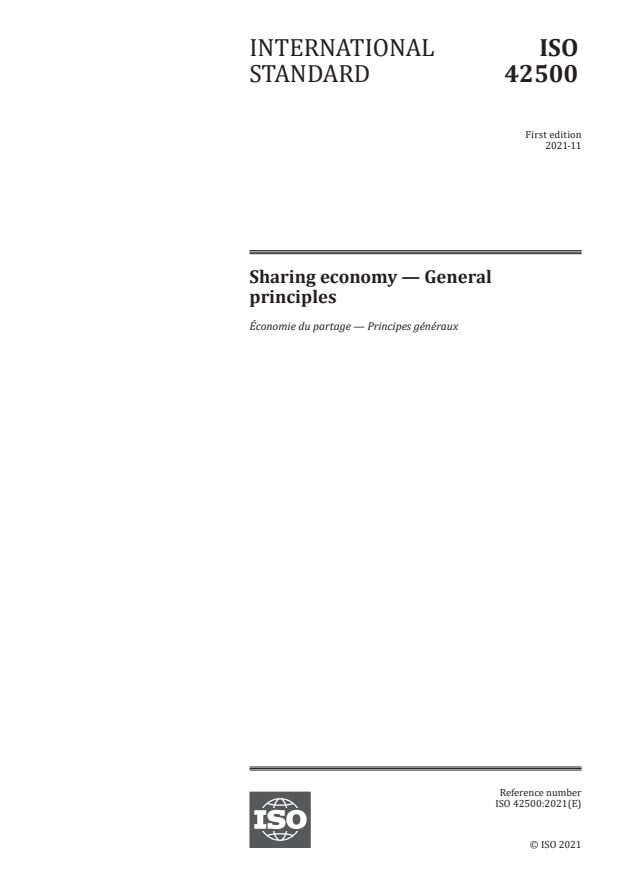
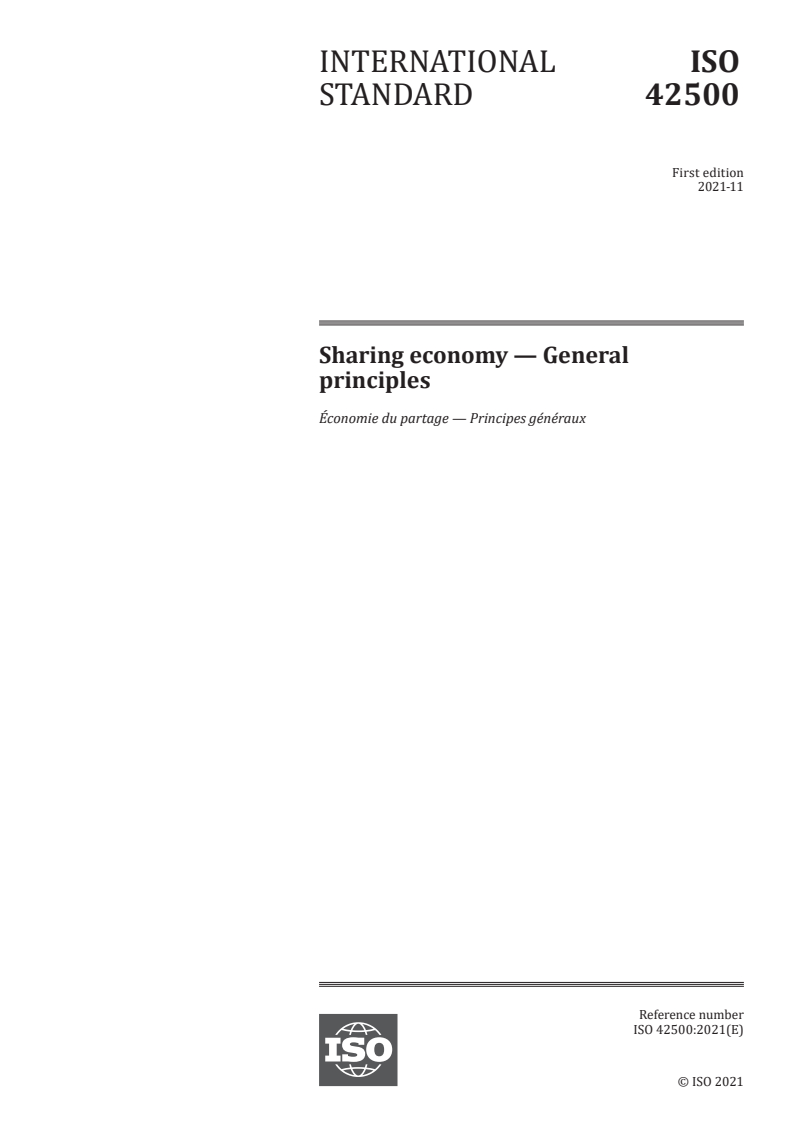
INTERNATIONAL ISO
STANDARD 42500
First edition
2021-11
Sharing economy — General
principles
Économie du partage — Principes généraux
Reference number
© ISO 2021
All rights reserved. Unless otherwise specified, or required in the context of its implementation, no part of this publication may
be reproduced or utilized otherwise in any form or by any means, electronic or mechanical, including photocopying, or posting on
the internet or an intranet, without prior written permission. Permission can be requested from either ISO at the address below
or ISO’s member body in the country of the requester.
ISO copyright office
CP 401 • Ch. de Blandonnet 8
CH-1214 Vernier, Geneva
Phone: +41 22 749 01 11
Email: copyright@iso.org
Website: www.iso.org
Published in Switzerland
ii
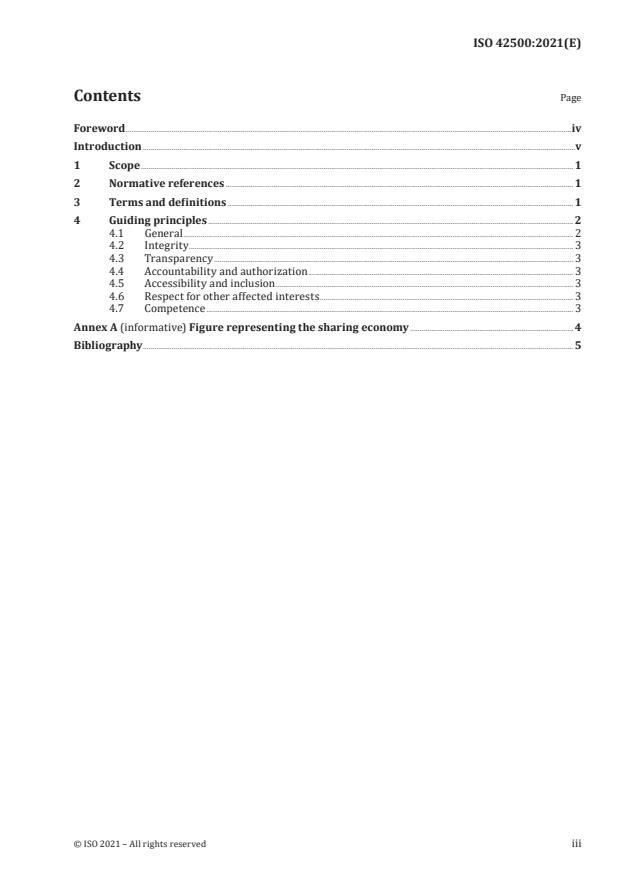
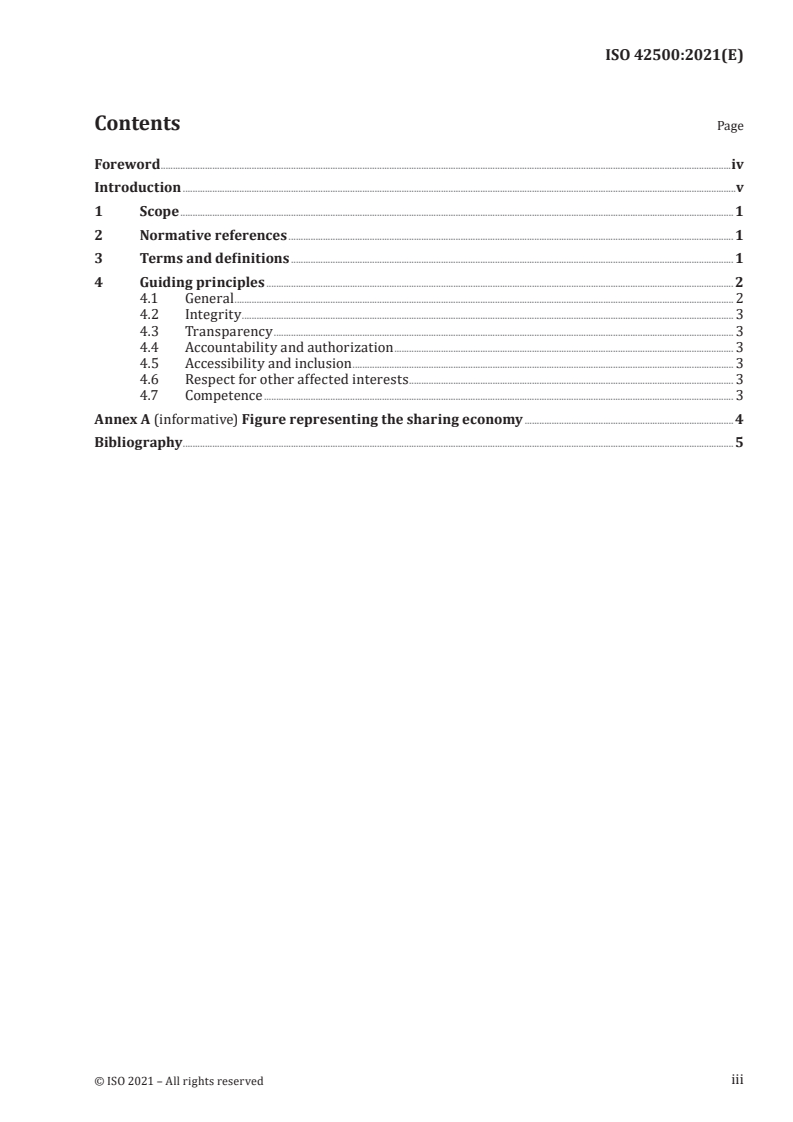
Contents Page
Foreword .iv
Introduction .v
1 Scope . 1
2 Normative references . 1
3 Terms and definitions . 1
4 Guiding principles . 2
4.1 General . 2
4.2 Integrity . 3
4.3 Transparency . 3
4.4 Accountability and authorization . 3
4.5 Accessibility and inclusion . 3
4.6 Respect for other affected interests . 3
4.7 Competence . 3
Annex A (informative) Figure representing the sharing economy . 4
Bibliography . 5
iii
Foreword
ISO (the International Organization for Standardization) is a worldwide federation of national standards
bodies (ISO member bodies). The work of preparing International Standards is normally carried out
through ISO technical committees. Each member body interested in a subject for which a technical
committee has been established has the right to be represented on that committee. International
organizations, governmental and non-governmental, in liaison with ISO, also take part in the work.
ISO collaborates closely with the International Electrotechnical Commission (IEC) on all matters of
electrotechnical standardization.
The procedures used to develop this document and those intended for its further maintenance are
described in the ISO/IEC Directives, Part 1. In particular, the different approval criteria needed for the
different types of ISO documents should be noted. This document was drafted in accordance with the
editorial rules of the ISO/IEC Directives, Part 2 (see www.iso.org/directives).
Attention is drawn to the possibility that some of the elements of this document may be the subject of
patent rights. ISO shall not be held responsible for identifying any or all such patent rights. Details of
any patent rights identified during the development of the document will be in the Introduction and/or
on the ISO list of patent declarations received (see www.iso.org/patents).
Any trade name used in this document is information given for the convenience of users and does not
constitute an endorsement.
For an explanation of the voluntary nature of standards, the meaning of ISO specific terms and
expressions related to conformity assessment, as well as information about ISO's adherence to
the World Trade Organization (WTO) principles in the Technical Barriers to Trade (TBT), see
www.iso.org/iso/foreword.html.
This document was prepared by Technical Committee ISO/TC 324, Sharing economy.
Any feedback or questions on this document should be directed to the user’s national standards body. A
complete listing of these bodies can be found at www.iso.org/members.html.
iv
Introduction
A combination of widespread internet use, technological developments, economic model innovation
and demographic shifts has led to the emergence of a new economic model often called the “sharing
economy”, which enables otherwise unconnected individuals and/or organizations to make
transactions.
The sharing economy creates opportunities to connect individuals and/or organizations with unused
assets and skills with those who want to use them. It enables services and products to reach a wider
range of consumers, support entrepreneurship, and create new business opportunities with a flexible
working style which contributes to economic growth. The shift from owning assets to sharing them
through the new model enables better resource optimization and is expected to contribute to the
resolution of environmental issues.
Meanwhile, issues of security, service quality and reliability can become an obstacle for users in using
sharing economy services, such as:
― products or assets in the sharing economy platform do not meet the quality expected, or are not
ti
...
INTERNATIONAL ISO
STANDARD 42500
First edition
2021-11
Sharing economy — General
principles
Économie du partage — Principes généraux
Reference number
© ISO 2021
All rights reserved. Unless otherwise specified, or required in the context of its implementation, no part of this publication may
be reproduced or utilized otherwise in any form or by any means, electronic or mechanical, including photocopying, or posting on
the internet or an intranet, without prior written permission. Permission can be requested from either ISO at the address below
or ISO’s member body in the country of the requester.
ISO copyright office
CP 401 • Ch. de Blandonnet 8
CH-1214 Vernier, Geneva
Phone: +41 22 749 01 11
Email: copyright@iso.org
Website: www.iso.org
Published in Switzerland
ii
Contents Page
Foreword .iv
Introduction .v
1 Scope . 1
2 Normative references . 1
3 Terms and definitions . 1
4 Guiding principles . 2
4.1 General . 2
4.2 Integrity . 3
4.3 Transparency . 3
4.4 Accountability and authorization . 3
4.5 Accessibility and inclusion . 3
4.6 Respect for other affected interests . 3
4.7 Competence . 3
Annex A (informative) Figure representing the sharing economy . 4
Bibliography . 5
iii
Foreword
ISO (the International Organization for Standardization) is a worldwide federation of national standards
bodies (ISO member bodies). The work of preparing International Standards is normally carried out
through ISO technical committees. Each member body interested in a subject for which a technical
committee has been established has the right to be represented on that committee. International
organizations, governmental and non-governmental, in liaison with ISO, also take part in the work.
ISO collaborates closely with the International Electrotechnical Commission (IEC) on all matters of
electrotechnical standardization.
The procedures used to develop this document and those intended for its further maintenance are
described in the ISO/IEC Directives, Part 1. In particular, the different approval criteria needed for the
different types of ISO documents should be noted. This document was drafted in accordance with the
editorial rules of the ISO/IEC Directives, Part 2 (see www.iso.org/directives).
Attention is drawn to the possibility that some of the elements of this document may be the subject of
patent rights. ISO shall not be held responsible for identifying any or all such patent rights. Details of
any patent rights identified during the development of the document will be in the Introduction and/or
on the ISO list of patent declarations received (see www.iso.org/patents).
Any trade name used in this document is information given for the convenience of users and does not
constitute an endorsement.
For an explanation of the voluntary nature of standards, the meaning of ISO specific terms and
expressions related to conformity assessment, as well as information about ISO's adherence to
the World Trade Organization (WTO) principles in the Technical Barriers to Trade (TBT), see
www.iso.org/iso/foreword.html.
This document was prepared by Technical Committee ISO/TC 324, Sharing economy.
Any feedback or questions on this document should be directed to the user’s national standards body. A
complete listing of these bodies can be found at www.iso.org/members.html.
iv
Introduction
A combination of widespread internet use, technological developments, economic model innovation
and demographic shifts has led to the emergence of a new economic model often called the “sharing
economy”, which enables otherwise unconnected individuals and/or organizations to make
transactions.
The sharing economy creates opportunities to connect individuals and/or organizations with unused
assets and skills with those who want to use them. It enables services and products to reach a wider
range of consumers, support entrepreneurship, and create new business opportunities with a flexible
working style which contributes to economic growth. The shift from owning assets to sharing them
through the new model enables better resource optimization and is expected to contribute to the
resolution of environmental issues.
Meanwhile, issues of security, service quality and reliability can become an obstacle for users in using
sharing economy services, such as:
― products or assets in the sharing economy platform do not meet the quality expected, or are not
ti
...