


IEC 60601-1-11:2010
(Main)Medical electrical equipment — Part 1-11: General requirements for basic safety and essential performance — Collateral standard: Requirements for medical electrical equipment and medical electrical systems used in the home healthcare environment
Medical electrical equipment — Part 1-11: General requirements for basic safety and essential performance — Collateral standard: Requirements for medical electrical equipment and medical electrical systems used in the home healthcare environment
IEC 60601-1-11:2010 applies to the basic safety and essential performance of medical electrical equipment and medical electrical systems which are intended by their manufacturer for use in the home healthcare environment, regardless of whether the medical electrical equipment or medical electrical system is intended for use by a lay operator or by trained healthcare personnel. The object of IEC 60601-1-11:2010 is to specify general requirements that are in addition to those of the general standard IEC 60601-1:2005 and to serve as the basis for particular standards. It is therecommendation of the committee that the content of this publication be adopted for implementation nationally not earlier than 3 years from the date of publication.
Appareils électromédicaux — Partie 1-11: Exigences générales pour la sécurité de base et les performances essentielles — Norme collatérale: Exigences pour les appareils électromédicaux et les systèmes électromédicaux utilisés dans l'environnement des soins à domicile
La CEI 60601-1-11:2010 s'applique à la sécurité de base et aux performances essentielles des appareils électromédicaux et des systèmes électromédicaux destinés par leur fabricant à être utilisés dans l'environnement des soins À domicile sans distinguer si l'appareil électromédical ou le système électromédical est prévu pour être utilisé par un opérateur non spécialiste ou par du personnel de santé qualifié. La CEI 60601-1-11:2010 est destinée à spécifier des exigences générales qui viennent s'ajouter à celles de la norme générale CEI 60601-1:2005 et à servir de base pour les normes particulières. Le comité recommande que le contenu de la présente publication soit adopté pour mise en oeuvre au niveau national au plus tôt 3 ans après la date de publication.
General Information
- Status
- Withdrawn
- Publication Date
- 03-May-2010
- Withdrawal Date
- 03-May-2010
- Current Stage
- 9599 - Withdrawal of International Standard
- Start Date
- 21-Jan-2015
- Completion Date
- 12-Feb-2026
Relations
- Effective Date
- 19-Jun-2021
- Effective Date
- 14-Dec-2013
Get Certified
Connect with accredited certification bodies for this standard

BSI Group
BSI (British Standards Institution) is the business standards company that helps organizations make excellence a habit.

TÜV Rheinland
TÜV Rheinland is a leading international provider of technical services.

TÜV SÜD
TÜV SÜD is a trusted partner of choice for safety, security and sustainability solutions.
Sponsored listings
Frequently Asked Questions
IEC 60601-1-11:2010 is a standard published by the International Organization for Standardization (ISO). Its full title is "Medical electrical equipment — Part 1-11: General requirements for basic safety and essential performance — Collateral standard: Requirements for medical electrical equipment and medical electrical systems used in the home healthcare environment". This standard covers: IEC 60601-1-11:2010 applies to the basic safety and essential performance of medical electrical equipment and medical electrical systems which are intended by their manufacturer for use in the home healthcare environment, regardless of whether the medical electrical equipment or medical electrical system is intended for use by a lay operator or by trained healthcare personnel. The object of IEC 60601-1-11:2010 is to specify general requirements that are in addition to those of the general standard IEC 60601-1:2005 and to serve as the basis for particular standards. It is therecommendation of the committee that the content of this publication be adopted for implementation nationally not earlier than 3 years from the date of publication.
IEC 60601-1-11:2010 applies to the basic safety and essential performance of medical electrical equipment and medical electrical systems which are intended by their manufacturer for use in the home healthcare environment, regardless of whether the medical electrical equipment or medical electrical system is intended for use by a lay operator or by trained healthcare personnel. The object of IEC 60601-1-11:2010 is to specify general requirements that are in addition to those of the general standard IEC 60601-1:2005 and to serve as the basis for particular standards. It is therecommendation of the committee that the content of this publication be adopted for implementation nationally not earlier than 3 years from the date of publication.
IEC 60601-1-11:2010 is classified under the following ICS (International Classification for Standards) categories: 11.040.10 - Anaesthetic, respiratory and reanimation equipment. The ICS classification helps identify the subject area and facilitates finding related standards.
IEC 60601-1-11:2010 has the following relationships with other standards: It is inter standard links to IEC 60601-1-11:2010/Cor 1:2011, IEC 60601-1-11:2015. Understanding these relationships helps ensure you are using the most current and applicable version of the standard.
IEC 60601-1-11:2010 is available in PDF format for immediate download after purchase. The document can be added to your cart and obtained through the secure checkout process. Digital delivery ensures instant access to the complete standard document.
Standards Content (Sample)
IEC 60601-1-11
Edition 1.0 2010-04
INTERNATIONAL
STANDARD
NORME
INTERNATIONALE
Medical electrical equipment –
Part 1-11: General requirements for basic safety and essential performance –
Collateral Standard: Requirements for medical electrical equipment and medical
electrical systems used in the home healthcare environment
Appareils électromédicaux –
Partie 1-11: Exigences générales pour la sécurité de base et les performances
essentielles – Norme Collatérale: Exigences pour les appareils électromédicaux
et les systèmes électromédicaux utilisés dans l’environnement des soins à
domicile
All rights reserved. Unless otherwise specified, no part of this publication may be reproduced or utilized in any form or by
any means, electronic or mechanical, including photocopying and microfilm, without permission in writing from either IEC or
IEC's member National Committee in the country of the requester.
If you have any questions about IEC copyright or have an enquiry about obtaining additional rights to this publication,
please contact the address below or your local IEC member National Committee for further information.
Droits de reproduction réservés. Sauf indication contraire, aucune partie de cette publication ne peut être reproduite
ni utilisée sous quelque forme que ce soit et par aucun procédé, électronique ou mécanique, y compris la photocopie
et les microfilms, sans l'accord écrit de la CEI ou du Comité national de la CEI du pays du demandeur.
Si vous avez des questions sur le copyright de la CEI ou si vous désirez obtenir des droits supplémentaires sur cette
publication, utilisez les coordonnées ci-après ou contactez le Comité national de la CEI de votre pays de résidence.
IEC Central Office
3, rue de Varembé
CH-1211 Geneva 20
Switzerland
Email: inmail@iec.ch
Web: www.iec.ch
About the IEC
The International Electrotechnical Commission (IEC) is the leading global organization that prepares and publishes
International Standards for all electrical, electronic and related technologies.
About IEC publications
The technical content of IEC publications is kept under constant review by the IEC. Please make sure that you have the
latest edition, a corrigenda or an amendment might have been published.
ƒ Catalogue of IEC publications: www.iec.ch/searchpub
The IEC on-line Catalogue enables you to search by a variety of criteria (reference number, text, technical committee,…).
It also gives information on projects, withdrawn and replaced publications.
ƒ IEC Just Published: www.iec.ch/online_news/justpub
Stay up to date on all new IEC publications. Just Published details twice a month all new publications released. Available
on-line and also by email.
ƒ Electropedia: www.electropedia.org
The world's leading online dictionary of electronic and electrical terms containing more than 20 000 terms and definitions
in English and French, with equivalent terms in additional languages. Also known as the International Electrotechnical
Vocabulary online.
ƒ Customer Service Centre: www.iec.ch/webstore/custserv
If you wish to give us your feedback on this publication or need further assistance, please visit the Customer Service
Centre FAQ or contact us:
Email: csc@iec.ch
Tel.: +41 22 919 02 11
Fax: +41 22 919 03 00
A propos de la CEI
La Commission Electrotechnique Internationale (CEI) est la première organisation mondiale qui élabore et publie des
normes internationales pour tout ce qui a trait à l'électricité, à l'électronique et aux technologies apparentées.
A propos des publications CEI
Le contenu technique des publications de la CEI est constamment revu. Veuillez vous assurer que vous possédez
l’édition la plus récente, un corrigendum ou amendement peut avoir été publié.
ƒ Catalogue des publications de la CEI: www.iec.ch/searchpub/cur_fut-f.htm
Le Catalogue en-ligne de la CEI vous permet d’effectuer des recherches en utilisant différents critères (numéro de référence,
texte, comité d’études,…). Il donne aussi des informations sur les projets et les publications retirées ou remplacées.
ƒ Just Published CEI: www.iec.ch/online_news/justpub
Restez informé sur les nouvelles publications de la CEI. Just Published détaille deux fois par mois les nouvelles
publications parues. Disponible en-ligne et aussi par email.
ƒ Electropedia: www.electropedia.org
Le premier dictionnaire en ligne au monde de termes électroniques et électriques. Il contient plus de 20 000 termes et
définitions en anglais et en français, ainsi que les termes équivalents dans les langues additionnelles. Egalement appelé
Vocabulaire Electrotechnique International en ligne.
ƒ Service Clients: www.iec.ch/webstore/custserv/custserv_entry-f.htm
Si vous désirez nous donner des commentaires sur cette publication ou si vous avez des questions, visitez le FAQ du
Service clients ou contactez-nous:
Email: csc@iec.ch
Tél.: +41 22 919 02 11
Fax: +41 22 919 03 00
IEC 60601-1-11
Edition 1.0 2010-04
INTERNATIONAL
STANDARD
NORME
INTERNATIONALE
Medical electrical equipment –
Part 1-11: General requirements for basic safety and essential performance –
Collateral Standard: Requirements for medical electrical equipment and
medical electrical systems used in the home healthcare environment
Appareils électromédicaux –
Partie 1-11: Exigences générales pour la sécurité de base et les performances
essentielles – Norme Collatérale: Exigences pour les appareils électromédicaux
et les systèmes électromédicaux utilisés dans l’environnement des soins à
domicile
INTERNATIONAL
ELECTROTECHNICAL
COMMISSION
COMMISSION
ELECTROTECHNIQUE
PRICE CODE
INTERNATIONALE
XA
CODE PRIX
ICS 11.040 ISBN 978-2-88910-920-3
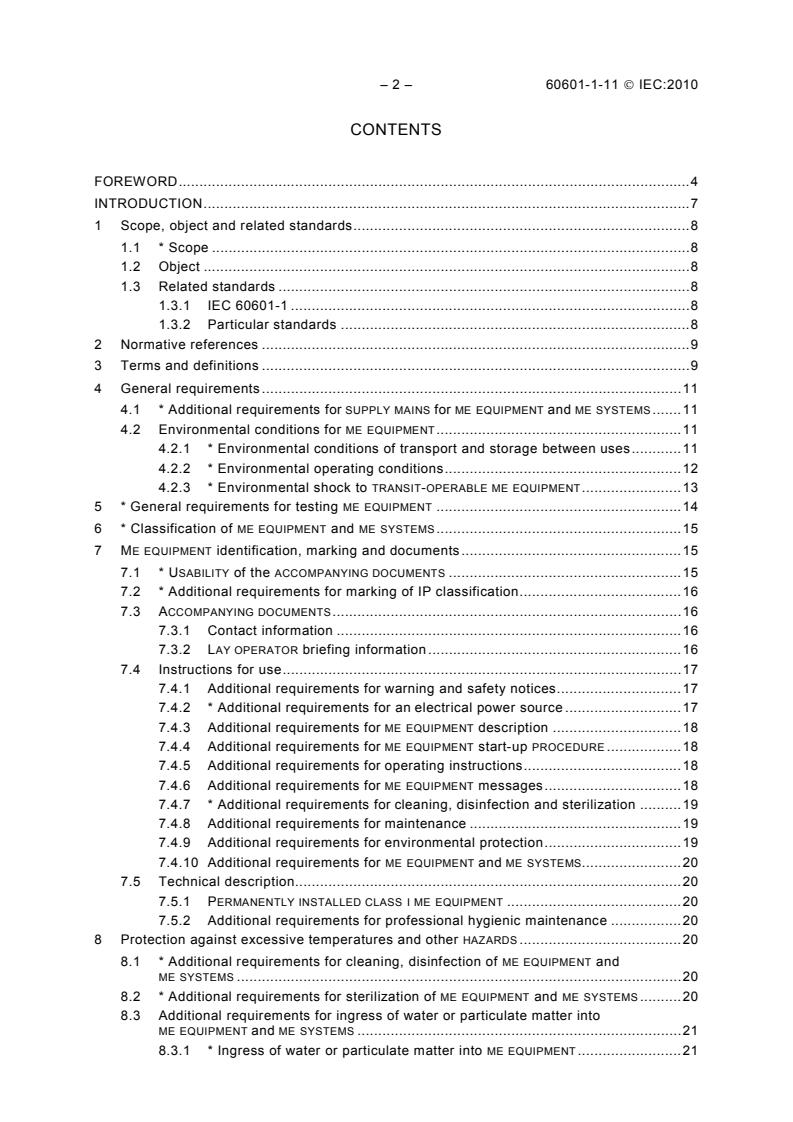
– 2 – 60601-1-11 © IEC:2010
CONTENTS
FOREWORD.4
INTRODUCTION.7
1 Scope, object and related standards.8
1.1 * Scope .8
1.2 Object .8
1.3 Related standards .8
1.3.1 IEC 60601-1 .8
1.3.2 Particular standards .8
2 Normative references .9
3 Terms and definitions .9
4 General requirements .11
4.1 * Additional requirements for SUPPLY MAINS for ME EQUIPMENT and ME SYSTEMS.11
4.2 Environmental conditions for ME EQUIPMENT.11
4.2.1 * Environmental conditions of transport and storage between uses.11
4.2.2 * Environmental operating conditions.12
4.2.3 * Environmental shock to TRANSIT-OPERABLE ME EQUIPMENT.13
5 * General requirements for testing ME EQUIPMENT .14
6 * Classification of ME EQUIPMENT and ME SYSTEMS.15
7 ME EQUIPMENT identification, marking and documents.15
7.1 * USABILITY of the ACCOMPANYING DOCUMENTS .15
7.2 * Additional requirements for marking of IP classification.16
7.3 ACCOMPANYING DOCUMENTS.16
7.3.1 Contact information .16
7.3.2 LAY OPERATOR briefing information.16
7.4 Instructions for use.17
7.4.1 Additional requirements for warning and safety notices.17
7.4.2 * Additional requirements for an electrical power source .17
7.4.3 Additional requirements for ME EQUIPMENT description .18
7.4.4 Additional requirements for ME EQUIPMENT start-up PROCEDURE .18
7.4.5 Additional requirements for operating instructions.18
7.4.6 Additional requirements for ME EQUIPMENT messages.18
7.4.7 * Additional requirements for cleaning, disinfection and sterilization .19
7.4.8 Additional requirements for maintenance .19
7.4.9 Additional requirements for environmental protection.19
7.4.10 Additional requirements for ME EQUIPMENT and ME SYSTEMS.20
7.5 Technical description.20
7.5.1 PERMANENTLY INSTALLED CLASS I ME EQUIPMENT .20
7.5.2 Additional requirements for professional hygienic maintenance .20
8 Protection against excessive temperatures and other HAZARDS .20
8.1 * Additional requirements for cleaning, disinfection of ME EQUIPMENT and
ME SYSTEMS .20
8.2 * Additional requirements for sterilization of ME EQUIPMENT and ME SYSTEMS .20
8.3 Additional requirements for ingress of water or particulate matter into
ME EQUIPMENT and ME SYSTEMS .21
8.3.1 * Ingress of water or particulate matter into ME EQUIPMENT.21
60601-1-11 © IEC:2010 – 3 –
8.3.2 * Ingress of water or particulate matter into ME SYSTEMS .21
8.4 Additional requirements for interruption of the power supply/SUPPLY MAINS to
ME EQUIPMENT and ME SYSTEM.21
9 Accuracy of controls and instruments and protection against hazardous outputs .22
10 Construction of ME EQUIPMENT .22
10.1 * Additional requirements for mechanical strength .22
10.1.1 General requirements for mechanical strength.22
10.1.2 * Requirements for mechanical strength for non-TRANSIT-OPERABLE
ME EQUIPMENT .24
10.1.3 * Requirements for mechanical strength for TRANSIT-OPERABLE
ME EQUIPMENT .25
10.2 * Additional requirements for an INTERNAL ELECTRICAL POWER SOURCE .26
10.3 Additional requirements for actuating parts of controls of ME EQUIPMENT .27
11 * Protection against strangulation or asphyxiation.27
12 Additional requirements for electromagnetic compatibility of ME EQUIPMENT and
ME SYSTEMS .27
12.1 Emissions classification.28
12.2 Protection of the PUBLIC MAINS NETWORK .28
12.3 * Additional technical description requirements applicable to ME EQUIPMENT
and ME SYSTEMS .28
12.4 * Additional requirements applicable to ME EQUIPMENT and ME SYSTEMS
specified for use only in a shielded location.28
12.5 * Additional requirements for ELECTROSTATIC DISCHARGE (ESD) tests.28
13 Additional requirements for ALARM SYSTEMS of ME EQUIPMENT and ME SYSTEMS .28
13.1 * Additional requirement for generation of ALARM SIGNALS .28
13.2 * Additional requirement for ALARM SIGNAL volume .29
Annex A (informative) General guidance and rationale.30
Annex B (informative) Guide to marking and labelling requirements for ME EQUIPMENT
and ME SYSTEMS .49
Annex C (informative) Symbols on marking.53
Bibliography.54
Index of defined terms used in this collateral standard.56
Figure 1 – Small finger probe ∅ 5,6 .15
Table 1 – Mechanical strength test applicability, non-TRANSIT-OPERABLE .23
Table 2 – Mechanical strength test applicability, TRANSIT-OPERABLE .24
Table A.1 – Summary by use of HOME HEALTHCARE ENVIRONMENT ME EQUIPMENT
ENCLOSURE ingress of water and particulate matter requirements.42
Table A.2 – Qualitative assessment of HOME HEALTHCARE ENVIRONMENT ME EQUIPMENT
subjected to shock and vibration .43
Table B.1 – Marking on the outside of ME EQUIPMENT, ME SYSTEMS or their parts .49
Table B.2 – ACCOMPANYING DOCUMENTS, general.49
Table B.3 – ACCOMPANYING DOCUMENTS, instructions for use .51
Table B.4 – ACCOMPANYING DOCUMENTS, instructions for use (continued).52
Table B.5 – ACCOMPANYING DOCUMENTS, technical description.52
Table C 1 – General symbols.53
– 4 – 60601-1-11 © IEC:2010
INTERNATIONAL ELECTROTECHNICAL COMMISSION
____________
MEDICAL ELECTRICAL EQUIPMENT –
Part 1-11: General requirements for basic safety
and essential performance –
Collateral Standard:
Requirements for medical electrical equipment
and medical electrical systems used
in the home healthcare environment
FOREWORD
1) The International Electrotechnical Commission (IEC) is a worldwide organization for standardization comprising
all national electrotechnical committees (IEC National Committees). The object of IEC is to promote
international co-operation on all questions concerning standardization in the electrical and electronic fields. To
this end and in addition to other activities, IEC publishes International Standards, Technical Specifications,
Technical Reports, Publicly Available Specifications (PAS) and Guides (hereafter referred to as “IEC
Publication(s)”). Their preparation is entrusted to technical committees; any IEC National Committee interested
in the subject dealt with may participate in this preparatory work. International, governmental and non-
governmental organizations liaising with the IEC also participate in this preparation. IEC collaborates closely
with the International Organization for Standardization (ISO) in accordance with conditions determined by
agreement between the two organizations.
2) The formal decisions or agreements of IEC on technical matters express, as nearly as possible, an international
consensus of opinion on the relevant subjects since each technical committee has representation from all
interested IEC National Committees.
3) IEC Publications have the form of recommendations for international use and are accepted by IEC National
Committees in that sense. While all reasonable efforts are made to ensure that the technical content of IEC
Publications is accurate, IEC cannot be held responsible for the way in which they are used or for any
misinterpretation by any end user.
4) In order to promote international uniformity, IEC National Committees undertake to apply IEC Publications
transparently to the maximum extent possible in their national and regional publications. Any divergence
between any IEC Publication and the corresponding national or regional publication shall be clearly indicated in
the latter.
5) IEC itself does not provide any attestation of conformity. Independent certification bodies provide conformity
assessment services and, in some areas, access to IEC marks of conformity. IEC is not responsible for any
services carried out by independent certification bodies.
6) All users should ensure that they have the latest edition of this publication.
7) No liability shall attach to IEC or its directors, employees, servants or agents including individual experts and
members of its technical committees and IEC National Committees for any personal injury, property damage or
other damage of any nature whatsoever, whether direct or indirect, or for costs (including legal fees) and
expenses arising out of the publication, use of, or reliance upon, this IEC Publication or any other IEC
Publications.
8) Attention is drawn to the Normative references cited in this publication. Use of the referenced publications is
indispensable for the correct application of this publication.
9) Attention is drawn to the possibility that some of the elements of this IEC Publication may be the subject of
patent rights. IEC shall not be held responsible for identifying any or all such patent rights.
International standard IEC 60601-1-11 has been prepared by a joint working group of
IEC subcommittee 62A: Common aspects of electrical equipment used in medical practice of
IEC technical committee 62: Electrical equipment in medical practice and ISO subcommittee
SC3: Lung ventilators and related devices, of ISO technical committee 121: Anaesthetic and
respiratory equipment.
It is published as a double logo standard.
This first edition constitutes a collateral standard to IEC 60601-1:2005 (third edition): Medical
electrical equipment – Part 1: General requirements for basic safety and essential
performance hereafter referred to as the general standard.
60601-1-11 © IEC:2010 – 5 –
The text of this collateral standard is based on the following documents of IEC:
FDIS Report on voting
62A/693/FDIS 62A/696/RVD
Full information on the voting for the approval of this collateral standard can be found in the
report on voting indicated in the above table. In ISO, the standard has been approved by
17 P-members out of 17 having cast a vote.
This publication has been drafted in accordance with the ISO/IEC Directives, Part 2.
In the 60601 series of publications, collateral standards specify general requirements for
safety applicable to:
– a subgroup of MEDICAL ELECTRICAL EQUIPMENT (e.g. radiological equipment); or
– a specific characteristic of all MEDICAL ELECTRICAL EQUIPMENT, not fully addressed in the
general standard (e.g. ALARM SYSTEMS).
In this collateral standard, the following print types are used:
– requirements and definitions: roman type.
– test specifications: italic type.
– informative material appearing outside of tables, such as notes, examples and references: in smaller type.
Normative text of tables is also in a smaller type.
– TERMS DEFINED IN CLAUSE 3 OF THE GENERAL STANDARD, IN THIS COLLATERAL STANDARD OR AS
NOTED: SMALL CAPITALS.
In referring to the structure of this standard, the term
– “clause” means one of the numbered divisions within the table of contents, inclusive of all
subdivisions (e.g. Clause 7 includes subclauses 7.1, 7.2, etc.);
– “subclause” means a numbered subdivision of a clause (e.g. 7.1, 7.2 and 7.2.1 are all
subclauses of Clause 7).
References to clauses within this standard are preceded by the term “Clause” followed by the
clause number. References to subclauses within this collateral standard are by number only.
In this standard, the conjunctive “or” is used as an “inclusive or” so a statement is true if any
combination of the conditions is true.
The verbal forms used in this standard conform to usage described in Annex H of the ISO/IEC
Directives, Part 2. For the purposes of this standard, the auxiliary verb:
– “shall” means that compliance with a requirement or a test is mandatory for compliance
with this standard;
– “should” means that compliance with a requirement or a test is recommended but is not
mandatory for compliance with this standard;
– “may” is used to describe a permissible way to achieve compliance with a requirement or
test.
Clauses, subclauses and definitions for which a rationale is provided in informative Annex A
are marked with an asterisk (*).
A list of all parts of the IEC 60601 series, published under the general title: Medical electrical
equipment, can be found on the IEC website.
– 6 – 60601-1-11 © IEC:2010
The committee has decided that the contents of this amendment and the base publication will
remain unchanged until the stability date indicated on the IEC web site under
"http://webstore.iec.ch" in the data related to the specific publication. At this date, the
publication will be
• reconfirmed;
• withdrawn;
• replaced by a revised edition, or
• amended
NOTE The attention of Member Bodies and National Committees is drawn to the fact that equipment
manufacturers and testing organizations may need a transitional period following publication of a new, amended or
revised ISO or IEC publication in which to make products in accordance with the new requirements and to equip
themselves for conducting new or revised tests. It is the recommendation of the committee that the content of this
publication be adopted for implementation nationally not earlier than 3 years from the date of publication.
60601-1-11 © IEC:2010 – 7 –
INTRODUCTION
Medical practice is increasingly using MEDICAL ELECTRICAL EQUIPMENT and MEDICAL ELECTRICAL
SYSTEMS for monitoring, treatment or diagnosis of PATIENTS in the HOME HEALTHCARE
ENVIRONMENT (see 3.2). The safety of MEDICAL ELECTRICAL EQUIPMENT in this uncontrolled
environment with regard to the electrical installation and its related safety and protection
means is a cause for concern.
The potential lack of training of the LAY OPERATOR and possibly of those supervising the use of
the MEDICAL ELECTRICAL EQUIPMENT or MEDICAL ELECTRICAL SYSTEM and their level of education
need to be addressed in the development of the ACCOMPANYING DOCUMENTS and in the
relevant marking on the equipment itself so that this material can be understood. This
collateral standard gives special guidance on how this should be addressed in the instructions
for use.
This collateral standard was developed with contributions from clinicians, engineers and
regulators. The terminology, requirements, general recommendations and guidance of this
collateral standard are intended to be useful for MANUFACTURERS of MEDICAL ELECTRICAL
EQUIPMENT and MEDICAL ELECTRICAL SYSTEMS and for technical committees responsible for the
development of particular standards.
– 8 – 60601-1-11 © IEC:2010
MEDICAL ELECTRICAL EQUIPMENT –
Part 1-11: General requirements for basic safety
and essential performance –
Collateral Standard:
Requirements for medical electrical equipment
and medical electrical systems used
in the home healthcare environment
1 Scope, object and related standards
1.1 * Scope
This International Standard applies to the BASIC SAFETY and ESSENTIAL PERFORMANCE of
MEDICAL ELECTRICAL EQUIPMENT and MEDICAL ELECTRICAL SYSTEMS, hereafter referred to as
ME EQUIPMENT and ME SYSTEMS, which are intended by their MANUFACTURER for use in the
HOME HEALTHCARE ENVIRONMENT, as defined in 3.2, regardless of whether the ME EQUIPMENT or
ME SYSTEM is intended for use by a LAY OPERATOR or by trained healthcare personnel.
NOTE 1 HOME HEALTHCARE ENVIRONMENT ME EQUIPMENT and ME SYSTEMS can also be intended for use in other
environments, for example, in a professional healthcare facility.
This International Standard does not apply to ME EQUIPMENT and ME SYSTEMS intended solely
for use by emergency medical services or solely for use in professional healthcare facilities.
NOTE 2 HOME HEALTHCARE ENVIRONMENT ME EQUIPMENT and ME SYSTEMS can frequently be used in locations with
unreliable electrical sources and poor electrical grounding.
1.2 Object
The object of this collateral standard is to specify general requirements that are in addition to
those of the general standard and to serve as the basis for particular standards.
1.3 Related standards
1.3.1 IEC 60601-1
For ME EQUIPMENT and ME SYSTEMS, this collateral standard complements IEC 60601-1.
When referring to IEC 60601-1 or to this collateral standard, either individually or in
combination, the following conventions are used:
• "the general standard" designates IEC 60601-1 alone;
• "this collateral standard" designates IEC 60601-1-11 alone;
• "this standard" designates the combination of the general standard and this collateral
standard.
1.3.2 Particular standards
A requirement in a particular standard takes priority over the corresponding requirement in
this collateral standard.
60601-1-11 © IEC:2010 – 9 –
2 Normative references
The following referenced documents are indispensable for the application of this document.
For dated references, only the edition cited applies. For undated references, the latest edition
of the referenced document (including any amendments) applies.
NOTE 1 The way in which these referenced documents are cited in normative requirements determines the extent
(in whole or in part) to which they apply.
NOTE 2 Informative references are listed in the bibliography on page 54.
IEC 60068-2-27:2008, Environmental testing – Part 2-27: Tests – Ea and guidance: Shock
IEC 60068-2-31:2008, Environmental testing – Part 2-31: Tests – Test Ec: Rough handling
shocks, primarily for equipment-type specimens
IEC 60068-2-64:2008, Environmental testing – Part 2-64: Tests – Test Fh: Vibration,
broadband random and guidance
IEC 60529:1989, Degrees of protection provided by enclosures (IP Code)
1)
Amendment 1 (1999)
IEC 60601-1:2005, Medical electrical equipment – Part 1: General requirements for basic
safety and essential performance
IEC 60601-1-2:2007, Medical electrical equipment – Part 1-2: General requirements for basic
safety and essential performance – Collateral standard: Electromagnetic compatibility –
Requirements and tests
IEC 60601-1-6:2010, Medical electrical equipment – Part 1-6: General requirements for basic
safety and essential performance – Collateral Standard: Usability
IEC 60601-1-8:2006, Medical electrical equipment – Part 1-8: General requirements for basic
safety and essential performance – Collateral standard: General requirements, tests and
guidance for alarm systems in medical electrical equipment and medical electrical systems
CISPR 11:2009, Industrial, scientific and medical equipment – Radio-frequency disturbance
characteristics - Limits and methods of measurement
3 Terms and definitions
For the purposes of this document, the terms and definitions given in IEC 60601-1:2005,
IEC 60601-1-2:2007, IEC 60601-1-6:2010, IEC 60601-1-8:2006 and the following definitions
apply.
NOTE 1 Where the terms “voltage” and “current” are used in this document, they mean the r.m.s. values of an
alternating, direct or composite voltage or current unless stated otherwise.
NOTE 2 The term “electrical equipment” is used to mean ME EQUIPMENT or other electrical equipment. This
standard also uses the term “equipment” to mean ME EQUIPMENT or other electrical or non-electrical equipment in
the context of an ME SYSTEM.
NOTE 3 An index of defined terms used in this collateral standard is found beginning on page 56.
—————————
1)
There exists a consolidated edition 2.1 including IEC 60529:1989 and Amendment 1 (1999).
– 10 – 60601-1-11 © IEC:2010
3.1
* BODY-WORN
term referring to TRANSPORTABLE equipment whose INTENDED USE includes operation while
being worn by a PATIENT or attached to a PATIENT'S clothing
NOTE TRANSPORTABLE equipment can be both BODY-WORN and HAND-HELD.
3.2
HOME HEALTHCARE ENVIRONMENT
dwelling place in which a PATIENT lives or other places where PATIENTS are present, excluding
professional healthcare facility environments where OPERATORS with medical training are
continually available when PATIENTS are present
NOTE 1 Professional healthcare facilities include hospitals, physician offices, freestanding surgical centres,
dental offices, freestanding birthing centres, limited care facilities, multiple treatment facilities and emergency
medical services.
NOTE 2 For the purpose of this collateral standard, nursing homes are considered the HOME HEALTHCARE
ENVIRONMENT.
NOTE 3 Other places where PATIENTS are present include the outdoor environment and in vehicles.
EXAMPLES In a car, bus, train, boat or plane, in a wheelchair or walking outdoors
3.3
* LAY
term referring to nonprofessional or professional without relevant specialized training
EXAMPLES LAY OPERATOR, LAY RESPONSIBLE ORGANIZATION
3.4
LIFE-SUPPORTING ME EQUIPMENT or ME SYSTEM
ME EQUIPMENT or ME SYSTEM that includes at least one FUNCTION that is intended to actively
keep alive or resuscitate a PATIENT and the failure of which is likely to lead to serious injury or
death of a PATIENT
[IEC 60601-1-2:2007, definition 3.18, modified]
EXAMPLE A ventilator for a ventilator-dependent PATIENT intended for use in the HOME HEALTHCARE ENVIRONMENT.
3.5
SHELF LIFE
maximum period of time that an item can be stored prior to its first use under the conditions
described in its labelling and remain suitable for use
3.6
TRANSIT-OPERABLE
term referring to TRANSPORTABLE equipment whose INTENDED USE includes operation while it is
being moved
EXAMPLES TRANSPORTABLE ME EQUIPMENT that is BODY-WORN, HAND-HELD, attached to a wheelchair, or used in a
car, bus, train, boat or plane.
NOTE For the purpose of this standard, TRANSIT-OPERABLE use in the HOME HEALTHCARE ENVIRONMENT can include
use indoors, outdoors and in vehicles.
3.7
USABILITY ENGINEERING
application of knowledge about human behaviour, abilities, limitations, and other
characteristics to the design of tools, machines, ME EQUIPMENT, devices, systems, tasks, jobs,
and environments to achieve adequate USABILITY
60601-1-11 © IEC:2010 – 11 –
3.8
USABILITY ENGINEERING FILE
set of RECORDS and other documents that are produced by USABILITY ENGINEERING activities
3.9
USABILITY SPECIFICATION
documentation defining the OPERATOR-EQUIPMENT INTERFACE requirements related to USABILITY
3.10
VALIDATION
confirmation, through the provision of objective evidence, that the requirements for a specific
intended use or application have been fulfilled
NOTE 1 The term “validated” is used to designate the corresponding status.
NOTE 2 The use conditions for VALIDATION can be real or simulated.
[ISO 9000:2000, definition 3.8.5]
4 General requirements
4.1 * Additional requirements for SUPPLY MAINS for ME EQUIPMENT and ME SYSTEMS
For ME EQUIPMENT or ME SYSTEMS intended for the HOME HEALTHCARE ENVIRONMENT, the
characteristics of the SUPPLY MAINS specified in 4.10.2 of the general standard apply, except
for replacement of the fifth dash as follows:
– for non-LIFE-SUPPORTING ME EQUIPMENT or ME SYSTEMS, no voltage in excess of 110 % or
lower than 85 % of the NOMINAL voltage between any of the conductors of the system or
between any of these conductors and earth; and
– for LIFE-SUPPORTING ME EQUIPMENT or ME SYSTEMS, no voltage in excess of 110 % or lower
than 80 % of the NOMINAL voltage between any of the conductors of the system or between
any of these conductors and earth.
4.2 Environmental conditions for ME EQUIPMENT
NOTE In IEC 60601-1:2005, the MANUFACTURER specifies the permissible conditions of use, including conditions
for transport and storage in the technical description (see 7.9.3.1, second dash). These conditions are referenced
in requirements for testing throughout the general standard, (e.g. 5.3 and 11.1.1).
4.2.1 * Environmental conditions of transport and storage between uses
The instructions for use shall indicate the permissible environmental conditions of transport
and storage of ME EQUIPMENT after the ME EQUIPMENT has been removed from its protective
packaging and subsequently between uses.
Unless otherwise indicated in the instructions for use or if the ME EQUIPMENT is STATIONARY, the
ME EQUIPMENT shall comply with this standard and shall remain operational in NORMAL USE
within its specification after transport or storage in the following environmental temperature
range:
– – 25 °C without relative humidity control; and
– + 70 °C at a relative humidity up to 93 %, non-condensing;
after having been removed from its protective packaging and subsequently between uses.
2)
NOTE 1 This represents class 7K3 as described in IEC/TR 60721-4-7:2001 [6 ] .
—————————
2)
Figures in square brackets refer to the Bibliography.
– 12 – 60601-1-11 © IEC:2010
If the instructions for use state a more restricted range of environmental transport and storage
conditions between uses, these environmental conditions shall be:
– justified in the RISK MANAGEMENT FILE;
– marked on the ME EQUIPMENT, unless such marking is not practicable, in which case the
more restricted range need only be disclosed in the instructions for use; and
– marked on the carrying case, if the instructions for use indicate the ME EQUIPMENT is
intended to be transported or stored in a carrying case between uses.
Compliance is checked by the following test and, when a more restricted range is stated in the
instructions for use, inspection of the RISK MANAGEMENT FILE.
a) Prepare the ME EQUIPMENT for transportation or storage according to instructions for use.
EXAMPLES Removal of batteries, emptying fluid reservoirs
b) Expose the ME EQUIPMENT at its lowest specified environmental transport and storage
conditions (temperature °C) for:
− 4
– at least 24 h; or
– ensure that the ME EQUIPMENT reaches THERMAL STABILITY for at least 2 h.
c) Then expose the ME EQUIPMENT at its highest specified environmental transport and
+ 4
storage conditions (temperature °C and relative humidity ± 3 %) for:
– at least 24 h; or
– ensure that the ME EQUIPMENT reaches THERMAL STABILITY for at least 2 h. The
transition from low to high conditions should be made slowly enough to provide a non-
condensing environment.
NOTE 2 The intent of specifying a minimum duration of the exposure to both the low and high temperature
conditions is to ensure that the entire ME EQUIPMENT reaches the stated conditions.
d) At the end of this conditioning period, allow the ME EQUIPMENT to return and stabilize at the
operating conditions of NORMAL USE.
e) Evaluate the ME EQUIPMENT to its specifications and ensure that it provides BASIC SAFETY
and ESSENTIAL PERFORMANCE.
4.2.2 * Environmental operating conditions
The instructions for use shall indicate the permissible environmental operating conditions of
the ME EQUIPMENT.
NOTE 1 The environmental operating conditions should be marked on TRANSIT-OPERABLE ME EQUIPMENT, unless such
marking is not practicable, in which case the environmental operating conditions need only be disclosed in the
instructions for use.
Unless otherwise indicated in the instructions for use, the ME EQUIPMENT shall comply with its
specifications and all the requirements of this standard when operated in NORMAL USE under
the following environmental operating conditions:
– a temperature range of + 5 °C to + 40 °C;
– a relative humidity range of 15 % to 93 %, non-condensing; and
– an atmospheric pressure range of 700 hPa to 1 060 hPa.
NOTE 2 This represents class 7K1 as described in IEC/TR 60721-4-7:2001 [6 ].
If the instructions for use state a more restricted range of environmental operating conditions,
these conditions shall be:
60601-1-11 © IEC:2010 – 13 –
– justified in the RISK MANAGEMENT FILE;
– marked on the ME EQUIPMENT, unless such marking is not practicable, in which case the
more restricted range need only be disclosed in the instructions for use; and
– marked on the carrying case if the instructions for use indicate the ME EQUIPMENT is
intended to be operated in a carrying case.
The ME EQUIPMENT shall comply with its specifications and all the requirements of this
standard when operated in NORMAL USE under the specified environmental operating
conditions.
Compliance is checked by the following test and, when a more restricted range is stated in the
instructions for use, inspection of the RISK MANAGEMENT FILE:
a) Expose the ME EQUIPMENT to the ambient conditions for:
– at least 6 h, or
– ensure that the ME EQUIPMENT reaches THERMAL STABILITY for at least 2 h.
b) Evaluate the ME EQUIPMENT to its specifications and ensure that it provides BASIC SAFETY
and ESSENTIAL PERFORMANCE.
c) Evaluate the ME EQUIPMENT to its specifications and ensure that it provides BASIC SAFETY
and ESSENTIAL PERFORMANCE while at the lowest specified atmospheric pressure.
d) Evaluate the ME EQUIPMENT to its specifications and ensure that it provides BASIC SAFETY
and ESSENTIAL PERFORMANCE while at the highest specified atmospheric pressure.
NOTE 3 For ME EQUIPMENT that utilizes or measures gas or pressures, evaluation of BASIC SAFETY and
ESSENTIAL PERFORMANCE while the pressure changes can be needed.
e) Cool the ME EQUIPMENT to its lowest specified environmental operating conditions
(temperature °C and relative humidity less than or equal to 15 %).
− 4
f) Hold the ME EQUIPMENT at its lowest specified environmental operating conditions:
– for at least 6 h, or
– ensure that the ME EQUIPMENT reaches THERMAL STABILITY for at least 2 h.
g) Evaluate the ME EQUIPMENT to its specifications and ensure that it provides BASIC SAFETY
and ESSENTIAL PERFORMANCE.
h) Warm the ME EQUIPMENT to its highest specified environmental operating conditions
+ 4
(temperature °C and relative humidity ± 3 %).
i) Hold the ME EQUIPMENT at its highest specified environmental operating conditions:
– for at least 6 h, or
– ensure that the ME EQUIPMENT reaches THERMAL STABILITY for at least 2 h.
j) Evaluate the ME EQUIPMENT to its specifications and ensure that it provides BASIC SAFETY
and ESSENTIAL PERFORMANCE.
4.2.3 * Environmental shock to TRANSIT-OPERABLE ME EQUIPMENT
If the instructions for use state a wider range of environmental operating conditions than
those indicated in 4. 2. 2, th e TRANSIT-OPERABLE ME EQUIPMENT shall maintain BASIC SAFETY and
ESSENTIAL PERFORMANCE in the presence of condensation and thermal shock resulting from
rapid changes in environmental temperature and humidity during INTENDED USE.
Compliance is checked by the following test:
– 14 – 60601-1-11 © IEC:2010
a) Set up the ME EQUIPMENT for operation according to INTENDED USE.
b) Expose the ME EQUIPMENT to its lowest specified environmental operating conditions
(temperature °C and relative humidity less than or equal to 15 %).
− 4
c) Hold the ME EQUIPMENT at its lowest specified environmental operating conditions:
– for at least 6 h, or
– ensure that the ME EQUIPMENT reaches THERMAL STABILITY for at least 2 h.
d) Expose the ME EQUIPMENT to its highest specified environmental operating conditions within
+ 4
5 min (temperature °C and relative humidity ± 3 %).
e) While maintaining the environment of the ME EQUIPMENT to the conditions in d), evaluate
the ME EQUIPMENT to its specifications and ensure that it continues to provide BASIC SAFETY
and ESSENTIAL PERFORMANCE until the ME EQUIPMENT reaches THERMAL STABILITY or for at
least 2 h. The evaluation of BASIC SAFETY need not include LEAKAGE CURRENT and dielectric
strength testing because of the pollution degree ratings required by the general standard.
A separate test sample may be used for the following tests.
f) Set up the ME EQUIPMENT for operation according to INTENDED USE.
g) Expose the ME EQUIPMENT to its highest specified environmental operating conditions
+ 4
(temperature °C and relative humidity ± 3 %).
h) Hold the ME EQUIPMENT at its highest specified environmental operating conditions:
– for at least 6 h, or
– ensure that the ME EQUIPMENT reaches THERMAL STABILITY for at least 2 h.
i) Expose the ME EQUIPMENT to its lowest specified environmental operating conditions within 5 min
(temperature °C and relative humidity less than or equal to 15 %).
− 4
j) While maintaining the environment of the ME EQUIPMENT to the conditions in i), evaluate
the ME EQUIPMENT to its specifications and ensure that it continues to provide BASIC SAFETY
and ESSENTIAL PERFORMANCE until the ME EQUIPMENT reaches THERMAL STABILITY or for at
least 2 h.
NOTE While the ME EQUIPMENT is warming or cooling, the evaluation of BASIC SAFETY and ESSENTIAL
PERFORMANCE is repeated for two hours or until THERMAL STABILITY is reached.
5 * General requirements for testing ME EQUIPMENT
In addition to the requirements of 5.9.2.1 of the general standard, accessibility is also
determined as indicated below.
Parts of ME EQUIPMENT that are to be regarded as ACCESSIBLE PARTS are identified by
inspection and, where necessary, by testing. In case of doubt, a part of ME EQUIPMENT that is
to be regarded as an ACCESSIBLE PART is determined by a test with the small finger probe
shown in Figure 1, applied in a bent or straight position:
– for all positions of the ME EQUIPMENT when operated as in NORMAL USE, and
– after opening ACCESS COVERS and removal of parts, including lamps, fuses and fuse
holders, when:
i) the ACCESS COVERS can be opened without the use of a TOOL, or
ii) the instructions for use instruct a LAY OPERATOR to open the relevant ACCESS COVER.
60601-1-11 © IEC:2010 – 15 –
Dimensions in millimetres
464,3 ± 0,8 101,6 ± 0,3 44 ± 0,15
Axes of joints
'A'
R 2,8 ± 0,05
∅25,4 ± 0,2
∅25,9 ± 0,2
∅5,6 ± 0,1 Hemispherical
= = =
Extension of handle
Collar
View 'A'
IEC 998/10
– Finger: metal material
– Handle: insulating material
NOTE 1 The extension of the handle represents the arm of the child.
The handle is provided with an extension 464,3 mm long, and the probe should be applied with or without this
extension, whichever is the more onerous condition. Both joints shall permit movement in the same plane and the
same direction through an angle of 90°.
NOTE 2 This probe is intended
...
Questions, Comments and Discussion
Ask us and Technical Secretary will try to provide an answer. You can facilitate discussion about the standard in here.
Loading comments...