

ISO 18722-2
(Main)Tobacco heating systems — Determination of aerosol collected mass and nicotine in the aerosol with a puffing regime according to the ISO 5501 series — Part 2: Aerosol heated tobacco products (aHTPs)
- Abstract
This document specifies an analytical method to determine aerosol collected mass (ACM) and nicotine in trapped aerosol from electrically heated tobacco products.
- Status
- Not Published
- Technical Committee
- ISO/TC 126 - Tobacco and tobacco products
- Drafting Committee
- ISO/TC 126/WG 22 - Tobacco heating systems
- Current Stage
- 6000 - International Standard under publication
- Start Date
- 26-Sep-2026
- Completion Date
- 10-Oct-2026
Buy Documents


ISO/FDIS 18722-2 - Tobacco heating systems — Determination of aerosol collected mass and nicotine in the aerosol with a puffing regime according to the ISO 5501 series — Part 2: Aerosol heated tobacco products (aHTPs)

REDLINE ISO/FDIS 18722-2 - Tobacco heating systems — Determination of aerosol collected mass and nicotine in the aerosol with a puffing regime according to the ISO 5501 series — Part 2: Aerosol heated tobacco products (aHTPs)
ISO 18722-2 is an International Standard published by ISO for measuring aerosol collected mass (ACM) and nicotine in the trapped aerosol from aerosol heated tobacco products (aHTPs). It specifies a laboratory method using the puffing regime in ISO 5501-2, gravimetric mass determination, and GC-FID analysis for use with a specific tobacco heating device (THD), so laboratories, manufacturers, and regulators can generate comparable aHTP emission data.
What does ISO 18722-2 specify?
ISO 18722-2 specifies an analytical method for aHTPs and organizes the method into scope, references, definitions, principle, reagents, apparatus, preparation, procedure, expression of results, precision, and test report requirements.
The document is built for routine laboratory work: clauses 4 to 9 cover the measurement steps, clause 10 gives repeatability and reproducibility information, and clause 11 states what the report should contain. Annexes A to C are informative supporting material.
| Annex | What it covers |
|---|---|
| Annex A | Capacity of glass fibre filter pads |
| Annex B | Simultaneous analysis of glycerol and propylene glycol with this method |
| Annex C | Example chromatogram |
What are the key requirements of ISO 18722-2?
ISO 18722-2 requires aerosol generation and collection to follow ISO 5501-2, then uses gravimetry for ACM and GC-FID for nicotine. In practice, the method combines a mass measurement and a chemical measurement on the same trapped aerosol sample.
Measurement principle and sample handling
Clause 4 states that the collected matter is extracted with propane-2-ol containing an internal standard, then nicotine is measured in an aliquot by GC-FID and quantified by internal-standard calibration. That means the laboratory must recover the trapped aerosol into solution and keep chromatographic separation good enough for reliable peak comparison.
Clause 8 requires test samples and filter pads to be conditioned and handled under controlled conditions, with filter pads stored in the test atmosphere for at least 24 h before weighing. This matters because moisture pickup or contamination can shift the mass result.
Reagents and equipment
Clause 5 sets the reagent quality expectations, including high-purity carrier and auxiliary gases, propane-2-ol with limited water content, suitable internal standards, and nicotine reference material of known purity. Clause 6 requires a gas chromatograph with flame ionization detector, a suitable capillary column, a puffing machine that meets ISO 5501-2, a balance readable to 0.1 mg, and basic lab handling equipment. In practice, the lab needs both accurate weighing and stable chromatographic separation.
Preparation and calibration
Clause 7 requires clean, dry glassware, preparation of the extraction solution with internal standard, and at least five calibration solutions covering the expected nicotine range. The calibration solutions are stored cold and protected from light, so the calibration curve stays usable during the run.
Clause 8.6 requires GC calibration by injecting each calibration solution, comparing nicotine to the internal standard, and fitting a linear regression. A check standard is run periodically. This gives the quantitation line that the test samples are compared against.
Determination and reporting
Clause 8.7 states that ACM and, optionally, THSML are determined gravimetrically to the nearest 0.1 mg. Clause 9 expresses nicotine as mg/combined consumable or mg/puff, depending on the study design. Clause 11 requires the report to identify the sample, the standard used, the results, any nonstandard operating conditions, anything that could affect the result, and the test date.
Precision information
Clause 10 gives repeatability and reproducibility estimates from a CORESTA study using one aHTP. For users, this sets an expectation for inter-laboratory variation when comparing results.
What terms does ISO 18722-2 define?
- aerosol collected mass (ACM) - The mass of aerosol collected on the trapping system during operation of a tobacco heating system.
- tobacco heating system mass loss (THSML) - The reduction in mass of the tobacco heating system during operation on the puffing machine.
- combined consumable - The one or more consumable types used together over the aerosol collection process.
- aerosol heated tobacco product (aHTP) - A heated tobacco product category used with a tobacco heating device to produce aerosol without combustion.
- tobacco heating system (THS) - The combination of the tobacco heating device and the heated tobacco product used together.
- GC-FID - Gas chromatography with flame ionization detection, the analytical finish used here for nicotine quantification.
Who uses ISO 18722-2?
ISO 18722-2 is used by testing laboratories that measure nicotine and ACM in aHTP aerosol. It is also used by manufacturers and development teams that compare product designs, verify analytical methods, and document emission data for study protocols.
Quality teams and regulators use ISO 18722-2 when they need standardized machine-generated results for product characterization or regulatory files. The test report requirements also make it useful for organizations that audit laboratory work or review third-party data.
Which standards are used with ISO 18722-2?
- ISO 5501-2 - Provides the standard conditions for aerosol generation and collection for aHTPs, including the puffing regime used by this method.
- ISO 3402 - Sets the conditioning atmosphere for tobacco and tobacco products, which is used for filter pads and sample conditioning.
- ISO 6080 - Supplies the vocabulary for tobacco heating systems and related terms.
- ISO 5725-2 - Supports the basic approach used for the repeatability and reproducibility analysis cited in clause 10.
- ISO 13276 - Is named as a way to verify nicotine purity when preparing or checking reference material.
What does the ISO 18722-2 document contain?
ISO 18722-2 contains formulas for ACM, THSML, and nicotine content per combined consumable or per puff, plus the calibration steps needed to turn GC-FID peak responses into a result. It also contains detailed reagent and apparatus lists, including the chromatography setup and the puffing machine interface.
The annexes add practical support: Annex A discusses glass fibre filter pad capacity, Annex B shows how glycerol and propylene glycol can be analyzed at the same time, and Annex C shows an example chromatogram. The repeatability and reproducibility tables give users a sense of the variability seen in the supporting study.
Buy Documents
ISO/FDIS 18722-2 - Tobacco heating systems — Determination of aerosol collected mass and nicotine in the aerosol with a puffing regime according to the ISO 5501 series — Part 2: Aerosol heated tobacco products (aHTPs)
REDLINE ISO/FDIS 18722-2 - Tobacco heating systems — Determination of aerosol collected mass and nicotine in the aerosol with a puffing regime according to the ISO 5501 series — Part 2: Aerosol heated tobacco products (aHTPs)
Get Certified
Connect with accredited certification bodies for this standard

Control Union Certifications
Global certification for agriculture and sustainability.

ECOCERT
Organic and sustainability certification.

FSC International
Forest Stewardship Council certification.
Sponsored listings
Frequently Asked Questions
ISO 18722-2 is a draft published by the International Organization for Standardization (ISO). Its full title is "Tobacco heating systems — Determination of aerosol collected mass and nicotine in the aerosol with a puffing regime according to the ISO 5501 series — Part 2: Aerosol heated tobacco products (aHTPs)". This standard covers: This document specifies an analytical method to determine aerosol collected mass (ACM) and nicotine in trapped aerosol from electrically heated tobacco products.
This document specifies an analytical method to determine aerosol collected mass (ACM) and nicotine in trapped aerosol from electrically heated tobacco products.
ISO 18722-2 is classified under the following ICS (International Classification for Standards) categories: 65.160 - Tobacco, tobacco products and related equipment. The ICS classification helps identify the subject area and facilitates finding related standards.
ISO 18722-2 is available in PDF format for immediate download after purchase. The document can be added to your cart and obtained through the secure checkout process. Digital delivery ensures instant access to the complete standard document.
Standards Content (Sample)
FINAL DRAFT
International
Standard
ISO/FDIS 18722-2
ISO/TC 126
Tobacco heating systems —
Secretariat: DIN
Determination of aerosol collected
Voting begins on:
mass and nicotine in the aerosol
2026-07-31
with a puffing regime according to
Voting terminates on:
the ISO 5501 series —
2026-09-25
Part 2:
Aerosol heated tobacco products
(aHTPs)
RECIPIENTS OF THIS DRAFT ARE INVITED TO SUBMIT,
WITH THEIR COMMENTS, NOTIFICATION OF ANY
RELEVANT PATENT RIGHTS OF WHICH THEY ARE AWARE
AND TO PROVIDE SUPPOR TING DOCUMENTATION.
IN ADDITION TO THEIR EVALUATION AS
BEING ACCEPTABLE FOR INDUSTRIAL, TECHNO-
LOGICAL, COMMERCIAL AND USER PURPOSES, DRAFT
INTERNATIONAL STANDARDS MAY ON OCCASION HAVE
TO BE CONSIDERED IN THE LIGHT OF THEIR POTENTIAL
TO BECOME STAN DARDS TO WHICH REFERENCE MAY BE
MADE IN NATIONAL REGULATIONS.
Reference number
ISO/FDIS 18722-2:2026(en) © ISO 2026
FINAL DRAFT
ISO/FDIS 18722-2:2026(en)
International
Standard
ISO/FDIS 18722-2
ISO/TC 126
Tobacco heating systems —
Secretariat: DIN
Determination of aerosol collected
Voting begins on:
mass and nicotine in the aerosol
with a puffing regime according to
Voting terminates on:
the ISO 5501 series —
Part 2:
Aerosol heated tobacco products
(aHTPs)
RECIPIENTS OF THIS DRAFT ARE INVITED TO SUBMIT,
WITH THEIR COMMENTS, NOTIFICATION OF ANY
RELEVANT PATENT RIGHTS OF WHICH THEY ARE AWARE
AND TO PROVIDE SUPPOR TING DOCUMENTATION.
© ISO 2026
IN ADDITION TO THEIR EVALUATION AS
All rights reserved. Unless otherwise specified, or required in the context of its implementation, no part of this publication may
BEING ACCEPTABLE FOR INDUSTRIAL, TECHNO-
LOGICAL, COMMERCIAL AND USER PURPOSES, DRAFT
be reproduced or utilized otherwise in any form or by any means, electronic or mechanical, including photocopying, or posting on
INTERNATIONAL STANDARDS MAY ON OCCASION HAVE
the internet or an intranet, without prior written permission. Permission can be requested from either ISO at the address below
TO BE CONSIDERED IN THE LIGHT OF THEIR POTENTIAL
or ISO’s member body in the country of the requester.
TO BECOME STAN DARDS TO WHICH REFERENCE MAY BE
MADE IN NATIONAL REGULATIONS.
ISO copyright office
CP 401 • Ch. de Blandonnet 8
CH-1214 Vernier, Geneva
Phone: +41 22 749 01 11
Email: copyright@iso.org
Website: www.iso.org
Published in Switzerland Reference number
ISO/FDIS 18722-2:2026(en) © ISO 2026
ii
ISO/FDIS 18722-2:2026(en)
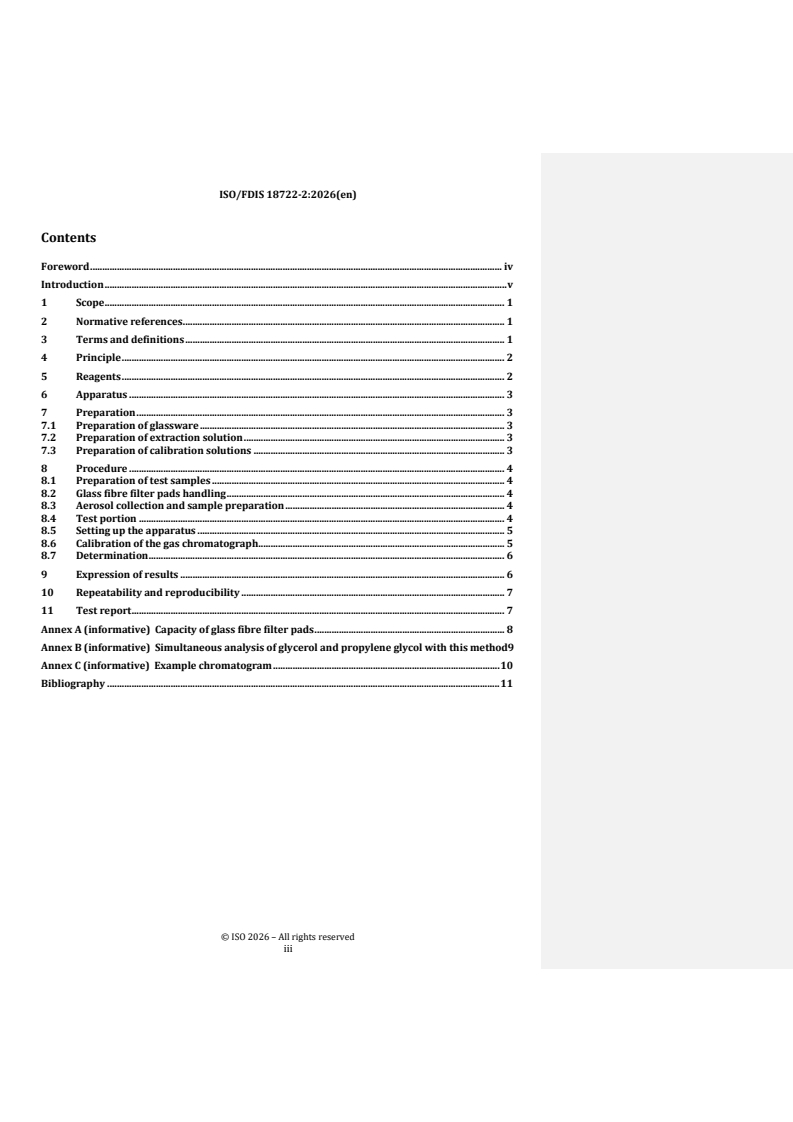
Contents Page
Foreword .iv
Introduction .v
1 Scope . 1
2 Normative references . 1
3 Terms and definitions . 1
4 Principle . 2
5 Reagents . 2
6 Apparatus . 2
7 Preparation . 3
7.1 Preparation of glassware .3
7.2 Preparation of extraction solution .3
7.3 Preparation of calibration solutions .3
8 Procedure . 4
8.1 Preparation of test samples .4
8.2 Glass fibre filter pads handling .4
8.3 Aerosol collection and sample preparation .4
8.4 Test portion .4
8.5 Setting up the apparatus .4
8.6 Calibration of the gas chromatograph .5
8.7 Determination .5
8.7.1 Determination of ACM .5
8.7.2 Determination of THSML .6
8.7.3 Determination of nicotine in the test portion .6
9 Expression of results . 6
10 Repeatability and reproducibility . 6
11 Test report . 7
Annex A (informative) Capacity of glass fibre filter pads . 8
Annex B (informative) Simultaneous analysis of glycerol and propylene glycol with this method . 9
Annex C (informative) Example chromatogram . 10
Bibliography .11
iii
ISO/FDIS 18722-2:2026(en)
Foreword
ISO (the International Organization for Standardization) is a worldwide federation of national standards
bodies (ISO member bodies). The work of preparing International Standards is normally carried out through
ISO technical committees. Each member body interested in a subject for which a technical committee
has been established has the right to be represented on that committee. International organizations,
governmental and non-governmental, in liaison with ISO, also take part in the work. ISO collaborates closely
with the International Electrotechnical Commission (IEC) on all matters of electrotechnical standardization.
The procedures used to develop this document and those intended for its further maintenance are described
in the ISO/IEC Directives, Part 1. In particular the different approval criteria needed for the different types
of ISO documents should be noted. This document was drafted in accordance with the editorial rules of the
ISO/IEC Directives, Part 2 (see www.iso.org/directives).
ISO draws attention to the possibility that the implementation of this document may involve the use of (a)
patent(s). ISO takes no position concerning the evidence, validity or applicability of any claimed patent
rights in respect thereof. As of the date of publication of this document, ISO had not received notice of (a)
patant(s) which may be required to implement this document. However, implementers are cautioned that
this may not represent the latest information, which may be obtained from the patent databease available at
www.iso.org/patents. ISO shall not be held responsible for identifying any or all such patent rights.
Any trade name used in this document is information given for the convenience of users and does not
constitute an endorsement.
For an explanation of the voluntary nature of standards, the meaning of ISO specific terms and expressions
related to conformity assessment, as well as information about ISO's adherence to the World Trade
Organization (WTO) principles in the Technical Barriers to Trade (TBT), see www.iso.org/iso/foreword.html.
This document was prepared by Technical Committee ISO/TC 126, Tobacco and tobacco products.
A list of all parts in the ISO 18722 series can be found on the ISO website.
Any feedback or questions on this document should be directed to the user’s national standards body. A
complete listing of these bodies can be found at www.iso.org/members.html.
iv
ISO/FDIS 18722-2:2026(en)
Introduction
Tobacco heating system (THS) is a specific combination of a tobacco heating device (THD) and a heated
tobacco product (HTP) used together and designed to produce a nicotine-containing aerosol without
combustion of the tobacco substrate. HTP is a product containing a tobacco substrate that is designed to be
heated and not combusted by a separate source to produce a nicotine-containing aerosol.
With the emerging development and commercialisation of HTPs, there are a number of different approaches
to heating the HTP, categorised as electrically, aerosol and carbon, HTPs (eHTP, aHTP and cHTP), respectively
[1]
as described in ISO 6080 . Carbon heated tobacco products (cHTPs) has not been commercially available
as of 2022.
In some countries, the regulation of heated tobacco products requires nicotine yields in aerosol. Therefore,
there is a necessity to have an international standard in place to get reliable/comparable data on nicotine in
the aerosol from tobacco heating systems, with a specific heated tobacco product. Technical investigation of
heated tobacco products requires determining aerosol collected mass (ACM) in combination with a specific
tobacco heating device.
This document was developed for the determination of ACM with a gravimetric method, and nicotine
yields in trapped aHTP aerosol utilizing gas chromatography coupled with a flame ionization detector. This
[2]
document is based on the CORESTA recommended method (CRM) 107 , which was written on the basis of
[3]
the results obtained in an interlaboratory study conducted in 2021 involving 17 laboratories .
No machine puffing regime can represent all human puffing behaviour.
— It is recommended that aHTP also be tested under conditions of a different intensity of machine puffing
than those specified in this document.
— Machine puffing testing is useful to characterize aHTP emissions for design and regulatory purposes, but
communication of machine measurements to users can result in misunderstandings about differences in
exposure and risk across brands.
— Aerosol emission data from machine measurements may be used as inputs for product hazard
assessment, but they are not intended to be nor are they valid as measures of human exposure or risks.
Communicating differences between products in machine measurements as differences in exposure or
risk is a misuse of testing using ISO standards.
IMPORTANT — Regulation and standardisation are independent from each other, and standardisation does
not pre-empt regulation.
v
FINAL DRAFT International Standard ISO/FDIS 18722-2:2026(en)
Tobacco heating systems — Determination of aerosol
collected mass and nicotine in the aerosol with a puffing
regime according to the ISO 5501 series —
Part 2:
Aerosol heated tobacco products (aHTPs)
1 Scope
[4]
This document specifies an analytical method with a puffing regime according to ISO 5501-2 to
determine aerosol collected mass (ACM) and nicotine in the aerosol from aerosol heated tobacco products in
combination with a specific tobacco heating device (THD).
2 Normative references
The following documents are referred to in the text in such a way that some or all of their content constitutes
requirements of this document. For dated references, only the edition cited applies. For undated references,
the latest edition of the referenced document (including any amendments) applies.
ISO 3402, Tobacco and tobacco products — Atmosphere for conditioning and testing
ISO 5501-2, Tobacco heating systems — Definitions and standard conditions for aerosol generation and
collection — Part 2: Aerosol heated tobacco products (aHTPs)
ISO 6080, Tobacco heating systems — Vocabulary
3 Terms and definitions
For the purposes of this document, the terms and definitions given in ISO 6080 and the following apply.
ISO and IEC maintain terminology databases for use in standardization at the following addresses:
— ISO Online browsing platform: available at http:// www .iso .org/ obp
— IEC Electropedia: available at http:// www .electropedia .org/
3.1
aerosol collected mass
ACM
mass of aerosol collected on an aerosol trapping system from the operation of a tobacco heating system
(THS) by a routine analytical puffing machine
[5]
Note 1 to entry: See ISO 4387 for total particulate matter (TPM).
[6]
[SOURCE: ISO 5501-3:2024 , 3.15]
3.2
tobacco heating system mass loss
THSML
reduction in mass of the tobacco heating system (THS) from its operation by a routine analytical puffing
machine
ISO/FDIS 18722-2:2026(en)
3.3
combined consumable
combination of one or more consumable types used together over the aerosol collection process
Note 1 to entry: aHTP category may include products having a more frequently changed HTP than the e-liquid based
consumable. Current products have a manufacturer-indicated maximum number of puffs for the aHTP, and termination
of the aerosol collection process should be aligned with this indication.
4 Principle
Aerosol shall be generated and collected as described in ISO 5501-2. The ACM and optionally THSML are
determined gravimetrically. The collected matter is then extracted with propane-2-ol solution containing
internal standard (see 7.2). The nicotine content of an aliquot of the solution is determined by gas
chromatography with flame ionization detection (GC-FID) and quantitated by internal standard calibration.
Results are expressed as the weight of nicotine collected per combined consumable, or per puff as warranted.
5 Reagents
Use only reagents of recognized analytical grade.
1)
5.1 Carrier gas, helium (CAS RN® 7440-59-7), nitrogen (CAS RN® 7727-37-9), or hydrogen (CAS RN®
1333-74-0) of high purity.
5.2 Auxiliary gases, air and
...
ISO/DISFDIS 18722-2
ISO/TC 126
Secretariat: DIN
Date: 2026-0607-17
Tobacco heating systems — Determination of aerosol collected mass
and nicotine in the aerosol with a puffing regime according to the ISO
5501-2 — series —
Part 2:
Aerosol heated tobacco products (aHTPs)
DISFDIS stage
VVVVototototiiiinnnngggg b b b beeeeggggiiiinnnnssss on on on on:::: 2222000022226666----00001111----00002222
VVVVooootintintintingggg te te te termrmrmrmiiiinnnnaaaatetetetessss o o o onnnn:::: 2 2 2 2000022226666----00003333----22227777
ISO/FDIS 18722-2:2026(en)
All rights reserved. Unless otherwise specified, or required in the context of its implementation, no part of this publication
may be reproduced or utilized otherwise in any form or by any means, electronic or mechanical, including photocopying,
or posting on the internet or an intranet, without prior written permission. Permission can be requested from either ISO
at the address below or ISO’s member body in the country of the requester.
ISO copyright office
CP 401 • Ch. de Blandonnet 8
CH-1214 Vernier, Geneva
Phone: + 41 22 749 01 11
E-mail: copyright@iso.org
Website: www.iso.org
Published in Switzerland
ii
ISO/FDIS 18722-2:2026(en)
Contents
Foreword . iv
Introduction . v
1 Scope . 1
2 Normative references . 1
3 Terms and definitions . 1
4 Principle . 2
5 Reagents . 2
6 Apparatus . 3
7 Preparation . 3
7.1 Preparation of glassware . 3
7.2 Preparation of extraction solution . 3
7.3 Preparation of calibration solutions . 3
8 Procedure . 4
8.1 Preparation of test samples . 4
8.2 Glass fibre filter pads handling . 4
8.3 Aerosol collection and sample preparation . 4
8.4 Test portion . 4
8.5 Setting up the apparatus . 5
8.6 Calibration of the gas chromatograph . 5
8.7 Determination . 6
9 Expression of results . 6
10 Repeatability and reproducibility . 7
11 Test report . 7
Annex A (informative) Capacity of glass fibre filter pads . 8
Annex B (informative) Simultaneous analysis of glycerol and propylene glycol with this method9
Annex C (informative) Example chromatogram . 10
Bibliography . 11
iii
ISO/FDIS 18722-2:2026(en)
Foreword
ISO (the International Organization for Standardization) is a worldwide federation of national standards
bodies (ISO member bodies). The work of preparing International Standards is normally carried out through
ISO technical committees. Each member body interested in a subject for which a technical committee has been
established has the right to be represented on that committee. International organizations, governmental and
non-governmental, in liaison with ISO, also take part in the work. ISO collaborates closely with the
International Electrotechnical Commission (IEC) on all matters of electrotechnical standardization.
The procedures used to develop this document and those intended for its further maintenance are described
in the ISO/IEC Directives, Part 1. In particular the different approval criteria needed for the different types of
ISO documents should be noted. This document was drafted in accordance with the editorial rules of the
ISO/IEC Directives, Part 2 (see www.iso.org/directives).
ISO draws attention to the possibility that the implementation of this document may involve the use of (a)
patent(s). ISO takes no position concerning the evidence, validity or applicability of any claimed patent rights
in respect thereof. As of the date of publication of this document, ISO had not received notice of (a) patant(s)
which may be required to implement this document. However, implementers are cautioned that this may not
represent the latest information, which may be obtained from the patent databease available at
www.iso.org/patents. ISO shall not be held responsible for identifying any or all such patent rights.
Any trade name used in this document is information given for the convenience of users and does not
constitute an endorsement.
For an explanation of the voluntary nature of standards, the meaning of ISO specific terms and expressions
related to conformity assessment, as well as information about ISO's adherence to the World Trade
Organization (WTO) principles in the Technical Barriers to Trade (TBT), see www.iso.org/iso/foreword.html.
This document was prepared by Technical Committee ISO/TC 126, Tobacco and tobacco products.
A list of all parts in the ISO 18722 series can be found on the ISO website.
Any feedback or questions on this document should be directed to the user’s national standards body. A
complete listing of these bodies can be found at www.iso.org/members.html.
iv
ISO/FDIS 18722-2:2026(en)
Introduction
Tobacco heating system (THS) is a specific combination of a tobacco heating device (THD) and a heated
tobacco product (HTP) used together and designed to produce a nicotine-containing aerosol without
combustion of the tobacco substrate. HTP is a product containing a tobacco substrate that is designed to be
heated and not combusted by a separate source to produce a nicotine-containing aerosol.
With the emerging development and commercialisation of HTPs, there are a number of different approaches
to heating the HTP, categorised as electrically, aerosol and carbon, HTPs (eHTP, aHTP and cHTP), respectively
as described in ISO 6080ISO 6080. Carbon heated tobacco products (cHTPs) has not been commercially
available as of 2022.
In some countries, the regulation of heated tobacco products requires nicotine yields in aerosol. Therefore,
there is a necessity to have an international standard in place to get reliable/comparable data on nicotine in
the aerosol from tobacco heating systems, with a specific heated tobacco product. Technical investigation of
heated tobacco products requires determining aerosol collected mass (ACM) in combination with a specific
tobacco heating device.
This document was developed for the determination of ACM with a gravimetric method, and nicotine yields in
trapped aHTP aerosol utilizing gas chromatography coupled with a flame ionization detector. This document
[2]
is based on the CORESTA recommended method (CRM) 107 , which was written on the basis of the results
[23]
obtained in an interlaboratory study conducted in 2021 involving 17 laboratories .
Field Code Changed
No machine puffing regime can represent all human puffing behaviour.
— It is recommended that aHTP also be tested under conditions of a different intensity of machine puffing
than those specified in this document.
— Machine puffing testing is useful to characterize aHTP emissions for design and regulatory purposes, but
communication of machine measurements to users can result in misunderstandings about differences in
exposure and risk across brands.
— Aerosol emission data from machine measurements may be used as inputs for product hazard assessment,
but they are not intended to be nor are they valid as measures of human exposure or risks. Communicating
differences between products in machine measurements as differences in exposure or risk is a misuse of
testing using ISO standards.
IMPORTANT — Regulation and standardisation are independent from each other, and standardisation does
not pre-empt regulation.
v
ISO/FDIS 18722-2:2026(en)
Tobacco heating systems — Determination of aerosol collected mass
and nicotine in the aerosol with a puffing regime according to the ISO
5501-2 series —
Part 2:
Aerosol heated tobacco products (aHTPs)
1 Scope
This document specifies an analytical method with a puffing regime according to ISO 5501-2ISO 5501-2 to
determine aerosol collected mass (ACM) and nicotine in the aerosol from aerosol heated tobacco products in
combination with a specific tobacco heating device (THD).
2 Normative references
The following documents are referred to in the text in such a way that some or all of their content constitutes
requirements of this document. For dated references, only the edition cited applies. For undated references,
the latest edition of the referenced document (including any amendments) applies.
ISO 3402, Tobacco and tobacco products — Atmosphere for conditioning and testing
ISO 5501-2, Tobacco heating systems — Definitions and standard conditions for aerosol generation and
collection — Part 2: Aerosol heated tobacco products (aHTPs)
ISO 6080, Tobacco heating systems — Vocabulary
3 Terms and definitions
For the purposes of this document, the terms and definitions given in ISO 6080 and the following apply.
ISO and IEC maintain terminologicalterminology databases for use in standardization at the following
addresses:
— ISO Online browsing platform: available at http://www.iso.org/obp
— IEC Electropedia: available at http://www.electropedia.org/
3.1
aerosol collected mass
ACM, noun
mass of aerosol collected on an aerosol trapping system from the operation of a tobacco heating system (THS)
by a routine analytical puffing machine
[5]
Note 1 to entry: See ISO 4387 for total particulate matter (TPM).
[SOURCE: ISO 5501-3:2024, 3.15]
3.2
tobacco heating system mass loss
THSML, noun
reduction in mass of the tobacco heating system (THS) from its operation by a routine analytical puffing
machine
ISO/FDIS 18722-2:2026(en)
3.3
combined consumable
combination of one or more consumable types used together over the aerosol collection process
Note 1 to entry: aHTP category may include products having a more frequently changed HTP than the e-liquid based
consumable. Current products have a manufacturer-indicated maximum number of puffs for the aHTP, and termination
of the aerosol collection process should be aligned with this indication.
4 Principle
Aerosol shall be generated and collected as described in ISO 5501-2. The ACM and optionally THSML are
determined gravimetrically. The collected matter is then extracted with propane-2-ol solution containing
internal standard ((see 7.2). The nicotine content of an aliquot of the solution is determined by gas
chromatography with flame ionization detection (GC-FID) and quantitated by internal standard calibration.
Results are expressed as the weight of nicotine collected per combined consumable, or per puff as warranted.
5 Reagents
Use only reagents of recognized analytical grade.
1)
5.1 Carrier gas, helium (CAS RN® 7440-59-7), nitrogen (CAS RN® 7727-37-9), or hydrogen (CAS RN®
1333-74-0) of high purity.
5.2 Auxiliary gases, air and hydrogen (CAS RN® 1333-74-0) for flame, and nitrogen (CAS RN® 7727-37-
9) as make-up gas, of high purity, for the flame ionization detector.
5.3 Propane-2-ol (CAS RN® 67-63-0), with maximum water content of 1,0 mg/ml, used with internal
standard(s) to prepare the extraction solution.
NOTE Propane-2-ol is hygroscopic and can absorb water over time if not stored in a sealed container/bottle.
5.4 Internal standards, quinaldine (CAS RN® 91-63-4), n-heptadecane (CAS RN® 629-78-7) or n-
octadecane (CAS RN® 593-45-3) of purity not less than 99 %.
Other appropriate internal standards may be used after assessment of their purity and determination that the
internal standard does not co-elute with other components in the sample extract. The peak area of the internal
standard on samples should be monitored for consistency. In cases where inconsistencies are found, analysis
of a prepared sample solution without the internal standard should be performed to confirm the absence of a
peak in the extract eluting at the same time as the internal standard.
5.5 Reference substances, nicotine (CAS RN® 54-11-5) of known purity not less than 98 %, or solution
of nicotine certified reference material. Nicotine salicylate (CAS: RN® 29790-52-1) of known purity not less
than 98 % may also be used. Store the reference substance at a temperature and exclude light in accordance
withaccording to the manufacturer’s recommendation.
NOTE The purity of the nicotine or nicotine salicylate can be verified in accordance with according to ISO 13276 or
by any other validated method.
1)
CAS Registry Number® is a trademark of the American Chemical Society (ACS). This information is given for the
convenience of users of this documen
...