


ISO 7146-1:2019
(Main)Plain bearings — Appearance and characterization of damage to metallic hydrodynamic bearings — Part 1: General
Plain bearings — Appearance and characterization of damage to metallic hydrodynamic bearings — Part 1: General
This document defines, describes and classifies the characteristics of damage occurring in service to hydrodynamically lubricated metallic plain bearings and journals. It assists in the understanding of the various characteristic forms of damage which can occur. Consideration is restricted to damage characteristics which have a well-defined appearance and which can be attributed to particular damage causes with a high degree of certainty. Various appearances are illustrated with photographs and diagrams.
Paliers lisses — Aspect et caractérisation de l'endommagement des paliers métalliques à couche lubrifiante fluide — Partie 1: Généralités
Drsni ležaji - Tekočinski sloj kovinskih ležajev - Izrazi in značilnosti poškodb - 1. del: Splošno
General Information
Relations


Standards Content (Sample)
SLOVENSKI STANDARD
01-oktober-2020
Drsni ležaji - Tekočinski sloj kovinskih ležajev - Izrazi in značilnosti poškodb - 1.
del: Splošno
Plain bearings - Appearance and characterization of damage to metallic hydrodynamic
bearings - Part 1: General
Paliers lisses -- Aspect et caractérisation de l'endommagement des paliers métalliques à
couche lubrifiante fluide
Ta slovenski standard je istoveten z: ISO 7146-1:2019
ICS:
21.100.10 Drsni ležaji Plain bearings
2003-01.Slovenski inštitut za standardizacijo. Razmnoževanje celote ali delov tega standarda ni dovoljeno.
INTERNATIONAL ISO
STANDARD 7146-1
Second edition
2019-05
Plain bearings — Appearance and
characterization of damage to metallic
hydrodynamic bearings —
Part 1:
General
Paliers lisses — Aspect et caractérisation de l'endommagement des
paliers métalliques à couche lubrifiante fluide —
Partie 1: Généralités
Reference number
©
ISO 2019
© ISO 2019
All rights reserved. Unless otherwise specified, or required in the context of its implementation, no part of this publication may
be reproduced or utilized otherwise in any form or by any means, electronic or mechanical, including photocopying, or posting
on the internet or an intranet, without prior written permission. Permission can be requested from either ISO at the address
below or ISO’s member body in the country of the requester.
ISO copyright office
CP 401 • Ch. de Blandonnet 8
CH-1214 Vernier, Geneva
Phone: +41 22 749 01 11
Fax: +41 22 749 09 47
Email: copyright@iso.org
Website: www.iso.org
Published in Switzerland
ii © ISO 2019 – All rights reserved
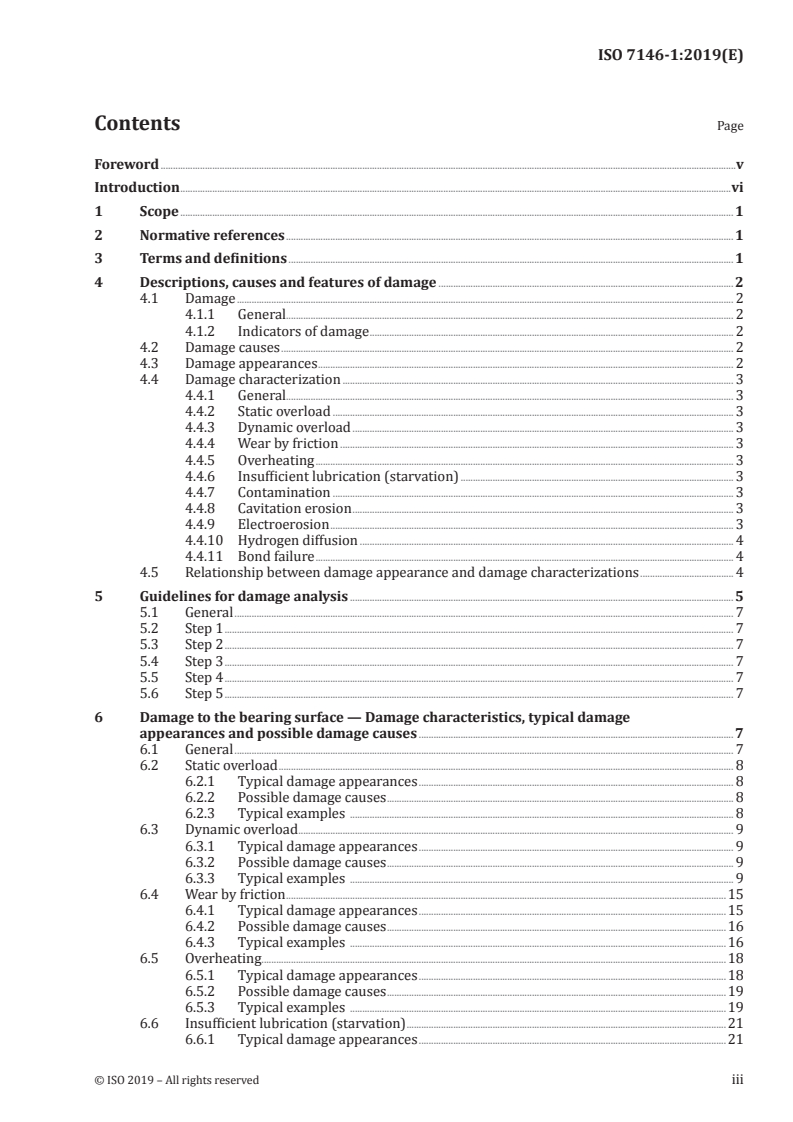
Contents Page
Foreword .v
Introduction .vi
1 Scope . 1
2 Normative references . 1
3 Terms and definitions . 1
4 Descriptions, causes and features of damage . 2
4.1 Damage . 2
4.1.1 General. 2
4.1.2 Indicators of damage . 2
4.2 Damage causes . 2
4.3 Damage appearances . 2
4.4 Damage characterization . 3
4.4.1 General. 3
4.4.2 Static overload . 3
4.4.3 Dynamic overload . 3
4.4.4 Wear by friction . 3
4.4.5 Overheating . 3
4.4.6 Insufficient lubrication (starvation) . 3
4.4.7 Contamination . 3
4.4.8 Cavitation erosion . 3
4.4.9 Electroerosion . 3
4.4.10 Hydrogen diffusion . 4
4.4.11 Bond failure . 4
4.5 Relationship between damage appearance and damage characterizations . 4
5 Guidelines for damage analysis . 5
5.1 General . 7
5.2 Step 1 . 7
5.3 Step 2 . 7
5.4 Step 3 . 7
5.5 Step 4 . 7
5.6 Step 5 . 7
6 Damage to the bearing surface — Damage characteristics, typical damage
appearances and possible damage causes . 7
6.1 General . 7
6.2 Static overload . 8
6.2.1 Typical damage appearances . 8
6.2.2 Possible damage causes . 8
6.2.3 Typical examples . 8
6.3 Dynamic overload . 9
6.3.1 Typical damage appearances . 9
6.3.2 Possible damage causes . 9
6.3.3 Typical examples . 9
6.4 Wear by friction .15
6.4.1 Typical damage appearances .15
6.4.2 Possible damage causes .16
6.4.3 Typical examples .16
6.5 Overheating.18
6.5.1 Typical damage appearances .18
6.5.2 Possible damage causes .19
6.5.3 Typical examples .19
6.6 Insufficient lubrication (starvation) .21
6.6.1 Typical damage appearances .21
6.6.2 Possible damage causes .21
6.6.3 Typical examples .21
6.7 Contamination .25
6.7.1 Contamination with particles .25
6.7.2 Contamination with chemicals .32
6.8 Cavitation erosion .37
6.8.1 General.37
6.8.2 Typical damage appearances .37
6.8.3 Possible damage causes .37
6.8.4 Typical examples .37
6.9 Electro-erosion .39
6.9.1 Typical damage appearance .39
6.9.2 Possible damage causes .39
6.9.3 Typical examples .39
6.10 Hydrogen diffusion .40
6.10.1 Typical damage appearances .40
6.10.2 Possible damage cause .41
6.10.3 Typical examples .41
6.11 Bond failure .42
6.11.1 Typical damage appearances .42
6.11.2 Possible damage causes .42
6.11.3 Typical example .42
7 Damage to the bearing back .43
7.1 General .43
7.2 Dynamic overload on the bearing back .43
7.2.1 Typical damage appearance .43
7.2.2 Possible damage causes .43
7.2.3 Typical examples .43
7.3 Wear by friction on the bearing back .45
7.3.1 Typical damage appearances .45
7.3.2 Possible damage causes .45
7.3.3 Typical examples .45
7.4 Contamination with particles on the bearing back .46
7.4.1 Typical damage appearances .46
7.4.2 Possible damage cause .46
7.4.3 Typical examples .47
8 Special position of damage appearances .48
Annex A (informative) Example of use of Table 1.51
Bibliography .53
iv © ISO 2019 – All rights reserved
Foreword
ISO (the International Organization for Standardization) is a worldwide federation of national standards
bodies (ISO member bodies). The work of preparing International Standards is normally carried out
through ISO technical committees. Each member body interested in a subject for which a technical
committee has been established has the right to be represented on that committee. International
organizations, governmental and non-governmental, in liaison with ISO, also take part in the work.
ISO collaborates closely with the International Electrotechnical Commission (IEC) on all matters of
electrotechnical standardization.
The procedures used to develop this document and those intended for its further maintenance are
described in the ISO/IEC Directives, Part 1. In particular, the different approval criteria needed for the
different types of ISO documents should be noted. This document was drafted in accordance with the
editorial rules of the ISO/IEC Directives, Part 2 (see www .iso .org/directives).
Attention is drawn to the possibility that some of the elements of this document may be the subject of
patent rights. ISO shall not be held responsible for identifying any or all such patent rights. Details of
any patent rights identified during the development of the document will be in the Introduction and/or
on the ISO list of patent declarations received (see www .iso .org/patents).
Any trade name used in this document is information given for the convenience of users and does not
constitute an endorsement.
For an explanation of the voluntary nature of standards, the meaning of ISO specific terms and
expressions related to conformity assessment, as well as information about ISO's adherence to the
World Trade Organization (WTO) principles in the Technical Barriers to Trade (TBT) see www .iso
.org/iso/foreword .html.
This document was prepared by Technical Committee ISO/TC 123 Plain bearings, Subcommittee SC 2,
Materials and lubricants, their properties, characteristics, test methods and testing conditions.
This second edition cancels and replaces the first edition (ISO 7146-1:2008), of which it constitutes a
minor revision. The changes compared to the previous edition are as follows:
— Adjustment to the ISO Directives, including the replacement of "may" with "can" throughout.
A list of all parts in the ISO 7146 series can be found on the ISO website.
Any feedback or questions on this document should be directed to the user’s national standards body. A
complete listing of these bodies can be found at www .iso .org/members .html.
Introduction
In practice, damage to a bearing can often be the result of several mechanisms operating simultaneously.
The complex combination of design, manufacture, assembly, operation, maintenance and possible
reconditioning often causes difficulty in establishing the primary cause of damage.
In the event of extensive damage or destruction of the bearing, the evidence is likely to be lost, in which
case it is impossible to identify how the damage came about.
In all cases, knowledge of the actual operating conditions of the assembly and the maintenance history
is of the utmost importance.
The classification of bearing damage established in this document is based primarily upon the features
visible on the running surfaces and elsewhere, and consideration of each aspect is needed for reliable
determination of the cause of bearing damage.
Since more than one process can cause similar effects on the running surface, a description of
appearance alone is occasionally inadequate in determining the cause of damage. Thus Clause 4 is
subdivided into several subclauses including damage appearance and damage characteristics.
For the procedure of damage analysis, Clause 5 can be a helpful guide.
In Clauses 6 and 7, examples of all damage characteristics with typically associated damage appearance
are given.
vi © ISO 2019 – All rights reserved
INTERNATIONAL STANDARD ISO 7146-1:2019(E)
Plain bearings — Appearance and characterization of
damage to metallic hydrodynamic bearings —
Part 1:
General
1 Scope
This document defines, describes and classifies the characteristics of damage occurring in service to
hydrodynamically lubricated metallic plain bearings and journals. It assists in the understanding of the
various characteristic forms of damage which can occur.
Consideration is restricted to damage characteristics which have a well-defined appearance and which
can be attributed to particular damage causes with a high degree of certainty. Various appearances are
illustrated with photographs and diagrams.
2 Normative references
The following documents are referred to in the text in such a way that some or all of their content
constitutes requirements of this document. For dated references, only the edition cited applies. For
undated references, the latest edition of the referenced document (including any amendments) applies.
ISO 4378-1, Plain bearings — Terms, definitions, classification and symbols — Part 1: Design, bearing
materials and their properties
ISO 4378-2, Plain bearings — Terms, definitions, classification and symbols — Part 2: Friction and wear
ISO 4378-3, Plain bearings — Terms, definitions, classification and symbols — Part 3: Lubrication
ISO 4378-4, Plain bearings — Terms, definitions, classification and symbols — Part 4: Basic symbols
3 Terms and definitions
For the purposes of this document, the terms and definitions given in ISO 4378-1, ISO 4378-2, ISO 4378-3,
ISO 4378-4 and the following apply.
ISO and IEC maintain terminological databases for use in standardization at the following addresses:
— ISO Online browsing platform: available at https: //www .iso .org/obp
— IEC Electropedia: available at http: //www .electropedia .org/
3.1
damage to plain bearings
bearing damage
change in appearance occurring on the bearing surface and/or on the bearing back during operation
that adversely affect the performance of the bearing
4 Descriptions, causes and features of damage
4.1 Damage
4.1.1 General
Damage to plain bearings is a phenomenon that adversely changes their tribological function and is
usually accompanied with a change in appearance. The damage is initiated by the damage cause and
develops to the end of service life.
As long as no abnormal conditions occur, service life of the plain bearing relates to the service life of the
machine.
4.1.2 Indicators of damage
Typical indicators observed during machine operation are: continuously increasing service temperature,
decline of lubricant pressure, noise, vibration and bad smell.
4.2 Damage causes
The cause is the practical event that initiates and leads to damage. The majority of damage causes are
found outside the bearing.
4.3 Damage appearances
Damage appearance is a defined visible picture of the bearing surface and/or of the bearing back.
Damage appearances are clearly different from each other.
A plain bearing failure can show various damage appearances. Usually, damage appearances are
directly associated with damage characteristics, but not directly with the damage cause (for exceptions,
see 6.8 and 6.9).
Damage appearances include:
a) depositions;
b) creep deformation;
c) deformation due to temperature cycles;
d) thermal cracks;
e) fatigue cracks;
f) material relief (loss of bond);
g) frictional corrosion;
h) melting out, seizure;
i) polishing, scoring;
j) traces of mixed lubrication, worn material;
k) discolouration (blue, black colour);
l) corrosion, fluid erosion;
m) embedded particles, particle-migration tracks, formation of wire wool;
n) electric arc craters;
2 © ISO 2019 – All rights reserved
o) cavitation erosion appearance: worn-out material.
4.4 Damage characterization
4.4.1 General
A damage characterization is a description of what has happened based on a detected typical
combination of damage appearances. Defined characteristics provide the basis for establishing the
cause of damage.
Damage characterizations are clearly different from each other, as specified in 4.4.2 to 4.4.11.
4.4.2 Static overload
Material is loaded above compressive yield strength corresponding to actual operation temperature.
4.4.3 Dynamic overload
Material is loaded above fatigue strength corresponding to actual operation temperature. Intensive
dynamic load also favours damage by weakening the fit.
4.4.4 Wear by friction
Wear by friction is confined to changes in microgeometry and to the loss of material as a result of
interaction between journal and bearing. Movement between backing and housing also favours wear
by friction.
4.4.5 Overheating
The heat balance in the lubricant, the bearing, the environment and the cooling system as required
at design stage is not realized resulting in a higher temperature than anticipated. The viscosity and,
therefore, the load capacity decrease with increasing temperature. This results again in temperature
increase. The bearing, therefore, cannot operate stably if cooling cannot stop further temperature
increase.
4.4.6 Insufficient lubrication (starvation)
This affects the tribological system.
4.4.7 Contamination
Contamination of lubricant with foreign particles or reaction products can result in damage to a
bearing. Foreign particles embedded between bearing backing and housing also favour damage.
4.4.8 Cavitation erosion
Decreased pressure in liquids leads to evaporation of liquids and formation of vapour bubbles, which,
when liquid pressure increases, implode, generating locally very high pressure, and cause erosion on
sliding surfaces.
4.4.9 Electroerosion
A potential difference between journal and bearing can lead to an electric arc with locally high current
flow which damages journal and bearing surface.
4.4.10 Hydrogen diffusion
Hydrogen can be incorporated in the steel backing or in an electroplated layer of the bearing. If
hydrogen diffusion is blocked by a layer, blisters occur.
4.4.11 Bond failure
Bond failure is delamination between lining and backing or between layers. A metallographic
examination is required to distinguish it from other damage characterizations.
4.5 Relationship between damage appearance and damage characterizations
Damage characterization and damage appearance alter with the progress of damage from a primary to
a secondary characteristic (see Figure 1).
Different damage characterizations can correspond to the same damage appearance.
One damage characterization can correspond to various damage appearances.
Multiple damage characteristics can be found in one failure event.
The damage characteristics provide the basis for analysing the cause (see Figure 2).
Typical relationships are shown in Table 1 for damage to sliding surface and to bearing back. In most
cases, Table 1 is the guideline for diagnosis of the final damage cause from the damage appearances via
the damage characteristics.
Figure 1 — Damage appearances altering with the progress from primary to secondary
characteristics
Key
a
Damage cause.
b
Damage characteristics.
c
Damage appearances.
Figure 2 — Damage characteristics provide the basis for analysing the cause
4 © ISO 2019 – All rights reserved
5 Guidelines for damage analysis
6 © ISO 2019 – All rights reserved
Table 1 — Interaction of damage appearances and damage characterizations
Damage
Damage appearance Subclause
characterizations
Embed-
ded par-
ticles,
Ma- Trace of Cavitation
Deforma- Melt- parti- Elec-
terial Fric- mixed Blue, erosion
Creep tions due Ther- Fa- ing Pol- Fluid cle-mi- tric
Deposi- relief tional lubri- black Corro- appear-
deforma- to tem- mal tigue out, ishing, ero- gration arc
tions (loss corro- cation, col- sion ance:
tion perature cracks cracks sei- scoring sion tracks, cra-
of sion worn our material
cycles zure forma- ters
bond) material worn out
tion of
wire
wool
× × × × Static overload 6.2
a
× × Dynamic overload 6.3
b
× × Dynamic overload 7.2
a
× × Wear by friction 6.4
b
× Wear by friction 7.3
× × × × × Overheating 6.5
Insufficient lubrication
× × × 6.6
(starvation)
Contamination (particles,
× × × × × × 6.7
a
chemicals)
Contamination (particles,
× × × × × 7.4
b
chemicals)
6.8 and
× Cavitation erosion
ISO 7146-2
× Electro-erosion 6.9
× Hydrogen diffusion 6.10
× Bond failure 6.11
a
Damage to the sliding surface.
b
Damage to the bearing back.
5.1 General
Analysis should be undertaken only by experts experienced in bearing metallurgy, bearing technology
and bearing damage. Damage analyses based on photos alone are mostly unsuccessful.
The following steps are a guideline for damage analysis.
5.2 Step 1
Establish service life. There is significant difference between damage after a short service life and
damage after a long service life. With both cases, similar damage appearances occur, but the cause is
usually different.
Typical causes of damage after short service life: faults in geometry or assembling, dirt, effect from a
previous damage, modified service conditions since last start up.
Typical cause of damage after long service life: modified service conditions.
Typical cause of damage after very long service life: reduced dynamic material capability due to fatigue.
5.3 Step 2
Strict differentiation between damage characterization and damage appearance is important. For
a thorough analysis, all visible damage appearances shall be evaluated and combined in one or more
damage characterizations, based on Table 1.
5.4 Step 3
Take into consideration the total system: bearing — shaft — lubricant — housing.
It is helpful to make a chemical analysis of a sample from the bearing layer and to check its
microstructure. If necessary, lubricant and filter content should be analysed.
5.5 Step 4
All information in connection with the period before the detected damage and the period during the
damage should be brought together.
5.6 Step 5
Reviewing the initial list of damage characteristics together with the information from steps 3 and 4
usually leads to a reduction of the number of damage characteristics under consideration. This leads to
the possible damage cause.
See Annex A for an example of use of Table 1.
6 Damage to the bearing surface — Damage characteristics, typical damage
appearances and possible damage causes
6.1 General
A discussion of damage to the bearing surface follows. For each damage characterization given in 4.4,
typical damage appearances, possible damage causes and typical examples are given.
6.2 Static overload
6.2.1 Typical damage appearances
— Creep deformation: shallow depressions of bearing material in the region of maximum load and
temperature, beginning smooth and ending in crack-free semicircular bulges in the direction of
rotation, sometimes like crests of waves (see Figure 3).
— Traces of mixed lubrication (see Figure 4), depositions, thermal cracks.
6.2.2 Possible damage causes
Loading of the bearing was higher than that allowed for in the design and/or the bearing temperature
was higher than estimated for an extended period.
6.2.3 Typical examples
See Figures 3 and 4.
Figure 3 — Creep deformation, shown by crack-free semicircular bulges in the direction of
rotation (material: steel/tin-based white metal)
8 © ISO 2019 – All rights reserved
Figure 4 — Propeller shaft bearing, showing the effects of too slow a speed in relation to load
capacity (material: steel/tin-based white metal)
6.3 Dynamic overload
6.3.1 Typical damage appearances
Fatigue cracks are cracks which extend from the sliding surface in the loaded zone propagating as a
network. The cracks change direction above the bonding area.
Lining material from the backing is the final result of the development of fatigue cracks (see Figure 5).
See also possible damage appearances such as frictional corrosion on the bearing back (Clause 7).
6.3.2 Possible damage causes
The cracks start when the fatigue limit of the bearing material is exceeded due to high dynamic load at
the operating temperature. The damage is not based on bond faults.
6.3.3 Typical examples
See Figures 5 to 12.
Key
1 lining material 5 eroded cracks
2 bonding area 6 cracks with perpendicular propagation
3 backing material 7 material relief
4 cracks
Figure 5 — Schematic diagram of progress of fatigue cracks
a) Under inertial load b) Under gas load
Figure 6 — Typical fatigue cracks of internal combustion engine bearing
(material: steel/aluminium alloy)
Direction of shaft rotation →
a)
10 © ISO 2019 – All rights reserved
Direction of shaft rotation →
b) Section from Figure 7 a) showing the lower half at increased magnification
Figure 7 — Cracks in the electroplated overlay (material: steel/lead bronze/electroplated
overlay)
Figure 8 — Cracks in the overlay of a multilayer bearing in a narrow area of high loading
(material: steel/lead bronze/electroplated overlay)
NOTE The crack runs at a small distance from the bonding area.
Figure 9 — Section of spalled layer (material: steel/tin-based white metal)
12 © ISO 2019 – All rights reserved
a)
b)
Figure 10 — Fatigue cracks and material relief by dynamic overload
(material: steel/tin-based white metal)
Figure 11 — Material relief by dynamic overload because of insufficient fit on the bearing back
(see also 7.2)
14 © ISO 2019 – All rights reserved
a)
b) Section from Figure 12 a): clear illustration of the defect at increased magnification
Figure 12 — Detachment of the overlay leaving occasional residual islands relieved by a dark
background (material: steel/lead bronze/electroplated overlay)
6.4 Wear by friction
6.4.1 Typical damage appearances
Polishing happens during a short period of mixed lubrication on start and stop conditions. As long as
this polishing does not give rise to a detectable reduction in wall thickness, such running-in marks are
normal. This is not damage in the sense of the definitions of this document (see Figure 13).
Scoring occurs under continuous or recurrent mixed-film lubrication conditions for longer periods.
Scoring marks appear in the most highly loaded region of the bearing, across the whole width of
the bearing. The transition from unmarked to marked areas is quite gradual. The reduction in wall
thickness is significant.
Segmented plain bearings experiencing appreciable wear at high rubbing surface temperatures often
initially show traces of mixed lubrication; later, worn material from one segment is deposited on the
leading edge of the next segment in the direction of rotation (see Figure 16).
For information on possible damage appearance on the bearing back, see 7.3.
6.4.2 Possible damage causes
Extreme operating conditions such as slow turning or starting under load, short and hard contact with
the counterface, inadequate clearance or other geometrical defects (misalignment or faulty mounting)
lead to wear by friction.
6.4.3 Typical examples
See Figures 13 to 17.
Figure 13 — Running-in polishing and burnishing in the main loaded area of a thin-walled
bearing (material: steel/AlSn)
Figure 14 — Abrasive wear of the overlay in the main loaded area on a thin-walled bearing
(material: steel/lead bronze/electroplated overlay)
16 © ISO 2019 – All rights reserved
Figure 15 — Abrasive wear near the ends of the bearing (joint face area) in a thick-walled
journal bearing, due to faulty mounting (material: steel/tin-based white metal)
Direction of shaft rotation →
NOTE The segment shown gets a reduction in oil supply (secondary damage characteristic: loss of lubricant).
Figure 16 — Wear by friction due to segment assembling on different levels — Worn material
from one segment deposited on the leading edge of the next segment in the direction of rotation
(material: steel/tin-based white metal)
Figure 17 — Wear by misalignment between bearing backing and shaft
(material: steel/tin-based white metal)
6.5 Overheating
6.5.1 Typical damage appearances
Deposition: overheating leads to ageing of the lubricant, its thermal decomposition, and finally to
depositions. The phenomenon is concentrated in the minimum oil film region, or in other places in the oil
circulatory system, occurring more severely when oil additives have become depleted (see Figure 19).
Brown or black deposits appear on the bearing surface, but not as a result of chemical attack between
the bearing material and the lubricant. The discoloration is due to very thin lacquer-like oxidized layers
in areas of maximum temperature. It is relatively soft and can generally be removed using a solvent
cleaning fluid or scratched off using a pointed instrument (see Figure 20).
Creep deformation: shallow depressions of bearing material in the region of maximum load and
temperature, initially smooth and ending in crack-free semicircular bulges in the direction of rotation,
sometimes like crests of wave (see Figure 18).
Deformations due to temperature changes: as tin crystals have anisotropic thermal expansion along
the different crystal axes, an extended period of excessive start-up cycles can cause thermal ratcheting
between crystals (in extreme cases, this can lead to intercrystalline cracking).
Thermal cracks have an irregular unsystematic orientation characteristic. These typical appearances
can be characterized as creep deformation, traces of mixed lubrication and worn material (see
Figure 21).
18 © ISO 2019 – All rights reserved
6.5.2 Possible damage causes
— Failure of heat flow, resulting in overheating.
— Defects in oil cooling, increased surrounding temperature, hot oil carry-over.
— Reduced melting point due to alloy impurities favours thermal cracks.
6.5.3 Typical examples
See Figures 18 to 21.
Direction of shaft rotation →
Figure 18 — Creep deformation due to overheating with formation of black depositions
(material: steel/tin-based white metal)
Direction of shaft rotation →
Figure 19 — Thrust bearing tilting pad with deposits of oil carbon
(material: steel/tin-based white metal)
NOTE The black/brown deposit is easily removed using the thumbnail (see lowest segment).
Figure 20 — Deposit of oil carbon on a thrust bearing ring (material: steel/tin-based white metal)
20 © ISO 2019 – All rights reserved
Direction of shaft rotation →
Figure 21 — Radial segments with thermal cracks and worn material
(material: steel/tin-based white metal)
6.6 Insufficient lubrication (starvation)
6.6.1 Typical damage appearances
— Blue, black colour on the bearing, shaft, housing.
— Traces of mixed lubrication, worn material.
— Melting out, seizure (adhesive wear).
6.6.2 Possible damage causes
— Insufficient lubricant supply.
— Reduction of lubricant supply due to geometric deviations (e.g. missing wedge gap or missing
bearing clearance).
— Most damages in a late secondary stage end with loss of lubrication.
6.6.3 Typical examples
See Figures 22 to 27.
Figure 22 — Seizure on a multilayer plain bearing with totally detached intermediate layer,
accompanied by melting, metal wear and severe scoring
(material: steel/lead bronze/electroplated overlay)
← Direction of shaft rotation
Figure 23 — Destruction of bearing metal due to loss
...
INTERNATIONAL ISO
STANDARD 7146-1
Second edition
2019-05
Plain bearings — Appearance and
characterization of damage to metallic
hydrodynamic bearings —
Part 1:
General
Paliers lisses — Aspect et caractérisation de l'endommagement des
paliers métalliques à couche lubrifiante fluide —
Partie 1: Généralités
Reference number
©
ISO 2019
© ISO 2019
All rights reserved. Unless otherwise specified, or required in the context of its implementation, no part of this publication may
be reproduced or utilized otherwise in any form or by any means, electronic or mechanical, including photocopying, or posting
on the internet or an intranet, without prior written permission. Permission can be requested from either ISO at the address
below or ISO’s member body in the country of the requester.
ISO copyright office
CP 401 • Ch. de Blandonnet 8
CH-1214 Vernier, Geneva
Phone: +41 22 749 01 11
Fax: +41 22 749 09 47
Email: copyright@iso.org
Website: www.iso.org
Published in Switzerland
ii © ISO 2019 – All rights reserved
Contents Page
Foreword .v
Introduction .vi
1 Scope . 1
2 Normative references . 1
3 Terms and definitions . 1
4 Descriptions, causes and features of damage . 2
4.1 Damage . 2
4.1.1 General. 2
4.1.2 Indicators of damage . 2
4.2 Damage causes . 2
4.3 Damage appearances . 2
4.4 Damage characterization . 3
4.4.1 General. 3
4.4.2 Static overload . 3
4.4.3 Dynamic overload . 3
4.4.4 Wear by friction . 3
4.4.5 Overheating . 3
4.4.6 Insufficient lubrication (starvation) . 3
4.4.7 Contamination . 3
4.4.8 Cavitation erosion . 3
4.4.9 Electroerosion . 3
4.4.10 Hydrogen diffusion . 4
4.4.11 Bond failure . 4
4.5 Relationship between damage appearance and damage characterizations . 4
5 Guidelines for damage analysis . 5
5.1 General . 7
5.2 Step 1 . 7
5.3 Step 2 . 7
5.4 Step 3 . 7
5.5 Step 4 . 7
5.6 Step 5 . 7
6 Damage to the bearing surface — Damage characteristics, typical damage
appearances and possible damage causes . 7
6.1 General . 7
6.2 Static overload . 8
6.2.1 Typical damage appearances . 8
6.2.2 Possible damage causes . 8
6.2.3 Typical examples . 8
6.3 Dynamic overload . 9
6.3.1 Typical damage appearances . 9
6.3.2 Possible damage causes . 9
6.3.3 Typical examples . 9
6.4 Wear by friction .15
6.4.1 Typical damage appearances .15
6.4.2 Possible damage causes .16
6.4.3 Typical examples .16
6.5 Overheating.18
6.5.1 Typical damage appearances .18
6.5.2 Possible damage causes .19
6.5.3 Typical examples .19
6.6 Insufficient lubrication (starvation) .21
6.6.1 Typical damage appearances .21
6.6.2 Possible damage causes .21
6.6.3 Typical examples .21
6.7 Contamination .25
6.7.1 Contamination with particles .25
6.7.2 Contamination with chemicals .32
6.8 Cavitation erosion .37
6.8.1 General.37
6.8.2 Typical damage appearances .37
6.8.3 Possible damage causes .37
6.8.4 Typical examples .37
6.9 Electro-erosion .39
6.9.1 Typical damage appearance .39
6.9.2 Possible damage causes .39
6.9.3 Typical examples .39
6.10 Hydrogen diffusion .40
6.10.1 Typical damage appearances .40
6.10.2 Possible damage cause .41
6.10.3 Typical examples .41
6.11 Bond failure .42
6.11.1 Typical damage appearances .42
6.11.2 Possible damage causes .42
6.11.3 Typical example .42
7 Damage to the bearing back .43
7.1 General .43
7.2 Dynamic overload on the bearing back .43
7.2.1 Typical damage appearance .43
7.2.2 Possible damage causes .43
7.2.3 Typical examples .43
7.3 Wear by friction on the bearing back .45
7.3.1 Typical damage appearances .45
7.3.2 Possible damage causes .45
7.3.3 Typical examples .45
7.4 Contamination with particles on the bearing back .46
7.4.1 Typical damage appearances .46
7.4.2 Possible damage cause .46
7.4.3 Typical examples .47
8 Special position of damage appearances .48
Annex A (informative) Example of use of Table 1.51
Bibliography .53
iv © ISO 2019 – All rights reserved
Foreword
ISO (the International Organization for Standardization) is a worldwide federation of national standards
bodies (ISO member bodies). The work of preparing International Standards is normally carried out
through ISO technical committees. Each member body interested in a subject for which a technical
committee has been established has the right to be represented on that committee. International
organizations, governmental and non-governmental, in liaison with ISO, also take part in the work.
ISO collaborates closely with the International Electrotechnical Commission (IEC) on all matters of
electrotechnical standardization.
The procedures used to develop this document and those intended for its further maintenance are
described in the ISO/IEC Directives, Part 1. In particular, the different approval criteria needed for the
different types of ISO documents should be noted. This document was drafted in accordance with the
editorial rules of the ISO/IEC Directives, Part 2 (see www .iso .org/directives).
Attention is drawn to the possibility that some of the elements of this document may be the subject of
patent rights. ISO shall not be held responsible for identifying any or all such patent rights. Details of
any patent rights identified during the development of the document will be in the Introduction and/or
on the ISO list of patent declarations received (see www .iso .org/patents).
Any trade name used in this document is information given for the convenience of users and does not
constitute an endorsement.
For an explanation of the voluntary nature of standards, the meaning of ISO specific terms and
expressions related to conformity assessment, as well as information about ISO's adherence to the
World Trade Organization (WTO) principles in the Technical Barriers to Trade (TBT) see www .iso
.org/iso/foreword .html.
This document was prepared by Technical Committee ISO/TC 123 Plain bearings, Subcommittee SC 2,
Materials and lubricants, their properties, characteristics, test methods and testing conditions.
This second edition cancels and replaces the first edition (ISO 7146-1:2008), of which it constitutes a
minor revision. The changes compared to the previous edition are as follows:
— Adjustment to the ISO Directives, including the replacement of "may" with "can" throughout.
A list of all parts in the ISO 7146 series can be found on the ISO website.
Any feedback or questions on this document should be directed to the user’s national standards body. A
complete listing of these bodies can be found at www .iso .org/members .html.
Introduction
In practice, damage to a bearing can often be the result of several mechanisms operating simultaneously.
The complex combination of design, manufacture, assembly, operation, maintenance and possible
reconditioning often causes difficulty in establishing the primary cause of damage.
In the event of extensive damage or destruction of the bearing, the evidence is likely to be lost, in which
case it is impossible to identify how the damage came about.
In all cases, knowledge of the actual operating conditions of the assembly and the maintenance history
is of the utmost importance.
The classification of bearing damage established in this document is based primarily upon the features
visible on the running surfaces and elsewhere, and consideration of each aspect is needed for reliable
determination of the cause of bearing damage.
Since more than one process can cause similar effects on the running surface, a description of
appearance alone is occasionally inadequate in determining the cause of damage. Thus Clause 4 is
subdivided into several subclauses including damage appearance and damage characteristics.
For the procedure of damage analysis, Clause 5 can be a helpful guide.
In Clauses 6 and 7, examples of all damage characteristics with typically associated damage appearance
are given.
vi © ISO 2019 – All rights reserved
INTERNATIONAL STANDARD ISO 7146-1:2019(E)
Plain bearings — Appearance and characterization of
damage to metallic hydrodynamic bearings —
Part 1:
General
1 Scope
This document defines, describes and classifies the characteristics of damage occurring in service to
hydrodynamically lubricated metallic plain bearings and journals. It assists in the understanding of the
various characteristic forms of damage which can occur.
Consideration is restricted to damage characteristics which have a well-defined appearance and which
can be attributed to particular damage causes with a high degree of certainty. Various appearances are
illustrated with photographs and diagrams.
2 Normative references
The following documents are referred to in the text in such a way that some or all of their content
constitutes requirements of this document. For dated references, only the edition cited applies. For
undated references, the latest edition of the referenced document (including any amendments) applies.
ISO 4378-1, Plain bearings — Terms, definitions, classification and symbols — Part 1: Design, bearing
materials and their properties
ISO 4378-2, Plain bearings — Terms, definitions, classification and symbols — Part 2: Friction and wear
ISO 4378-3, Plain bearings — Terms, definitions, classification and symbols — Part 3: Lubrication
ISO 4378-4, Plain bearings — Terms, definitions, classification and symbols — Part 4: Basic symbols
3 Terms and definitions
For the purposes of this document, the terms and definitions given in ISO 4378-1, ISO 4378-2, ISO 4378-3,
ISO 4378-4 and the following apply.
ISO and IEC maintain terminological databases for use in standardization at the following addresses:
— ISO Online browsing platform: available at https: //www .iso .org/obp
— IEC Electropedia: available at http: //www .electropedia .org/
3.1
damage to plain bearings
bearing damage
change in appearance occurring on the bearing surface and/or on the bearing back during operation
that adversely affect the performance of the bearing
4 Descriptions, causes and features of damage
4.1 Damage
4.1.1 General
Damage to plain bearings is a phenomenon that adversely changes their tribological function and is
usually accompanied with a change in appearance. The damage is initiated by the damage cause and
develops to the end of service life.
As long as no abnormal conditions occur, service life of the plain bearing relates to the service life of the
machine.
4.1.2 Indicators of damage
Typical indicators observed during machine operation are: continuously increasing service temperature,
decline of lubricant pressure, noise, vibration and bad smell.
4.2 Damage causes
The cause is the practical event that initiates and leads to damage. The majority of damage causes are
found outside the bearing.
4.3 Damage appearances
Damage appearance is a defined visible picture of the bearing surface and/or of the bearing back.
Damage appearances are clearly different from each other.
A plain bearing failure can show various damage appearances. Usually, damage appearances are
directly associated with damage characteristics, but not directly with the damage cause (for exceptions,
see 6.8 and 6.9).
Damage appearances include:
a) depositions;
b) creep deformation;
c) deformation due to temperature cycles;
d) thermal cracks;
e) fatigue cracks;
f) material relief (loss of bond);
g) frictional corrosion;
h) melting out, seizure;
i) polishing, scoring;
j) traces of mixed lubrication, worn material;
k) discolouration (blue, black colour);
l) corrosion, fluid erosion;
m) embedded particles, particle-migration tracks, formation of wire wool;
n) electric arc craters;
2 © ISO 2019 – All rights reserved
o) cavitation erosion appearance: worn-out material.
4.4 Damage characterization
4.4.1 General
A damage characterization is a description of what has happened based on a detected typical
combination of damage appearances. Defined characteristics provide the basis for establishing the
cause of damage.
Damage characterizations are clearly different from each other, as specified in 4.4.2 to 4.4.11.
4.4.2 Static overload
Material is loaded above compressive yield strength corresponding to actual operation temperature.
4.4.3 Dynamic overload
Material is loaded above fatigue strength corresponding to actual operation temperature. Intensive
dynamic load also favours damage by weakening the fit.
4.4.4 Wear by friction
Wear by friction is confined to changes in microgeometry and to the loss of material as a result of
interaction between journal and bearing. Movement between backing and housing also favours wear
by friction.
4.4.5 Overheating
The heat balance in the lubricant, the bearing, the environment and the cooling system as required
at design stage is not realized resulting in a higher temperature than anticipated. The viscosity and,
therefore, the load capacity decrease with increasing temperature. This results again in temperature
increase. The bearing, therefore, cannot operate stably if cooling cannot stop further temperature
increase.
4.4.6 Insufficient lubrication (starvation)
This affects the tribological system.
4.4.7 Contamination
Contamination of lubricant with foreign particles or reaction products can result in damage to a
bearing. Foreign particles embedded between bearing backing and housing also favour damage.
4.4.8 Cavitation erosion
Decreased pressure in liquids leads to evaporation of liquids and formation of vapour bubbles, which,
when liquid pressure increases, implode, generating locally very high pressure, and cause erosion on
sliding surfaces.
4.4.9 Electroerosion
A potential difference between journal and bearing can lead to an electric arc with locally high current
flow which damages journal and bearing surface.
4.4.10 Hydrogen diffusion
Hydrogen can be incorporated in the steel backing or in an electroplated layer of the bearing. If
hydrogen diffusion is blocked by a layer, blisters occur.
4.4.11 Bond failure
Bond failure is delamination between lining and backing or between layers. A metallographic
examination is required to distinguish it from other damage characterizations.
4.5 Relationship between damage appearance and damage characterizations
Damage characterization and damage appearance alter with the progress of damage from a primary to
a secondary characteristic (see Figure 1).
Different damage characterizations can correspond to the same damage appearance.
One damage characterization can correspond to various damage appearances.
Multiple damage characteristics can be found in one failure event.
The damage characteristics provide the basis for analysing the cause (see Figure 2).
Typical relationships are shown in Table 1 for damage to sliding surface and to bearing back. In most
cases, Table 1 is the guideline for diagnosis of the final damage cause from the damage appearances via
the damage characteristics.
Figure 1 — Damage appearances altering with the progress from primary to secondary
characteristics
Key
a
Damage cause.
b
Damage characteristics.
c
Damage appearances.
Figure 2 — Damage characteristics provide the basis for analysing the cause
4 © ISO 2019 – All rights reserved
5 Guidelines for damage analysis
6 © ISO 2019 – All rights reserved
Table 1 — Interaction of damage appearances and damage characterizations
Damage
Damage appearance Subclause
characterizations
Embed-
ded par-
ticles,
Ma- Trace of Cavitation
Deforma- Melt- parti- Elec-
terial Fric- mixed Blue, erosion
Creep tions due Ther- Fa- ing Pol- Fluid cle-mi- tric
Deposi- relief tional lubri- black Corro- appear-
deforma- to tem- mal tigue out, ishing, ero- gration arc
tions (loss corro- cation, col- sion ance:
tion perature cracks cracks sei- scoring sion tracks, cra-
of sion worn our material
cycles zure forma- ters
bond) material worn out
tion of
wire
wool
× × × × Static overload 6.2
a
× × Dynamic overload 6.3
b
× × Dynamic overload 7.2
a
× × Wear by friction 6.4
b
× Wear by friction 7.3
× × × × × Overheating 6.5
Insufficient lubrication
× × × 6.6
(starvation)
Contamination (particles,
× × × × × × 6.7
a
chemicals)
Contamination (particles,
× × × × × 7.4
b
chemicals)
6.8 and
× Cavitation erosion
ISO 7146-2
× Electro-erosion 6.9
× Hydrogen diffusion 6.10
× Bond failure 6.11
a
Damage to the sliding surface.
b
Damage to the bearing back.
5.1 General
Analysis should be undertaken only by experts experienced in bearing metallurgy, bearing technology
and bearing damage. Damage analyses based on photos alone are mostly unsuccessful.
The following steps are a guideline for damage analysis.
5.2 Step 1
Establish service life. There is significant difference between damage after a short service life and
damage after a long service life. With both cases, similar damage appearances occur, but the cause is
usually different.
Typical causes of damage after short service life: faults in geometry or assembling, dirt, effect from a
previous damage, modified service conditions since last start up.
Typical cause of damage after long service life: modified service conditions.
Typical cause of damage after very long service life: reduced dynamic material capability due to fatigue.
5.3 Step 2
Strict differentiation between damage characterization and damage appearance is important. For
a thorough analysis, all visible damage appearances shall be evaluated and combined in one or more
damage characterizations, based on Table 1.
5.4 Step 3
Take into consideration the total system: bearing — shaft — lubricant — housing.
It is helpful to make a chemical analysis of a sample from the bearing layer and to check its
microstructure. If necessary, lubricant and filter content should be analysed.
5.5 Step 4
All information in connection with the period before the detected damage and the period during the
damage should be brought together.
5.6 Step 5
Reviewing the initial list of damage characteristics together with the information from steps 3 and 4
usually leads to a reduction of the number of damage characteristics under consideration. This leads to
the possible damage cause.
See Annex A for an example of use o
...
Questions, Comments and Discussion
Ask us and Technical Secretary will try to provide an answer. You can facilitate discussion about the standard in here.
Loading comments...