

ISO 7509:2015
(Main)Plastics piping systems — Glass-reinforced thermosetting plastics (GRP) pipes — Determination of time to failure under sustained internal pressure
General Information
- Abstract
ISO 7509:2015 specifies a method for determining the time-to-failure of glass-reinforced thermosetting plastics (GRP) pipes under internal hydrostatic pressure at a specified temperature. The external environment can be air or water. NOTE For other internal or external environments, the referring standard is to specify any additional requirement.
- Status
- Published
- Publication Date
- 03-Mar-2015
- Drafting Committee
- ISO/TC 138/SC 6/WG 1 - Methods of test
- Current Stage
- 9093 - International Standard confirmed
- Start Date
- 15-Jan-2026
- Completion Date
- 29-Aug-2026
Buy Documents
ISO 7509:2015 - Plastics piping systems -- Glass-reinforced thermosetting plastics (GRP) pipes -- Determination of time to failure under sustained internal pressure
ISO 7509:2015 - Plastics piping systems — Glass-reinforced thermosetting plastics (GRP) pipes — Determination of time to failure under sustained internal pressure/4/2015
Overview
ISO 7509:2015 specifies a laboratory method for determining the time-to-failure of glass-reinforced thermosetting plastics (GRP) pipes under sustained internal hydrostatic pressure at a defined temperature. The method applies when the external environment is air or water and is intended to generate data for long‑term pressure resistance of GRP piping systems. Typical outputs are time-to-failure results used to assess material performance, quality control, and design validation.
Key Topics and Requirements
- Scope and principle: Measures failure time for GRP pipes subjected to a constant internal hydrostatic pressure at a specified temperature; results vary with end‑loading conditions and external environment.
- Failure modes defined:
- Bursting - rupture with immediate loss of liquid and pressure drop.
- Leaking - visible liquid loss or continuous pressure drop.
- Weeping - slow passage of liquid detectable visually or electronically.
- Apparatus and accuracy:
- Dimensional measurements accurate to ±1.0 %.
- Pressure measuring device accurate to ±1.0 % of test pressure.
- Optional strain gauges accurate to ±2 %.
- Optional electrical resistance detection capable of sensing ≤ 3 MΩ between test liquid and an external conductive layer.
- Specimen preparation and conditioning: Full-length pipe section with smooth, perpendicular ends; condition at test temperature for 24 h prior to testing.
- Test procedure highlights:
- Fill specimen (water or test liquid), avoid air entrapment.
- Raise pressure to target within 5 min and maintain until failure.
- Record test duration with an accuracy of ±2 % (or ±24 h for long tests).
- Interruptions under 100 h may be allowed and must be recorded and deducted.
- Detection and reporting: Visual, pressure-loss, or electronic detection per the standard. The standard requires documented test reports including specimen ID, dimensions, environment, pressure, state of stress (end thrust), strain data (if measured), and time‑to‑failure.
Applications and Who Uses It
ISO 7509:2015 is used by:
- GRP pipe manufacturers for product development and quality control.
- Independent testing laboratories performing long‑term pressure tests.
- Design and materials engineers validating service life and safety margins.
- Certification bodies and standards committees assessing compliance. Practical uses include material selection, verifying design pressure ratings, producing long‑term resistance data for life‑prediction (used with regression analysis), and supporting type approval and product certification.
Related Standards
- ISO 10928 - methods for regression analysis and establishing long‑term time‑to‑failure relationships (commonly used with ISO 7509 data).
- ISO 3126 - dimensional measurement procedures for plastics piping components.
Keywords: ISO 7509:2015, GRP pipes, glass‑reinforced thermosetting plastics, time‑to‑failure, hydrostatic pressure test, sustained internal pressure, pressure testing, failure detection.
Relations
- Effective Date
- 25-Aug-2026
- Effective Date
- 25-Aug-2026
- Effective Date
- 25-Aug-2026
- Effective Date
- 01-Apr-2026
- Effective Date
- 26-Nov-2011
Buy Documents
ISO 7509:2015 - Plastics piping systems -- Glass-reinforced thermosetting plastics (GRP) pipes -- Determination of time to failure under sustained internal pressure
ISO 7509:2015 - Plastics piping systems — Glass-reinforced thermosetting plastics (GRP) pipes — Determination of time to failure under sustained internal pressure/4/2015
Get Certified
Connect with accredited certification bodies for this standard

Institut za varilstvo d.o.o. (Welding Institute)
Slovenia's leading welding institute since 1952. ISO 3834, EN 1090, pressure equipment certification, NDT personnel, welder qualification. Only IIW Au
Sponsored listings
Frequently Asked Questions
ISO 7509:2015 is a standard published by the International Organization for Standardization (ISO). Its full title is "Plastics piping systems — Glass-reinforced thermosetting plastics (GRP) pipes — Determination of time to failure under sustained internal pressure". This standard covers: ISO 7509:2015 specifies a method for determining the time-to-failure of glass-reinforced thermosetting plastics (GRP) pipes under internal hydrostatic pressure at a specified temperature. The external environment can be air or water. NOTE For other internal or external environments, the referring standard is to specify any additional requirement.
ISO 7509:2015 specifies a method for determining the time-to-failure of glass-reinforced thermosetting plastics (GRP) pipes under internal hydrostatic pressure at a specified temperature. The external environment can be air or water. NOTE For other internal or external environments, the referring standard is to specify any additional requirement.
ISO 7509:2015 is classified under the following ICS (International Classification for Standards) categories: 23.040.20 - Plastics pipes. The ICS classification helps identify the subject area and facilitates finding related standards.
ISO 7509:2015 has the following relationships with other standards: It is inter standard links to EN ISO 11297-4:2018, EN ISO 23856:2021, EN ISO 11298-4:2021, CEN/TS 14632:2023, ISO 7509:2000. Understanding these relationships helps ensure you are using the most current and applicable version of the standard.
ISO 7509:2015 is available in PDF format for immediate download after purchase. The document can be added to your cart and obtained through the secure checkout process. Digital delivery ensures instant access to the complete standard document.
Standards Content (Sample)
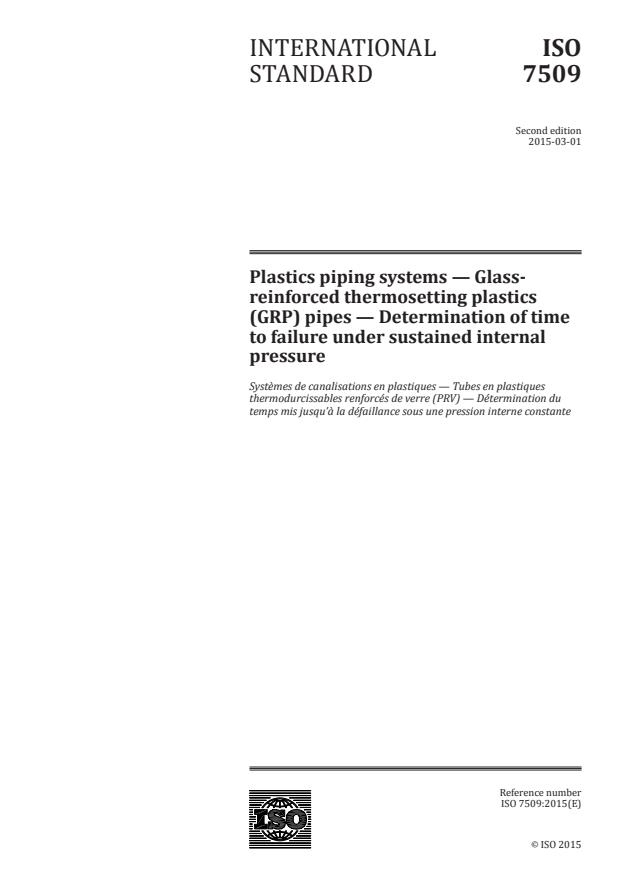
INTERNATIONAL ISO
STANDARD 7509
Second edition
2015-03-01
Plastics piping systems — Glass-
reinforced thermosetting plastics
(GRP) pipes — Determination of time
to failure under sustained internal
pressure
Systèmes de canalisations en plastiques — Tubes en plastiques
thermodurcissables renforcés de verre (PRV) — Détermination du
temps mis jusqu’à la défaillance sous une pression interne constante
Reference number
©
ISO 2015
© ISO 2015
All rights reserved. Unless otherwise specified, no part of this publication may be reproduced or utilized otherwise in any form
or by any means, electronic or mechanical, including photocopying, or posting on the internet or an intranet, without prior
written permission. Permission can be requested from either ISO at the address below or ISO’s member body in the country of
the requester.
ISO copyright office
Case postale 56 • CH-1211 Geneva 20
Tel. + 41 22 749 01 11
Fax + 41 22 749 09 47
E-mail copyright@iso.org
Web www.iso.org
Published in Switzerland
ii © ISO 2015 – All rights reserved
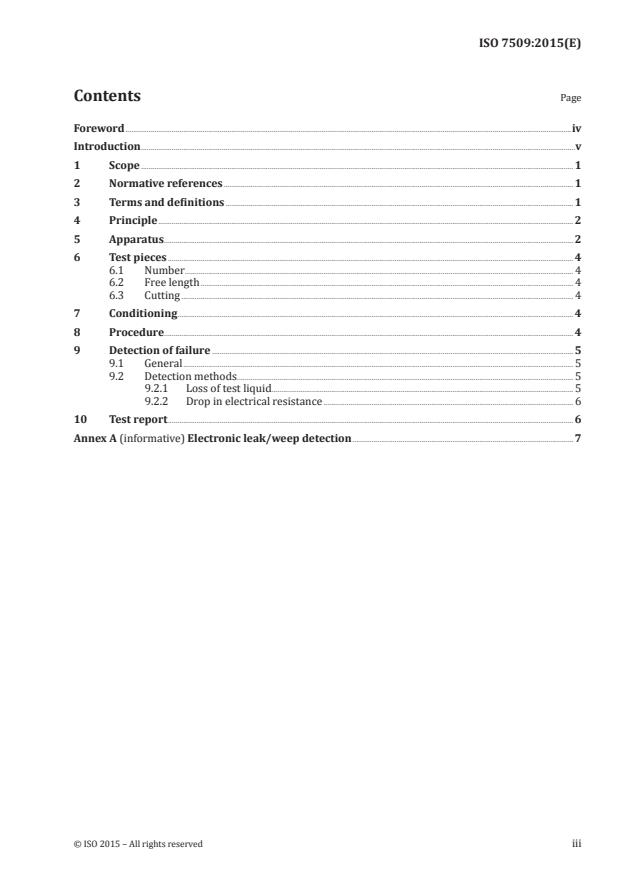
Contents Page
Foreword .iv
Introduction .v
1 Scope . 1
2 Normative references . 1
3 Terms and definitions . 1
4 Principle . 2
5 Apparatus . 2
6 Test pieces . 4
6.1 Number . 4
6.2 Free length . 4
6.3 Cutting . 4
7 Conditioning . 4
8 Procedure. 4
9 Detection of failure . 5
9.1 General . 5
9.2 Detection methods . 5
9.2.1 Loss of test liquid . . 5
9.2.2 Drop in electrical resistance . 6
10 Test report . 6
Annex A (informative) Electronic leak/weep detection . 7
Foreword
ISO (the International Organization for Standardization) is a worldwide federation of national standards
bodies (ISO member bodies). The work of preparing International Standards is normally carried out
through ISO technical committees. Each member body interested in a subject for which a technical
committee has been established has the right to be represented on that committee. International
organizations, governmental and non-governmental, in liaison with ISO, also take part in the work.
ISO collaborates closely with the International Electrotechnical Commission (IEC) on all matters of
electrotechnical standardization.
The procedures used to develop this document and those intended for its further maintenance are
described in the ISO/IEC Directives, Part 1. In particular the different approval criteria needed for the
different types of ISO documents should be noted. This document was drafted in accordance with the
editorial rules of the ISO/IEC Directives, Part 2 (see www.iso.org/directives).
Attention is drawn to the possibility that some of the elements of this document may be the subject of
patent rights. ISO shall not be held responsible for identifying any or all such patent rights. Details of any
patent rights identified during the development of the document will be in the Introduction and/or on
the ISO list of patent declarations received (see www.iso.org/patents).
Any trade name used in this document is information given for the convenience of users and does not
constitute an endorsement.
For an explanation on the meaning of ISO specific terms and expressions related to conformity
assessment, as well as information about ISO’s adherence to the WTO principles in the Technical Barriers
to Trade (TBT), see the following URL: Foreword — Supplementary information.
The committee responsible for this document is ISO/TC 138, Plastics pipes, fittings and valves for the
transport of fluids, Subcommittee SC 06, Reinforced plastics pipes and fittings for all applications.
This second edition cancels and replaces the first edition (ISO 7509:2000), which has been technically
revised.
iv © ISO 2015 – All rights reserved
Introduction
This International Standard describes a method for determining the long-term resistance to internal
pressure of glass-reinforced thermosetting plastics (GRP) pipes.
It is a method which uses the following conditions:
— water as the reference liquid inside the test piece;
— water or air, as the environment outside the test piece.
The method can be used for tests at different temperatures. It should be noted that, for a given
temperature, the results obtained can differ depending on the end loading conditions and whether the
external environment is water or air.
The method described in this International Standard differs from those in some other similar standards
in the following details:
— the failure criteria and the detection of failure;
— the strain in the longitudinal and circumferential directions can be measured during the test;
— the test pressure is maintained constant.
This method can be used to obtain data to establish internal pressure versus time-to-failure relationships
at different temperatures. The procedures for establishing the relationships are not within the scope of
this International Standard. For such purposes, attention is drawn to ISO 10928.
INTERNATIONAL STANDARD ISO 7509:2015(E)
Plastics piping systems — Glass-reinforced thermosetting
plastics (GRP) pipes — Determination of time to failure
under sustained internal pressure
1 Scope
This International Standard specifies a method for determining the time-to-failure of glass-reinforced
thermosetting plastics (GRP) pipes under internal hydrostatic pressure at a specified temperature. The
external environment can be air or water.
NOTE For other internal or external environments, the referring standard is to specify any additional requirement.
2 Normative references
The following documents, in whole or in part, are normatively referenced in this document and are
indispensable for its application. For dated references, only the edition cited applies. For undated
references, the latest edition of the referenced document (including any amendments) applies.
ISO 3126, Plastics piping systems — Plastics components — Determination of dimensions
ISO 10928, Plastics piping systems — Glass-reinforced thermosetting plastics (GRP) pipes and fittings —
Methods for regression analysis and their use
3 Terms and definitions
For the purposes of this document, the following terms and definitions apply.
3.1
failure
occurrence of bursting, leaking, or weeping
Note 1 to entry: See 9.1.
3.2
bursting
failure by rupture of the pipe wall with immediate loss of test liquid and drop of pressure
Note 1 to entry: See 9.1 and 9.2.1.
3.3
leaking
failure by visible loss of the pressurizing liquid through the pipe wall to an extent detectable visually
and/or by a continuous drop in pressure
Note 1 to entry: See 9.1 and 9.2.1
3.4
weeping
failure by passage of the pressurizing liquid through the pipe wall to an extent detectable visually
and/or electronically
Note 1 to entry: See 9.1 and 9.2.2.
4 Principle
A cut length of pipe at the required temperature is subjected to a specified internal hydrostatic pressure
to cause a state of stress in the pipe wall, which depends upon the loading conditions (i.e. with or wit
...
INTERNATIONAL ISO
STANDARD 7509
Second edition
2015-03-01
Plastics piping systems — Glass-
reinforced thermosetting plastics
(GRP) pipes — Determination of time
to failure under sustained internal
pressure
Systèmes de canalisations en plastiques — Tubes en plastiques
thermodurcissables renforcés de verre (PRV) — Détermination du
temps mis jusqu’à la défaillance sous une pression interne constante
Reference number
©
ISO 2015
© ISO 2015
All rights reserved. Unless otherwise specified, no part of this publication may be reproduced or utilized otherwise in any form
or by any means, electronic or mechanical, including photocopying, or posting on the internet or an intranet, without prior
written permission. Permission can be requested from either ISO at the address below or ISO’s member body in the country of
the requester.
ISO copyright office
Case postale 56 • CH-1211 Geneva 20
Tel. + 41 22 749 01 11
Fax + 41 22 749 09 47
E-mail copyright@iso.org
Web www.iso.org
Published in Switzerland
ii © ISO 2015 – All rights reserved
Contents Page
Foreword .iv
Introduction .v
1 Scope . 1
2 Normative references . 1
3 Terms and definitions . 1
4 Principle . 2
5 Apparatus . 2
6 Test pieces . 4
6.1 Number . 4
6.2 Free length . 4
6.3 Cutting . 4
7 Conditioning . 4
8 Procedure. 4
9 Detection of failure . 5
9.1 General . 5
9.2 Detection methods . 5
9.2.1 Loss of test liquid . . 5
9.2.2 Drop in electrical resistance . 6
10 Test report . 6
Annex A (informative) Electronic leak/weep detection . 7
Foreword
ISO (the International Organization for Standardization) is a worldwide federation of national standards
bodies (ISO member bodies). The work of preparing International Standards is normally carried out
through ISO technical committees. Each member body interested in a subject for which a technical
committee has been established has the right to be represented on that committee. International
organizations, governmental and non-governmental, in liaison with ISO, also take part in the work.
ISO collaborates closely with the International Electrotechnical Commission (IEC) on all matters of
electrotechnical standardization.
The procedures used to develop this document and those intended for its further maintenance are
described in the ISO/IEC Directives, Part 1. In particular the different approval criteria needed for the
different types of ISO documents should be noted. This document was drafted in accordance with the
editorial rules of the ISO/IEC Directives, Part 2 (see www.iso.org/directives).
Attention is drawn to the possibility that some of the elements of this document may be the subject of
patent rights. ISO shall not be held responsible for identifying any or all such patent rights. Details of any
patent rights identified during the development of the document will be in the Introduction and/or on
the ISO list of patent declarations received (see www.iso.org/patents).
Any trade name used in this document is information given for the convenience of users and does not
constitute an endorsement.
For an explanation on the meaning of ISO specific terms and expressions related to conformity
assessment, as well as information about ISO’s adherence to the WTO principles in the Technical Barriers
to Trade (TBT), see the following URL: Foreword — Supplementary information.
The committee responsible for this document is ISO/TC 138, Plastics pipes, fittings and valves for the
transport of fluids, Subcommittee SC 06, Reinforced plastics pipes and fittings for all applications.
This second edition cancels and replaces the first edition (ISO 7509:2000), which has been technically
revised.
iv © ISO 2015 – All rights reserved
Introduction
This International Standard describes a method for determining the long-term resistance to internal
pressure of glass-reinforced thermosetting plastics (GRP) pipes.
It is a method which uses the following conditions:
— water as the reference liquid inside the test piece;
— water or air, as the environment outside the test piece.
The method can be used for tests at different temperatures. It should be noted that, for a given
temperature, the results obtained can differ depending on the end loading conditions and whether the
external environment is water or air.
The method described in this International Standard differs from those in some other similar standards
in the following details:
— the failure criteria and the detection of failure;
— the strain in the longitudinal and circumferential directions can be measured during the test;
— the test pressure is maintained constant.
This method can be used to obtain data to establish internal pressure versus time-to-failure relationships
at different temperatures. The procedures for establishing the relationships are not within the scope of
this International Standard. For such purposes, attention is drawn to ISO 10928.
INTERNATIONAL STANDARD ISO 7509:2015(E)
Plastics piping systems — Glass-reinforced thermosetting
plastics (GRP) pipes — Determination of time to failure
under sustained internal pressure
1 Scope
This International Standard specifies a method for determining the time-to-failure of glass-reinforced
thermosetting plastics (GRP) pipes under internal hydrostatic pressure at a specified temperature. The
external environment can be air or water.
NOTE For other internal or external environments, the referring standard is to specify any additional requirement.
2 Normative references
The following documents, in whole or in part, are normatively referenced in this document and are
indispensable for its application. For dated references, only the edition cited applies. For undated
references, the latest edition of the referenced document (including any amendments) applies.
ISO 3126, Plastics piping systems — Plastics components — Determination of dimensions
ISO 10928, Plastics piping systems — Glass-reinforced thermosetting plastics (GRP) pipes and fittings —
Methods for regression analysis and their use
3 Terms and definitions
For the purposes of this document, the following terms and definitions apply.
3.1
failure
occurrence of bursting, leaking, or weeping
Note 1 to entry: See 9.1.
3.2
bursting
failure by rupture of the pipe wall with immediate loss of test liquid and drop of pressure
Note 1 to entry: See 9.1 and 9.2.1.
3.3
leaking
failure by visible loss of the pressurizing liquid through the pipe wall to an extent detectable visually
and/or by a continuous drop in pressure
Note 1 to entry: See 9.1 and 9.2.1
3.4
weeping
failure by passage of the pressurizing liquid through the pipe wall to an extent detectable visually
and/or electronically
Note 1 to entry: See 9.1 and 9.2.2.
4 Principle
A cut length of pipe at the required temperature is subjected to a specified internal hydrostatic pressure
to cause a state of stress in the pipe wall, which depends upon the loading conditions (i.e. with or wit
...