

ISO/IEC 13346-4:1999
(Main)Information technology — Volume and file structure of write-once and rewritable media using non-sequential recording for information interchange — Part 4: File structure
General Information
- Abstract
ISO/IEC 13346 specifies a format and associated system requirements for volume and boot block recognition, volume structure, file structure and record structure for the interchange of information on media between users of information processing systems. The media shall be recorded as if the recording of sectors may be done in any order. Note 1 - The medium is not restricted to being of only one type; the type of medium may be either write once, or read only, or rewritable, or a combination of these types. This International Standard consists of the following five Parts: Part 1: General Part 2: Volume and Boot Block Recognition Part 3: Volume Structure Part 4: File Structure Part 5: Record Structure Annex A - ICB Strategies, is part of this part of ISO/IEC 13346. This part of ISO/IEC 13346 specifies a format and associated system requirements for file structure by specifying: - the placement of files; - the attributes of the files; - the relationship among files of a logical volume; - levels of medium interchange; - requirements for the processes which are provided within information processing systems, to enable information to be interchanged between different systems; for this purpose, it specifies the functions to be provided within systems which are intended to originate or receive media which conform to this part of ISO/IEC 13346.
- Status
- Published
- Publication Date
- 31-Mar-1999
- Technical Committee
- ISO/IEC JTC 1 - Information technology
- Drafting Committee
- ISO/IEC JTC 1 - Information technology
- Current Stage
- 9060 - Close of review
- Completion Date
- 02-Sep-2031
Buy Documents
ISO/IEC 13346-4:1999 - Information technology -- Volume and file structure of write-once and rewritable media using non-sequential recording for information interchange
ISO/IEC 13346-4:1999 - Information technology — Volume and file structure of write-once and rewritable media using non-sequential recording for information interchange — Part 4: File structure/1/1999
Overview - ISO/IEC 13346-4:1999 (File structure)
ISO/IEC 13346-4:1999 is Part 4 of the ISO standard defining the file structure for media recorded using non‑sequential recording (write‑once, read‑only, rewritable or mixed media). It specifies the format and system requirements needed to enable reliable information interchange between different information‑processing systems. This part focuses on how files are placed, described and related on a logical volume so that different systems can originate, read and interpret recorded media consistently.
Key topics and technical requirements
The standard defines a comprehensive set of file‑structure mechanisms, including:
- File set and volume concepts - logical volume, partition, file set and their relationships for interchange.
- Descriptor architecture - Tagged descriptors such as File Set Descriptor, File Identifier Descriptor, Allocation Extent Descriptor, Terminating Descriptor and Partition Header Descriptor.
- Information Control Block (ICB) - hierarchy and tag structures used to describe files, directories and stream entries (Annex A covers ICB strategies).
- Directories and pathnames - rules for directory descriptors, hierarchy size limits and resolved pathname semantics.
- File attributes and streams - attributes assigned to files, stream directories and multi‑stream file data model.
- Allocation descriptors and data space - how file data extents are described and recorded on a partition.
- Partition space and integrity management - unallocated/freed space tables and integrity requirements for partitions.
- Recording and conformance - how descriptors are recorded, and conformance requirements for media and information processing systems.
These topics are specified to ensure predictable interpretation of file metadata and data on non‑sequential media.
Applications and who uses it
ISO/IEC 13346-4 is used by:
- Firmware and device developers (optical disc drives, removable media controllers) implementing non‑sequential recording support.
- File system and OS engineers designing or supporting interoperable file systems for write‑once and rewritable media.
- Media authoring and mastering tool vendors producing interoperable media images.
- Archival and preservation specialists requiring standardized media interchange for long‑term storage.
- Test labs and interoperability assessors validating conformance of media and systems.
Practical applications include creating interoperable optical discs, designing partition and allocation schemes for non‑sequential media, implementing directory and pathname handling, and ensuring cross‑platform file interchange.
Related standards
This part is one of a five‑part set in ISO/IEC 13346:
- Part 1: General
- Part 2: Volume and Boot Block Recognition
- Part 3: Volume Structure
- Part 4: File Structure (this document)
- Part 5: Record Structure
Keywords: ISO/IEC 13346-4, file structure, non‑sequential recording, write‑once media, rewritable media, logical volume, ICB, allocation descriptors, file set descriptor, media interchange.
Relations
- Consolidated By
ISO 5457:1999/Amd 1:2010 - Technical product documentation — Sizes and layout of drawing sheets — Amendment 1 - Effective Date
- 06-Jun-2022
- Effective Date
- 15-Apr-2008
Buy Documents
ISO/IEC 13346-4:1999 - Information technology -- Volume and file structure of write-once and rewritable media using non-sequential recording for information interchange
ISO/IEC 13346-4:1999 - Information technology — Volume and file structure of write-once and rewritable media using non-sequential recording for information interchange — Part 4: File structure/1/1999
Get Certified
Connect with accredited certification bodies for this standard

BSI Group
BSI (British Standards Institution) is the business standards company that helps organizations make excellence a habit.

NYCE
Mexican standards and certification body.
Sponsored listings
Frequently Asked Questions
ISO/IEC 13346-4:1999 is a standard published by the International Organization for Standardization (ISO). Its full title is "Information technology — Volume and file structure of write-once and rewritable media using non-sequential recording for information interchange — Part 4: File structure". This standard covers: ISO/IEC 13346 specifies a format and associated system requirements for volume and boot block recognition, volume structure, file structure and record structure for the interchange of information on media between users of information processing systems. The media shall be recorded as if the recording of sectors may be done in any order. Note 1 - The medium is not restricted to being of only one type; the type of medium may be either write once, or read only, or rewritable, or a combination of these types. This International Standard consists of the following five Parts: Part 1: General Part 2: Volume and Boot Block Recognition Part 3: Volume Structure Part 4: File Structure Part 5: Record Structure Annex A - ICB Strategies, is part of this part of ISO/IEC 13346. This part of ISO/IEC 13346 specifies a format and associated system requirements for file structure by specifying: - the placement of files; - the attributes of the files; - the relationship among files of a logical volume; - levels of medium interchange; - requirements for the processes which are provided within information processing systems, to enable information to be interchanged between different systems; for this purpose, it specifies the functions to be provided within systems which are intended to originate or receive media which conform to this part of ISO/IEC 13346.
ISO/IEC 13346 specifies a format and associated system requirements for volume and boot block recognition, volume structure, file structure and record structure for the interchange of information on media between users of information processing systems. The media shall be recorded as if the recording of sectors may be done in any order. Note 1 - The medium is not restricted to being of only one type; the type of medium may be either write once, or read only, or rewritable, or a combination of these types. This International Standard consists of the following five Parts: Part 1: General Part 2: Volume and Boot Block Recognition Part 3: Volume Structure Part 4: File Structure Part 5: Record Structure Annex A - ICB Strategies, is part of this part of ISO/IEC 13346. This part of ISO/IEC 13346 specifies a format and associated system requirements for file structure by specifying: - the placement of files; - the attributes of the files; - the relationship among files of a logical volume; - levels of medium interchange; - requirements for the processes which are provided within information processing systems, to enable information to be interchanged between different systems; for this purpose, it specifies the functions to be provided within systems which are intended to originate or receive media which conform to this part of ISO/IEC 13346.
ISO/IEC 13346-4:1999 is classified under the following ICS (International Classification for Standards) categories: 35.220.20 - Magnetic storage devices in general; 35.220.30 - Optical storage devices. The ICS classification helps identify the subject area and facilitates finding related standards.
ISO/IEC 13346-4:1999 has the following relationships with other standards: It is inter standard links to ISO 5457:1999/Amd 1:2010, ISO/IEC 13346-4:1995. Understanding these relationships helps ensure you are using the most current and applicable version of the standard.
ISO/IEC 13346-4:1999 is available in PDF format for immediate download after purchase. The document can be added to your cart and obtained through the secure checkout process. Digital delivery ensures instant access to the complete standard document.
Standards Content (Sample)
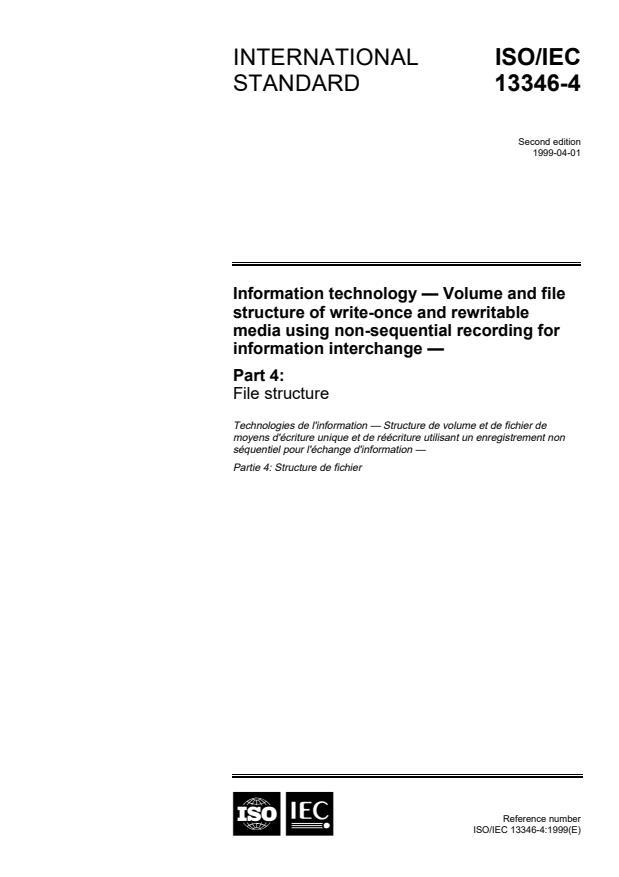
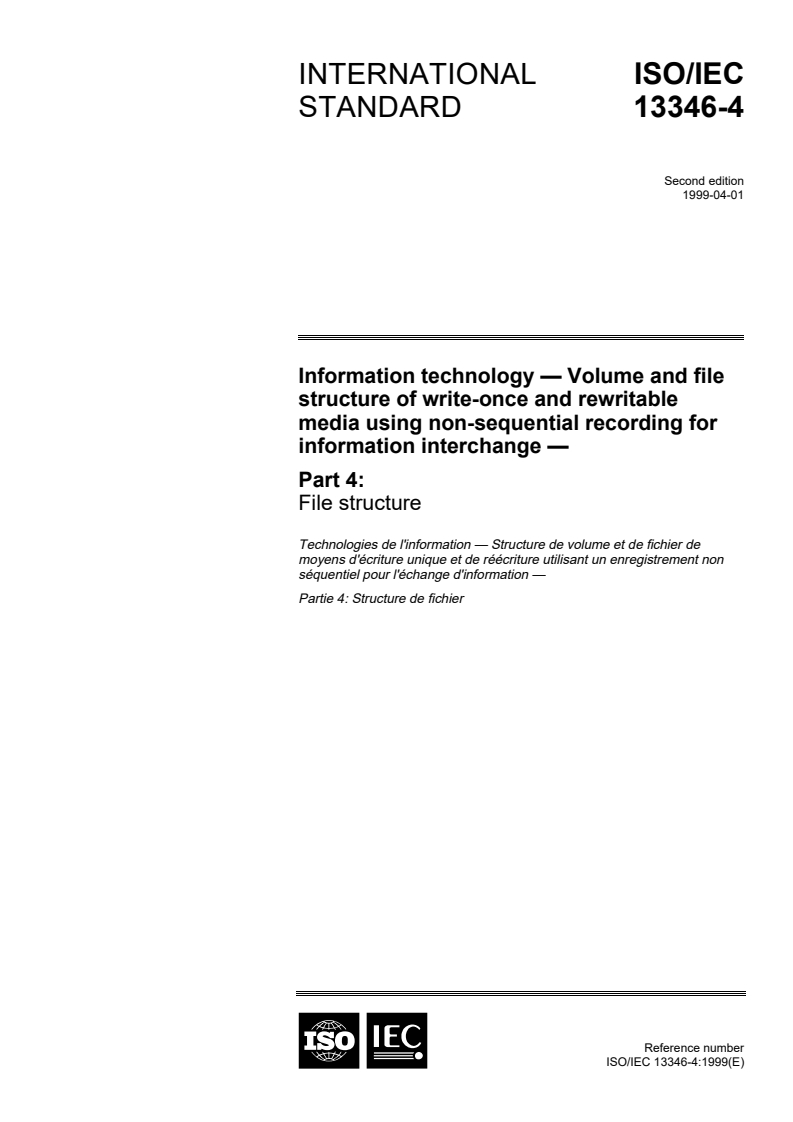
INTERNATIONAL ISO/IEC
STANDARD 13346-4
Second edition
1999-04-01
Information technology — Volume and file
structure of write-once and rewritable
media using non-sequential recording for
information interchange —
Part 4:
File structure
Technologies de l'information — Structure de volume et de fichier de
moyens d'écriture unique et de réécriture utilisant un enregistrement non
séquentiel pour l'échange d'information —
Partie 4: Structure de fichier
Reference number
B C
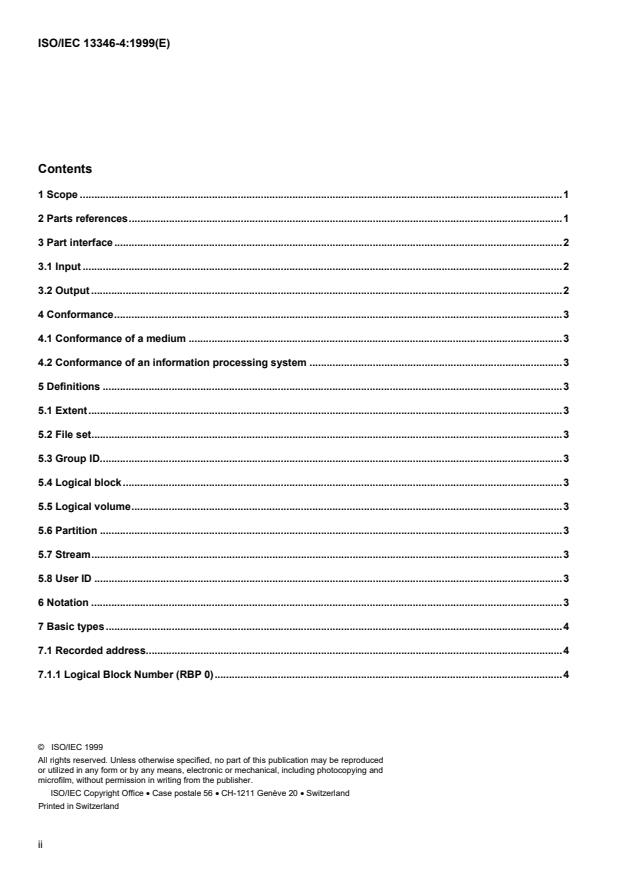
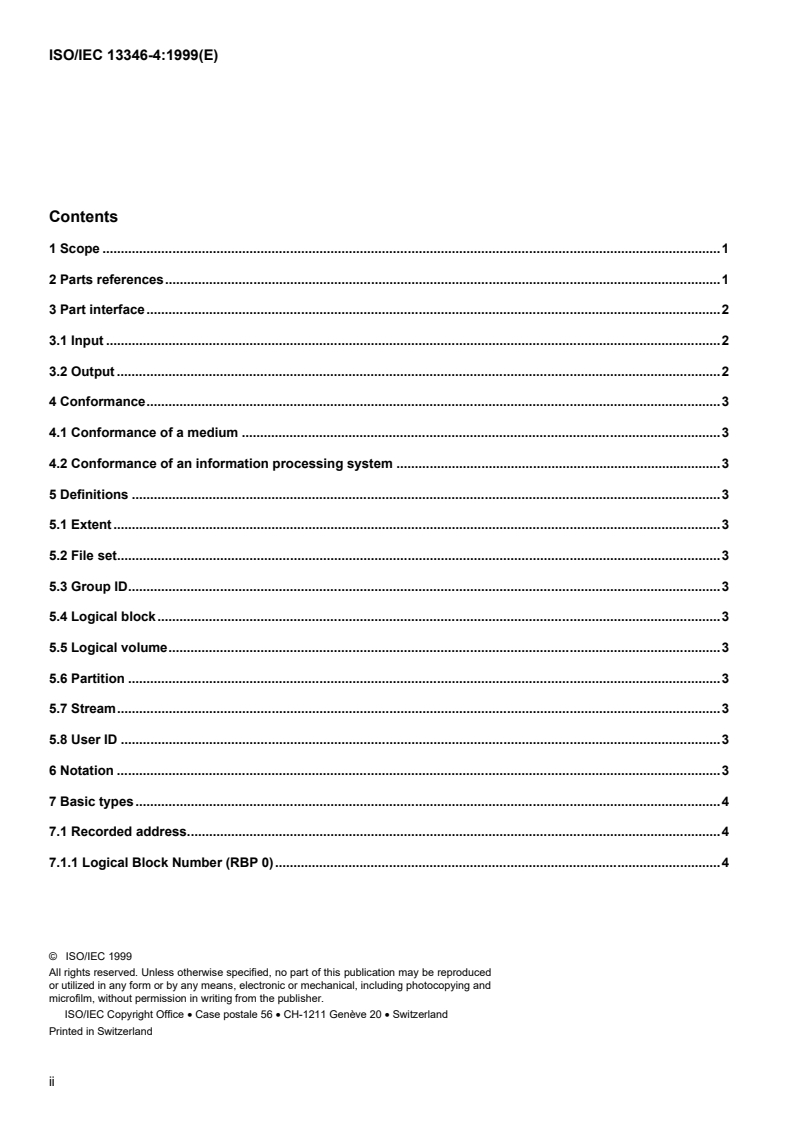
Contents
1 Scope .1
2 Parts references.1
3 Part interface.2
3.1 Input .2
3.2 Output .2
4 Conformance.3
4.1 Conformance of a medium .3
4.2 Conformance of an information processing system .3
5 Definitions .3
5.1 Extent.3
5.2 File set.3
5.3 Group ID.3
5.4 Logical block.3
5.5 Logical volume.3
5.6 Partition .3
5.7 Stream.3
5.8 User ID .3
6 Notation .3
7 Basic types.4
7.1 Recorded address.4
7.1.1 Logical Block Number (RBP 0).4
© ISO/IEC 1999
All rights reserved. Unless otherwise specified, no part of this publication may be reproduced
or utilized in any form or by any means, electronic or mechanical, including photocopying and
microfilm, without permission in writing from the publisher.
ISO/IEC Copyright Office • Case postale 56 • CH-1211 Genève 20 • Switzerland
Printed in Switzerland
ii
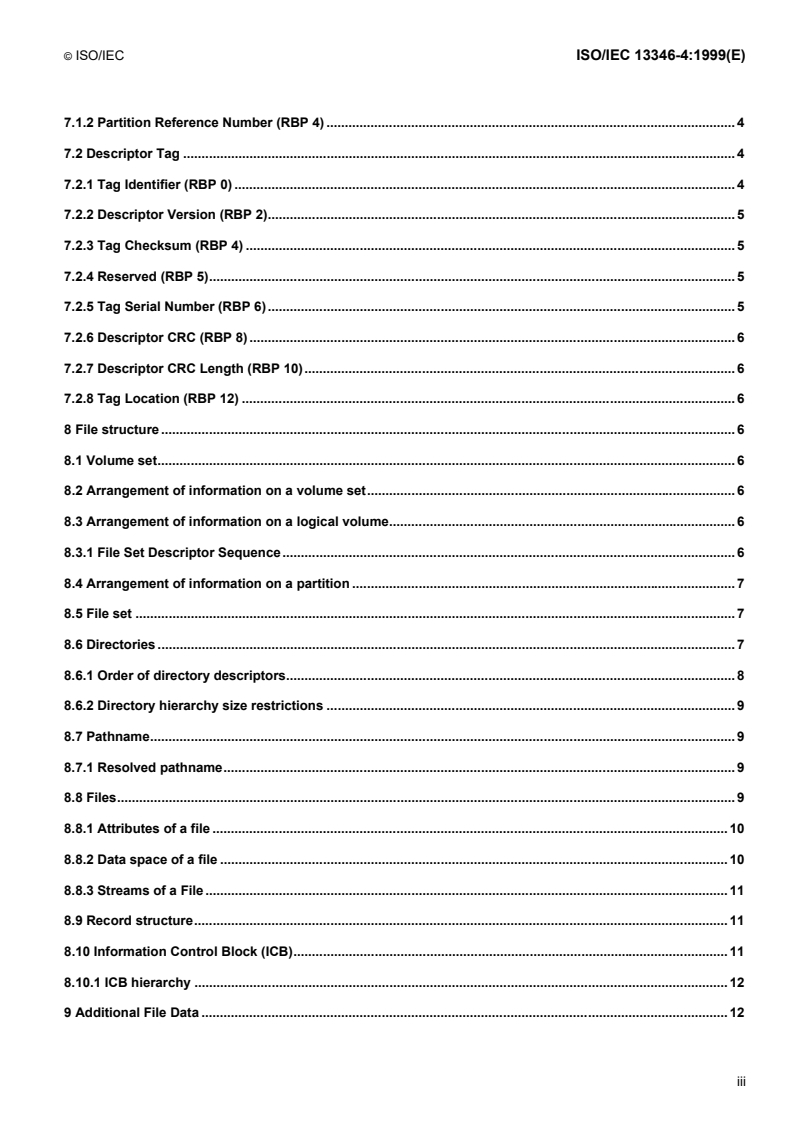
© ISO/IEC ISO/IEC 13346-4:1999(E)
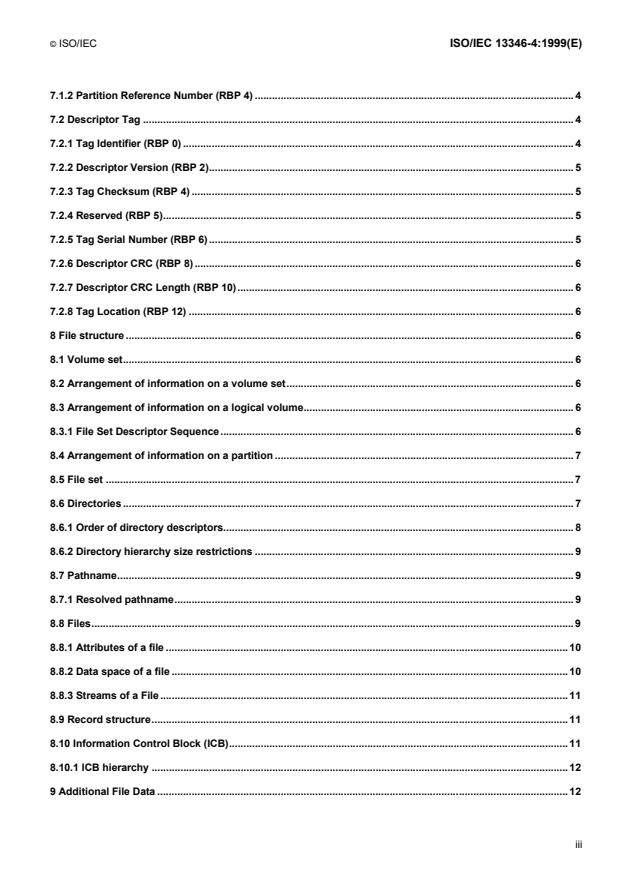
7.1.2 Partition Reference Number (RBP 4) . 4
7.2 Descriptor Tag . 4
7.2.1 Tag Identifier (RBP 0) . 4
7.2.2 Descriptor Version (RBP 2). 5
7.2.3 Tag Checksum (RBP 4) . 5
7.2.4 Reserved (RBP 5). 5
7.2.5 Tag Serial Number (RBP 6). 5
7.2.6 Descriptor CRC (RBP 8). 6
7.2.7 Descriptor CRC Length (RBP 10). 6
7.2.8 Tag Location (RBP 12) . 6
8 File structure . 6
8.1 Volume set. 6
8.2 Arrangement of information on a volume set. 6
8.3 Arrangement of information on a logical volume. 6
8.3.1 File Set Descriptor Sequence. 6
8.4 Arrangement of information on a partition . 7
8.5 File set . 7
8.6 Directories . 7
8.6.1 Order of directory descriptors. 8
8.6.2 Directory hierarchy size restrictions . 9
8.7 Pathname. 9
8.7.1 Resolved pathname. 9
8.8 Files. 9
8.8.1 Attributes of a file . 10
8.8.2 Data space of a file . 10
8.8.3 Streams of a File . 11
8.9 Record structure. 11
8.10 Information Control Block (ICB). 11
8.10.1 ICB hierarchy . 12
9 Additional File Data . 12
iii
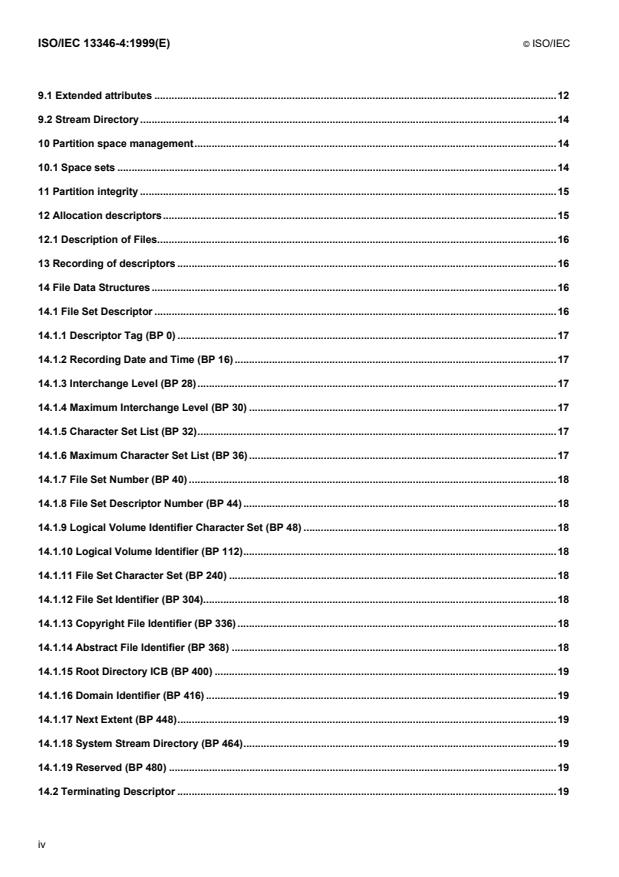
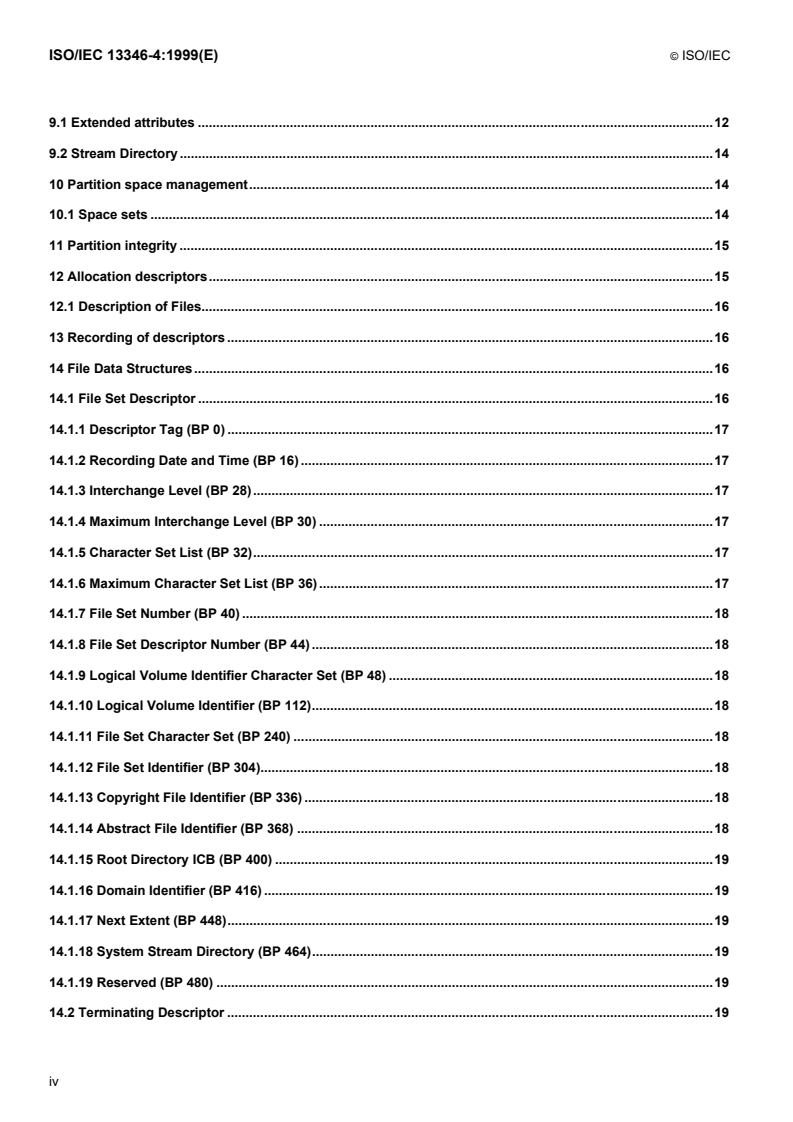
9.1 Extended attributes .12
9.2 Stream Directory.14
10 Partition space management.14
10.1 Space sets .14
11 Partition integrity .15
12 Allocation descriptors.15
12.1 Description of Files.16
13 Recording of descriptors .16
14 File Data Structures.16
14.1 File Set Descriptor .16
14.1.1 Descriptor Tag (BP 0) .17
14.1.2 Recording Date and Time (BP 16) .17
14.1.3 Interchange Level (BP 28).17
14.1.4 Maximum Interchange Level (BP 30) .17
14.1.5 Character Set List (BP 32).17
14.1.6 Maximum Character Set List (BP 36) .17
14.1.7 File Set Number (BP 40) .18
14.1.8 File Set Descriptor Number (BP 44) .18
14.1.9 Logical Volume Identifier Character Set (BP 48) .18
14.1.10 Logical Volume Identifier (BP 112).18
14.1.11 File Set Character Set (BP 240) .18
14.1.12 File Set Identifier (BP 304).18
14.1.13 Copyright File Identifier (BP 336) .18
14.1.14 Abstract File Identifier (BP 368) .18
14.1.15 Root Directory ICB (BP 400) .19
14.1.16 Domain Identifier (BP 416) .19
14.1.17 Next Extent (BP 448).19
14.1.18 System Stream Directory (BP 464).19
14.1.19 Reserved (BP 480) .19
14.2 Terminating Descriptor .19
iv
© ISO/IEC ISO/IEC 13346-4:1999(E)
14.2.1 Descriptor Tag (BP 0). 19
14.2.2 Reserved (BP 16) . 19
14.3 Partition Header Descriptor. 19
14.3.1 Unallocated Space Table (RBP 0) . 20
14.3.2 Unallocated Space Bitmap (RBP 8). 20
14.3.3 Partition Integrity Table (RBP 16). 20
14.3.4 Freed Space Table (RBP 24). 20
14.3.5 Freed Space Bitmap (RBP 32) . 20
14.3.6 Reserved (RBP 40). 20
14.4 File Identifier Descriptor . 20
14.4.1 Descriptor Tag (RBP 0) . 21
14.4.2 File Version Number (RBP 16). 21
14.4.3 File Characteristics (RBP 18). 21
14.4.4 Length of File Identifier (=L_FI) (RBP 19). 22
14.4.5 ICB (RBP 20). 22
14.4.6 Length of Implementation Use (=L_IU) (RBP 36). 22
14.4.7 Implementation Use (RBP 38). 22
14.4.8 File Identifier (RBP [L_IU+38]) . 23
14.4.9 Padding (RBP [L_FI+L_IU+38]). 23
14.5 Allocation Extent Descriptor . 23
14.5.1 Descriptor Tag (BP 0). 23
14.5.2 Previous Allocation Extent Location (BP 16). 23
14.5.3 Length of Allocation Descriptors (=L_AD) (BP 20) . 23
14.6 ICB Tag . 23
14.6.1 Prior Recorded Number of Direct Entries (RBP 0) . 24
14.6.2 Strategy Type (RBP 4). 24
14.6.3 Strategy Parameter (RBP 6). 24
14.6.4 Maximum Number of Entries (RBP 8). 24
14.6.5 Reserved (RBP 10). 24
14.6.6 File Type (RBP 11) . 24
v
14.6.7 Parent ICB Location (RBP 12) .25
14.6.8 Flags (RBP 18).25
14.7 Indirect Entry.27
14.7.1 Descriptor Tag (BP 0) .27
14.7.2 ICB Tag (BP 16).27
14.7.3 Indirect ICB (BP 36) .27
14.8 Terminal Entry.27
14.8.1 Descriptor Tag (BP 0) .27
14.8.2 ICB Tag (BP 16).27
14.9 File Entry.27
14.9.1 Descriptor Tag (BP 0) .28
14.9.2 ICB Tag (BP 16).28
14.9.3 Uid (BP 36).28
14.9.4 Gid (BP 40).28
14.9.5 Permissions (BP 44) .28
14.9.6 File Link Count (BP 48) .30
14.9.7 Record Format (BP 50).30
14.9.8 Record Display Attributes (BP 51) .30
14.9.9 Record Length (BP 52) .31
14.9.10 Information Length (BP 56).31
14.9.11 Logical Blocks Recorded (BP 64) .31
14.9.12 Access Date and Time (BP 72) .31
14.9.13 Modification Date and Time (BP 84).31
14.9.14 Attribute Date and Time (BP 96).32
14.9.15 Checkpoint (BP 108).32
14.9.16 Extended Attribute ICB (BP 112) .32
14.9.17 Implementation Identifier (BP 128).32
14.9.18 Unique Id (BP 160) .32
14.9.19 Length of Extended Attributes (=L_EA) (BP 168).32
14.9.20 Length of Allocation Descriptors (=L_AD) (BP 172).32
vi
© ISO/IEC ISO/IEC 13346-4:1999(E)
14.9.21 Extended Attributes (BP 176) . 32
14.9.22 Allocation Descriptors (BP [L_EA+176]) . 32
14.10 Extended Attributes. 32
14.10.1 Extended Attribute Header Descriptor . 33
14.10.2 Generic format . 33
14.10.3 Character Set Information. 34
14.10.4 Alternate Permissions. 35
14.10.5 File Times Extended Attribute. 38
14.10.6 Information Times Extended Attribute . 39
14.10.7 Device Specification. 40
14.10.8 Implementation Use Extended Attribute . 41
14.10.9 Application Use Extended Attribute . 42
14.11 Unallocated Space Entry. 43
14.11.1 Descriptor Tag (BP 0). 43
14.11.2 ICB Tag (BP 16). 43
14.11.3 Length of Allocation Descriptors (=L_AD) (BP 36) . 43
14.11.4 Allocation Descriptors (BP 40). 43
14.12 Space Bitmap Descriptor. 44
14.12.1 Descriptor Tag (BP 0). 44
14.12.2 Number of Bits (=N_BT) (BP 16). 44
14.12.3 Number of Bytes (=N_B) (BP 20). 44
14.12.4 Bitmap (BP 24) . 44
14.13 Partition Integrity Entry. 44
14.13.1 Descriptor Tag (BP 0). 44
14.13.2 ICB Tag (BP 16). 45
14.13.3 Recording Date and Time (BP 36). 45
14.13.4 Integrity Type (BP 48). 45
14.13.5 Reserved (BP 49) . 45
14.13.6 Implementation Identifier (BP 224) . 45
14.13.7 Implementation Use (BP 256) . 45
vii
14.14 Allocation descriptors.45
14.14.1 Short Allocation Descriptor .45
14.14.2 Long Allocation Descriptor.46
14.14.3 Extended Allocation Descriptor .46
14.15 Logical Volume Header Descriptor .47
14.15.1 Unique Id (RBP 0).47
14.15.2 Reserved (RBP 8).48
14.16 Pathname.48
14.16.1 Path Component .48
14.17 Extended File Entry .49
14.17.1 Descriptor Tag (BP 0) .49
14.17.2 ICB Tag (BP 16).50
14.17.3 Uid (BP 36).50
14.17.4 Gid (BP 40).50
14.17.5 Permissions (BP 44) .50
14.17.6 File Link Count (BP 48) .50
14.17.7 Record Format (BP 50).50
14.17.8 Record Display Attributes (BP 51) .50
14.17.9 Record Length (BP 52) .50
14.17.10 Information Length (BP 56).50
14.17.11 Object Size (BP 64) .50
14.17.12 Logical Blocks Recorded (BP 72) .50
14.17.13 Access Date and Time (BP 80) .50
14.17.14 Modification Date and Time (BP 92).50
14.17.15 Creation Date and Time (BP 104) .50
14.17.16 Attribute Date and Time (BP 116).51
14.17.17 Checkpoint (BP 128).51
14.17.18 Extended Attribute ICB (BP 136) .51
14.17.19 Stream Directory ICB (BP 152) .51
14.17.20 Implementation Identifier (BP 168).51
viii
© ISO/IEC ISO/IEC 13346-4:1999(E)
14.17.21 Unique Id (BP 200). 51
14.17.22 Length of Extended Attributes (=L_EA) (BP 208). 51
14.17.23 Length of Allocation Descriptors (=L_AD) (BP 212) . 51
14.17.24 Extended Attributes (BP 216) . 51
14.17.25 Allocation Descriptors (BP [L_EA+216]) . 51
15 Levels of medium interchange. 51
15.1 Level 1. 51
15.2 Level 2. 52
15.3 Level 3. 52
16 Requirements for the description of systems . 53
17 Requirements for an originating system. 53
17.1 General . 53
17.2 Mandatory access by user. 53
17.2.1 Files. 53
17.2.2 File set . 53
17.2.3 Descriptors. 53
17.3 Optional access by user . 54
17.3.1 Records . 55
17.3.2 File types . 55
17.3.3 Permissions . 55
17.4 Restrictions . 55
17.4.1 Multivolume volume sets. 55
17.4.2 Record length. 55
17.4.3 File Times . 55
17.4.4 Information Times. 55
17.4.5 Alternate Permissions. 55
18 Requirements for a receiving system. 56
18.1 General . 56
18.2 Files. 56
18.2.1 File types . 56
ix
18.2.2 Permissions.56
18.3 Mandatory access by user.56
18.3.1 Descriptors.56
18.4 Restrictions .57
18.4.1 Record length.57
18.4.2 File Times .57
18.4.3 Information Times.57
18.4.4 Alternate Permissions.57
Annex A (normative) ICB Strategies .58
Annex B (informative) Changes from ISO/IEC 13346-4:1995 to this second edition.62
x
© ISO/IEC ISO/IEC 13346-4:1999(E)
Foreword
ISO (the International Organization for Standardization) and IEC (the International Electrotechnical Commission)
form the specialised system for worldwide standardisation. National Bodies that are members of ISO or IEC
participate in the development of International Standards through technical committees established by the
respective organisation to deal with particular fields of technical activity. ISO and IEC technical committees
collaborate in fields of mutual interest. Other international organisations, governmental and non-governmental, in
liaison with ISO and IEC, also take part in this work.
In the field of information technology, ISO and IEC have established a Joint Technical Committee, ISO/IEC JTC 1.
Draft International Standards adopted by the Joint Technical Committee are circulated to National Bodies for voting.
Publication of an International Standard requires approval by at least 75% of the national bodies casting a vote.
International Standard ISO/IEC 13346-4 was prepared by ECMA, (as Standard ECMA-167) and was adopted,
under a special “fast-track procedure”, by Joint Technical Committee ISO/IEC JTC 1, Information technology, in
parallel with its approval by National Bodies of ISO and IEC.
This second edition cancels and replaces the first edition (ISO/IEC 13346-4:1995), which has been technically
revised.
ISO/IEC 13346 consists of the following parts, under the general title Information technology — Volume and file
structure of write-once and rewritable media using non-sequential recording for information interchange:
Part 1: General
Part 2: Volume and boot block recognition
Part 3: Volume structure
Part 4: File structure
Part 5: Record structure
Annex A forms an integral part of this part of ISO/IEC 13346. Annex B is for information only.
xi
Introduction
ISO/IEC 13346 is a volume and file structure standard for interchanging files and as such, it is a peer to existing
volume and file structure standards such as ISO 9293 and ISO 9660. It is rather different from those standards in at
least two important ways. Firstly, it offers much more functionality, mainly because of user needs for increased
character set support and for more powerful file system features. Secondly, it acknowledges the separate concerns
of booting, volume structure and file system structure. Rather than bundling these different functions together,
ISO/IEC 13346 carefully segregates these functions into separate parts and describes in detail how those parts fit
together. It is expected that future volume and file structure standards will fit into this framework, rather than building
other distinct and incompatible formats.
ISO/IEC 13346 is published in five Parts. Part 1 - general - specifies references, definitions, notations and basic
structures used in the other four Parts. Part 2 - volume and boot block recognition - specifies formats and system
requirements for recognising the volume structures on a medium and booting from a medium. Part 3 - volume
structure - specifies how to record various volume-related entities such as volumes, volume sets and logical
volumes. Part 4 - file structure - specifies how to record and interpret files, both file data and file attributes, and file
hierarchies within logical volumes. Part 5 - record structure - specifies how to record and interpret file data encoded
as records.
xii
©
INTERNATIONAL STANDARD ISO/IEC ISO/IEC 13346-4:1999(E)
Information technology — Volume and file structure of write-once and
rewritable media using non-sequential recording for information
interchange —
Part 4:
File structure
1 Scope
ISO/IEC 13346 specifies a format and associated system requirements for volume and boot block recognition,
volume structure, file structure and record structure for the interchange of information on media between users of
information processing systems.
The media shall be recorded as
...
INTERNATIONAL ISO/IEC
STANDARD 13346-4
Second edition
1999-04-01
Information technology — Volume and file
structure of write-once and rewritable
media using non-sequential recording for
information interchange —
Part 4:
File structure
Technologies de l'information — Structure de volume et de fichier de
moyens d'écriture unique et de réécriture utilisant un enregistrement non
séquentiel pour l'échange d'information —
Partie 4: Structure de fichier
Reference number
B C
Contents
1 Scope .1
2 Parts references.1
3 Part interface.2
3.1 Input .2
3.2 Output .2
4 Conformance.3
4.1 Conformance of a medium .3
4.2 Conformance of an information processing system .3
5 Definitions .3
5.1 Extent.3
5.2 File set.3
5.3 Group ID.3
5.4 Logical block.3
5.5 Logical volume.3
5.6 Partition .3
5.7 Stream.3
5.8 User ID .3
6 Notation .3
7 Basic types.4
7.1 Recorded address.4
7.1.1 Logical Block Number (RBP 0).4
© ISO/IEC 1999
All rights reserved. Unless otherwise specified, no part of this publication may be reproduced
or utilized in any form or by any means, electronic or mechanical, including photocopying and
microfilm, without permission in writing from the publisher.
ISO/IEC Copyright Office • Case postale 56 • CH-1211 Genève 20 • Switzerland
Printed in Switzerland
ii
© ISO/IEC ISO/IEC 13346-4:1999(E)
7.1.2 Partition Reference Number (RBP 4) . 4
7.2 Descriptor Tag . 4
7.2.1 Tag Identifier (RBP 0) . 4
7.2.2 Descriptor Version (RBP 2). 5
7.2.3 Tag Checksum (RBP 4) . 5
7.2.4 Reserved (RBP 5). 5
7.2.5 Tag Serial Number (RBP 6). 5
7.2.6 Descriptor CRC (RBP 8). 6
7.2.7 Descriptor CRC Length (RBP 10). 6
7.2.8 Tag Location (RBP 12) . 6
8 File structure . 6
8.1 Volume set. 6
8.2 Arrangement of information on a volume set. 6
8.3 Arrangement of information on a logical volume. 6
8.3.1 File Set Descriptor Sequence. 6
8.4 Arrangement of information on a partition . 7
8.5 File set . 7
8.6 Directories . 7
8.6.1 Order of directory descriptors. 8
8.6.2 Directory hierarchy size restrictions . 9
8.7 Pathname. 9
8.7.1 Resolved pathname. 9
8.8 Files. 9
8.8.1 Attributes of a file . 10
8.8.2 Data space of a file . 10
8.8.3 Streams of a File . 11
8.9 Record structure. 11
8.10 Information Control Block (ICB). 11
8.10.1 ICB hierarchy . 12
9 Additional File Data . 12
iii
9.1 Extended attributes .12
9.2 Stream Directory.14
10 Partition space management.14
10.1 Space sets .14
11 Partition integrity .15
12 Allocation descriptors.15
12.1 Description of Files.16
13 Recording of descriptors .16
14 File Data Structures.16
14.1 File Set Descriptor .16
14.1.1 Descriptor Tag (BP 0) .17
14.1.2 Recording Date and Time (BP 16) .17
14.1.3 Interchange Level (BP 28).17
14.1.4 Maximum Interchange Level (BP 30) .17
14.1.5 Character Set List (BP 32).17
14.1.6 Maximum Character Set List (BP 36) .17
14.1.7 File Set Number (BP 40) .18
14.1.8 File Set Descriptor Number (BP 44) .18
14.1.9 Logical Volume Identifier Character Set (BP 48) .18
14.1.10 Logical Volume Identifier (BP 112).18
14.1.11 File Set Character Set (BP 240) .18
14.1.12 File Set Identifier (BP 304).18
14.1.13 Copyright File Identifier (BP 336) .18
14.1.14 Abstract File Identifier (BP 368) .18
14.1.15 Root Directory ICB (BP 400) .19
14.1.16 Domain Identifier (BP 416) .19
14.1.17 Next Extent (BP 448).19
14.1.18 System Stream Directory (BP 464).19
14.1.19 Reserved (BP 480) .19
14.2 Terminating Descriptor .19
iv
© ISO/IEC ISO/IEC 13346-4:1999(E)
14.2.1 Descriptor Tag (BP 0). 19
14.2.2 Reserved (BP 16) . 19
14.3 Partition Header Descriptor. 19
14.3.1 Unallocated Space Table (RBP 0) . 20
14.3.2 Unallocated Space Bitmap (RBP 8). 20
14.3.3 Partition Integrity Table (RBP 16). 20
14.3.4 Freed Space Table (RBP 24). 20
14.3.5 Freed Space Bitmap (RBP 32) . 20
14.3.6 Reserved (RBP 40). 20
14.4 File Identifier Descriptor . 20
14.4.1 Descriptor Tag (RBP 0) . 21
14.4.2 File Version Number (RBP 16). 21
14.4.3 File Characteristics (RBP 18). 21
14.4.4 Length of File Identifier (=L_FI) (RBP 19). 22
14.4.5 ICB (RBP 20). 22
14.4.6 Length of Implementation Use (=L_IU) (RBP 36). 22
14.4.7 Implementation Use (RBP 38). 22
14.4.8 File Identifier (RBP [L_IU+38]) . 23
14.4.9 Padding (RBP [L_FI+L_IU+38]). 23
14.5 Allocation Extent Descriptor . 23
14.5.1 Descriptor Tag (BP 0). 23
14.5.2 Previous Allocation Extent Location (BP 16). 23
14.5.3 Length of Allocation Descriptors (=L_AD) (BP 20) . 23
14.6 ICB Tag . 23
14.6.1 Prior Recorded Number of Direct Entries (RBP 0) . 24
14.6.2 Strategy Type (RBP 4). 24
14.6.3 Strategy Parameter (RBP 6). 24
14.6.4 Maximum Number of Entries (RBP 8). 24
14.6.5 Reserved (RBP 10). 24
14.6.6 File Type (RBP 11) . 24
v
14.6.7 Parent ICB Location (RBP 12) .25
14.6.8 Flags (RBP 18).25
14.7 Indirect Entry.27
14.7.1 Descriptor Tag (BP 0) .27
14.7.2 ICB Tag (BP 16).27
14.7.3 Indirect ICB (BP 36) .27
14.8 Terminal Entry.27
14.8.1 Descriptor Tag (BP 0) .27
14.8.2 ICB Tag (BP 16).27
14.9 File Entry.27
14.9.1 Descriptor Tag (BP 0) .28
14.9.2 ICB Tag (BP 16).28
14.9.3 Uid (BP 36).28
14.9.4 Gid (BP 40).28
14.9.5 Permissions (BP 44) .28
14.9.6 File Link Count (BP 48) .30
14.9.7 Record Format (BP 50).30
14.9.8 Record Display Attributes (BP 51) .30
14.9.9 Record Length (BP 52) .31
14.9.10 Information Length (BP 56).31
14.9.11 Logical Blocks Recorded (BP 64) .31
14.9.12 Access Date and Time (BP 72) .31
14.9.13 Modification Date and Time (BP 84).31
14.9.14 Attribute Date and Time (BP 96).32
14.9.15 Checkpoint (BP 108).32
14.9.16 Extended Attribute ICB (BP 112) .32
14.9.17 Implementation Identifier (BP 128).32
14.9.18 Unique Id (BP 160) .32
14.9.19 Length of Extended Attributes (=L_EA) (BP 168).32
14.9.20 Length of Allocation Descriptors (=L_AD) (BP 172).32
vi
© ISO/IEC ISO/IEC 13346-4:1999(E)
14.9.21 Extended Attributes (BP 176) . 32
14.9.22 Allocation Descriptors (BP [L_EA+176]) . 32
14.10 Extended Attributes. 32
14.10.1 Extended Attribute Header Descriptor . 33
14.10.2 Generic format . 33
14.10.3 Character Set Information. 34
14.10.4 Alternate Permissions. 35
14.10.5 File Times Extended Attribute. 38
14.10.6 Information Times Extended Attribute . 39
14.10.7 Device Specification. 40
14.10.8 Implementation Use Extended Attribute . 41
14.10.9 Application Use Extended Attribute . 42
14.11 Unallocated Space Entry. 43
14.11.1 Descriptor Tag (BP 0). 43
14.11.2 ICB Tag (BP 16). 43
14.11.3 Length of Allocation Descriptors (=L_AD) (BP 36) . 43
14.11.4 Allocation Descriptors (BP 40). 43
14.12 Space Bitmap Descriptor. 44
14.12.1 Descriptor Tag (BP 0). 44
14.12.2 Number of Bits (=N_BT) (BP 16). 44
14.12.3 Number of Bytes (=N_B) (BP 20). 44
14.12.4 Bitmap (BP 24) . 44
14.13 Partition Integrity Entry. 44
14.13.1 Descriptor Tag (BP 0). 44
14.13.2 ICB Tag (BP 16). 45
14.13.3 Recording Date and Time (BP 36). 45
14.13.4 Integrity Type (BP 48). 45
14.13.5 Reserved (BP 49) . 45
14.13.6 Implementation Identifier (BP 224) . 45
14.13.7 Implementation Use (BP 256) . 45
vii
14.14 Allocation descriptors.45
14.14.1 Short Allocation Descriptor .45
14.14.2 Long Allocation Descriptor.46
14.14.3 Extended Allocation Descriptor .46
14.15 Logical Volume Header Descriptor .47
14.15.1 Unique Id (RBP 0).47
14.15.2 Reserved (RBP 8).48
14.16 Pathname.48
14.16.1 Path Component .48
14.17 Extended File Entry .49
14.17.1 Descriptor Tag (BP 0) .49
14.17.2 ICB Tag (BP 16).50
14.17.3 Uid (BP 36).50
14.17.4 Gid (BP 40).50
14.17.5 Permissions (BP 44) .50
14.17.6 File Link Count (BP 48) .50
14.17.7 Record Format (BP 50).50
14.17.8 Record Display Attributes (BP 51) .50
14.17.9 Record Length (BP 52) .50
14.17.10 Information Length (BP 56).50
14.17.11 Object Size (BP 64) .50
14.17.12 Logical Blocks Recorded (BP 72) .50
14.17.13 Access Date and Time (BP 80) .50
14.17.14 Modification Date and Time (BP 92).50
14.17.15 Creation Date and Time (BP 104) .50
14.17.16 Attribute Date and Time (BP 116).51
14.17.17 Checkpoint (BP 128).51
14.17.18 Extended Attribute ICB (BP 136) .51
14.17.19 Stream Directory ICB (BP 152) .51
14.17.20 Implementation Identifier (BP 168).51
viii
© ISO/IEC ISO/IEC 13346-4:1999(E)
14.17.21 Unique Id (BP 200). 51
14.17.22 Length of Extended Attributes (=L_EA) (BP 208). 51
14.17.23 Length of Allocation Descriptors (=L_AD) (BP 212) . 51
14.17.24 Extended Attributes (BP 216) . 51
14.17.25 Allocation Descriptors (BP [L_EA+216]) . 51
15 Levels of medium interchange. 51
15.1 Level 1. 51
15.2 Level 2. 52
15.3 Level 3. 52
16 Requirements for the description of systems . 53
17 Requirements for an originating system. 53
17.1 General . 53
17.2 Mandatory access by user. 53
17.2.1 Files. 53
17.2.2 File set . 53
17.2.3 Descriptors. 53
17.3 Optional access by user . 54
17.3.1 Records . 55
17.3.2 File types . 55
17.3.3 Permissions . 55
17.4 Restrictions . 55
17.4.1 Multivolume volume sets. 55
17.4.2 Record length. 55
17.4.3 File Times . 55
17.4.4 Information Times. 55
17.4.5 Alternate Permissions. 55
18 Requirements for a receiving system. 56
18.1 General . 56
18.2 Files. 56
18.2.1 File types . 56
ix
18.2.2 Permissions.56
18.3 Mandatory access by user.56
18.3.1 Descriptors.56
18.4 Restrictions .57
18.4.1 Record length.57
18.4.2 File Times .57
18.4.3 Information Times.57
18.4.4 Alternate Permissions.57
Annex A (normative) ICB Strategies .58
Annex B (informative) Changes from ISO/IEC 13346-4:1995 to this second edition.62
x
© ISO/IEC ISO/IEC 13346-4:1999(E)
Foreword
ISO (the International Organization for Standardization) and IEC (the International Electrotechnical Commission)
form the specialised system for worldwide standardisation. National Bodies that are members of ISO or IEC
participate in the development of International Standards through technical committees established by the
respective organisation to deal with particular fields of technical activity. ISO and IEC technical committees
collaborate in fields of mutual interest. Other international organisations, governmental and non-governmental, in
liaison with ISO and IEC, also take part in this work.
In the field of information technology, ISO and IEC have established a Joint Technical Committee, ISO/IEC JTC 1.
Draft International Standards adopted by the Joint Technical Committee are circulated to National Bodies for voting.
Publication of an International Standard requires approval by at least 75% of the national bodies casting a vote.
International Standard ISO/IEC 13346-4 was prepared by ECMA, (as Standard ECMA-167) and was adopted,
under a special “fast-track procedure”, by Joint Technical Committee ISO/IEC JTC 1, Information technology, in
parallel with its approval by National Bodies of ISO and IEC.
This second edition cancels and replaces the first edition (ISO/IEC 13346-4:1995), which has been technically
revised.
ISO/IEC 13346 consists of the following parts, under the general title Information technology — Volume and file
structure of write-once and rewritable media using non-sequential recording for information interchange:
Part 1: General
Part 2: Volume and boot block recognition
Part 3: Volume structure
Part 4: File structure
Part 5: Record structure
Annex A forms an integral part of this part of ISO/IEC 13346. Annex B is for information only.
xi
Introduction
ISO/IEC 13346 is a volume and file structure standard for interchanging files and as such, it is a peer to existing
volume and file structure standards such as ISO 9293 and ISO 9660. It is rather different from those standards in at
least two important ways. Firstly, it offers much more functionality, mainly because of user needs for increased
character set support and for more powerful file system features. Secondly, it acknowledges the separate concerns
of booting, volume structure and file system structure. Rather than bundling these different functions together,
ISO/IEC 13346 carefully segregates these functions into separate parts and describes in detail how those parts fit
together. It is expected that future volume and file structure standards will fit into this framework, rather than building
other distinct and incompatible formats.
ISO/IEC 13346 is published in five Parts. Part 1 - general - specifies references, definitions, notations and basic
structures used in the other four Parts. Part 2 - volume and boot block recognition - specifies formats and system
requirements for recognising the volume structures on a medium and booting from a medium. Part 3 - volume
structure - specifies how to record various volume-related entities such as volumes, volume sets and logical
volumes. Part 4 - file structure - specifies how to record and interpret files, both file data and file attributes, and file
hierarchies within logical volumes. Part 5 - record structure - specifies how to record and interpret file data encoded
as records.
xii
©
INTERNATIONAL STANDARD ISO/IEC ISO/IEC 13346-4:1999(E)
Information technology — Volume and file structure of write-once and
rewritable media using non-sequential recording for information
interchange —
Part 4:
File structure
1 Scope
ISO/IEC 13346 specifies a format and associated system requirements for volume and boot block recognition,
volume structure, file structure and record structure for the interchange of information on media between users of
information processing systems.
The media shall be recorded as
...