

SIST EN 15022-4:2012
(Main)Copper and copper alloys - Determination of tin content - Part 4: Medium tin content - Flame atomic absorption spectrometric method (FAAS)
- Abstract
This European Standard specifies a flame atomic absorption spectrometric method (FAAS) for the determination of the tin content of copper and copper alloys in the form of unwrought, wrought and cast products.
The method is applicable to products having medium tin mass fractions between 0,2 % and 3,0 %.
- Status
- Published
- Publication Date
- 13-Nov-2011
- Technical Committee
- INEK - Nonferrous metals
- Current Stage
- 6060 - National Implementation/Publication (Adopted Project)
- Start Date
- 11-Nov-2011
- Due Date
- 16-Jan-2012
- Completion Date
- 14-Nov-2011



SIST EN 15022-4:2012 is the Slovenian adoption of EN 15022-4:2011 from SIST and CEN. It specifies a flame atomic absorption spectrometric method (FAAS) for determining tin in copper and copper alloys. The method is intended for unwrought, wrought and cast products with medium tin content.
What does SIST EN 15022-4:2012 specify?
SIST EN 15022-4:2012 specifies how to measure the tin content of copper and copper alloys by FAAS. It applies to products with medium tin mass fractions from 0.2 % to 3.0 %, so it is the right part of the tin-content series when the material is neither low tin nor outside that range.
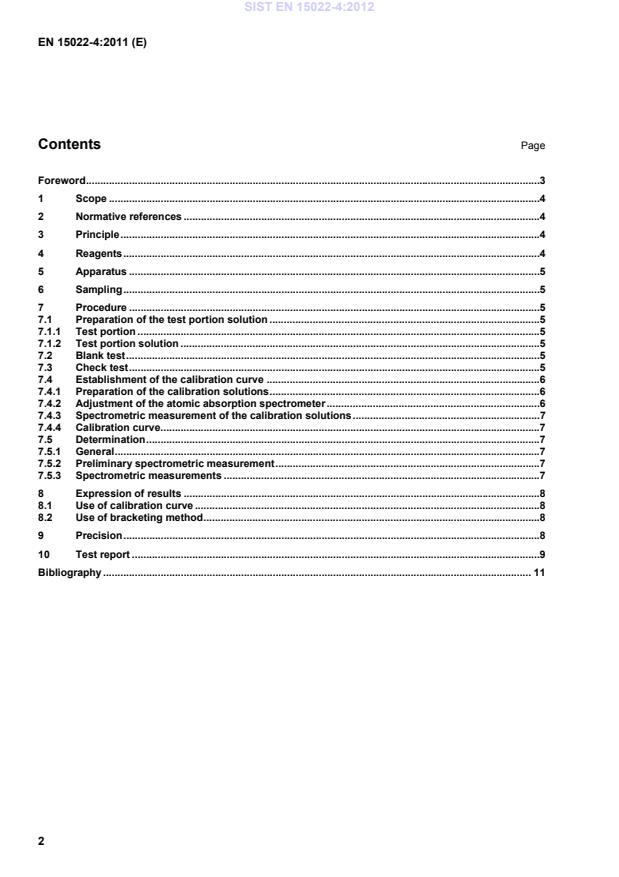
The document is organized into clauses on scope, normative references, principle, reagents, apparatus, sampling, procedure, expression of results, precision and test report, followed by a bibliography. In practice, that structure takes the user from sample preparation through measurement to the reportable result.
What are the key requirements of SIST EN 15022-4:2012?
SIST EN 15022-4:2012 is a laboratory method built around dissolution of a weighed sample, calibration with matched standards, and measurement of tin absorption at 286.3 nm. The important points are the sample preparation controls, the way the calibration solutions are matched to the test solution, and the two allowed ways to calculate the result.
Sample preparation and reagents
The standard requires sampling in accordance with ISO 1811-1 or ISO 1811-2, depending on the product form, and the test samples must be fine drillings, chips or millings with a maximum thickness of 0.5 mm. This matters because coarse or poorly prepared samples can dissolve unevenly and distort the tin result.
A 1 g test portion is dissolved in hydrochloric acid and hydrogen peroxide, then diluted to a defined volume. A blank test is run at the same time with pure copper, using the same reagent quantities, so the analyst can correct for reagent and preparation effects.
Calibration and spectrometric measurement
SIST EN 15022-4:2012 requires calibration solutions whose copper, chloride and acidity match those of the test solution. If an alloying element is present above 10 % by mass, it is added to the calibration solutions as well. This matching reduces matrix effects, which is important when the alloy composition can influence the signal.
The spectrometer uses a tin hollow-cathode lamp, a nitrous oxide/acetylene burner and an oxidizing flame. The method is set up around the 286.3 nm line, and the calibration series is measured with constant aspiration rate. In practice, this is the part that keeps the instrument conditions stable enough for a linear calibration.
Before the final determination, the document calls for a check test with a reference material or synthetic sample of known tin content. The analyses are performed independently in duplicate, so the user has two results to compare for consistency.
Calculation of the result
SIST EN 15022-4:2012 allows two calculation routes: use of the calibration curve or use of the bracketing method. The bracketing approach uses calibration solutions slightly below and above the estimated tin concentration, which helps when the unknown lies near the middle of a narrow range.
The result is reported as tin mass fraction in percent. Clause 8 gives the calculation framework, while Clause 9 gives validated precision data from six laboratories.
What terms does SIST EN 15022-4:2012 use?
- FAAS - Flame atomic absorption spectrometric method, used here to measure tin by its absorption in a flame.
- Test portion - The weighed sample amount taken for dissolution and analysis.
- Blank test - A parallel preparation without the sample, used to correct for reagent and procedural contribution.
- Check test - A preliminary verification using a known reference material or synthetic sample.
- Calibration curve - The relationship between absorbance and tin amount used to read the unknown concentration.
- Bracketing method - A way of estimating the result by measuring the sample between two nearby standards.
- Repeatability - Agreement between results under the same measurement conditions, reported in the precision section.
- Reproducibility - Agreement between results from different laboratories, also reported in the precision section.
Who uses SIST EN 15022-4:2012?
SIST EN 15022-4:2012 is used by analytical laboratories, quality control teams, and producers of copper and copper alloy products. It is relevant when unwrought, wrought or cast materials need a standardized tin determination for incoming inspection, production control or product verification.
What changed in SIST EN 15022-4:2012 from the previous edition?
SIST EN 15022-4:2012 supersedes CEN/TS 15022-4:2006. The foreword states two significant technical changes: the document was converted into a European Standard, and Clause 9 was completely revised to include precision results.
Which standards are used with SIST EN 15022-4:2012?
- ISO 1811-1 - Sampling of cast unwrought products for chemical analysis.
- ISO 1811-2 - Sampling of wrought products and castings for chemical analysis.
- prEN 15022-1 - The first part of the tin-content series, covering the titrimetric method.
- CEN/TS 15022-2 - The tin-content series part covering the spectrophotometric method.
- EN 15022-3 - The tin-content series part for low tin content by FAAS.
What does the SIST EN 15022-4:2012 document contain?
SIST EN 15022-4:2012 contains the full analytical procedure, including reagent preparation, apparatus setup, sampling, dissolution, blank and check tests, calibration, and result calculation. It also includes a calibration table for the medium tin range, precision data from a six-laboratory validation, and a figure showing the relationship between tin concentration and precision values. The test report clause lists the information that must be recorded, such as sample identification, method used, results and any unusual observations.
Relations
- Effective Date
- 01-Jan-2012
- Effective Date
- 28-Jan-2026
- Effective Date
- 28-Jan-2026
- Effective Date
- 28-Jan-2026
Get Certified
Connect with accredited certification bodies for this standard

Element Materials Technology
Materials testing and product certification.

Inštitut za kovinske materiale in tehnologije
Institute of Metals and Technology. Materials testing, metallurgical analysis, NDT.
Sponsored listings
Frequently Asked Questions
SIST EN 15022-4:2012 is a standard published by the Slovenian Institute for Standardization (SIST). Its full title is "Copper and copper alloys - Determination of tin content - Part 4: Medium tin content - Flame atomic absorption spectrometric method (FAAS)". This standard covers: This European Standard specifies a flame atomic absorption spectrometric method (FAAS) for the determination of the tin content of copper and copper alloys in the form of unwrought, wrought and cast products. The method is applicable to products having medium tin mass fractions between 0,2 % and 3,0 %.
This European Standard specifies a flame atomic absorption spectrometric method (FAAS) for the determination of the tin content of copper and copper alloys in the form of unwrought, wrought and cast products. The method is applicable to products having medium tin mass fractions between 0,2 % and 3,0 %.
SIST EN 15022-4:2012 is classified under the following ICS (International Classification for Standards) categories: 77.120.30 - Copper and copper alloys. The ICS classification helps identify the subject area and facilitates finding related standards.
SIST EN 15022-4:2012 has the following relationships with other standards: It is inter standard links to SIST-TS CEN/TS 15022-4:2007, SIST EN 12492:2000, SIST EN 960:1996, SIST EN ISO 6721-2:2008. Understanding these relationships helps ensure you are using the most current and applicable version of the standard.
SIST EN 15022-4:2012 is available in PDF format for immediate download after purchase. The document can be added to your cart and obtained through the secure checkout process. Digital delivery ensures instant access to the complete standard document.
Standards Content (Sample)
2003-01.Slovenski inštitut za standardizacijo. Razmnoževanje celote ali delov tega standarda ni dovoljeno.Kupfer und Kupferlegierungen - Bestimmung des Zinngehaltes - Teil 4: Mittlerer Zinngehalt - Flammenatomabsorptionsspektrometrisches Verfahren (FAAS)Cuivre et alliages de cuivre - Dosage de l'étain - Partie 4: Etain en moyenne teneur - Méthode par spectrométrie d'absorption atomique dans la flamme (SAAF)Copper and copper alloys - Determination of tin content - Part 4: Medium tin content - Flame atomic absorption spectrometric method (FAAS)77.120.30Baker in bakrove zlitineCopper and copper alloysICS:Ta slovenski standard je istoveten z:EN 15022-4:2011SIST EN 15022-4:2012en,de01-januar-2012SIST EN 15022-4:2012SLOVENSKI
STANDARDSIST-TS CEN/TS 15022-4:20071DGRPHãþD
EUROPEAN STANDARD NORME EUROPÉENNE EUROPÄISCHE NORM
EN 15022-4
November 2011 ICS 77.120.30 Supersedes CEN/TS 15022-4:2006English Version
Copper and copper alloys - Determination of tin content - Part 4: Medium tin content - Flame atomic absorption spectrometric method (FAAS)
Cuivre et alliages de cuivre - Détermination de la teneur en étain - Partie 4: Étain en moyenne teneur - Méthode par spectrométrie d'absorption atomique dans la flamme (SAAF)
Kupfer und Kupferlegierungen - Bestimmung des Zinngehaltes - Teil 4: Mittlerer Zinngehalt - Flammenatomabsorptionsspektrometrisches Verfahren (FAAS) This European Standard was approved by CEN on 24 September 2011.
CEN members are bound to comply with the CEN/CENELEC Internal Regulations which stipulate the conditions for giving this European Standard the status of a national standard without any alteration. Up-to-date lists and bibliographical references concerning such national standards may be obtained on application to the CEN-CENELEC Management Centre or to any CEN member.
This European Standard exists in three official versions (English, French, German). A version in any other language made by translation under the responsibility of a CEN member into its own language and notified to the CEN-CENELEC Management Centre has the same status as the official versions.
CEN members are the national standards bodies of Austria, Belgium, Bulgaria, Croatia, Cyprus, Czech Republic, Denmark, Estonia, Finland, France, Germany, Greece, Hungary, Iceland, Ireland, Italy, Latvia, Lithuania, Luxembourg, Malta, Netherlands, Norway, Poland, Portugal, Romania, Slovakia, Slovenia, Spain, Sweden, Switzerland and United Kingdom.
EUROPEAN COMMITTEE FOR STANDARDIZATION
COMITÉ EUROPÉEN DE NORMALISATION EUROPÄISCHES KOMITEE FÜR NORMUNG
Management Centre:
Avenue Marnix 17,
B-1000 Brussels © 2011 CEN All rights of exploitation in any form and by any means reserved worldwide for CEN national Members. Ref. No. EN 15022-4:2011: ESIST EN 15022-4:2012
...