

SIST EN 16090:2020
(Main)Copper and copper alloys - Estimation of average grain size by ultrasound
General Information
- Abstract
This document specifies a method for the estimation of the average grain size of copper and copper alloy products by ultrasound. This document can be applied for seamless round tubes as well as for flat products.
This method can be used in place of test methods according to EN ISO 2624, mentioned in the relevant product standards. As reference method and in case of doubt the intercept procedure or planimetric procedure will be used.
- Status
- Published
- Public Enquiry End Date
- 24-Apr-2019
- Publication Date
- 11-Dec-2019
- Technical Committee
- INEK - Nonferrous metals
- Current Stage
- 6060 - National Implementation/Publication (Adopted Project)
- Start Date
- 11-Dec-2019
- Due Date
- 15-Feb-2020
- Completion Date
- 12-Dec-2019

Overview
SIST EN 16090:2020 is a European standard that defines a non-destructive testing (NDT) method for estimating the average grain size in copper and copper alloy products using ultrasound. Developed by the Slovenski inštitut za standardizacijo (SIST), this standard provides guidelines for applying ultrasonic techniques to both seamless round tubes and flat copper products. The method serves as an alternative to traditional metallographic approaches, supporting efficient quality control and production processes in the copper industry.
Key Topics
- Scope of Application: The standard applies to copper and copper alloy products in annealed, light-annealed, light-drawn, or soft annealed conditions. It is suitable for various product forms, especially seamless tubes and flat products.
- Ultrasonic Testing Method: The process uses ultrasonic pulse-echo techniques to assess grain size by detecting backscattered signals from grain boundaries. Modern automated ultrasonic systems often perform these tasks with high repeatability and minimal operator intervention.
- Calibration and Reference Samples: Accurate grain size estimation relies on calibration against reference samples, which should represent the range of grain sizes found in the relevant product standards. Calibration involves comparing ultrasonic measurements with results from established reference methods (e.g., intercept or planimetric procedure).
- Personnel Qualification: Tests must be performed by trained operators under the supervision of qualified staff. When agreed upon, the standard references EN ISO 9712 for the qualification and certification of NDT personnel.
- Instrument Adjustment and Consistency: Regular adjustment and calibration of ultrasonic equipment against reference samples are required to maintain accuracy and reliability in measurement.
Applications
Implementing SIST EN 16090:2020 brings practical value to manufacturers and users of copper products by:
- Enabling Non-Destructive Quality Control: The ultrasonic estimation method is non-destructive, allowing for grain size evaluation without damaging the product, essential for maintaining product integrity.
- Supporting Production Efficiency: Automated ultrasonic systems can quickly screen large volumes of material, making the process suitable for in-process quality monitoring and high-throughput environments.
- Ensuring Product Consistency: Maintaining control of grain size is crucial for mechanical properties, corrosion resistance, and electrical conductivity in copper and copper alloy products.
- Facilitating Compliance: The standard is referenced in relevant product standards, helping manufacturers demonstrate regulatory and quality compliance in domestic and international markets.
- Offering Alternative to Metallographic Methods: This method provides a practical alternative where traditional invasive tests are not suitable, or as a rapid screening tool before more detailed examination.
Related Standards
Several complementary standards are referenced in SIST EN 16090:2020 for terminology, calibration, and equipment requirements, including:
- EN ISO 2624 - Copper and copper alloys - Estimation of average grain size (reference metallographic methods).
- EN ISO 5577 - Non-destructive testing - Ultrasonic testing vocabulary.
- EN ISO 9712 - Qualification and certification of NDT personnel.
- EN ISO 16810 - Non-destructive testing - Ultrasonic testing - General principles.
- EN 12668-1 / EN 12668-2 - Characterization and verification of ultrasonic examination equipment (instruments and probes).
These related standards ensure harmonization, interoperability, and best practices across the field of non-destructive testing in metallurgy and materials engineering. Adopting SIST EN 16090:2020 helps organizations align their processes with up-to-date European and international requirements for copper and copper alloy product assessment.
Relations
- Replaces
SIST EN 16090:2012 - Copper and copper alloys - Estimation of average grain size by ultrasound - Effective Date
- 01-Jan-2020
- Effective Date
- 28-Jan-2026
- Refers
SIST EN ISO 2624:1998 - Copper and copper alloys - Estimation of average grain size (ISO 2624:1990) - Effective Date
- 28-Jan-2026
- Refers
SIST EN ISO 5577:2026 - Non-destructive testing - Ultrasonic testing - Vocabulary (ISO 5577:2025) - Effective Date
- 28-Jan-2026
- Effective Date
- 28-Jan-2026
- Referred By
SIST EN 12449:2023 - Copper and copper alloys - Seamless, round tubes for general purposes - Effective Date
- 28-Jan-2026
- Referred By
SIST EN 12451:2012 - Copper and copper alloys - Seamless, round tubes for heat exchangers - Effective Date
- 28-Jan-2026
- Referred By
SIST EN 12449:2016 - Copper and copper alloys - Seamless, round tubes for general purposes - Effective Date
- 28-Jan-2026
- Referred By
SIST EN 12449:2016+A1:2019 - Copper and copper alloys - Seamless, round tubes for general purposes - Effective Date
- 28-Jan-2026
- Referred By
SIST EN 12452:2012 - Copper and copper alloys - Rolled, finned, seamless tubes for heat exchangers - Effective Date
- 28-Jan-2026
- Referred By
SIST EN 12449:2012 - Copper and copper alloys - Seamless, round tubes for general purposes - Effective Date
- 28-Jan-2026
- Effective Date
- 28-Jan-2026
Get Certified
Connect with accredited certification bodies for this standard

Element Materials Technology
Materials testing and product certification.

Inštitut za kovinske materiale in tehnologije
Institute of Metals and Technology. Materials testing, metallurgical analysis, NDT.
Sponsored listings
Frequently Asked Questions
SIST EN 16090:2020 is a standard published by the Slovenian Institute for Standardization (SIST). Its full title is "Copper and copper alloys - Estimation of average grain size by ultrasound". This standard covers: This document specifies a method for the estimation of the average grain size of copper and copper alloy products by ultrasound. This document can be applied for seamless round tubes as well as for flat products. This method can be used in place of test methods according to EN ISO 2624, mentioned in the relevant product standards. As reference method and in case of doubt the intercept procedure or planimetric procedure will be used.
This document specifies a method for the estimation of the average grain size of copper and copper alloy products by ultrasound. This document can be applied for seamless round tubes as well as for flat products. This method can be used in place of test methods according to EN ISO 2624, mentioned in the relevant product standards. As reference method and in case of doubt the intercept procedure or planimetric procedure will be used.
SIST EN 16090:2020 is classified under the following ICS (International Classification for Standards) categories: 77.120.30 - Copper and copper alloys. The ICS classification helps identify the subject area and facilitates finding related standards.
SIST EN 16090:2020 has the following relationships with other standards: It is inter standard links to SIST EN 16090:2012, SIST EN ISO 16810:2014, SIST EN ISO 2624:1998, SIST EN ISO 5577:2026, SIST EN ISO 9712:2022, SIST EN 12449:2023, SIST EN 12451:2012, SIST EN 12449:2016, SIST EN 12449:2016+A1:2019, SIST EN 12452:2012, SIST EN 12449:2012, SIST EN 12735-2:2025. Understanding these relationships helps ensure you are using the most current and applicable version of the standard.
SIST EN 16090:2020 is available in PDF format for immediate download after purchase. The document can be added to your cart and obtained through the secure checkout process. Digital delivery ensures instant access to the complete standard document.
Standards Content (Sample)
SLOVENSKI STANDARD
01-januar-2020
Nadomešča:
SIST EN 16090:2012
Baker in bakrove zlitine - Ocena povprečne velikosti zrn z ultrazvokom
Copper and copper alloys - Estimation of average grain size by ultrasound
Kupfer und Kupferlegierungen - Bestimmung der mittleren Korngröße durch Ultraschall
Cuivre et alliages de cuivre - Estimation de la taille moyenne de grain par ultrasons
Ta slovenski standard je istoveten z: EN 16090:2019
ICS:
77.120.30 Baker in bakrove zlitine Copper and copper alloys
2003-01.Slovenski inštitut za standardizacijo. Razmnoževanje celote ali delov tega standarda ni dovoljeno.
EN 16090
EUROPEAN STANDARD
NORME EUROPÉENNE
November 2019
EUROPÄISCHE NORM
ICS 77.120.30 Supersedes EN 16090:2011
English Version
Copper and copper alloys - Estimation of average grain
size by ultrasound
Cuivre et alliages de cuivre - Estimation de la taille Kupfer und Kupferlegierungen - Bestimmung der
moyenne de grain par ultrasons mittleren Korngröße durch Ultraschall
This European Standard was approved by CEN on 4 September 2019.
CEN members are bound to comply with the CEN/CENELEC Internal Regulations which stipulate the conditions for giving this
European Standard the status of a national standard without any alteration. Up-to-date lists and bibliographical references
concerning such national standards may be obtained on application to the CEN-CENELEC Management Centre or to any CEN
member.
This European Standard exists in three official versions (English, French, German). A version in any other language made by
translation under the responsibility of a CEN member into its own language and notified to the CEN-CENELEC Management
Centre has the same status as the official versions.
CEN members are the national standards bodies of Austria, Belgium, Bulgaria, Croatia, Cyprus, Czech Republic, Denmark, Estonia,
Finland, France, Germany, Greece, Hungary, Iceland, Ireland, Italy, Latvia, Lithuania, Luxembourg, Malta, Netherlands, Norway,
Poland, Portugal, Republic of North Macedonia, Romania, Serbia, Slovakia, Slovenia, Spain, Sweden, Switzerland, Turkey and
United Kingdom.
EUROPEAN COMMITTEE FOR STANDARDIZATION
COMITÉ EUROPÉEN DE NORMALISATION
EUROPÄISCHES KOMITEE FÜR NORMUNG
CEN-CENELEC Management Centre: Rue de la Science 23, B-1040 Brussels
© 2019 CEN All rights of exploitation in any form and by any means reserved Ref. No. EN 16090:2019 E
worldwide for CEN national Members.
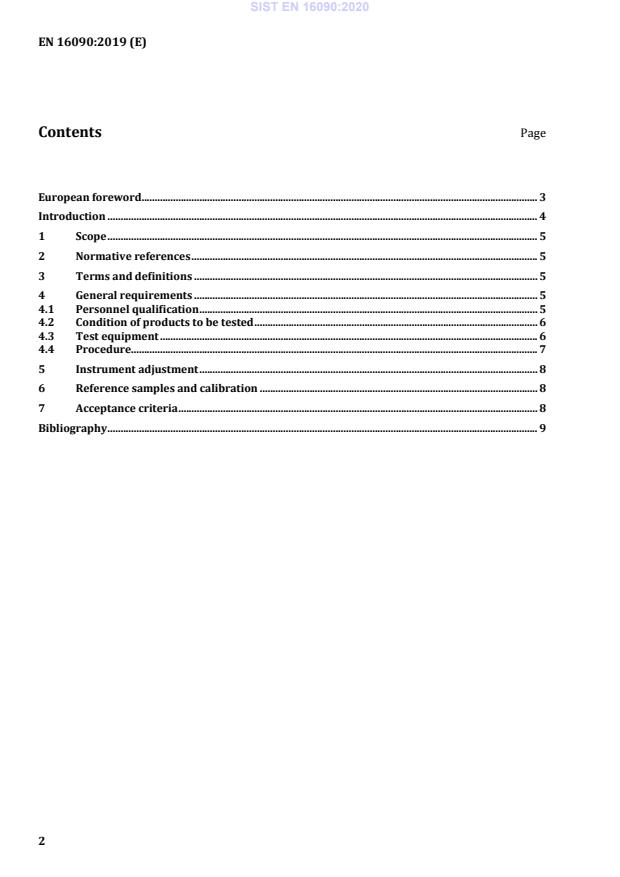
Contents Page
European foreword . 3
Introduction . 4
1 Scope . 5
2 Normative references . 5
3 Terms and definitions . 5
4 General requirements . 5
4.1 Personnel qualification . 5
4.2 Condition of products to be tested . 6
4.3 Test equipment . 6
4.4 Procedure. 7
5 Instrument adjustment . 8
6 Reference samples and calibration . 8
7 Acceptance criteria . 8
Bibliography . 9
European foreword
This document (EN 16090:2019) has been prepared by Technical Committee CEN/TC 133 “Copper and
copper alloys”, the secretariat of which is held by DIN.
This European Standard shall be given the status of a national standard, either by publication of an
identical text or by endorsement, at the latest by May 2020, and conflicting national standards shall be
withdrawn at the latest by May 2020.
Attention is drawn to the possibility that some of the elements of this document may be the subject of
patent rights. CEN shall not be held responsible for identifying any or all such patent rights.
This document supersedes EN 16090:2011.
The following modifications were implemented in this new edition of EN 16090:
— updated normative references;
— editorial modifications.
According to the CEN-CENELEC Internal Regulations, the national standards organisations of the
following countries are bound to implement this European Standard: Austria, Belgium, Bulgaria,
Croatia, Cyprus, Czech Republic, Denmark, Estonia, Finland, France, Germany, Greece, Hungary, Iceland,
Ireland, Italy, Latvia, Lithuania, Luxembourg, Malta, Netherlands, Norway, Poland, Portugal, Republic of
North Macedonia, Romania, Serbia, Slovakia, Slovenia, Spain, Sweden, Switzerland, Turkey and the
United Kingdom.
Introduction
The test by ultrasound described in this standard has the objective of estimating the dimension of
average grain size in copper and copper alloy products.
When using this test by ultrasound technique it is important to recognize that the estimation of grain
size is not a precise measurement because a metal structure is an aggregate of three-dimensional
crystals of varying sizes and shapes. Clearly, no two areas of observation can then be exactly the same.
S
...