


kSIST FprEN IEC 61169-1-3:2026
(Main)Radio-frequency connectors - Part 1-3: Electrical test methods - Surge withstand - Surge protective devices built-in coaxial connector - Performance requirements and testing methods
Radio-frequency connectors - Part 1-3: Electrical test methods - Surge withstand - Surge protective devices built-in coaxial connector - Performance requirements and testing methods
IEC 61169-1-3:2026 is applicable to built-in devices (hereinafter referred to as "SPD" - surge protective device) or surge protection of telecommunications and signalling networks against indirect and direct effects of lightning or other transient over voltages.
An SPD is intended to protect the electrical apparatus from transient over voltages and to divert surge currents.
The SPD built in the coaxial connector can be a gas discharge tube type, a ¼ wavelength short stub type, a flash-off gap type, and a hybrid type thereof.
The purpose of these built-in SPD is to protect modern electronic equipment connected to telecommunications and signalling networks with nominal system voltages up to 1 000 V (RMS) AC and 1 500 V DC.
Hochfrequenz-Steckverbinder – Teil 1-3: Elektrische Prüfverfahren – Überspannungsschutz – Überspannungsschutzgeräte mit eingebautem Koaxialstecker – Leistungsanforderungen und Prüfverfahren
Connecteurs pour fréquences radioélectriques - Partie 1-3: Méthodes d'essais électriques - Tenue aux tensions de choc - Connecteurs coaxiaux intégrés pour parafoudres - Exigences de performance et méthodes d'essai
L’IEC 61169-1-3:2026 est applicable aux dispositifs intégrés (appelés ci-dessous parafoudres ou SPD) ou à la protection des réseaux de télécommunications et de signalisation contre les surtensions, y compris les effets directs et indirects de la foudre ou d'autres surtensions transitoires.
Un parafoudre est destiné à protéger l'appareillage électrique contre les surtensions transitoires et à dévier les courants de choc.
Le parafoudre intégré dans le connecteur coaxial peut être de type tube à décharge de gaz, de type à ligne courte quart d'onde, de type à espace d'évaporation, et d'un type hybride de ceux-ci.
L'objectif de ces parafoudres intégrés est de protéger les équipements électroniques modernes connectés à des réseaux de télécommunications et de signalisation au moyen de tensions de système nominales allant jusqu'à 1 000 V (valeur efficace) en courant alternatif et 1 500 V en courant continu.
Radiofrekvenčni konektorji - 1-3. del: Električne preskusne metode - Odpornost na prenapetost - Prenapetostna zaščitna naprava z vgrajenim koaksialnim konektorjem - Zahtevane lastnosti in preskusne metode
General Information
- Status
- Not Published
- Public Enquiry End Date
- 31-Jul-2025
- Technical Committee
- MOC - Mobile Communications
- Current Stage
- 5020 - Formal vote (FV) (Adopted Project)
- Start Date
- 20-Jan-2026
- Due Date
- 10-Mar-2026
- Completion Date
- 23-Jan-2026
Overview
kSIST FprEN IEC 61169-1-3:2026 is a CLC and IEC standard that defines electrical test methods and performance requirements for radio-frequency (RF) connectors with built-in surge protective devices (SPDs). These specialized coaxial connectors are engineered to protect telecommunications and signaling equipment from transient overvoltages, such as those caused by lightning or electrical surges. The standard outlines comprehensive test procedures, environmental conditions, and performance benchmarks to ensure safety, reliability, and consistent surge protection in RF applications.
Key Topics
- Surge Protection in RF Connectors
- Addresses the integration of SPDs directly within coaxial connectors.
- Details various SPD types, including gas discharge tube (GDT), 1/4 wavelength short stub, flash-off gap, and hybrid designs.
- Electrical Test Methods
- Specifies procedures for sparkover voltage, return loss (VSWR), insertion loss, and insulation resistance.
- Outlines impulse durability tests to verify connector capability under surge events.
- Service and Test Conditions
- Defines environmental parameters for storage and operation, such as air pressure (altitude), temperature, and humidity.
- Provides guidance for both indoor (–5°C to +40°C) and outdoor (–40°C to +70°C) environments.
- Measurement Procedures
- Includes DC and impulse sparkover voltage tests.
- Details usage of measurement equipment such as oscilloscopes, high voltage probes, withstand voltage testers, and lightning surge simulators.
- Establishes the correct setup and procedures to obtain reliable and repeatable test results.
Applications
- Telecommunications
- Vital for protecting base stations, antenna feeders, and other RF communication lines from surge damage.
- Ensures equipment connected to networks with system voltages up to 1,000 V AC or 1,500 V DC are safeguarded.
- Broadcast and Data Transmission
- Used in broadcasting transmitters, satellite communication, and broadband network infrastructure requiring coaxial cable connections.
- Maintains operational integrity during electrical storms or power grid disturbances.
- Industrial and Commercial Electronics
- Applicable in automated systems, CCTV, cellular networks, and sensitive measurement equipment requiring RF interconnections and robust overvoltage protection.
- Signal and Communication Systems
- Ensures reliability and protection in systems where equipment interfaces with external cabling exposed to transient events.
Related Standards
- IEC 61169-1: General requirements and measuring methods for RF connectors.
- IEC 61643 Series: Covers surge protective devices for power distribution, telecommunications, and low-voltage networks.
- IEC 61000-4-5: Electromagnetic compatibility - Surge immunity test methods.
- ITU-T K-Series: Recommendations for overvoltage and surge protection in communication networks.
- IEC 61169-1-2: Additional performance and measuring requirements for RF connectors.
- IEC 61643-21: Performance requirements and testing methods for telecom and signaling network SPDs.
Practical Value
Implementing kSIST FprEN IEC 61169-1-3:2026 ensures that RF connectors with built-in surge protection meet internationally recognized benchmarks for safety and durability. By following standardized test methods, manufacturers and users can:
- Achieve reliable, repeatable qualification and acceptance of surge-protected connectors.
- Reduce risks of equipment failure and costly downtime due to transient overvoltages.
- Streamline compliance with global regulatory and certification requirements.
- Enhance confidence in the operational stability and service life of telecommunication, broadcast, and industrial RF systems utilizing coaxial connectors.
This standard is an essential reference for manufacturers, system integrators, and operators looking to ensure robust electrical protection in RF communications infrastructure.

Get Certified
Connect with accredited certification bodies for this standard

ANCE
Mexican certification and testing association.

Intertek Slovenia
Intertek testing, inspection, and certification services in Slovenia.

LNE (Laboratoire National de Métrologie et d'Essais)
French national laboratory for metrology and testing.
Sponsored listings
Frequently Asked Questions
kSIST FprEN IEC 61169-1-3:2026 is a draft published by the Slovenian Institute for Standardization (SIST). Its full title is "Radio-frequency connectors - Part 1-3: Electrical test methods - Surge withstand - Surge protective devices built-in coaxial connector - Performance requirements and testing methods". This standard covers: IEC 61169-1-3:2026 is applicable to built-in devices (hereinafter referred to as "SPD" - surge protective device) or surge protection of telecommunications and signalling networks against indirect and direct effects of lightning or other transient over voltages. An SPD is intended to protect the electrical apparatus from transient over voltages and to divert surge currents. The SPD built in the coaxial connector can be a gas discharge tube type, a ¼ wavelength short stub type, a flash-off gap type, and a hybrid type thereof. The purpose of these built-in SPD is to protect modern electronic equipment connected to telecommunications and signalling networks with nominal system voltages up to 1 000 V (RMS) AC and 1 500 V DC.
IEC 61169-1-3:2026 is applicable to built-in devices (hereinafter referred to as "SPD" - surge protective device) or surge protection of telecommunications and signalling networks against indirect and direct effects of lightning or other transient over voltages. An SPD is intended to protect the electrical apparatus from transient over voltages and to divert surge currents. The SPD built in the coaxial connector can be a gas discharge tube type, a ¼ wavelength short stub type, a flash-off gap type, and a hybrid type thereof. The purpose of these built-in SPD is to protect modern electronic equipment connected to telecommunications and signalling networks with nominal system voltages up to 1 000 V (RMS) AC and 1 500 V DC.
kSIST FprEN IEC 61169-1-3:2026 is classified under the following ICS (International Classification for Standards) categories: 33.120.30 - RF connectors. The ICS classification helps identify the subject area and facilitates finding related standards.
kSIST FprEN IEC 61169-1-3:2026 is available in PDF format for immediate download after purchase. The document can be added to your cart and obtained through the secure checkout process. Digital delivery ensures instant access to the complete standard document.
Standards Content (Sample)
SLOVENSKI STANDARD
oSIST prEN IEC 61169-1-3:2025
01-julij-2025
Radiofrekvenčni konektorji - 1-3. del: Električne preskusne metode - Odpornost na
prenapetost - Prenapetostna zaščitna naprava z vgrajenim koaksialnim
konektorjem - Zahtevane lastnosti in preskusne metode
Radio-frequency connectors - Part 1-3: Electrical test methods - Surge withstand - Surge
protective devices built-in coaxial connector - Performance requirements and testing
methods
Connecteurs pour fréquences radioélectriques - Partie 1-3: Méthodes d'essais
électriques - Tenue aux tensions de choc - Connecteurs coaxiaux intégrés pour
parafoudres - Exigences de performance et méthodes d'essai
Ta slovenski standard je istoveten z: prEN IEC 61169-1-3:2025
ICS:
33.120.30 Radiofrekvenčni konektorji RF connectors
(RF)
oSIST prEN IEC 61169-1-3:2025 en
2003-01.Slovenski inštitut za standardizacijo. Razmnoževanje celote ali delov tega standarda ni dovoljeno.
oSIST prEN IEC 61169-1-3:2025
oSIST prEN IEC 61169-1-3:2025
46F/706/CDV
COMMITTEE DRAFT FOR VOTE (CDV)
PROJECT NUMBER:
IEC 61169-1-3 ED1
DATE OF CIRCULATION: CLOSING DATE FOR VOTING:
2025-05-09 2025-08-01
SUPERSEDES DOCUMENTS:
46F/688/CD, 46F/700/CC
IEC SC 46F : RF AND MICROWAVE PASSIVE COMPONENTS
SECRETARIAT: SECRETARY:
United States of America Mr John Morelli
OF INTEREST TO THE FOLLOWING COMMITTEES: HORIZONTAL FUNCTION(S):
ASPECTS CONCERNED:
SUBMITTED FOR CENELEC PARALLEL VOTING NOT SUBMITTED FOR CENELEC PARALLEL VOTING
Attention IEC-CENELEC parallel voting
The attention of IEC National Committees, members of
CENELEC, is drawn to the fact that this Committee Draft for Vote
(CDV) is submitted for parallel voting.
The CENELEC members are invited to vote through the
CENELEC online voting system.
This document is still under study and subject to change. It should not be used for reference purposes.
Recipients of this document are invited to submit, with their comments, notification of any relevant patent rights of which they are
aware and to provide supporting documentation.
Recipients of this document are invited to submit, with their comments, notification of any relevant “In Some Countries” clau ses to
be included should this proposal proceed. Recipients are reminded that the CDV stage is the final stage for submitting ISC c lauses.
(SEE AC/22/2007 OR NEW GUIDANCE DOC).
TITLE:
Radio-frequency connectors – Part 1-3: Electrical test methods - Surge withstand – Surge protective devices
built-in coaxial connector – Performance requirements and testing methods
PROPOSED STABILITY DATE: 2028
NOTE FROM TC/SC OFFICERS:
The latest version from Japanese NC
electronic file, to make a copy and to print out the content for the sole purpose of preparing National Committee positions.
You may not copy or "mirror" the file or printed version of the document, or any part of it, for any other purpose without
permission in writing from IEC.
oSIST prEN IEC 61169-1-3:2025
– 2 – IEC CDV 61169-1-3 © IEC 2025
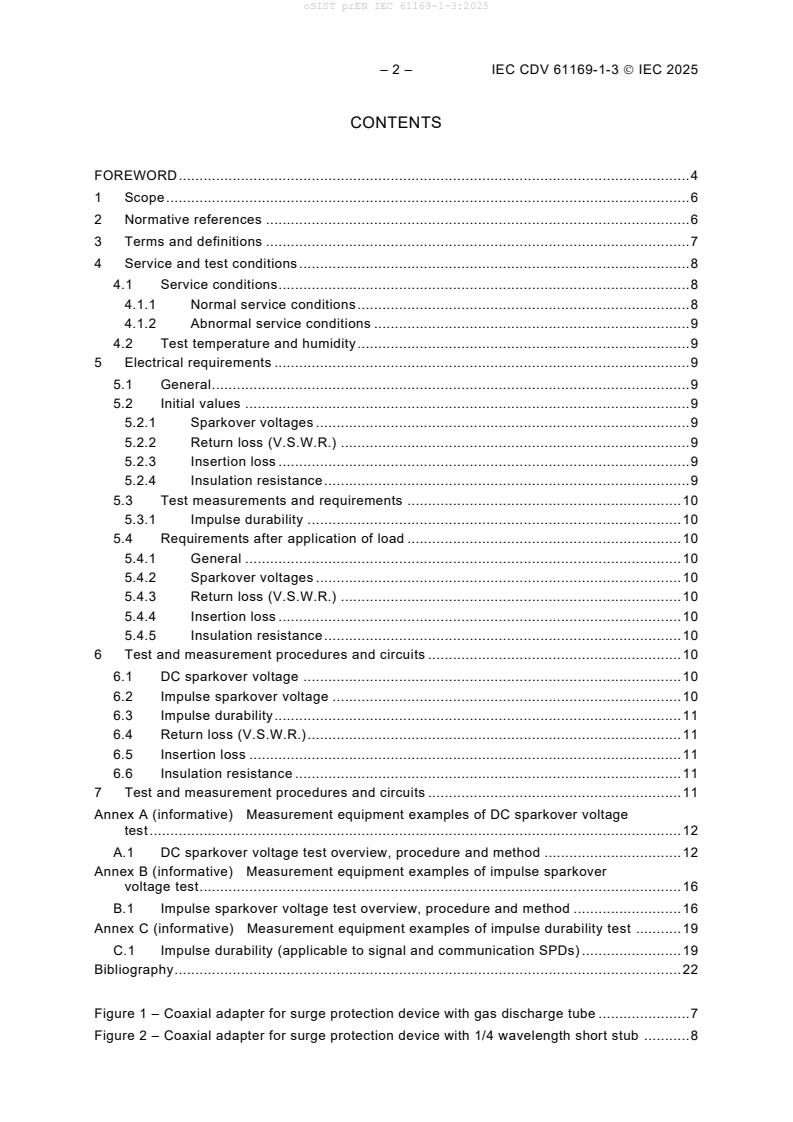
CONTENTS
FOREWORD . 4
1 Scope . 6
2 Normative references . 6
3 Terms and definitions . 7
4 Service and test conditions . 8
4.1 Service conditions . 8
4.1.1 Normal service conditions . 8
4.1.2 Abnormal service conditions . 9
4.2 Test temperature and humidity . 9
5 Electrical requirements . 9
5.1 General . 9
5.2 Initial values . 9
5.2.1 Sparkover voltages . 9
5.2.2 Return loss (V.S.W.R.) . 9
5.2.3 Insertion loss . 9
5.2.4 Insulation resistance . 9
5.3 Test measurements and requirements . 10
5.3.1 Impulse durability . 10
5.4 Requirements after application of load . 10
5.4.1 General . 10
5.4.2 Sparkover voltages . 10
5.4.3 Return loss (V.S.W.R.) . 10
5.4.4 Insertion loss . 10
5.4.5 Insulation resistance . 10
6 Test and measurement procedures and circuits . 10
6.1 DC sparkover voltage . 10
6.2 Impulse sparkover voltage . 10
6.3 Impulse durability . 11
6.4 Return loss (V.S.W.R.) . 11
6.5 Insertion loss . 11
6.6 Insulation resistance . 11
7 Test and measurement procedures and circuits . 11
Annex A (informative) Measurement equipment examples of DC sparkover voltage
test . 12
A.1 DC sparkover voltage test overview, procedure and method . 12
Annex B (informative) Measurement equipment examples of impulse sparkover
voltage test . 16
B.1 Impulse sparkover voltage test overview, procedure and method . 16
Annex C (informative) Measurement equipment examples of impulse durability test . 19
C.1 Impulse durability (applicable to signal and communication SPDs) . 19
Bibliography . 22
Figure 1 – Coaxial adapter for surge protection device with gas discharge tube . 7
Figure 2 – Coaxial adapter for surge protection device with 1/4 wavelength short stub . 8
oSIST prEN IEC 61169-1-3:2025
IEC CDV 61169-1-3 © IEC 202X – 3 –
Figure 3 – Circuit for d.c. sparkover voltage test at 100 V/s . 10
Figure 4 – Circuit for impulse sparkover voltage at 1 000 V/μs . 11
Figure 5 – Test circuits for impulse durability and overstressed fault mode . 11
Figure A.1 – Withstand voltage tester . 12
Figure A.2 – Oscilloscope . 12
Figure A.3 – High voltage probe . 13
Figure A.4a – Test Overview . 14
Figure A.4b – Test Overview . 14
Figure A.5a – Test results . 15
Figure A.5b – Test results (monitoring) . 15
Figure B.1 – Lightning surge tester . 16
Figure B.2 – Test Overview . 17
Figure B.3a – Test results . 17
Figure B.3b – Test results (monitoring) . 18
Figure C.1 – Direct lightning impulse generator. 19
Figure C.2 – Names of the parts of the direct lightning impulse generator . 20
Figure C.3a – Impulse durability measurement layout . 20
Figure C.3b – Impulse durability measurement layout (other view) . 20
Figure C.4a – Connector setup example . 21
Figure C.4b – Connector setup example (detail) . 21
oSIST prEN IEC 61169-1-3:2025
– 4 – IEC CDV 61169-1-3 © IEC 2025
INTERNATIONAL ELECTROTECHNICAL COMMISSION
____________
RADIO-FREQUENCY CONNECTORS –
Part 1-3: Electrical test methods – Surge withstand –
Surge protective devices built-in coaxial connector –
Performance requirements and testing methods
FOREWORD
1) The International Electrotechnical Commission (IEC) is a worldwide organization for standardization comprising
all national electrotechnical committees (IEC National Committees). The object of IEC is to promote international
co-operation on all questions concerning standardization in the electrical and electronic fields. To this end and
in addition to other activities, IEC publishes International Standards, Technical Specifications, Technical Reports,
Publicly Available Specifications (PAS) and Guides (hereafter referred to as “IEC Publication(s)”). Their
preparation is entrusted to technical committees; any IEC National Committee interested in the subject dealt with
may participate in this preparatory work. International, governmental and non-governmental organizations liaising
with the IEC also participate in this preparation. IEC collaborates closely with the International Org anization for
Standardization (ISO) in accordance with conditions determined by agreement between the two organizations.
2) The formal decisions or agreements of IEC on technical matters express, as nearly as possible, an international
consensus of opinion on the relevant subjects since each technical committee has representation from all
interested IEC National Committees.
3) IEC Publications have the form of recommendations for international use and are accepted by IEC National
Committees in that sense. While all reasonable efforts are made to ensure that the technical content of IEC
Publications is accurate, IEC cannot be held responsible for the way in which they are used or for any
misinterpretation by any end user.
4) In order to promote international uniformity, IEC National Committees undertake to apply IEC Publications
transparently to the maximum extent possible in their national and regional publications. Any divergence between
any IEC Publication and the corresponding national or regional publication shall be clearly indicated in the latter.
5) IEC itself does not provide any attestation of conformity. Independent certification bodies provide conformity
assessment services and, in some areas, access to IEC marks of conformity. IEC is not responsible for any
services carried out by independent certification bodies.
6) All users should ensure that they have the latest edition of this publication.
7) No liability shall attach to IEC or its directors, employees, servants or agents including individual experts and
members of its technical committees and IEC National Committees for any personal injury, property damage or
other damage of any nature whatsoever, whether direct or indirect, or for costs (including legal fees) and
expenses arising out of the publication, use of, or reliance upon, this IEC Publication or any other IEC Publications.
8) Attention is drawn to the Normative references cited in this publication. Use of the referenced publications is
indispensable for the correct application of this publication.
9) Attention is drawn to the possibility that some of the elements of this IEC Publication may be the subject of patent
rights. IEC shall not be held responsible for identifying any or all such patent rights.
International Standard IEC 61169-1 has been prepared by subcommittee 46F: R.F. and
microwave passive components, of IEC technical committee TC46.
The text of this International Standard is based on the following documents:
FDIS Report on voting
XX/XX/FDIS XX/XX/RVD
Full information on the voting for the approval of this International Standard can be found in the
report on voting indicated in the above table.
This document has been drafted in accordance with the ISO/IEC Directives, Part 2.
The committee has decided that the contents of this document will remain unchanged until the
stability date indicated on the IEC website under "http://webstore.iec.ch" in the data related to
the specific document. At this date, the document will be
oSIST prEN IEC 61169-1-3:2025
IEC CDV 61169-1-3 © IEC 202X – 5 –
• reconfirmed,
• withdrawn,
• replaced by a revised edition, or
• amended.
The National Committees are requested to note that for this document the stability date
is 20XX.
THIS TEXT IS INCLUDED FOR THE INFORMATION OF THE NATIONAL COMMITTEES AND WILL BE DELETED
AT THE PUBLICATION STAGE.
oSIST prEN IEC 61169-1-3:2025
– 6 – IEC CDV 61169-1-3 © IEC 2025
1 RADIO-FREQUENCY CONNECTORS –
3 Part 1-3: Electrical test methods – Surge withstand –
4 Surge protective devices built-in coaxial connector –
5 Performance requirements and testing methods
9 1 Scope
10 This International Standard is applicable to built-in devices (hereinafter referred to as SPD) or
11 surge protection of telecommunications and signalling networks against indirect and direct
12 effects of lightning or other transient over voltages.
14 SPD device that is intended to protect the electrical apparatus from transient overvoltages
15 and to divert surge currents.
17 The SPD built in the coaxial connector includes a gas discharge tube type, a 1/4 wavelength
18 short stub type, a flash-off gap type, and a hybrid type thereof.
20 The purpose of these built-in SPD connectors is to protect modern electronic equipment
21 connected to telecommunications and signaling networks with nominal system voltages up to
22 1 000 V (r.m.s.) a.c. and 1 500 V d.c.
24 2 Normative references
25 The following referenced documents are indispensable for the application of this document.
26 For dated references, only the edition cited applies. For undated references, the latest edition
27 of the referenced document (including any amendments) applies.
29 IEC 60050(702):1992, International Electrotechnical Vocabulary – Chapter 702: Oscillations,
30 signals and related devices
31 IEC 60050(726):1982, International Electrotechnical Vocabulary – Chapter 726: Transmission
32 lines and waveguides
33 IEC 61000-4-5, Electromagnetic compatibility (EMC) – Part 4: Testing and measurement
34 techniques – Section 5 – Surge immunity test
35 IEC 61169-1:2013, Radio frequency connectors - Part 1: Generic specification - General
36 requirements and measuring methods
37 IEC 61643-1, Surge protective devices connected to low-voltage power distribution systems –
38 Part 1: Performance requirements and testing methods
39 IEC 61643-11:2011, Low-voltage surge protective devises – Part 11: Surge protective devices
40 connected to low-voltage power systems – Requirements and test methods
41 IEC 61643-12:2008, Low-voltage surge protective devices – Part 12: Surge protective devices
42 connected to low-voltage power distribution systems – Selection and application principles
43 IEC 61643-21:2009, Low-voltage surge protective devices – Part 21: Surge protection devices
44 connected to telecommunications and signaling networks – Performance requirements and
45 testing methods
46 IEC 61643-22:2004, Low-voltage surge protective devices – Part 22: Surge protection devices
47 connected to telecommunications and signaling networks – Selection and application
48 principles
50 ITU-T Recommendation K.30:1993, Positive temperature coefficient (PTC) thermistors
51 ITU-T Recommendation K.55:2002, Overvoltage and overcurrent requirements for insulation
52 displacement connectors (IDC) terminations
oSIST prEN IEC 61169-1-3:2025
IEC CDV 61169-1-3 © IEC 202X – 7 –
53 ITU-T Recommendation K.65:2004, Overvoltage and overcurrent requirements for termination
54 modules with contacts for test ports or SPDs
55 ITU-T Recommendation O.9:1999, Measuring arrangements to assess the degree of
56 unbalance about earth
58 3 Terms and definitions
59 3.1
60 For the purposes of this document, the terms and definitions given in IEC 61169-1 2nd.
61 3.2
62 surge protective device
63 SPD
64 device that restricts the voltage of a designated port or ports, caused by a surge, when it
65 exceeds a predetermined level
66 NOTE 1 Secondary functions may be incorporated, such as a current-limiting to restrict
67 a terminal current.
68 NOTE 2 Typically the protective circuit has at least one non-linear voltage-limiting surge
69 protective component.
70 NOTE 3 An SPD is a complete assembly, having terminals to connect to the circuit
71 conductors.
72 3.3
73 voltage switching type SPD
74 SPD that has a high shunt impedance and will have a sudden and large reduction in
75 impedance in response to a voltage surge exceeding the threshold level of the SPD
76 NOTE Examples of components used in voltage switching type SPDs: air gaps, gas
77 discharge tubes (GDT) and thyristor surge suppressors (TSS).
91 Figure 1 - Coaxial adapter for surge protection device with gas discharge tube
93 3.4
94 1/4 wavelength short stub
95 specialized coaxial component that leverages a short stub design at a specific length to offer
96 surge protection for electronic devices. It serves to shield connected equipment from voltage
97 surges, ensuring the safe and reliable
...
Questions, Comments and Discussion
Ask us and Technical Secretary will try to provide an answer. You can facilitate discussion about the standard in here.
Loading comments...