


oSIST prEN 18338:2026
(Main)Food authenticity - Sample preparation for isotope ratio analysis of fruit and vegetable juices and related products
Food authenticity - Sample preparation for isotope ratio analysis of fruit and vegetable juices and related products
This document describes a method for sample preparation for the determination of C, N and H isotope ratio values in different fractions (sugar and pulp) of fruit and vegetable juices and their derivatives (concentrates, nectars, beverages etc.) by Elemental Analyser-Isotope Ratio Mass Spectrometry (EA-IRMS) or Isotope Ratio Measurement-Deuterium Nuclear Magnetic Resonance Spectroscopy (irm-2H-NMR).
It also covers ethanol produced by the fermentation of fruit and vegetable juices, and their derivatives.
Sample measurement is not included within this document.
This document does not concern the analytical methods after sample preparation, namely methods using IRMS (Isotope Ratio Mass Spectrometry) technique and isotope ratio measurement-deuterium nuclear magnetic resonance spectroscopy (irm-2H-NMR), also known as SNIF-NMR (Site-specific Natural Isotopic Fractionation by Nuclear Magnetic Resonance), used to quantify the isotopic ratios of the following nuclei: 13C/12C, 15N/14N and 2H/1H.
The interpretation of the obtained isotope delta values is not covered by this document.
Lebensmittelauthentizität - Probenvorbereitung für die Isotopenverhältnisanalyse von Frucht- und Gemüsesäften und verwandten Produkten
Dieses Dokument beschreibt ein Verfahren zur Probenvorbereitung für die Bestimmung der Werte der Isoto
penverhältnisse von C, N und H in verschiedenen Fraktionen (Zucker und Pulpe) von Obst- und Gemüsesäften und deren Derivaten (Konzentrate, Nektare, Getränke usw.) mittels Elementaranalyse mit Isotopenverhältnis- Massenspektrometrie (EA-IRMS) oder Messung von Isotopenverhältnissen mit nuklearmagnetischer
nanzspektroskopie von Deuterium (irm-2H-NMR).
Es umfasst auch Ethanol, das durch die Fermentation von Frucht- und Gemüsesäften sowie deren Derivaten hergestellt wird.
Die Messung von Proben ist in diesem Dokument nicht enthalten.
Dieses Dokument betrifft nicht die Analyseverfahren nach der Probenvorbereitung, d.h. Verfahren unter Verwendung der IRMS-Technik (Isotopenverhältnis-Massenspektrometrie) und der Messung von Isotopen
verhältnissen mit nuklearmagnetischer Resonanzspektroskopie von Deuterium (irm-2H-NMR), auch bekannt als SNIF-NMR (en:Site-specific Natural Isotopic Fractionation by Nuclear Magnetic Resonance (
zifische natürliche Isotopenfraktionierung, gemessen durch kernmagnetische Resonanzspektroskopie)), die zur quantitativen Bestimmung der Isotopenverhältnisse der folgenden Kerne verwendet werden: 13C/12C, 15N/14N und 2H/1H.
Die Interpretation der erhaltenen Isotopen-Delta-Werte wird in diesem Dokument nicht behandelt.
Authenticité des aliments - Préparation des échantillons pour l'analyse des rapports isotopiques des jus de fruits et de légumes et des produits dérivés
Le présent document décrit une méthode de préparation des échantillons pour la détermination des valeurs des rapports isotopiques des atomes de carbone C, d'azote N et d'hydrogène H dans différentes fractions (sucre et pulpe) des jus de fruits et de légumes et de leurs dérivés (concentrés, nectars, boissons, etc.) par spectrométrie de masse des rapports isotopiques couplée à un analyseur élémentaire (AE-SMRI) ou par spectroscopie de résonance magnétique nucléaire du deutérium pour mesure du rapport isotopique (irm-2H-RMN).
Il couvre également l'éthanol produit par la fermentation des jus de fruits et de légumes et de leurs dérivés.
Le mesurage de l'échantillon n'est pas inclus dans le présent document.
Le présent document ne concerne pas les méthodes analytiques après la préparation de l'échantillon, à savoir les méthodes utilisant la technique SMRI (spectrométrie de masse des rapports isotopiques) et la spectroscopie de résonance magnétique nucléaire du deutérium pour mesure du rapport isotopique (irm-2H-RMN), également connue sous le nom de SNIF-RMN (fractionnement isotopique naturel site spécifique mesuré par résonance magnétique nucléaire), utilisées pour quantifier les rapports isotopiques suivants: 13C/12C, 15N/14N et 2H/1H.
L'interprétation des déviations isotopiques obtenues n'est pas couverte par le présent document.
Pristnost živil - Priprava vzorcev za analizo izotopskih razmerij sadnih in zelenjavnih sokov ter sorodnih izdelkov
Ta dokument opisuje metodo za pripravo vzorcev za določanje izotopskih razmerij C, N in H v različnih frakcijah (sladkor in pulpa) sadnih in zelenjavnih sokov ter njihovih derivatov (koncentrati, nektarji, pijače itd.) z uporabo Elementnega analizatorja-izotopsko razmerje masne spektrometrije (EA-IRMS) ali merjenja izotopskega razmerja-deuterij jedrske magnetne resonance spektroskopije (irm-2H-NMR).
Prav tako zajema etanol, proizveden s fermentacijo sadnih in zelenjavnih sokov ter njihovih derivatov.
Merjenje vzorcev ni vključeno v ta dokument.
Ta dokument ne obravnava analitskih metod po pripravi vzorcev, in sicer metod, ki uporabljajo tehniko IRMS (izotopsko razmerje masne spektrometrije) in merjenje izotopskega razmerja-deuterij jedrske magnetne resonance spektroskopije (irm-2H-NMR), znano tudi kot SNIF-NMR (lokalno specifična naravna izotopska frakcionacija z jedrsko magnetno resonanco), ki se uporabljajo za kvantifikacijo izotopskih razmerij naslednjih jeder: 13C/12C, 15N/14N in 2H/1H.
Interpretacija dobljenih izotopskih delta vrednosti ni zajeta v tem dokumentu.
General Information
- Status
- Not Published
- Public Enquiry End Date
- 30-May-2026
- Technical Committee
- KŽP - Agricultural food products
- Current Stage
- 4020 - Public enquire (PE) (Adopted Project)
- Start Date
- 09-Apr-2026
- Due Date
- 27-Aug-2026
- Completion Date
- 01-Jun-2026

Overview
oSIST prEN 18338:2026: Food authenticity - Sample preparation for isotope ratio analysis of fruit and vegetable juices and related products is a draft European standard developed by CEN/TC 460 “Food Authenticity.” This document specifies a comprehensive method for preparing samples for the determination of carbon (C), nitrogen (N), and hydrogen (H) isotope ratios in different fractions-namely sugar and pulp-of fruit and vegetable juices and their derivatives (such as concentrates, nectars, and beverages). The protocol is also applicable to ethanol produced through fermentation from these products.
The standard is scoped to describe only the sample preparation process prior to the analytical measurement. It does not encompass the subsequent analytical techniques or interpretation of isotope ratio results, but it ensures that samples are prepared in a consistent and repeatable manner, enabling reliable results for isotope ratio determinations using Elemental Analyser-Isotope Ratio Mass Spectrometry (EA-IRMS) or Isotope Ratio Measurement-Deuterium Nuclear Magnetic Resonance Spectroscopy (irm-2H-NMR/SNIF-NMR).
Key Topics
- Sample Preparation for Isotope Analysis:
- Procedures for extracting sugars and pulp from fruit and vegetable juices, including concentrates, nectars, and beverages.
- Methods for fermenting sugars and extracting ethanol for hydrogen isotope (deuterium) analysis.
- Guidelines for centrifugation, purification, freeze-drying, and washing of juice fractions to eliminate interfering substances.
- Coverage of Different Juice Types and Derivatives:
- Applicability to a wide variety of juice matrices, including both direct juices and those made from concentrates or preserved products.
- Procedures for handling products with preservatives or low sugar content.
- Preparation for Downstream Analytical Techniques:
- Detailed steps to ensure isotopic integrity and prevent fractionation during sample processing.
- Requirements for equipment, including centrifuges, fermenters, distillation apparatus, and balances.
- Recommendations for using reference materials and validation of preparation performance.
- Precision and Repeatability:
- Summaries of method validation and permitted variances in sample preparation to support laboratory consistency.
Applications
oSIST prEN 18338:2026 plays a critical role in the field of food authenticity and quality control. By standardizing sample preparation, it supports:
- Detection of Food Adulteration:
- Reliable preparation of samples allows subsequent isotopic analysis (such as δ¹³C/¹²C, δ¹⁵N/¹⁴N, (D/H)) to verify the geographic and botanical origin of fruit and vegetable juices.
- Facilitates the identification of common fraudulent practices, such as addition of exogenous sugars or mislabeling of juice origin.
- Industry Quality Assurance:
- Juice producers, laboratories, and regulatory agencies can confidently use these protocols to ensure samples sent for isotope ratio testing are handled uniformly.
- Research and Method Validation:
- Provides a reproducible foundation for interlaboratory studies and validation work in isotope ratio measurement for fruit and vegetable juice products.
- Supporting Regulatory Compliance:
- Helps align testing laboratories with European and international standards used for food authenticity and labeling enforcement.
Related Standards
Implementation of oSIST prEN 18338:2026 is intended to work in harmony with multiple standards and reference methods, including:
- EN 18054: Determination of C and/or N isotope ratios in food by Elemental Analyzer - Isotope Ratio Mass Spectrometry (EA-IRMS).
- AOAC Official Method 995.17: Beet Sugar in Fruit Juices using Site-Specific Natural Isotope Fractionation-Nuclear Magnetic Resonance (SNIF-NMR).
- OIV Methods: International methods for stable isotope analysis of grape juice and wine, often referenced for specific isotopic ratios.
oSIST prEN 18338:2026 harmonizes with these standards by ensuring consistent sample preparation, thus supporting accurate and comparable isotope ratio measurements essential for verifying food authenticity and origin.
Keywords: food authenticity, isotope ratio analysis, fruit juice, vegetable juice, sample preparation, EA-IRMS, irm-2H-NMR, SNIF-NMR, food fraud detection, quality control, CEN standards, food adulteration, laboratory procedures, food analytical methods.
Get Certified
Connect with accredited certification bodies for this standard

BSI Group
BSI (British Standards Institution) is the business standards company that helps organizations make excellence a habit.

Bureau Veritas
Bureau Veritas is a world leader in laboratory testing, inspection and certification services.

DNV
DNV is an independent assurance and risk management provider.
Sponsored listings
Frequently Asked Questions
oSIST prEN 18338:2026 is a draft published by the Slovenian Institute for Standardization (SIST). Its full title is "Food authenticity - Sample preparation for isotope ratio analysis of fruit and vegetable juices and related products". This standard covers: This document describes a method for sample preparation for the determination of C, N and H isotope ratio values in different fractions (sugar and pulp) of fruit and vegetable juices and their derivatives (concentrates, nectars, beverages etc.) by Elemental Analyser-Isotope Ratio Mass Spectrometry (EA-IRMS) or Isotope Ratio Measurement-Deuterium Nuclear Magnetic Resonance Spectroscopy (irm-2H-NMR). It also covers ethanol produced by the fermentation of fruit and vegetable juices, and their derivatives. Sample measurement is not included within this document. This document does not concern the analytical methods after sample preparation, namely methods using IRMS (Isotope Ratio Mass Spectrometry) technique and isotope ratio measurement-deuterium nuclear magnetic resonance spectroscopy (irm-2H-NMR), also known as SNIF-NMR (Site-specific Natural Isotopic Fractionation by Nuclear Magnetic Resonance), used to quantify the isotopic ratios of the following nuclei: 13C/12C, 15N/14N and 2H/1H. The interpretation of the obtained isotope delta values is not covered by this document.
This document describes a method for sample preparation for the determination of C, N and H isotope ratio values in different fractions (sugar and pulp) of fruit and vegetable juices and their derivatives (concentrates, nectars, beverages etc.) by Elemental Analyser-Isotope Ratio Mass Spectrometry (EA-IRMS) or Isotope Ratio Measurement-Deuterium Nuclear Magnetic Resonance Spectroscopy (irm-2H-NMR). It also covers ethanol produced by the fermentation of fruit and vegetable juices, and their derivatives. Sample measurement is not included within this document. This document does not concern the analytical methods after sample preparation, namely methods using IRMS (Isotope Ratio Mass Spectrometry) technique and isotope ratio measurement-deuterium nuclear magnetic resonance spectroscopy (irm-2H-NMR), also known as SNIF-NMR (Site-specific Natural Isotopic Fractionation by Nuclear Magnetic Resonance), used to quantify the isotopic ratios of the following nuclei: 13C/12C, 15N/14N and 2H/1H. The interpretation of the obtained isotope delta values is not covered by this document.
oSIST prEN 18338:2026 is classified under the following ICS (International Classification for Standards) categories: 67.050 - General methods of tests and analysis for food products. The ICS classification helps identify the subject area and facilitates finding related standards.
oSIST prEN 18338:2026 is available in PDF format for immediate download after purchase. The document can be added to your cart and obtained through the secure checkout process. Digital delivery ensures instant access to the complete standard document.
Standards Content (Sample)
SLOVENSKI STANDARD
01-maj-2026
Pristnost živil - Priprava vzorcev za analizo izotopskih razmerij sadnih in
zelenjavnih sokov ter sorodnih proizvodov
Food authenticity - Sample preparation for isotope ratio analysis of fruit and vegetable
juices and related products
Lebensmittelauthentizität - Probenvorbereitung für die Isotopenverhältnisanalyse von
Frucht- und Gemüsesäften und verwandten Produkten
Authenticité des aliments - Préparation des échantillons pour l'analyse des rapports
isotopiques des jus de fruits et de légumes et des produits dérivés
Ta slovenski standard je istoveten z: prEN 18338
ICS:
67.050 Splošne preskusne in General methods of tests and
analizne metode za živilske analysis for food products
proizvode
2003-01.Slovenski inštitut za standardizacijo. Razmnoževanje celote ali delov tega standarda ni dovoljeno.
DRAFT
EUROPEAN STANDARD
NORME EUROPÉENNE
EUROPÄISCHE NORM
April 2026
ICS 67.050
English Version
Food authenticity - Sample preparation for isotope ratio
analysis of fruit and vegetable juices and related products
Authenticité des aliments - Préparation des Lebensmittelauthentizität - Probenvorbereitung für die
échantillons pour l'analyse des rapports isotopiques Isotopenverhältnisanalyse von Frucht- und
des jus de fruits et de légumes et des produits dérivés Gemüsesäften und verwandten Produkten
This draft European Standard is submitted to CEN members for enquiry. It has been drawn up by the Technical Committee
CEN/TC 460.
If this draft becomes a European Standard, CEN members are bound to comply with the CEN/CENELEC Internal Regulations
which stipulate the conditions for giving this European Standard the status of a national standard without any alteration.
This draft European Standard was established by CEN in three official versions (English, French, German). A version in any other
language made by translation under the responsibility of a CEN member into its own language and notified to the CEN-CENELEC
Management Centre has the same status as the official versions.
CEN members are the national standards bodies of Austria, Belgium, Bulgaria, Croatia, Cyprus, Czech Republic, Denmark, Estonia,
Finland, France, Germany, Greece, Hungary, Iceland, Ireland, Italy, Latvia, Lithuania, Luxembourg, Malta, Netherlands, Norway,
Poland, Portugal, Republic of North Macedonia, Romania, Serbia, Slovakia, Slovenia, Spain, Sweden, Switzerland, Türkiye and
United Kingdom.
Recipients of this draft are invited to submit, with their comments, notification of any relevant patent rights of which they are
aware and to provide supporting documentation.
Warning : This document is not a European Standard. It is distributed for review and comments. It is subject to change without
notice and shall not be referred to as a European Standard.
EUROPEAN COMMITTEE FOR STANDARDIZATION
COMITÉ EUROPÉEN DE NORMALISATION
EUROPÄISCHES KOMITEE FÜR NORMUNG
CEN-CENELEC Management Centre: Rue de la Science 23, B-1040 Brussels
© 2026 CEN All rights of exploitation in any form and by any means reserved Ref. No. prEN 18338:2026 E
worldwide for CEN national Members.
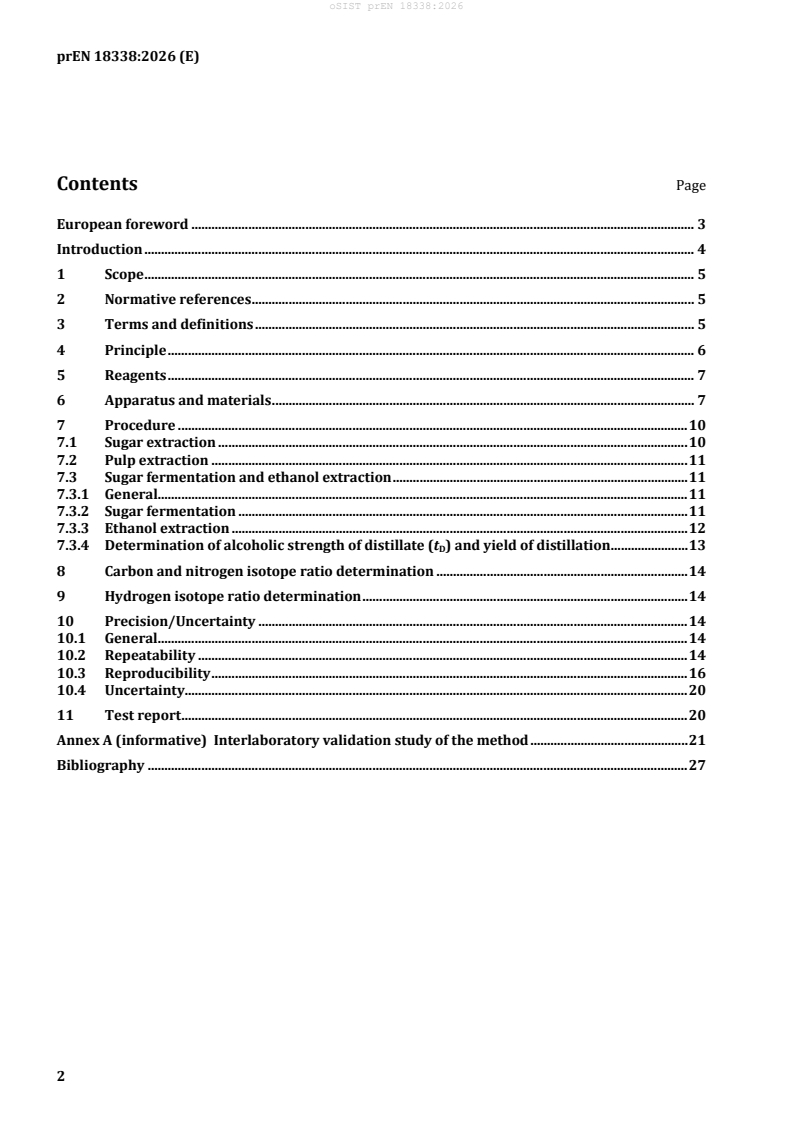
Contents Page
European foreword . 3
Introduction . 4
1 Scope . 5
2 Normative references . 5
3 Terms and definitions . 5
4 Principle . 6
5 Reagents . 7
6 Apparatus and materials . 7
7 Procedure . 10
7.1 Sugar extraction . 10
7.2 Pulp extraction . 11
7.3 Sugar fermentation and ethanol extraction . 11
7.3.1 General. 11
7.3.2 Sugar fermentation . 11
7.3.3 Ethanol extraction . 12
7.3.4 Determination of alcoholic strength of distillate (t ) and yield of distillation. . 13
D
8 Carbon and nitrogen isotope ratio determination . 14
9 Hydrogen isotope ratio determination . 14
10 Precision/Uncertainty . 14
10.1 General. 14
10.2 Repeatability . 14
10.3 Reproducibility . 16
10.4 Uncertainty. 20
11 Test report . 20
Annex A (informative) Interlaboratory validation study of the method . 21
Bibliography . 27
European foreword
This document (prEN 18338:2026) has been prepared by Technical Committee CEN/TC 460 “Food
Authenticity”, the secretariat of which is held by DIN.
This document is currently submitted to the CEN Enquiry.
This document is intended to serve as a framework in which the analysts can define their own analytical
work within the parameters of this document.
Introduction
A significant difference exists between the isotopic content of sugars, and other subsequent molecules in
biosynthesis, from plants following the different photosynthetic C3 (Calvin cycle), C4 (Hatch-Slack) or
CAM (Crassulean acid metabolism) cycles. Differences also exist due to climatological conditions during
cultivation of fruits and vegetables. Isotopic contents of the sugar, pulp, as well as ethanol obtained by
fermentation, are correlated within the same juice. Stable isotope ratios of these metabolites and their
correlation have the potential to reveal information on authenticity and adulterations such as exogenous
sugar addition, organic acids addition, etc. [1].
The relevant standards that could be used after sample preparation to quantify the isotopic ratios of the
13 12 15 14 2 1
following nuclei: C/ C, N/ N and H/ H are:
a) EN 18054:2025 “Determination of C and/or N isotope ratios in food by Elemental Analyzer – Isotope
Ratio Mass Spectrometry (EA- IRMS)” [2]
b) AOAC Official Method 995.17 Beet Sugar in Fruit Juices. Site Specific Natural Isotope Fractionation-
Nuclear Magnetic Resonance (SNIF-NMR) Method [3]
Following this protocol will result in isotope delta values or ppm (parts per million) with associated
measurement uncertainties.
13 15
Although other instrumental techniques can be applied to determine δ C or δ N, these other techniques
are not covered by this document.
13 12
For the determination of the C/ C and, (D/H) isotope ratio in grape juice, the International
I
Organization of Vine and Wine (OIV) methods are available as reference methods [4].
1 Scope
This document describes a method for sample preparation for the determination of C, N and H isotope
ratio values in different fractions (sugar and pulp) of fruit and vegetable juices and their derivatives
(concentrates, nectars, beverages etc.) by Elemental Analyser-Isotope Ratio Mass Spectrometry (EA-
IRMS) or Isotope Ratio Measurement-Deuterium Nuclear Magnetic Resonance Spectroscopy (irm- H-
NMR).
It also covers ethanol produced by the fermentation of fruit and vegetable juices, and their derivatives.
Sample measurement is not included within this document.
This document does not concern the analytical methods after sample preparation, namely methods using
IRMS (Isotope Ratio Mass Spectrometry) technique and isotope ratio measurement-deuterium nuclear
magnetic resonance spectroscopy (irm- H-NMR), also known as SNIF-NMR (Site-specific Natural Isotopic
Fractionation by Nuclear Magnetic Resonance), used to quantify the isotopic ratios of the following
13 12 15 14 2 1
nuclei: C/ C, N/ N and H/ H.
The interpretation of the obtained isotope delta values is not covered by this document.
2 Normative references
There are no normative references in this document.
3 Terms and definitions
For the purposes of this document, the following terms and definitions apply.
ISO and IEC maintain terminology databases for use in standardization at the following addresses:
— ISO Online browsing platform: available at https://www.iso.org/obp/
— IEC Electropedia: available at https://www.electropedia.org/
3.1
isotope delta
δ
stable isotope ratio of a sample expressed relative to a reference
Note 1 to entry: For carbon, this expression is given in Formula (1):
13 12 (1)
R C / C
( )
sample
13 12
δ C / C =
( )
ref
13 12
R C / C
( )
reference
13 12 13
Note 2 to entry: The term δref( C/ C) is often changed from the IUPAC format to δ Cref; this document uses the
IUPAC format for familiarity.
Note 3 to entry: To ensure international comparability of isotope delta values, a common reference is used; this
reference is an international measurement standard assigned by convention with isotope delta value exactly equal
to zero.
Note 4 to entry: Carbon isotope delta values for natural isotopic abundance in food materials are small and
expressed in permille (‰) rather than in their native form.
3.2
Vienna Peedee Belemnite
VPDB
international measurement standard for δ C
Note 1 to entry: VPDB is a virtual carbonate.
Note 2 to entry: The VPDB carbon isotope delta scale is defined by the exact isotope delta value assigned to the
calcium carbonate reference material NBS 19 of δ C = +1,95 ‰.
VPDB
3.3
atmospheric nitrogen
Air-N
international measurement standard for δ N
Note 1 to entry: The Air-N2 nitrogen isotope delta scale is defined by the exact isotope delta values assigned to
atmospheric nitrogen and the potassium nitrate reference material USGS32, with δ N = 0 and +180 ‰,
Air-N2
respectively [5, 6].
3.4
D/H
deuterium content measured by irm- H-NMR is generally expressed in absolute ratio D/H in ppm units,
according to the following expression (2):
2H A
ST A ST
I
A P Mm ST
DH//= × ×× × DH (2)
( ) ( )
i A ST A 2H ST
PM m I
i
where
P is the number of equivalent positions of hydrogen atoms;
M is the molar mass;
m is the mass;
I is the signal intensity of H;
ST this index refers to the standard;
this index refers to sample A;
A
(D/H) (D/H) is the site-specific isotope ratio for either the methyl group [(D/H) ] or the
i i I
methylene group [(D/H) ] in the ethanol molecule in sample A.
II
4 Principle
Analytical sample preparation of fruit and vegetable juices, and related products, for the C, N and H
isotope ratios analysis in the following matrices, is mandatory if elemental analyser-isotope ratio mass
spectrometry (EA-IRMS) or isotope ratio measurement-deuterium nuclear magnetic resonance
spectroscopy (irm- H-NMR) are willing to be used, according to Table 1.
Table 1 — Sample preparation of fruit and vegetable juices, and related products matrices,
according to EA-IRMS or irm- H-NMR techniques used
Isotope ratio Matrix Technique
13 12
C/ C sugar, pulp and ethanol (from the EA-IRMS
13 fermentation of sugar)
(expressed as δ C)
15 14
N/ N pulp EA-IRMS
(expressed as δ N)
2 1 2
H/ H ethanol (from the fermentation of irm- H-NMR
sugar)
in molecule I(CH DCH OH)
(expressed as (D/H)I 2 2
5 Reagents
Unless otherwise stated, use only reagents of recognized analytical grade.
5.1 Sugar extraction/isolation
5.1.1 Calcium hydroxide (powder, a mass fraction of 90 %)
5.1.2 Sulfuric acid, a mass fraction from 95 % to 97 %
5.2 Pulp extraction/isolation
5.2.1 Acetone
5.3 Sugar fermentation and ethanol extraction/isolation
5.3.1 Active dry yeast - Saccharomices bayanus cerevisiae, or equivalent
5.3.2 Karl Fischer reagent
Available commercially or prepare as indicated in AOAC official method 995.17 [3] - Optional
The alcoholic strength (% in mass fraction) of the distillate shall be determined with a precision better
than 0,1 %.
5.3.3 Clinic test for determination of glucose and ketones (optional) (e.g. Glucose Test Method:
colorimetric with test strips Glucose MQuant®)
5.3.4 Hydrogen peroxide (H O ), with a mass fraction of 30 %/35 % - Optional
2 2
5.3.5 Sodium hydroxide
5.3.6 Pumice stones - Optional
6 Apparatus and materials
6.1 Sugar and pulp extraction
6.1.1 Centrifuge
Capable of producing a centrifugal acceleration of 1 400 g at the base of the centrifuge tube.
NOTE The rotational frequency required to give correct centrifugal acceleration can be calculated from the
following equation:
n
ar11,18 ×× (3)
1 000
where
a is the centrifugal acceleration;
r is the radius of the centrifuge in cm, measured from the mid-point (the centrifuge axis) to the
bottom of the centrifuge tube when swung out;
n is the rotational frequency per minute.
6.1.2 Centrifuge tubes, of minimum 50 mL capacity
6.1.3 Water bath or hot plate with temperature control
6.1.4 Magnetic stirrer
6.1.5 pH meter
6.1.6 Freeze dryer
6.2 Sugar fermentation and ethanol extraction
6.2.1 Steam distillation system or an alternative device for determining alcoholic grade of the
fermented juice.
6.2.2 Electronic densitometer or an alternative device for determining alcoholic grade of the distillate
(pycnometer, chromatographic system or equivalent).
6.2.3 Preparatory distillation system
Any method for ethanol extraction can be used as long as the alcohol in the fermented product is
recovered without isotopic fractionation.
The Cadiot column shown in Figure 1 is an example of a manual distillation system.
=
Key
1 motor
2 water-tight seal
3 thermometer
4 atmosphere
5 column
6 stopper
7 probe
8 flask (this flask it is just an example; its shape may differ. A round-bottom distillation flask is more commonly
used)
* optional equipment
Figure 1 — Example of fully equipped distillation device (EN 16466-1:2024 [7])
Such a distillation system is composed of:
— electric heating mantle with voltage regulator;
— round-bottom flask with ground glass neck joint;
— cadiot column with rotating band (moving part in Polytetrafluoroethylene (PTFE)) as shown in
Figure 1;
— conical flasks with ground glass neck joints, for collection of the distillate.
Automatic distillation systems are also available.
Performance characteristics: preparatory distillation system shall be capable of isolating ethanol present
in a fermented product of minimum of 1 % alcoholic grade without isotopic fractionation (distillation
yield > 85 %) and obtaining a distillate with an alcoholic grade higher than a mass fraction of 85 %.
The performance of the distillation system shall be checked periodically for both the yield of extraction,
as well as for accuracy for the isotopic determination (e.g. by measuring certified reference materials as
BCR 660 or by participating in interlaboratory proficiency tests).
6.2.4 Refractometer to measure the sugar content of juices or concentrates, with a precision of 0,1°
Brix – Optional
6.2.5 Computerized system for monitoring fermentation - Optional
6.2.6 Karl Fisher titrator - Optional
6.2.7 Analytical balance, with a precision of at least 0,01 g
6.2.8 Fermentation vessel, equipped with a device to keep it airtight and to avoid loss of ethanol
6.2.9 Rotatory evaporator
7 Procedure
7.1 Sugar extraction
Remove any solids from a sample of approximately 50 mL of juice (or juice concentrate diluted up to the
minimum AIJN-Brix level listed in [8] by centrifugation (6.1.1), at minimum 1 400 g for 10 min.
After centrifugation, purify the supernatant. To do so, transfer the supernatant into a beaker (with a
magnetic flea and a temperature sensor) which is placed onto a hot plate at 90 °C (±5 °C) and activate the
magnetic stirrer. Alternatively, transfer the supernatant to a fresh centrifuge tube (with a magnetic flea)
and place the tube securely clamped or held in place by a rack/stand into water at 90 °C (±5 °C) (using a
water bath or a sufficiently large beaker with water on a hot plate).
Once the sample has reached 90 °C (±5 °C) add 2 g of powdered calcium hydroxide (5.1.1) to the solution
whilst stirring thoroughly and keeping it at 90 °C (±5 °C) for a minimum of 3 min.
Alternatively, if experiencing any problems with the distribution of calcium hydroxide, the calcium
hydroxide can be placed into a beaker where the supernatant is added under stirring, prior to heating
and further stirring for a minimum of 3 min at 90 °C (±5 °C).
NOTE 1 Other means of stirring (e.g. overhead stirrer or manual stirring with glass rod) are acceptable.
During this stage of the procedure, organic acids, amino acids and other compounds precipitate. Separate
the precipitates by centrifugation (6.1.1) of the hot solution (for a minimum of 3 min at 1 400 g minimum)
or by filtration. Decant the clear supernatant and acidify it with 1 mol/L sulfuric acid (5.1.2) in order to
obtain a pH of approximately 5 when the colour of the solution changes. This solution contains mainly
sugars, calcium sulphate and some colorants as minor ingredients. Partially remove residual calcium
sulphate by storing the solution in a refrigerator at approximately 4 °C overnight (approximately 15 h)
and decant afterwards. Freeze-dry the supernatant (or evaporate the liquid) and homogenize to a fine
powder before storing it in a glass vial with an air-tight cap.
NOTE 2 The final colour depends on the type of juice, for example in the case of orange juice it gets lighter.
7.2 Pulp extraction
Centrifuge a sample volume from 50 mL to 100 mL of fruit juice (direct or from concentrate) at 1 400 g
for 10 min to separate the suspended solids (pulp). To remove any adhering sugars, the pulp is washed
with water. To achieve this, resuspend the pellet in 40 mL of water and gently stir. Centrifuge this
suspension (6.1.1) for 5 min, and discard the water. Add a fresh aliquot of water, and repeat the process.
A further aliquot of water is used in the third and final wash with water.
After this third wash with water, resuspend the pulp in 40 mL of acetone to extract any lipid material.
After stirring in acetone with a glass rod centrifuge the pulp (6.1.1) as given above for 5 min and separate
the pulp from the solvent. Add a fresh aliquot of acetone, and repeat the process twice.
To obtain meaningful results it is essential that both, the water and acetone washes, are carried out
thoroughly. This ensures that all the sugars and lipids present are removed. If the pulp is not properly
washed, the lipids will cause a significant negative shift in the of C content of the pulp.
On completion of washes dry the pulp, e.g. by freeze-drying. This gives a white/grey solid.
7.3 Sugar fermentation and ethanol extraction
7.3.1 General
Ethanol shall be extracted from juices or related products by distilling after the sugars have been
fermented.
7.3.2 Sugar fermentation
7.3.2.1 Non-preserved single strength juice made from squeezed fruit
Determine the concentration of fermentable sugars of single strength juice, using (Brix by refractometry,
or HPLC). Place between 0,6 L and 1 L of juice, into a fermentation vessel. Based on the chosen juice
volume add the required amount of dry yeast. The yeast can be reactivated beforehand in a volume of
juice. The fermentation vessel is equipped with a device to keep it airtight and to avoid loss of ethanol.
Insert device to keep it airtight. Allow fermentation to proceed preferably in a dark place at 20 °C to25 °C
until the sugar is used up. It takes a few days depending on the type of fruit. Check for complete
fermentation of fermentable sugars (less than 5 g/L) by measuring residual sugars using liquid
chromatography or equivalent methods like colour reaction or clinic test for determination of glucose
and ketones.
Centrifuge or filter fermented liquid.
Determine alcoholic strength (t ) of supernatant or filtered liquid by following the instrument
Q
manufacturer’s instructions for steam distillation system (6.2.2). Collect distillate and measure alcoholic
content by densitometry (6.2.3). Alternatively, determine alcoholic strength of fermented product by
either pycnometric or chromatographic method or equivalent methods by following the instrument
manufacturer’s instructions.
The fermented product can then be distilled, following the procedure in 7.3.2.
7.3.2.2 Fermentation of juice concentrate
Dilute concentrate in fermentation vessel with demineralized water to approximately 0,6 L or slightly
more to obtain ca. 12 % to 15 % soluble solids considered as a mass fraction (Brix value measured by
refractometry) in diluted product. The diluted product can then be fermented following the procedure in
7.3.1.1.
When (D/H) ratio will be determined, dilute concentrated juices in one of these following ways:
I
— with an enriched fermented water prepared (prepared by diluting commercial D O with local tap
water) to have a (D/H) ratio around 155,7 ppm;
— with tap water. In this case the (D/H) parameter measured on ethanol shall be be normalized. For
I
18 16
this purpose, retain at a at least about 2 mL of diluted concentrate juice for determination of O/ O
isotopes ratio of the diluted sample’s water before fermentation for (D/H) calculation as indicated
sw
in [9] or [10]. The (D/H) ratio of the diluted sample’s water can be also measured directly on the juice
usin
...