

oSIST prEN IEC 62676-5:2026
(Main)Video surveillance systems for use in security applications - Part 5: Data specifications and image quality performance for camera devices
- Status
- Not Published
- Public Enquiry End Date
- 29-Nov-2026
- Technical Committee
- EAL - Alarm systems
- Current Stage
- 4020 - Public enquire (PE) (Adopted Project)
- Start Date
- 06-Oct-2026
- Due Date
- 23-Feb-2027

oSIST prEN IEC 62676-5:2026 is the Slovenian standard published by SIST for Video surveillance systems for use in security applications - Part 5: Data specifications and image quality performance for camera devices. It is the Slovenian version of prEN IEC 62676-5:2026 and it sets out how camera performance values should be described and how they should be measured.
The document is aimed at people who write, compare, test, buy, install, or maintain video surveillance cameras. In practice, it helps them use the same terms, the same test conditions, and the same reporting approach for analogue and digital camera outputs.
What does oSIST prEN IEC 62676-5:2026 specify?
oSIST prEN IEC 62676-5:2026 specifies recommendations and requirements for the representation and measurement of performance values for video surveillance camera equipment. It also states that camera output may be analogue, such as composite video, or digital, such as compressed network output or uncompressed SDI.
The document is organized into two main parts:
- requirements for describing video surveillance camera specification items
- requirements for measuring those specification items
The main clauses cover scope, normative references, terms and definitions, description of specification items, and measurement methods. The annexes add a normative test chart and several informative methods, examples, and application notes.
| Annex | What it covers |
|---|---|
| Annex A | Normative sine wave star test chart |
| Annex B | Informative IR illuminator safety requirements according to IEC 62471 |
| Annex C | Informative application specific performance requirements |
| Annex D | Informative streaming bit rate measurement |
| Annex E | Informative IP video latency measurement |
| Annex F | Informative motion blur measurement |
| Annex G | Informative SD/HD test target example |
| Annex H | Informative UL test chart implementations |
| Annex I | Informative explanation of image flare from light sources within and outside the field of view |
| Annex J | Informative complete requirements for camera equipment of video surveillance systems for use in security applications |
What are the key requirements of oSIST prEN IEC 62676-5:2026?
oSIST prEN IEC 62676-5:2026 sets a common language for camera specification data and a common way to test the data. That matters because the document is not only about performance claims - it also says how those claims are to be checked.
Specification items that should be described
Clause 4 lists the camera characteristics that should be provided in product information, such as the image sensor, maximum resolution, minimum illumination, low light performance, dynamic range, visible dynamic range, lens data, network functions, network security, and other general specifications. Table J.1 cross-references these items to the clause where each item is defined and to the test or verification method, where one is used.
For a buyer or specifier, this means product sheets should not rely on vague camera claims. They should state the relevant parameters in a way that can be compared across products, and where needed, checked by the methods in Clause 5.
Common measurement conditions
Clauses 5.1 to 5.3 set the standard shooting condition, the video signal quantization level, and the measurement environment. These clauses use fixed lighting conditions, standard camera settings, defined test charts, and specified measurement software.
In practice, a laboratory or manufacturer cannot freely choose the setup if it wants results that can be compared with other results. The document is trying to make the same camera give the same kind of result when it is measured by different parties.
Resolution, illumination, dynamic range and low light
Clause 5.4 includes dedicated methods for resolution, minimum illumination, dynamic range, visible dynamic range, and low light performance. Annex A supplies the sine wave star test chart used for resolution and focus-related measurements.
This is important because those are the parameters that often drive camera selection in security projects. Resolution shows how much detail the camera can capture, minimum illumination and low light performance show how the camera behaves in dim scenes, and dynamic range or VDR show how it handles bright and dark areas in the same image.
HDR and UHDR naming
The definitions in Clause 3 tie the name of the camera to measured dynamic range. High dynamic range (HDR) is defined as dynamic range measured according to 5.4.4 that reaches at least 70 dB, and ultra-high dynamic range (UHDR) is tied to 140 dB or more.
For users, this means the words HDR, WDR, UHDR, and similar terms are not just marketing labels in this document - they are linked to measured thresholds. If a camera does not reach the stated level, it should not be described with that term under this standard.
IR operation, distortion, flare, frame rate, and shading
Clause 5.4.7 covers infra-red illumination operating view distance for cameras with built-in IR illuminators, including dark-room setup, viewing distance reporting, and safety references to IEC 62471 and IEC 60825-1. Clause 5.4.8 covers image distortion, including line geometric distortion and chromatic displacement. Clause 5.4.9 covers image flare using a collimated light source and angle-dependent measurement. Clause 5.4.10 covers capture frame rate with an LED array test fixture. Clause 5.4.11 covers shading analysis for luminance and colour non-uniformity.
In practice, these clauses matter because they cover the problems that affect real surveillance images: bent straight lines, glare, low-light blur, frame-rate loss, uneven brightness, and colour shifts across the image.
Application-specific quality levels
Annex C gives application-specific performance requirements and introduces camera quality assessment and camera quality levels. It is presented as informative in this edition, but it shows how performance needs can vary by use case.
That is useful when a project needs to balance image quality against cost or environment. A wide-area public space and a critical infrastructure site may not need the same level of camera performance in every category.
What terms does oSIST prEN IEC 62676-5:2026 define?
oSIST prEN IEC 62676-5:2026 defines technical terms that are used throughout the document so that camera specifications and test reports mean the same thing to different readers.
- 4k - an image size format with about 4 000 horizontal pixels, identified here as 3 840 × 2 160 UHDTV.
- C/CS mount - the lens mounting standards commonly used for video surveillance cameras.
- Compression ratio - the ratio between uncompressed and compressed size; a higher ratio usually means smaller files and lower image quality.
- Dynamic range (DR) - the quotient between the maximum measurable signal and the minimum measurable signal.
- High dynamic range (HDR) - a camera dynamic range of at least 70 dB when measured as specified in the standard.
- Image flare - unwanted signal increase caused by light that does not come from the subject point.
- Group of pictures (GOP) - a coded video sequence made up of I, P, and B frames.
- Latency - the time between a network request for data and the start of the data transfer.
Who uses oSIST prEN IEC 62676-5:2026?
oSIST prEN IEC 62676-5:2026 is used by camera manufacturers, test laboratories, installers, integrators, specifiers, and maintenance teams. It is also relevant to buyers and quality managers who need to compare camera claims against a testable method.
Manufacturers use it to write product documentation and declare measurable camera data. Test houses use it to run repeatable measurements. Specifiers and buyers use it to set procurement requirements. Installers and integrators use it when they need to confirm that a camera mode, mounting position, or IR setup matches the intended application.
What changed in oSIST prEN IEC 62676-5:2026 from the previous edition?
oSIST prEN IEC 62676-5:2026 is the second edition and it cancels and replaces the first edition published in 2018. The document states that this edition is a technical revision.
The significant changes listed are:
- revision based on international change requests
- a new camera specification and measurement item for minimum illumination, including test charts
- an updated low-light performance camera test example report for state-of-the-art cameras
- a new informative Annex C with application specific performance requirements for critical infrastructure monitoring
- new minimum dynamic-range requirements for HDR at 70 dB and for UHDR at 140 dB
Which standards are used with oSIST prEN IEC 62676-5:2026?
oSIST prEN IEC 62676-5:2026 depends on several referenced standards for symbols, safety, colour, image tests, transmission, and camera interfaces. These references supply the measurement and safety foundations that this part builds on.
| Standard | What it contributes |
|---|---|
| IEC 60417 | Graphical symbols used on equipment and in warning labels |
| IEC 60825-1 | Laser product safety classification and requirements |
| IEC 61146-1 | Video camera test chart and measurement methods |
| IEC 61966-2-1 | sRGB colour space conversion |
| IEC 62471 | Photobiological safety of lamps and lamp systems |
| IEC 62676-1-2:2013 | Video transmission performance requirements |
| IEC 62676-2-3 | IP interoperability implementation based on Web services |
| IEC 62676-3 | Analog and digital video interfaces |
| ISO 12233 | Resolution and spatial frequency response methods |
| ISO 14524 | Opto-electronic conversion function measurement |
| ISO 15739 | Noise measurement in electronic imaging |
| ITU-R BT.601 | Studio encoding parameters for SD television |
| ITU-R BT.709 | HDTV production and exchange encoding parameters |
The introduction also places this part within the IEC 62676 series, alongside Parts 1 to 4 on system requirements, transmission protocols, video interfaces, and application guidelines.
What does the oSIST prEN IEC 62676-5:2026 document contain?
oSIST prEN IEC 62676-5:2026 contains measurement methods, test setups, figures, tables, and formulas for camera performance evaluation. It includes detailed procedures for resolution, minimum illumination, dynamic range, visible dynamic range, low light performance, IR viewing distance, image distortion, image flare, capture frame rate, and shading analysis.
It also contains a large set of figures showing test charts and camera setups, including reflective and transparent chart setups, alignment methods, distortion grids, flare geometry, and frame-rate testers. Annex A gives the sine wave star chart design, Annex B explains IR safety reporting, Annex D through F provide extra test methods for streaming bit rate, latency, and motion blur, and Annex J compiles the camera-equipment requirements in one place.
Relations
- Effective Date
- 24-Jan-2023
Get Certified
Connect with accredited certification bodies for this standard

ANCE
Mexican certification and testing association.

CIS Institut d.o.o.
Personal Protective Equipment (PPE) certification body. Notified Body NB-2890 for EU Regulation 2016/425 PPE.

Intertek Slovenia
Intertek testing, inspection, and certification services in Slovenia.
Sponsored listings
Frequently Asked Questions
oSIST prEN IEC 62676-5:2026 is a draft published by the Slovenian Institute for Standardization (SIST). Its full title is "Video surveillance systems for use in security applications - Part 5: Data specifications and image quality performance for camera devices". This standard covers: Video surveillance systems for use in security applications - Part 5: Data specifications and image quality performance for camera devices
Video surveillance systems for use in security applications - Part 5: Data specifications and image quality performance for camera devices
oSIST prEN IEC 62676-5:2026 is classified under the following ICS (International Classification for Standards) categories: 13.320 - Alarm and warning systems; 33.160.40 - Video systems. The ICS classification helps identify the subject area and facilitates finding related standards.
oSIST prEN IEC 62676-5:2026 has the following relationships with other standards: It is inter standard links to SIST EN IEC 62676-5:2018. Understanding these relationships helps ensure you are using the most current and applicable version of the standard.
oSIST prEN IEC 62676-5:2026 is available in PDF format for immediate download after purchase. The document can be added to your cart and obtained through the secure checkout process. Digital delivery ensures instant access to the complete standard document.
Standards Content (Sample)
SLOVENSKI STANDARD
01-november-2026
Sistemi videonadzora za uporabo v varnostnih aplikacijah - 5. del: Specifikacije
podatkov in kakovost slike kamer
Video surveillance systems for use in security applications - Part 5: Data specifications
and image quality performance for camera devices
Videoüberwachungsanlagen für Sicherungsanwendungen — Teil 5:
Leistungsbeschreibung und Bildqualitätseigenschaften für Kameras
Systèmes de vidéosurveillance destines à être utilisés dans les applications de sécurité -
Partie 5: Spécifications des données et performances de la qualité d'image pour les
dispositifs de caméra
Ta slovenski standard je istoveten z: prEN IEC 62676-5:2026
ICS:
13.320 Alarmni in opozorilni sistemi Alarm and warning systems
33.160.40 Video sistemi Video systems
2003-01.Slovenski inštitut za standardizacijo. Razmnoževanje celote ali delov tega standarda ni dovoljeno.
79/750/CDV
COMMITTEE DRAFT FOR VOTE (CDV)
PROJECT NUMBER:
IEC 62676-5 ED2
DATE OF CIRCULATION: CLOSING DATE FOR VOTING:
2026-09-25 2026-12-18
SUPERSEDES DOCUMENTS:
79/714/CD, 79/719A/CC
IEC TC 79 : ALARM AND ELECTRONIC SECURITY SYSTEMS
SECRETARIAT: SECRETARY:
France Mr Jean-François LIGNEREUX
OF INTEREST TO THE FOLLOWING COMMITTEES: HORIZONTAL FUNCTION(S):
ASPECTS CONCERNED:
SUBMITTED FOR CENELEC PARALLEL VOTING NOT SUBMITTED FOR CENELEC PARALLEL VOTING
Attention IEC-CENELEC parallel voting
The attention of IEC National Committees, members of
CENELEC, is drawn to the fact that this Committee Draft
for Vote (CDV) is submitted for parallel voting.
The CENELEC members are invited to vote through the
CENELEC online voting system.
This document is still under study and subject to change. It should not be used for reference purposes.
Recipients of this document are invited to submit, with their comments, notification of any relevant patent rights of
which they are aware and to provide supporting documentation.
Recipients of this document are invited to submit, with their comments, notification of any relevant “In Some
Countries” clauses to be included should this proposal proceed. Recipients are reminded that the CDV stage is
the final stage for submitting ISC clauses. (SEE AC/22/2007 OR NEW GUIDANCE DOC).
TITLE:
Video surveillance systems for use in security applications - Part 5: Data specifications and
image quality performance for camera devices
PROPOSED STABILITY DATE: 2031
NOTE FROM TC/SC OFFICERS:
download this electronic file, to make a copy and to print out the content for the sole purpose of preparing National
Committee positions. You may not copy or "mirror" the file or printed version of the document, o r any part of it,
for any other purpose without permission in writing from IEC.
IEC CDV 62676-5 © IEC 2026
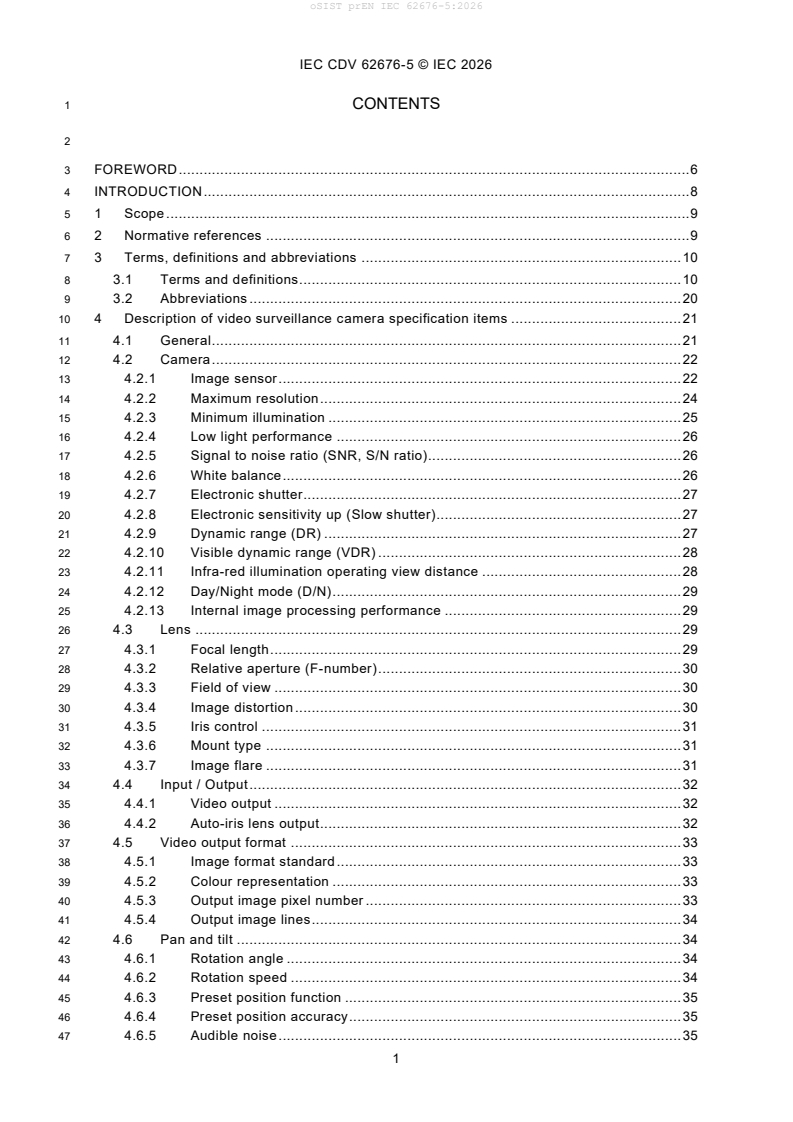
1 CONTENTS
3 FOREWORD . 6
4 INTRODUCTION . 8
5 1 Scope . 9
6 2 Normative references . 9
7 3 Terms, definitions and abbreviations . 10
8 3.1 Terms and definitions . 10
9 3.2 Abbreviations . 20
10 4 Description of video surveillance camera specification items . 21
11 4.1 General . 21
12 4.2 Camera . 22
13 4.2.1 Image sensor . 22
14 4.2.2 Maximum resolution . 24
15 4.2.3 Minimum illumination . 25
16 4.2.4 Low light performance . 26
17 4.2.5 Signal to noise ratio (SNR, S/N ratio) . 26
18 4.2.6 White balance . 26
19 4.2.7 Electronic shutter . 27
20 4.2.8 Electronic sensitivity up (Slow shutter). 27
21 4.2.9 Dynamic range (DR) . 27
22 4.2.10 Visible dynamic range (VDR) . 28
23 4.2.11 Infra-red illumination operating view distance . 28
24 4.2.12 Day/Night mode (D/N) . 29
25 4.2.13 Internal image processing performance . 29
26 4.3 Lens . 29
27 4.3.1 Focal length . 29
28 4.3.2 Relative aperture (F-number) . 30
29 4.3.3 Field of view . 30
30 4.3.4 Image distortion . 30
31 4.3.5 Iris control . 31
32 4.3.6 Mount type . 31
33 4.3.7 Image flare . 31
34 4.4 Input / Output . 32
35 4.4.1 Video output . 32
36 4.4.2 Auto-iris lens output . 32
37 4.5 Video output format . 33
38 4.5.1 Image format standard . 33
39 4.5.2 Colour representation . 33
40 4.5.3 Output image pixel number . 33
41 4.5.4 Output image lines . 34
42 4.6 Pan and tilt . 34
43 4.6.1 Rotation angle . 34
44 4.6.2 Rotation speed . 34
45 4.6.3 Preset position function . 35
46 4.6.4 Preset position accuracy . 35
47 4.6.5 Audible noise . 35
IEC CDV 62676-5 © IEC 2026
48 4.7 Network . 35
49 4.7.1 Network interface. 35
50 4.7.2 Image and video compression format. 36
51 4.7.3 Bit rate control . 36
52 4.7.4 Maximum frame rate . 37
53 4.7.5 Maximum number of encoding streams . 37
54 4.7.6 Multicast streaming . 37
55 4.7.7 Maximum number of connections . 38
56 4.7.8 Total encoding performance . 38
57 4.7.9 Image stream delay (Latency) . 38
58 4.7.10 Camera storage (Local storage). 38
59 4.7.11 Audio function. 39
60 4.7.12 Network protocol. 39
61 4.7.13 Camera time synchronization and localization . 39
62 4.8 Network security . 40
63 4.8.1 General description . 40
64 4.8.2 Network authentication . 40
65 4.8.3 Video authentication and watermarking . 40
66 4.9 Other specifications . 41
67 5 Measurement methods of video surveillance camera specification items . 41
68 5.1 Setting of standard shooting condition . 41
69 5.1.1 General . 41
70 5.1.2 Common standard shooting condition . 41
71 5.2 Video signal quantization level . 43
72 5.2.1 General . 43
73 5.2.2 Digital video signal quantization level . 43
74 5.2.3 Other quantization levels . 44
75 5.3 Measurement environment . 44
76 5.3.1 General . 44
77 5.3.2 Test chart . 44
78 5.3.3 Software for measurement . 47
79 5.4 Measuring methods . 47
80 5.4.1 General . 47
81 5.4.2 Resolution . 47
82 5.4.3 Minimum illumination . 55
83 5.4.4 Dynamic range . 58
84 5.4.5 Visible dynamic range (VDR) . 68
85 5.4.6 Low light performance . 71
86 5.4.7 Infra-red illumination operating view distance . 83
87 5.4.8 Image distortion . 87
88 5.4.9 Image flare . 91
89 5.4.10 Capture frame rate . 99
90 5.4.11 Shading analysis . 102
91 Annex A (normative) Sine wave star test chart . 104
92 Annex B (informative) Infra-red illuminator safety requirements according to
93 IEC 62471 . 107
94 B.1 General . 107
95 B.2 Declaration of the hazard distance. 107
IEC CDV 62676-5 © IEC 2026
96 B.3 Other information to be declared . 108
97 B.4 Item indication . 108
98 B.5 Content indication . 108
99 Annex C (informative) Application specific performance requirements . 109
100 C.1 General . 109
101 Annex D (informative) Streaming bit rate (bit-stream) . 112
102 D.1 General . 112
103 D.2 Description . 112
104 D.3 Uncompressed and compressed video streams . 112
105 D.4 Content indication . 113
106 D.4.1 General . 113
107 D.4.2 Video streaming in a system . 113
108 D.4.3 Network traffic analysis (NTA) . 113
109 D.5 Measuring the video streaming . 114
110 D.5.1 General . 114
111 D.5.2 The procedure of measuring streaming bit rate in a system . 114
112 Annex E (informative) IP video latency measurement . 117
113 E.1 General . 117
114 E.2 Description . 117
115 E.3 Visual perception of the latency . 119
116 E.4 Measurement procedure for IP video latency . 119
117 E.5 Content indication . 120
118 Annex F (informative) Motion blur measurement . 121
119 F.1 General . 121
120 F.2 Description . 121
121 F.3 Projected pixel shift (PPS) due to moving objects . 121
122 F.4 Content indication . 121
123 F.5 Calculating the projected pixel shift of moving objects . 122
124 F.6 Calculating the projected pixel shift of moving objects at various angles . 123
125 F.7 Acceptable PPS . 123
126 F.8 Test chart measuring of moving objects . 124
127 Annex G (informative) SD/HD test target example . 128
128 Annex H (informative) UL test chart implementations . 129
129 Annex I (informative) Explanation of image flare from light source within and outside
130 of camera field of view . 130
131 I.1 Image flare of light source within the field of view . 130
132 I.2 Image flare of light source outside of the field of view . 130
133 Annex J (informative) Complete requirements for Camera Equipment of Video
134 Surveillance Systems for use in security applications . 132
135 Bibliography . 136
137 Figure 1 – Test set-up for reflective test chart . 45
138 Figure 2 – Test set-up for transparent test chart . 45
139 Figure 3 – Test set-up for fixture with lamps . 46
IEC CDV 62676-5 © IEC 2026
140 Figure 4 – Alignment of the camera with the target plane using a mirror . 47
141 Figure 5 – IEC 61146-1 No. 4 and No. 5 (Resolution chart) . 48
142 Figure 6 – ISO 12233:2000 Resolution test chart . 49
143 Figure 7 – Sine wave modulated starburst pattern test chart . 50
144 Figure 8 – The star is divided into eight segments for the analysis . 52
145 Figure 9 – The star is analysed radius by radius, equivalent to frequency by frequency . 52
146 Figure 10 – The pixels along a specific radius are located . 53
147 Figure 11 – Digital code values as a function of the angle . 54
148 Figure 12 – Calculation of the contrast of the sine curve . 55
149 Figure 13 – Example of grey scale test chart . 56
150 Figure 14 – Example of OECF transparent test chart . 57
151 Figure 15 – Signal difference between white area and black surrounding . 57
152 Figure 16 – Example of OECF transparent test chart . 60
153 Figure 17 – Example of lamp fixture . 60
154 Figure 18 – Possible arrangements of luminance levels . 61
155 Figure 19 – Graphical presentation of results . 68
156 Figure 20 – Example of signal level . 70
157 Figure 21 – Graphical presentation of results . 71
158 Figure 22 - An Example for a multipurpose test chart with frame rate tester . 72
159 Figure 23 – An example for a multipurpose test chart. 78
160 Figure 24 – White chart . 84
161 Figure 25 – Camera positioning . 85
162 Figure 26 – Video level . 85
163 Figure 27 – Conversion measurement using electronic shutter . 86
164 Figure 28 – Example of the impact of geometric distortion . 87
165 Figure 29 – Line grid pattern chart . 88
166 Figure 30 – Schematic drawings for measuring the horizontal line distortion . 90
167 Figure 31 – Schematic drawings for measuring the vertical line distortion . 90
168 Figure 32 – Collimated light source shining onto the camera at 0° . 93
169 Figure 33 – Rotated collimated light source shining on the camera . 94
170 Figure 34 – Collimated light source and its image while taking the reference exposure . 97
171 Figure 35 – Flare over the angle of incidence for a horizontal sweep . 98
172 Figure 36 – Amount of flare in a single image for a (0,0) angle of incidence . 99
173 Figure 37 – Frame rate test target. 100
174 Figure A.1 – Sine wave test chart (multiple target version) . 105
175 Figure D.1 – Network connection for video streaming measurement . 116
176 Figure D.2 – An example graph of network traffic . 117
177 Figure E.1 – Comparison of image compression and video compression . 118
178 Figure E.2 – Example of GOP . 119
179 Figure E.3 – Video latency . 121
180 Figure F.1 – Motion blur due to moving objects . 122
181 Figure F.2 – Calculation of projected pixel shift . 123
182 Figure F.3 – Movement in various angles . 124
IEC CDV 62676-5 © IEC 2026
183 Figure F.4 – Measuring of moving objects . 126
184 Figure F.5 – Example of moving test chart . 128
185 Figure G.1 – SD/HD test target example . 129
186 Figure I.1 – Image flare from a light source within the camera field of view . 131
187 Figure I.2 – Image flare from a light source outside of the camera field of view . 132
189 Table 1 – Lighting condition . 41
190 Table 2 – Relation of illuminance and luminance . 42
191 Table 3 – Standard camera settings . 43
192 Table 4 – Digital video signal quantization level . 44
193 Table 5 – Camera settings for resolution . 48
194 Table 6 – Camera settings for minimum illumination . 56
195 Table 7 – Camera settings for dynamic range . 59
196 Table 8 – Example results of dynamic range measurement . 66
197 Table 9 – Camera settings for visible dynamic range . 69
198 Table 10 – Results table of an example camera . 76
199 Table 11 – Camera settings for IR illumination operating view distance . 84
200 Table 12 – Camera settings for image flare . 91
201 Table 13 – Camera settings for capture frame rate . 99
202 Table A.1 – Features of sine wave test chart . 106
203 Table A.2 – Design of sine wave star test chart . 107
204 Table C.1 – Camera Quality assessment . 110
205 Table C.2 – Camera Quality Levels required for the various applications . 111
206 Table J.1 – Table of potential parameters in requirements . 133
IEC CDV 62676-5 © IEC 2026
211 INTERNATIONAL ELECTROTECHNICAL COMMISSION
212 ____________
214 VIDEO SURVEILLANCE SYSTEMS FOR USE
215 IN SECURITY APPLICATIONS –
217 Part 5: Data specifications and image
218 quality performance test methods for camera devices
220 FOREWORD
221 1) The International Electrotechnical Commission (IEC) is a worldwide organization for standardization comprising
222 all national electrotechnical committees (IEC National Committees). The object of IEC is to promote international
223 co-operation on all questions concerning standardization in the electrical and electronic fields. To this end and
224 in addition to other activities, IEC publishes International Standards, Technical Specifications, Technical Reports,
225 Publicly Available Specifications (PAS) and Guides (hereafter referred to as “IEC Publication(s)”). Their
226 preparation is entrusted to technical committees; any IEC National Committee interested in the subject dealt with
227 may participate in this preparatory work. International, governmental and non-governmental organizations liaising
228 with the IEC also participate in this preparation. IEC collaborates closely with the International Organization for
229 Standardization (ISO) in accordance with conditions determined by agreement between the two organizations.
230 2) The formal decisions or agreements of IEC on technical matters express, as nearly as possible, an international
231 consensus of opinion on the relevant subjects since each technical committee has representation from all
232 interested IEC National Committees.
233 3) IEC Publications have the form of recommendations for international use and are accepted by IEC National
234 Committees in that sense. While all reasonable efforts are made to ensure that the technical content of IEC
235 Publications is accurate, IEC cannot be held responsible for the way in which they are used or for any
236 misinterpretation by any end user.
237 4) In order to promote international uniformity, IEC National Committees undertake to apply IEC Publications
238 transparently to the maximum extent possible in their national and regional publications. Any divergence between
239 any IEC Publication and the corresponding national or regional publication shall be clearly indicated in the latter.
240 5) IEC itself does not provide any attestation of conformity. Independent certification bodies provide conformity
241 assessment services and, in some areas, access to IEC marks of conformity. IEC is not responsible for any
242 services carried out by independent certification bodies.
243 6) All users should ensure that they have the latest edition of this publication.
244 7) No liability shall attach to IEC or its directors, employees, servants or agents including individual experts and
245 members of its technical committees and IEC National Committees for any personal injury, property damage or
246 other damage of any nature whatsoever, whether direct or indirect, or for costs (including legal fees) and
247 expenses arising out of the publication, use of, or reliance upon, this IEC Publication or any other IEC
248 Publications.
249 8) Attention is drawn to the Normative references cited in this publication. Use of the referenced publications is
250 indispensable for the correct application of this publication.
251 9) IEC draws attention to the possibility that the implementation of this document may involve the use of patents.
252 IEC takes no position concerning the evidence, validity or applicability of any claimed patent rights in respect
253 thereof. As of the date of publication of this document, IEC had not received notice of (a) patent(s), which may
254 be required to implement this document. However, implementers are cautioned that this may not represent the
255 latest information, which may be obtained from the patent database available at https://patents.iec.ch and
256 www.iso.org/patents. IEC shall not be held responsible for identifying any or all such patent rights.
257 International Standard IEC 62676-5 has been prepared by IEC technical committee 79: Alarm
258 and electronic security systems.
259 This second edition cancels and replaces the first edition published in 2018. This edition
260 constitutes a technical revision.
261 This edition includes the following significant technical changes with respect to the previous
262 edition:
263 a) Revision based on international change requests;
IEC CDV 62676-5 © IEC 2026
264 b) Introduced new camera specification & measurement item ´Minimum Illumination´ including
265 test-charts (chapter 4.5.3);
266 c) Low-Light-performance camera test example report updated to state-of-the-art cameras;
267 d) Introduction of new Annex C ´Application specific performance requirements´
268 recommendation for critical infrastructure monitoring
269 e) New minimum requirement for dynamic-range camera specifications:
270 1) For wide- or high-dynamic-range HDR a minimum of 70 dB (see 3.1.26).
271 2) For ultra-high or ultra-wide-dynamic range UHDR a minimum value of 140 dB (clause
272 3.1.91).
274 The text of this International Standard is based on the following documents:
FDIS Report on voting
79/XXX/FDIS 79/XXX/RVD
276 Full information on the voting for the approval of this International Standard can be found in the
277 report on voting indicated in the above table.
278 This document has been drafted in accordance with the ISO/IEC Directives, Part 2.
279 A list of all parts in the IEC 62676 series, published under the general title Video surveillance
280 systems for use in security applications, can be found on the IEC website.
281 The committee has decided that the contents of this document will remain unchanged until the
282 stability date indicated on the IEC website under "http://webstore.iec.ch" in the data related to
283 the specific document. At this date, the document will be
284 • reconfirmed,
285 • withdrawn,
286 • replaced by a revised edition, or
287 • amended.
IMPORTANT – The 'colour inside' logo on the cover page of this publication indicates that it
contains colours which are considered to be useful for the correct understanding of its
contents. Users should therefore print this document using a colour printer.
IEC CDV 62676-5 © IEC 2026
291 INTRODUCTION
292 IEC Technical Committee 79 in charge of alarm and electronic security systems together with
293 many governmental organizations, test houses and equipment manufacturers has defined a
294 common framework for video surveillance transmission in order to achieve interoperability
295 between products.
296 The IEC 62676 series of standards on video surveillance systems is divided into five
297 independent parts:
298 Part 1: System requirements
299 Part 2: Video transmission protocols
300 Part 3: Analog and digital video interfaces
301 Part 4: Application guidelines
302 Part 5: Data specifications and image quality performance for camera devices
303 Each part offers its own clauses for the scope, normative references, definitions and
304 requirements.
305 The purpose of this part of IEC 62676 is to specify representation and measuring methods of
306 performance values to be described in materials such as instruction manuals, brochures and
307 specifications of video surveillance camera equipment, and provide convenience for users,
308 installers, integrators and maintenance companies, etc.
IEC CDV 62676-5 © IEC 2026
311 VIDEO SURVEILLANCE SYSTEMS FOR USE
312 IN SECURITY APPLICATIONS –
314 Part 5: Data specifications and image
315 quality performance test methods for camera devices
319 1 Scope
320 This part of IEC 62676 defines recommendations and requirements for representation and
321 measuring methods of performance values to be described in materials such as instruction
322 manuals, brochures and specifications of video surveillance camera equipment.
323 This document consists of two parts. The first part is requirements for description of video
324 surveillance camera specification items. The second part is requirements for measurement
325 methods of video surveillance camera specification items.
326 A video surveillance camera's output can be analogue (e.g. composite video such as NTSC or
327 PAL) or digital (e.g. compressed network output, uncompressed SDI (serial digital output), etc.).
328 2 Normative references
329 The following documents are referred to in the text in such a way that some or all of their content
330 constitutes requirements of this document. For dated references, only the edition cited applies.
331 For undated references, the latest edition of the referenced document (including any
332 amendments) applies.
333 IEC 60417, Graphical symbols for use on equipment
334 IEC 60825-1, Safety of laser products – Part 1: Equipment classification and requirements
335 IEC 61146-1, Video cameras (PAL/SECAM/NTSC) – Methods of measurement – Part 1: Non-
336 broadcast single-sensor cameras
337 IEC 61966-2-1, Multimedia systems and equipment - Colour measurement and management -
338 Part 2-1: Colour management - Default RGB colour space - sRGB
339 IEC 62471, Photobiological safety of lamps and lamp systems
340 IEC 62676-1-2:2013, Video surveillance systems for use in security applications – Part 1-2:
341 System requirements – Performance requirements for video transmission
342 IEC 62676-2-3, Video surveillance systems for use in security applications – Part 2-3: Video
343 transmission protocols – IP interoperability implementation based on Web services
344 IEC 62676-3, Video surveillance systems for use in security applications – Part 3: Analog and
345 digital video interfaces
346 ISO 12233, Digital cameras — Resolution and spatial frequency responses
347 ISO 14524, Photography – Electronic still picture cameras – Methods for measuring opto-
348 electronic conversion functions (OECFs)
IEC CDV 62676-5 © IEC 2026
349 ISO 15739, Photography – Electronic still-picture imaging – Noise measurements
350 ITU-R Recommendation BT.601, Studio encoding parameters of digital television for standard
351 4:3 and wide-screen 16:9 aspect ratios
352 ITU-R Recommendation BT.709, Parameter values for the HDTV standards for production and
353 international programme exchange
354 3 Terms, definitions and abbreviations
355 3.1 Terms and definitions
356 3.1.1
357 4k
358 image size format with approximately 4 000 horizontal pixels defined as SMPTE 2036
359 (3 840 2 160 UHDTV)
360 3.1.2
361 aperture
362 opening of lens diaphragm through which light passes
363 3.1.3
364 bit rate
365 amount of digital signal in a second
366 3.1.4
367 C/CS mount
368 lens physical mounting standards (C mount and CS mount) typically used for video surveillance
369 cameras
370 Note 1 to entry: C mount is an older standard defined as one inch (25,4 mm) in diameter with 32 threads per inch
371 and the flange back distance where an image is projected on a sensor is 17,526 mm.
372 Note 2 to entry: CS mount is a newer standard which uses the same diameter and thread of C mount, but the flange
373 back distance is 12,5 mm.
374 3.1.5
375 colour temperature
376 measure of temperature of a heated surface which generates a radiant energy having the same
377 spectral distribution generated from a blackbody of the same temperature
378 Note 1 to entry: Colour temperature is expressed in kelvins (K).
379 [SOURCE: IEC 60194:2015, 24.1355]
380 3.1.6
381 compression
382 process of reducing the size of data (image or video)
383 [SOURCE: IEC 62676-1-1:2013, 3.1.27, modified – In the definition, "data (image or video)"
384 has replaced "a data (image) file".]
385 3.1.7
386 compression ratio
387 ratio of the uncompressed size of files, images or videos to the compressed size
388 Note 1 to entry: A high compression ratio means smaller image files and lower image quality and vice versa.
IEC CDV 62676-5 © IEC 2026
389 [SOURCE: IEC 62676-1-1:2013, 3.1.28, modified – In the definition, "files, images or videos"
390 has replaced "files or images".]
391 3.1.8
392 contrast
393 difference in visual luminance properties that makes an object (or its
394 representation in an image) distinguishable from other objects and the background
395 Note 1 to entry: In visual perception of the real world, contrast is determined by the difference in the colour and
396 brightness of the object and other objects within the same field of view.
397 [SOURCE: IEC 62676-1-1:2013, 3.1.33]
398 3.1.9
399 dome camera
400 camera mounted inside a dome, usually protecting it from outside influences
401 3.1.10
402 dynamic range
403 quotient of the signal from the maximum measurable indication of a quantity by the signal from
404 the minimum measurable value of that quantity
405 [SOURCE: IEC 62232:2011, 3.15]
406 3.1.11
407 electronic shutter
408 arrangement in the camera changing its sensitivity by electronically controlling the exposure
409 time of the image sensor
410 [SOURCE: IEC 62676-4:2014, 3.1.14]
411 3.1.12
412 encoding streams
413 series of consecutive encoded images or video from the same image source which are
414 transmitted from one system component to another
415 [SOURCE: IEC 62676-1-1:2013, 3.1.77, modified – In the definition, "encoding streams" has
416 replaced "image streams", "encoded images or video" has replaced "images".]
417 3.1.13
418 exposure control
419 electronic control of the time needed to expose image sensor pixels to light
420 Note 1 to entry: For "live" video stream the default exposure is typically 1/25 s or 1/30 s.
421 3.1.14
422 exposure time
423 length of time for which image sensor pixels are exposed to light
424 3.1.15
425 flare
426 light falling on an image, in an imaging system, which does not emanate from the subject point
427 Note 1 to entry: Flare is also sometimes referred to as veiling glare.
428 Note 2 to entry: See also image flare (3.1.31).
IEC CDV 62676-5 © IEC 2026
429 3.1.16
430 frame
431 full frame of video as acquired in progressive mode or as combination
432 of two interlaced fields together
433 [SOURCE: IEC 62676-2-1:2013, 3.1.20, modified – The specific context "
434 format>" is added.]
435 3.1.17
436 frame rate
437 number of frames per second
438 3.1.18
439 F-number
440 iris opening of a lens defined as a ratio between the focal length of the lens and its iris opening
441 Note 1 to entry: It is typically a number larger then 1 (e.g. F1.4, F2, F2.8) and indicates the amount of light coming
442 through the lens where a lens with lower F-number transmits more light than a lens with higher numbers.
443 3.1.19
444 gain
445 camera function to amplify the electronic signal
446 3.1.20
447 gamma correction
448 correction of the linear response of a camera to compensate for the monitor screen non-linear
449 response
450 Note 1 to entry: It is measured with the exponential value of the curve describing the non -linearity. A typical
451 monochrome monitor’s gamma is 2,2, and a camera needs to be set to the inverse value of 2,2 (which is 0,45) for
452 the overall system to respond linearly (i.e. unity).
453 3.1.21
454 global shutter
455 image read-out method of the image sensor where the exposure timing of all visible lines is the
456 same
457 Note 1 to entry: Global shutter is a term associated with the CMOS image sensors where the image read-out is
458 usually sequential, i.e. line by line, which produces the so-called "rolling shutter" effect. If the read-out is non-
459 sequential, i.e. all visible lines are read out at the same time, it is called "global sh
...