

kSIST FprEN IEC 60679-2:2026
(Main)Piezoelectric, dielectric and electrostatic oscillators of assessed quality - Part 2: Guidelines for the use of oscillators
- Status
- Not Published
- Public Enquiry End Date
- 31-Mar-2025
- Technical Committee
- I11 - Imaginarni 11
- Current Stage
- 5020 - Formal vote (FV) (Adopted Project)
- Start Date
- 26-May-2026
- Due Date
- 14-Jul-2026
- Completion Date
- 27-May-2026

kSIST FprEN IEC 60679-2:2026 is a CLC standard in the IEC 60679 series for piezoelectric, dielectric and electrostatic oscillators of assessed quality. It gives guidelines for the use of quartz crystal oscillators, including their operating principle, main types, performance characteristics, specification items and practical usage precautions. The document is written for designers, manufacturers, specifiers and users who need to choose and apply oscillators in real equipment.
What does kSIST FprEN IEC 60679-2:2026 specify?
kSIST FprEN IEC 60679-2:2026 describes the general properties, performance characteristics and usage precautions for quartz crystal oscillators. It mainly deals with crystal oscillators, but some guidance also applies to other oscillator types such as MEMS resonators.
The document is organized into clauses 1 to 10 and informative Annex A. Clause 1 gives the scope, Clause 2 lists normative references, Clause 3 gives terms and definitions, Clauses 4 to 6 explain the oscillating principle, oscillator classifications and frequency stability, Clauses 7 to 10 cover specification, key parameters, article-sheet content and usage precautions. Annex A focuses on differential output of crystal oscillators.
What are the key requirements of kSIST FprEN IEC 60679-2:2026?
Clause 4 explains oscillation using a feedback model, negative resistance and load capacitance. In practice, this matters because the circuit around the crystal is not just a carrier for the resonator - it affects whether the oscillator starts, where it runs and how far it can be tuned.
Clause 5 classifies the main oscillator types: simple packaged crystal oscillator (SPXO), temperature compensated crystal oscillator (TCXO), voltage controlled crystal oscillator (VCXO), oven-controlled crystal oscillator (OCXO) and disciplining control crystal oscillator (DCXO). This classification helps the reader choose the right architecture by balancing stability, size, power, tuning range and complexity.
Clause 6 states that frequency stability is strongly affected by temperature and ageing, and that the required quality depends on the application. For example, the document links high-stability sources to backbone communication systems, while simpler clock sources are used where a stable output waveform and high reliability are the main needs.
Clause 7 says oscillator performance should be specified and measured with attention to environmental effects and random frequency variations. It points to IEC 62884-1 to IEC 62884-4 for detailed measurement methods, which matters because temperature, supply voltage, load, vibration, shock, noise and ageing all change the output in different ways.
Clause 8.2 treats stabilization time as a parameter that must be defined with the actual operating condition in mind. The clause distinguishes SPXO, TCXO, OCXO and DCXO behavior, so users need to state whether they care about warm-up, temperature change after switch-on, or lock-in time in a disciplined system.
Clause 8.3 says the frequency adjustment range should be wide enough to cover ageing, initial tolerance and loading effects over the life of the oscillator. In practice, this is where design trade-offs appear: a wider range and finer resolution may require separate coarse and fine adjustment methods.
Clause 9 gives a checklist for article sheets covering description, operating conditions, frequency characteristics, output characteristics, input characteristics, environmental characteristics, mechanical characteristics and other items such as EMC and ESD protection. This is useful when a buyer or engineer needs to write a complete specification and avoid disputes over unstated parameters.
Clause 10 gives usage precautions for power supply resistance and noise, VCXO control voltage polarity and linearity, EMC, bypass capacitor selection, PLL connections and ESD. These points matter because many oscillator problems come from the surrounding circuit rather than the oscillator block itself.
Annex A explains differential output of crystal oscillators for high-speed signal transmission. It describes why differential signaling is used, what noise and skew do to signal quality, and why proper termination and waveform evaluation are important in fast digital links.
What terms does kSIST FprEN IEC 60679-2:2026 define?
Simple packaged crystal oscillator (SPXO) - a basic crystal oscillator whose frequency stability mainly follows the crystal unit and ambient temperature.
Temperature compensated crystal oscillator (TCXO) - a crystal oscillator with compensation circuitry that reduces frequency change over temperature.
Voltage controlled crystal oscillator (VCXO) - a crystal oscillator whose frequency is adjusted by an input control voltage, commonly used for FM, FSK and PLL applications.
Oven-controlled crystal oscillator (OCXO) - a crystal oscillator kept in a temperature-controlled oven to obtain higher frequency stability.
Disciplining control crystal oscillator (DCXO) - a local oscillator combined with a disciplining control circuit that locks to an external reference and can operate in free-running, locked and holdover modes.
Phase Locked Loop (PLL) - a control loop sometimes used in or with oscillators; the document warns that cascade connections can amplify jitter.
Who uses kSIST FprEN IEC 60679-2:2026?
kSIST FprEN IEC 60679-2:2026 is used by oscillator manufacturers, circuit designers, system integrators, test engineers and users who must specify or evaluate frequency sources. It is also relevant to quality and procurement teams because Clause 9 turns performance into an article-sheet checklist.
The document fits work in telecommunications, mobile communication systems, optical communication, satellite communication, navigation, data processing, frequency counters, synthesizers and computer clocking. It is especially useful when the task is to choose an oscillator type, define test conditions, or check whether the surrounding circuit will preserve frequency stability, noise performance and signal integrity.
What changed in kSIST FprEN IEC 60679-2:2026 from the previous edition?
kSIST FprEN IEC 60679-2:2026 is the second edition and it cancels and replaces the first edition published in 1981. The standard describes this edition as a technical revision.
The document states three significant changes:
- new content reflecting the latest manufacturing technologies
- added content on the operating principle of crystal oscillators
- added content on usage precautions for crystal oscillators
Which standards are used with kSIST FprEN IEC 60679-2:2026?
- IEC 60027 - provides the letter symbols used in electrical technology.
- IEC 60050-561 - gives the terminology for piezoelectric, dielectric and electrostatic devices and associated materials for frequency control, selection and detection.
- IEC 60068 - provides environmental testing methods used when oscillator behavior is checked under temperature, vibration, shock and related conditions.
- IEC 60679-1 - gives the generic specification for assessed-quality oscillators and is referenced throughout the article-sheet checklist.
- IEC 62884-1 - provides basic measurement methods for oscillator performance.
- IEC 62884-2 - provides the phase jitter measurement method.
- IEC 62884-3 - provides frequency ageing test methods.
- IEC 62884-4 - provides short-term frequency stability test methods.
What does the kSIST FprEN IEC 60679-2:2026 document contain?
The document contains explanatory figures for the oscillating principle, including pendulum analogy, Colpitts circuit diagrams and the equivalent circuit of a crystal oscillator. It also includes classification diagrams and block diagrams for SPXO, TCXO, VCXO, OCXO and DCXO behavior.
It contains tables for typical oscillator parameters, OCXO stabilization parameters and an article-sheet checklist. These tables are used when writing specifications, comparing products and deciding which performance items must be declared.
The document also includes figures and explanations for output spectrum, phase noise, stabilization behavior, bypass capacitor placement, PLL jitter cascade effects and differential signaling. Annex A adds figures and an eye-pattern example for differential output evaluation, which supports design and signal-integrity review of high-speed clock paths.
Relations
- Effective Date
- 22-Sep-2026
Frequently Asked Questions
kSIST FprEN IEC 60679-2:2026 is a draft published by the Slovenian Institute for Standardization (SIST). Its full title is "Piezoelectric, dielectric and electrostatic oscillators of assessed quality - Part 2: Guidelines for the use of oscillators". This standard covers: Piezoelectric, dielectric and electrostatic oscillators of assessed quality - Part 2: Guidelines for the use of oscillators
Piezoelectric, dielectric and electrostatic oscillators of assessed quality - Part 2: Guidelines for the use of oscillators
kSIST FprEN IEC 60679-2:2026 is classified under the following ICS (International Classification for Standards) categories: 31.140 - Piezoelectric devices. The ICS classification helps identify the subject area and facilitates finding related standards.
kSIST FprEN IEC 60679-2:2026 has the following relationships with other standards: It is inter standard links to SIST EN 60679-1:2018. Understanding these relationships helps ensure you are using the most current and applicable version of the standard.
kSIST FprEN IEC 60679-2:2026 is available in PDF format for immediate download after purchase. The document can be added to your cart and obtained through the secure checkout process. Digital delivery ensures instant access to the complete standard document.
Standards Content (Sample)
SLOVENSKI STANDARD
oSIST prEN IEC 60679-2:2025
01-marec-2025
Piezoelektrični, dielektrični in elektrostatični oscilatorji ocenjene kakovosti - 2. del:
Smernice za uporabo oscilatorjev
Piezoelectric, dielectric and electrostatic oscillators of assessed quality - Part 2:
Guidelines for the use of oscillators
Oscillateurs piézoélectriques, diélectriques et électrostatiques sous assurance de la
qualité - Partie 2: Lignes directrices pour l’utilisation des oscillateurs
Ta slovenski standard je istoveten z: prEN IEC 60679-2:2025
ICS:
31.140 Piezoelektrične naprave Piezoelectric devices
oSIST prEN IEC 60679-2:2025 en
2003-01.Slovenski inštitut za standardizacijo. Razmnoževanje celote ali delov tega standarda ni dovoljeno.
oSIST prEN IEC 60679-2:2025
oSIST prEN IEC 60679-2:2025
49/1475/CDV
COMMITTEE DRAFT FOR VOTE (CDV)
PROJECT NUMBER:
IEC 60679-2 ED2
DATE OF CIRCULATION: CLOSING DATE FOR VOTING:
2025-01-17 2025-04-11
SUPERSEDES DOCUMENTS:
49/1459/CD, 49/1464/CC
IEC TC 49 : PIEZOELECTRIC, DIELECTRIC AND ELECTROSTATIC DEVICES AND ASSOCIATED MATERIALS FOR FREQUENCY
CONTROL, SELECTION AND DETECTION
SECRETARIAT: SECRETARY:
Japan Mr Masanobu Okazaki
OF INTEREST TO THE FOLLOWING COMMITTEES: HORIZONTAL FUNCTION(S):
ASPECTS CONCERNED:
SUBMITTED FOR CENELEC PARALLEL VOTING NOT SUBMITTED FOR CENELEC PARALLEL VOTING
Attention IEC-CENELEC parallel voting
The attention of IEC National Committees, members of
CENELEC, is drawn to the fact that this Committee Draft
for Vote (CDV) is submitted for parallel voting.
The CENELEC members are invited to vote through the
CENELEC online voting system.
This document is still under study and subject to change. It should not be used for reference purposes.
Recipients of this document are invited to submit, with their comments, notification of any relevant patent rights of
which they are aware and to provide supporting documentation.
Recipients of this document are invited to submit, with their comments, notification of any relevant “In Some
Countries” clauses to be included should this proposal proceed. Recipients are reminded that the CDV stage is
the final stage for submitting ISC clauses. (SEE AC/22/2007 OR NEW GUIDANCE DOC).
TITLE:
Piezoelectric, dielectric and electrostatic oscillators of assessed quality - Part 2: Guidelines
for the use of oscillators
PROPOSED STABILITY DATE: 2028
NOTE FROM TC/SC OFFICERS:
download this electronic file, to make a copy and to print out the content for the sole purpose of preparing National
Committee positions. You may not copy or "mirror" the file or printed version of the document, or any part of it,
for any other purpose without permission in writing from IEC.
oSIST prEN IEC 60679-2:2025
IEC CDV 60679-2 © IEC 2024 – 2 – 49/1475/CDV
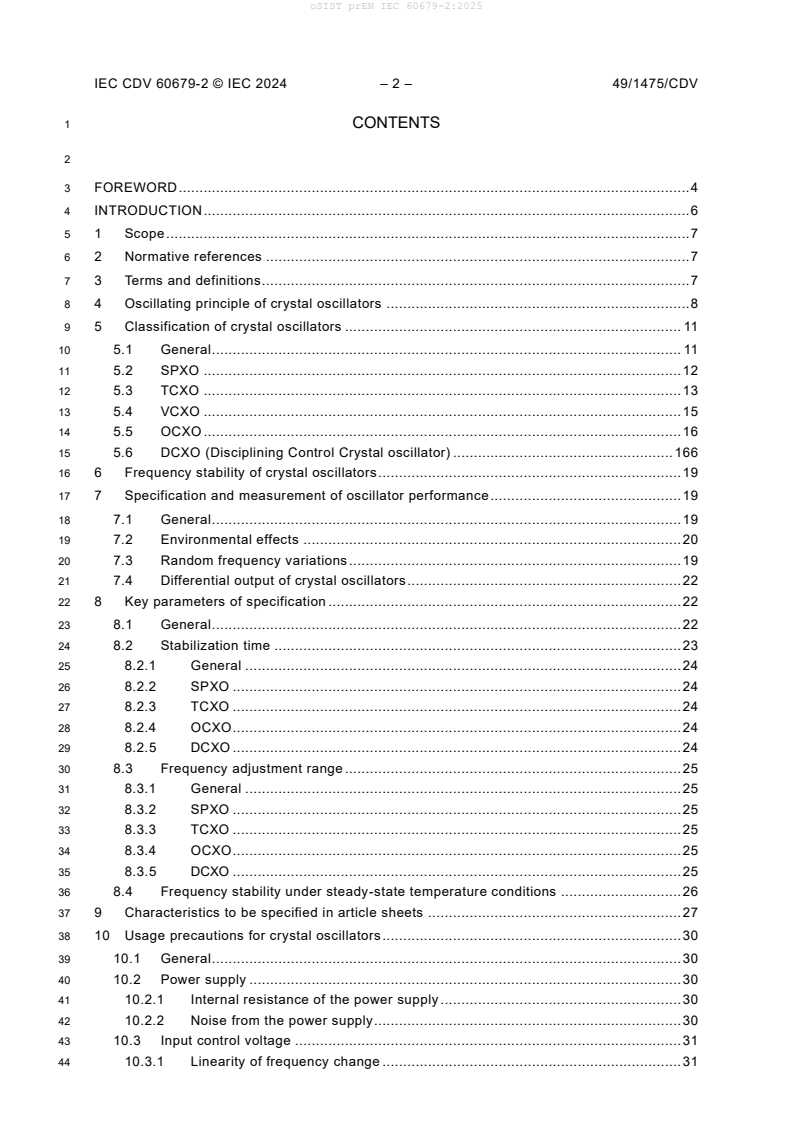
1 CONTENTS
3 FOREWORD . 4
4 INTRODUCTION . 6
5 1 Scope . 7
6 2 Normative references . 7
7 3 Terms and definitions . 7
8 4 Oscillating principle of crystal oscillators . 8
9 5 Classification of crystal oscillators . 11
10 5.1 General . 11
11 5.2 SPXO . 12
12 5.3 TCXO . 13
13 5.4 VCXO . 15
14 5.5 OCXO . 16
15 5.6 DCXO (Disciplining Control Crystal oscillator) . 166
16 6 Frequency stability of crystal oscillators . 19
17 7 Specification and measurement of oscillator performance . 19
18 7.1 General . 19
19 7.2 Environmental effects . 20
20 7.3 Random frequency variations . 19
21 7.4 Differential output of crystal oscillators . 22
22 8 Key parameters of specification . 22
23 8.1 General . 22
24 8.2 Stabilization time . 23
25 8.2.1 General . 24
26 8.2.2 SPXO . 24
27 8.2.3 TCXO . 24
28 8.2.4 OCXO . 24
29 8.2.5 DCXO . 24
30 8.3 Frequency adjustment range . 25
31 8.3.1 General . 25
32 8.3.2 SPXO . 25
33 8.3.3 TCXO . 25
34 8.3.4 OCXO . 25
35 8.3.5 DCXO . 25
36 8.4 Frequency stability under steady-state temperature conditions . 26
37 9 Characteristics to be specified in article sheets . 27
38 10 Usage precautions for crystal oscillators . 30
39 10.1 General . 30
40 10.2 Power supply . 30
41 10.2.1 Internal resistance of the power supply . 30
42 10.2.2 Noise from the power supply. 30
43 10.3 Input control voltage . 31
44 10.3.1 Linearity of frequency change . 31
oSIST prEN IEC 60679-2:2025
IEC CDV 60679-2 © IEC 2024 – 3 – 49/1475/CDV
45 10.3.2 Polarity of control voltage . 31
46 10.4 EMC (Electromagnetic Compatibility) . 30
47 10.5 Selecting bypass capacitors . 30
48 10.6 PLL oscillators . 33
49 10.7 ESD (Electric-Static Discharge) . 332
50 Annex A (informative) Differential output of crystal oscillators . 35
51 A.1 Clock rate and signal level . 35
52 A.2 Features of differential output wave . 36
53 A.3 Advantage and precaution of differential signal . 36
54 A.4 Advantage of differential output oscillator. 37
55 A.5 Differential output signal evaluation . 37
56 Bibliography . 38
58 Figure 1 – Swinging pendulum motion. 10
59 Figure 2 – Colpitts oscillator circuit . 10
60 Figure 3 – Equivalent circuit of a Colpitts oscillation circuit . 10
61 Figure 4 – Basic diagram of a crystal oscillator . 11
62 Figure 5 – Frequency-temperature characteristics of typical AT-cut crystals with
63 different orientation angles . 13
64 Figure 7 – Block diagrams of various TCXO . 15
65 Figure 8 – VCXO oscillator circuit and equivalent circuit . 15
66 Figure 9 – VCXO with added circuits for improved bandwidth and linearity. 16
67 Figure 11 – Crystal oscillator type and frequency stability . 19
68 Figure 12 – Typical output power spectrum of a crystal oscillator . 20
69 Figure 13 – Dependence of the standard deviation of frequency measurements on the
70 sample averaging for a typical crystal oscillator . 22
71 Figure 14– Typical frequency stabilization behavior of an OCXO following initial
72 switching on . 26
73 Figure 15 – Output waveform . 30
74 Figure 16 – Phase Noise Characteristics . 30
75 Figure 17 – Example of positive polarity VCXO input circuit . 31
76 Figure 18 – Control voltage-frequency change characteristics(positive polarity) . 31
77 Figure 19 – Control voltage-frequency change characteristics(negative polarity) . 32
78 Figure 20 – Example of input circuit for negative polarity VCXO . 32
79 Figure 21 – Simulation of Frequency Response of Bypass Capacitor . 33
80 Figure 22 – Distance between crystal oscillator and bypass capacitor . 33
81 Figure 23 – Jitter amplification image by PLL cascade connection . 34
82 Figure A.1 – Clock rate signal vs. level (constant edge rate) . 35
83 Figure A.2 – Effect of noise (single output) . 36
84 Figure A.3 – Effect of noise (differential output) . 36
85 Figure A.4 – Common mode noise . 37
86 Figure A.5 – eye pattern (eye diagram) . 37
oSIST prEN IEC 60679-2:2025
IEC CDV 60679-2 © IEC 2024 – 4 – 49/1475/CDV
88 Table 1 – List of typical oscillator parameters . 23
89 Table 2 – OCXO stabilization parameters . 24
90 Table 3 – The check list of parameters . 27
91 Table A.1 – Clock Waveforms and Specifications . 35
oSIST prEN IEC 60679-2:2025
IEC CDV 60679-2 © IEC 2024 – 5 – 49/1475/CDV
116 INTERNATIONAL ELECTROTECHNICAL COMMISSION
117 ____________
119 PIEZOELECTRIC, DIELECTRIC AND ELECTROSTATIC OSCILLATORS OF
120 ASSESSED QUALITY
122 Part 2: Guidelines for the use of oscillators
124 FOREWORD
125 1) The International Electrotechnical Commission (IEC) is a worldwide organization for standardization comprising
126 all national electrotechnical committees (IEC National Committees). The object of IEC is to promote
127 international co-operation on all questions concerning standardization in the electrical and electronic fields. To
128 this end and in addition to other activities, IEC publishes International Standards, Technical Specifications,
129 Technical Reports, Publicly Available Specifications (PAS) and Guides (hereafter referred to as "IEC
130 Publication(s)"). Their preparation is entrusted to technical committees; any IEC National Committee interested
131 in the subject dealt with may participate in this preparatory work. International, governmental and non -
132 governmental organizations liaising with the IEC also participate in this preparation. IEC collaborates closely
133 with the International Organization for Standardization (ISO) in accordance with conditions determined by
134 agreement between the two organizations.
135 2) The formal decisions or agreements of IEC on technical matters express, as nearly as possible, an international
136 consensus of opinion on the relevant subjects since each technical committee has representation from all
137 interested IEC National Committees.
138 3) IEC Publications have the form of recommendations for international use and are accepted by IEC National
139 Committees in that sense. While all reasonable efforts are made to ensure that the technical content of IEC
140 Publications is accurate, IEC cannot be held responsible for the way in which they are used or for any
141 misinterpretation by any end user.
142 4) In order to promote international uniformity, IEC National Committees undertake to apply IEC Publications
143 transparently to the maximum extent possible in their national and regional publications. Any divergence
144 between any IEC Publication and the corresponding national or regional publication shall be clearly indicated in
145 the latter.
146 5) IEC itself does not provide any attestation of conformity. Independent certification bodies provide conformity
147 assessment services and, in some areas, access to IEC marks of conformity. IEC is not responsible for any
148 services carried out by independent certification bodies.
149 6) All users should ensure that they have the latest edition of this publication.
150 7) No liability shall attach to IEC or its directors, employees, servants or agents including individual experts and
151 members of its technical committees and IEC National Committees for any personal injury, property damage or
152 other damage of any nature whatsoever, whether direct or indirect, or for costs (including legal fees) and
153 expenses arising out of the publication, use of, or reliance upon, this IEC Publication or any other IEC
154 Publications.
155 8) Attention is drawn to the Normative references cited in this publication. Use of the referenced publications is
156 indispensable for the correct application of this publication.
157 9) IEC draw attention to the possibility that the implementation of this document may involve the use of (a)
158 patent(s). IEC take no position concerning the evidence, validity or applicability of any claimed patent rights in
159 respect thereof. As of the date of publication of this document, IEC had not received notice of (a) patent(s),
160 which may be required to implement this document. However, implementers are cautioned that this may not
161 represent the latest information, which may be obtained from the patent database available at
162 https://patents.iec.ch [and/or] www.iso.org/patents. IEC shall not be held responsible for identifying any or all
163 such patent rights.
164 IEC 60679-2 has been prepared by IEC technical committee 49: Piezoelectric, dielectric and
165 electrostatic devices and associated materials for frequency control, selection and detection.
166 This second edition cancels and replaces the first edition published in 1981. This edition
167 constitutes a technical revision.
oSIST prEN IEC 60679-2:2025
IEC CDV 60679-2 © IEC 2024 – 6 – 49/1475/CDV
168 This edition includes the following significant technical changes with respect to the previous
169 edition:
170 a) Some new contents that reflect the latest manufacturing technologies;
171 b) Added contents about the operating principle of crystal oscillators;
172 c) Added contents about usage precautions for crystal oscillators.
173 The text of this International Standard is based on the following documents:
Draft Report on voting
XX/XX/FDIS XX/XX/RVD
175 Full information on the voting for its approval can be found in the report on voting indicated in
176 the above table.
177 The language used for the development of this International Standard is English.
178 This document was drafted in accordance with ISO/IEC Directives, Part 2, and developed in
179 accordance with ISO/IEC Directives, Part 1 and ISO/IEC Directives, IEC Supplement, available
180 at www.iec.ch/members_experts/refdocs. The main document types developed by IEC are
181 described in greater detail at www.iec.ch/publications.
182 The committee has decided that the contents of this document will remain unchanged until the
183 stability date indicated on the IEC website under webstore.iec.ch in the data related to the
184 specific document. At this date, the document will be
185 • reconfirmed,
186 • withdrawn,
187 • replaced by a revised edition, or
188 • amended.
oSIST prEN IEC 60679-2:2025
IEC CDV 60679-2 © IEC 2024 – 7 – 49/1475/CDV
190 INTRODUCTION
191 Crystal controlled oscillators are commonly used to provide the stable frequencies required for
192 telecommunications, navigations and data processing systems. Depending upon the frequency
193 of operation, ambient conditions and specific oscillator design, crystal oscillators are capable
-4 -10
194 of providing frequency stability varying from 1x10 to 1x 10 .
195 This guideline describes the general properties, performance characteristics and usage
196 precautions for crystal oscillators.
oSIST prEN IEC 60679-2:2025
IEC CDV 60679-2 © IEC 2024 – 8 – 49/1475/CDV
197 PIEZOELECTRIC, DIELECTRIC AND ELECTROSTATIC OSCILLATORS OF
198 ASSESSED QUALITY
200 Part 2: Guidelines for the use of oscillators
204 1 Scope
205 This part of IEC 60679 describes the general properties, performance characteristics and usage
206 precautions for quartz crystal oscillators. This content mainly describes crystal oscillators, but
207 some descriptions also apply to oscillators other than crystal units (e.g. MEMS resonators).
208 2 Normative references
209 The following documents are referred to in the text in such a way that some or all of their content
210 constitutes requirements of this document. For dated references, only the edition cited applies.
211 For undated references, the latest edition of the referenced document (including any
212 amendments) applies.
213 IEC 60027 (all parts). Letter symbols to be used in electrical technology.
214 IEC 60050-561, International electrotechnical vocabulary – Part 561 Piezoelectric, dielectric
215 and electrostatic devices and associated materials for frequency control, selection and
216 detection. Available at www.electropedia.org
217 IEC60068 Environmental testing.
218 IEC 60679-1, Piezoelectric, dielectric, and electrostatic oscillators of assessed quality – Part 1:
219 Generic specification
220 IEC 62884-1, Measurement technologies of piezoelectric, dielectric and electrostatic oscillators
221 – Part 1: Basic methods for the measurement
222 IEC 62884-2, Measurement technologies of piezoelectric, dielectric and electrostatic oscillators
223 – Part 2: Phase jitter measurement method
224 IEC 62884-3, Measurement technologies of piezoelectric, dielectric and electrostatic oscillators
225 – Part 3: Frequency Aging test methods
226 IEC 62884-4, Measurement technologies of piezoelectric, dielectric and electrostatic oscillators
227 – Part 4: Short-term frequency stability test methods
228 3 Terms and definitions
229 For the purposes of this document, the terms and definitions given in IEC 60679-1 and the
230 following apply.
231 ISO and IEC maintain terminology databases for use in standardization at the following
232 addresses:
oSIST prEN IEC 60679-2:2025
IEC CDV 60679-2 © IEC 2024 – 9 – 49/1475/CDV
233 • IEC Electropedia: available at https://www.electropedia.org/
234 • ISO Online browsing platform: available at https://www.iso.org/obp
236 4 Oscillating principle of crystal oscillators
237 The operating principle of crystal oscillators is easier to understand when compared with that
238 of a pendulum. To maintain the swing of a pendulum, the position and time point of maximum
239 amplitude of the pendulum should be detected, and the operation of pushing the pendulum back
240 should be repeated so that the time point and position are maintained. The pendulum
241 corresponds to a crystal unit which comprises an amplifier with a feedback circuit that provides
242 the detection and push-back force (See Figure 1).
243 A typical feedback amplifier (Colpitts circuit) is shown in Figure 2, where the signals at both
244 terminals of the crystal unit are divided at capacitors CA, CB , one connected to the input side
245 and the other to the output side. It can be considered that the "detection" in the case of the
246 pendulum is on the input side of the feedback amplifier and the "push-back force" is given on
247 the output side. Here, R and R are bleeder resistance to provide a fixed bias to the base
A B
248 terminal of the oscillation transistor, R is negative feedback resistance connected to the
E
249 emitter and R is load resistance connected to the collector.
C
250 Next, in the state of oscillation, as shown in Figure 3, the oscillator circuit side which is viewed
251 from the crystal unit terminals can be represented by a series circuit of equivalent input
252 capacitance C and equivalent input resistance R . In this case, the crystal unit side is
i i
253 equivalently an inductive effective inductance L and an effective resistance R and the crystal
e e
254 oscillation conditions are as follows:
255 Frequency condition . L−=0
e
C
i
256 Amplitude condition . R, R (R : negative resistance)
ei i
257 The frequency condition determines the oscillation frequency. For the amplitude condition,
258 equivalent input resistance on the circuit side shall be negative value in the vicinity of the
259 oscillation frequency and at the small signal on the start-up, then this is called negative
260 resistance. This negative resistance can be obtained with active circuits such as transistors and
261 operational amplifiers. The absolute value of the negative resistance shall be designed to
R
i
262 be sufficiently larger than R in order to ensure oscillation at the start-up of the oscillator,
e
263 meaning that in the steady-state following the end of the start-up and the oscillation
RR=
ei
264 becomes the steady-state amplitude.
oSIST prEN IEC 60679-2:2025
IEC CDV 60679-2 © IEC 2024 – 10 – 49/1475/CDV
273 Figure 1 – Swinging pendulum motion
C
A
C
B
275 Figure 2 – Colpitts oscillator circuit
277 Figure 3 – Equivalent circuit of a Colpitts oscillation circuit
279 The circuit side capacitance C is called the load capacitance C with respect to the unit and
( )
i
L
280 is an important parameter that determines the frequency change amount from the series
281 resonance frequency, variable sensitivity and frequency stability, etc. The relational equation
282 is as follows:
283 Fractional load resonance frequency offset (D L)
=
C
L
21r +
C
0
−1
=
284 Pulling sensitivity (S)
C
L
21rC +
0
C
285 Where
286 C : Shunt capacitance of the crystal unit,
287 C : Motional capacitance of the crystal unit,
oSIST prEN IEC 60679-2:2025
IEC CDV 60679-2 © IEC 2024 – 11 – 49/1475/CDV
288 C : Load capacitance (C on the circuit side),
L i
289 r : Capacitance ratio of the crystal unit (CC ).
292 5 Classification of crystal oscillators
293 5.1 General
294 In very general terms, a crystal oscillator may be described as consisting of an amplifier or gain
295 circuit, together with a positive feedback network. A typical oscillation circuit is shown in Figure
296 4.
298 Figure 4 – Basic diagram of a crystal oscillator
300 Self-oscillation of such a circuit will occur provided the loop gain exceeds unity at some
301 frequency for which the total loop phase is 2nπ (n = 0, 1, 2.). The level of the oscillation signal
302 will depend on circuit gain characteristics, while the oscillation frequency will be determined by
303 phase considerations. The output signal spectrum will depend upon the level of oscillation,
304 electrical noise from circuit elements and the bandwidths of the circuits. Generally, the spectral
305 width is extremely small and, for a majority of applications, only the center or average frequency
306 behaviour need to be considered. Disregarding for the moment the degradation of a signal purity
307 by electrical noise, the average frequency of oscillation will always be determined by the loop
308 phase requirement. Frequency deviations will result whenever any perturbation of loop phase
309 occurs. These perturbations may be generally considered to be of two types, namely:
310 a) deviations in electrical circuit parameters.
311 b) deviations in the crystal unit
312 Type a) deviations include such factors as the temperature coefficients of capacitors, inductors,
313 resistors and transistors; the ageing of these devices; their voltage and current characteristics
314 and their susceptibility to mechanical disturbance. Whatever the cause, a phase perturbation
315 ( ) in the circuit transfer phase will cause a change in the average oscillation frequency:
N
N
ff=
2Q
X
oSIST prEN IEC 60679-2:2025
IEC CDV 60679-2 © IEC 2024 – 12 – 49/1475/CDV
Q
317 where f is the nominal oscillation frequency and Q is the effective of the narrowband
0 X
318 crystal network.
319 Type b) deviations include changes in crystal unit characteristics caused by temperature,
320 temperature gradient, drive level, "frequency ageing" and mechanical environment (shock,
321 acceleration and vibration). The crystal oscillation circuit is generally designed to use a gain
322 circuit having a band as broad as practicable, in order to reduce the network phase sensitivity
323 as much as possible. The crystal feedback network, on the other hand, is usually designed to
324 have a transmission band as narrow as can be obtained so as to make the oscillation frequency
325 depend essentially only upon the crystal unit characteristics. When frequency adjustment is
326 required, it is preferably accomplished by introducing a variable reactance which changes the
327 frequency of the crystal network without widening the transmission band. When these general
328 practices are followed, the oscillator frequency stability will depend primarily upon the
329 characteristics of the crystal unit, which should be chosen so as to:
330 1) have a high Q-factor.
331 2) exhibit a small change of frequency over the intended operating temperature range.
332 3) have a low drive level dependence (DLD) of frequency and resonance resistance .
333 4) provide low sensitivity to mechanical shock, acceleration, and vibration.
334 5) exhibit a small frequency drift due to ageing.
335 5.2 SPXO
336 Most electronic equipment is required to operate over a range of ambient temperatures, i.e. -
337 10 °C to +60 °C, or -40 °C to +85 °C. Consequently, the frequency/temperature characteristic
338 of the crystal unit is usually the most important factor in determining th e frequency stability of
339 simple packaged crystal oscillators (SPXO). For low-frequency crystal units vibrating in flexural
-4
340 or extensional modes, deviations as great as ± 1 x 10 might be expected, while the thickness
-5
341 shear types (frequencies above about 1 MHz) could be expected to deviate by about ± 2 x 10
342 over a temperature range of -40 °C to +90 °C. When better frequency stability is required, it is
343 necessary to provide temperature compensation circuitry, or to provide a temperature-stabilized
344 environment for the crystal unit by means of a temperature control device. Special
345 characteristics of oscillators of these types are considered in later clauses. The temperature
346 behaviour of frequency of crystal units is dependent upon the dimensions of the quartz plate,
347 the mode of vibration, the material and thickness of electrodes, the mounting methods employed
348 and, mainly, the orientation of the plate with respect to the crystallographic axes. Figure 5
349 shows the characteristics which may be obtained for various orientations of an AT -cut crystal
350 unit.
oSIST prEN IEC 60679-2:2025
IEC CDV 60679-2 © IEC 2024 – 13 – 49/1475/CDV
352 Figure 5 – Frequency-temperature characteristics of typical AT-cut crystals with
353 different orientation angles
355 The frequency change as a function of time, usually referred to as "ageing", is primarily
356 determined by the crystal used. A typical ageing rate for 10 MHz fundamental mode crystals is
-7
357 1 x 10 per week while overtone units and well-aged units exhibit values lower than this. The
358 ageing is usually unimportant in applications using SPXO, since it is small compared with the
359 frequency deviations caused by temperature variations. The oscillation circuit of the SPXO is a
360 feedback amplifier for operating the crystal unit, and the CMOS oscillation circuit used in crystal
361 oscillators for clocks, etc. is an equivalent circuit as shown in Figure 6, and the circuit side can
362 be represented by internal resistance R and a square wave voltage supply that varies from 0
d
363 to V .
DD
C
A
Rd
Inverter Square
VD
CB
wave
C
A
D
C
B
365 Figure 6 – CMOS oscillator circuit and equivalent circuit
366 For the frequency stability of the SPXO, the characteristics of the crystal unit used are almost
367 the same as the characteristics of the oscillator. The frequency stability is said to be determined
368 by the crystal unit's characteristics, among which, frequency/temperature characteristics and
369 ageing are usually predominant.
370 5.3 TCXO
371 To obtain better stability than that possible with the SPXO, temperature compensated crystal
372 oscillators (TCXO) can be used. Improved stability in TCXO will be obtained at the expense of
373 added circuit complexity, increased size, higher power consumption and increased cost.
oSIST prEN IEC 60679-2:2025
IEC CDV 60679-2 © IEC 2024 – 14 – 49/1475/CDV
374 TCXO are oscillators that provide temperature compensation for the frequency/temperature
375 characteristics, which fluctuate the most in the characteristics of the frequency stability, so that
376 the frequency fluctuations are even lower than those of theoretical frequency/temperature
377 characteristics of crystal units. New communication systems for the transition to high frequency
378 bands and the effective utilisation of frequencies need high frequency stability over a wide
379 temperature range. TCXO are used in many mobile communication systems as reference
380 oscillators suitable for this purpose. They can be broadly classified into the following three
381 categories according to the frequency-temperature compensation method and required
382 performance.
383 (a) Direct analogue type
384 As the temperature compensation circuit is connected directly to the crystal unit, resistance
385 component of the circuit is added to the crystal resonance circuit, resulting in a decrease in
386 effective Q and a large change in effective Q depending on temperature. The temperature
387 compensation circuit section requires a compensation circuit design to flatten the frequency
-6
388 characteristics of the crystal unit. Generally, a frequency stability of about ± 1.5 to ± 3.0 x 10
389 (-40 °C to +85 °C) can be obtained.
390 (b) Indirect analogue type
391 This is an oscillator designed so that the reference voltage supplied from a stabilized power
392 supply is used to create a compensation voltage by a temperature compensation circuit
393 consisting of resistance and a temperature sensor and the compensation voltage is supplied to
394 the voltage-controlled crystal oscillator VCXO, resulting in flat characteristics in frequency
395 fluctuations due to changes in ambient temperature. To determine the element values of the
396 circuit that compensate for the frequency/temperature characteristics being the cubic function
397 of the crystal unit over a wide temperature range, it is necessary to use a computer to obtain a
398 multi-point approximate solution with temperature as a function. The compensation accuracy is
-6
399 limited to ± 0.5 x 10 (-20 °C to +70 °C), although it is much better than the former. In recent
400 years, using IC circuit technology, the appearance of single-chip TCXO ICs incorporating a
401 temperature compensation circuit which is configured to obtain a higher -order temperature
402 compensation function by combining differential amplifiers and an oscillation circuit, has made
403 it possible to manufacture smaller TCXO, contributing significantly to the miniaturization of
-6
404 mobile terminals. Generally, a frequency stability of about ± 0.5 to ± 2.0 x 10 (-40°C to +85°C)
405 can be obtained.
407 (c) Indirect digital type
408 This is a method that digitally performs fine compensation control for minute temperature
409 changes in order to increase frequency stability. Typical of this method is to digitally convert
410 the temperature information obtained by the temperature sensor and record the corresponding
411 voltage information such the frequency deviation becomes zero in a storage medium such as
412 ROM. Then, during operation, the VCXO is controlled by reading the voltage information
413 corresponding to the temperature information from the storage medium. The theoretical limit of
414 frequency stability is determined by the maximum temperature coefficient of the crystal unit with
415 respect to the increment of ambient temperature and the voltage conversion accuracy of the
-6
416 D/A or A/D converter. Generally, a frequency stability of about ± 0.05 to ± 0.5 x 10 (-10 °C to
417 +60 °C) can be obtained. The operating principle diagrams of the oscillation circuits for the
418 above three types of TCXO are shown in Figure 7.
420 (a) Direct analogue type (b) Indirect analogue type (c) Indirect digital type
oSIST prEN IEC 60679-2:2025
IEC CDV 60679-2 © IEC 2024 – 15 – 49/1475/CDV
421 Figure 7 – Block diagrams of various TCXO
423 5.4 VCXO
424 In many applications such as for the generation of narrow-band frequency modulation (FM)
425 telecommunication signals or frequency shift-keying (FSK) data streams, it is convenient to be
426 able to control the frequency of a crystal oscillator by means of a variable voltage applied to
427 the device. This function is accomplished in much the same way as the frequency of the TCXO
428 is adjusted by the temperature-dependent voltage function generated with the thermistor
429 network. The principle differences are that for the former, the variable-capacitance diode
430 voltage leads are accessible to the user, no thermistor network is required and the range over
431 which the oscillator frequency can be tuned is made relatively large. The operating principle is
432 similar to that of the SPXO, but the basic circuit is as shown in Figure 8, with a variable-
433 capacitance diode connected in series with the crystal unit as an additional circuit and a terminal
434 to supply voltage to it from an external source. In the case of identical crystal unit, the frequency
435 control range and operating point are determined by the voltage vs. capacitance characteristic
436 of the variable-capacitance diode and by the variable range of the input capacitance on the
437 circuit side, including this diode. If an inductance L is added in series with the crystal unit to
438 widen the frequency control range or to improve its linearity, the input capacitance described
439 above is the same result as having a negative capacitance value −C in series which is
T
440 equivalent to the reactance of the coil and can be designed using the following formula. Namely,
441 this can be calculated as:
CC
Ti
442 Input capacitance of circuit: C
IN=−
CC−
iT
445 Figure 8 – VCXO oscillator circuit and equivalent circuit
446 The bandwidth of the modulation signal to which the VCXO responds depends on the radio
447 frequency bandwidth of the crystal feedback network, just as it depends on the basic bandwidth
448 of the variable-capacitance diode drive circuit. The modulation linearity (i.e., as a function of
449 modulation voltage) depends on the combination of variable-capacitance diode characteristics
450 and crystal unit parameters. To achieve good linearity and/or to increase the frequency
451 deviation range, it is often necessary to use a more sophisticated feedback network, for
452 example as shown in Figure 9.
oSIST prEN IEC 60679-2:2025
IEC CDV 60679-2 © IEC 2024 – 16 – 49/1475/CDV
454 Figure 9 – VCXO with added circuits for improved bandwidth and linearity
455 VCXO can be roughly classified into the following two types:
456 (a) Those in which linearity of input voltage vs. frequency change is important, such as FM and
457 FSK modulation.
458 (b) Those for obtaining an output frequency phase locked (PLL) to an external reference signal
459 As FM communication systems become more sophisticated, the former is suitable for
460 communications with a wide modulation frequency component, such as digital signals, and can
461 be made into an FM modulator with high frequency stability if a PLL function is added. The latter
462 is used as a signal source in communication systems and measuring instruments etc. that need
463 to be phase-locked to a reference signal. In addition, because crystal units are used, the
464 oscillators have better features in signal purity and phase noise than those using other devices.
465 5.5 OCXO
-7
466 The TCXO discussed in 5.3 can provide frequency-temperature stability of about 1 x 10 over
467 a wide range of ambient temperature. For applications requiring better stability, an oven -
468 controlled crystal oscillator (OCXO) is used. To achieve higher frequency stability, OCXO
469 provides high frequency stability by controlling the temperature in the oven over a wide range
470 of temperature for components largely affected by temperature. Although dependent on the
471 oven’s temperature-controlling capability, oscillators providing frequency stability varying from
-7 -10
472 ± 1 x 10 to ± 5 x 10 (-10 °C to +60 °C, 0 °C to +70 °C) are manufacturable in general. Such
473 oscillators are widely used as frequency reference in frequency counters and synthesizers etc.,
474 and as frequency-time reference in backbone infrastructure apparatuses for the entire
475 communication system (high-speed transmitting device such as optical communication as well
476 as mobile communication and satellite communication etc.) and in navigational devices.
477 Temperature controlling methods may be roughly classified into one of the following three
478 methods according to required frequency stability.
479 (a) controlling only the crystal unit
480 (b) controlling the crystal unit and the circuit components together
481 (c) dual controlling: the outer oven controlling the oscillation circuit and the inner oven
482 controlling the crystal unit
483 Recent technological development has brought about high-performance electronic components
484 and crystal units with high stability. Specially designed crystal units, i.e., third or fifth overtone
oSIST prEN IEC 60679-2:2025
IEC CDV 60679-2 © IEC 2024 – 17 – 49/1475/CDV
485 convex crystal units with high Q-factor and better frequency aging characteristics are used. The
486 thermal design of ovens has also progressed. Improved adjusting methods such as matching
487 the temperature in the oven with the temperature at which the crystal unit has a zero-
488 temperature coefficient, have enabled sufficient frequency stability in most applications by using
489 method (b).
490 An OCXO circuit consists of an oven controlling unit and an oscillation circuit unit. Although the
491 basics of the oscillation circuit do not differ from others, a third overtone crystal unit would be
492 used in a Colpitts oscillation circuit with suppressed fundamental mode, and a fifth overtone
493 crystal unit would require a frequency selection circuit. By adding an AGC circuit that activates
494 the crystal unit quickly and keeps the operation level low and constant, the oscillator will
-10
495 maintain a stable operation level and provide frequency stability in the 1 x 10 range. The
496 temperature of an oven-controlled circuit is usually controlled by a differential DC amplifier
497 comprising a resistance bridge
...