

SIST EN 14939:2006
(Main)Copper and copper alloys - Determination of beryllium content - FAAS method
General Information
- Abstract
This European Standard specifies a flame atomic absorption spectrometric method (FAAS) for the determination of the beryllium content of copper and copper alloys in the form of unwrought, wrought and cast products.
The method is applicable to products having beryllium mass fractions between 0,01 % and 3,0 %.
- Status
- Published
- Publication Date
- 31-Aug-2006
- Technical Committee
- INEK - Nonferrous metals
- Current Stage
- 6060 - National Implementation/Publication (Adopted Project)
- Start Date
- 01-Sep-2006
- Due Date
- 01-Sep-2006
- Completion Date
- 01-Sep-2006



Overview
SIST EN 14939:2006 is a European Standard developed by CEN for the precise determination of beryllium content in copper and copper alloys using the flame atomic absorption spectrometric (FAAS) method. This standard applies to a range of copper products including unwrought, wrought, and cast forms with beryllium mass fractions between 0.01% and 3.0%. The standard ensures uniformity and accuracy in analytical testing, critical for quality control and regulatory compliance in industries using copper alloys.
Key Topics
- Scope and Applicability: Focuses on copper and copper alloys with beryllium content from 0.01% to 3.0%, covering all product forms such as unwrought, wrought, and cast.
- Analytical Principle: Involves dissolving the sample in hydrochloric and nitric acids followed by measurement of beryllium via atomic absorption at a wavelength of 234.8 nm using a beryllium hollow-cathode lamp and a nitrous oxide/acetylene flame.
- Preparation and Sampling: Specifies sample preparation techniques including fine drillings, chips, or millings with a maximum thickness of 0.5 mm as per ISO 1811-1 and ISO 1811-2 for sampling cast and wrought products respectively.
- Reagents and Calibration: Defines preparation of reagents such as hydrochloric acid, nitric acid, and standard beryllium and copper solutions essential for calibration. Emphasizes maintaining consistent chemical compositions in calibration solutions to match the test samples.
- Testing Procedure: Details procedure from sample dissolution, blank testing, establishment of calibration curves for different beryllium concentration ranges, to actual spectrometric measurement and use of calibration or bracketing methods for result determination.
- Precision and Quality Assurance: Includes statistical data on repeatability and reproducibility ensuring reliability of the FAAS method. It mandates duplicate analyses and use of standard materials for system checks.
- Test Reporting: Specifies requirements for comprehensive test reports including sample identification, method details, results, and any deviations or observations.
Applications
- Quality Control in Copper Alloy Manufacturing: SIST EN 14939:2006 helps manufacturers verify beryllium content, ensuring alloy properties meet design specifications and regulatory limits.
- Material Certification: Laboratories utilize this method to certify copper alloys for aerospace, electronics, and automotive sectors where beryllium content impacts performance and safety.
- Regulatory Compliance: Supports compliance with environmental and occupational health regulations regarding beryllium due to its toxicity and carcinogenic nature.
- Research and Development: Used in metallurgical research to develop new copper alloys with controlled beryllium additions for enhanced mechanical or electrical properties.
Related Standards
- ISO 1811-1 & ISO 1811-2: Sampling standards for selection and preparation of copper and copper alloy samples, essential complements for EN 14939 testing.
- ISO 5725-1: Defines accuracy (trueness and precision) of measurement methods, supporting the statistical evaluation included in EN 14939.
- Other Copper Alloy Analysis Methods: Complementary standards addressing determination of other trace elements in copper alloys may be applied alongside EN 14939 depending on analytical requirements.
By adhering to SIST EN 14939:2006, laboratories and manufacturers can achieve accurate, consistent, and reproducible measurements of beryllium in copper alloys using the FAAS method, facilitating quality assurance, safety compliance, and material innovation in industries relying on copper-based materials.
Relations
- Effective Date
- 28-Jan-2026
- Effective Date
- 28-Jan-2026
Get Certified
Connect with accredited certification bodies for this standard

Element Materials Technology
Materials testing and product certification.

Inštitut za kovinske materiale in tehnologije
Institute of Metals and Technology. Materials testing, metallurgical analysis, NDT.
Sponsored listings
Frequently Asked Questions
SIST EN 14939:2006 is a standard published by the Slovenian Institute for Standardization (SIST). Its full title is "Copper and copper alloys - Determination of beryllium content - FAAS method". This standard covers: This European Standard specifies a flame atomic absorption spectrometric method (FAAS) for the determination of the beryllium content of copper and copper alloys in the form of unwrought, wrought and cast products. The method is applicable to products having beryllium mass fractions between 0,01 % and 3,0 %.
This European Standard specifies a flame atomic absorption spectrometric method (FAAS) for the determination of the beryllium content of copper and copper alloys in the form of unwrought, wrought and cast products. The method is applicable to products having beryllium mass fractions between 0,01 % and 3,0 %.
SIST EN 14939:2006 is classified under the following ICS (International Classification for Standards) categories: 77.120.30 - Copper and copper alloys. The ICS classification helps identify the subject area and facilitates finding related standards.
SIST EN 14939:2006 has the following relationships with other standards: It is inter standard links to SIST EN 12492:2000, SIST EN 960:1996. Understanding these relationships helps ensure you are using the most current and applicable version of the standard.
SIST EN 14939:2006 is available in PDF format for immediate download after purchase. The document can be added to your cart and obtained through the secure checkout process. Digital delivery ensures instant access to the complete standard document.
Standards Content (Sample)
2003-01.Slovenski inštitut za standardizacijo. Razmnoževanje celote ali delov tega standarda ni dovoljeno.Copper and copper alloys - Determination of beryllium content - FAAS methodCuivre et alliages de cuivre - Dosage du béryllium - Méthode par spectrométrie d'absorption atomique dans la flamme (SAAF)Kupfer und Kupferlegierungen - Bestimmung des Berylliumgehaltes - Flammenatomabsorptionsspektrometrisches Verfahren (FAAS)Ta slovenski standard je istoveten z:EN 14939:2006SIST EN 14939:2006en77.120.30ICS:SLOVENSKI
STANDARDSIST EN 14939:200601-september-2006
EUROPEAN STANDARDNORME EUROPÉENNEEUROPÄISCHE NORMEN 14939June 2006ICS 77.120.30 English VersionCopper and copper alloys - Determination of beryllium content -FAAS methodCuivre et alliages de cuivre - Dosage du béryllium -Méthode par spectrométrie d'absorption atomique dans laflamme (SAAF)Kupfer und Kupferlegierungen - Bestimmung desBerylliumgehaltes -Flammenatomabsorptionsspektrometrisches Verfahren(FAAS)This European Standard was approved by CEN on 15 May 2006.CEN members are bound to comply with the CEN/CENELEC Internal Regulations which stipulate the conditions for giving this EuropeanStandard the status of a national standard without any alteration. Up-to-date lists and bibliographical references concerning such nationalstandards may be obtained on application to the Central Secretariat or to any CEN member.This European Standard exists in three official versions (English, French, German). A version in any other language made by translationunder the responsibility of a CEN member into its own language and notified to the Central Secretariat has the same status as the officialversions.CEN members are the national standards bodies of Austria, Belgium, Cyprus, Czech Republic, Denmark, Estonia, Finland, France,Germany, Greece, Hungary, Iceland, Ireland, Italy, Latvia, Lithuania, Luxembourg, Malta, Netherlands, Norway, Poland, Portugal, Romania,Slovakia, Slovenia, Spain, Sweden, Switzerland and United Kingdom.EUROPEAN COMMITTEE FOR STANDARDIZATIONCOMITÉ EUROPÉEN DE NORMALISATIONEUROPÄISCHES KOMITEE FÜR NORMUNGManagement Centre: rue de Stassart, 36
B-1050 Brussels© 2006 CENAll rights of exploitation in any form and by any means reservedworldwide for CEN national Members.Ref. No. EN 14939:2006: E
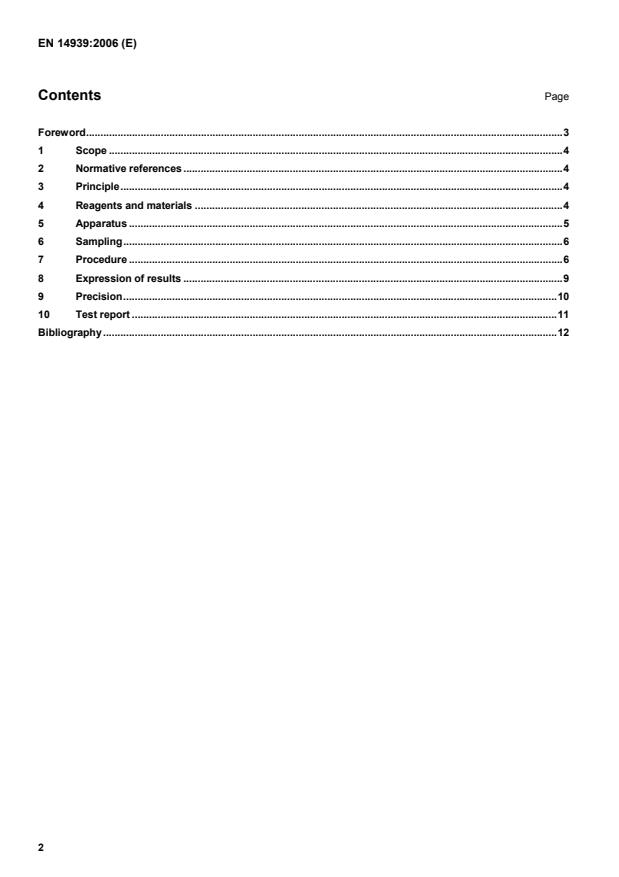
Contents Page Foreword.3 1 Scope.4 2 Normative references.4 3 Principle.4 4 Reagents and materials.4 5 Apparatus.5 6 Sampling.6 7 Procedure.6 8 Expression of results.9 9 Precision.10 10 Test report.11 Bibliography.12
3 Foreword This document (EN 14939:2006) has been prepared by Technical Committee CEN/TC 133 “Copper and copper al-loys”, the secretariat of which is held by DIN. This European Standard shall be given the status of a national standard, either by publication of an identical text or by endorsement, at the latest by December 2006, and conflicting national standards shall be withdrawn at the latest by December 2006. Within its programme of work, Technical Committee CEN/TC 133 requested CEN/TC 133/WG 10 "Methods of analysis" to prepare the following standard: EN 14939, Copper and copper alloys — Determination of beryllium content — FAAS method According to the CEN/CENELEC Internal Regulations, the national standards organizations of the following coun-tries are bound to implement this European Standard: Austria, Belgium, Cyprus, Czech Republic, Denmark, Esto-nia, Finland, France, Germany, Greece, Hungary, Iceland, Ireland, Italy, Latvia, Lithuania, Luxembourg, Malta, Netherlands, Norway, Poland, Portugal, Romania, Slovakia, Slovenia, Spain, Sweden, Switzerland and United Kingdom.
1 Scope This European Standard specifies a flame atomic absorption spectrometric method (FAAS) for the determination of the beryllium content of copper and copper alloys in the form of unwrought, wrought and cast products. The method is applicable to products having beryllium mass fractions between 0,01 % and 3,0 %. 2 Normative references The following referenced documents are indispensable for the application of this document. For dated references, only the edition cited applies. For undated references, the latest edition of the referenced document (including any amendments) applies. ISO 1811-1, Copper and copper alloys — Selection and preparation of samples for chemical analysis — Part 1: Sampling of cast unwrought products ISO 1811-2, Copper and copper alloys — Selection and preparation of samples for chemical analysis — Part 2: Sampling of wrought products and castings NOTE Informative references to documents used in the preparation of this standard, and cited at the appropriate places in the text, are listed in the Bibliography. 3 Principle Dissolution of a test portion in hydrochloric/nitric acid mixture followed, after suitable dilution, by aspiration into a ni-trous oxide/acetylene flame of an atomic absorption spectrometer. Measurement of the absorption of the 234,8 nm line emitted by a beryllium hollow-cathode lamp. 4 Reagents and materials WARNING — Beryllium is an extremely poisonous metal and the inhalation of dust can cause cancer. 4.1 General During the analysis, use only reagents of recognized analytical grade and only distilled water or water of equivalent purity. 4.2 Hydrochloric acid, HCl (ρ = 1,19 g/ml). 4.3 Hydrochloric acid solution, 1 + 1 Dilute 1 000 ml of hydrochloric acid (4.2) in 1 000 ml of water. 4.4 Nitric acid, HNO3 (ρ = 1,40 g/ml). 4.5 Nitric acid solution, 1 + 1 Dilute 1 000 ml of nitric acid (4.4) in 1 000 ml of water.
5 4.6 Beryllium stock solution, 1,000 g/l Be Weigh (1 ± 0,001) g of beryllium (Be ≥ 99,9 %) and transfer it into a 250 ml beaker. Add 20 ml of hydrochloric acid (4.2). Cover and heat gently until the beryllium is completely dissolved. Cool to room temperature, transfer the solu-tion quantitatively into a 1 000 ml one-mark volumetric flask, dilute to the mark with water and mix well. 1 ml of this solution contains 1,000 mg of Be. 4.7 Beryllium standard solution, 0,010 g/l Be Transfer 5,0 ml of the beryllium stock solution (4.6) into a 500 ml one-mark volumetric flask. Dilute to the mark with water and mix well. Prepare this solution immediately prior to use. 1 ml of this solution contains 0,010 mg of Be. 4.8 Beryllium standard solution, 0,005 g/l Be Transfer 50,0 ml of the beryllium standard solution (4.7) into a 100 ml one-mark volumetric flask. Dilute to the mark with water and mix well. Prepare this solution immediately prior to use. 1 ml of this solution contains 0,005 mg of Be. 4.9 Copper base solution, 5 g/l Cu Weigh (5 ± 0,001) g of beryllium-free copper (Be ≤ 0,001 5 %) and transfer it into a 400 ml beaker. Add 50 ml of hydrochloric acid solution (4.3) and, cautiously, 50 ml of nitric acid solution (4.5). Heat gently until the copper is dis-solved and then bring to the boiling point until the nitrous fumes have been expelled. Cool to room temperature, transfer the solution quantitatively into a 1 000 ml one-mark volumetric flask, dilute to the mark with water and mix well. 1 ml of this solution contains 5 mg of Cu. 4.10 Copper base solution, 1 g/l Cu Transfer 50,0 ml of the copper base solution (4.9) into a 250 ml one-mark volumetric flask. Dilute to the mark with water and mix well. 1 ml of this solution contains 1 mg of Cu. 5 Apparatus 5.1 Ordinary laboratory apparatus. 5.2 Atomic absorption spectrometer, fitted with a nitrous oxide/acetylene burner. 5.3 Beryllium hollow-cathode lamp.
6 Sampling Sampling shall be carried out in accordance with ISO 1811-1 or ISO 1811-2, as appropriate. Test samples shall be in the form of fine drillings, chips or millings with a maximum thickness of 0,5 mm. 7 Procedure 7.1 Preparation of the test portion solution 7.1.1 Test portion Weigh (1 ± 0,001) g of the test sample. 7.1.2 Test portion solution Transfer the test portion (7.1.1) into a 250 ml beaker. Add 10 ml of hydrochloric acid (4.2) and 10 ml of the nitric acid solution (4.5). Cover with a watch glass and heat gently until the test portion is completely dissolved, then heat at a temperature of approximately 90 °C until brown fumes have been expelled. Allow to cool. Wash the beaker cover and the sides of the beaker with water. Transfer the dissolved test portion into a 100 ml one-mark volumetric flask. Dilute to the mark with water and mix well. 7.1.3 Beryllium mass fractions between 0,01 % and 0,10 % Transfer 10 ml of the test portion solution (7.1.2) into a 100 ml one-mar
...