


oSIST prEN 13200-10:2023
(Main)Spectator facilities - Part 10: Calculating of safe capacity in case of emergency
Spectator facilities - Part 10: Calculating of safe capacity in case of emergency
This European Standard specifies general characteristics regarding infrastructures of safety and emergency management in spectator facilities.
It specifies the method of calculating a safe capacity for the planning of the any event.
Zuschaueranlagen - Teil 10: Berechnung der Sicherheitskapazität im Notfall
Dieses Dokument legt allgemeine Eigenschaften in Bezug auf die Sicherheits- und Notfallmanagement-Infrastrukturen in Zuschaueranlagen fest.
Es legt das Verfahren zur Berechnung einer sicheren Kapazität zur Planung von Veranstaltungen fest.
Installations pour spectateurs - Partie 10 : Calcul de la jauge de sécurité en cas d'urgence
Le présent document spécifie les caractéristiques générales concernant les infrastructures de management de la sécurité et des urgences dans les installations pour spectateurs.
Il spécifie la méthode de calcul de la jauge de sécurité pour la planification d’une manifestation.
Prostori za gledalce - 10. del: Izračun varne zmogljivosti v sili
General Information
- Status
- Not Published
- Public Enquiry End Date
- 19-Apr-2023
- Technical Committee
- ISS SPL.GPO - Building construction
- Current Stage
- 4020 - Public enquire (PE) (Adopted Project)
- Start Date
- 25-Jan-2023
- Due Date
- 14-Jun-2023
- Completion Date
- 17-Apr-2023
Overview
prEN 13200-10 - Spectator facilities - Part 10: Calculating of safe capacity in case of emergency (CEN) defines a harmonized method for determining the safe capacity of spectator facilities for event planning and emergency preparedness. The standard sets out principles, terminology and a step‑by‑step approach to assess how many spectators can be safely accommodated, taking into account both built infrastructure and safety management arrangements.
Key topics
- Safe capacity methodology: A structured process to calculate capacity that combines spatial assessment, circulation/entry/exit performance and evacuation capability.
- (P) factor - Physical categorisation: Assessment of the physical condition of stands, barriers, exits, circulation spaces and maintenance regimes. Well‑maintained infrastructure merits a higher (P) factor; deficiencies reduce it (potentially to zero).
- (S) factor - Safety management: Assessment of operational controls, staffing, procedures and emergency plans. The management quality directly affects permissible capacity.
- Calculation steps: Includes measuring available viewing area, selecting appropriate spectator density, computing holding capacity, entry capacity, exit capacity and emergency evacuation capacity, then establishing final permitted capacity.
- Use of modelling: Guidance on pedestrian dynamic (crowd) simulation - outputs, uses and limitations - to support evacuation analysis and complex circulation scenarios.
- Special cases: Considerations for fan zones, events on the field of play and different event types that may require amended capacities or additional safety certificates.
- Risk and maintenance: Emphasis on risk assessment, planned preventative maintenance, good housekeeping and professional inspection of structural/load‑bearing elements.
Applications and users
prEN 13200-10 is intended for practical use by:
- Stadium and arena owners/operators and venue safety managers
- Event organisers and promoters (for planning and licensing)
- Local authorities and issuing bodies responsible for safety certificates
- Fire and emergency planners and civil protection agencies
- Architects, structural and crowd‑safety engineers conducting design reviews
- Consultants performing risk assessments and pedestrian dynamic modelling
Typical applications:
- Setting maximum permitted occupancy for stands, sectors and fan zones
- Informing safety certificates, event-specific contingency plans and staffing levels
- Verifying that entry/exit provision and evacuation times meet acceptable safety criteria
- Supporting refurbishment, new construction and maintenance planning
Related standards
- EN 13200 (all parts) - Spectator facilities series
- EN 13200‑8 - Spectator facilities - Part 8: Safety Management (referenced for (S) factor and operations)
Keywords: prEN 13200-10, spectator facilities, safe capacity, emergency evacuation, (P) factor, (S) factor, capacity calculation, safety management, pedestrian dynamic modelling.


Frequently Asked Questions
oSIST prEN 13200-10:2023 is a draft published by the Slovenian Institute for Standardization (SIST). Its full title is "Spectator facilities - Part 10: Calculating of safe capacity in case of emergency". This standard covers: This European Standard specifies general characteristics regarding infrastructures of safety and emergency management in spectator facilities. It specifies the method of calculating a safe capacity for the planning of the any event.
This European Standard specifies general characteristics regarding infrastructures of safety and emergency management in spectator facilities. It specifies the method of calculating a safe capacity for the planning of the any event.
oSIST prEN 13200-10:2023 is classified under the following ICS (International Classification for Standards) categories: 91.040.10 - Public buildings; 97.200.10 - Theatre, stage and studio equipment; 97.220.10 - Sports facilities. The ICS classification helps identify the subject area and facilitates finding related standards.
oSIST prEN 13200-10:2023 is available in PDF format for immediate download after purchase. The document can be added to your cart and obtained through the secure checkout process. Digital delivery ensures instant access to the complete standard document.
Standards Content (Sample)
SLOVENSKI STANDARD
01-april-2023
Prostori za gledalce - 10. del: Izračun varne zmogljivosti v sili
Spectator facilities - Part 10: Calculating of safe capacity in case of emergency
Zuschaueranlagen - Teil 10: Berechnung der Sicherheitskapazität im Notfall
Installations pour spectateurs - Partie 10 : Calcul de la jauge de sécurité en cas
d'urgence
Ta slovenski standard je istoveten z: prEN 13200-10
ICS:
91.040.10 Javne stavbe Public buildings
97.200.10 Gledališka, odrska in Theatre, stage and studio
studijska oprema ter delovne equipment
postaje
97.220.10 Športni objekti Sports facilities
2003-01.Slovenski inštitut za standardizacijo. Razmnoževanje celote ali delov tega standarda ni dovoljeno.
DRAFT
EUROPEAN STANDARD
NORME EUROPÉENNE
EUROPÄISCHE NORM
January 2023
ICS 91.040.10; 97.200.10; 97.220.10
English Version
Spectator facilities - Part 10: Calculating of safe capacity in
case of emergency
Installations pour spectateurs - Partie 10 : Calcul de la Zuschaueranlagen - Teil 10: Berechnung der
jauge de sécurité en cas d'urgence Sicherheitskapazität im Notfall
This draft European Standard is submitted to CEN members for enquiry. It has been drawn up by the Technical Committee
CEN/TC 315.
If this draft becomes a European Standard, CEN members are bound to comply with the CEN/CENELEC Internal Regulations
which stipulate the conditions for giving this European Standard the status of a national standard without any alteration.
This draft European Standard was established by CEN in three official versions (English, French, German). A version in any other
language made by translation under the responsibility of a CEN member into its own language and notified to the CEN-CENELEC
Management Centre has the same status as the official versions.
CEN members are the national standards bodies of Austria, Belgium, Bulgaria, Croatia, Cyprus, Czech Republic, Denmark, Estonia,
Finland, France, Germany, Greece, Hungary, Iceland, Ireland, Italy, Latvia, Lithuania, Luxembourg, Malta, Netherlands, Norway,
Poland, Portugal, Republic of North Macedonia, Romania, Serbia, Slovakia, Slovenia, Spain, Sweden, Switzerland, Türkiye and
United Kingdom.
Recipients of this draft are invited to submit, with their comments, notification of any relevant patent rights of which they are
aware and to provide supporting documentation.
Warning : This document is not a European Standard. It is distributed for review and comments. It is subject to change without
notice and shall not be referred to as a European Standard.
EUROPEAN COMMITTEE FOR STANDARDIZATION
COMITÉ EUROPÉEN DE NORMALISATION
EUROPÄISCHES KOMITEE FÜR NORMUNG
CEN-CENELEC Management Centre: Rue de la Science 23, B-1040 Brussels
© 2023 CEN All rights of exploitation in any form and by any means reserved Ref. No. prEN 13200-10:2023 E
worldwide for CEN national Members.
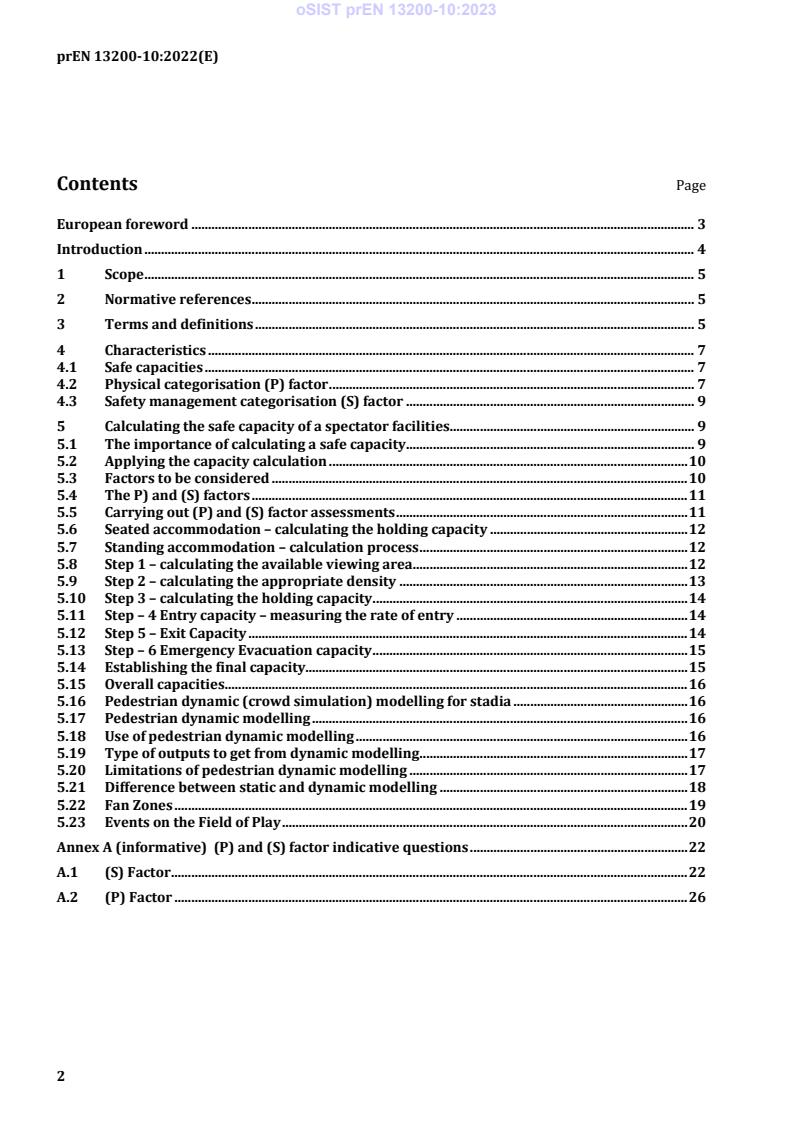
Contents Page
European foreword . 3
Introduction . 4
1 Scope . 5
2 Normative references . 5
3 Terms and definitions . 5
4 Characteristics . 7
4.1 Safe capacities . 7
4.2 Physical categorisation (P) factor . 7
4.3 Safety management categorisation (S) factor . 9
5 Calculating the safe capacity of a spectator facilities. 9
5.1 The importance of calculating a safe capacity . 9
5.2 Applying the capacity calculation . 10
5.3 Factors to be considered . 10
5.4 The P) and (S) factors . 11
5.5 Carrying out (P) and (S) factor assessments . 11
5.6 Seated accommodation – calculating the holding capacity . 12
5.7 Standing accommodation – calculation process . 12
5.8 Step 1 – calculating the available viewing area . 12
5.9 Step 2 – calculating the appropriate density . 13
5.10 Step 3 – calculating the holding capacity . 14
5.11 Step – 4 Entry capacity – measuring the rate of entry . 14
5.12 Step 5 – Exit Capacity . 14
5.13 Step – 6 Emergency Evacuation capacity . 15
5.14 Establishing the final capacity. 15
5.15 Overall capacities . 16
5.16 Pedestrian dynamic (crowd simulation) modelling for stadia . 16
5.17 Pedestrian dynamic modelling . 16
5.18 Use of pedestrian dynamic modelling . 16
5.19 Type of outputs to get from dynamic modelling . 17
5.20 Limitations of pedestrian dynamic modelling . 17
5.21 Difference between static and dynamic modelling . 18
5.22 Fan Zones . 19
5.23 Events on the Field of Play . 20
Annex A (informative) (P) and (S) factor indicative questions . 22
A.1 (S) Factor . 22
A.2 (P) Factor . 26
European foreword
This document (prEN 13200-10:2023) has been prepared by Technical Committee CEN/TC 315
“Spectator facilities”, the secretariat of which is held by UNI.
This document is currently submitted to the CEN Enquiry.
Introduction
This document has been prepared in order to specify the general criteria for spectator safety
management.
Attention is drawn to the fact that in certain Countries additional/different requirements may be
applicable due to existing national regulations or equivalent.
This document starts from the Council of the European Union Resolution of 4 December 2006 and has
been prepared in order to specify the technical general criteria for the planning and safety of the
management in spectator facilities.
The principal objective of this document is to provide guidance on the assessment of how many
spectators can be safely accommodated within the viewing accommodation of spectator facilities used
for a sporting event.
The assessment to determine the safe capacity of spectator facilities is the most important step towards
the achievement of reasonable safety.
1 Scope
This document specifies general characteristics regarding infrastructures of safety and emergency
management in spectator facilities.
It specifies the method of calculating a safe capacity for the planning of the any event. e.
2 Normative references
The following documents are referred to in the text in such a way that some or all of their content
constitutes requirements of this document. For dated references, only the edition cited applies. For
undated references, the latest edition of the referenced document (including any amendments) applies.
EN 13200 (all parts), Spectator facilities
3 Terms and definitions
For the purposes of this document, the following terms and definitions apply.
ISO and IEC maintain terminology databases for use in standardization at the following addresses:
— ISO Online browsing platform: available at https://www.iso.org/obp/
— IEC Electropedia: available at https://www.electropedia.org/
3.1
activity area
area where the event takes place
3.2
barrier
any element of spectator facilities, permanent or temporary, intended to prevent people from falling,
and to retain, stop or guide people
Note 1 to entry: Types of barriers used at spectator facilities are further defined in EN 13200 "Spectator
Facilities".
3.3
circulation
free movement of spectators within spectator facilities
3.4
crush barrier
barrier which protects spectators from crushing, positioned in areas of standing accommodation
3.5
design capacity
total number of spectators for which a spectator facility or some division of a spectator facility (block or
sector) is designed
3.6
event
occurrence of a particular set of circumstances
3.7
entry system
set of different types of entrances, linked to form a passage for spectators
3.8
exit
stairway, gangway, passageway, ramp, gateway, door, and all other means of passage used to leave the
spectator facilities and their accommodation
3.9
spectator facilities management
management will normally be either the owner or lessee of the spectator facilities, who may not
necessarily be the promoter of the event
3.10
(P) factor
term used for the assessment of the physical condition of an area of viewing accommodation
3.11
(S) factor
term used for the assessment of the safety management of an area of viewing accommodation
3.12
spectator accommodation
area of a spectator facilities or structure in the spectator facilities provided for the use of spectators;
including all circulation areas, concourses and the viewing accommodation
3.13
spectator facilities
place where sports or other competitive activities take place in the open air and where accommodation
has been provided for spectators, consisting of artificial structures or of natural structures artificially
modified for the purpose
3.14
infrastructure
basic physical and organizational structures needed for the operation
3.15
safe capacity
number of people who can be safely accommodated in a specific space
3.16
risk assessment
overall process of risk analysis and risk evaluation
3.17
risk analysis
systematic use of information to identify sources and to estimate the risk
3.18
risk
combination of the probability of an event and its consequence
3.19
risk criteria
terms of reference by which the significance of risk is assessed
3.20
risk evaluation
process of comparing the estimated risk against given risk criteria to determine the significance of the
risk
4 Characteristics
4.1 Safe capacities
The most important condition for spectator facility safety is to set the maximum number of spectators
that may be accommodated. At spectator facilities, the safety management team should prescribe the
capacities for the premises as a whole and for each separate section of the viewing accommodation.
This standard provides guidance on how to determine the safe capacity within every kind of spectator
facilities. It emphasises that this capacity depends not merely on the available viewing accommodation
and the capacities of the entrances and exits, including the emergency exit capacity, but on the physical
condition (the (P) factor) and the quality of the safety management (the (S) factor) of the spectator
facilities. The safe capacity of a seated stand may be lower than the number of seats within it.
Another important aspect of the process is the type of event. Ground management will be used to
preparing for all the issues presented by the usual activity or event at the spectator facilities. However,
it needs to be recognised that different events will have their own unique circumstances, requirements
or audience profile. Where another sport or different event, such as a musical performance, is planned,
the additional considerations will include the possible requirement for a special safety certificate plus
new contingency plans or appropriate alterations to the existing plans.
The management of the spectator facilities should take responsibility for assessing the (P) and (S)
factors and calculating the safe capacity. These should take account of all the recommendations in this
standard, not merely those with which the spectator facilities already comply. The (S) factor and to a
lesser extent the (P) factor will reflect the operations manual and its underlying risk assessments (see
EN 13200-8 Spectator facilities - Part 8: Safety Management). The Authority issuing the safety
certificate should be satisfied that the proposed (P) and (S) factors are reasonable and that the
methodology and calculations are correct.
In calculating the permitted capacity, the spectator facilities management should set a single (P) factor
and a single (S) factor for each separate area of the spectator facilities. It should then use whichever is
lower to determine the capacity of that area. It should neither multiply the two factors by each other
nor adopt the average. Both these approaches would distort the final figure.
4.2 Physical categorisation (P) factor
4.2.1 General
It is the responsibility of management to assess the (P) factor for each section of viewing facilities. An
important indicator to be used when determining the (P) factor is the standard of spectator facilities
maintenance (see EN 13200-8 Spectator facilities - Part 8: Safety Management).
If all structures, installations and safety-related components at the spectator facilities are maintained in
good condition and working order, a (P) factor of 1,0 should be applied.
Where there are deficiencies, the (P) factor should be reduced accordingly.
If appropriate, the (P) factor could be set as low as 0,0, and therefore the capacity of the area in question
will be zero.
It is imperative therefore that maintenance procedures for both new and existing structures are
properly understood. It is further recommended that a system of planned maintenance be adopted.
Where necessary professional advice on this matter should be sought from competent persons.
It is also essential that maintenance is carried out in accordance with the written instructions provided
by the designer or manufacturer.
For new construction, the provision of operating and maintenance manuals detailing the expected life
cycles of components should be a necessary part of the completion of any new project. This is
notwithstanding any separate tests and inspection periods which may be recommended below or form
part of the annual inspection.
The maintenance of new structures may be equally, or even more onerous than that of existing
structures. Management should be aware that the provision of a new structure does not reduce its
responsibility for the maintenance of a safe structure.
A planned preventative maintenance schedule and its implementation demonstrate that the
management is taking its responsibilities for maintenance seriously.
Good housekeeping is a fundamental part of fostering and maintaining a safety culture at the spectator
facilities.
Management should therefore demonstrate a positive attitude in this respect, and in doing so,
encourage a conscientious, co-operative and vigilant attitude among all members of staff.
In particular, all staff must identify and report to management at an early stage any problem which
might compromise safety, be it relating to the structures at the spectator facilities, their systems,
facilities or equipment.
Their efforts and, if appropriate, suggestions, should always be acknowledged, and they should be
informed of any resultant remedial action.
A positive attitude towards good housekeeping should also be communicated to visiting personnel and
outside contractors.
4.2.2 Structures and installations
All structures at spectator facilities should be safe, serviceable and durable at all times during their use,
and where necessary, fire-resistant. They should comply with statutory requirements, including those
for health and safety at work.
In order to be safe, a structure should be capable of resisting all loads in service (including sporting and
non-sporting use) with an adequate reserve of strength and without motion that would cause alarm to
people on or in the structure.
Specialist advice from a competent engineer should be sought to assess the adequacy of all load-bearing
elements in spectator facilities.
Designers should pay particular attention both to minimising the risk of progressive or
disproportionate collapse from unforeseen incidents, and to the dynamic response of structures. In
doing so, designers should:
a) Systematically assess conceivable hazards to structures and design the structures to be stable and
robust in the light of a risk assessment.
b) Adopt structural forms which minimise the effects of the hazards identified.
c) Provide spectator facilities management with manuals which define the key elements and
components of the structure requiring regular inspection and maintenance.
4.2.3 Structural dynamics for permanent structures
In addition to the ability to resist static loading, structures at spectator facilities may also need to resist
dynamic loading. Permanent structures particularly sensitive to dynamic loading include those with
long spanning or cantilevered seating decks.
4.3 Safety management categorisation (S) factor
The assessment of a spectator facilities capacity should take into account the quality of safety
management that is the (S) factor. An important indicator to be used when determining the (S) factor is
the standard to which the safety management structure, as outlined in this chapter, is implemented.
For example, it is not enough to have a written safety policy for spectators. That policy must be fully
implemented and understood by all staff. Similarly, a safety officer may have a detailed job description,
but may fail to meet its requirements on event days.
Contingency plans may have been drawn up, but never tested.
If all the management’s safety-related responsibilities are fully met, and the stewarding is of a high
standard, an (S) factor of 1,0 should be applied.
Where there are deficiencies in any aspect of the safety management, the (S) factor should be reduced
accordingly. If appropriate, the (S) factor could be set as low as 0,0, and therefore the capacity of the
area in question will be zero.
Management should therefore be aware, that where a safety certificate is in force, its own performance
in safety-related matters will have a direct effect on the calculation of the spectator facilities capacity.
Adverse weather conditions could affect both the (P) or (S) factors.
5 Calculating the safe capacity of a spectator facilities
5.1 The importance of calculating a safe capacity
The purpose of this chapter is to outline the main factors which must be considered in making an
assessment, leading to a calculation of the final safe capacity of each section of the spectator facilities.
Clearly the assessments made will differ according to the unique spectator facilities and to the type of
spectator accommodation being assessed; primarily whether it is for seated or standing
accommodation. But the factors to be applied in each case are the same for every spectator facilities,
regardless of the sport being staged.
To further illustrate the methods of assessment and calculation, worked examples are also provided in
Annex A. However, the details of each step can only be fully understood by a thorough reading of the
whole EN 13200 (All parts).
The assessment and calculation process will require properly detailed plans of the spectator facilities,
where practical drawn to a scale of 1:200. Wherever possible the physical dimensions should be
verified on site.
At the majority of spectator facilities, the capacities of each section will be added to establish the final
capacity of the spectator facilities as a whole. However, as explained in EN 13200-8 Spectator facilities -
Part 8: Safety Management, there are certain spectator facilities including, for example, those staging
horse racing or golfing events where it may be difficult to calculate the overall capacity of the whole
spectator facilities. In such cases, however, the final capacities of individual sections of viewing
accommodation must still be calculated and occupation levels of all areas determined so that, where
necessary, numbers are controlled to ensure they do not compromise safety.
Management must undertake a series of risk assessments (see EN 13200-8 Spectator facilities - Part 8:
Safety Management). These must be taken into account when assessing the (P) and (S) factors.
5.2 Applying the capacity calculation
Once the final capacity of a section or of the whole spectator facilities is determined, in no
circumstances should a larger number of spectators be admitted.
If the final capacity is lower than the level management ideally requires, it can only be raised after the
necessary remedial work has been completed, and/or the quality of safety management improved, and
the area in question then re-assessed.
Similarly, if part of the spectator facilities is required to be closed, this must be done. It must not be re-
opened for spectator viewing for any reason until the necessary remedial work has been completed to
remove the deficiencies which led to its closure, and not before these measures have been approved by
the relevant authority.
5.3 Factors to be considered
The common factors which apply to both seated and standing accommodation can be summarised as
follows.
a) The entry capacity of the section
The entry capacity is the number of people who can pass through all the turnstiles and other entry
points serving the section, within a period of one hour. Historical data may be used to determine a
value.
b) The holding capacity of the section
This is the number of people that can be safely accommodated in each section.
In the case of seats, this will be determined by the actual number of seats, less any that cannot be used
safely owing to seriously restricted views or their inadequate condition (see EN 13200- 8 Spectator
facilities - Part 8: Safety Management) and an assessment of the (P) and (S) factors.
(P) and (S) factors are explained in EN 13200-8 Spectator facilities - Part 8: Safety Management.
In the case of a standing area, this will be determined by a number of features, including crush barrier
strengths and layouts (see EN 13200-3 Spectator facilities - Part 3: Separating elements -
Requirements), areas which offer restricted views, and a further assessment of both the (P) and
(S) factors.
c) The exit capacity of the section
This is the number of people that can safely exit from the viewing area of the section under normal
conditions.
d) The emergency evacuation capacity
This is determined by the emergency evacuation time, which is based largely on the level of risk of the
section and its associated emergency evacuation routes.
The emergency evacuation capacity is the number of people that can safely negotiate the emergency
evacuation routes and reach a place of safety within that set time.
e) The final capacity
Having established all the above figures, the final capacity of the section, and hence of the whole
spectator facilities, will be determined by whichever is the lowest figure arrived at for (a), (b),
(c) or (d).
Diagrams 2.1 and 2.2 summarise the main steps outlined above.
5.4 The P) and (S) factors
In order to calculate the holding capacity (as defined in clause 5.3), each part of the spectator facilities
viewing accommodation should be assessed according to its physical condition. This assessment is
known as the (P) factor.
Similarly, each part of the spectator facilities viewing accommodation should be assessed according to
the quality of the safety management of that area. This assessment is known as the (S) factor.
To help in the assessment of the (P) and (S) factors, it is recommended that each should be given a
numerical value. This value should be quantified as a factor of between 0.0 and 1.0, as the following
examples indicate:
a) Where the physical condition of the accommodation is of a high standard, a (P) factor of 1.0 should
be applied.
b) Where the physical condition is extremely poor, a factor of 0.0 should be applied. As explained
below, this would have the effect of imposing a zero capacity on the area assessed.
c) An intermediate assessment might result in, for example, a (P) factor of 0.6, or perhaps an (S) factor
of 0.8.
While recognising that it is difficult to place specific numerical values on such assessments, it is
nevertheless essential and inevitable that some form of quantified assessment be made. It may also be
noted that this form of assessment is now widely used in other safety related fields.
Owing to the wide variation of conditions and facilities to be found at spectator facilities, this Technical
Report does not seek to place specific values on any of the elements that are likely to be considered
when assessing (P) and (S) factors. This is because the assessments should not aim to create a
cumulative scoring system in which values for individual elements are simply added together.
Instead, the assessment should reflect a considered and reasonable overall judgement of the physical
condition or safety management of the area in question, taking full account of all circumstances and the
wider guidance in this document.
The (P) and (S) factors should be reassessed annually and when there is a physical alteration to the
spectator facilities or a change in the nature of the event, safety management structure or personnel.
Where a safety certificate is in force the reassessment should be agreed with the responsible authority.
5.5 Carrying out (P) and (S) factor assessments
It is the responsibility of spectator facilities management to ensure that (P) and (S) factors are assessed
and, where a safety certificate is in force, that those assessments are agreed in consultation with the
responsible authority.
It is recommended that (P) and (S) factors should be assessed by competent persons with knowledge
and understanding of the spectator facilities concerned, their operation and the general principles of
safety.
It is further recommended that written records of all assessments be kept. Where a safety certificate is
in force the assessments should be held with the safety certificate.
Written records of the assessment should identify any deficiencies found, so that these can be acted
upon by the spectator facilities management, thereby leading to a potential increase of the (P) or (S)
factors (which in turn may lead to an increase in the holding capacity).
Similarly, the records will enable any other deficiencies to be monitored, which may in turn require a
reduction of the (P) or (S) factors.
5.6 Seated accommodation – calculating the holding capacity
One of the figures needed in order to calculate the final capacity is the holding capacity. It should be
noted that the holding capacity of a seated area will not automatically correspond with the number of
seats provided. The following factors must also be considered:
a) Seats that offer a seriously restricted view should be discounted from the holding capacity.
b) Seats that exceed the numbers permitted between radial gangways in each row may be discounted
from the holding capacity.
c) Seats that are damaged, unavailable for use or whose dimensions fall below the specified
minimums for seating row depths, seat widths and/or clearways (see CEN Standard) should be
discounted from the holding capacity.
Having established the number of useable seats, (P) and (S) factors must then be applied.
Having established values for both the (P) and (S) factors, the holding capacity of the seated area can
thus be calculated as follows:
holding capacity = the number of useable seats x (P) o r (S), wichever is lower (1)
It is stressed that the (P) and (S) factors should not be multiplied by each other, but that the lower of
the two factors should be applied to the calculation.
5.7 Standing accommodation – calculation process
The calculation of the holding capacity for standing areas is considerably more complicated than for
seated areas.
As shown in Diagram below, three steps are involved:
Step 1: To establish the available viewing area (A)
Step 2: To establish the appropriate density (D)
Step 3: Using both the above figures, to establish the holding capacity
5.8 Step 1 – calculating the available viewing area
The available viewing area (A) is not the entire area available for standing spectators. Rather, it consists
only of the areas immediately behind crush barriers, less those areas from which only seriously
restricted views are possible.
The extent of the areas behind crush barriers depends on the strength of those crush barriers, and how
far the crush barriers are spaced apart in relation to the angle of slope. For further guidance on the
inter-relation of these factors, see CEN Standard.
Once the crush barriers have been tested, and the spacing between barriers and the angle of slope
measured, the available viewing area can then be calculated, as follows:
a) If, as recommended, the crush barriers are provided continuously between radial gangways, and
are designed for the correct loads and spacing according to CEN Standard, all areas behind the
crush barriers will be considered as the available viewing area.
b) If the crush barriers are not continuous between radial gangways, only the areas behind individual
crush barriers should be counted, according to the strength of each individual barrier. All other
areas must be discounted, even though in practice they will be occupied by standing spectators.
c) The available viewing area must be limited if there is excessive spacing between barriers.
d) Areas immediately behind those crush barriers which have failed the testing procedures must also
be discounted from the available viewing area.
e) If the crush barriers are not continuous and there are no clearly marked gangways, further areas
must be discounted, calculated on the basis of how much space measured at minimum?
1,2 wide the required number of gangways would take up if provided.
f) Standing areas without crush barriers cannot be considered as safe unless the capacity is set at
such a level that the risks are minimised.
If the standing area has no crush barriers, but has a front barrier (be it a barrier, rail, wall or fence)
which meets the horizontal imposed load requirements of a crush barrier, the available viewing
area will be limited to the space immediately behind the front barrier, depending on the strength of
the barrier.
g) It is recognised that there are standing areas and enclosures at certain spectator facilities – such as
lawns in front of stands at race courses which are used for both general circulation and viewing,
and where the recommendations provided in paragraphs (f) and (g) above may not be appropriate.
These areas might not have any crush barriers or even a front barrier which meets the loading
requirement of a crush barrier. However, because the nature of the sport requires that spectators
are able to move freely, it is likely that spectators will be spread throughout the area, rather than
being concentrated behind the front rails.
In such circumstances, the available viewing area may extend beyond 1,5m behind the front rail, and
may cover those parts of the enclosure from which viewing is possible, provided that in order to allow
for circulation a significantly reduced (P) factor is applied.
If this approach is taken, it must be demonstrated through risk assessment, effective monitoring and
appropriate safety management procedures that there is no forward movement or exerted pressure
concentrated on the front rails. Even if all these measures are implemented a careful assessment should
be made of the (P) and (S) factors for each individual division or separate area of viewing
accommodation.
It is also stressed that the calculation of capacities for such enclosures should be separate from the
calculation of capacities for any seated or standing accommodation adjoining them. Where there is a
free-movement of spectators between, for example, a lawn area and a standing terrace, spectator
facilities management must ensure that neither area is filled beyond its capacity.
It should be noted that in all cases any areas affected by seriously restricted views must still be
discounted from the available viewing area.
5.9 Step 2 – calculating the appropriate density
Having established the available viewing area (A) in square metres, this must then be considered in
conjunction with the appropriate density (D). The appropriate density is expressed in terms of a
number of spectators per 10 square metres.
For the purposes of calculating the capacity of standing areas at spectator facilities, the
maximum number that can be applied is 47 persons per 10 square metres.
This maximum figure will then be subject to the assessment of the physical condition of the area (P),
and the quality of the safety management of the area (S).
It is recommended that (P) and (S) factors be quantified as a factor of between 0,0 and 1,0. Guidance on
the assessment of (P) factors and on (S) factor can be found in EN 13200-8 Spectator facilities - Part 8:
Safety Management.
Having established both the (P) and (S) factors, the appropriate density (D) of the standing area is then
calculated using the following formula:
appropriate density (D) = (P) or (S) factor (whichever is lower) % 47 (2)
Thus, if both the (P) and (S) factors are 1,0, the appropriate density will be 47 persons per 10 square
metres. (see EN 13200-1, Spectator facilities - Part 1: General characteristics for spectator viewing area)
If the (P) factor is 0,6 and the (S) factor is 0,9, the appropriate density will be 28,2 persons per 10
square metres; that is, the lower of the two factors (0,6) x 47.
5.10 Step 3 – calculating the holding capacity
Having established the available viewing area (A) and the appropriate density (D), the holding capacity
of the standing area can then be calculated using the following formula:
𝐴𝐴
hold capacity = %𝐷𝐷 (3)
It should be noted that at spectator facilities staging different types of event, the holding capacity may
vary for each event. For example, the free movement of standing spectators between different areas of
viewing accommodation may be permitted at one event but not at another, resulting in a different
appropriate density being applied to the calculation.
5.11 Step – 4 Entry capacity – measuring the rate of entry
The rate at which people can pass through each entry point in one hour (or whatever other time period
is appropriate to the ground or the nature of the event) will vary according to a number of factors.
However, for the purposes of calculating the entry capacity, an upper limit of 660 persons per entry
point per hour should be applied. This is because a higher rate of entry is likely to cause crowd pressure
to build up within the areas immediately inside the ground.
Therefore, if the recorded rate of entry proves to be greater than 660 persons per entry point per hour
– as may well be possible where electronic card entry systems are in place – the upper limit of 660
should still apply when calculating the entry capacity.
Where the recorded rate of entry proves to be lower than 660 persons per entry point per hour for
reasons other than low demand, that lower figure is the figure that should be used for the purposes of
calculating the entry capacity.
If the entry capacity is lower than the holding capacity of the section, the final capacity of that section
should be reduced accordingly.
All rates of entry should be measured at least once a year and recorded.
5.12 Step 5 – Exit Capacity
5.12.1 Flow rates – calculations
For the purposes of calculation, flow rates are expressed in terms of persons per metre width per
minute.
For an exit route the maximum flow rates used for calculation should be:
a) On a stepped surface, 66 persons per metre width per minute
Thus with an exit route measuring 1.2m in width, 79 persons should be able to exit reasonably in one
minute.
b) On a level surface, 82 persons per metre width per minute
Thus with an exit route measuring 1.2m in width, 98 persons should be able to exit reasonably in one
minute.
It is emphasised, however, that basing the design of a level circulation route on a flow rate calculation of
fewer than 82 persons per metre width per minute will achieve more comfortable circulation.
Note also that flow rates may be affected by changes of direction along the exit routes, and, in the case
of stairways, may be reduced if the movement is upwards.
Where it is apparent that, despite using the recommended flow rates, spectators in Zone 2 cannot,
under normal conditions, reach a place of reasonable safety within eight minutes (see EN 13200-1
2019), or where, under emergency conditions, all people present cannot evacuate to a place of
reasonable safety or place of safety within the appropriate emergency egress time, the design and
management of the circulations routes in question will need to be reassessed.
It is stressed that raising the flow rates used for calculation in order to meet exit or emergency exit
times is not acceptable.
Whilst the flow rates cited above provide an essential basis for understanding crowd flow – and should
always be used as the basis for calculating the exit capacity – the use of crowd simulation modelling can,
as stated in Sections 15.13, offer a useful evaluation of movement patterns and help to identify any
issues that might affect the calculation of the exit capacity.
Such modelling is also useful to highlight sections of the exit route where design features or
obstructions may be slowing down flow rates, and to demonstrate where an absence of flow control
measures (see Section 10.6), may result in flow rates that are too high for the exit system as a whole to
accommodate safely.
For further advice on flow rates, refer to the informative annex of EN 13200-1, Spectator facilities.
General characteristics for spectator viewing area.
5.13 Step – 6 Emergency Evacuation capacity
The emergency egress time is a determination which, together with the flow rate and emergency exit
widths, is used to calculate the capacity of the emergency exit routes leading from the viewing
accommodation to a place of reasonable safety, or to a place of safety in the event of an emergency. The
maximum emergency egress time varies between two and half minutes and eight minutes, depending
largely upon the level of fire risk present.
5.14 Establishing the final capacity
Whether for seated or standing areas, having established the holding capacity of the area, a comparison
must then be made between:
a) The holding capacity.
b) The entry capacity.
c) The exit capacity.
d) The emergency evacuation capacity.
The final capacity of the section or whole spectator facilities will be determined by whichever is the
lowest figure of the four criteria.
Any exits in the ground designated for use in an emergency should be sufficiently wide, not only for
spectators but for all other people present to be able to exit within the specified emergency egress time.
Therefore, when calculating the emergency exit capacity of the ground (See EN 13200-7) it will be
necessary to factor in the numbers of staff, event officials and any other people present in the ground.
Once the final capacity of a section, and thence of the whole spectator facilities, is determined, in no
circumstances should a larger number of spectators be admitted without remedial work and the
approval of the relevant authorities.
5.15 Overall capacities
There are certain spectator facilities including, for example, those staging horse racing or golfing events
where it may be difficult to calculate the overall capacity of the whole spectator facilities.
Such spectator facilities may contain large areas of open land to which entry by members of the public
is not controlled, and where spectators may view the event from areas not strictly designed as viewing
accommodation.
In such cases, the capacities of individual, enclosed sections of viewing accommodation must still be
calculated, and a risk assessment undertaken to identify the effective monitoring and appropriate safety
...
Questions, Comments and Discussion
Ask us and Technical Secretary will try to provide an answer. You can facilitate discussion about the standard in here.
Loading comments...