

SIST EN 16309:2014+A1:2015
(Main)Sustainability of construction works - Assessment of social performance of buildings - Calculation methodology
General Information
- Abstract
This European Standard is one part of a suite of European Standards. The standard provides the specific methods and requirements for the assessment of social performance of a building while taking into account the building’s functionality and technical characteristics.
This European Standard applies to all types of buildings, both new and existing. In this first version of the standard, the social dimension of sustainability concentrates on the assessment of aspects and impacts for the use stage of a building expressed using the following social performance categories (from EN 15643 3):
- accessibility;
- adaptability;
- health and comfort;
- impacts on the neighbourhood;
- maintenance;
- safety and security.
NOTE 1 Only impacts and aspects of the above social performance categories are deemed to have an agreed basis for European standardization at this time. Two of the social performance categories included in EN 15643–3 (sourcing of materials and services and stakeholder involvement) are not deemed to be ready for standardization at this time and will be considered for inclusion in future versions of this standard (see informative Annex C).
This standard does not set the rules for how building assessment schemes may provide valuation methods. Nor does it prescribe levels, classes or benchmarks of performance.
Valuation methods, levels, classes or benchmarks may be prescribed in the requirements for environmental, social and economic performance in the client’s brief, building regulations, national standards, national codes of practice, building assessment and certification schemes, etc.
NOTE 2 Where National building regulations give minimum requirements and reference to assessment methods on these aspects, the social performance determined by assessment according to this standard can be used to determine the degree to which the building goes beyond the regulatory/legal requirements.
The corporate social responsibility (CSR) of organizations is not covered by this standard.
The standard gives requirements for:
- the description of the object of assessment;
- the system boundary that applies at the building level;
- the list of indicators and procedures for the application of these indicators;
- the presentation of the results in reporting and communication;
- the data necessary for the application of the standard, and
- verification.
- Status
- Published
- Publication Date
- 16-Dec-2014
- Technical Committee
- TGO - Sustainability of construction works
- Current Stage
- 6060 - National Implementation/Publication (Adopted Project)
- Start Date
- 15-Sep-2014
- Due Date
- 20-Nov-2014
- Completion Date
- 17-Dec-2014


Overview
SIST EN 16309:2014+A1:2015, developed by CEN, defines a methodology for assessing the social performance of buildings within the broader context of sustainable construction. As part of the CEN/TC 350 suite of standards, it focuses on the systematic evaluation of social aspects during the use phase of both new and existing buildings, considering building functionality and technical requirements.
This European Standard stands as a foundational reference for social sustainability in construction works, complementing the assessment of environmental and economic performance. Its calculation methodology enables transparent documentation and comparison, supporting decision-making for planners, developers, regulators, and certification bodies.
Key Topics
Social Performance Categories:
EN 16309 identifies six primary categories to express the social dimension of building sustainability:
- Accessibility - Evaluates physical access for all user groups, supporting inclusive design.
- Adaptability - Assesses the ability of a building to accommodate changing user needs over time.
- Health and Comfort - Considers factors such as indoor air quality, thermal conditions, acoustics, and visual comfort.
- Impacts on the Neighbourhood - Examines how the building affects surrounding communities relating to noise, emissions, and visual aspects.
- Maintenance - Addresses maintainability and upkeep requirements for continued use.
- Safety and Security - Measures systems and characteristics to protect occupants from accidental or intentional harm.
The standard provides requirements for the description of the object of assessment, system boundaries (at the building level), selection and use of indicators, reporting and communication, required input data, and verification of results.
Scope and Boundaries:
- Applies to all types of buildings-residential, commercial, industrial, both new and existing.
- Focuses on the "use stage" of buildings, considering functional equivalents and reference study periods.
- Excludes corporate social responsibility (CSR) and currently does not standardize “sourcing of materials and services” or “stakeholder involvement,” but these may be addressed in future revisions.
Applications
Practical Applications of SIST EN 16309:2014+A1:2015 include:
Decision Support:
- Compare social performance of multiple design, refurbishment, or construction options.
- Identify improvement opportunities for building projects during planning, design, or renovation.
Documentation & Certification:
- Document a building's social performance for reporting in sustainability certifications, declarations, or marketing.
- Aid in meeting or exceeding national building regulations concerning social aspects of sustainability.
Policy & Strategy Development:
- Support governments and organizations in developing policies for sustainable buildings by providing a harmonized assessment method.
- Enable benchmarking of buildings above minimum regulatory or legal requirements.
Transparency and Communication:
- Standardizes how results are reported and communicated, promoting clarity for clients, regulators, and third-party evaluators.
Related Standards
SIST EN 16309:2014+A1:2015 interrelates with several key standards in sustainable construction, including:
- EN 15643-1: General framework for the sustainability assessment of buildings.
- EN 15643-3: Social performance assessment framework referenced by EN 16309.
- EN 15978: Methodology for environmental performance assessment of buildings.
- ISO 15686 Series: Service life planning for buildings and constructed assets.
- EN 15251: Indoor environmental input parameters for building design and assessment.
- Relevant building acoustics, lighting, and indoor air quality standards as cited in the standard’s normative references.
The use of EN 16309 in combination with these related standards facilitates a comprehensive approach to assessing sustainability across its environmental, economic, and social pillars, ensuring holistic and robust building performance evaluations.
Keywords: EN 16309, social performance, sustainable construction, buildings, assessment methodology, CEN, building certification, accessibility, health and comfort, building maintenance, safety and security, neighborhood impact, sustainability standard.
Relations
- Effective Date
- 25-Aug-2026
- Effective Date
- 25-Aug-2026
- Effective Date
- 09-Feb-2026
- Effective Date
- 09-Feb-2026
- Effective Date
- 28-Jan-2026
- Effective Date
- 28-Jan-2026
- Refers
SIST EN 12464-1:2011 - Light and lighting - Lighting of work places - Part 1: Indoor work places - Effective Date
- 28-Jan-2026
- Effective Date
- 28-Jan-2026
- Effective Date
- 28-Jan-2026
- Effective Date
- 28-Jan-2026
- Effective Date
- 28-Jan-2026
- Effective Date
- 28-Jan-2026
- Effective Date
- 28-Jan-2026
- Effective Date
- 28-Jan-2026
- Effective Date
- 28-Jan-2026
Get Certified
Connect with accredited certification bodies for this standard

BSI Group
BSI (British Standards Institution) is the business standards company that helps organizations make excellence a habit.

Bureau Veritas
Bureau Veritas is a world leader in laboratory testing, inspection and certification services.

DNV
DNV is an independent assurance and risk management provider.
Sponsored listings
Frequently Asked Questions
SIST EN 16309:2014+A1:2015 is a standard published by the Slovenian Institute for Standardization (SIST). Its full title is "Sustainability of construction works - Assessment of social performance of buildings - Calculation methodology". This standard covers: This European Standard is one part of a suite of European Standards. The standard provides the specific methods and requirements for the assessment of social performance of a building while taking into account the building’s functionality and technical characteristics. This European Standard applies to all types of buildings, both new and existing. In this first version of the standard, the social dimension of sustainability concentrates on the assessment of aspects and impacts for the use stage of a building expressed using the following social performance categories (from EN 15643 3): - accessibility; - adaptability; - health and comfort; - impacts on the neighbourhood; - maintenance; - safety and security. NOTE 1 Only impacts and aspects of the above social performance categories are deemed to have an agreed basis for European standardization at this time. Two of the social performance categories included in EN 15643–3 (sourcing of materials and services and stakeholder involvement) are not deemed to be ready for standardization at this time and will be considered for inclusion in future versions of this standard (see informative Annex C). This standard does not set the rules for how building assessment schemes may provide valuation methods. Nor does it prescribe levels, classes or benchmarks of performance. Valuation methods, levels, classes or benchmarks may be prescribed in the requirements for environmental, social and economic performance in the client’s brief, building regulations, national standards, national codes of practice, building assessment and certification schemes, etc. NOTE 2 Where National building regulations give minimum requirements and reference to assessment methods on these aspects, the social performance determined by assessment according to this standard can be used to determine the degree to which the building goes beyond the regulatory/legal requirements. The corporate social responsibility (CSR) of organizations is not covered by this standard. The standard gives requirements for: - the description of the object of assessment; - the system boundary that applies at the building level; - the list of indicators and procedures for the application of these indicators; - the presentation of the results in reporting and communication; - the data necessary for the application of the standard, and - verification.
This European Standard is one part of a suite of European Standards. The standard provides the specific methods and requirements for the assessment of social performance of a building while taking into account the building’s functionality and technical characteristics. This European Standard applies to all types of buildings, both new and existing. In this first version of the standard, the social dimension of sustainability concentrates on the assessment of aspects and impacts for the use stage of a building expressed using the following social performance categories (from EN 15643 3): - accessibility; - adaptability; - health and comfort; - impacts on the neighbourhood; - maintenance; - safety and security. NOTE 1 Only impacts and aspects of the above social performance categories are deemed to have an agreed basis for European standardization at this time. Two of the social performance categories included in EN 15643–3 (sourcing of materials and services and stakeholder involvement) are not deemed to be ready for standardization at this time and will be considered for inclusion in future versions of this standard (see informative Annex C). This standard does not set the rules for how building assessment schemes may provide valuation methods. Nor does it prescribe levels, classes or benchmarks of performance. Valuation methods, levels, classes or benchmarks may be prescribed in the requirements for environmental, social and economic performance in the client’s brief, building regulations, national standards, national codes of practice, building assessment and certification schemes, etc. NOTE 2 Where National building regulations give minimum requirements and reference to assessment methods on these aspects, the social performance determined by assessment according to this standard can be used to determine the degree to which the building goes beyond the regulatory/legal requirements. The corporate social responsibility (CSR) of organizations is not covered by this standard. The standard gives requirements for: - the description of the object of assessment; - the system boundary that applies at the building level; - the list of indicators and procedures for the application of these indicators; - the presentation of the results in reporting and communication; - the data necessary for the application of the standard, and - verification.
SIST EN 16309:2014+A1:2015 is classified under the following ICS (International Classification for Standards) categories: 13.020.20 - Environmental economics. Sustainability; 91.040.01 - Buildings in general. The ICS classification helps identify the subject area and facilitates finding related standards.
SIST EN 16309:2014+A1:2015 has the following relationships with other standards: It is inter standard links to SIST ISO 2631-2:2022, SIST ISO 2631-1:2022, SIST ISO 2631-1:2022/Amd 1:2022, SIST ISO 15686-2:2014, SIST EN 12354-6:2004, SIST EN ISO 3382-2:2008, SIST EN 12464-1:2011, SIST EN ISO 3382-3:2022, oSIST prEN 13381-1:2009, SIST EN 12354-5:2023, SIST EN 1208:2005, SIST EN 12470-4:2001/kprA1:2009, SIST EN ISO 12354-3:2017, SIST EN ISO 717-2:2021, SIST EN ISO 10140-3:2021. Understanding these relationships helps ensure you are using the most current and applicable version of the standard.
SIST EN 16309:2014+A1:2015 is available in PDF format for immediate download after purchase. The document can be added to your cart and obtained through the secure checkout process. Digital delivery ensures instant access to the complete standard document.
Standards Content (Sample)
2003-01.Slovenski inštitut za standardizacijo. Razmnoževanje celote ali delov tega standarda ni dovoljeno.Nachhaltigkeit von Bauwerken - Bewertung der sozialen Qualität von Gebäuden - BerechnungsmethodenContribution des ouvrages de construction au développement durable - Évaluation de la performance sociale des bâtiments - Méthodes de calculSustainability of construction works - Assessment of social performance of buildings - Calculation methodology91.040.01Stavbe na splošnoBuildings in general13.020.20Okoljevarstvena ekonomikaEnvironmental economicsICS:Ta slovenski standard je istoveten z:EN 16309:2014+A1:2014SIST EN 16309:2014+A1:2015en,fr,de01-januar-2015SIST EN 16309:2014+A1:2015SLOVENSKI
STANDARD
EUROPEAN STANDARD NORME EUROPÉENNE EUROPÄISCHE NORM
EN 16309:2014+A1
August 2014 ICS 91.040.01 Supersedes EN 16309:2014English Version
Sustainability of construction works - Assessment of social performance of buildings - Calculation methodology
Contribution des ouvrages de construction au développement durable - Évaluation de la performance sociale des bâtiments - Méthodes
Nachhaltigkeit von Bauwerken - Bewertung der sozialen Qualität von Gebäuden - Berechnungsmethoden This European Standard was approved by CEN on 23 November 2013 and includes Amendment 1 approved by CEN on 22 July 2014.
CEN members are bound to comply with the CEN/CENELEC Internal Regulations which stipulate the conditions for giving this European Standard the status of a national standard without any alteration. Up-to-date lists and bibliographical references concerning such national standards may be obtained on application to the CEN-CENELEC Management Centre or to any CEN member.
This European Standard exists in three official versions (English, French, German). A version in any other language made by translation under the responsibility of a CEN member into its own language and notified to the CEN-CENELEC Management Centre has the same status as the official versions.
CEN members are the national standards bodies of Austria, Belgium, Bulgaria, Croatia, Cyprus, Czech Republic, Denmark, Estonia, Finland, Former Yugoslav Republic of Macedonia, France, Germany, Greece, Hungary, Iceland, Ireland, Italy, Latvia, Lithuania, Luxembourg, Malta, Netherlands, Norway, Poland, Portugal, Romania, Slovakia, Slovenia, Spain, Sweden, Switzerland, Turkey and United Kingdom.
EUROPEAN COMMITTEE FOR STANDARDIZATION
COMITÉ EUROPÉEN DE NORMALISATION EUROPÄISCHES KOMITEE FÜR NORMUNG
CEN-CENELEC Management Centre:
Avenue Marnix 17,
B-1000 Brussels © 2014 CEN All rights of exploitation in any form and by any means reserved worldwide for CEN national Members. Ref. No. EN 16309:2014+A1:2014 ESIST EN 16309:2014+A1:2015
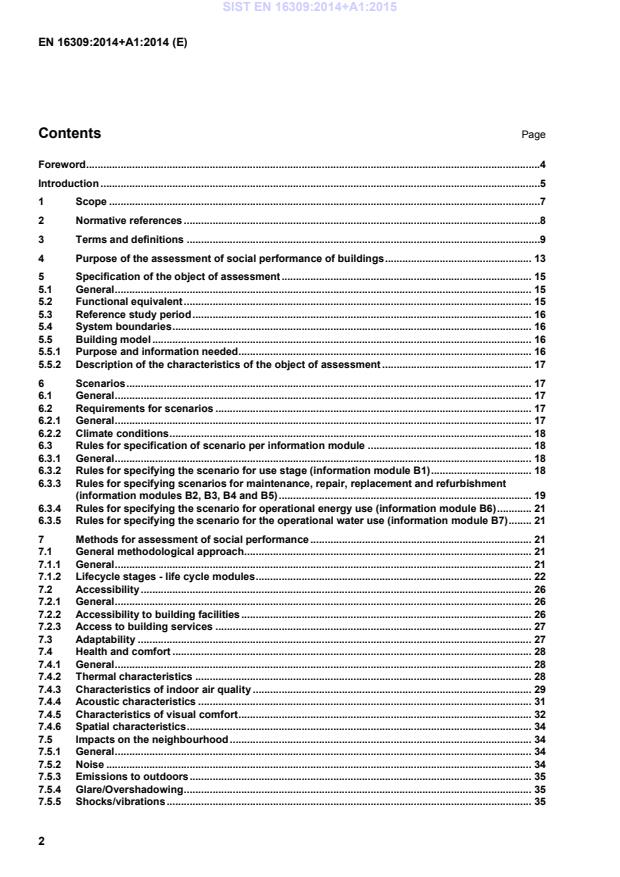
Assessment procedure . 45 A.1 Introduction . 45 A.2 Assessment table for the information module “B1 - use” . 47 A.3 Assessment table “Influence Allocation” . 49 A.4 Assessment tables for the information modules B2 to B7 . 51 Annex B (informative)
Building characteristics used in an assessment . 54 Annex C (informative)
Sourcing of materials and services . 56 C.1 General . 56 C.2 Sourcing of materials . 56 C.3 Sourcing of services . 57 Bibliography . 58
Figure 1 — Concept of sustainability assessment of buildings This European Standard is intended to support the decision making process and documentation of the assessment of the social performance of a building. In this European Standard, the method of assessment of the social performance of a building is based on a life cycle approach. The general requirements for sustainability assessment of buildings are described in EN 15643-1 (the General Framework standard). The framework for the assessment of social performance is given in EN 15643-3. Figure 2 shows other standards developed by CEN/TC 350 in this area, and also how they are related to this standard. The assessment of social performance differs from the assessment of economic and ecological aspects in that it requires both quantitative and descriptive approaches. Where methods leading to a quantitative result are not available for assessment criteria and indicators, a checklist-approach is adopted to make the descriptive approach quantifiable. SIST EN 16309:2014+A1:2015
NOTE The grey boxes represent the work programme as presented in EN 15643-1. Figure 2 — Work programme of CEN/TC 350 SIST EN 16309:2014+A1:2015
Figure 3 — Steps in the process of assessment Aspects included in a social performance assessment may be covered by regulation and or legal requirements. Where this is the case, the general principle of this standard is to declare the performance determined, and the extent to which performance improves upon any national or local legal and/or regulatory requirements, in such a way that compliance or improvement over compliance can be assessed. Depending on the context, the intended use of the assessment may include the following: a) assistance in a decision making process, for example: 1) comparison of the social performance of different design options; 2) comparison of the social performance of refurbishment, reconstruction and/or new construction; 3) identification of the potential for social performance improvements; b) documenting the social performance of a building for use in, for example: 1) certification; 2) declaring social performance; 3) labelling; 4) marketing; c) support for sustainability policy development. SIST EN 16309:2014+A1:2015
The standards of CEN/TC 350 do not define or predefine scenarios but provide rules for describing and specifying scenarios. A predefined scenario would limit creativity in design and could discriminate specific solutions, products, installations or systems. NOTE 3
The scenarios generally apply to the environmental, social and economic assessment. Within the context of the assessment of the social performance in this standard, information that has significant impact on social aspects needs to be profiled here. 6.2 Requirements for scenarios 6.2.1 General The purpose of a scenario is to assist in the quantification of social aspects arising from the activities in using the building and activities for ensuring the technical and functional use over the required service life of the building. The boundaries to be taken into account shall be in accordance with the system boundary described in 5.4. The scenarios employed in an assessment shall be described and documented, making clear the assumptions used. This implies the reporting on appropriate information, data and the limits of their application in the context of the building and its life cycle. It should be clear from the assessment report whether information/data has been assumed, estimated, calculated or is based on actual measurement. Sources of information shall be documented. SIST EN 16309:2014+A1:2015
...