

SIST EN 15978:2026
(Main)Sustainability of construction works - Assessment of environmental performance of buildings - Requirements and guidance
General Information
- Abstract
This document specifies the calculation method, based on Life Cycle Assessment (LCA) and other quantified environmental information, to assess the environmental performance of a building and its site, during whole life cycle, based on a building life cycle model. It also establishes a system for the reporting and communication of the outcome of the assessment.
The document gives:
- the description of the object of assessment based on the functional equivalent;
- the system boundary that applies at the building level;
- calculation rules and procedure to be used to compile and assess the life cycle inventory and life cycle environmental impacts of buildings;
- the list of indicators and procedures for the calculation of these indicators;
- demand for information concerning building generated energy reporting;
- the requirements for the data necessary for the calculation;
- provides recommendations on how to assess aspects at the local environment level; and
- the requirements for presentation of the results in reporting and communication.
The approach to the assessment covers all stages of the building life cycle and is based on data obtained from Environmental Product Declarations (EPD) and their "information modules" (EN 15804:2012+A2:2019), generic data according to EN 15941 and other data and information necessary and relevant for carrying out the assessment. The assessment includes all building related construction products, processes and services, used over the life cycle of the building.
The document is applicable to new, existing buildings and buildings undergoing refurbishment or any other kind of activity to extend its service life. Environmental impacts and aspects that are not related to the building are outside the scope of this standard. Methodologies for and approaches to the interpretation and the making of value judgments of the results of the assessment are outside the scope of this document.
The document also provides the methodological basis and assessment rules to support the achievement of environment related macro-objectives in Europe and instruments such as the European reporting framework Level(s).
NOTE More information on the European reporting framework Level(s)can be found at Level(s) (europa.eu).
Informative Annexes B and C provide non-LCA information covering environmental aspects at the local environment level and additional information on end-of-life scenarios.
- Status
- Published
- Public Enquiry End Date
- 18-Jul-2024
- Publication Date
- 13-May-2026
- Technical Committee
- TGO - Sustainability of construction works
- Current Stage
- 6060 - National Implementation/Publication (Adopted Project)
- Start Date
- 06-May-2026
- Due Date
- 11-Jul-2026
- Completion Date
- 14-May-2026

Overview
SIST EN 15978:2026 is a European standard that sets out the comprehensive requirements and guidance for assessing the environmental performance of buildings. Developed by SIST and aligned with CEN/TC 350, this standard applies to new, existing, and refurbished buildings, covering the full building life cycle. Using a Life Cycle Assessment (LCA) approach and other quantified methods, it ensures that building projects evaluate and communicate their environmental impacts accurately and consistently.
This standard supports the integration of environmental data into decision-making and reporting, aligning environmental performance assessment practices across Europe. It is essential for professionals in architectural design, construction, building operation, and sustainable building assessment.
Key Topics
- Life Cycle Assessment (LCA): The core method for evaluating environmental performance throughout a building's life cycle, from construction to end-of-life.
- Functional Equivalent: Defines the building’s primary function for clear, comparable assessments.
- System Boundary: Specifies the physical and temporal boundaries for environmental data collection at the building level.
- Calculation Rules: Sets out the procedures for compiling and evaluating the environmental inventory and impacts.
- Indicators: Lists and details environmental performance indicators, including emissions, resource use, and waste generation.
- Data Requirements: Outlines the necessary data sources, such as Environmental Product Declarations (EPD) per EN 15804 and generic data per EN 15941.
- Building Generated Energy: Details energy reporting for on-site and site-generated renewables, supporting comprehensive energy accounting.
- Local Environmental Aspects: Recommends how to assess environmental impacts at the site or neighborhood level.
- Reporting and Communication: Sets requirements for presenting, reporting, and communicating assessment results transparently.
- Support for European Frameworks: Provides the foundation for macro-objectives in the European Level(s) reporting framework.
Applications
The SIST EN 15978:2026 standard is highly relevant for a variety of stakeholders in the construction and real estate sectors:
- Building Designers & Architects: Use the standard to integrate environmental performance targets from concept through detailed design and construction.
- Environmental Consultants: Apply consistent LCA and reporting methods for certification, compliance, and eco-labeling.
- Property Developers & Owners: Evaluate refurbishment options, understand whole-life environmental impacts, and support sustainable investment decisions.
- Facilities Managers: Use the outputs to inform operational strategies for reducing carbon footprint and resource use over the building's life.
- Public Authorities & Policymakers: Reference the standard for environmental regulations, green public procurement, and urban sustainability strategies.
- Green Building Certification: Facilitates alignment with frameworks like Level(s), BREEAM, LEED, and national sustainable building requirements.
By following SIST EN 15978:2026, organizations ensure that environmental assessments are transparent, credible, and comparable, supporting the move toward climate-neutral, resource-efficient buildings.
Related Standards
For a robust sustainability assessment in the built environment, SIST EN 15978:2026 should be used in conjunction with complementary standards:
- EN 15804:2012+A2:2019 – Core rules for Environmental Product Declarations (EPD) of construction products.
- EN 15643:2021 – General sustainability framework for assessment of buildings and civil engineering works.
- EN 15941:2024 – Data quality requirements for environmental assessment in construction.
- EN ISO 52000-1:2017 – Energy performance of buildings and overarching assessment methodologies.
- ISO 15686 Series – Guidance on service life planning, estimation, and evaluation.
For those reporting under the European Level(s) framework, SIST EN 15978:2026 provides the technical structure for assessing macro-objectives such as greenhouse gas emissions, resource efficiency, and water use efficiency across the building lifecycle.
SIST EN 15978:2026 is an essential standard for driving sustainability and environmental performance in the construction sector, helping to meet European and global sustainability goals.
Relations
- Effective Date
- 01-Jun-2026
- Effective Date
- 08-Apr-2026
- Effective Date
- 08-Apr-2026
- Effective Date
- 08-Apr-2026
- Effective Date
- 01-Apr-2026
- Effective Date
- 01-Apr-2026
- Effective Date
- 01-Apr-2026
- Effective Date
- 01-Apr-2026
- Effective Date
- 01-Apr-2026
- Effective Date
- 01-Apr-2026
- Effective Date
- 01-Apr-2026
- Effective Date
- 01-Apr-2026
- Effective Date
- 01-Apr-2026
- Effective Date
- 01-Apr-2026
- Effective Date
- 01-Apr-2026
Get Certified
Connect with accredited certification bodies for this standard

BSI Group
BSI (British Standards Institution) is the business standards company that helps organizations make excellence a habit.

Bureau Veritas
Bureau Veritas is a world leader in laboratory testing, inspection and certification services.

DNV
DNV is an independent assurance and risk management provider.
Sponsored listings
Frequently Asked Questions
SIST EN 15978:2026 is a standard published by the Slovenian Institute for Standardization (SIST). Its full title is "Sustainability of construction works - Assessment of environmental performance of buildings - Requirements and guidance". This standard covers: This document specifies the calculation method, based on Life Cycle Assessment (LCA) and other quantified environmental information, to assess the environmental performance of a building and its site, during whole life cycle, based on a building life cycle model. It also establishes a system for the reporting and communication of the outcome of the assessment. The document gives: - the description of the object of assessment based on the functional equivalent; - the system boundary that applies at the building level; - calculation rules and procedure to be used to compile and assess the life cycle inventory and life cycle environmental impacts of buildings; - the list of indicators and procedures for the calculation of these indicators; - demand for information concerning building generated energy reporting; - the requirements for the data necessary for the calculation; - provides recommendations on how to assess aspects at the local environment level; and - the requirements for presentation of the results in reporting and communication. The approach to the assessment covers all stages of the building life cycle and is based on data obtained from Environmental Product Declarations (EPD) and their "information modules" (EN 15804:2012+A2:2019), generic data according to EN 15941 and other data and information necessary and relevant for carrying out the assessment. The assessment includes all building related construction products, processes and services, used over the life cycle of the building. The document is applicable to new, existing buildings and buildings undergoing refurbishment or any other kind of activity to extend its service life. Environmental impacts and aspects that are not related to the building are outside the scope of this standard. Methodologies for and approaches to the interpretation and the making of value judgments of the results of the assessment are outside the scope of this document. The document also provides the methodological basis and assessment rules to support the achievement of environment related macro-objectives in Europe and instruments such as the European reporting framework Level(s). NOTE More information on the European reporting framework Level(s)can be found at Level(s) (europa.eu). Informative Annexes B and C provide non-LCA information covering environmental aspects at the local environment level and additional information on end-of-life scenarios.
This document specifies the calculation method, based on Life Cycle Assessment (LCA) and other quantified environmental information, to assess the environmental performance of a building and its site, during whole life cycle, based on a building life cycle model. It also establishes a system for the reporting and communication of the outcome of the assessment. The document gives: - the description of the object of assessment based on the functional equivalent; - the system boundary that applies at the building level; - calculation rules and procedure to be used to compile and assess the life cycle inventory and life cycle environmental impacts of buildings; - the list of indicators and procedures for the calculation of these indicators; - demand for information concerning building generated energy reporting; - the requirements for the data necessary for the calculation; - provides recommendations on how to assess aspects at the local environment level; and - the requirements for presentation of the results in reporting and communication. The approach to the assessment covers all stages of the building life cycle and is based on data obtained from Environmental Product Declarations (EPD) and their "information modules" (EN 15804:2012+A2:2019), generic data according to EN 15941 and other data and information necessary and relevant for carrying out the assessment. The assessment includes all building related construction products, processes and services, used over the life cycle of the building. The document is applicable to new, existing buildings and buildings undergoing refurbishment or any other kind of activity to extend its service life. Environmental impacts and aspects that are not related to the building are outside the scope of this standard. Methodologies for and approaches to the interpretation and the making of value judgments of the results of the assessment are outside the scope of this document. The document also provides the methodological basis and assessment rules to support the achievement of environment related macro-objectives in Europe and instruments such as the European reporting framework Level(s). NOTE More information on the European reporting framework Level(s)can be found at Level(s) (europa.eu). Informative Annexes B and C provide non-LCA information covering environmental aspects at the local environment level and additional information on end-of-life scenarios.
SIST EN 15978:2026 is classified under the following ICS (International Classification for Standards) categories: 13.020.20 - Environmental economics. Sustainability; 91.040.01 - Buildings in general; 91.040.99 - Other buildings. The ICS classification helps identify the subject area and facilitates finding related standards.
SIST EN 15978:2026 has the following relationships with other standards: It is inter standard links to SIST EN 15978:2011, SIST ISO 15686-2:2014, SIST EN ISO 52000-1:2018, SIST EN 15316-4-5:2018, SIST EN 15804:2012+A1:2013, SIST EN 15643:2021, SIST EN 50583-1:2016, SIST EN 15941:2024, SIST EN 15804:2012, SIST EN 16783:2024, SIST EN 17680:2023, SIST EN 16908:2017, SIST EN 15643-5:2018, SIST EN 15643-2:2011, SIST EN 15804:2012+A2:2019. Understanding these relationships helps ensure you are using the most current and applicable version of the standard.
SIST EN 15978:2026 is associated with the following European legislation: Standardization Mandates: M/350. When a standard is cited in the Official Journal of the European Union, products manufactured in conformity with it benefit from a presumption of conformity with the essential requirements of the corresponding EU directive or regulation.
SIST EN 15978:2026 is available in PDF format for immediate download after purchase. The document can be added to your cart and obtained through the secure checkout process. Digital delivery ensures instant access to the complete standard document.
Standards Content (Sample)
SLOVENSKI STANDARD
01-junij-2026
Nadomešča:
SIST EN 15978:2011
Trajnostnost gradbenih objektov - Vrednotenje učinkov ravnanja z okoljem v
stavbah - Zahteve in navodilo
Sustainability of construction works - Assessment of environmental performance of
buildings - Requirements and guidance
Nachhaltigkeit von Bauwerken - Bewertung der Umweltleistung von Gebäuden -
Anforderungen und Anleitungen
Contribution des ouvrages de construction au développement durable - Évaluation de la
performance environnementale des bâtiments - Exigences et recommandations
Ta slovenski standard je istoveten z: EN 15978:2026
ICS:
13.020.20 Okoljska ekonomija. Environmental economics.
Trajnostnost Sustainability
91.040.01 Stavbe na splošno Buildings in general
2003-01.Slovenski inštitut za standardizacijo. Razmnoževanje celote ali delov tega standarda ni dovoljeno.
EN 15978
EUROPEAN STANDARD
NORME EUROPÉENNE
March 2026
EUROPÄISCHE NORM
ICS 91.040.99 Supersedes EN 15978:2011
English Version
Sustainability of construction works - Assessment of
environmental performance of buildings - Requirements
and guidance
Contribution des ouvrages de construction au Nachhaltigkeit von Bauwerken - Bewertung der
développement durable - Évaluation de la performance Umweltleistung von Gebäuden - Methodik
environnementale des bâtiments - Exigences et
recommandations
This European Standard was approved by CEN on 24 November 2025.
CEN members are bound to comply with the CEN/CENELEC Internal Regulations which stipulate the conditions for giving this
European Standard the status of a national standard without any alteration. Up-to-date lists and bibliographical references
concerning such national standards may be obtained on application to the CEN-CENELEC Management Centre or to any CEN
member.
This European Standard exists in three official versions (English, French, German). A version in any other language made by
translation under the responsibility of a CEN member into its own language and notified to the CEN-CENELEC Management
Centre has the same status as the official versions.
CEN members are the national standards bodies of Austria, Belgium, Bulgaria, Croatia, Cyprus, Czech Republic, Denmark, Estonia,
Finland, France, Germany, Greece, Hungary, Iceland, Ireland, Italy, Latvia, Lithuania, Luxembourg, Malta, Netherlands, Norway,
Poland, Portugal, Republic of North Macedonia, Romania, Serbia, Slovakia, Slovenia, Spain, Sweden, Switzerland, Türkiye and
United Kingdom.
EUROPEAN COMMITTEE FOR STANDARDIZATION
COMITÉ EUROPÉEN DE NORMALISATION
EUROPÄISCHES KOMITEE FÜR NORMUNG
CEN-CENELEC Management Centre: Rue de la Science 23, B-1040 Brussels
© 2026 CEN All rights of exploitation in any form and by any means reserved Ref. No. EN 15978:2026 E
worldwide for CEN national Members.
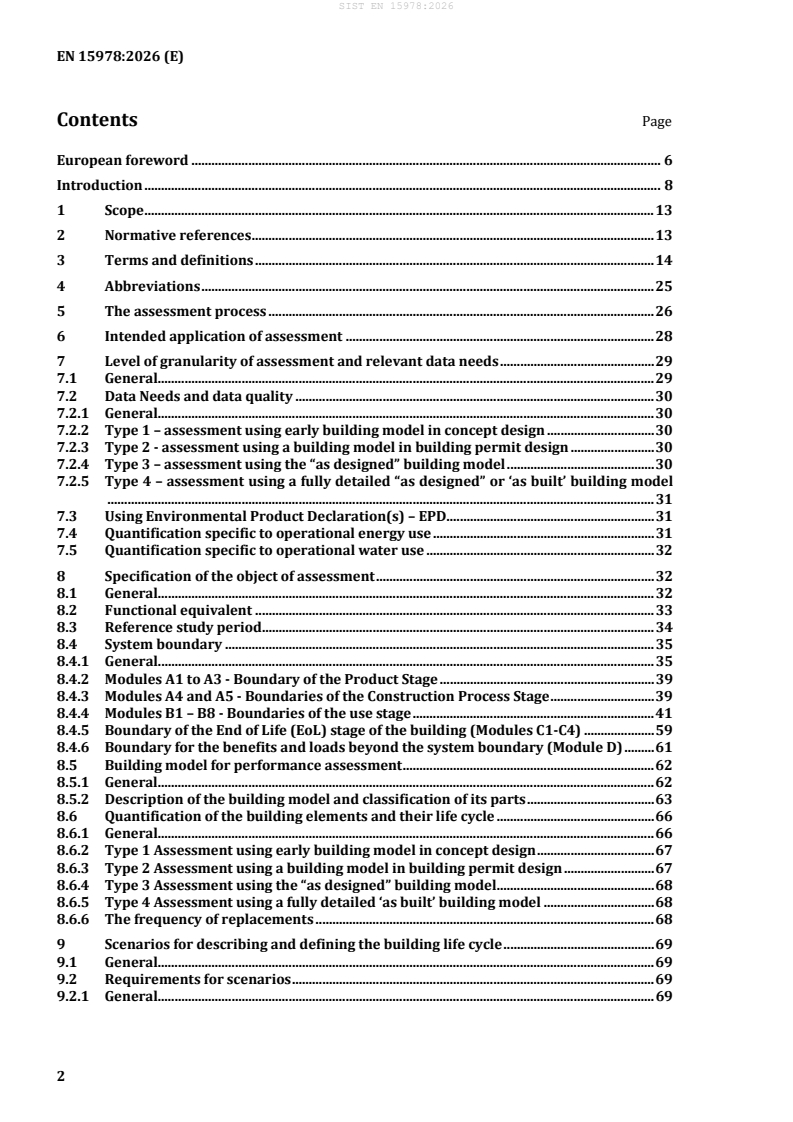
Contents Page
European foreword . 6
Introduction . 8
1 Scope . 13
2 Normative references . 13
3 Terms and definitions . 14
4 Abbreviations . 25
5 The assessment process . 26
6 Intended application of assessment . 28
7 Level of granularity of assessment and relevant data needs . 29
7.1 General. 29
7.2 Data Needs and data quality . 30
7.2.1 General. 30
7.2.2 Type 1 – assessment using early building model in concept design . 30
7.2.3 Type 2 - assessment using a building model in building permit design . 30
7.2.4 Type 3 – assessment using the “as designed” building model . 30
7.2.5 Type 4 – assessment using a fully detailed “as designed” or ‘as built’ building model
................................................................................................................................................................... 31
7.3 Using Environmental Product Declaration(s) – EPD . 31
7.4 Quantification specific to operational energy use . 31
7.5 Quantification specific to operational water use . 32
8 Specification of the object of assessment . 32
8.1 General. 32
8.2 Functional equivalent . 33
8.3 Reference study period . 34
8.4 System boundary . 35
8.4.1 General. 35
8.4.2 Modules A1 to A3 - Boundary of the Product Stage . 39
8.4.3 Modules A4 and A5 - Boundaries of the Construction Process Stage . 39
8.4.4 Modules B1 – B8 - Boundaries of the use stage . 41
8.4.5 Boundary of the End of Life (EoL) stage of the building (Modules C1-C4) . 59
8.4.6 Boundary for the benefits and loads beyond the system boundary (Module D) . 61
8.5 Building model for performance assessment . 62
8.5.1 General. 62
8.5.2 Description of the building model and classification of its parts . 63
8.6 Quantification of the building elements and their life cycle . 66
8.6.1 General. 66
8.6.2 Type 1 Assessment using early building model in concept design . 67
8.6.3 Type 2 Assessment using a building model in building permit design . 67
8.6.4 Type 3 Assessment using the “as designed” building model . 68
8.6.5 Type 4 Assessment using a fully detailed ‘as built’ building model . 68
8.6.6 The frequency of replacements . 68
9 Scenarios for describing and defining the building life cycle . 69
9.1 General. 69
9.2 Requirements for scenarios . 69
9.2.1 General. 69
9.2.2 Addressing technical progress and performance improvement during the building
life cycle . 71
9.3 Time-related characteristics and associated scenarios for maintenance, repair,
replacements, and other periodic operations. 71
9.3.1 General . 71
9.4 Scenarios for climate conditions . 71
9.5 Scenarios for the pre-construction stage (module A0) . 72
9.6 Scenarios for the product stage (modules A1 to A3) . 72
9.7 Scenarios for the construction process stage (modules A4-A5) . 72
9.8 Scenarios for Use Stage (modules B1 to B8) . 73
9.8.1 General . 73
9.8.2 Scenario related to use stage (except energy and water) - module B1 . 73
9.8.3 Scenarios for maintenance, repair, replacement - modules B2, B3 and B4 . 73
9.8.4 Scenarios for refurbishment - module B5 . 74
9.8.5 Scenarios for operational energy use - module B6. 74
9.8.6 Scenarios for operational water use (module B7). 75
9.8.7 Scenarios for the building related users’ activities (module B8) . 75
9.9 Scenarios for the End-of-Life stage (modules C1 to C4) . 76
9.9.1 General . 76
9.9.2 Scenarios for deconstruction - module C1 . 77
9.9.3 Scenarios for transport - module C2 . 77
9.9.4 Scenarios for waste processing for reuse, recycling and energy recovery - module C3
................................................................................................................................................................... 77
9.9.5 Scenarios for disposal - Module C4 . 77
9.10 Scenarios for benefits and loads beyond the system boundary - module D. 77
10 Calculation of the environmental indicators . 78
10.1 Environmental impacts and aspects and related indicators . 78
10.1.1 General . 78
10.1.2 Indicators describing environmental impacts . 78
10.1.3 Indicators describing resource use . 81
10.1.4 Information on biogenic carbon content . 82
10.1.5 Indicators describing additional environmental information . 83
10.1.6 Additional information on carbon storage . 83
10.1.7 Optional information on use of primary raw materials . 84
10.2 Environmental aspects relating to the local environment . 84
10.2.1 General . 84
10.2.2 Purpose of measurement - objectives and benefits . 85
10.2.3 Indicator description and methodology . 85
10.2.4 Output . 86
10.2.5 Evidence . 86
11 Verification of results . 86
12 Additional information on end-of-life scenarios . 87
12.1 General . 87
13 The Assessment Report . 87
13.1 General . 87
13.2 General information on the assessment . 88
13.3 General information on the assessment . 88
13.4 Statement of boundaries and scenarios used in the assessment . 89
13.5 Statement regarding the building model description . 90
13.6 Data sources, types and quality . 90
13.7 List of indicators used for assessment and expression of results . 90
13.8 Specific information in the assessment report . 91
14 Communication of assessment results . 92
Annex A (normative) Building integrated and site generated energy reporting . 93
A.1 General. 93
A.2 Approach A . 93
A.3 Approach B . 94
A.4 Documentation and reporting of background information . 94
A.5 Illustrative example of reporting impacts under Approaches A and B . 97
A.6 Energy use and exported energy scenarios (following Approach A) . 102
A.6.1 General. 102
A.6.2 Case 1 . 102
A.6.3 Case 2 . 102
A.6.4 Case 3 . 103
A.6.5 Case 4 . 104
Annex B (informative) Information describing environmental aspects and impacts to local
environment . 106
B.1 General. 106
B.2 Local land use and land use change . 106
B.2.1 General. 106
B.2.2 Quality of building land and sealing on construction site area . 106
B.3 Local emissions to outdoor air, soil and ground and surface water . 108
B.3.1 General. 108
B.3.2 Purpose of measurement – objectives and benefits . 108
B.3.3 Indicator description . 109
B.3.4 Output . 109
B.3.5 Evidence . 109
Annex C (informative) Additional information on end-of-life scenarios . 111
C.1 General. 111
C.2 Purpose . 111
C.3 Coverage of the additional information on ease of disassembly and the recycling and
reuse potential at the end – of -life stage . 111
C.4 Scenarios . 112
C.5 Object of assessment. 112
C.6 Bill of materials/ quantities . 113
C.7 Ease of disassembly . 113
C.7.1 Purpose of measurement -objectives and benefits . 113
C.7.2 Indicator description and methodology . 113
C.7.3 Result (Unit, Dimension, Measures, Checklist) . 113
C.7.4 Evidence and documentation . 114
C.8 Reuse and recycling potential of dismantled building products and components . 114
C.8.1 Purpose of measurement - objectives and benefits . 114
C.8.2 Indicator description and methodology . 114
C.8.3 Result (Unit, Dimension, Measures, Checklist) . 118
C.9 Additional options to model EoL at building level - how to create alternative scenarios
and what are the consequences . 118
C.9.1 General . 118
C.9.2 Context and use cases . 119
Annex D (informative) A-deviations . 122
Bibliography . 124
European foreword
This document (EN 15978:2026) has been prepared by Technical Committee CEN/TC 350 “Sustainability
of construction works”, the secretariat of which is held by AFNOR.
This European Standard shall be given the status of a national standard, either by publication of an
identical text or by endorsement, at the latest by September 2026, and conflicting national standards shall
be withdrawn at the latest by March 2028.
Attention is drawn to the possibility that some of the elements of this document may be the subject of
patent rights. CEN shall not be held responsible for identifying any or all such patent rights.
This document supersedes EN 15978:2011.
In relation to EN 15978:2011, the following changes have been made:
— environmental impact indicators have been aligned with EN 15804:2012+A2:2019;
— EN 15978 has been aligned with EN 15643 regarding modules B8 and D1 and D2;
— use of baseline and future prospect scenarios have been described;
— requirements and recommendations have been provided for different design stages;
— system boundaries of module B7 “Operational Water Use” (B7.1, B7.2, B7.3 and B7.4) have been
provided in a detailed way similar to module B6 “Operational Energy Use” (B6.1, B6.2 and B6.3);
— the assignment of activities between B4 (Replacement) and B5 (Refurbishment) has been clarified;
— two approaches for the reporting of energy generated in, at or near the building have been described
in subclause 8.4.4.6.4 and Annex A to improve transparency:
• approach A as in EN 15978:2011 and
• approach B where a proportion of the embodied impacts of the energy production appliances
that export energy are outside the system boundary of the building together with their
operational impacts and these are reported as additional information
— impacts resulting from the user’s activities may be declared optionally in Module B8, including
impacts of commuting of users;
— to ensure that all on-site activities are considered, a separate sub-module A5.1 has been introduced
to account for deconstruction of existing construction works in the case of refurbishment projects
with the benefits and loads beyond the system boundary in module D1;
— additional information on end-of-life scenarios are included in the informative text in subclause 12
and in Annex C;
— information concerning environmental aspects at the local environment level is in the informative
text in 10.2 and Annex B.
This document includes A-deviation from France as the French regulation is in conflict with the specific
requirements defined in 8.4.1 and 10.1.6.
This document has been prepared under a mandate given to CEN by the European Commission and the
European Free Trade Association.
Any feedback and questions on this document should be directed to the users’ national standards body.
A complete listing of these bodies can be found on the CEN website.
According to the CEN-CENELEC Internal Regulations, the national standards organisations of the
following countries are bound to implement this European Standard: Austria, Belgium, Bulgaria, Croatia,
Cyprus, Czech Republic, Denmark, Estonia, Finland, France, Germany, Greece, Hungary, Iceland, Ireland,
Italy, Latvia, Lithuania, Luxembourg, Malta, Netherlands, Norway, Poland, Portugal, Republic of North
Macedonia, Romania, Serbia, Slovakia, Slovenia, Spain, Sweden, Switzerland, Türkiye and the United
Kingdom.
Introduction
The purpose of this document is to provide requirements and guidance for the assessment of the
environmental performance of new and existing buildings.
This document is part of a suite of European Standards, Technical Specifications and Technical Reports
for the assessment of the environmental performance of buildings that together support quantification
of the contribution of the assessed building to sustainable construction and sustainable development.
The environmental performance of a building is only one aspect of its sustainability. The social and
economic performance of the building are also aspects of sustainability that should be assessed as part
of a sustainability assessment. These are described in the framework standard (EN 15643).
NOTE 1 The environmental performance assessment at building level requires information from products and
services such as EPD or DoPC according to EN 15804:2012+A2:2019 or generic data according to EN 15941.
The evaluation of technical and functional performance is beyond the scope of this document. Technical
and functional characteristics are taken into account here by reference to the functional equivalent, which
also forms a basis for comparison of the results of assessments.
This document is intended to support the assessment of the environmental performance of a building
and its documentation that can be used in decision-making process. The assessment results are based on
scenarios, which affect the environmental performance of the building. Such scenarios are uncertain, for
example, there may be new processes and/or technologies or future changes in operation, and this could
affect the assessment result. Figure 1 illustrates how the assessment of the environmental performance
takes place within the concept of the sustainability assessment of buildings.
Figure 1 — Concept of sustainability assessment of buildings
NOTE 2 The outer box with the red dotted line represents the area standardized by CEN/TC 350.
In this document, the assessment method for the quantitative evaluation of the environmental
performance of the building is based on a life cycle approach. The general requirements for sustainability
assessment of buildings are described in EN 15643 (the general framework standard). Other standards
developed by CEN/TC 350 in this area, and how they are related to this European Standard, are shown in
Figure 2.
Figure 2 — Standards of CEN/TC 350
EN ISO 52000-1, in common with all EPB standards, provide input data to the calculations relating to
environmental impacts and aspects caused by operational energy use according to EN 15978. EPB
standards provide also a certain flexibility with regard to the methods, the required input data and
references to other EPB standards. For the use of EN ISO 52000-1, informative default choices are
provided in EN ISO 52000-1:2017, Annex B. As EPB standards are used in the context of national or
regional legal requirements, mandatory choices can be given at national or regional level for such specific
applications.
NOTE 3 This document supports the assessment of buildings within the Level(s) Framework (see Bibliography)
for macro-objectives 1, (Greenhouse gas emissions along a building’s life cycle), 2 (Resource efficient and circular
material life cycles) and 3 (Efficient use of water resources). Other standards from CEN/TC350 can also support
Level(s) macro-objectives: for instance, EN 16309 for objective 4 (Healthy and comfortable spaces) and for
objective 5 (Adaptation and resilience to climate change), and EN 16627 for macro-objective 6 (Optimized life cycle
cost and value).
NOTE 4 Level(s), is a common European approach to assess and report on the sustainability of buildings. Using
existing standards, the voluntary Level(s) framework provides a common language for building sustainability, see
Bibliography
Buildings and constructed assets have an impact on sustainable development. Therefore, the
internationally recognized Sustainable Development Goals (SDGs) formulated by the United Nations also
apply to the construction and real estate industry. The construction of sustainable and resilient buildings
is required as part of targets towards sustainable cities and communities formulated in SDG 11, as is an
efficient use of natural resource and a substantial reduction of waste generation through prevention,
reduction, and reuse formulated in SDG12. These goals are closely interrelated with the other SDGs. Both
providers and buyers of real estate need clear characteristics and assessment criteria in order to assess
and communicate the contribution of buildings to sustainable development. Currently the main
sustainability target in the construction and real estate sector is to tackle climate change, among other
SDGs. This standard is contributing directly or is un-directly linked to all SDGs.
Assessments based on the requirements of this document can be used to demonstrate whether the
development and use of an assessed building has the potential to contribute to United Nations SDG Goals
11, 12 and 13, and other SDGs such as 6, 7 and 8 (Figure 3).
Figure 3 — Sustainable Development Goals (SDGs) formulated by the United Nations,
particularly relevant to the environmental performance of buildings and constructed assets
1 Scope
This document specifies the calculation method, based on Life Cycle Assessment (LCA) and other
quantified environmental information, to assess the environmental performance of a building and its site,
during whole life cycle, based on a building life cycle model. It also establishes a system for the reporting
and communication of the outcome of the assessment.
The document gives:
— the description of the object of assessment based on the functional equivalent;
— the system boundary that applies at the building level;
— calculation rules and procedure to be used to compile and assess the life cycle inventory and life cycle
environmental impacts of buildings;
— the list of indicators and procedures for the calculation of these indicators;
— demand for information concerning building generated energy reporting;
— the requirements for the data necessary for the calculation;
— provides recommendations on how to assess aspects at the local environment level; and
— the requirements for presentation of the results in reporting and communication.
The approach to the assessment covers all stages of the building life cycle and is based on data obtained
from Environmental Product Declarations (EPD) and their “information modules”
(EN 15804:2012+A2:2019), generic data according to EN 15941 and other data and information
necessary and relevant for carrying out the assessment. The assessment includes all building related
construction products, processes and services, used over the life cycle of the building.
The document is applicable to new, existing buildings and buildings undergoing refurbishment or any
other kind of activity to extend its service life. Environmental impacts and aspects that are not related to
the building are outside the scope of this standard. Methodologies for and approaches to the
interpretation and the making of value judgments of the results of the assessment are outside the scope
of this document.
The document also provides the methodological basis and assessment rules to support the achievement
of environment related macro-objectives in Europe and instruments such as the European reporting
framework Level(s).
NOTE More information on the European reporting framework Level(s)can be found at Level(s) (europa.eu).
Informative Annexes B and C provide non-LCA information covering environmental aspects at the local
environment level and additional information on end-of-life scenarios.
2 Normative references
The following documents are referred to in the text in such a way that some or all of their content
constitutes requirements of this document. For dated references, only the edition cited applies. For
undated references, the latest edition of the referenced document (including any amendments) applies.
EN 15316-4-5, Energy performance of buildings - Method for calculation of system energy requirements and
system efficiencies - Part 4-5: District heating and cooling, Module M3-8-5, M4-8-5, M8-8-5, M11-8-5
EN 15643:2021, Sustainability of construction works - Framework for assessment of buildings and civil
engineering works
EN 15804:2012+A2:2019, Sustainability of construction works - Environmental product declarations -
Core rules for the product category of construction products
EN 15941:2024, Sustainability of construction works - Data quality for environmental assessment of
products and construction work - Selection and use of data
EN ISO 52000-1:2017, Energy performance of buildings - Overarching EPB assessment - Part 1: General
framework and procedures (ISO 52000-1:2017)
ISO 15686-1, Building and constructed assets — Service life planning — Part 1: General principles and
framework
ISO 15686-2, Building and constructed assets — Service life planning — Part 2: Service life prediction
procedures
ISO 15686-7, Buildings and constructed assets — Service life planning — Part 7: Performance evaluation
for feedback of service life data from practice
ISO 15686-8, Buildings and constructed assets — Service-life planning — Part 8: Reference service life and
service-life estimation
3 Terms and definitions
For the purposes of this document, the following terms and definitions apply:
ISO and IEC maintain terminology databases for use in standardization at the following addresses:
— IEC Electropedia: available at https://www.electropedia.org/
— ISO Online browsing platform: available at https://www.iso.org/obp/ui/#home
3.1
bill of materials
bill of quantities
documented formal hierarchical tabulation of the physical assemblies, subassemblies, components
products and materials with their quantities needed to fabricate a building
3.2
building
construction works (3.12) that have the provision of shelter for its occupants or contents as one of its
main purposes and are usually enclosed and designed to stand permanently in one place
[SOURCE: ISO 6707-1:2020, 3.1.1.3 modified – “partially and totally” has been removed from the
definition; Note 1 to entry deleted]
As impacted by EN 15804:2012+A2:2019/AC:2021.
3.3
building integrated technical system
installed technical equipment that enables the continued operation of a building’s (3.2) core functions
Note 1 to entry: This includes the technical appliances for space heating, space cooling, ventilation, domestic hot
water, built-in (installed) lighting, in building transportation (e.g. lifts, escalators, travelators) building automation
and control, on-site electricity generation, or a combination thereof, (including those systems using energy from
renewable sources), and other systems e.g. for sanitation, security, fire safety, and IT communications.
Note 2 to entry: Building-integrated technical appliances (including onsite energy generating equipment) are
construction products/building components.
3.4
cleaning
operations that ensure a level of cleanliness and appearance, consisting of separating and eliminating
generally visible dirt from a surface by means of the following combined factors, in variable proportions,
such as chemical action, mechanical action, temperature, duration of application
[SOURCE: ISO 22716:2007, 2.8]
3.5
client
person or organization that requires a building (3.2) to be provided, altered or extended and is
responsible for initiating and financing a project, and approving the brief
[SOURCE: ISO 6707-2:2017, 3.8.2]
3.6
complementary product category rules
c-PCR
product group specific or horizontal PCR, which provide additional compliant and non-contradictory
requirements to EN 15804
Note 1 to entry: c-PCR are meant to be used together with EN 15804 and to be in line with EN 15804.
[SOURCE: CEN/TR 16970:2016, 3.1, modified – the end of the Note 1 added.]
3.7
component
product manufactured as a distinct unit to serve a specific function or functions
[SOURCE: ISO 6707-1:2020, 3.4.13]
3.8
construction element
building component
building element
assembled system
parts of works
component (3.7) or a set of assembled components incorporated in a building (3.2) or other construction
works (3.12)
[SOURCE: EN 15643:2021, 3.15]
3.9
construction product
item manufactured or processed for incorporation in construction works (3.12)
Note 1 to entry: According to CPR “construction product” means any formed or formless physical item, including
3D-printed products, or a kit that is placed on the market, including by means of supply to the construction site, for
incorporation in a permanent manner in construction works or parts thereof with the exception of items necessarily
first integrated into a kit or another construction product prior to being incorporated in a permanent manner in
construction works.
Note 2 to entry: According to CPR “permanent” means intended to remain in the construction works or parts thereof
after the completion of the construction or renovation process.
Note 3 to entry: This definition includes products that are not considered construction products within the CPR
definition, e.g. ready-mixed concrete.
[SOURCE: EN 15643:2021, 3.16 – modified Note 1, Note 2 and Note 3 to entry have been added]
3.10
construction site
area where construction work (3.11) is undertaken or construction services (EN 15804:2012+A2:2019,
3.7) are provided
[SOURCE: ISO 21930:2017, 3.2.10]
3.11
construction work
construction operations
activities of forming a construction works (3.12)
Note 1 to entry: Refers to both buildings (3.2) and civil engineering works (EN 15643:2021, 3.10)
[SOURCE: ISO 6707-1:2020, 3.1.1.1, modified - Note 1 to entry modified]
3.12
construction works
constructed assets (buildings (3.2), civil engineering works (EN 15643:2021, 3.10), landscaping (3.32),
external works (3.24) and other structures) resulting from construction operations (3.11)
Note 1 to entry: From an economic perspective, completed construction works are typically referred to as a
constructed asset.
[SOURCE: ISO 15392:2019, modified – some terms in Note 1 to entry combined into definition]
3.13
cut-off criteria
specification of the amount of material or energy flows or the level of significance associated with unit
processes or product system, including building level assessment, that may be excluded from a study
according to EN 15941
[SOURCE: EN ISO 14044:2006, 3.18, modified – term “flow” made plural, term “environmental” deleted
from definition, term “to be” replaced in the definition by “that may be” after term “product system”,
“including building level assessment” added, “according to EN 15941” added]
3.14
deconstruction
process of selectively and systematically dismantling a building (3.2) to reduce the amount of waste
disposal created and generate a supply of high value components (3.7), construction products (3.9),
building integrated technical systems (3.3), building elements (3.8) and their parts and secondary materials
(3.52) that are suitable for reuse (3.48) or for material recycling (3.40) as well as for recovered (3.39) for
energy
Note 1 to entry “Design for deconstruction” enables selective and systematic dismantling of a building
3.15
disassembly
dismantling
non-destructive taking-apart of assembled systems (3.8) or components (3.7) at the end of its life, in such
a way that enables their parts to be reused (3.48), recycled (3.40), recovered (3.39) for energy or, in some
other way, diverted from the waste disposal stream
Note 1 to entry: Design for disassembly enables non-destructive taking apart of assembled systems or components.
3.16
embodied impact
sum of an environmental impact (3.19) caused within the system boundary (3.55) by the processes
associated with the extraction, production, transportation, installation, emissions of materials during use
(excluding operational energy use (3.36) and operational water use (3.37)), maintenance (3.34), repair
(3.44) replacement (3.45), deconstruction (3.14), waste treatment and disposal at end of life of the object
of assessment
Note 1 to entry: Embodied impact of a building will comprise all impacts associated with the construction products
(3.9) and building integrated technical systems (3.3) used within the scope of the object of assessment.
Note 2 to entry: Module D1 reports net benefits and loads beyond the system boundary and complements Modules
A, B and C. It is reported separately as additional information.
3.17
embodied carbon
embodied greenhouse gas emissions
embedded greenhouse gas emissions
sum of the greenhouse gases emissions and removals, within the system boundary (3.55) in the processes
associated with the extraction, production, transportation, installation, emissions of materials during use,
(excluding operational energy use (3.36) and operational water use (3.37)), maintenance (3.34), repair
(3.44), replacement (3.45),
...