

SIST EN 13498:2003
(Main)Thermal insulation products for building applications - Determination of the resistance to penetration of external thermal insulation composite systems (ETICS)
- Abstract
This European Standard specifies equipment and a procedure for determining the resistance to penetration of external thermal insulation composite systems. It is applicable to external thermal insulation composite systems (ETICS).
- Status
- Published
- Publication Date
- 30-Nov-2003
- Technical Committee
- TOP - Thermal insulation
- Current Stage
- 6060 - National Implementation/Publication (Adopted Project)
- Start Date
- 01-Dec-2003
- Due Date
- 01-Dec-2003
- Completion Date
- 01-Dec-2003



SIST EN 13498:2003 is a European Standard from SIST for thermal insulation products in building applications. It specifies the equipment and procedure for determining the resistance to penetration of external thermal insulation composite systems (ETICS), so a laboratory can measure how much force is needed to push a probe into a finished ETICS surface.
What does SIST EN 13498:2003 specify?
SIST EN 13498:2003 covers one laboratory test method for ETICS: measuring resistance to penetration by pressing a steel probe into the surface and recording the maximum force. It is intended for building applications, and the document organizes the method from scope through test report.
The main clauses are:
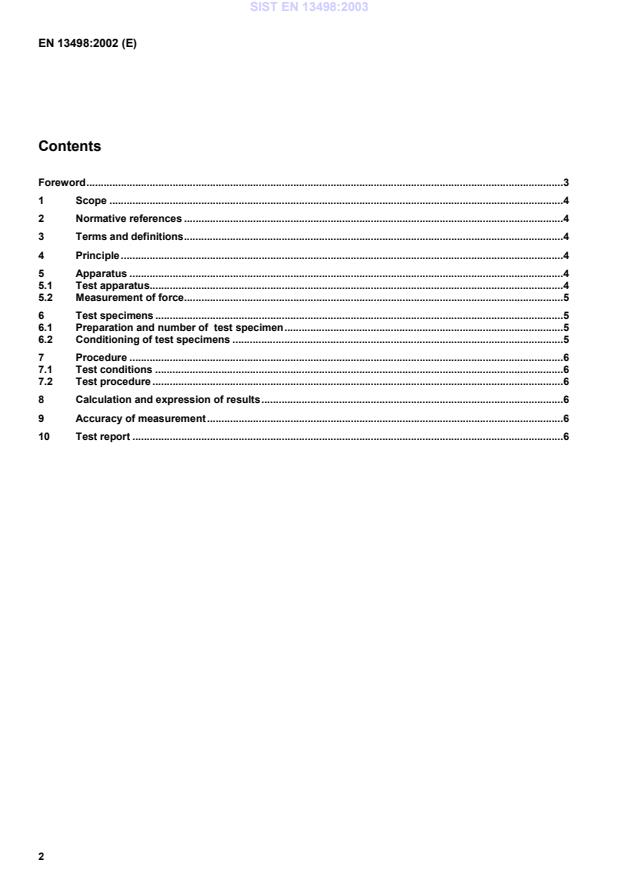
- Clause 1 - Scope
- Clause 2 - Normative references
- Clause 3 - Terms and definitions
- Clause 4 - Principle
- Clause 5 - Apparatus
- Clause 6 - Test specimens
- Clause 7 - Procedure
- Clause 8 - Calculation and expression of results
- Clause 9 - Accuracy of measurement
- Clause 10 - Test report
In practice, this structure takes the user from specimen preparation to reporting, so test results are comparable between laboratories and tied to the product information that matters for ETICS assessment.
What are the key requirements of SIST EN 13498:2003?
SIST EN 13498:2003 defines a very specific penetration test: a steel cylinder with a hemispherical end is pressed into the ETICS surface, and the peak force is reported as the resistance to penetration. That means the result is a force value in newtons, not a visual rating.
Test apparatus and force measurement
Clause 5 requires a compression testing machine with constant crosshead speed of (10 ± 1) mm/min and force reading to 1 %. The machine needs a rigid plane parallel plate and a penetration device with the specified steel cylinder geometry. The force sensor must measure continuously and be aligned so its own deformation is negligible or corrected for. In practice, this ensures the measured value reflects the ETICS response, not the test rig.
Test specimens
Clause 6 requires specimens with minimum dimensions of 200 mm x 200 mm x 60 mm, and five test specimens are needed. The base coat with reinforcement is applied according to the manufacturer’s instructions, then the finishing material is applied after the specified time. If the coated sample is larger, the test pieces are cut from it. This matters because the test is performed on a representative finished system, not on separate layers.
Conditioning and test conditions
Clause 6.2 says conditioning follows the relevant ETICS product standard, or by agreement between parties if no product standard or technical specification is available. Clause 7 sets the test temperature at (23 ± 5) °C. For the reader, this means specimen history and laboratory conditions need to be controlled and documented before the force value can be trusted.
Procedure and result expression
Clause 7 requires the penetration device to be pressed into the center of each specimen at the specified speed, while force is recorded simultaneously. Clause 8 says the maximum force is the resistance to penetration, and the reported result is the mean of the five measurements, rounded to the nearest 1 N. This gives a single comparable value for decision-making and specification checks.
Test report content
Clause 10 requires detailed reporting of product identification, the finishing material, base coat, reinforcement, and thermal insulating material, plus sampling, conditioning, deviations, test date, specimen count, speed, discarded specimens, and all individual values with the mean. This is the part that supports traceability and technical review.
What terms does SIST EN 13498:2003 define?
SIST EN 13498:2003 applies the terms and definitions from prEN ISO 9229:1997 and prEN 13499:1999. The following terms are central to using the method:
- ETICS - external thermal insulation composite systems, the finished insulating system being tested.
- Base coat - the layer applied to the insulation material before the finishing material, often with reinforcement embedded in it.
- Finishing material - the outer layer applied over the base coat.
- Reinforcement - the reinforcing component in the base coat, identified by type and mass per square metre in the report.
- Thermal insulating material - the insulation layer that carries the coated system and is part of the test specimen.
- Resistance to penetration - the maximum force recorded when the probe is pressed into the ETICS surface.
Who uses SIST EN 13498:2003?
SIST EN 13498:2003 is used by test laboratories, ETICS manufacturers, and suppliers of finishing materials, base coats, reinforcement, and insulation boards. It is also relevant to quality managers, buyers, and specifiers who need a repeatable test for comparing ETICS products or checking conformity to a product standard. Because the report requires detailed product and sampling information, it also supports certification and technical file work.
What changed in SIST EN 13498:2003 from the previous edition?
SIST EN 13498:2003 is identical to EN 13498:2002.
Which standards are used with SIST EN 13498:2003?
SIST EN 13498:2003 cites several related standards that support specimen preparation, material characterization, and terminology:
- EN 823 - thickness measurement of thermal insulating products, used for reporting insulation thickness.
- EN 826 - compression behaviour and force measurement requirements for the test machine.
- EN 1015-1 - particle size distribution of mortar, used for maximum grain size in the report.
- EN 1602 - apparent density of thermal insulating products, used for reporting declared density.
- EN 1607 - tensile strength perpendicular to faces, used for reporting declared tensile strength.
- prEN 13499:1999 - ETICS based on expanded polystyrene, used as the product standard for terms and conditioning.
- prEN ISO 3251 - non-volatile matter content, used for pastes in the report.
- EN ISO 3451-1 - ash determination, used when the main binder is organic.
- prEN ISO 9229:1997 - thermal insulation vocabulary, used for terms and definitions.
What does the SIST EN 13498:2003 document contain?
The document contains a clear laboratory procedure, including a defined test apparatus, specimen preparation steps, conditioning guidance, the test sequence, calculation of the mean maximum force, and a reporting template. Figure 1 shows the penetration test apparatus and the geometry of the steel cylinder. Clause 10 gives a detailed list of the identification data and material properties that should appear in the test report, so the result can be traced back to the ETICS components and sampling history.
Relations
- Effective Date
- 10-Jun-2026
- Effective Date
- 28-Jan-2026
- Effective Date
- 28-Jan-2026
- Effective Date
- 28-Jan-2026
- Effective Date
- 28-Jan-2026
- Effective Date
- 28-Jan-2026
- Effective Date
- 28-Jan-2026
- Effective Date
- 28-Jan-2026
- Effective Date
- 28-Jan-2026
- Effective Date
- 28-Jan-2026
- Effective Date
- 28-Jan-2026
- Effective Date
- 18-Jan-2023
- Effective Date
- 07-Dec-2016
Get Certified
Connect with accredited certification bodies for this standard

DIBt (Deutsches Institut für Bautechnik)
German Institute for Building Technology.
DIN CERTCO
DIN Group product certification.

Aboma Certification B.V.
Specialized in construction, metal, and transport sectors.
Sponsored listings
Frequently Asked Questions
SIST EN 13498:2003 is a standard published by the Slovenian Institute for Standardization (SIST). Its full title is "Thermal insulation products for building applications - Determination of the resistance to penetration of external thermal insulation composite systems (ETICS)". This standard covers: This European Standard specifies equipment and a procedure for determining the resistance to penetration of external thermal insulation composite systems. It is applicable to external thermal insulation composite systems (ETICS).
This European Standard specifies equipment and a procedure for determining the resistance to penetration of external thermal insulation composite systems. It is applicable to external thermal insulation composite systems (ETICS).
SIST EN 13498:2003 is classified under the following ICS (International Classification for Standards) categories: 91.100.60 - Thermal and sound insulating materials. The ICS classification helps identify the subject area and facilitates finding related standards.
SIST EN 13498:2003 has the following relationships with other standards: It is inter standard links to SIST EN ISO 3451-1:2026, SIST EN 1015-1:1999, SIST EN ISO 3251:2019, SIST EN ISO 29466:2023, SIST EN ISO 29470:2020, SIST EN ISO 29469:2023, SIST EN ISO 3451-1:2019, SIST EN 1607:2013, SIST EN ISO 9229:2008, SIST EN 13500:2003, SIST EN 13499:2003, oSIST prEN 17237:2018, oSIST prEN 17237:2018. Understanding these relationships helps ensure you are using the most current and applicable version of the standard.
SIST EN 13498:2003 is associated with the following European legislation: EU Directives/Regulations: 305/2011, 89/106/EEC. When a standard is cited in the Official Journal of the European Union, products manufactured in conformity with it benefit from a presumption of conformity with the essential requirements of the corresponding EU directive or regulation.
SIST EN 13498:2003 is available in PDF format for immediate download after purchase. The document can be added to your cart and obtained through the secure checkout process. Digital delivery ensures instant access to the complete standard document.
Standards Content (Sample)
2003-01.Slovenski inštitut za standardizacijo. Razmnoževanje celote ali delov tega standarda ni dovoljeno.Toplotnoizolacijski proizvodi za uporabo v gradbeništvu – Ugotavljanje odpornosti proti preboju kontaktnih fasadnih toplotnoizolacijskih sistemov (ETICS)Wärmedämmstoffe für das Bauwesen - Bestimmung des Eindringwiderstandes von außenseitigen Wärmedämm-Verbundsystemen (WDVS)Produits isolants thermiques pour le bâtiment - Détermination de la résistance a la pénétration des systemes composites d'isolation thermique par l'extérieur (systemes I.T.E.)Thermal insulation products for building applications - Determination of the resistance to penetration of external thermal insulation composite systems (ETICS)91.100.60Thermal and sound insulating materialsICS:Ta slovenski standard je istoveten z:EN 13498:2002SIST EN 13498:2003en01-december-2003SIST EN 13498:2003SLOVENSKI
STANDARD
EUROPEAN STANDARDNORME EUROPÉENNEEUROPÄISCHE NORMEN 13498October 2002ICS 91.100.60English versionThermal insulation products for building applications -Determination of the resistance to penetration of externalthermal insulation composite systems (ETICS)Produits isolants thermiques destinés aux applications dubâtiment - Détermination de la résistance à la pénétrationdes systèmes d'isolation par l'extérieur (systèmes I.T.E.)Wärmedämmstoffe für das Bauwesen - Bestimmung desEindringwiderstandes von außenseitigen Wärmedämm-Verbundsystemen (WDVS)This European Standard was approved by CEN on 19 August 2002.CEN members are bound to comply with the CEN/CENELEC Internal Regulations which stipulate the conditions for giving this EuropeanStandard the status of a national standard without any alteration. Up-to-date lists and bibliographical references concerning such nationalstandards may be obtained on application to the Management Centre or to any CEN member.This European Standard exists in three official versions (English, French, German). A version in any other language made by translationunder the responsibility of a CEN member into its own language and notified to the Management Centre has the same status as the officialversions.CEN members are the national standards bodies of Austria, Belgium, Czech Republic, Denmark, Finland, France, Germany, Greece,Iceland, Ireland, Italy, Luxembourg, Malta, Netherlands, Norway, Portugal, Spain, Sweden, Switzerland and United Kingdom.EUROPEAN COMMITTEE FOR STANDARDIZATIONCOMITÉ EUROPÉEN DE NORMALISATIONEUROPÄISCHES KOMITEE FÜR NORMUNGManagement Centre: rue de Stassart, 36
B-1050 Brussels© 2002 CENAll rights of exploitation in any form and by any means reservedworldwide for CEN national Members.Ref. No. EN 13498:2002 ESIST EN 13498:2003
test specimen.56.2Conditioning of test specimens.57Procedure.67.1Test conditions.67.2Test procedure.68Calculation and expression of results.69Accuracy of measurement.610Test report.6SIST EN 13498:2003
...