

SIST EN 13115:2020
(Main)Windows - Classification of mechanical properties - Racking, torsion and operating forces
General Information
- Abstract
This document provides a means of classifying the performance of opening windows according to their strength in resisting, where appropriate, racking load, static torsion and their manual operating forces. Special aspects such as those of burglar resistance are not covered. 1)
1) Effects on other criteria, such as air permeability, are not addressed by EN 13115.
- Status
- Published
- Public Enquiry End Date
- 19-Jun-2018
- Publication Date
- 07-Sep-2020
- Technical Committee
- ISTP - Doors and windows
- Current Stage
- 6060 - National Implementation/Publication (Adopted Project)
- Start Date
- 03-Sep-2020
- Due Date
- 08-Nov-2020
- Completion Date
- 08-Sep-2020


Overview
EN 13115:2020 - Windows: Classification of mechanical properties - Racking, torsion and operating forces (CEN) defines a standardized way to classify the mechanical performance of opening windows. The standard covers resistance to racking loads, static torsion and manual operating forces for various window types. It does not address special aspects such as burglar resistance or effects on other criteria (for example, air permeability).
Key topics and requirements
- Scope: Classification of opening windows according to mechanical strength and manual operating effort. Sliding windows have specific rules.
- Referenced test methods:
- EN 14608 - Determination of the resistance to racking
- EN 14609 - Determination of the resistance to static torsion
- EN 12046-1 - Operating forces - Test method (windows)
- EN 12519 - Windows and pedestrian doors - Terminology
- Operating forces:
- Windows (excluding vertical sliding) are classified by maximum hardware and hand-operated forces/torques into classes (e.g., Class 0, 1, 2) based on threshold values. The highest average measured force/torque defines the operating-force classification.
- Racking and static torsion:
- All openable windows are tested for resistance to racking (EN 14608). Static torsion testing (EN 14609) applies to non-sliding casements.
- Classification for mechanical strength uses ascending force thresholds (Class 0 up to Class 4). For example, racking classes range from <200 N (Class 0) to 800 N (Class 4); static torsion classes range from <200 N to 350 N.
- The lowest average measured value from the relevant tests determines the overall racking/torsion classification.
- Special cases:
- Sliding windows: tested for racking and operating forces only.
- Secondary sashes/casements (cleaning/maintenance mode): testing limited to 100 N for certain cases, per the standard.
Practical applications and users
- Who uses EN 13115:2020:
- Window and façade manufacturers developing product datasheets and CE marking evidence
- Independent test laboratories conducting EN 14608 / EN 14609 / EN 12046-1 tests
- Specifiers, architects and façade engineers selecting windows for performance requirements
- Building authorities and procurement teams requiring mechanical classification in tender documents
- Why it matters:
- Provides objective, repeatable classifications for mechanical strength and ease of operation
- Helps ensure safety, durability and usability of window products across projects
- Facilitates market comparison and regulatory compliance within CEN member states
Related standards
- EN 14608, EN 14609, EN 12046-1, EN 12519 - all referenced by EN 13115:2020 for test methods and terminology. EN 13115:2020 supersedes EN 13115:2001 and is part of the CEN window standards series.
Keywords: EN 13115:2020, window classification, racking, static torsion, operating forces, window testing, CEN, mechanical properties of windows.
Relations
- Effective Date
- 01-Oct-2020
- Effective Date
- 28-Jan-2026
- Effective Date
- 28-Jan-2026
- Effective Date
- 28-Jan-2026
- Effective Date
- 28-Jan-2026
- Effective Date
- 28-Jan-2026
- Effective Date
- 28-Jan-2026
- Effective Date
- 28-Jan-2026
- Effective Date
- 28-Jan-2026
Get Certified
Connect with accredited certification bodies for this standard

DIBt (Deutsches Institut für Bautechnik)
German Institute for Building Technology.
DIN CERTCO
DIN Group product certification.

Aboma Certification B.V.
Specialized in construction, metal, and transport sectors.
Sponsored listings
Frequently Asked Questions
SIST EN 13115:2020 is a standard published by the Slovenian Institute for Standardization (SIST). Its full title is "Windows - Classification of mechanical properties - Racking, torsion and operating forces". This standard covers: This document provides a means of classifying the performance of opening windows according to their strength in resisting, where appropriate, racking load, static torsion and their manual operating forces. Special aspects such as those of burglar resistance are not covered. 1) 1) Effects on other criteria, such as air permeability, are not addressed by EN 13115.
This document provides a means of classifying the performance of opening windows according to their strength in resisting, where appropriate, racking load, static torsion and their manual operating forces. Special aspects such as those of burglar resistance are not covered. 1) 1) Effects on other criteria, such as air permeability, are not addressed by EN 13115.
SIST EN 13115:2020 is classified under the following ICS (International Classification for Standards) categories: 91.060.50 - Doors and windows. The ICS classification helps identify the subject area and facilitates finding related standards.
SIST EN 13115:2020 has the following relationships with other standards: It is inter standard links to SIST EN 13115:2002, SIST EN 12046-1:2020, SIST EN 14609:2004, SIST EN 12519:2018, SIST EN 14608:2004, SIST EN 14351-1:2006+A1:2010, SIST EN 13420:2011, SIST EN 14351-1:2006+A2:2016, SIST EN 12400:2003. Understanding these relationships helps ensure you are using the most current and applicable version of the standard.
SIST EN 13115:2020 is associated with the following European legislation: EU Directives/Regulations: 305/2011. When a standard is cited in the Official Journal of the European Union, products manufactured in conformity with it benefit from a presumption of conformity with the essential requirements of the corresponding EU directive or regulation.
SIST EN 13115:2020 is available in PDF format for immediate download after purchase. The document can be added to your cart and obtained through the secure checkout process. Digital delivery ensures instant access to the complete standard document.
Standards Content (Sample)
SLOVENSKI STANDARD
01-oktober-2020
Nadomešča:
SIST EN 13115:2002
Okna - Klasifikacija mehanskih lastnosti - Navpične obremenitve, torzija in sile pri
uporabi
Windows - Classification of mechanical properties - Racking, torsion and operating
forces
Fenster - Klassifizierung mechanischer Eigenschaften - Vertikallasten, Verwindung und
Bedienkräfte
Fenêtres - Classification des propriétés mécaniques - Charge verticale, torsion et efforts
de manoeuvre
Ta slovenski standard je istoveten z: EN 13115:2020
ICS:
91.060.50 Vrata in okna Doors and windows
2003-01.Slovenski inštitut za standardizacijo. Razmnoževanje celote ali delov tega standarda ni dovoljeno.
EN 13115
EUROPEAN STANDARD
NORME EUROPÉENNE
August 2020
EUROPÄISCHE NORM
ICS 91.060.50 Supersedes EN 13115:2001
English Version
Windows - Classification of mechanical properties -
Racking, torsion and operating forces
Fenêtres - Classification des propriétés mécaniques - Fenster - Klassifizierung mechanischer Eigenschaften -
Charge verticale, torsion et efforts de manoeuvre Vertikallasten, Verwindung und Bedienkräfte
This European Standard was approved by CEN on 19 July 2020.
CEN members are bound to comply with the CEN/CENELEC Internal Regulations which stipulate the conditions for giving this
European Standard the status of a national standard without any alteration. Up-to-date lists and bibliographical references
concerning such national standards may be obtained on application to the CEN-CENELEC Management Centre or to any CEN
member.
This European Standard exists in three official versions (English, French, German). A version in any other language made by
translation under the responsibility of a CEN member into its own language and notified to the CEN-CENELEC Management
Centre has the same status as the official versions.
CEN members are the national standards bodies of Austria, Belgium, Bulgaria, Croatia, Cyprus, Czech Republic, Denmark, Estonia,
Finland, France, Germany, Greece, Hungary, Iceland, Ireland, Italy, Latvia, Lithuania, Luxembourg, Malta, Netherlands, Norway,
Poland, Portugal, Republic of North Macedonia, Romania, Serbia, Slovakia, Slovenia, Spain, Sweden, Switzerland, Turkey and
United Kingdom.
EUROPEAN COMMITTEE FOR STANDARDIZATION
COMITÉ EUROPÉEN DE NORMALISATION
EUROPÄISCHES KOMITEE FÜR NORMUNG
CEN-CENELEC Management Centre: Rue de la Science 23, B-1040 Brussels
© 2020 CEN All rights of exploitation in any form and by any means reserved Ref. No. EN 13115:2020 E
worldwide for CEN national Members.
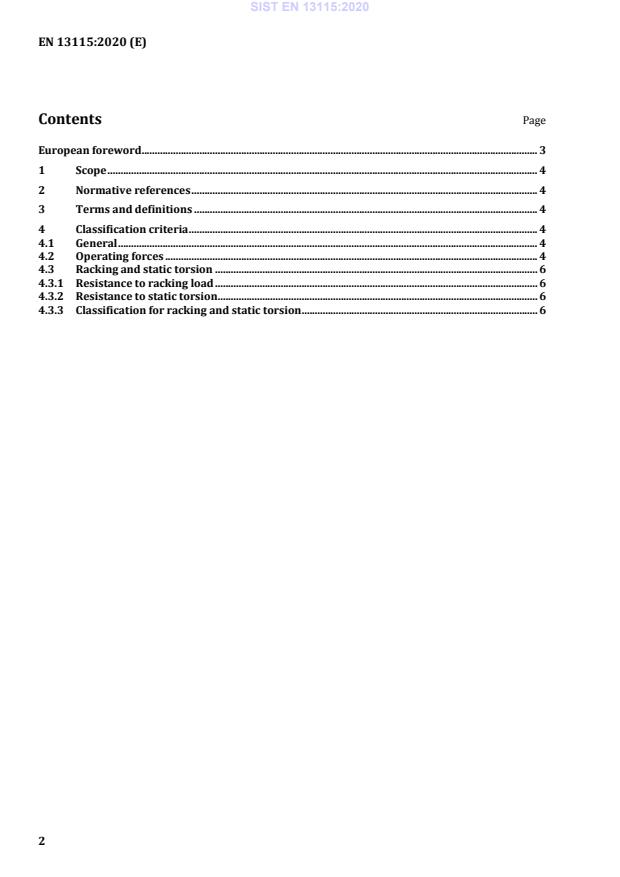
Contents Page
European foreword . 3
1 Scope . 4
2 Normative references . 4
3 Terms and definitions . 4
4 Classification criteria . 4
4.1 General . 4
4.2 Operating forces . 4
4.3 Racking and static torsion . 6
4.3.1 Resistance to racking load . 6
4.3.2 Resistance to static torsion . 6
4.3.3 Classification for racking and static torsion . 6
European foreword
This document (EN 13115:2020) has been prepared by Technical Committee CEN/TC 33 “Doors,
windows, shutters, building hardware and curtain walling”, the secretariat of which is held by AFNOR.
This European Standard shall be given the status of a national standard, either by publication of an
identical text or by endorsement, at the latest by February 2021, and conflicting national standards
shall be withdrawn at the latest by February 2021.
Attention is drawn to the possibility that some of the elements of this document may be the subject of
patent rights. CEN shall not be held responsible for identifying any or all such patent rights.
This document supersedes EN 13115:2001.
This documen
...