

kSIST FprEN 50463-1:2026
(Main)Railway applications - Energy measurement on board trains - Part 1: General
- Abstract
EN 50463-1 describes the primary purpose of the EMS, which is to meter energy consumption for billing and provide compiled energy billing data (CEBD) to a DCS. The EMS may also be used for other functions such as energy management. In addition, EN 50463-1 also describes the primary purpose of a DCS and its interactions with an EMS and settlement system.
- Status
- Not Published
- Public Enquiry End Date
- 31-Dec-2025
- Technical Committee
- ŽEN - Electrical applications for railways
- Current Stage
- 5020 - Formal vote (FV) (Adopted Project)
- Start Date
- 26-Nov-2026
- Due Date
- 14-Jan-2027

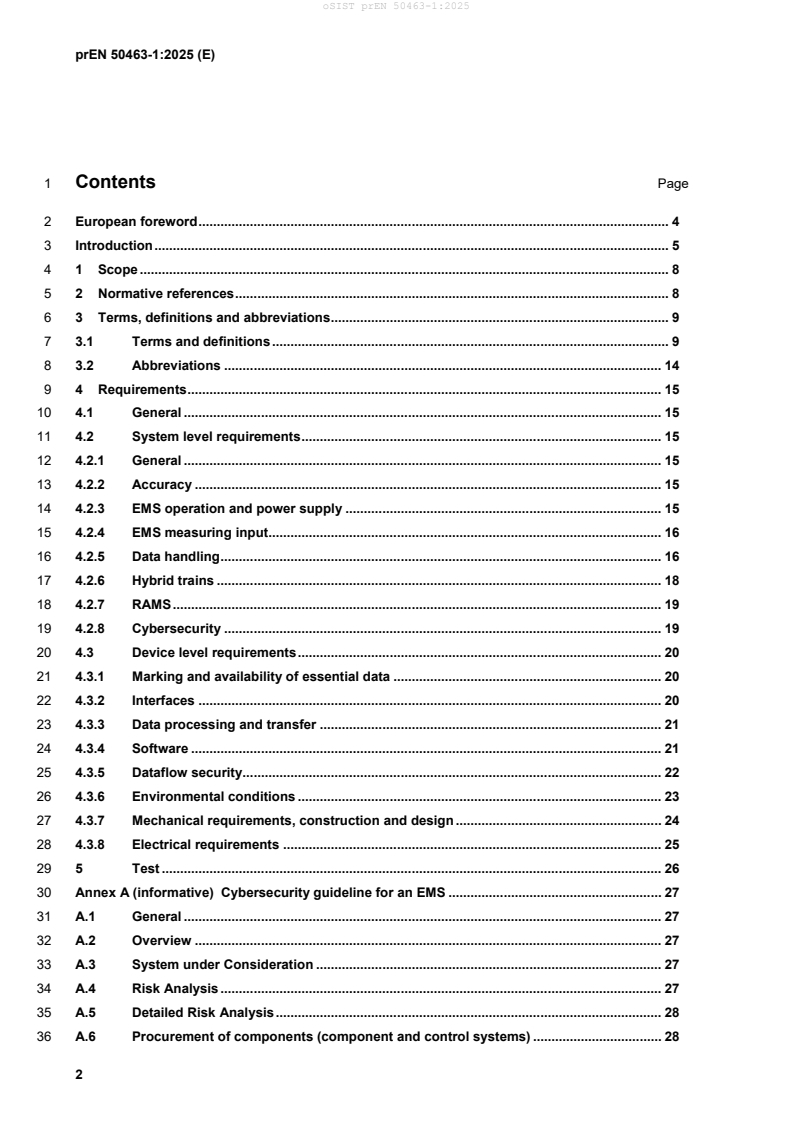
oSIST prEN 50463-1:2025 is a draft CENELEC European Standard for railway applications, Part 1 of the EN 50463 series on energy measurement on board trains. It specifies the purpose, system-level requirements and common device requirements for an energy measurement system (EMS) used on traction units, with compiled energy billing data (CEBD) intended for billing and transfer to a data collecting system (DCS).
What does oSIST prEN 50463-1:2025 specify?
oSIST prEN 50463-1:2025 describes the EMS as a whole and the common requirements that apply to devices implementing one or more EMS functions. The document is focused on on-board energy measurement for traction units powered by AC and/or DC supply voltages listed in EN 50163, and it does not apply to portable EMSs.
The standard is organized into scope, normative references, terms and abbreviations, requirements, and test. It also includes two informative annexes:
| Annex | What it covers |
|---|---|
| Annex A | Cybersecurity guideline for an EMS, including risk analysis, procurement, integration, cybersecurity case, maintenance and patch process |
| Annex ZZ | Relationship between this European Standard and the essential requirements of Directive 2016/797/EU |
Part 1 sits within a five-part series. The other parts cover energy measuring, data handling, communication, and conformity assessment. In practice, Part 1 gives the system frame that the later parts fill in with measurement, data and test details.
What are the key requirements of oSIST prEN 50463-1:2025?
oSIST prEN 50463-1:2025 sets requirements for the complete EMS and for each device that makes up the EMS. The main practical message is that the billing data must remain accurate, traceable, secure and available across the full life cycle of the traction unit.
System-level performance and data integrity
Clause 4.2 says that any extra functions added to the EMS must not affect accuracy, degrade operation, or influence the production and storage of CEBD and CEBD-related data. Configuration changes must be logged, and the device marking and stored information must be updated. For a buyer or integrator, this means extra local functions may be added only if they do not interfere with billing data.
Accuracy is tied to the energy measurement function and is determined according to prEN 50463-2:2025. Part 1 does not define the accuracy itself; it tells the reader where that performance is specified.
Power supply, start-up and loss of power
Clause 4.2.3 requires the EMS to be fully operational whenever energy flows from or to the contact line (CL). If the EMS uses auxiliary power, that supply must comply with EN 50155:2021, and the rated power supply voltage and maximum power consumption must be stated.
The EMS must be ready to measure energy within 60 s after power is applied. If power is lost intentionally or unintentionally, no CEBD or other data may be lost. In practice, this means the installation and shutdown strategy must protect stored data and support a reliable start-up sequence.
Measuring input and electric traction power supply systems
Clause 4.2.4 requires the positions of the voltage measurement function (VMF) and current measurement function (CMF) to ensure that all active and reactive energy taken from and returned to the CL is measured. The measuring input ratings must suit the intended electric traction power supply system and the traction unit rated current.
Clause 4.2.5 requires an EMS to cover all electric traction power supply systems used by the traction unit. When the traction unit changes supply systems, the EMS must continue to function correctly and log each change, with one stated exception for 600 V and 750 V DC because they share the same code in the related part. The EMS must measure energy consumption within 1 s of a change to the new system. This matters where a train crosses networks or changes electrification.
Consumption Point Identification and traceability
Clause 4.2.5.2 introduces the consumption point (CP) identity structure. A CP is identified by NVR, VKM, EVN and EMSID, and the CPID must be stored in non-volatile memory. Security procedures must prevent unauthorized changes, and the integrator or maintenance entity must provide a reference method linking the CPID to the physical devices for life-cycle traceability.
A change of CPID is treated as an EMS installed in another consumption point. After all data have been transferred to ground, former CPID data must be deleted except data needed for the EMS life cycle, such as maintenance information. In practice, this supports auditability when the EMS is moved, replaced or reconfigured.
Hybrid trains and additional status data
Clause 4.2.6 addresses hybrid trains. When traction can come from sources other than the CL, the EMS must carry additional status information so the measured data can be validated correctly. The clause points to EnergySourceActivated and EnergyFlowToBattery elements in the data blocks, and it allows extra measurement points for internal generation or battery charging and discharging. This helps settlement or infrastructure managers interpret periods when low or zero CL energy use is expected.
RAMS, safety and cybersecurity
Clause 4.2.7 covers reliability, availability, maintainability and safety (RAMS). Reliability and maintainability are linked to EN 50155:2021, while safety must address electric shock, excessive temperature and fire spread. The practical result is that the EMS must be designed and installed as railway equipment, not only as a measuring device.
Clause 4.2.8 requires cybersecurity measures to be declared, documented and applied during integration, installation, operation and maintenance. Annex A gives one way to do that, using the cybersecurity concepts and lifecycle approach of CLC/TS 50701 and related security standards.
Device marking, interfaces, software and protection of data
Clause 4.3 requires each device to be clearly marked with the manufacturer, equipment type, serial number and date of manufacture. Essential information about configuration, control characteristics and special installation requirements must also be available.
The EMS must provide maintenance and service access for qualified people, operational interfaces between functions, and test interfaces for injection and monitoring. Access to data, software and parameters that affect CEBD must go through authorization, and requests and changes must be logged.
Software must be designed, tested and documented according to EN 50155:2021. Software version identification, protection against accidental or intentional change, and protection of CEBD and CEBD-related data are all required. The same clause also requires dataflow security for analogue and digital connections, including authenticity and integrity safeguards.
What terms does oSIST prEN 50463-1:2025 define?
oSIST prEN 50463-1:2025 defines the main technical vocabulary used across the series so that the EMS, data and interfaces are described consistently.
- Energy measurement system (EMS) - the system that comprises the energy measurement function (EMF), the data handling system (DHS) and associated communications functions.
- Energy measurement function (EMF) - the function made up of voltage measurement, current measurement and energy calculation.
- Compiled energy billing data (CEBD) - the dataset compiled by the DHS that is suitable for energy billing.
- Data collecting system (DCS) - the on-ground service that collects CEBD from an EMS.
- Consumption Point (CP) - the EMS installed on board a traction unit.
- Consumption Point Identification (CPID) - the unique identifier allocated to each EMS installed on a traction unit.
- Hybrid train - a train with electrical traction units and also an on-board energy source and/or energy storage used for traction.
- Authenticity - the state in which information is valid and known to have originated from the stated source.
Who uses oSIST prEN 50463-1:2025?
oSIST prEN 50463-1:2025 is used by railway rolling stock manufacturers, EMS suppliers, integrators, maintenance organizations, railway undertakings, infrastructure managers and purchasers. It is also relevant to settlement systems that receive CEBD for billing.
In practice, they use it to specify, design, integrate, mark, install, test, maintain and assess on-board energy measurement equipment. It is especially relevant when a traction unit has more than one consumption point, operates on more than one electrification system, or uses hybrid traction arrangements.
What changed in oSIST prEN 50463-1:2025 from the previous edition?
oSIST prEN 50463-1:2025 is stated to supersede EN 50463-1:2017 and its amendment and corrigendum. The significant technical changes listed in the foreword are:
- creation of the consumption point concept for EMS installed on board
- introduction of hybrid trains
- grouping and adjustment of cybersecurity requirements in a new clause and informative annex
- added figures for commissioning and maintenance
Which standards are used with oSIST prEN 50463-1:2025?
oSIST prEN 50463-1:2025 relies on several standards to complete the EMS specification:
- prEN 50463-2:2025 - defines energy measuring, including accuracy and metrological aspects.
- prEN 50463-3:2025 - defines data handling and CEBD transfer to the DCS.
- prEN 50463-4:2025 - defines communication services and interfaces between EMS functions and between EMS and DCS.
- prEN 50463-5:2025 - defines conformity assessment procedures for the EMS.
- EN 50124-1:2017 - supports insulation coordination, creepage, clearances and withstand levels.
- EN 50125-1:2014 and EN 50155:2021 - define environmental, mechanical and electronic equipment requirements for rolling stock.
- EN 50153:2014 - supports protection against electrical hazards.
- EN 60085:2008 - supports thermal evaluation of insulation.
- EN 60529:1991 - supports enclosure protection.
- EN 61010-1:2010 - supports terminal cover and electrical safety details.
- EN ISO 13732-1:2008 - supports protection against excessive surface temperature.
- EN 50163:2004 - is referenced for traction supply voltages.
- CLC/TS 50701 and the EN IEC 62443 series - support the cybersecurity approach described in Annex A.
What does the oSIST prEN 50463-1:2025 document contain?
oSIST prEN 50463-1:2025 contains the EMS functional structure and dataflow diagram, an example of an energy index value, and commissioning and maintenance figures for CPID use. It also includes tables that connect essential EMS functions to cybersecurity requirements and map those requirements to EN IEC 62443-4-2.
Annex A gives a structured cybersecurity guideline covering system definition, risk analysis, detailed risk analysis, procurement, integration, cybersecurity case, maintenance review, decommissioning and patch management. Annex ZZ links selected clauses to Directive 2016/797/EU and the related technical specification for interoperability, so the reader can see where the standard is intended to support railway interoperability requirements.
Relations
- Revises
SIST EN 50463-1:2018 - Railway applications - Energy measurement on board trains - Part 1: General - Effective Date
- 03-Dec-2024
- Effective Date
- 03-Dec-2024
Get Certified
Connect with accredited certification bodies for this standard

IRIS Certification (UNIFE)
International Railway Industry Standard certification.

TÜV SÜD Rail GmbH
TÜV SÜD railway certification services.

Bureau Veritas Railway Certification
Railway and transportation certification.
Sponsored listings
Frequently Asked Questions
kSIST FprEN 50463-1:2026 is a draft published by the Slovenian Institute for Standardization (SIST). Its full title is "Railway applications - Energy measurement on board trains - Part 1: General". This standard covers: EN 50463-1 describes the primary purpose of the EMS, which is to meter energy consumption for billing and provide compiled energy billing data (CEBD) to a DCS. The EMS may also be used for other functions such as energy management. In addition, EN 50463-1 also describes the primary purpose of a DCS and its interactions with an EMS and settlement system.
EN 50463-1 describes the primary purpose of the EMS, which is to meter energy consumption for billing and provide compiled energy billing data (CEBD) to a DCS. The EMS may also be used for other functions such as energy management. In addition, EN 50463-1 also describes the primary purpose of a DCS and its interactions with an EMS and settlement system.
kSIST FprEN 50463-1:2026 is classified under the following ICS (International Classification for Standards) categories: 45.060.10 - Tractive stock. The ICS classification helps identify the subject area and facilitates finding related standards.
kSIST FprEN 50463-1:2026 has the following relationships with other standards: It is inter standard links to SIST EN 50463-1:2018, SIST EN 50463-1:2018/A1:2024. Understanding these relationships helps ensure you are using the most current and applicable version of the standard.
kSIST FprEN 50463-1:2026 is associated with the following European legislation: EU Directives/Regulations: 2016/797/EU; Standardization Mandates: M/591. When a standard is cited in the Official Journal of the European Union, products manufactured in conformity with it benefit from a presumption of conformity with the essential requirements of the corresponding EU directive or regulation.
kSIST FprEN 50463-1:2026 is available in PDF format for immediate download after purchase. The document can be added to your cart and obtained through the secure checkout process. Digital delivery ensures instant access to the complete standard document.
Standards Content (Sample)
Contents
- 84 Introduction
- 95 EN 50463-1 provides system level requirements for the complete EMS and common requirements
- 99 The EMF provides measurement of the consumed and regenerated active energy of a railway
- 4.3.7.2 between the TSI
84 Introduction
85 The energy measurement system (EMS) provides measurement and data suitable for billing and may also 86 be used for energy management, e.g. energy saving.
87 This series of European Standards uses the functional approach to describe the EMS and on-ground data 88 collecting system (DCS). These functions are implemented in one or more physical devices. The user of this 89 Series of standards is free to choose the physical implementation arrangements. 90 a) Structure and main contents of EN 50463 series:
91 This series of European Standards is divided into five parts. The titles and brief descriptions of each part 92 are given below:
93 1) EN 50463-1 — General:
94 The scope of EN 50463-1 is the energy measurement system (EMS).
95 EN 50463-1 provides system level requirements for the complete EMS and common requirements
96 for all devices implementing one or more functions of the EMS. 97 2) EN 50463-2 — Energy measuring:
98 The scope of EN 50463-2 is the energy measurement function (EMF).
99 The EMF provides measurement of the consumed and regenerated active energy of a railway
100 traction unit. If the traction unit is designed for use on AC electric traction power supply systems the 101 EMF also provides measurement of reactive energy. The EMF provides the measured quantities via 102 an interface to the data handling system.
103 The EMF consists of the three functions: voltage measurement function, current measurement 104 function and energy calculation function. For each of these functions, accuracy classes are 105 specified and associated reference conditions are defined. EN 50463-2 also defines all specific 106 requirements for all functions of the EMF.
107 The voltage measurement function measures the voltage of the contact line (CL) system and the 108 current measurement function measures the current taken from and returned to the CL system. 109 These functions provide signal inputs to the energy calculation function. 110 The energy calculation function inputs the signals from the current and voltage measurement 111 functions and calculates a set of values representing the consumed and regenerated energies. 112 These values are transferred to the data handling system and are used in the creation of compiled 113 energy billing data (CEBD).
114 The standard has been developed taking into account that in some applications the EMF is 115 subjected to legal metrological control. All relevant metrological aspects are covered in EN 50463-2. 116 EN 50463-2 also defines the conformity assessment of the EMF and the functions of the EMF. 117 3) EN 50463-3 — Data handling:
118 The scope of EN 50463-3 is the data handling system (DHS) and the associated requirements of 119 data collecting system (DCS).
120 The on board DHS receives, produces and stores data, ready for transmission to any authorized 121 receiver of data onboard or on ground. The main goal of the DHS is to produce compiled energy 122 billing data (CEBD) and transfer it to an on ground data collecting system (DCS). The DHS can
oSIST prEN 50463-1:2025 prEN 50463-1:2025 (E) 123 support other functions on board or on ground with data, as long as this does not conflict with the 124 main goal.
125 The DCS on ground receives CEBD, stores the CEBD and transfer it to upstream servers such as 126 settlement system.
127 EN 50463-3 also defines the conformity assessment of the DHS and for the transfer of CEBD to an 128 on-ground DCS.
129 4) EN 50463-4 — Communication:
130 The scope of EN 50463-4 is the communication services.
131 EN 50463-4 gives requirements and guidance regarding the data communication between the 132 functions implemented within EMS as well as between such functions and other on board units 133 where data are exchanged using a communications protocol stack over a dedicated physical 134 interface or a shared network.
135 It includes the board to ground communication service and covers the requirements necessary to 136 support data transfer between DHS and DCS.
137 EN 50463-4 also defines the conformity assessment of the communications services. 138 5) EN 50463-5 — Conformity assessment:
139 The scope of EN 50463-5 is the conformity assessment procedures for the EMS. 140 EN 50463-5 also covers re-verification procedures and conformity assessment in the event of the 141 replacement of a device of the EMS.
142 b) EMS functional structure and dataflow:
143 Figure 1 illustrates the functional structure of the EMS, the relevant operating dataflow and is informative 144 only. Only the main interfaces required by this EN 50463 series are displayed by arrows. 145 Since the communication function is distributed throughout the EMS, it has been widely omitted for 146 clarity, except for the train to ground communication. Not all interfaces are shown.
oSIST prEN 50463-1:2025 prEN 50463-1:2025 (E)
148 Figure 1 — EMS functional structure and dataflow diagram
oSIST prEN 50463-1:2025 prEN 50463-1:2025 (E) 149 1 Scope 150 This part of the EN 50463 series describes the purpose of the energy measurement system (EMS), which 151 measures energy consumption on board for applications such as energy billing, energy management, energy 152 saving and others.
153 This part of the EN 50463 series specifies the requirements for the complete EMS and also the requirements 154 for all devices implementing one or more functions of the EMS. 155 This document applies to newly manufactured EMSs for use on-board traction units, powered by AC and/or 156 DC supply voltages as listed in EN 50163, and does not apply to portable EMSs. 157 2 Normative references 158 The following documents are referred to in the text in such a way that some or all of their content constitutes 159 requirements of this document. For dated references, only the edition cited applies. For undated references, 160 the latest edition of the referenced document (including any amendments) applies. 161 EN 50124-1:2017, Railway applications - Insulation coordination - Part 1: Basic requirements - Clearances 162 and creepage distances for all electrical and electronic equipment 163 EN 50125-1:2014, Railway applications - Environmental conditions for equipment - Part 1: Rolling stock and 164 on-board equipment
165 EN 50153:2014, Railway applications — Rolling stock — Protective provisions relating to electrical hazards 166 EN 50155:2021, Railway applications - Rolling stock - Electronic equipment 167 prEN 50463-2:2025, Railway applications - Energy measurement on board trains - Part 2: Energy measuring 168 prEN 50463-3:2025, Railway applications — Energy measurement on board trains — Part 3: Data handling 169 prEN 50463-4:2025, Railway applications — Energy measurement on board trains — Part 4: Communication 170 prEN 50463-5:2025, Railway applications — Energy measurement on board trains — Part 5: Conformity 171 assessment 172 EN 60085:2008, Electrical insulation - Thermal evaluation and designation (IEC 60085:2007)
173 EN 60529:1991, Degrees of protection provided by enclosures (IP Code) (IEC 60529:1989) 174 EN 61010-1:2010, Safety requirements for electrical equipment for measurement, control, and laboratory use 175 - Part 1: General requirements (IEC 61010-1:2010) 176 EN ISO 13732-1:2008, Ergonomics of the thermal environment - Methods for the assessment of human 177 responses to contact with surfaces - Part 1: Hot surfaces (ISO 13732-1:2006)
As impacted by EN 50153:2014/A1:2017 and EN 50153:2014/A2:2020.
As impacted by EN 60529:1991/corrigendum May:1993, EN 60529:1991/A1:2000, EN 60529:1991/A2:2013, EN 60529:1991/A2:2013/AC:2019-02, and EN 60529:1991/AC:2016-12.
oSIST prEN 50463-1:2025 prEN 50463-1:2025 (E) 178 3 Terms, definitions and abbreviations 179 3.1 Terms and definitions 180 For the purposes of this document, the following terms and definitions apply. 181 ISO and IEC maintain terminology databases for use in standardization at the following addresses:
182 • ISO Online browsing platform: available at https://www.iso.org/obp 183 • IEC Electropedia: available at http://www.electropedia.org 184 NOTE When possible, the following definitions have been taken from the relevant chapters of the International 185 Electrotechnical Vocabulary (IEV), IEC 60050 series. In such cases, the appropriate IEV reference is given. Certain new 186 definitions or modifications of IEV definitions have been added in this document in order to facilitate understanding. 187 Expression of the performance of electrical and electronic measuring equipment has been taken from EN 60359. 188 3.1.1 189 authenticity 190 state in which information is valid and known to have originated from the stated source 191 [SOURCE: IEC 60050-821:2017, 821-11-05] 192 3.1.2 193 CEBD identification 194 CEBDID 195 sequential number to identify each CEBD 196 Note 1 to entry: See prEN 50463-4:2025, 4.3.4.2.
197 3.1.3 198 CEBD-related data 199 data produced by any function of the EMS required for the production of CEBD 200 Note 1 to entry: This includes energy data, time data, location data, quality codes and electric traction power supply 201 system code.
202 3.1.4 203 compiled energy billing data 204 CEBD 205 dataset compiled by the DHS suitable for energy billing 206 3.1.5 207 consumption point 208 CP 209 EMS installed on board 210 Note 1 to entry: A traction unit might have more than one Consumption Point. Each Consumption Point has one EMS. 211 3.1.6 212 consumption point identification 213 CPID 214 unique identifier allocated to each EMS installed on-board a traction unit 215 3.1.7 216 contact line 217 CL 218 conductor system for supplying electric energy to a traction unit through current-collecting equipment
oSIST prEN 50463-1:2025 prEN 50463-1:2025 (E) 219 [SOURCE: IEC 60050-811:2017, 811-33-01, modified - “vehicles” has been replaced with “traction unit”. 220 Note 1 to entry has been omitted.] 221 3.1.8 222 coordinated universal time 223 UTC 224 timescale which forms the basis of a coordinated radio dissemination of standard frequencies and time 225 signals, and corresponds exactly in rate with international atomic time, but differs from it by an integral 226 number of seconds 227 Note 1 to entry: Coordinated universal time is established by the International Bureau of Weights and Measures (BIPM) 228 and the International Earth Rotation Services (IERS).
229 Note 2 to entry: The UTC scales is adjusted by the insertion or deletion of seconds, so called positive or negative leap 230 seconds, to ensure approximate agreement with UT1.
231 [SOURCE: IEC 60050-713:1998, 713-05-20] 232 3.1.9 233 current measurement function 234 CMF 235 function of an EMF measuring the current taken from and returned to the CL at the CP 236 3.1.10 237 data collecting system 238 DCS 239 on-ground service collecting the CEBD from an EMS 240 3.1.11 241 data handling system 242 DHS 243 function combining the energy data produced by one or more EMF with other data, storing and transmitting 244 the data to a DCS and other systems 245 3.1.12 246 electric traction power supply system
247 electricity type feed to the traction unit from a CL that it is in contact with, as defined in EN 50163:2004 248 3.1.13 249 enclosure 250 housing affording the type and degree of protection suitable for the intended application 251 [SOURCE: IEC 60050-151:2001, 151-13-08] 252 3.1.14 253 energy calculation function 254 ECF 255 function calculating energy data using input signals from the VMF and CMF 256 3.1.15 257 energy data 258 set of measured energy values transferred from EMF to DHS
As impacted by EN 50163:2004/A1:2007, EN 50163:2004/Corrigendum May 2010, EN 50163:2004/AC:2013, EN 50163:2004/A2:2020, and EN 50163:2004/A3:2022.
oSIST prEN 50463-1:2025 prEN 50463-1:2025 (E) 259 3.1.16 260 energy delta value 261 energy consumed and/or regenerated during a time period 262 Note 1 to entry: See Figure 2 for example.
263 3.1.17 264 energy index value 265 total accumulated energy consumption and/or energy regeneration at the end of a time period 266 Note 1 to entry: See Figure 2 for example.
268 Figure 2 — Example of energy index value 269 3.1.18 270 energy measurement function 271 EMF 272 function comprising the voltage measurement function, the current measurement function and the energy 273 calculation function 274 3.1.19 275 energy measurement system 276 EMS 277 system comprising the EMF, DHS and associated communications functions 278 3.1.20 279 energy measurement system ID 280 EMSID 281 single-digit value that, together with the NVR, VKM and EVN, uniquely identifying each CP on the traction 282 unit (default value is 1) 283 3.1.21 284 energy meter, 285 <railway applications> device holding an ECF 286 3.1.22 287 equipment type 288 specific design of device containing one or more functions, produced by one supplier and having similar 289 properties including where applicable metrological properties, the same uniform construction of parts 290 determining these properties and the same functional components 291 Note 1 to entry: Equipment is designated by the manufacturer by one or more groups of letters or numbers, or a 292 combination of letters and numbers. Each equipment type has one designation only. 293 Note 2 to entry: The equipment type is represented by the equipment sample as provided for type test.
oSIST prEN 50463-1:2025 prEN 50463-1:2025 (E) 294 Note 3 to entry: Functions can be e.g. VMF, CMF, ECF or DHS. 295 3.1.23 296 European Vehicle Number 297 EVN 298 number that consists of 12 digits 299 Note 1 to entry: Further details are set out in Commission Decision (EU) 2018/1614. 300 Note 2 to entry: CIS wagons to be coded according to OSJD-UIC leaflet 402, which allows the conversion from 8 digits 301 to 12 digits and vice versa.
302 3.1.24 303 flag 304 <energy measurement system> code indicating information relevant to the functioning of the EMS 305 Note 1 to entry: Examples include operational status, etc. 306 3.1.25 307 function, 308 <of a product> mode of action or activity by which a product fulfils its purpose 309 Note 1 to entry: A function (considered as a black-box) transfers input parameters (material, energy, information) into 310 related output parameters (material, energy, information). 311 [SOURCE: IEC 60050-821:2017, 821-12-25, modified – Note 1 to entry has been added.] 312 3.1.26 313 hybrid train 314 train having electrical traction units but also having an on-board energy source (e.g. diesel or hydrogen) 315 and/or an on-board energy storage (e.g. batteries) able to be used for traction 316 Note 1 to entry: Hybrid trains can have synchronous or asynchronous operation. Asynchronous operation is the use of 317 the onboard storage or current collector. During the train run, either the onboard source/storage is used (diesel, 318 hydrogen and battery), or the electrical energy is coming from the current collector. During synchronous operation, many 319 sources of energy are used simultaneously.
320 3.1.27 321 implementation under assessment 322 IUA 323 specific EMS equipment type used throughout the conformity assessment 324 3.1.28 325 index value overrun 326 return to zero of the index value after reaching the maximum value allowed by the register 327 3.1.29 328 interface, 329 <energy measurement system> link between two functions of the EMS or between the EMS and other 330 functions 331 Note 1 to entry: A link can be physical or virtual.
332 3.1.30 333 k-factor 334 multiplicand necessary to convert a secondary value into a primary value 335 Note 1 to entry: Each Voltage Measurement Function and/or Current Measurement Function can have a specific k- 336 factor. If the k-factor is applied to Energy Data, this factor is the product of the k-factors of the Voltage Measurement 337 Function and/or Current Measurement Function used.
oSIST prEN 50463-1:2025 prEN 50463-1:2025 (E) 338 3.1.31 339 National Vehicle Registers code 340 NVR 341 identification code which is assigned to each individual vehicle, in particular traction unit, in country where it 342 is registered, and which consists of valid 2 character country code as defined by the EN ISO 3166-1 alpha-2- 343 codes for representation of countries 344 3.1.32 345 primary value 346 value referred to the measuring inputs of an EMF 347 3.1.33 348 purchaser 349 entity that is a recipient of the EMS or parts of the EMS provided by a supplier 350 3.1.34 351 secondary value 352 value of current, voltage, power or energy which is equal to a primary value when multiplied by a specific k- 353 factor 354 3.1.35 355 sensor 356 < energy measurement system> device performing the VMF or CMF 357 Note 1 to entry: Sensor is used as a general term and encompasses a wide variety of technology / devices for 358 measurement purposes, e.g. inductive transformers, hall-effect devices, capacitive and resistive dividers, resistive 359 shunts, etc.
360 Note 2 to entry: One sensor can perform multiple functions. 361 3.1.36 362 settlement system 363 system capable of receiving CEBD from a DCS intended to use it for billing 364 3.1.37 365 supplier 366 < energy measurement system> entity that supplies EMS or parts of the EMS 367 3.1.38 368 time period 369 period of time for which energy data is produced 370 3.1.39 371 time reference period 372 TRP 373 time period for which CEBD is produced 374 3.1.40 375 traction unit, 376 <energy measurement system> vehicle or group of vehicles in fixed formation, for which the energy taken 377 from and/or returned to the CL is measured by one or more EMS 378 Note 1 to entry: The prEN 50463 series uses the term ‘traction unit’ to describe the part of a train to which energy 379 metering is applied. The term ‘traction unit’ is considered to be a more suitable term than ‘vehicle’ because the latter term 380 is generally used to describe the smallest part of a train i.e. an individual vehicle.
oSIST prEN 50463-1:2025 prEN 50463-1:2025 (E) 381 3.1.41 382 train control and monitoring system 383 TCMS 384 set of interrelated objects providing on board control and monitoring of the train 385 3.1.42 386 Vehicle Keeper Marking 387 VKM 388 alphanumeric code, consisting of 2 to 5 letters as defined by the European Railway Agency (ERA) in 389 Commission Decision (EU) 2018/1614 390 Note 1 to entry: This codification is managed in cooperation by ERA and OTIF. 391 3.1.43 392 voltage measurement function 393 VMF 394 function of an EMF measuring the voltage of the CL at the CP 395 3.2 Abbreviations 396 For the purposes of this document, the following abbreviations apply. AC Alternating Current CEBD Compiled Energy Billing Data CEBDID CEBD identification CL Contact Line CMF Current Measurement Function CP Consumption Point CPID Consumption Point Identification DC Direct Current DCS Data Collecting System DHS Data Handling System ECF Energy Calculation Function EMF Energy Measurement Function EMS Energy Measurement System EMSID Energy Measurement System ID EVN European Vehicle Number IEMF Integrated EMF IM Infrastructure Manager IUA Implementation Under Assessment NVR National Vehicle Registers code RAMS Reliability, Availability, Maintainability and Safety RU Railway Undertaking SuC System under Consideration TCMS Train Control and Monitoring System TRP Time Reference Period UTC Coordinated Universal Time
oSIST prEN 50463-1:2025 prEN 50463-1:2025 (E) VKM Vehicle Keeper Marking VMF Voltage Measurement Function 397 4 Requirements 398 4.1 General 399 Clause 4 of this document describes the requirements of an EMS (generic application, i.e. not yet installed 400 on board) or of a CP (specific application, i.e. installed on a traction unit, e.g. locomotive, consist, trainset). 401 Subclause 4.2 gives system level requirements for the CP.
...