

oSIST prEN 18373:2026
(Main)Workplace exposure - Measurement of viruses in workplace air
- Abstract
This document specifies general requirements for the measurement of viruses in workplace air. This document complements the scope of EN 13098.
The document provides guidelines for the assessment of workplace exposure to airborne viruses comprising the methodology for sampling as well as for analysis, which is applicable for both, active or inactive viruses, e.g. methods based on cell-culture or molecular biology.
This document is not applicable for the measurement of other microorganisms than viruses and microbial compounds.
- Status
- Not Published
- Public Enquiry End Date
- 01-Oct-2026
- Technical Committee
- KAZ - Air quality
- Current Stage
- 4020 - Public enquire (PE) (Adopted Project)
- Start Date
- 22-Jul-2026
- Due Date
- 09-Dec-2026
- Completion Date
- 08-Oct-2026

oSIST prEN 18373:2026 is a draft CEN European Standard on measuring viruses in workplace air. It sets general requirements for assessing exposure to human pathogenic viruses in workplace atmospheres, including sampling, transport, storage, laboratory analysis, and interpretation. It is intended for exposure assessment work where virus measurements support screening, risk assessment, prevention, or scientific studies.
What does oSIST prEN 18373:2026 specify?
oSIST prEN 18373:2026 specifies general requirements for the measurement of viruses in workplace air. The scope covers human pathogenic viruses in bioaerosols and links the measurement work to the broader framework of EN 13098.
The document is organized into clauses on scope, references, terms, symbols, purpose and aim, overall requirements, sampling, transport and storage, sample processing, analytical methods, and data interpretation. It also includes five informative annexes that help with virus groups, sampling choices, documentation, and cultivation-based methods.
| Annex | What it covers |
|---|---|
| Annex A | Respiratory viruses |
| Annex B | The most frequent enteric viruses |
| Annex C | Consideration for the choice of sampling methods |
| Annex D | Information regarding samples and sampling conditions, with a form example |
| Annex E | Cultivation of viruses and other methods |
What are the key requirements of oSIST prEN 18373:2026?
Planning the measurement
Clause 5 says measurements need a clear purpose and a predefined strategy. oSIST prEN 18373:2026 lists use cases such as fast screening during wave or epidemic events, biological risk assessment in specific work situations, checking the effectiveness of prevention measures, and scientific studies.
In practice, the aim drives the whole campaign. You choose the sampling locations, number of samples, timing, and analytical method to match the question being asked, not the other way around.
Clause 5.2 requires contextual information for planning and interpreting results. The document points to prior occupational health and safety measures, emission sources, cleaning practices, ventilation, the number of workers, task patterns, natural ventilation, HVAC status, air exchange, temperature, relative humidity, and carbon dioxide levels when helpful.
In practice, these details are part of the result, not just background notes. They explain why two workplaces with similar sampling results may still present different exposure situations.
Clause 5.3 assumes the use of molecular genetic detection methods. oSIST prEN 18373:2026 notes that these methods can confirm the presence of a target virus, but they may not confirm viability or infectivity, and airborne virus concentration cannot be treated as one single sum parameter.
In practice, a result should be read as method-specific detection, not as a direct count of all airborne virus in the way that bacterial colony counts are sometimes used.
Safety, quality, and personnel
Clause 6 links occupational safety to the risk class of the target virus, with Biosafety level II or III controls as appropriate. It calls for good laboratory practice, engineered protection such as Biosafety Cabinets or negative-pressure contained laboratories, and personal protective equipment when needed.
Clause 6 also requires planning for quality and contamination control across all steps, from objective setting to final analysis. The operator must be trained in biological risk assessment and management and know how to work safely and decontaminate equipment, clothing, and personal protective equipment.
In practice, this means the campaign needs both biosafety measures and traceable procedures. The sampling and laboratory teams must be trained to avoid contamination and to follow the same documented approach every time.
Sampling, transport, and storage
Clause 7 says sampling devices shall comply with EN 481:1993, EN 13098:2019, and EN 14583:2021. oSIST prEN 18373:2026 allows impaction, impingement, or filtration techniques and notes that the sampling method should match the aim, the need to preserve viability, and the downstream analysis.
In practice, the device choice matters because it can affect both recovery and infectivity. Annex C helps select a method, and Annex D supports documentation of the sampling conditions.
Clause 7 also requires all materials in contact with the sample during sampling, transport, and storage to be sterile disposable or sterilized by a validated method. The sampling record should identify the device, media or matrix, location, duration, personal or stationary sampling, and the work activity observed.
Clauses 8 and 9 address transport, storage, and sample processing. oSIST prEN 18373:2026 recommends quick transfer into stabilization liquid where applicable, transport and storage conditions compatible with EN 13098:2019, about 4 °C for up to 24 hours, dry ice for longer periods, and about -80 °C storage if analysis does not start within 24 hours after arrival. It also warns against repeated freeze-thaw cycles.
In practice, sample handling can change the detectable virus content. The document therefore treats temperature control, elapsed time, and processing consistency as part of method performance, not as optional details.
Clause 9 requires aseptic processing in a biosafety cabinet, with homogenization, centrifugation, and documented elution steps. For filters and dry samples, the document points to buffer-based recovery and careful documentation of the extraction procedure.
Analytical methods and interpretation
Clause 10 says analysis should generally use molecular biology-based methods. It covers DNA / RNA extraction, reverse transcription for RNA virus detection, PCR-based amplification, genomic sequencing for confirmation, and positive and negative controls.
In practice, the laboratory method must be validated and documented, including kits, protocols, primers, and control results. Clause 10.3 also recommends inter-laboratory proficiency testing.
Clause 11 says there is no occupational limit value or guide value for airborne viruses in the document. Interpretation depends on the original measurement objective, the assays used, the analytical results, the pathogenicity of the target virus, the detection method, and the working context.
In practice, a negative result does not prove absence of virus in air. The LOD and LOQ depend on the sampler, the sample medium, storage, interference, and the analytical method, so uncertainty has to be considered alongside the result.
What terms does oSIST prEN 18373:2026 define?
- Bioaerosol - airborne particles or volatile compounds with biological origin.
- Exposure by inhalation - a situation in which a chemical or biological agent is present in air that a person breathes in.
- RT-PCR - Reverse Transcriptase-polymerase Chain Reaction, used when RNA must first be converted before PCR detection.
- qPCR - real-time quantitative PCR, a PCR method that measures amplification during the reaction and supports quantification.
- TCID50 - tissue culture infectious dose, a culture-based measure used to express infectious virus quantity.
- LOD - limit of detection, the lowest level the method can reliably detect.
- LOQ - limit of quantification, the lowest level the method can reliably quantify.
Who uses oSIST prEN 18373:2026?
oSIST prEN 18373:2026 is used by occupational hygienists, exposure assessors, biosafety staff, laboratory analysts, and health and safety managers who need to measure airborne viruses in workplaces. It is also relevant for quality managers who need traceable sampling and analytical records.
The document fits workplaces where viral bioaerosols may matter, including healthcare settings, wastewater treatment, laboratories, waste processing, and hospitality. The annexes also point to respiratory viruses, enteric viruses, and virus cultivation methods, so the standard supports both field measurement and laboratory follow-up.
Which standards are used with oSIST prEN 18373:2026?
- EN 481:1993 - provides size fraction definitions for airborne particles, which supports how airborne material is sampled.
- EN 13098:2019 - gives general requirements for measuring airborne microorganisms and microbial compounds; oSIST prEN 18373:2026 complements this framework for viruses.
- EN 14583:2021 - sets general requirements and performance evaluation for volumetric bioaerosol samplers, which supports sampler selection and use.
What does the oSIST prEN 18373:2026 document contain?
oSIST prEN 18373:2026 contains a full measurement workflow from planning to interpretation. It includes a figure on assessing airborne viruses, guidance on contextual information, and detailed instructions for sampling, transport, storage, sample processing, and molecular analysis.
Annex A and Annex B provide background on respiratory and enteric viruses that are relevant to workplace air. Annex C discusses how to choose a sampling method, Annex D gives a sample-recording form, and Annex E describes cultivation of viruses and other identification methods such as IFA and EM.
The analytical part covers DNA / RNA extraction, reverse transcription, PCR platforms, sequencing, positive and negative controls, and validation. For a reader setting up a campaign, the document is mainly a practical framework for choosing a method, documenting it, and interpreting the result in context.
Get Certified
Connect with accredited certification bodies for this standard

CIS Institut d.o.o.
Personal Protective Equipment (PPE) certification body. Notified Body NB-2890 for EU Regulation 2016/425 PPE.

Kiwa BDA Testing
Building and construction product certification.
Kmetijski inštitut Slovenije
Agricultural Institute of Slovenia. Soil testing, plant health, agricultural product analysis.
Sponsored listings
Frequently Asked Questions
oSIST prEN 18373:2026 is a draft published by the Slovenian Institute for Standardization (SIST). Its full title is "Workplace exposure - Measurement of viruses in workplace air". This standard covers: This document specifies general requirements for the measurement of viruses in workplace air. This document complements the scope of EN 13098. The document provides guidelines for the assessment of workplace exposure to airborne viruses comprising the methodology for sampling as well as for analysis, which is applicable for both, active or inactive viruses, e.g. methods based on cell-culture or molecular biology. This document is not applicable for the measurement of other microorganisms than viruses and microbial compounds.
This document specifies general requirements for the measurement of viruses in workplace air. This document complements the scope of EN 13098. The document provides guidelines for the assessment of workplace exposure to airborne viruses comprising the methodology for sampling as well as for analysis, which is applicable for both, active or inactive viruses, e.g. methods based on cell-culture or molecular biology. This document is not applicable for the measurement of other microorganisms than viruses and microbial compounds.
oSIST prEN 18373:2026 is classified under the following ICS (International Classification for Standards) categories: 13.040.30 - Workplace atmospheres. The ICS classification helps identify the subject area and facilitates finding related standards.
oSIST prEN 18373:2026 is available in PDF format for immediate download after purchase. The document can be added to your cart and obtained through the secure checkout process. Digital delivery ensures instant access to the complete standard document.
Standards Content (Sample)
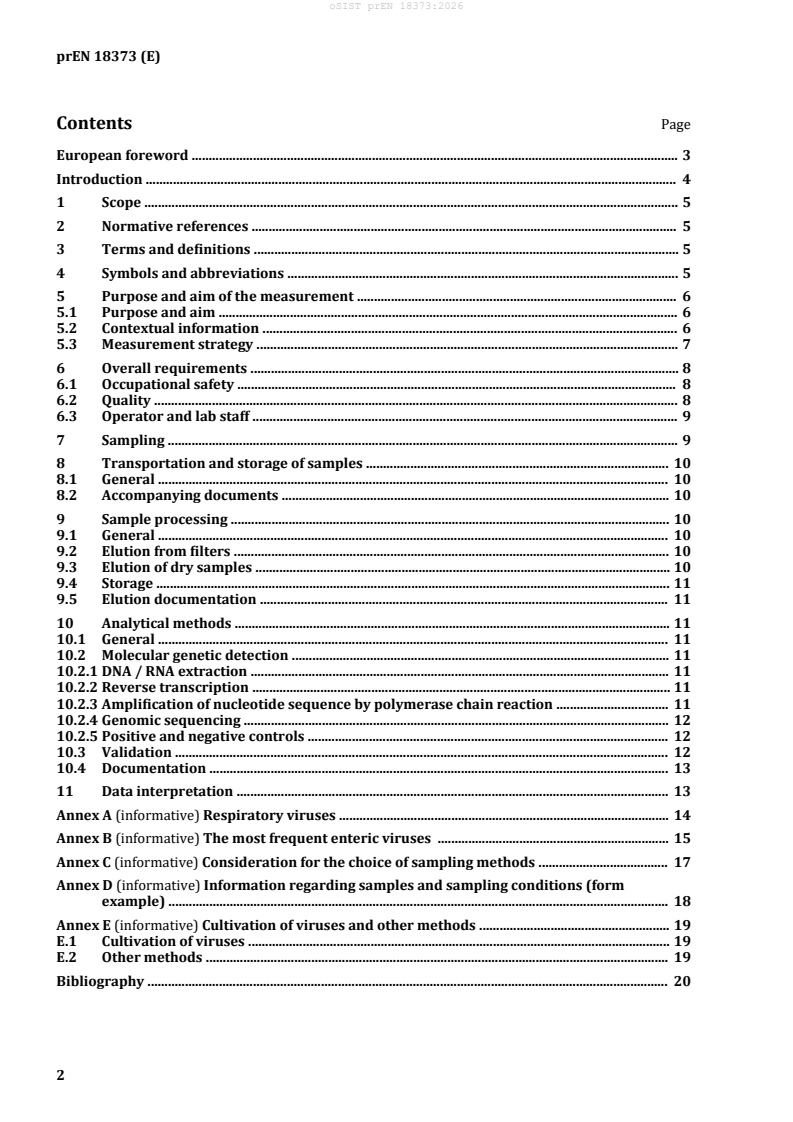
Contents
- Introduction
- 1 Scope
- 2 Normative references
- 3 Terms and definitions
- 3.1 bioaerosol
- 3.2 exposure by inhalation
- 4 Symbols and abbreviations
- 5 Purpose and aim of the measurement
- 5.1 Purpose and aim
- 5.2 Contextual information
- 5.3 Measurement strategy
- 6 Overall requirements
- 6.1 Occupational safety
- 6.2 Quality
- 6.3 Operator and lab staff
- 7 Sampling
- 8 Transportation and storage of samples
- 8.1 General
- 8.2 Accompanying documents
- 9 Sample processing
- 9.1 General
- 9.2 Elution from filters
- 9.3 Elution of dry samples
- 9.4 Storage
- 9.5 Elution documentation
- 10 Analytical methods
- 10.1 General
- 10.2 Molecular genetic detection
- 10.3 Validation
- 10.4 Documentation
- 11 Data interpretation
- Annex A
- Annex B
- Annex C
- Annex D
- Annex E
- Bibliography
Introduction
Viruses are classified as submicronic biological agents made up of nucleic acids associated with a protein envelope. They only replicate inside the living cells of organisms and some can cause infectious diseases in humans. Among the microorganisms spread by bioaerosols, viruses represent a very important potential health hazard for workers, because they can be found in a wide variety of reservoirs and have a potential for transmission by different routes in occupational environments. Their stability under environmental conditions, as well as their infectious dose may also be favourable for spread of virus diseases among worker populations.
The increasing occurrence of virus epidemics and the recent COVID-19 pandemic have rekindled the need to advance our knowledge of disease transmission mechanisms. As a result, it has also become necessary to have reliable and well-characterized methods for measuring and studying viruses. Recent research has proposed sampling and analytical methods for certain viruses or groups of viruses, but there is not yet a consensus on these, nor are there any internationally standardized methods. Such standardized methods would harmonize measurement practices across the world and facilitate an appropriate response in the event of a new virus pandemic.
oSIST prEN 18373:2026 prEN 18373 (E)
1 Scope
This document specifies general requirements for detection of human pathogenic viruses in bioaerosols in workplace atmospheres (Annex A and Annex B), including sampling strategy, sample transportation and processing and methods of laboratory analysis.
2 Normative references
The following documents are referred to in the text in such a way that some or all of their content constitutes requirements of this document. For dated references, only the edition cited applies. For undated references, the latest edition of the referenced document (including any amendments) applies. EN 481:1993, Workplace atmospheres - Size fraction definitions for measurement of airborne particles EN 13098:2019, Workplace exposure - Measurement of airborne microorganisms and microbial compounds - General requirements EN 14583:2021, Workplace exposure - Volumetric bioaerosol samplers - General requirements and evaluation of performance
3 Terms and definitions
For the purposes of this document, the following terms and definitions apply.
3.1 bioaerosol
airborne particles or volatile compounds with biological origin
3.2 exposure by inhalation
situation in which a chemical or biological agent is present in the air which is inhaled by a person
4 Symbols and abbreviations
RT-PCR Reverse Transcriptase-polymerase Chain Reaction RSV respiratory syncytial virus RS respirovirus SARS-CoV-1,-2 severe acute respiratory syndrome coronavirus type 1, - type 2 MERS-CoV Middle East respiratory syndrome-related coronavirus HCoV-HKU1 Human coronavirus HKU1 HCoV-OC43 Human coronavirus OC43 HCoV-NL63 Human coronavirus NL63 HCoV-229E Human coronavirus 229E HA hemagglutinin NA neuraminidase AAV adeno associated virus
oSIST prEN 18373:2026 prEN 18373 (E) PTFE Polytetrafluorethylene, Teflon GSP Gesamtstaub-Probenahmesystem AGI 30 All Glass Impinger SKC company name, no abbreviation VIVAS name of the bioaerosol sampler, no abbreviation NIOSH National Institute for Occupational Safety and Health of the United States of America SinCon II name of the bioaerosol sampler, no abbreviation BGMK buffalo green monkey kidney cells (cell line) VERO cell line originating from African green monkey kidney cells Hep2 human cervix, Epithelial (HeLa derivative, human cell line) A549 human lung cancer cell line CaCo2 human male colorectoral tissue, adenocarcinoma (cell line) MA104 epithelial cell line from the kidney of an African green monkey CPE cytopathic effects TCID50 tissue culture infectious dose IFA immunofluorescence assay
5 Purpose and aim of the measurement
5.1 Purpose and aim
The measurement of human pathogenic viruses in the air can be necessary to support or supplement an initial qualitative risk assessment for given work situations. Measurements can be taken in the following cases:
a) the fast screening in the case of wave or epidemic events; b) the assessment of biological risk in given working situations; c) the evaluation of the efficiency of prevention measures; d) a scientific study.
Measurements shall be carried out with a precise objective and a pre-defined strategy. This document describes the different steps of off-line measurement methods, including sampling, transport and storage of samples and their analysis. The interpretation of measurement results takes into account the assays employed, the exposure levels, the intrinsic pathogenicity of the targeted viruses and the contextual information regarding the working situation and sampling conditions.
5.2 Contextual information
Collection of contextual information is necessary to define sampling strategy and to interpret results related to the measurements obtained. This includes detailed information about previous occupational health and safety measures, such as training on safety issues related to the working tasks, previous exposure measurement campaigns, emission sources, cleaning practices and ventilation conditions.
oSIST prEN 18373:2026 prEN 18373 (E) Specific conditions for each sampling location should be recorded whenever possible. This includes the number of workers and activities in each workstation, air movement due to natural ventilation (windows open or closed) and whether heating, ventilation and air conditioning (HVAC) was on or off, air exchange rates, temperature and relative humidity. Carbon dioxide levels are also helpful to record.
5.3 Measurement strategy
For the purposes of this document, the use of molecular genetic detection methods is assumed. These can confirm the presence of a target virus but might not confirm its viability/potential infectivity. When planning a virus exposure assessment at the workplace, it is important to note that total virus concentrations in the air cannot be determined as one sum parameter, in contrast to total colony counts for bacteria or total bacterial DNA (see references [1][2][3][4][5][6][7][8][9][10][11][12][13][14][15] [16][17][18][19][20][21][22][23][24][25][26]).
This is owing to the variety of genomic types that exist for viruses as well as the wide range of host specificities.
To develop a measuring strategy for the workplace, several points should be considered. They may be decisive for the choice of the sampling, as well as for the analytical procedure. Collectively, these should contribute to a useful and accurate measurement procedure. The points to consider are:
- The aim of the assessment (5.1): determines the objective of the measurement (fast screening in case of an outbreak, in support of a risk assessment, testing the efficacy of exposure control measures, conducting scientific studies) and based on that the best approach for sampling- and analytical procedure are selected.
- Setting (where to sample, how many samples should be taken): this is determined by the measurement objective and it may influence the choice of the sampling procedure and devices to employ. For example, stationary sampling at several places in a working area should be preferred in case of air monitoring, when viruses originate from workplace air and are distributed by aerosols. Due to small particle size, transport of airborne viruses from a source may lead to their “stratified” distribution in the air before they reach the receptor. For this reason, personal sampling is more useful in case of workers activities which are directly addressed to potential sources of viruses (e.g. healthcare activities with infected persons). Number of samples depends on the sampling procedure regarding sampling volume and duration. The pooling of multiple air samples prior to analysis can increase the sensitivity of downstream detection. Retention of the original samples enables re-analysis if required.
- Exposure variability over time: Little information is available about viral bioaerosol exposures in the workplace. However, the numbers of air samples taken should be sufficient to represent variability in the workplace location, the activity of the exposed workers, and their proximity to any obvious sources of bioaerosols, bearing in mind also the need to asses the most critical scenario regarding exposure. The use of replicate sampling might be helpful. - Sampling device and sampling condition (volume flow, personal, stationary): Mainly used active air sampling methods are cyclonic air sampling (100 L/min to 300 L/min) or impingement methods (12,5 L/min to 12,7 L/min). If personal sampling is required, sampling devices may be used which can be attached to the working person (small cyclones, filtration samplers). Sampling duration (time frame to examine) should be optimized to avoid loss of biological activity. This demand may preferably be fulfilled by high volume samplers, especially because viruses do not multiply in the air but their concentration may decline by the influence of environmental factors as UV, temperature, humidity. A particular challenge for virus measurement is the need to detect small amounts of target organisms in high sample volumes. Sampling procedures are therefore required to optimize the concentration of target organisms in the sample and should consider the analytical protocol foreseen and its intrinsic sensitivity and specificity. Figure 1 presents the assessment of airborne viruses.
oSIST prEN 18373:2026 prEN 18373 (E) Figure 1 — Assessment of airborne viruses
6 Overall requirements
6.1 Occupational safety
Occupational safety precautions to prevent infection should be proportionate to the severity of infection and therefore dependent on the risk class (Biosafety level II or III) of the target virus. Appropriate good laboratory practice should be in place especially when handling high titre samples. This should be supplemented as appropriate with engineered protection (such as Biosafety Cabinets, negative pressure contained laboratories) and personal protective equipment.
6.2 Quality
All steps, from defining the objective, chosen sampling strategy and final sample analysis should be planned in such a way that high quality samples and results can be achieved.
oSIST prEN 18373:2026 prEN 18373 (E) As the concentration of virus particles in air is expected to be low, in comparison to concentrations inside infected individuals, the careful taking and handling of the samples is important. Contamination of samples should be avoided at every step by using clean materials and by protecting the sample from external contamination during handling, storage and transit.
To ensure data quality across the measurement procedure, detailed documentation of all procedural steps is required.
6.3 Operator and lab staff
Regarding bio safety, the operator shall have training in biological risk assessment and management and be aware of all the safety procedures needed. All steps along the measurement process (e.g. sampling, transport, sample handling, analysis) should be considered, including:
- knowing how to carry out all steps under appropriate safety conditions by applying a risk assessment and management plan for each setting, and
- considering decontamination steps required for sampling equipment, clothing and personal protection equipment during and after activities.
Regarding quality, the operator that performs the sampling shall:
- avoid contamination of the sample during all phases of sampling,
- have knowledge of the correct use of sampling equipment and analytical processes.
7 Sampling
The sampling devices shall comply with the requirements in EN 481:1993, EN 13098:2019, EN 14583:2021.
The sampling should be conducted utilizing sampling devices based on impaction, impingement or a filtration technique. The longer the suction time required for sampling of viruses, the greater the risk of damaging the sample and underestimating the concentration.
All materials in contact with the sample used during sampling, transportation and storage shall be sterile disposable or sterilized by a validated method (e.g steam sterilization or gamma radiation). Considering the "state-of-the-art" regarding sampling devices, it is not possible to indicate the most suitable sampling device for all applications. Considerations regarding the choice of the sampling method are presented in informative Annex C.
The device selection to be used in field campaigns should consider the following aspects:
- suitability of sampling procedure regarding the sampling condition,
- collection efficiency of the sampler system for the targeted viruses,
- suitability of collection media and filters for the analysis,
- whether the preservation of viability is of importance,
- whether the sampling medium is critical for the analyses to be performed in the laboratory. Regarding the sampling strategy, considerations and the specific equipment shall be documented. The sampling documentation should include specific details on sampling devices, sampling media/matrix, sampling locations, sampling duration, if personal then who and a description of activity pattern and observations during the sampling.
An example of a sampling documentation condition is given in Annex D.
oSIST prEN 18373:2026 prEN 18373 (E)
8 Transportation and storage of samples
8.1 General
It is recommended that the transportation of samples comply with international regulations. Transportation and storage of samples should consider important aspects such as temperature, transport duration, type of targeted viruses (DNA, RNA) and the need of assessing viability. Samples should be transferred into stabilization liquid as soon as possible, if applicable directly after sampling. Transportation conditions shall comply with the requirements given in EN 13098:2019 with the exception that viruses can be kept at about 4 °C for a maximum of 24 hours. For longer periods of times the samples shall be transported in dry ice.
Prior to analysis, samples shall never be repeatedly frozen and thawed, as this can affect the detectable virus content within the sample. If the sample is not analysed within 24 hours after arrival to the laboratory, the sample shall be stored at about –80 °C for longer periods of time. Snap freezing samples in liquid nitrogen prior to -80 °C storage can help to minimize the damage caused to samples even from a single freeze-thaw cycle.
8.2 Accompanying documents
Documentation should include duration, conditions and temperature of transport and storage. Accompanying documents include sampling documents (see Annex D).
9 Sample processing
9.1 General
Depending on the sampling method used, the sample needs to be processed to elute the material from the surface or by dissolving the filter in buffer. Liquid samples should be homogenized by some form of agitation, usually achieved by vortex mixing. All samples should be centrifuged as a final step of processing and the chosen agitation methods should be applied consistently across samples, when multiple samples are being processed.
For the safety of the operators and for sample quality control purposes, the work shall be conducted in aseptic conditions in a biosafety cabinet.
9.2 Elution from filters
Depending on the filters used, different amounts of buffer are necessary to recover and resuspend viruses.
...