

SIST ISO 24095:2026
(Main)Workplace air - Guidance for the measurement of respirable crystalline silica
- Abstract
This document gives guidelines for the measurements of respirable crystalline silica in air using direct on‑filter or indirect X‑ray diffraction and infrared analysis methods, including quality aspects of the measurements. The scope of this document includes the following crystalline silica polymorphs: quartz and cristobalite.
These guidelines are intended for use in conjunction with the following specific analytical methods under the jurisdiction of ISO TC 146 SC 2: ISO 16258-1, ISO 16258-2, and ISO 19087. When used with any of these documents, this guidance will help to ensure measurement procedures meet the uncertainty requirements stipulated in ISO 20581, to enable the results to be compared to occupational exposure limit values (OELV) in accordance with EN 689[40].
These guidelines are also relevant to the analysis of filters obtained from dustiness measurements in accordance with EN 15051[1] and EN 17289[35].
- Status
- Published
- Public Enquiry End Date
- 02-Aug-2026
- Publication Date
- 13-Sep-2026
- Technical Committee
- KAZ - Air quality
- Current Stage
- 6060 - National Implementation/Publication (Adopted Project)
- Start Date
- 06-Aug-2026
- Due Date
- 11-Oct-2026
- Completion Date
- 14-Sep-2026
Buy Documents



ISO 24095:2021 - Workplace air — Guidance for the measurement of respirable crystalline silica/13/2021

ISO 24095:2021 - Air des lieux de travail — Lignes directrices pour le mesurage de la fraction alvéolaire de la silice cristalline/13/2021
SIST ISO 24095:2026 is the SIST adoption of ISO 24095 for workplace air. It gives guidance for measuring respirable crystalline silica (RCS) in air by direct on-filter or indirect X-ray diffraction (XRD) and infrared (IR) analysis, with attention to measurement quality. The guidance is written for laboratories, occupational hygienists, and other users who need results that can be compared with occupational exposure limit values (OELV).
What does SIST ISO 24095:2026 specify?
SIST ISO 24095:2026 specifies guidance for sampling, analysis, quality control, reporting, and uncertainty for RCS measurements in workplace air. It covers the crystalline silica polymorphs quartz and cristobalite, and it is intended to be used together with the listed analytical methods so that the results are fit for comparing with OELV in practice.
The document is organized into clauses 1 to 11 and six informative annexes:
- Clause 1 Scope
- Clause 2 Normative references
- Clause 3 Terms and definitions
- Clause 4 Principle
- Clause 5 Analytical quality requirements
- Clause 6 Administrative controls
- Clause 7 Sampling
- Clause 8 Procedures
- Clause 9 Internal quality control
- Clause 10 External verification and assessment of uncertainty
- Clause 11 Test report
- Annexes A to F give supporting technical material on interferences, cristobalite, quality control, uncertainty, sampler differences, and proficiency test data
| Annex | What it covers |
|---|---|
| Annex A | Polymorphs of crystalline silica and their interferences |
| Annex B | Quantification of cristobalite using XRD |
| Annex C | Example of quality control charting for RCS |
| Annex D | Estimation of expanded uncertainty for RCS measurements |
| Annex E | Differences between samplers, including cyclones and other types |
| Annex F | Use of proficiency test data to evaluate XRD and IR methods in the presence of interferences |
What are the key requirements of SIST ISO 24095:2026?
SIST ISO 24095:2026 focuses on controlling the whole measurement chain, because the final result depends on both sampling and analysis. The most important practical message is that a valid RCS result is not just a lab measurement - it depends on how the air was sampled, handled, prepared, measured, checked, and reported.
Select a sampling strategy that matches the survey objective
Clause 7.1 says the sampling strategy shall suit the objective of the survey. In practice, this means the number of samples, their duration, and their placement need to reflect whether the goal is exposure assessment, control verification, or compliance checking.
Use compatible samplers, pumps, and collection media
Clause 7.2 and 7.3 require a respirable sampler that meets the respirable size-selective definition in ISO 7708, with performance in line with EN 13205, and compatible filters or foams. The guidance also points to ISO 13137 pumps and their pulsation requirements. In practice, sampler, filter, and pump must work as one system, or the collected dust may not represent the respirable fraction correctly.
Control flow rate and sampling period
Clause 7.4 requires traceable flow measurement, pre-sampling and post-sampling flow checks, and maintenance of the nominal flow within ± 5 %. Clause 7.5 says the sampling period must be long enough for acceptable uncertainty, but short enough to avoid overloading at high dust levels or failing to collect enough mass at low levels. This matters because too little mass reduces sensitivity, while too much mass can distort the analytical response.
Prepare samples in a way that manages interferences and recovery
Clause 8.1 to 8.4 cover cassette handling, method validation, calibration, and sample preparation. Laboratories shall use published validated methods or prove that any deviation gives comparable performance. In practice, this means checking for dust loss, deciding whether direct-on-filter or indirect analysis is appropriate, and confirming that any clean-up or redeposition step does not introduce unacceptable recovery bias.
Measure with attention to detection limits and matrix effects
Clause 8.5 covers sample measurement, including LOD, XRD, and IR analysis. XRD may need alternate peaks when other minerals interfere, and Annex A gives examples of overlapping minerals. IR analysis is also affected by silicates and other polymorphs, so the choice of band and any spectral correction matters for real workplace dusts.
Monitor instrument stability and analytical variation
Clause 8.6 requires attention to XRD drift, line position, and IR drift, resolution, and absorbance checks. This means laboratories must not assume the instrument stays stable between calibrations or between batches. Routine checks help prevent slow instrument changes from being mistaken for changes in workplace exposure.
Run internal QC, external verification, and uncertainty assessment
Clause 9 calls for internal quality control with matrix-matched samples and charting, and Clause 10 calls for external verification through proficiency testing and uncertainty assessment. Annex C shows a Shewhart-style chart approach, and Annex D gives an expanded uncertainty model. In practice, the laboratory must be able to show not only precision, but also that bias and uncertainty are understood well enough for occupational decisions.
Report and archive the information needed to interpret the result
Clause 11 requires a report that includes the key analytical and sampling details, the estimated expanded uncertainty, the LOD and, where relevant, the LOQ, plus factors that could influence the result. The laboratory also has to keep technical records such as calibration curves, scans, procedures, and supporting test data. That makes the result traceable and allows later review if an exposure decision is challenged.
What terms does SIST ISO 24095:2026 define?
Respirable crystalline silica (RCS) is crystalline silica dust small enough to penetrate to the unciliated airways. In practice, this is the particle fraction the standard is concerned with because it is the one measured for workplace exposure assessment.
Collection substrate is the medium on which airborne agents are collected before analysis. For RCS, this can be a filter or polyurethane foam, often housed in a cassette or capsule.
Analysis filter is the filter used for the RCS measurement itself. In direct-on-filter analysis, the sampling filter is the analysis filter; in indirect analysis, the dust is transferred to another filter before measurement.
X-ray diffraction (XRD) is the analytical method used in the document to identify and quantify crystalline silica from diffraction peaks. It is useful when the silica peak can be separated from mineral interferences.
Infrared analysis (IR) is the spectral method used to measure crystalline silica from absorbance bands. It is especially sensitive to matrix effects, so sample composition and spectral overlap matter.
OELV means occupational exposure limit values. The document uses this term for the workplace limit against which RCS results are compared.
Who uses SIST ISO 24095:2026?
SIST ISO 24095:2026 is used by laboratories that analyse workplace air samples for crystalline silica, especially when they work with XRD or IR methods. It is also used by industrial hygienists, safety and health professionals, and agencies concerned with health and safety at work when they design surveys, judge exposure, or verify control measures.
The document is relevant to industrial users and their workers because it supports decisions about exposure control and respiratory protection. The introduction and annexes also show use in industries where mineral dust is common, including coal mining, iron and steel, agriculture, ceramics, and similar workplaces.
What changed in SIST ISO 24095:2026 from the previous edition?
SIST ISO 24095:2026 is identical to ISO 24095:2021.
Which standards are used with SIST ISO 24095:2026?
SIST ISO 24095:2026 cites these normative references:
- ISO 7708 - defines the respirable particle size fraction used for sampling
- ISO 13137 - sets requirements and test methods for personal sampling pumps
- ISO 18158 - provides workplace air terminology
- ISO/IEC 17025 - sets competence and traceability requirements for testing and calibration laboratories
- EN 13205 - gives performance assessment requirements for instruments used to measure airborne particle concentrations
The scope also names companion documents that are intended to be used with this guidance:
- ISO 16258-1 - direct-on-filter XRD method for respirable crystalline silica
- ISO 16258-2 - indirect XRD method for respirable crystalline silica
- ISO 19087 - Fourier-Transform Infrared spectroscopy method for respirable crystalline silica
- ISO 20581 - performance requirements for procedures used to measure chemical agents
- EN 689 - strategy for testing compliance with OELV
- EN 15051 and EN 17289 - dustiness and crystalline silica analysis of bulk materials that can feed into related filter analysis
What does the SIST ISO 24095:2026 document contain?
The document contains guidance text, not a single fixed test method. It includes a principle section that explains uncertainty sources, practical guidance for sampling and flow control, calibration and sample-preparation advice, and sections on LOD, XRD, and IR measurement practice.
It also contains a quality-control example in Annex C, a worked uncertainty framework in Annex D, and a sampler comparison table in Annex E. Annex A and Annex B provide technical background on mineral interferences and cristobalite quantification, while Annex F reviews proficiency-test evidence for XRD and IR performance in the presence of interferences.
Buy Documents
ISO 24095:2021 - Workplace air — Guidance for the measurement of respirable crystalline silica/13/2021
ISO 24095:2021 - Air des lieux de travail — Lignes directrices pour le mesurage de la fraction alvéolaire de la silice cristalline/13/2021
Get Certified
Connect with accredited certification bodies for this standard

CIS Institut d.o.o.
Personal Protective Equipment (PPE) certification body. Notified Body NB-2890 for EU Regulation 2016/425 PPE.

Kiwa BDA Testing
Building and construction product certification.
Kmetijski inštitut Slovenije
Agricultural Institute of Slovenia. Soil testing, plant health, agricultural product analysis.
Sponsored listings
Frequently Asked Questions
SIST ISO 24095:2026 is a standard published by the Slovenian Institute for Standardization (SIST). Its full title is "Workplace air - Guidance for the measurement of respirable crystalline silica". This standard covers: This document gives guidelines for the measurements of respirable crystalline silica in air using direct on‑filter or indirect X‑ray diffraction and infrared analysis methods, including quality aspects of the measurements. The scope of this document includes the following crystalline silica polymorphs: quartz and cristobalite. These guidelines are intended for use in conjunction with the following specific analytical methods under the jurisdiction of ISO TC 146 SC 2: ISO 16258-1, ISO 16258-2, and ISO 19087. When used with any of these documents, this guidance will help to ensure measurement procedures meet the uncertainty requirements stipulated in ISO 20581, to enable the results to be compared to occupational exposure limit values (OELV) in accordance with EN 689[40]. These guidelines are also relevant to the analysis of filters obtained from dustiness measurements in accordance with EN 15051[1] and EN 17289[35].
This document gives guidelines for the measurements of respirable crystalline silica in air using direct on‑filter or indirect X‑ray diffraction and infrared analysis methods, including quality aspects of the measurements. The scope of this document includes the following crystalline silica polymorphs: quartz and cristobalite. These guidelines are intended for use in conjunction with the following specific analytical methods under the jurisdiction of ISO TC 146 SC 2: ISO 16258-1, ISO 16258-2, and ISO 19087. When used with any of these documents, this guidance will help to ensure measurement procedures meet the uncertainty requirements stipulated in ISO 20581, to enable the results to be compared to occupational exposure limit values (OELV) in accordance with EN 689[40]. These guidelines are also relevant to the analysis of filters obtained from dustiness measurements in accordance with EN 15051[1] and EN 17289[35].
SIST ISO 24095:2026 is classified under the following ICS (International Classification for Standards) categories: 13.040.30 - Workplace atmospheres. The ICS classification helps identify the subject area and facilitates finding related standards.
SIST ISO 24095:2026 is available in PDF format for immediate download after purchase. The document can be added to your cart and obtained through the secure checkout process. Digital delivery ensures instant access to the complete standard document.
Standards Content (Sample)
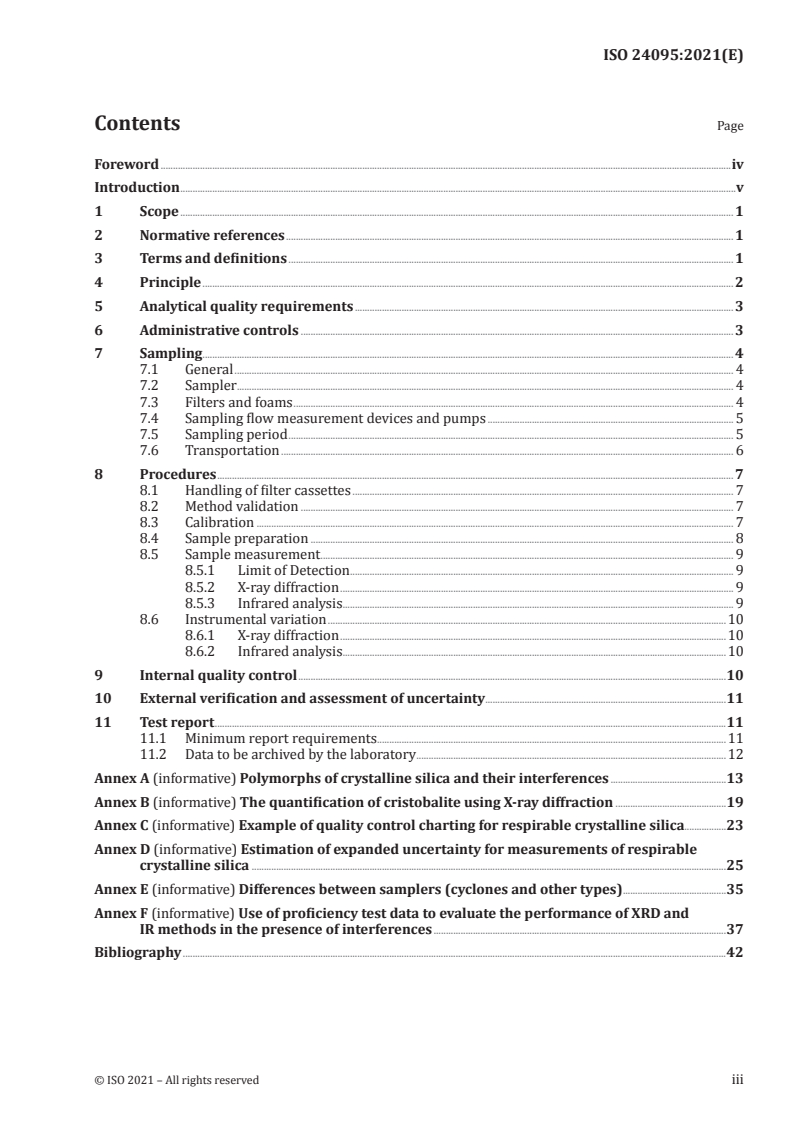
Contents
- Introduction
- 1 Scope
- 2 Normative references
- 3 Terms and definitions
- 3.1 respirable crystalline silica (RCS)
- 3.2 collection substrate
- 3.3 analysis filter
- 4 Principle
- 5 Analytical quality requirements
- 6 Administrative controls
- 7 Sampling
- 7.1 General
- 7.2 Sampler
- 7.3 Filters and foams
- 7.4 Sampling flow measurement devices and pumps
- 7.5 Sampling period
- 7.6 Transportation
- 8 Procedures
- 8.1 Handling of filter cassettes
- 8.2 Method validation
- 8.3 Calibration
- 8.4 Sample preparation
- 8.5 Sample measurement
- 8.6 Instrumental variation
- 9 Internal quality control
- 10 External verification and assessment of uncertainty
- 11 Test report
- 11.1 Minimum report requirements
- 11.2 Data to be archived by the laboratory
- Annex A
- Annex B
- Annex C
- Annex D
- Annex E
- Annex F
- 2 X-ray
- 2 CMD
- 3 CMD_Talc
- Bibliography
Introduction
Respirable crystalline silica (RCS) is a hazard to the health of workers in many industries through exposure by inhalation. Industrial hygienists and other public health professionals need to determine the effectiveness of measures taken to control workers' exposure. Taking samples of air during a work activity and then measuring the amount of RCS present is often done to assess the exposure of an individual, the effectiveness of their respiratory protection or effectiveness of other controls. Studies have found that procedures to ensure the quality of RCS measurements must be followed to ensure results are fit-for-purpose. This is especially true if it is desired to accurately measure RCS at levels below applicable occupational exposure limit values where greater measurement variability can be observed. Reasonable measurement uncertainty can be achieved with proper controls to limit bias and measurement variability and the usefulness of RCS measurements to make informed decisions to protect worker health can be upheld. This document is intended to be of benefit to those involved in the determination of RCS in the workplace, e.g. agencies concerned with health and safety at work; industrial hygienists; safety and health professionals; analytical laboratories; industrial users and their workers. Readers should be aware that in some countries there are legal requirements for the quality assurance of these measurements.
SIST ISO 24095:2026
SIST ISO 24095:2026 INTERNATIONAL STANDARD ISO 24095:2021(E) Workplace air — Guidance for the measurement of respirable crystalline silica
1 Scope
This document gives guidelines for the measurements of respirable crystalline silica in air using direct on-filter or indirect X-ray diffraction and infrared analysis methods, including quality aspects of the measurements. The scope of this document includes the following crystalline silica polymorphs: quartz and cristobalite.
These guidelines are intended for use in conjunction with the following specific analytical methods under the jurisdiction of ISO TC 146 SC 2: ISO 16258-1, ISO 16258-2, and ISO 19087. When used with any of these documents, this guidance will help to ensure measurement procedures meet the uncertainty requirements stipulated in ISO 20581, to enable the results to be compared to occupational exposure [40] limit values (OELV) in accordance with EN 689 .
These guidelines are also relevant to the analysis of filters obtained from dustiness measurements in [1] [35] accordance with EN 15051 and EN 17289 .
2 Normative references
The following documents are referred to in the text in such a way that some or all of their content constitutes requirements of this document. For dated references, only the edition cited applies. For undated references, the latest edition of the referenced document (including any amendments) applies. ISO 7708, Air quality — Particle size fraction definitions for health-related sampling ISO 13137, Workplace atmospheres — Pumps for personal sampling of chemical and biological agents — Requirements and test methods ISO 18158, Workplace air — Terminology ISO/IEC 17025, General requirements for the competence of testing and calibration laboratories EN 13205, Workplace atmospheres — Assessment of performance of instruments for measurement of airborne particle concentrations
3 Terms and definitions
For the purposes of this document, the terms and definitions given in ISO 18158 and the following apply. ISO and IEC maintain terminology databases for use in standardization at the following addresses:
- ISO Online browsing platform: available at https:// www .iso .org/ obp
- IEC Electropedia: available at https:// www .electropedia .org/
3.1 respirable crystalline silica (RCS)
RCS particles of crystalline silica that can penetrate to the unciliated airways
SIST ISO 24095:2026 ISO 24095:2021(E)
3.2 collection substrate
medium on which airborne chemical and/or biological agents are collected for subsequent analysis Note 1 to entry: In RCS analysis, filters or polyurethane foams, alone or contained within capsules or cassettes are examples of collection substrates for airborne particles. Impinger solutions are not applicable. [SOURCE: ISO 18158:2016, 2.2.3.7, modified for relevance to RCS measurement]
3.3 analysis filter
suitable filter used to carry out the RCS analysis Note 1 to entry: For direct-on-filter analysis the collection substrate is the analysis filter. Note 2 to entry: For the indirect analysis the dust is removed from the collection substrate and redeposited onto an analysis filter.
4 Principle
The aim of this document is to give information to select the most appropriate method for the analysis of RCS. In addition, information is provided to minimise the uncertainty in measurement. Therefore, sections in this document deal with the many factors that may influence the variability of a measurement around the true value. The uncertainty of an air measurement is the combination of the variation of measurements from the true value from both the sampling and chemical analysis. Within these two broad headings are other factors, some of which are illustrated below. a) Organisational factors:
1) strategy; 2) method; 3) training and experience.
b) Measurement factors:
1) sampling instruments; 2) calibration; 3) sample preparation; 4) instrumental variation; 5) interferences.
The variability of these individual factors combines to add to the uncertainty of the measurement. At stages within the sampling and analysis process, the factors that contribute to the variance of a measurement can be monitored and controlled to reduce the expanded uncertainty. With such an approach, the variation of the measurements is minimised.
The quantifiable contributions to the uncertainty of crystalline silica in air measurement are illustrated in the classic cause and effect diagram often used as an aid to estimate uncertainty in measurement in Figure 1.
SIST ISO 24095:2026 ISO 24095:2021(E)
Figure 1 — Cause and effect diagram illustrating sources of uncertainty in the measurement of respirable crystalline silica
5 Analytical quality requirements
The level of analytical quality necessary for effective occupational hygiene monitoring should be considered before establishing requirements for a quality assurance program. Statistical quality control procedures can determine what is currently achievable in terms of intra- and interlaboratory precision and bias and may throw some light on the relative accuracy of different methods, but they do not determine what are desirable levels of trueness and precision. The existence of legislative requirements to take corrective action when exposure limits are exceeded has a bearing on analytical quality requirements.
NOTE Performance criteria give limits to the expanded uncertainty in occupational hygiene analyses to reduce the potential for incorrect decisions due to the poor precision of results (ISO 20581). This uncertainty includes the imprecision in the sampling and analytical methods and is specified as a maximum of ± 30 % at the exposure limit value and ± 50 % at about half the limit value. The National Institute for Occupational Safety and Health (NIOSH) in the USA stipulates an expanded accuracy requirement of ± 25 % for its occupational hygiene [2] methods based on laboratory tests . The NIOSH accuracy requirement can be expanded to ± 35 % for accuracy [3] determined using field comparison of methods . The relationship between different approaches to determining [4,5] uncertainty limits have been explored .
6 Administrative controls
ISO/IEC 17025 specifically addresses the establishment of a management system to ensure the traceability of measurements. In some countries, accreditation to ISO/IEC 17025 may be a legislative requirement.
Communication between those collecting the samples and those analysing them is encouraged in all cases but is especially important where the analyst does not prepare the sampling media. Laboratory managers should consider whether analysts would benefit from training in mineralogy and/or advanced analytical techniques, such as peak profile fitting and spectral interferences.
SIST ISO 24095:2026 ISO 24095:2021(E)
7 Sampling
7.1 General
The sampling strategy shall be appropriate to the objectives of the survey. [40] NOTE EN 689 specifies one sampling strategy. Other examples include Reference [6] from the NIOSH and Reference [7] from the American Industrial Hygiene Association (AIHA). Additional factors that should be considered are minimum sampling times for low concentrations and maximum sampling times for high concentrations.
Pumps conforming to the requirements of ISO 13137 are preferred, and the main requirement concerning pump pulsation from ISO 13137 shall be fulfilled for the pumps in use. [8] NOTE CEN/TR 15230 contains information regarding size-selective sampling procedures. Sampling equipment and the associated collection substrate shall be compatible with the intended method of analysis. In some recommended or official methods, the sampling instrument is specified. Changes to official or recommended methods shall be validated to ensure they are appropriate and comparable.
7.2 Sampler
A specific sampler shall sample aerosol in accordance with the definition for respirable sizeselective penetration given in ISO 7708, except where local regulation requires otherwise, and have a [10] performance as required by EN 13205. Conventions for particle deposition may also be considered. All connections included in the sampling trains shall be checked prior to use to avoid leaks. Because of the range of sampler types available, practical aspects of their use require consideration. One of the most important is the flow rate required, both with respect to the size, mass, and cost of pump needed, the preferred sampling time-period, as well as with respect to the Limit of Detection (LOD) and Limit of Quantitation (LOQ), but conversely also the potential for overloading. There may be issues specific to certain samplers such as particles adhering to walls, orientation to the wind, ability to clean and re-use or even complexity of calibration and checking the flow rates. Refer to Annex E for information on the differences in performance of samplers. Consult the product information before use. NOTE The most commonly used sampler for respirable size-selection is the miniature cyclone, and a wide variety of types are available. Many of these are designed for connection to a housing containing a filter to collect the separated, respirable particles. In recent years it has been shown that particles passing through the cyclone which should then be deposited on the filter can be attracted instead to the walls of the housing if it is made of [10] non-conducting plastic . These particles are intended to be part of the sample but are not included if only the filter catch is analysed. It is recommended to use conductive (static-dissipative) plastic cassettes for the purpose of housing filters instead of non-conductive plastic cassettes.
7.3 Filters and foams
Filters shall be of a diameter suitable for use in the selected sampler. The filter type selected for sampling shall have a filtration efficiency of not less than 95 % over the range of particle sizes to be [11] collected (1 µm to 10 µm) . Most polymer membrane filters, except polycarbonate filters, regardless of the nominal pore size, exhibit this characteristic over most flow rates. Foams are generally associated with a specific sampler and only the type of foams supplied for the sampler shall be used. A different type of filter than the foam or filter used for sampling may be preferred for analysis. Re-deposition of a collected foam or filter sample on another filter or other medium is generally referred to as an indirect analysis, rather than a direct analysis where the sampling filter is directly inserted in the analytical instrumentation. While it is possible to re-deposit the sample on to a different substrate from that used for sampling, this step may add to the uncertainty budget of the procedure. The advantage or disadvantage of re-deposition should be balanced against other considerations (evenness and thickness of deposit, removal of interfering species, etc.). Not all filters are suitable for all analytical methods. For example, silver membrane filters are suitable for X-ray diffraction (XRD) analysis but not infrared
SIST ISO 24095:2026 ISO 24095:2021(E)
(IR) spectroscopy. Polyvinylchloride (PVC), polypropylene, or PVC-acrylonitrile co-polymer filters [12] have suitable IR characteristics , but a potassium bromide bead can also be created for indirect [13] analysis . Filter material may degrade if the sampling environment is particularly humid.
7.4 Sampling flow measurement devices and pumps
The device used to measure the flow through a sampling pump shall have its calibration traceable to national or international standards through an organization accredited for the purpose. Float-type flow meters (rotameters) are not traceable to national or international standards and can only be used to indicate the possibility that flow rates have deviated from the allowed range. Corrections to the flow rate readings from rotameters may be necessary to take account of changes in air density resulting from conditions of temperature and pressure and relative humidity which differ from those of the initial calibration of the rotameter. The reading of a rotameter used for this purpose shall be checked prior to use with a calibrator traceable to primary standards. Extreme conditions of temperature and pressure can have an influence on volumetric flow meters, and they should be calibrated to provide accurate measurements at the worksite conditions. Mass flow meters require correction for air density. Corrections are only necessary when the conditions at the site differ substantially from those where the flow rate check was originally made (e.g. using the universal gas law, a temperature change of 10 °C would change the volume sampled by about 3 %, but an altitude change of several thousand metres would have a much more profound effect). If the flow rate has been set away from the sampling site, a flow rate check of the sampling train should be made close to the site of the working operation to ensure the pump is functioning correctly and any necessary adjustments are made prior to sampling. The battery for the sampling pump should be fully charged prior to the sampling exercise. When taking personal samples, sampling pumps worn by personnel should not impede normal work activity. Sampling pumps shall comply with the provisions of ISO 13137, or equivalent performance standard. Most pumps have an adjustable flow rate and a means for setting a specific flow rate. The sampler requires operation at a specific (nominal) flow rate to meet specified size-selective criteria in collecting a respirable size fraction. Excessive pulsation in flow will cause deviations from the required [14] performance , therefore pumps for this purpose shall meet the requirements of the pulsation test in ISO 13137. Pumps shall maintain the nominal flow rate to within ± 5 % throughout the sampling period, and thus shall incorporate a flow fault indicator, or have their flow rate checked frequently throughout the sampling period to detect flow deviations. Prior to sampling, the flow rate value shall be set as close as possible to the nominal and in any case within a range of +/- 5 % of nominal. The pre-sampling flow rate shall be recorded. If flow rate through the sampler is checked at regular intervals during the sampling period by means of a rotameter, this device does not require a calibration traceable to national or international standards. If the flow rate during sampling is not within ± 5 % of the nominal value, the person recording the flow rate measurement shall inform the person responsible for communicating the results to note the observation in the final report. Flow rates can fall below 95 % of the nominal value when sampling very high concentrations, and the pressure drop resulting from build-up of dust on the filter exceeds the flow compensation capability of the pump. The sampler is removed from the pump at the end of the sampling period. The flow rate through the pump and the sampler used to set the presampling flow rate shall be measured post-sampling and reported. When the post-sampling flow rate measurement is within 5 % of the pre-sampling value either the pre-sampling value, the average value, or the nominal value may be used to calculate the concentration, according to the standard procedure [15] in use . Where the post-sampling flow rate measurement is not within 5 % of the nominal value, the user of the results must consider that the size-selective performance of the sampler may have been compromised. Therefore, the results may have no validity, even if only the low or high flow rate value is used for calculating concentration.
7.5 Sampling period
7.5.1 Select a sampling period that is appropriate for the measurement task but ensure that it is long enough to enable RCS to be determined with acceptable uncertainty at levels of industrial hygiene significance. Many OELVs for RCS are couched in terms of an 8-hour shift average, and so sample numbers and/or sampling times should be sufficient to ensure appropriate coverage. If work-shifts are longer and
SIST ISO 24095:2026 ISO 24095:2021(E)
exposure continues, longer sampling periods may be necessary, together with consequent adjustment of the OELV.
NOTE If the minimum sampling time required for analytical sensitivity is too long, consider the possibility of using a sampler designed to be used at a higher flow rate or modifying the analytical procedure to obtain greater sensitivity.
7.5.2 When high concentrations of airborne particles are anticipated, the sampling period may
be reduced to not risk overloading the filter with particles (with subsequent additional samples as necessary where compliance with an OELV is being tested). While many published methods caution not to exceed 2 mg total deposit, this is a very conservative recommendation as loadings up to 4 mg have [16] been circulated in round-robin studies without significant loss of sample . However, it is also necessary to consider the matrix absorption effects from sample loading on the maximum allowable value. Table 4 of the Reference [17] shows that in a “worst case” standard sample, which was defined as 5 % quartz in a matrix with an x-ray absorption coefficient of 1 000 (hematite), the critical value where deviation from linear XRD calibration is 20 % is 2 mg on a 2,1 cm filter diameter, and so above this loading appropriate corrections should be applied to account for the non-linearity. If the sample is 80 % quartz the deviation will be much less (see Figure 17), and, since the effect also depends on the mass absorption coefficient of the interferent, a “typical” coefficient of 40 (with feldspar or calcite) would lead to a critical value for
80 % quartz of 2,4 mg.cm . Over a 2,1 cm diameter filter this is greater than 4 mg loading before nonlinearity.
...
Contents
- Introduction
- 1 Scope
- 2 Normative references
- 3 Terms and definitions
- 3.1 respirable crystalline silica (RCS)
- 3.2 collection substrate
- 3.3 analysis filter
- 4 Principle
- 5 Analytical quality requirements
- 6 Administrative controls
- 7 Sampling
- 7.1 General
- 7.2 Sampler
- 7.3 Filters and foams
- 7.4 Sampling flow measurement devices and pumps
- 7.5 Sampling period
- 7.6 Transportation
- 8 Procedures
- 8.1 Handling of filter cassettes
- 8.2 Method validation
- 8.3 Calibration
- 8.4 Sample preparation
- 8.5 Sample measurement
- 8.6 Instrumental variation
- 9 Internal quality control
- 10 External verification and assessment of uncertainty
- 11 Test report
- 11.1 Minimum report requirements
- 11.2 Data to be archived by the laboratory
- Annex A
- Annex B
- Annex C
- Annex D
- Annex E
- Annex F
- 2 X-ray
- 2 CMD
- 3 CMD_Talc
- Bibliography
Introduction
Respirable crystalline silica (RCS) is a hazard to the health of workers in many industries through exposure by inhalation. Industrial hygienists and other public health professionals need to determine the effectiveness of measures taken to control workers' exposure. Taking samples of air during a work activity and then measuring the amount of RCS present is often done to assess the exposure of an individual, the effectiveness of their respiratory protection or effectiveness of other controls. Studies have found that procedures to ensure the quality of RCS measurements must be followed to ensure results are fit-for-purpose. This is especially true if it is desired to accurately measure RCS at levels below applicable occupational exposure limit values where greater measurement variability can be observed. Reasonable measurement uncertainty can be achieved with proper controls to limit bias and measurement variability and the usefulness of RCS measurements to make informed decisions to protect worker health can be upheld. This document is intended to be of benefit to those involved in the determination of RCS in the workplace, e.g. agencies concerned with health and safety at work; industrial hygienists; safety and health professionals; analytical laboratories; industrial users and their workers. Readers should be aware that in some countries there are legal requirements for the quality assurance of these measurements.
INTERNATIONAL STANDARD ISO 24095:2021(E) Workplace air — Guidance for the measurement of respirable crystalline silica
1 Scope
This document gives guidelines for the measurements of respirable crystalline silica in air using direct on-filter or indirect X-ray diffraction and infrared analysis methods, including quality aspects of the measurements. The scope of this document includes the following crystalline silica polymorphs: quartz and cristobalite.
These guidelines are intended for use in conjunction with the following specific analytical methods under the jurisdiction of ISO TC 146 SC 2: ISO 16258-1, ISO 16258-2, and ISO 19087. When used with any of these documents, this guidance will help to ensure measurement procedures meet the uncertainty requirements stipulated in ISO 20581, to enable the results to be compared to occupational exposure [40] limit values (OELV) in accordance with EN 689 .
These guidelines are also relevant to the analysis of filters obtained from dustiness measurements in [1] [35] accordance with EN 15051 and EN 17289 .
2 Normative references
The following documents are referred to in the text in such a way that some or all of their content constitutes requirements of this document. For dated references, only the edition cited applies. For undated references, the latest edition of the referenced document (including any amendments) applies. ISO 7708, Air quality — Particle size fraction definitions for health-related sampling ISO 13137, Workplace atmospheres — Pumps for personal sampling of chemical and biological agents — Requirements and test methods ISO 18158, Workplace air — Terminology ISO/IEC 17025, General requirements for the competence of testing and calibration laboratories EN 13205, Workplace atmospheres — Assessment of performance of instruments for measurement of airborne particle concentrations
3 Terms and definitions
For the purposes of this document, the terms and definitions given in ISO 18158 and the following apply. ISO and IEC maintain terminology databases for use in standardization at the following addresses:
- ISO Online browsing platform: available at https:// www .iso .org/ obp
- IEC Electropedia: available at https:// www .electropedia .org/
3.1 respirable crystalline silica (RCS)
RCS particles of crystalline silica that can penetrate to the unciliated airways
ISO 24095:2021(E)
3.2 collection substrate
medium on which airborne chemical and/or biological agents are collected for subsequent analysis Note 1 to entry: In RCS analysis, filters or polyurethane foams, alone or contained within capsules or cassettes are examples of collection substrates for airborne particles. Impinger solutions are not applicable. [SOURCE: ISO 18158:2016, 2.2.3.7, modified for relevance to RCS measurement]
3.3 analysis filter
suitable filter used to carry out the RCS analysis Note 1 to entry: For direct-on-filter analysis the collection substrate is the analysis filter. Note 2 to entry: For the indirect analysis the dust is removed from the collection substrate and redeposited onto an analysis filter.
4 Principle
The aim of this document is to give information to select the most appropriate method for the analysis of RCS. In addition, information is provided to minimise the uncertainty in measurement. Therefore, sections in this document deal with the many factors that may influence the variability of a measurement around the true value. The uncertainty of an air measurement is the combination of the variation of measurements from the true value from both the sampling and chemical analysis. Within these two broad headings are other factors, some of which are illustrated below. a) Organisational factors:
1) strategy; 2) method; 3) training and experience.
b) Measurement factors:
1) sampling instruments; 2) calibration; 3) sample preparation; 4) instrumental variation; 5) interferences.
The variability of these individual factors combines to add to the uncertainty of the measurement. At stages within the sampling and analysis process, the factors that contribute to the variance of a measurement can be monitored and controlled to reduce the expanded uncertainty. With such an approach, the variation of the measurements is minimised.
The quantifiable contributions to the uncertainty of crystalline silica in air measurement are illustrated in the classic cause and effect diagram often used as an aid to estimate uncertainty in measurement in Figure 1.
ISO 24095:2021(E)
Figure 1 — Cause and effect diagram illustrating sources of uncertainty in the measurement of respirable crystalline silica
5 Analytical quality requirements
The level of analytical quality necessary for effective occupational hygiene monitoring should be considered before establishing requirements for a quality assurance program. Statistical quality control procedures can determine what is currently achievable in terms of intra- and interlaboratory precision and bias and may throw some light on the relative accuracy of different methods, but they do not determine what are desirable levels of trueness and precision. The existence of legislative requirements to take corrective action when exposure limits are exceeded has a bearing on analytical quality requirements.
NOTE Performance criteria give limits to the expanded uncertainty in occupational hygiene analyses to reduce the potential for incorrect decisions due to the poor precision of results (ISO 20581). This uncertainty includes the imprecision in the sampling and analytical methods and is specified as a maximum of ± 30 % at the exposure limit value and ± 50 % at about half the limit value. The National Institute for Occupational Safety and Health (NIOSH) in the USA stipulates an expanded accuracy requirement of ± 25 % for its occupational hygiene [2] methods based on laboratory tests . The NIOSH accuracy requirement can be expanded to ± 35 % for accuracy [3] determined using field comparison of methods . The relationship between different approaches to determining [4,5] uncertainty limits have been explored .
6 Administrative controls
ISO/IEC 17025 specifically addresses the establishment of a management system to ensure the traceability of measurements. In some countries, accreditation to ISO/IEC 17025 may be a legislative requirement.
Communication between those collecting the samples and those analysing them is encouraged in all cases but is especially important where the analyst does not prepare the sampling media. Laboratory managers should consider whether analysts would benefit from training in mineralogy and/or advanced analytical techniques, such as peak profile fitting and spectral interferences.
ISO 24095:2021(E)
7 Sampling
7.1 General
The sampling strategy shall be appropriate to the objectives of the survey. [40] NOTE EN 689 specifies one sampling strategy. Other examples include Reference [6] from the NIOSH and Reference [7] from the American Industrial Hygiene Association (AIHA). Additional factors that should be considered are minimum sampling times for low concentrations and maximum sampling times for high concentrations.
Pumps conforming to the requirements of ISO 13137 are preferred, and the main requirement concerning pump pulsation from ISO 13137 shall be fulfilled for the pumps in use. [8] NOTE CEN/TR 15230 contains information regarding size-selective sampling procedures. Sampling equipment and the associated collection substrate shall be compatible with the intended method of analysis. In some recommended or official methods, the sampling instrument is specified. Changes to official or recommended methods shall be validated to ensure they are appropriate and comparable.
7.2 Sampler
A specific sampler shall sample aerosol in accordance with the definition for respirable sizeselective penetration given in ISO 7708, except where local regulation requires otherwise, and have a [10] performance as required by EN 13205. Conventions for particle deposition may also be considered. All connections included in the sampling trains shall be checked prior to use to avoid leaks. Because of the range of sampler types available, practical aspects of their use require consideration. One of the most important is the flow rate required, both with respect to the size, mass, and cost of pump needed, the preferred sampling time-period, as well as with respect to the Limit of Detection (LOD) and Limit of Quantitation (LOQ), but conversely also the potential for overloading. There may be issues specific to certain samplers such as particles adhering to walls, orientation to the wind, ability to clean and re-use or even complexity of calibration and checking the flow rates. Refer to Annex E for information on the differences in performance of samplers. Consult the product information before use. NOTE The most commonly used sampler for respirable size-selection is the miniature cyclone, and a wide variety of types are available. Many of these are designed for connection to a housing containing a filter to collect the separated, respirable particles. In recent years it has been shown that particles passing through the cyclone which should then be deposited on the filter can be attracted instead to the walls of the housing if it is made of [10] non-conducting plastic . These particles are intended to be part of the sample but are not included if only the filter catch is analysed. It is recommended to use conductive (static-dissipative) plastic cassettes for the purpose of housing filters instead of non-conductive plastic cassettes.
7.3 Filters and foams
Filters shall be of a diameter suitable for use in the selected sampler. The filter type selected for sampling shall have a filtration efficiency of not less than 95 % over the range of particle sizes to be [11] collected (1 µm to 10 µm) . Most polymer membrane filters, except polycarbonate filters, regardless of the nominal pore size, exhibit this characteristic over most flow rates. Foams are generally associated with a specific sampler and only the type of foams supplied for the sampler shall be used. A different type of filter than the foam or filter used for sampling may be preferred for analysis. Re-deposition of a collected foam or filter sample on another filter or other medium is generally referred to as an indirect analysis, rather than a direct analysis where the sampling filter is directly inserted in the analytical instrumentation. While it is possible to re-deposit the sample on to a different substrate from that used for sampling, this step may add to the uncertainty budget of the procedure. The advantage or disadvantage of re-deposition should be balanced against other considerations (evenness and thickness of deposit, removal of interfering species, etc.). Not all filters are suitable for all analytical methods. For example, silver membrane filters are suitable for X-ray diffraction (XRD) analysis but not infrared
ISO 24095:2021(E)
(IR) spectroscopy. Polyvinylchloride (PVC), polypropylene, or PVC-acrylonitrile co-polymer filters [12] have suitable IR characteristics , but a potassium bromide bead can also be created for indirect [13] analysis . Filter material may degrade if the sampling environment is particularly humid.
7.4 Sampling flow measurement devices and pumps
The device used to measure the flow through a sampling pump shall have its calibration traceable to national or international standards through an organization accredited for the purpose. Float-type flow meters (rotameters) are not traceable to national or international standards and can only be used to indicate the possibility that flow rates have deviated from the allowed range. Corrections to the flow rate readings from rotameters may be necessary to take account of changes in air density resulting from conditions of temperature and pressure and relative humidity which differ from those of the initial calibration of the rotameter. The reading of a rotameter used for this purpose shall be checked prior to use with a calibrator traceable to primary standards. Extreme conditions of temperature and pressure can have an influence on volumetric flow meters, and they should be calibrated to provide accurate measurements at the worksite conditions. Mass flow meters require correction for air density. Corrections are only necessary when the conditions at the site differ substantially from those where the flow rate check was originally made (e.g. using the universal gas law, a temperature change of 10 °C would change the volume sampled by about 3 %, but an altitude change of several thousand metres would have a much more profound effect). If the flow rate has been set away from the sampling site, a flow rate check of the sampling train should be made close to the site of the working operation to ensure the pump is functioning correctly and any necessary adjustments are made prior to sampling. The battery for the sampling pump should be fully charged prior to the sampling exercise. When taking personal samples, sampling pumps worn by personnel should not impede normal work activity. Sampling pumps shall comply with the provisions of ISO 13137, or equivalent performance standard. Most pumps have an adjustable flow rate and a means for setting a specific flow rate. The sampler requires operation at a specific (nominal) flow rate to meet specified size-selective criteria in collecting a respirable size fraction. Excessive pulsation in flow will cause deviations from the required [14] performance , therefore pumps for this purpose shall meet the requirements of the pulsation test in ISO 13137. Pumps shall maintain the nominal flow rate to within ± 5 % throughout the sampling period, and thus shall incorporate a flow fault indicator, or have their flow rate checked frequently throughout the sampling period to detect flow deviations. Prior to sampling, the flow rate value shall be set as close as possible to the nominal and in any case within a range of +/- 5 % of nominal. The pre-sampling flow rate shall be recorded. If flow rate through the sampler is checked at regular intervals during the sampling period by means of a rotameter, this device does not require a calibration traceable to national or international standards. If the flow rate during sampling is not within ± 5 % of the nominal value, the person recording the flow rate measurement shall inform the person responsible for communicating the results to note the observation in the final report. Flow rates can fall below 95 % of the nominal value when sampling very high concentrations, and the pressure drop resulting from build-up of dust on the filter exceeds the flow compensation capability of the pump. The sampler is removed from the pump at the end of the sampling period. The flow rate through the pump and the sampler used to set the presampling flow rate shall be measured post-sampling and reported. When the post-sampling flow rate measurement is within 5 % of the pre-sampling value either the pre-sampling value, the average value, or the nominal value may be used to calculate the concentration, according to the standard procedure [15] in use . Where the post-sampling flow rate measurement is not within 5 % of the nominal value, the user of the results must consider that the size-selective performance of the sampler may have been compromised. Therefore, the results may have no validity, even if only the low or high flow rate value is used for calculating concentration.
7.5 Sampling period
7.5.1 Select a sampling period that is appropriate for the measurement task but ensure that it is long enough to enable RCS to be determined with acceptable uncertainty at levels of industrial hygiene significance. Many OELVs for RCS are couched in terms of an 8-hour shift average, and so sample numbers and/or sampling times should be sufficient to ensure appropriate coverage. If work-shifts are longer and
ISO 24095:2021(E)
exposure continues, longer sampling periods may be necessary, together with consequent adjustment of the OELV.
NOTE If the minimum sampling time required for analytical sensitivity is too long, consider the possibility of using a sampler designed to be used at a higher flow rate or modifying the analytical procedure to obtain greater sensitivity.
7.5.2 When high concentrations of airborne particles are anticipated, the sampling period may
be reduced to not risk overloading the filter with particles (with subsequent additional samples as necessary where compliance with an OELV is being tested). While many published methods caution not to exceed 2 mg total deposit, this is a very conservative recommendation as loadings up to 4 mg have [16] been circulated in round-robin studies without significant loss of sample . However, it is also necessary to consider the matrix absorption effects from sample loading on the maximum allowable value. Table 4 of the Reference [17] shows that in a “worst case” standard sample, which was defined as 5 % quartz in a matrix with an x-ray absorption coefficient of 1 000 (hematite), the critical value where deviation from linear XRD calibration is 20 % is 2 mg on a 2,1 cm filter diameter, and so above this loading appropriate corrections should be applied to account for the non-linearity. If the sample is 80 % quartz the deviation will be much less (see Figure 17), and, since the effect also depends on the mass absorption coefficient of the interferent, a “typical” coefficient of 40 (with feldspar or calcite) would lead to a critical value for
80 % quartz of 2,4 mg.cm . Over a 2,1 cm diameter filter this is greater than 4 mg loading before nonlinearity.
...
Contents
- Introduction
- 1 Domaine d’application
- 2 Références normatives
- 3 Termes et définitions
- 3.1 silice cristalline alvéolaire
- 3.2 substrat de collecte
- 3.3 filtre d’analyse
- 4 Principe
- 5 Exigences relatives à la qualité des analyses
- 6 Contrôles administratifs
- 7 Prélèvement
- 7.1 Généralités
- 7.2 Dispositif de prélèvement
- 7.3 Filtres et mousses
- 7.4 Dispositifs de mesure du débit de prélèvement et pompes
- 7.5 Durée de prélèvement
- 7.6 Transport
- 8 Procédures
- 8.1 Manipulation des cassettes porte-filtres
- 8.2 Validation de la méthode
- 8.3 Étalonnage
- 8.4 Préparation des échantillons
- 8.5 Mesurage des échantillons
- 8.6 Variation instrumentale
- 9 Contrôle qualité interne
- 10 Vérification externe et évaluation de l’incertitude
- 11 Rapport d’essai
- 11.1 Exigences minimales pour le rapport
- 11.2 Données à archiver par le laboratoire
- Annexe A
- Annexe B
- Annexe C
- Annexe D
- Annexe E
- Annexe F
- 2 CMD
- 3 CMD et talc
- Bibliographie
Introduction
La silice cristalline alvéolaire (RCS, de l’anglais «respirable crystalline silica ») constitue un danger pour la santé des travailleurs dans beaucoup d’industries en cas d’exposition par inhalation. Il est nécessaire que les hygiénistes du travail et autres professionnels de santé publique déterminent l’efficacité des mesures prises pour contrôler l’exposition des travailleurs. Des prélèvements d’échantillons d’air pendant le travail et des mesurages de la quantité de RCS présente sont souvent effectués pour évaluer l’exposition individuelle, l’efficacité de la protection respiratoire ou l’efficacité d’autres dispositions. Des études ont démontré que les procédures visant à assurer la qualité des mesurages de la RCS devaient être suivies afin de garantir l’adéquation des résultats avec l’objectif fixé. Cela s’applique d’autant plus si l’on souhaite mesurer avec exactitude la RCS à des niveaux inférieurs aux valeurs limites d’exposition professionnelle applicables, où une plus grande variabilité des mesures peut être observée. Une incertitude de mesure raisonnable peut être atteinte avec des dispositions appropriées pour limiter le biais et la variabilité des mesures, et l’utilité des mesurages de la RCS permettant de prendre des décisions adaptées pour protéger la santé des travailleurs peut être maintenue. Le présent document est destiné à ceux qui sont impliqués dans la détermination de la quantité de RCS sur les lieux de travail, tels que les agences de santé et de sécurité au travail, les hygiénistes du travail, les professionnels de santé et de sécurité, les laboratoires d’analyse, les utilisateurs industriels et leurs travailleurs. Il convient que les lecteurs soient conscients que dans certains pays, il existe des exigences réglementaires relatives à l’assurance qualité de ces mesurages.
NORME INTERNATIONALE ISO 24095:2021(F) Air des lieux de travail — Lignes directrices pour le mesurage de la fraction alvéolaire de la silice cristalline
1 Domaine d’application
Le présent document fournit des lignes directrices relatives aux mesurages de la silice cristalline alvéolaire dans l’air en utilisant une méthode directe sur filtre ou des méthodes indirectes d’analyse par diffraction de rayons X et infrarouge, incluant les aspects qualité des mesurages. Le domaine d’application du présent document inclut les polymorphes de silice cristalline suivants: quartz, cristobalite et tridymite.
Ces lignes directrices sont destinées à être utilisées conjointement avec les méthodes d’analyse suivantes, sous la juridiction de l’ISO TC 146, SC 2: ISO 16258-1, ISO 16258-2 et ISO 19087. Utilisé avec l’un de ces documents, ces lignes directrices contribuent à garantir que les procédures de mesure satisfont aux exigences d’incertitude spécifiées dans l’ISO 20581, afin de permettre la comparaison des [40] résultats aux valeurs limites d’exposition professionnelle (VLEP) conformément à l’EN 689 . Ces lignes directrices sont également appropriées pour l’analyse des filtres obtenus à partir des [1] [35] mesurages du pouvoir de resuspension conformément à l’EN 15051 et à l’EN 17289 .
2 Références normatives
Les documents suivants sont cités dans le texte de sorte qu’ils constituent, pour tout ou partie de leur contenu, des exigences du présent document. Pour les références datées, seule l’édition citée s’applique. Pour les références non datées, la dernière édition du document de référence s’applique (y compris les éventuels amendements).
ISO 7708, Qualité de l'air — Définitions des fractions de taille des particules pour l'échantillonnage lié aux problèmes de santé ISO 13137, Air des lieux de travail — Pompes pour l’échantillonnage individuel des agents chimiques et biologiques — Exigences et méthodes d’essai ISO 18158, Qualité de l'air — Terminologie ISO/IEC 17025, Exigences générales concernant la compétence des laboratoires d'étalonnages et d'essais EN 13205, Exposition sur les lieux de travail — Évaluation des performances des dispositifs de prélèvement pour le mesurage des concentrations de particules en suspension dans l’air
3 Termes et définitions
Pour les besoins du présent document, les termes et définitions de l’ISO 18158 ainsi que les suivants, s’appliquent.
L’ISO et l’IEC tiennent à jour des bases de données terminologiques destinées à être utilisées en normalisation, consultables aux adresses suivantes:
- ISO Online browsing platform: disponible à l’adresse https:// www .iso .org/ obp
- IEC Electropedia: disponible à l’adresse https:// www .electropedia .org/
ISO 24095:2021(F)
3.1 silice cristalline alvéolaire
RCS particules de silice cristalline qui peuvent pénétrer dans les voies respiratoires non ciliées
3.2 substrat de collecte
milieu sur lequel des agents chimiques et/ou biologiques en suspension dans l’air sont collectés en vue d’une analyse ultérieure Note 1 à l'article: Dans l’analyse de RCS, les filtres ou les mousses de polyuréthane, seuls ou contenus dans des capsules ou cassettes, sont des exemples de substrats de collecte de particules en suspension dans l’air. Les solutions à impacteur ne sont pas applicables.
[SOURCE: ISO 18158:2016, 2.2.3.7, modifiée pour être applicable au mesurage de la RCS]
3.3 filtre d’analyse
filtre adapté utilisé pour réaliser l’analyse de RCS Note 1 à l'article: Pour l’analyse directe sur filtre, le substrat de collecte est le filtre d’analyse. Note 2 à l'article: Pour l’analyse indirecte, la poussière est retirée du substrat de collecte et redéposée sur un filtre d’analyse.
4 Principe
Le présent document a pour objectif de fournir des informations permettant de sélectionner la méthode la plus appropriée pour l’analyse de RCS. En outre, des informations sont fournies pour réduire au minimum l’incertitude de mesure. Par conséquent, les sections du présent document traitent des nombreux facteurs qui peuvent influencer la variabilité d’une mesure autour de la valeur vraie. L’incertitude d’une mesure de la qualité de l’air est la combinaison de la variabilité des mesures par rapport à la valeur vraie, provenant à la fois du prélèvement et de l’analyse chimique. Dans ces deux grandes rubriques sont inclus d’autres facteurs, dont certains sont illustrés ci-dessous. a) Facteurs organisationnels:
1) stratégie; 2) méthode; 3) formation et expérience.
b) Facteurs liés au mesurage:
1) dispositifs de prélèvement; 2) étalonnage; 3) préparation des échantillons; 4) variation instrumentale; 5) interférences.
La variabilité de ces facteurs individuels vient s’ajouter à l’incertitude de mesure. À certaines étapes du processus de prélèvement et d’analyse, les facteurs qui contribuent à la variance d’une mesure peuvent être surveillés et contrôlés pour réduire l’incertitude élargie. Une telle approche permet de réduire au minimum la variabilité des mesures.
ISO 24095:2021(F)
Les contributions quantifiables à l’incertitude liée au mesurage de la silice cristalline dans l’air sont illustrées à la Figure 1, dans le diagramme classique de cause et effet souvent utilisé comme aide pour évaluer l’incertitude de mesure.
Figure 1 — Diagramme de cause et effet illustrant les sources d’incertitude dans le mesurage de la silice cristalline alvéolaire
5 Exigences relatives à la qualité des analyses
Il convient d’examiner le niveau de qualité analytique nécessaire pour un contrôle efficace en hygiène industrielle avant d’établir des exigences en vue d’un programme d’assurance qualité. Les procédures statistiques de contrôle qualité peuvent déterminer ce qui est actuellement réalisable en termes de fidélité et de biais intralaboratoire et interlaboratoires et peuvent fournir quelques éclaircissements sur l’exactitude relative des différentes méthodes, mais elles ne déterminent pas quels sont les niveaux souhaitables de justesse et de fidélité.
L’existence d’exigences réglementaires imposant de prendre des mesures correctives lorsque des limites d’exposition sont dépassées influe sur les exigences de qualité analytique. NOTE Les critères de performance fixent des limites à l’incertitude élargie des analyses d’hygiène industrielle pour réduire la possibilité de prendre des décisions incorrectes du fait d’une mauvaise fidélité des résultats (ISO 20581). Cette incertitude inclut le manque de fidélité des méthodes de prélèvement et d’analyse et est fixée à un maximum de ± 30 % à la valeur limite d’exposition et à ± 50 % à environ la moitié de la valeur limite. Le National Institute of Occupational Safety and Health (NIOSH) aux États-Unis stipule une exigence d’exactitude [2] élargie de ± 25 % pour ses méthodes d’hygiène industrielle basées sur des essais en laboratoire . L’exigence d’exactitude du NIOSH peut être étendue à ± 35 % lorsque l’exactitude est déterminée par une comparaison des [3] méthodes sur le terrain . La relation entre les différentes approches pour déterminer les limites d’incertitude a [4,5] été étudiée .
6 Contrôles administratifs
L’ISO/IEC 17025 traite spécifiquement de l’établissement d’un système de management pour assurer la traçabilité des mesures. Dans certains pays, une accréditation selon l’ISO/IEC 17025 peut être une exigence législative.
ISO 24095:2021(F)
La communication entre ceux qui prélèvent les échantillons et ceux qui les analysent est encouragée dans tous les cas, mais elle est particulièrement importante lorsque l’analyste ne prépare pas le support de prélèvement.
Il convient que les responsables de laboratoires déterminent si les analystes devraient bénéficier d’une formation en minéralogie et/ou sur des techniques analytiques avancées telles que l’analyse de pic par ajustement des profils et les interférences spectrales.
7 Prélèvement
7.1 Généralités
La stratégie de prélèvement doit être adaptée aux objectifs de l’enquête. [40] NOTE L’EN 689 spécifie une stratégie de prélèvement. La Référence [6] du NIOSH et la Référence [7] de l’American Industrial Hygiene Association (AIHA) constituent d’autres exemples. Il convient de tenir compte de facteurs supplémentaires, à savoir les durées minimales de prélèvement pour les faibles concentrations et les durées maximales de prélèvement pour les concentrations élevées. Les pompes conformes aux exigences de l’ISO 13137 sont privilégiées et la principale exigence concernant la pulsation du débit de la pompe de l’ISO 13137 doit être satisfaite pour les pompes utilisées. [8] NOTE Le CEN/TR 15230 contient des informations concernant les procédures de prélèvement sélectives de la fraction granulométrique.
Le matériel de prélèvement et le substrat de collecte associé doivent être compatibles avec la méthode d’analyse prévue. Certaines méthodes recommandées ou officielles spécifient le dispositif de prélèvement à utiliser. Les modifications apportées aux méthodes officielles ou recommandées doivent être validées pour s’assurer qu’elles sont adaptées et comparables.
7.2 Dispositif de prélèvement
Un dispositif de prélèvement spécifique doit prélever des aérosols conformément à la définition de la pénétration sélective de la fraction alvéolaire de l’ISO 7708, sauf exigence contraire de la réglementation locale, et doit avoir des performances répondant aux exigences de l’EN 13205. Des conventions pour [10] le dépôt de particules peuvent également être prises en considération. L’étanchéité de tous les raccordements de la ligne de prélèvement doit être vérifiée avant utilisation afin d’éviter toute fuite. En raison de la variété des dispositifs de prélèvement disponibles, il est important de prendre en considération les aspects pratiques de leur utilisation. L’un des aspects les plus importants est le débit de prélèvement requis, tant du point de vue de la taille, de la masse, du coût de la pompe à utiliser et de la durée de prélèvement privilégiée que de celui de la limite de détection (LD) et de la limite de quantification (LQ), mais à l’inverse de la susceptibilité de colmatage. Certains dispositifs de prélèvement peuvent présenter des problèmes spécifiques tels que des dépôts de particules sur les parois, l’orientation par rapport au vent, la possibilité de nettoyage et de réutilisation, voire la complexité de l’étalonnage et la vérification des débits. Se reporter à l’Annexe E pour des informations sur les différences de performance des dispositifs de prélèvement. Consulter la notice d’information du produit avant de l’utiliser.
NOTE Le dispositif de prélèvement le plus couramment utilisé pour la sélection de la fraction alvéolaire est le mini-cyclone et différents modèles sont disponibles. Plusieurs d’entre eux sont conçus pour être raccordés à un porte-filtre contenant un filtre destiné à collecter les particules alvéolaires séparées. Au cours des dernières années, il a été démontré que les particules passant à travers le cyclone qui sont ensuite censées se déposer sur le filtre peuvent être au lieu de cela attirées vers les parois du porte-filtre si celles-ci sont en plastique [10] non conducteur . Il est prévu que ces particules fassent partie de l’échantillon, mais celles-ci ne sont pas incluses si seul le dépôt du filtre est analysé. Il est recommandé d’utiliser des cassettes en plastique conducteur (antistatique) afin de disposer les filtres plutôt que des cassettes en plastique non conducteur.
ISO 24095:2021(F)
7.3 Filtres et mousses
Les filtres doivent avoir un diamètre adapté au dispositif de prélèvement choisi. Le type de filtre choisi pour le prélèvement doit avoir un rendement de filtration d’au moins 95 % sur l’étendue [11] granulométrique des particules à collecter (1 µm à 10 µm) . La plupart des filtres à membrane polymère, à l’exception des filtres en polycarbonate, indépendamment de la taille nominale des pores, présentent cette caractéristique pour la plupart des débits. Les mousses sont généralement associées à un dispositif de prélèvement spécifique et seul le type de mousses fourni avec ce dispositif doit être utilisé. Un type de filtre différent de la mousse ou du filtre utilisé pour le prélèvement peut être préféré pour l’analyse. La redéposition d’un échantillon de mousse ou de filtre collecté sur un autre filtre ou un autre support est généralement appelée analyse indirecte, par opposition à une analyse directe où le filtre de prélèvement est directement inséré dans l’instrument d’analyse. S’il est possible de redéposer l’échantillon sur un substrat différent de celui utilisé pour le prélèvement, cette étape peut contribuer à augmenter l’incertitude de la procédure. Il convient d’apprécier les avantages ou les inconvénients que peut entraîner une redéposition face à d’autres considérations (la régularité et l’épaisseur du dépôt sur le filtre, l’élimination de composés interférents, etc.). Les filtres ne sont pas tous appropriés pour toutes les méthodes d’analyse. Par exemple, les filtres en argent conviennent à l’analyse par diffraction de rayons X (DRX), mais pas à la spectroscopie infrarouge (IR). Les filtres en polychlorure de vinyle (PVC), en polypropylène ou en copolymère de PVC-acrylonitrile ont des caractéristiques infrarouges [12] appropriées , mais une pastille de bromure de potassium peut également être créée pour une [13] analyse indirecte . Le matériau du filtre peut se dégrader si le prélèvement est effectué dans un environnement particulièrement humide.
7.4 Dispositifs de mesure du débit de prélèvement et pompes
L’étalonnage du dispositif utilisé pour mesurer le débit s’écoulant à travers une pompe de prélèvement doit pouvoir être raccordé à des étalons nationaux ou internationaux par un organisme accrédité à cet effet. Les débitmètres à flotteur (rotamètres) ne sont pas raccordés à des étalons nationaux ou internationaux et peuvent uniquement être utilisés pour indiquer la possibilité d’un écart par rapport aux débits de la plage admissible. Des corrections des lectures de débit des rotamètres peuvent être nécessaires pour tenir compte des variations de la masse volumique de l’air résultant de conditions de température, de pression et d’humidité relative qui diffèrent de celles de l’étalonnage initial du rotamètre. Avant utilisation, la lecture d’un rotamètre utilisé à cette fin doit être vérifiée avec un étalon raccordé à des étalons primaires. Les conditions extrêmes de température et de pression peuvent avoir une influence sur les débitmètres volumétriques et il convient que ceux-ci soient étalonnés de sorte à fournir des mesures exactes dans les conditions du lieu de travail. Les débitmètres massiques nécessitent d’être corrigés en fonction de la masse volumique de l’air. Des corrections ne sont nécessaires que lorsque les conditions sur le site diffèrent sensiblement de celles dans lesquelles le contrôle de débit a été initialement réalisé (par exemple selon la loi universelle des gaz une variation de température de 10 °C modifierait le volume prélevé d’environ 3 %, mais un changement d’altitude de plusieurs milliers de mètres aurait un effet bien plus considérable). Si le débit a été réglé à distance du site de prélèvement, il convient de procéder à un contrôle du débit de la ligne de prélèvement à proximité du site de l’activité professionnelle afin de s’assurer que la pompe fonctionne correctement et que tout ajustement nécessaire est effectué avant le prélèvement.
Il convient que la batterie de la pompe de prélèvement soit totalement chargée avant le prélèvement. Lors du prélèvement d’échantillons individuels, il convient que le port d’une pompe de prélèvement par le personnel ne nuise pas à l’activité normale. Les pompes de prélèvement doivent être conformes aux dispositions de l’ISO 13137 ou à une norme de performance équivalente. La plupart des pompes ont un débit réglable et disposent d’un moyen de réglage spécifique du débit. Il est requis que le dispositif de prélèvement fonctionne à un débit spécifique (nominal) afin de répondre à des critères de sélection par fraction granulométrique spécifiés pour la collecte d’une fraction alvéolaire. Une pulsation excessive [14] du débit entraînera des écarts par rapport aux performances requises ; de ce fait, les pompes utilisées à cette fin doivent satisfaire aux exigences de l’essai de pulsation donné dans l’ISO 13137. Les pompes doivent maintenir le débit nominal à ±5 % près pendant toute la durée de prélèvement et doivent donc intégrer un indicateur de défaut de débit ou être soumises à une vérification fréquente de leur débit pendant toute la durée de prélèvement afin de détecter tout écart de débit. Avant le prélèvement, la valeur du débit doit être réglée de sorte à se rapprocher autant que possible de la
ISO 24095:2021(F)
...