

SIST EN 12365-3:2003
(Main)Building hardware - Gasket and weatherstripping for doors, windows, shutters and curtain walling - Part 3: Deflection recovery test method
- Abstract
This part 3 of prEN 33/WI 131/246 specifies the method to be used to select, percentage of recovery after being deflected through its working range under the conditions laid down in the test. The test has been devised to cover all likely gasket and weatherstripping shapes or materials.
- Status
- Published
- Publication Date
- 31-Oct-2003
- Technical Committee
- ISTP - Doors and windows
- Current Stage
- 6060 - National Implementation/Publication (Adopted Project)
- Start Date
- 01-Nov-2003
- Due Date
- 01-Nov-2003
- Completion Date
- 01-Nov-2003

SIST EN 12365-3:2003 is the Slovenian adoption of EN 12365-3:2003, published by SIST. It specifies a test method for measuring the deflection recovery of gaskets and weatherstripping for doors, windows, shutters and curtain walling. In practice, it gives laboratories, manufacturers and specifiers a common way to check how well a sealing profile returns after being compressed or deflected through its working range.
What does SIST EN 12365-3:2003 specify?
SIST EN 12365-3:2003 specifies how to select, prepare, condition and test gasket and weatherstripping samples to determine recovery after deflection or compression. The method is intended to cover likely shapes and materials used in building hardware, so the same approach can be applied across a wide range of sealing products.
The document is organized into scope, normative references, terms and definitions, requirements, test apparatus, test procedure, test method and test report. It also includes two informative annexes that support the test setup and the sequence of steps.
| Annex | What it covers |
|---|---|
| Annex A | Typical arrangement of the compression block used for the deflection test |
| Annex B | Flow chart of the test procedure |
What are the key requirements of SIST EN 12365-3:2003?
Clause 4 sets out the grading basis used with this test method. It identifies six working temperature range grades and eight deflection recovery grades, which matters because product selection and reporting depend on the grade achieved, not just on a pass/fail statement.
Sample condition and preparation
Clause 6 requires samples to be tested soon after forming where possible, then conditioned in a relaxed state before test. Test pieces are taken from different positions in the sample and must have smooth, defect-free edges. In practice, this helps the result represent the product as manufactured and avoids bias from one local area.
Test equipment
Clause 5 requires a compression block that can hold one or more test pieces and compress them to minimum working width. The heating chamber must comply with ISO 188, method A, and must reach the maximum working temperature for the material being tested. This means the lab needs equipment that can reproduce the thermal conditions relevant to the product grade.
Measurement control
Clause 6 gives the measurement tolerances used in the test: temperature, deflection and relative humidity are all controlled tightly. That matters because the result is sensitive to how far the specimen is compressed, how warm it is and how it is conditioned before measurement.
Test sequence
Clause 7 requires the free height to be measured first, then the specimen to be compressed in the block, heated for the specified period, cooled, and measured again. The standard requires three specimen tests and uses the average result as the final sample result. For users, this means the reported value is an average performance measure, not a single reading.
Result expression and reporting
Clause 7 expresses deflection recovery as a percentage based on the change in free height relative to the working range. Clause 8 then requires a test report with the specimen identification, the performance level achieved, the test body, the place of test, the product designation, the measurements or observations, and the date and signature. This is the information needed for technical files, supplier comparison and product assessment.
What terms does SIST EN 12365-3:2003 define?
The standard uses the terms and definitions from EN 12365-1:2003 and prEN 12519:2003. In practice, that means the test method relies on the same vocabulary as the broader gaskets, weatherstripping, windows and doors standards.
- Working temperature range - the temperature band used to classify the material for this test method.
- Deflection recovery - the percentage by which a specimen returns after being compressed or deflected.
- Free height - the uncompressed height of the test piece before and after the test.
- Working range - the span of movement or compression used as the basis for the recovery calculation.
- Test piece - the cut specimen taken from the submitted sample for measurement and testing.
- Compression block - the fixture that holds and compresses the specimen during the test.
Who uses SIST EN 12365-3:2003?
SIST EN 12365-3:2003 is used by manufacturers of gaskets and weatherstripping, test laboratories, and technical staff who specify or buy building hardware for doors, windows, shutters and curtain walling. Quality managers use it to compare materials and verify declared recovery grades. Buyers and specifiers use it when they need a standardized test method for product evaluation and acceptance.
Which standards are used with SIST EN 12365-3:2003?
| Standard | Role in this document |
|---|---|
| EN 12365-1:2003 | Provides the performance requirements and classification framework, and the terms and definitions used here |
| prEN 12519:2003 | Supplies window and door terminology used in the standard |
| ISO 188 | Sets the heating chamber requirement through method A for accelerated ageing and heat resistance conditions |
| EN 12365-2 | Companion part in the same series for linear compression force testing |
| EN 12365-4 | Companion part in the same series for recovery after accelerated ageing testing |
What does the SIST EN 12365-3:2003 document contain?
The document contains the graded requirements in Clause 4, the apparatus description in Clause 5, the specimen conditioning and preparation steps in Clause 6, and the detailed test sequence and result calculation in Clause 7. It also contains a reporting list in Clause 8 that supports consistent documentation of the test outcome.
Annex A gives a typical compression-block arrangement, which helps laboratories build or check the test fixture. Annex B provides a flow chart of the procedure, which is useful for carrying out the steps in order during routine testing. The bibliography points to related parts of the EN 12365 series.
Relations
- Effective Date
- 28-Jan-2026
- Effective Date
- 28-Jan-2026
- Effective Date
- 28-Jan-2026
- Effective Date
- 28-Jan-2026
- Effective Date
- 22-Dec-2008
Get Certified
Connect with accredited certification bodies for this standard

DIBt (Deutsches Institut für Bautechnik)
German Institute for Building Technology.
DIN CERTCO
DIN Group product certification.

Aboma Certification B.V.
Specialized in construction, metal, and transport sectors.
Sponsored listings
Frequently Asked Questions
SIST EN 12365-3:2003 is a standard published by the Slovenian Institute for Standardization (SIST). Its full title is "Building hardware - Gasket and weatherstripping for doors, windows, shutters and curtain walling - Part 3: Deflection recovery test method". This standard covers: This part 3 of prEN 33/WI 131/246 specifies the method to be used to select, percentage of recovery after being deflected through its working range under the conditions laid down in the test. The test has been devised to cover all likely gasket and weatherstripping shapes or materials.
This part 3 of prEN 33/WI 131/246 specifies the method to be used to select, percentage of recovery after being deflected through its working range under the conditions laid down in the test. The test has been devised to cover all likely gasket and weatherstripping shapes or materials.
SIST EN 12365-3:2003 is classified under the following ICS (International Classification for Standards) categories: 91.060.50 - Doors and windows. The ICS classification helps identify the subject area and facilitates finding related standards.
SIST EN 12365-3:2003 has the following relationships with other standards: It is inter standard links to SIST EN 12519:2004, SIST EN 12365-1:2003, SIST EN 14351-2:2019, SIST EN 12365-4:2003; is excused to SIST EN 12365-1:2003. Understanding these relationships helps ensure you are using the most current and applicable version of the standard.
SIST EN 12365-3:2003 is associated with the following European legislation: EU Directives/Regulations: 305/2011, 89/106/EEC. When a standard is cited in the Official Journal of the European Union, products manufactured in conformity with it benefit from a presumption of conformity with the essential requirements of the corresponding EU directive or regulation.
SIST EN 12365-3:2003 is available in PDF format for immediate download after purchase. The document can be added to your cart and obtained through the secure checkout process. Digital delivery ensures instant access to the complete standard document.
Standards Content (Sample)
2003-01.Slovenski inštitut za standardizacijo. Razmnoževanje celote ali delov tega standarda ni dovoljeno.Stavbno okovje – Tesnila in tesnilni trakovi za vrata, okna, polkna in obešene fasade – 3. del: Preskusna metoda za ugotavljanje povratnih deformacijBaubeschläge - Dichtungen und Dichtungenprofile für Fenster, Türen und andere Abschlüsse sowie vorgehängte Fassaden - Teil 3: Rückstellvermögen, PrüfverfahrenQuincaillerie pour le bâtiment - Profilés d'étanchéité de vitrage et entre ouvrant et dormant pour portes, de fenetres, fermeture et façades rideaux - Partie 3: Méthode d'essai pour déterminer la reprise élastiqueBuilding hardware - Gasket and weatherstripping for doors, windows, shutters and curtain walling - Part 3: Deflection recovery test method91.060.50Vrata in oknaDoors and windowsICS:Ta slovenski standard je istoveten z:EN 12365-3:2003SIST EN 12365-3:2003en,fr,de01-november-2003SIST EN 12365-3:2003SLOVENSKI
STANDARD
EUROPEAN STANDARDNORME EUROPÉENNEEUROPÄISCHE NORMEN 12365-3September 2003ICS 91.060.50; 91.190English versionBuilding hardware - Gasket and weatherstripping for doors,windows, shutters and curtain walling - Part 3: Deflectionrecovery test methodQuincaillerie pour le bâtiment - Profilés d'étanchéité devitrage et entre ouvrant et dormant pour portes, fenêtres,fermetures et façades rideaux - Partie 3: Méthode d'essaipour déterminer la reprise élastiqueBaubeschläge - Dichtungen und Dichtungenprofile fürFenster, Türen und andere Abschlüsse sowie vorgehängteFassaden - Teil 3: Rückstellvermögen, PrüfverfahrenThis European Standard was approved by CEN on 1 August 2003.CEN members are bound to comply with the CEN/CENELEC Internal Regulations which stipulate the conditions for giving this EuropeanStandard the status of a national standard without any alteration. Up-to-date lists and bibliographical references concerning such nationalstandards may be obtained on application to the Management Centre or to any CEN member.This European Standard exists in three official versions (English, French, German). A version in any other language made by translationunder the responsibility of a CEN member into its own language and notified to the Management Centre has the same status as the officialversions.CEN members are the national standards bodies of Austria, Belgium, Czech Republic, Denmark, Finland, France, Germany, Greece,Hungary, Iceland, Ireland, Italy, Luxembourg, Malta, Netherlands, Norway, Portugal, Slovakia, Spain, Sweden, Switzerland and UnitedKingdom.EUROPEAN COMMITTEE FOR STANDARDIZATIONCOMITÉ EUROPÉEN DE NORMALISATIONEUROPÄISCHES KOMITEE FÜR NORMUNGManagement Centre: rue de Stassart, 36
B-1050 Brussels© 2003 CENAll rights of exploitation in any form and by any means reservedworldwide for CEN national Members.Ref. No. EN 12365-3:2003 ESIST EN 12365-3:2003
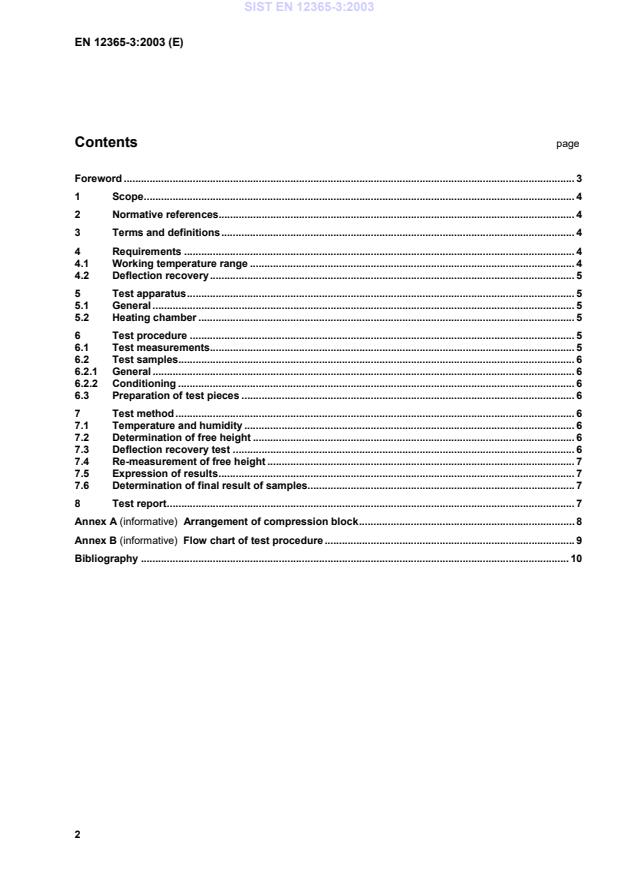
Arrangement of compression block.8Annex B (informative)
Flow chart of test procedure.9Bibliography.10SIST EN 12365-3:2003
...