

SIST EN 14972-2:2026
(Main)Fixed firefighting systems - Water mist systems - Part 2: Test protocol for shopping areas for automatic nozzle systems
- Abstract
This document specifies the evaluation of the fire performance of water mist systems for shopping areas, adjacent storage areas. This document is only applicable for horizontal, solid, flat ceilings with heights of 2,6 m and above.
This document does not cover storage with movable shelves or shelves.
- Status
- Published
- Public Enquiry End Date
- 29-Nov-2024
- Publication Date
- 25-Aug-2026
- Technical Committee
- POZ - Požarna varnost
- Current Stage
- 6060 - National Implementation/Publication (Adopted Project)
- Start Date
- 14-Aug-2026
- Due Date
- 19-Oct-2026
- Completion Date
- 26-Aug-2026

SIST EN 14972-2:2026 is a CEN European Standard for fixed firefighting systems using water mist. It specifies a fire-performance test protocol for automatic nozzle systems in shopping areas and adjacent storage areas, so manufacturers, test laboratories and approval bodies can compare a water mist system with a reference sprinkler arrangement under the same fire scenarios.
What does SIST EN 14972-2:2026 specify?
SIST EN 14972-2:2026 sets the test method for evaluating water mist systems in shopping areas and nearby storage areas. It applies only to horizontal, solid, flat ceilings with heights of 2.6 m and above, and it excludes storage with movable shelves or shelves.
The document is organized into clauses 1 to 10. It covers scope, normative references, terms and definitions, general requirements, fuel packages, test arrangement, test equipment, instrumentation, testing criteria and the test report. That structure tells a reader where to find the mock-up, the measurement rules and the comparison method.
What are the key requirements of SIST EN 14972-2:2026?
General test conditions
SIST EN 14972-2:2026 requires the water mist system to complete the fire tests without manual intervention and to be tested as a ceiling-mounted automatic nozzle system. The system layout must be submitted before testing, with the relevant component list and full dimensions such as pipe lengths and nozzle spacing.
The manufacturer’s instructions control nozzle placement, spray flux and operating pressure, and the test setup must stay unchanged throughout a given series. In practice, that means the test lab cannot adjust the system between fire tests to improve the result.
Clause 4 also requires the water supply to meet the manufacturer’s minimum flow and pressure in the actual pipework layout used for the test. The water flow is shut off 10 min after the first automatic nozzle activates, any remaining fire is manually extinguished, and the resulting damage is recorded.
Fuel packages and fire load
SIST EN 14972-2:2026 uses identical fuel packages within a test series so the sprinkler reference and the water mist system are judged against the same combustible load. The fire load is made from cardboard boxes filled with plastic cups, conditioned before testing, and checked by weight before use.
Clause 5 defines two storage configurations - shelf storage and block storage. Shelf storage uses steel shelves with boxed cups arranged in layers, while block storage uses cardboard boxes stacked on standard wooden euro pallets. This matters because the same fuel package is used to represent different retail and storage arrangements.
The ignition source is a steel fire pan with heptane placed either below one sprinkler or nozzle, or between four sprinklers or nozzles. Those two ignition positions create the U1 and B4 test scenarios and let the protocol compare localized fire growth with a wider spread condition.
Reference sprinkler and water mist arrangement
Clause 6 sets the sprinkler baseline as an Ordinary Hazard 3 ceiling sprinkler system arranged on a square grid and using sprinklers from EN 12259-1. The reference system gives the benchmark against which the water mist system is judged.
The water mist system is then tested in the same scenarios, with the nozzle orientation fixed in advance for the whole series. The system is run at the manufacturer’s maximum ceiling height, maximum nozzle spacing and minimum discharge conditions for the application, so the test reflects the most demanding approved installation case.
Where the system builds pressure after activation, the delay to reach minimum operating pressure must follow the manufacturer’s limit and be documented. In practice, that delay is part of the approval evidence because it affects how quickly suppression starts.
Test hall, instrumentation and report
Clauses 7 and 8 define the test environment and the measurements. The hall must be large enough and ventilated enough not to interfere with the fire, and the test records must include oxygen concentration, temperature, pressure, time and video.
Temperature is measured with thermocouples below the ceiling, pressure is recorded at the hydraulically most remote point, and timing marks include ignition, activation, extinguishment and shut-off. The report then follows EN 14972-1:2020+A1:2025, Annex A.8, so the evidence is recorded in a consistent format.
How the results are judged
Clause 9 compares the water mist test series with the reference sprinkler test series. SIST EN 14972-2:2026 evaluates three things - fire damage to the cups, ceiling gas temperature and the total area of activated sprinklers or nozzles - and the water mist system passes only when its averaged results are no worse than the sprinkler baseline.
That comparison is important in practice because the protocol does not rely on one single indicator. It checks how much product damage remains, how hot the ceiling layer becomes and how much of the installed system operates during the fire, which are the results engineers and buyers use when judging protection performance.
What terms does SIST EN 14972-2:2026 define?
SIST EN 14972-2:2026 uses the terms and definitions from EN 14972-1, so the common water-mist vocabulary comes from Part 1. Readers should use that part for the shared terminology of the series.
- Water mist system - the fixed firefighting system being tested, using water mist in place of a conventional sprinkler discharge.
- Automatic nozzle - a nozzle that operates automatically during the fire test, which is why nozzle placement and pressure matter in the protocol.
- Reference sprinkler system - the sprinkler baseline used for comparison with the water mist system.
- Fuel package - the standard fire load made from cardboard boxes and plastic cups, used to keep each test series comparable.
- Shelf storage - the test arrangement that uses steel shelving, representing product storage in a retail or similar setting.
- Block storage - the test arrangement that stacks boxes on euro pallets, representing palletized storage.
- U1 - the scenario where the ignition source is placed below one sprinkler or one water mist nozzle.
- B4 - the scenario where the ignition source is placed between four sprinklers or four water mist nozzles.
Who uses SIST EN 14972-2:2026?
SIST EN 14972-2:2026 is used by water mist system manufacturers, fire test laboratories and fire protection engineers who need a repeatable way to assess performance in shopping-area applications. It is also relevant to approval and certification bodies that review test evidence, and to specifiers, buyers and quality managers who compare one tested system with another.
In practice, these users apply the standard when planning type tests, fixing the fuel load and nozzle layout, recording the fire response and issuing the final report. It is especially relevant for sales areas, adjacent storage areas, archives, libraries, technical areas and similar occupancies.
Which standards are used with SIST EN 14972-2:2026?
| Standard | What it contributes |
|---|---|
| EN 12259-1 | Defines the sprinkler components used for the reference sprinkler arrangement. |
| EN 13698-1 | Specifies the wooden euro pallets used in block storage tests. |
| EN 14972-1:2020+A1:2025 | Provides the shared water-mist terminology and the report structure used by this part. |
| EN ISO/IEC 17025 | Sets the competence requirements for the laboratories carrying out the fire tests. |
The EN 14972 series also includes other parts for offices, schools, hotels, car garages, machinery enclosures, atria, cable tunnels, commercial fryers, wet benches, combustion turbines, industrial oil cookers and residential occupancies. For a specifier or buyer, that matters because the shopping-area protocol is one application-specific test method within a wider family of occupancy-based protocols.
What does the SIST EN 14972-2:2026 document contain?
SIST EN 14972-2:2026 contains figures for the shelf-storage and block-storage arrangements, the sprinkler and nozzle grids, and the ignition positions. It also contains the test setup for the cardboard-box fuel package and the fire pan ignition source.
The tables organize the test series and show how damage, ceiling temperature and activation area are compared between the sprinkler reference and the water mist system. For test laboratories, that makes the document a practical protocol for arranging the mock-up, running the fire tests and writing the report.
Relations
- Effective Date
- 12-Aug-2026
- Effective Date
- 12-Aug-2026
- Effective Date
- 05-Aug-2026
- Effective Date
- 05-Aug-2026
- Effective Date
- 05-Aug-2026
Get Certified
Connect with accredited certification bodies for this standard

CIS Institut d.o.o.
Personal Protective Equipment (PPE) certification body. Notified Body NB-2890 for EU Regulation 2016/425 PPE.

Kiwa BDA Testing
Building and construction product certification.
Kmetijski inštitut Slovenije
Agricultural Institute of Slovenia. Soil testing, plant health, agricultural product analysis.
Sponsored listings
Frequently Asked Questions
SIST EN 14972-2:2026 is a standard published by the Slovenian Institute for Standardization (SIST). Its full title is "Fixed firefighting systems - Water mist systems - Part 2: Test protocol for shopping areas for automatic nozzle systems". This standard covers: This document specifies the evaluation of the fire performance of water mist systems for shopping areas, adjacent storage areas. This document is only applicable for horizontal, solid, flat ceilings with heights of 2,6 m and above. This document does not cover storage with movable shelves or shelves.
This document specifies the evaluation of the fire performance of water mist systems for shopping areas, adjacent storage areas. This document is only applicable for horizontal, solid, flat ceilings with heights of 2,6 m and above. This document does not cover storage with movable shelves or shelves.
SIST EN 14972-2:2026 is classified under the following ICS (International Classification for Standards) categories: 13.220.10 - Fire-fighting; 13.220.20 - Fire protection. The ICS classification helps identify the subject area and facilitates finding related standards.
SIST EN 14972-2:2026 has the following relationships with other standards: It is inter standard links to SIST EN 12259-1:2000 + A1:2001, SIST EN 13698-1:2003, SIST EN 17450-2:2024, SIST EN 14972-1:2021+A1:2025, SIST EN 14972-1:2021. Understanding these relationships helps ensure you are using the most current and applicable version of the standard.
SIST EN 14972-2:2026 is available in PDF format for immediate download after purchase. The document can be added to your cart and obtained through the secure checkout process. Digital delivery ensures instant access to the complete standard document.
Standards Content (Sample)
SLOVENSKI STANDARD
01-oktober-2026
Vgrajeni gasilni sistemi - Sistemi s pršečo vodo - 2. del: Protokol preskušanja
sistemov s samodejnimi šobami za nakupovalne prostore
Fixed firefighting systems - Water mist systems - Part 2: Test protocol for shopping areas
for automatic nozzle systems
Ortsfeste Brandbekämpfungsanlagen - Wassernebelsysteme - Teil 2: Prüfprotokoll für
Einkaufsbereiche für automatische Düsensysteme
Installations fixes de lutte contre l'incendie - Systèmes à brouillard d'eau - Partie 2 :
Protocole d'essai des systèmes à buses automatiques pour zones commerciales
Ta slovenski standard je istoveten z: EN 14972-2:2026
ICS:
13.220.10 Gašenje požara Fire-fighting
2003-01.Slovenski inštitut za standardizacijo. Razmnoževanje celote ali delov tega standarda ni dovoljeno.
EN 14972-2
EUROPEAN STANDARD
NORME EUROPÉENNE
July 2026
EUROPÄISCHE NORM
ICS 13.220.20
English Version
Fixed firefighting systems - Water mist systems - Part 2:
Test protocol for shopping areas for automatic nozzle
systems
Installations fixes de lutte contre l'incendie - Systèmes Ortsfeste Brandbekämpfungsanlagen -
à brouillard d'eau - Partie 2 : Protocole d'essai des Wassernebelsysteme - Teil 2: Prüfprotokoll für
systèmes à buses automatiques pour zones Einkaufsbereiche für automatische Düsensysteme
commerciales
This European Standard was approved by CEN on 15 June 2026.
CEN members are bound to comply with the CEN/CENELEC Internal Regulations which stipulate the conditions for giving this
European Standard the status of a national standard without any alteration. Up-to-date lists and bibliographical references
concerning such national standards may be obtained on application to the CEN-CENELEC Management Centre or to any CEN
member.
This European Standard exists in three official versions (English, French, German). A version in any other language made by
translation under the responsibility of a CEN member into its own language and notified to the CEN-CENELEC Management
Centre has the same status as the official versions.
CEN members are the national standards bodies of Austria, Belgium, Bulgaria, Croatia, Cyprus, Czech Republic, Denmark, Estonia,
Finland, France, Germany, Greece, Hungary, Iceland, Ireland, Italy, Latvia, Lithuania, Luxembourg, Malta, Netherlands, Norway,
Poland, Portugal, Republic of North Macedonia, Romania, Serbia, Slovakia, Slovenia, Spain, Sweden, Switzerland, Türkiye and
United Kingdom.
EUROPEAN COMMITTEE FOR STANDARDIZATION
COMITÉ EUROPÉEN DE NORMALISATION
EUROPÄISCHES KOMITEE FÜR NORMUNG
CEN-CENELEC Management Centre: Rue de la Science 23, B-1040 Brussels
© 2026 CEN All rights of exploitation in any form and by any means reserved Ref. No. EN 14972-2:2026 E
worldwide for CEN national Members.
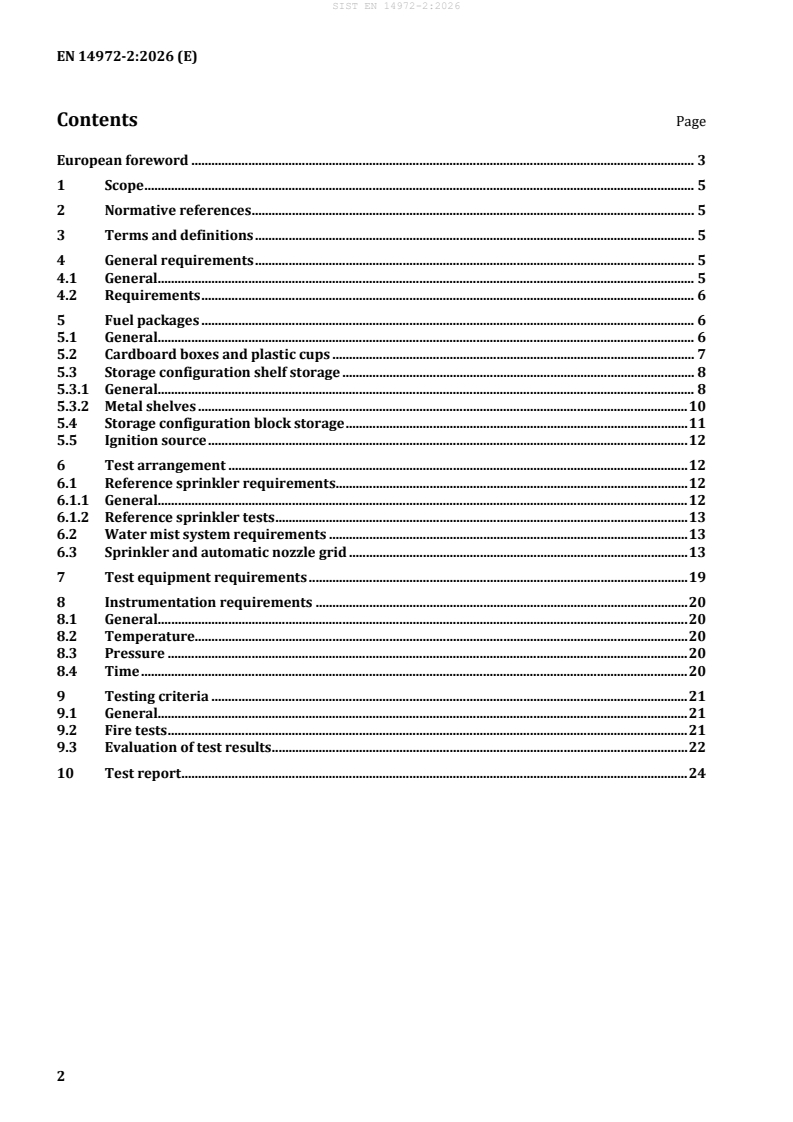
Contents Page
European foreword . 3
1 Scope . 5
2 Normative references . 5
3 Terms and definitions . 5
4 General requirements . 5
4.1 General. 5
4.2 Requirements . 6
5 Fuel packages . 6
5.1 General. 6
5.2 Cardboard boxes and plastic cups . 7
5.3 Storage configuration shelf storage . 8
5.3.1 General. 8
5.3.2 Metal shelves . 10
5.4 Storage configuration block storage . 11
5.5 Ignition source . 12
6 Test arrangement . 12
6.1 Reference sprinkler requirements . 12
6.1.1 General. 12
6.1.2 Reference sprinkler tests . 13
6.2 Water mist system requirements . 13
6.3 Sprinkler and automatic nozzle grid . 13
7 Test equipment requirements . 19
8 Instrumentation requirements . 20
8.1 General. 20
8.2 Temperature. 20
8.3 Pressure . 20
8.4 Time . 20
9 Testing criteria . 21
9.1 General. 21
9.2 Fire tests . 21
9.3 Evaluation of test results . 22
10 Test report . 24
European foreword
This document (EN 14972-2:2026) has been prepared by Technical Committee CEN/TC 191 “Fixed
firefighting systems”, the secretariat of which is held by BSI.
This European Standard shall be given the status of a national standard, either by publication of an
identical text or by endorsement, at the latest by January 2027, and conflicting national standards shall
be withdrawn at the latest by January 2027.
Attention is drawn to the possibility that some of the elements of this document may be the subject of
patent rights. CEN shall not be held responsible for identifying any or all such patent rights.
EN 14972, Fixed firefighting systems — Water mist systems, consists of the following parts:
— Part 1: Design, installation, inspection and maintenance;
— Part 2: Test protocol for shopping areas for automatic nozzle systems;
— Part 3: Test protocol for office, school class rooms and hotel for automatic nozzle systems;
— Part 4: Test protocol for non-storage occupancies for automatic nozzle systems;
— Part 5: Test protocol for car garages for automatic nozzle systems;
— Part 6: Test protocol for false floors and false ceilings for automatic nozzle systems;
— Part 7: Test protocol for commercial low hazard occupancies for automatic nozzle systems;
— Part 8: Test protocol for machinery in enclosures exceeding 260 m for open nozzle systems;
— Part 9: Test protocol for machinery in enclosures not exceeding 260 m for open nozzle systems;
— Part 10: Test protocol for atrium protection with sidewall nozzles for open nozzle systems;
— Part 11: Test protocol for cable tunnels for open nozzle systems;
— Part 12: Test protocol for commercial deep fat cooking fryers for manually activated open nozzle
systems;
— Part 13: Test protocol for wet benches and other similar processing equipment for open nozzle systems;
— Part 14: Test protocol for combustion turbines in enclosures exceeding 260 m for open nozzle systems;
— Part 15: Test protocol for combustion turbines in enclosures not exceeding 260 m for open nozzle
systems;
— Part 16: Test protocol for industrial oil cookers for open nozzle systems.
— Part 17: Test protocol for residential occupancies for automatic nozzle systems.
Any feedback and questions on this document should be directed to the users’ national standards body.
A complete listing of these bodies can be found on the CEN website.
According to the CEN-CENELEC Internal Regulations, the national standards organisations of the
following countries are bound to implement this European Standard: Austria, Belgium, Bulgaria, Croatia,
Cyprus, Czech Republic, Denmark, Estonia, Finland, France, Germany, Greece, Hungary, Iceland, Ireland,
Italy, Latvia, Lithuania, Luxembourg, Malta, Netherlands, Norway, Poland, Portugal, Republic of North
Macedonia, Romania, Serbia, Slovakia, Slovenia, Spain, Sweden, Switzerland, Türkiye and the United
Kingdom.
1 Scope
This document specifies the evaluation of the fire performance of water mist systems for shopping areas,
adjacent storage areas. This document is only applicable for horizontal, solid, flat ceilings with heights of
2,6 m and above.
This document does not cover storage with movable shelves or shelves.
2 Normative references
The following documents are referred to in the text in such a way that some or all of their content
constitutes requirements of this document. For dated references, only the edition cited applies. For
undated references, the latest edition of the referenced document (including any amendments) applies.
EN 12259-1, Fixed firefighting systems — Components for sprinkler and water spray systems — Part 1:
Sprinklers
EN 13698-1, Pallet production specification - Part 1: Construction specification for 800 mm x 1200 mm flat
wooden pallets
EN 14972-1:2020+A1:2025, Fixed firefighting systems — Water mist systems — Part 1: Design,
installation, inspection and maintenance
EN ISO/IEC 17025, General requirements for the competence of testing and calibration laboratories
(ISO/IEC 17025)
3 Terms and definitions
For the purposes of this document, the terms and definitions given in EN 14972-1 apply.
ISO and IEC maintain terminology databases for use in standardization at the following addresses:
— ISO Online browsing platform: available at https://www.iso.org/obp/
— IEC Electropedia: available at https://www.electropedia.org/
4 General requirements
4.1 General
The following areas are considered to be covered by the fuel package described in this document:
— sales areas;
— storage areas adjacent to sales areas;
— archives;
— libraries;
— technical areas;
— similar.
4.2 Requirements
4.2.1 Up to a maximum of 5 nozzles used in the fire tests shall be kept for later verification.
4.2.2 The water mist system, operating without manual intervention, shall successfully complete all
described performance fire tests.
4.2.3 The fire load shall be taken from the conditioning area according to 5.1 and arranged into the test
area just before conducting the test.
4.2.4 The water flow shall be shut-off 10 min after the activation of the first automatic nozzle in the fire
test. Any remaining fire shall be manually extinguished and the fire damage shall be recorded.
4.2.5 Prior to the testing, a layout of the water mist system to be tested shall be submitted for test
preparation purposes. This layout shall include any components required for the testing as well as the
full dimensioning (e.g. length of pipes, distances of automatic nozzles).
4.2.6 System components, component locations, operating conditions and test enclosure details shall
remain unaltered throughout all of the fire tests for a given application.
4.2.7 All fire tests shall be conducted using the manufacturer instructions in regard to automatic nozzle
placement, spray flux, and operating pressure. Sprays shall not be intermittent.
4.2.8 The test protocol is only applicable to ceiling mounted automatic nozzles.
4.2.9 The water supply shall be capable of supplying a flow rate and pressure at the minimum operating
pressure and flow rate as specified by the manufacturer. These parameters shall be met based on the
actual layout of the pipework installation as used in the test scenario.
4.2.10 The tests with the water mist system shall be conducted at maximum ceiling height, maximum
spacing and minimum discharge conditions regarding water flow and pressure as specified by the
manufacturer for this application. The system shall be installed to achieve the maximum allowed time
delay of water pressure build up of the system.
4.2.11 The tests shall be carried out in accordance with EN ISO/IEC 17025.
5 Fuel packages
5.1 General
The reference testing with a prescribed sprinkler system serves to indicate the baseline performance at
each different test facility and set-up. Within one test series, all fuel packages shall be identical.
The test assembly to be provided for the tests shall comply with the following specifications and figures.
The fire loads provided for the tests shall have humidity content as obtained by storage indoors at
(20 ± 5) °C for 2 weeks.
In case of storing fire loads in conditioned environment at a temperature of (23 ± 2) °C and a relative
humidity of (50 ± 5) % conditioning time may be reduced to minimum of 48 h.
The storing conditions shall be the same for all fire loads used during all tests.
Prior to the tests, the weight of the boxes including their contents will be checked (randomly 5 boxes per
test).
5.2 Cardboard boxes and plastic cups
The cardboard boxes to be used shall meet the following requirements:
a) Cardboard box:
1) Material: simple corrugated cardboard;
2) Dimensions:
— Small boxes: (600 × 400 × 300) mm (length × width × height);
— Large boxes: (600 × 400 × 500) mm (length × width × height);
3) Total weight including cups:
— Small boxes: ∼3,5 kg;
— Large boxes: ~4,5 kg;
4) Underliners (corrugated cardboard) divided into 5 levels:
— 18 cups per level, cups secured against shifting by dividers and underliners made of
corrugated cardboard;
— Boxes are sealed with adhesive type and marked in the direction of the stacks;
b) Content in box:
1) Type: Plastic cups;
2) Material: Unexpanded polystyrene, transparent;
3) Unit weight: 28,2 g;
4) Number per Box:
— Large boxes: 90 items, total weight of cups approximately 2,5 kg;
— Small boxes: 54 items, total weight of cups approximately 1,5 kg;
5) Storage with cup bottom turned up (see Figure 1a).
Packing of the cups is shown in Figure 1. Figure 2 shows the cardboard box.
a) Side view b) Top view
Key
1 cardboard box (large)
2 underliner
3 plastic cup
NOTE 18 cups per level. 54 cups per box (small). 90 cups per box (large).
Figure 1 — Storage of cups in cardboard box
a) Closed cardboard box b) Open cardboard box with
...