

SIST EN 17980:2024
(Main)Algae and algae products - Sampling - Guidelines for the definition of sampling programs and sampling protocols
General Information
- Abstract
This document specifies a set of principles and rules that algae producers, algae products industries, laboratories or other entities that collect algae and algae products samples can follow for the definition of their own sampling programs and sampling protocols.
In the context of this document, algae are a functional group that include microalgae, macroalgae, cyanobacteria and Labyrinthulomycetes.
As algae and their production processes are so diverse, this document does not define a specific sampling program and/or a specific sampling protocol. Instead, this document specifies the aspects that can be considered when defining its own sampling program and protocol.
This document describes when, where and how to draw a representative sample. For guidance on sample preparation of dry and wet samples of micro- and macroalgae, and algae products, please refer to EN 17605.
This document is to be used for the collection of samples for lot characterization for commercial or legal/regulatory purposes. However, this document can also be used for any type of sampling of algae, including samples for quality control during production.
- Status
- Published
- Public Enquiry End Date
- 01-Aug-2023
- Publication Date
- 22-Apr-2024
- Technical Committee
- I13 - Imaginarni 13
- Current Stage
- 6060 - National Implementation/Publication (Adopted Project)
- Start Date
- 11-Apr-2024
- Due Date
- 16-Jun-2024
- Completion Date
- 23-Apr-2024

Overview
EN 17980:2024 - "Algae and algae products - Sampling - Guidelines for the definition of sampling programs and sampling protocols" is a CEN standard that provides principles and rules to help define representative algae sampling strategies. It covers functional groups including microalgae, macroalgae, cyanobacteria and Labyrinthulomycetes, and is intended for algae producers, processors, laboratories and regulators who collect samples for lot characterization, commercial or legal purposes, and quality control.
This standard does not prescribe one fixed sampling protocol. Instead it specifies the aspects to consider when designing a sampling program and a sampling protocol: when, where and how to draw representative samples, and how to prepare, package, label, preserve and transport them. For sample preparation of dry and wet samples, EN 17605 is referenced.
Key topics and requirements
- Principles of sampling: definitions (lot, sample, increment, aggregate sample, representative sample) and the importance of representativeness and sampling strategy.
- Design of sampling programs: how to identify a lot, determine timing, number and dimension of increments and aggregate samples, and sampling frequency (time or production based).
- Sampling protocols: step-by-step procedures for sample collection, packaging, labeling, preservation, transport and transfer of responsibility at final destination.
- Practical guidance by production type: informative annexes include examples for microalgae in controlled environments, macroalgae harvested from the wild, and macroalgae produced in ponds/tanks.
- Equipment and personnel: requirements for sampling tools, storage and transport containers, personal protective equipment, sample identification, and required knowledge and training of sampling personnel.
- Good sampling practices: mitigating segregation, mixing/agitation, randomization, increasing increments or sample size to improve confidence.
Applications and who uses it
- Algae producers and processors: design sampling programs for lot release, quality control and supplier verification.
- Analytical laboratories: ensure chain-of-custody, representative sampling and sample integrity for testing.
- Regulators and certification bodies: define sampling approaches for compliance, inspections and legal disputes.
- R&D and production QC teams: implement repeatable sampling protocols for process control, optimization and product safety.
Practical benefits include improved sample representativeness, clearer traceability, consistent lot characterization and better comparability of analytical results across the supply chain.
Related standards
- EN 17605 - sample preparation of dry and wet samples of micro- and macroalgae and algae products (referenced for sample preparation).
- EN 17399 - terms and definitions for algae and algae products (terminology referenced in EN 17980).
Keywords: EN 17980:2024, algae sampling, sampling program, sampling protocol, microalgae, macroalgae, representative sample, lot characterization, EN 17605.
Relations
- Effective Date
- 28-Jan-2026
Get Certified
Connect with accredited certification bodies for this standard

BSI Group
BSI (British Standards Institution) is the business standards company that helps organizations make excellence a habit.

Bureau Veritas
Bureau Veritas is a world leader in laboratory testing, inspection and certification services.

DNV
DNV is an independent assurance and risk management provider.
Sponsored listings
Frequently Asked Questions
SIST EN 17980:2024 is a standard published by the Slovenian Institute for Standardization (SIST). Its full title is "Algae and algae products - Sampling - Guidelines for the definition of sampling programs and sampling protocols". This standard covers: This document specifies a set of principles and rules that algae producers, algae products industries, laboratories or other entities that collect algae and algae products samples can follow for the definition of their own sampling programs and sampling protocols. In the context of this document, algae are a functional group that include microalgae, macroalgae, cyanobacteria and Labyrinthulomycetes. As algae and their production processes are so diverse, this document does not define a specific sampling program and/or a specific sampling protocol. Instead, this document specifies the aspects that can be considered when defining its own sampling program and protocol. This document describes when, where and how to draw a representative sample. For guidance on sample preparation of dry and wet samples of micro- and macroalgae, and algae products, please refer to EN 17605. This document is to be used for the collection of samples for lot characterization for commercial or legal/regulatory purposes. However, this document can also be used for any type of sampling of algae, including samples for quality control during production.
This document specifies a set of principles and rules that algae producers, algae products industries, laboratories or other entities that collect algae and algae products samples can follow for the definition of their own sampling programs and sampling protocols. In the context of this document, algae are a functional group that include microalgae, macroalgae, cyanobacteria and Labyrinthulomycetes. As algae and their production processes are so diverse, this document does not define a specific sampling program and/or a specific sampling protocol. Instead, this document specifies the aspects that can be considered when defining its own sampling program and protocol. This document describes when, where and how to draw a representative sample. For guidance on sample preparation of dry and wet samples of micro- and macroalgae, and algae products, please refer to EN 17605. This document is to be used for the collection of samples for lot characterization for commercial or legal/regulatory purposes. However, this document can also be used for any type of sampling of algae, including samples for quality control during production.
SIST EN 17980:2024 is classified under the following ICS (International Classification for Standards) categories: 13.020.55 - Biobased products. The ICS classification helps identify the subject area and facilitates finding related standards.
SIST EN 17980:2024 has the following relationships with other standards: It is inter standard links to SIST EN 17399:2020. Understanding these relationships helps ensure you are using the most current and applicable version of the standard.
SIST EN 17980:2024 is associated with the following European legislation: Standardization Mandates: M/547. When a standard is cited in the Official Journal of the European Union, products manufactured in conformity with it benefit from a presumption of conformity with the essential requirements of the corresponding EU directive or regulation.
SIST EN 17980:2024 is available in PDF format for immediate download after purchase. The document can be added to your cart and obtained through the secure checkout process. Digital delivery ensures instant access to the complete standard document.
Standards Content (Sample)
SLOVENSKI STANDARD
01-junij-2024
Alge in izdelki iz alg - Vzorčenje - Smernice za opredelitev programov in
protokolov vzorčenja
Algae and algae products - Sampling - Guidelines for the definition of sampling programs
and sampling protocols
Algen und Algenprodukte - Probenahme - Leitlinien für die Festlegung von
Probenahmeprogrammen und Probenahmeprotokollen
Algues et produits d'algues - Échantillonnage - Lignes directrices pour la définition des
programmes et des protocoles d'échantillonnage
Ta slovenski standard je istoveten z: EN 17980:2024
ICS:
13.020.55 Biološki izdelki Biobased products
2003-01.Slovenski inštitut za standardizacijo. Razmnoževanje celote ali delov tega standarda ni dovoljeno.
EN 17980
EUROPEAN STANDARD
NORME EUROPÉENNE
March 2024
EUROPÄISCHE NORM
ICS 13.020.55
English Version
Algae and algae products - Sampling - Guidelines for the
definition of sampling programs and sampling protocols
Algues et produits d'algues - Échantillonnage - Lignes Algen und Algenprodukte - Probenahme - Leitlinien für
directrices pour la définition des programmes et des die Festlegung von Probenahmeprogrammen und
protocoles d'échantillonnage Probenahmeprotokollen
This European Standard was approved by CEN on 19 February 2024.
CEN members are bound to comply with the CEN/CENELEC Internal Regulations which stipulate the conditions for giving this
European Standard the status of a national standard without any alteration. Up-to-date lists and bibliographical references
concerning such national standards may be obtained on application to the CEN-CENELEC Management Centre or to any CEN
member.
This European Standard exists in three official versions (English, French, German). A version in any other language made by
translation under the responsibility of a CEN member into its own language and notified to the CEN-CENELEC Management
Centre has the same status as the official versions.
CEN members are the national standards bodies of Austria, Belgium, Bulgaria, Croatia, Cyprus, Czech Republic, Denmark, Estonia,
Finland, France, Germany, Greece, Hungary, Iceland, Ireland, Italy, Latvia, Lithuania, Luxembourg, Malta, Netherlands, Norway,
Poland, Portugal, Republic of North Macedonia, Romania, Serbia, Slovakia, Slovenia, Spain, Sweden, Switzerland, Türkiye and
United Kingdom.
EUROPEAN COMMITTEE FOR STANDARDIZATION
COMITÉ EUROPÉEN DE NORMALISATION
EUROPÄISCHES KOMITEE FÜR NORMUNG
CEN-CENELEC Management Centre: Rue de la Science 23, B-1040 Brussels
© 2024 CEN All rights of exploitation in any form and by any means reserved Ref. No. EN 17980:2024 E
worldwide for CEN national Members.
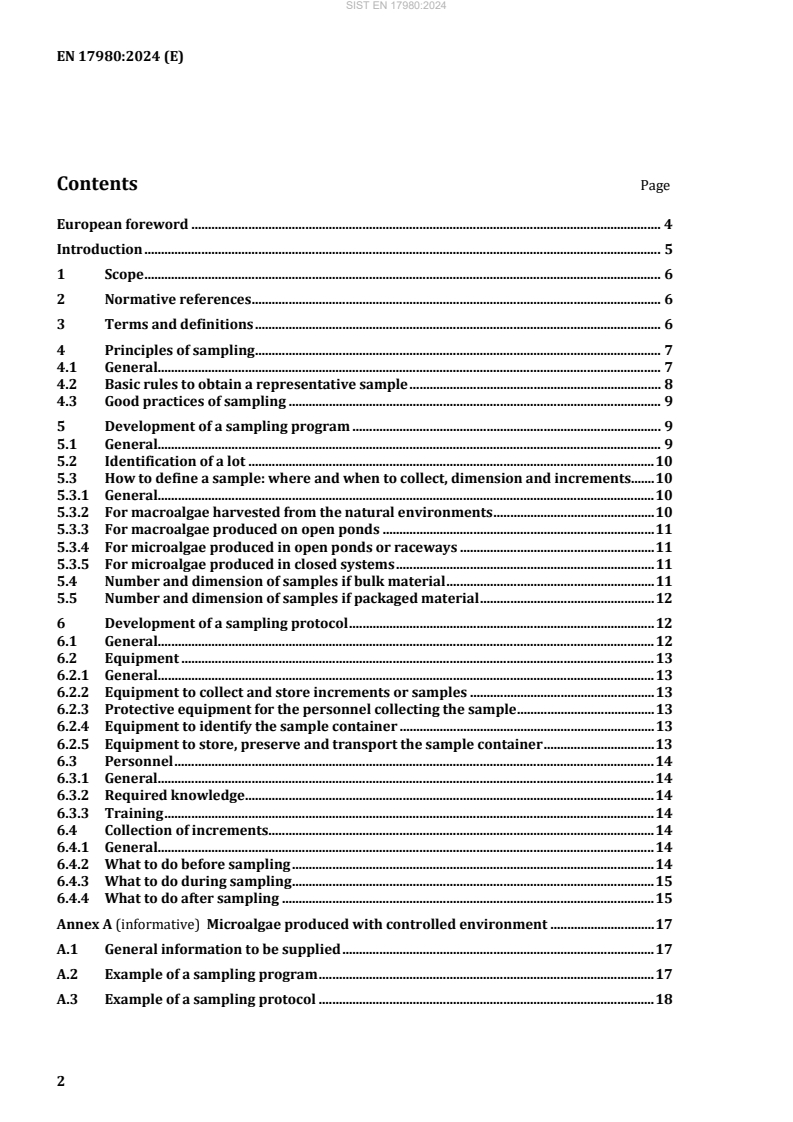
Contents Page
European foreword . 4
Introduction . 5
1 Scope . 6
2 Normative references . 6
3 Terms and definitions . 6
4 Principles of sampling . 7
4.1 General. 7
4.2 Basic rules to obtain a representative sample . 8
4.3 Good practices of sampling . 9
5 Development of a sampling program . 9
5.1 General. 9
5.2 Identification of a lot . 10
5.3 How to define a sample: where and when to collect, dimension and increments. 10
5.3.1 General. 10
5.3.2 For macroalgae harvested from the natural environments . 10
5.3.3 For macroalgae produced on open ponds . 11
5.3.4 For microalgae produced in open ponds or raceways . 11
5.3.5 For microalgae produced in closed systems . 11
5.4 Number and dimension of samples if bulk material . 11
5.5 Number and dimension of samples if packaged material . 12
6 Development of a sampling protocol . 12
6.1 General. 12
6.2 Equipment . 13
6.2.1 General. 13
6.2.2 Equipment to collect and store increments or samples . 13
6.2.3 Protective equipment for the personnel collecting the sample . 13
6.2.4 Equipment to identify the sample container . 13
6.2.5 Equipment to store, preserve and transport the sample container . 13
6.3 Personnel . 14
6.3.1 General. 14
6.3.2 Required knowledge . 14
6.3.3 Training . 14
6.4 Collection of increments . 14
6.4.1 General. 14
6.4.2 What to do before sampling . 14
6.4.3 What to do during sampling . 15
6.4.4 What to do after sampling . 15
Annex A (informative) Microalgae produced with controlled environment . 17
A.1 General information to be supplied . 17
A.2 Example of a sampling program . 17
A.3 Example of a sampling protocol . 18
Annex B (informative) Macroalgae produced/collected from the wild . 19
B.1 General information to be supplied . 19
B.2 Example of a sampling program . 19
B.3 Example of a sampling protocol . 20
Annex C (informative) Macroalgae produced in ponds/tanks with controlled environment21
C.1 General information to be supplied . 21
C.2 Example of a sampling program . 21
C.3 Example of a sampling protocol . 22
Bibliography . 23
European foreword
This document (EN 17980:2024) has been prepared by Technical Committee CEN/TC 454 “Algae and
algae products”, the secretariat of which is held by NEN.
This European Standard shall be given the status of a national standard, either by publication of an
identical text or by endorsement, at the latest by September 2024, and conflicting national standards shall
be withdrawn at the latest by September 2024.
Attention is drawn to the possibility that some of the elements of this document may be the subject of
patent rights. CEN shall not be held responsible for identifying any or all such patent rights.
This document has been prepared under a standardization request addressed to CEN by the European
Commission. The Standing Committee of the EFTA States subsequently approves these requests for its
Member States.
Any feedback and questions on this document should be directed to the users’ national standards body.
A complete listing of these bodies can be found on the CEN website.
According to the CEN-CENELEC Internal Regulations, the national standards organisations of the
following countries are bound to implement this European Standard: Austria, Belgium, Bulgaria, Croatia,
Cyprus, Czech Republic, Denmark, Estonia, Finland, France, Germany, Greece, Hungary, Iceland, Ireland,
Italy, Latvia, Lithuania, Luxembourg, Malta, Netherlands, Norway, Poland, Portugal, Republic of North
Macedonia, Romania, Serbia, Slovakia, Slovenia, Spain, Sweden, Switzerland, Türkiye and the United
Kingdom.
Introduction
This document has been prepared by the experts of CEN/TC 454 “Algae and algae products”.
The European Committee for Standardization (CEN) was requested by the European Commission (EC) to
draft European standards or European standardization deliverables to support the implementation of
Article 3 of Directive 2009/28/EC for algae and algae products.
This request, presented as Mandate M/547, also contributes to the Communication on “Innovating for
Sustainable Growth: A Bio economy for Europe”.
The former working group CEN Technical Board Working Group 218 “Algae”, was created in 2016 to
develop a work programme as part of this Mandate. The technical committee CEN/TC 454 'Algae and
algae products' was established to carry out the work programme that will prepare a series of standards.
The interest in algae and algae products has increased significantly in Europe as a valuable source
including but not limited to carbohydrates, proteins, lipids, and several pigments. These materials are
suitable for use in a wide range of applications from food and feed purposes to other sectors, such as
textile, cosmetics, biopolymers, biofuel and fertilizer/biostimulants. Standardization was identified as
having an important role in order to promote the use of algae and algae products.
The work of CEN/TC 454 should improve the reliability of the supply chain, thereby improving the
confidence of industry and consumers in algae and algae products and will promote and support
commercialisation of the European algae industry.
This document has been developed with the aim to help algae producers and algae products industries
to establish a sound sampling program and a correct sampling protocol. The sampling program will
define the strategy for sampling, when, where and how much, and the sampling protocol will define how
the samples will be collected, packaged, labelled, preserved and transported until the final destination:
laboratory, long term storage, customer, health safety authority, etc.
1 Scope
This document specifies a set of principles and rules that algae producers, algae products industries,
laboratories or other entities that collect algae and algae products samples can follow for the definition
of their own sampling programs and sampling protocols.
In the context of this document, algae are a functional group that include microalgae, macroalgae,
cyanobacteria and Labyrinthulomycetes.
As algae and their production processes are so diverse, this document does not define a specific sampling
program and/or a specific sampling protocol. Instead, this document specifies the aspects that can be
considered when defining its own sampling program and protocol.
This document describes when, where and how to draw a representative sample. For guidance on sample
preparation of dry and wet samples of micro- and macroalgae, and algae products, please refer to
EN 17605.
This document is to be used for the collection of samples for lot characterization for commercial or
legal/regulatory purposes. However, this document can also be used for any type of sampling of algae,
including samples for quality control during production.
2 Normative references
The following documents are referred to in the text in such a way that some or all of their content
constitutes requirements of this document. For dated references, only the edition cited applies. For
undated references, the latest edition of the referenced document (including any amendments) applies.
EN 17399:2020, Algae and algae products — Terms and definitions
3 Terms and definitions
For the purposes of this document, the terms and definitions given in EN 17399:2020 and the following
apply.
ISO and IEC maintain terminology databases for use in standardization at the following addresses:
• ISO Online browsing platform: available at https://www.iso.org/obp
• IEC Electropedia: available at https://www.electropedia.org/
3.1
lot
quantity of material that is assumed to be of the same production process and represented by specified
sampling rules
[SOURCE: EN 17605:2022, 3.1]
3.2
sample
quantity of material, from a larger amount for which the quality is to be determined
Note 1 to entry: A sample is intended to provide information on a given characteristic of the studied lot, and to form
a basis for a decision concerning the lot.
Note 2 to entry: A sample can be a laboratory sample, a test sample, a test portion, an incremental sample, or a
reserve sample.
[SOURCE: ISO 21637:2020, 3.63 ,modified – Notes to entry have been removed]
3.3
increment
incremental sample
quantity of material taken from a single place in the lot (3.1)
[SOURCE: Commission Regulation (EC) No 333/2007 of 28 March 2007]
3.4
aggregate sample
the combined total of all the incremental samples (3.3) taken from the lot (3.1)
[SOURCE: Commission Regulation (EC) No 333/2007 of 28 March 2007]
3.5
representative sample
sample (3.2) in which the characteristics of the lot (3.1) from which it is drawn are maintained
Note 1 to entry: It is the case of a simple random sample where each of the items of the lot has been given the same
probability of entering the sample.
[SOURCE: CODEX ALIMENTARIUS, General Guidelines on Sampling CAC/GL 50-2004]
3.6
sampling
process of drawing or constituting a sample (3.2)
[SOURCE: ISO 21637:2020, 3.68]
3.7
sampling program
predetermined procedure for the definition of the amount, the number of increments (3.3), the timing of
the sample (3.2) and the sample collection point, to obtain representative samples (3.5)
3.8
sampling protocol
predetermined procedure for the definition of the steps to prepare, collect, package and label for
shipping, and deliver the sample (3.2) until the transfer of responsibility at final destination
4 Principles of sampling
4.1 General
Sampling is an activity that is a common practice in almost any industrial, commercial or service area. It
is done due to economic or time constraints to characterize a collection (a lot) of heterogeneous items, as
it is not feasible to analyse the entire collection because the analysis is destructive, or too expensive.
The quality or confidence on the results of the sampling is related to two aspects: the representativeness
of the sample, and the relation between the number of items sampled and the number of items of the
entire collection.
The representativeness of the sample is based on the definition of a representative sample: the
probability of being present on the sample is the same for any item in the collection.
To ensure that this probability is verified is not a trivial issue. If the production line has in some place a
conveyor belt where the entire production passes in sequence, it is possible to ensure representativeness
if samples are collected in the entire width of the belt, and at random intervals. However, the most
common situation is the collection of samples from a pile, a tank or other three-dimensional stock of
production.
There are many aspects that can skew the results of sampling, such as;
• material segregation by size, form, density, etc.;
• production process variation due to raw material differences, parameter deviation, human error, etc.
To minimize the impact of those anomalies different strategies can be chosen, such as;
• mixing;
• agitating;
• have samples made of different increments collected in different/random periods, locations, depths,
etc.;
• take a larger sample or collect a larger number of increments to obtain a higher confidence interval.
A sampling program should define clearly the “when” to sample and “how much” sample material should
be collected. The “when” can be time or production (at which stage of production) dependent. The “how
much” should be a function of the lot size and should also be destination dependent. The “how much” may
be dependent of the confidence interval that is required for the destination.
A sampling protocol should consider 4 stages:
a) initial preparation, which defines the set of knowledge, expertise, experience needed for a correct
collection, and the safety procedures and PPE (personal protective equipment) required, and the set
of tools, packaging, labelling, preservation and transport equipment needed to be available for
collection;
b) before collection, which defines the checklist and the verification of tools, PPE, and other equipment;
c) collection, which defines the procedure of collection;
d) after collection, which defines the procedure for sample packaging, labelling, preservation, storage
and delivery to the destination, until its responsibility is transferred to other entity.
4.2 Basic rules to obtain a representative sample
To obtain a representative sample the following rules should be in place:
a) ensure that the probability of any item being in the sample, is equal for all items: randomize the place,
time and depth of the sample collection according to the specific situation, and stick to it;
b) ensure that the items are not segregated by any means, and mix, agitate or scramble the entire
collection before sample collection if possible;
c) take as many increments as possible to complete the sample, at random locations, periods and
depths, and homogenize the collected material. If too large, this sample can be divided into
subsamples without losing representativeness;
d) if samples or increments are collected at different time intervals, be sure that they are not
synchronous with normal production cycles or other aspects of the production: avoid collection at
personnel changing, at same time in the day, etc.;
e) when sampling complex items such as macroalgae, it is important to clarify if the whole or a part, and
which part of the algae, i.e. stem or leaf, is the relevant object of sampling.
4.3 Good practices of sampling
Besides specific aspects of sampling algae or algae products, there are many other aspects that are
common to sampling. This list is a reminder of those aspects that anyone collecting samples should keep
in mind for the success of their task:
a) be sure of the objective of sampling;
b) ensure that you have available all items needed to collect the sample, and following steps;
c) take all safety measures required to collect the sample;
d) ensure that the sample collected is representative of the collection;
e) take all the steps to close the container, label and preserve the sample;
f) deliver the sample as soon as possible.
It is good practice of sampling to keep a counter sample under the control for any future reference or
dispute that may arise from final destination (external lab, customer, health and safety authority, etc.).
This counter sample shall be collected following the same protocol and at the same conditions (location,
time and amount) as the normal sample.
5 Development of a sampling program
5.1 General
A sampling program shall be defined based on both the internal and external context of production of
algae and algae products.
The internal context includes information on:
• production conditions, e.g. wild stock or controlled conditions;
• the production facility and unit;
• algae species;
• lot size;
• final product.
The external context includes information on:
• the local, national or regional legal, regulatory and commercial framework;
• objective of the sampling, e.g. microbiology, contamination, physical and chemical characterization,
genetic analysis;
• final use of the sample.
When it is requested to keep a counter sample in house for future reference, then a
...