

SIST EN 18204:2026
(Main)Algae and algae products - Determination of the phycocyanin content in Arthrospira (Spirulina)
General Information
- Abstract
This document specifies the extraction and determination procedures for the phycobiliproteins C-phycocyanin (C-PC) and the complementary pigment allophycocyanin (APC) from dry samples of species belonging to the genus Arthrospira (Cyanobacteria, Cyanoprokaryota or blue-green algae)(nowadays referred to Limnospira, [1]), and commercially known as Spirulina. This document enables laboratories analysing Arthrospira samples to report accurate C-PC and APC concentrations and yields.
- Status
- Published
- Public Enquiry End Date
- 09-Sep-2025
- Publication Date
- 15-Jun-2026
- Technical Committee
- I13 - Imaginarni 13
- Current Stage
- 6060 - National Implementation/Publication (Adopted Project)
- Start Date
- 02-Jun-2026
- Due Date
- 07-Aug-2026
- Completion Date
- 16-Jun-2026

Overview
SIST EN 18204:2026 specifies standardized methods for the extraction and quantitative determination of the phycobiliproteins C-phycocyanin (C-PC) and allophycocyanin (APC) in dry samples of Arthrospira (commonly known as Spirulina), a widely studied cyanobacterium used in various industries. Developed by SIST under the guidance of CEN/TC 454 “Algae and algae products”, this standard supports laboratories in performing reliable and reproducible analyses of phycocyanin content in algae and algae-derived products.
Phycocyanin is a valuable pigment-protein found in Spirulina and is widely used for its antioxidant, coloring, and nutritional properties. Standardized determination of C-PC and APC content is essential for quality control, regulatory compliance, and product innovation within the food, feed, biotechnology, cosmetics, and nutraceutical sectors.
Key Topics
Scope and Purpose
- Extraction, spectrophotometric quantification, and purity assessment of C-PC and APC in dry Spirulina (Arthrospira/Limnospira) samples.
- Enables reporting of accurate concentrations and yields by analytical laboratories.
Sample Handling and Preparation
- Standardized guidelines for storage, homogeneity testing, and pre-treatment of dry biomass (oven-dried, freeze-dried, or spray-dried).
- References established preparatory methods for ensuring sample consistency.
Extraction and Analytical Procedures
- Detailed instructions for buffer preparation, sample extraction using freeze–thaw cycles, and precautions to prevent pigment degradation.
- Use of vortexing, magnetic stirring, and centrifugation to obtain clear supernatant for analysis.
- Spectrophotometric measurement at specific wavelengths (280, 615, and 652 nm) for both C-PC and APC, with calculation formulas provided.
Purity and Quality Criteria
- Purity indexes for food, reagent, and analytical grade phycocyanin based on absorbance ratios.
- Interlaboratory reproducibility requirements to ensure the comparability of results.
Result Reporting
- Mandated documentation of methodologies, sample identification, results, and any deviations, ensuring transparency and traceability.
Applications
The standardized determination of phycocyanin and allophycocyanin content in Spirulina is crucial for multiple sectors:
Food and Beverage Industry
- Quality assurance and regulatory compliance for Spirulina-based ingredients, natural colorants, and supplements.
- Verification of pigment content for labeling and nutritional claims.
Feed and Aquaculture
- Support risk assessment and quality control for algae-based feed additives, ensuring consistent bioactive compound delivery.
Cosmetics and Pharmaceuticals
- Characterization and quality verification of bioactive ingredients in formulations using Spirulina extracts.
Biotechnology and Research
- Provides reliable methods for process development, biorefinery, and academic studies on cyanobacterial pigments.
Sustainability and Bioeconomy
- Facilitates traceability and value assessment for algae products, supporting the circular bioeconomy and sustainable sourcing initiatives.
Related Standards
Organizations and laboratories implementing SIST EN 18204:2026 may also reference the following standards for complementary procedures and terminology:
EN 17399: Algae and algae products - Vocabulary
Establishes definitions for terms used in the algae industry and standardization.EN 17605: Algae and algae products – Methods of sampling and analysis – Sample treatment
Provides guidelines for handling, sampling, and treating algae samples prior to analysis.Other Relevant Standards:
- Methods for protein purification, photometric analysis, and product characterization in food and feed.
- National and international regulations regarding natural pigments and food additives.
Implementing SIST EN 18204:2026 enhances analytical consistency, product transparency, and trust in the rapidly growing algae and blue-green algae products market. Accurate phycocyanin determination brings scientific credibility and supports commercial innovation across the bio-based economy.
Relations
- Refers
SIST EN 17605:2022 - Algae and algae products - Methods of sampling and analysis - Sample treatment - Effective Date
- 08-Jul-2026
- Effective Date
- 08-Jul-2026
Get Certified
Connect with accredited certification bodies for this standard

BSI Group
BSI (British Standards Institution) is the business standards company that helps organizations make excellence a habit.

Bureau Veritas
Bureau Veritas is a world leader in laboratory testing, inspection and certification services.

DNV
DNV is an independent assurance and risk management provider.
Sponsored listings
Frequently Asked Questions
SIST EN 18204:2026 is a standard published by the Slovenian Institute for Standardization (SIST). Its full title is "Algae and algae products - Determination of the phycocyanin content in Arthrospira (Spirulina)". This standard covers: This document specifies the extraction and determination procedures for the phycobiliproteins C-phycocyanin (C-PC) and the complementary pigment allophycocyanin (APC) from dry samples of species belonging to the genus Arthrospira (Cyanobacteria, Cyanoprokaryota or blue-green algae)(nowadays referred to Limnospira, [1]), and commercially known as Spirulina. This document enables laboratories analysing Arthrospira samples to report accurate C-PC and APC concentrations and yields.
This document specifies the extraction and determination procedures for the phycobiliproteins C-phycocyanin (C-PC) and the complementary pigment allophycocyanin (APC) from dry samples of species belonging to the genus Arthrospira (Cyanobacteria, Cyanoprokaryota or blue-green algae)(nowadays referred to Limnospira, [1]), and commercially known as Spirulina. This document enables laboratories analysing Arthrospira samples to report accurate C-PC and APC concentrations and yields.
SIST EN 18204:2026 is classified under the following ICS (International Classification for Standards) categories: 13.020.55 - Biobased products. The ICS classification helps identify the subject area and facilitates finding related standards.
SIST EN 18204:2026 has the following relationships with other standards: It is inter standard links to SIST EN 17605:2022, SIST EN 17399:2024. Understanding these relationships helps ensure you are using the most current and applicable version of the standard.
SIST EN 18204:2026 is associated with the following European legislation: Standardization Mandates: M/547. When a standard is cited in the Official Journal of the European Union, products manufactured in conformity with it benefit from a presumption of conformity with the essential requirements of the corresponding EU directive or regulation.
SIST EN 18204:2026 is available in PDF format for immediate download after purchase. The document can be added to your cart and obtained through the secure checkout process. Digital delivery ensures instant access to the complete standard document.
Standards Content (Sample)
SLOVENSKI STANDARD
01-julij-2026
Alge in izdelki iz alg - Ugotavljanje vsebnosti fikocianina v Arthrospira (Spirulina)
Algae and algae products - Determination of the phycocyanin content in Arthrospira
(Spirulina)
Algen und Algenprodukte - Bestimmung des Phycocyaningehalts in Arthrospira
(Spirulina)
Algues et produits à base d’algues - Détermination de la teneur en phycocyanine
d’Arthrospira (Spiruline)
Ta slovenski standard je istoveten z: EN 18204:2026
ICS:
13.020.55 Biološki izdelki Biobased products
2003-01.Slovenski inštitut za standardizacijo. Razmnoževanje celote ali delov tega standarda ni dovoljeno.
EN 18204
EUROPEAN STANDARD
NORME EUROPÉENNE
May 2026
EUROPÄISCHE NORM
ICS 13.020.55
English Version
Algae and algae products - Determination of the
phycocyanin content in Arthrospira (Spirulina)
Algues et produits d'algues - Détermination de la Algen und Algenprodukte - Bestimmung des
teneur en phycocyanine dans Arthrospira (spiruline) Phycocyaningehalts in Arthrospira (Spirulina)
This European Standard was approved by CEN on 13 April 2026.
CEN members are bound to comply with the CEN/CENELEC Internal Regulations which stipulate the conditions for giving this
European Standard the status of a national standard without any alteration. Up-to-date lists and bibliographical references
concerning such national standards may be obtained on application to the CEN-CENELEC Management Centre or to any CEN
member.
This European Standard exists in three official versions (English, French, German). A version in any other language made by
translation under the responsibility of a CEN member into its own language and notified to the CEN-CENELEC Management
Centre has the same status as the official versions.
CEN members are the national standards bodies of Austria, Belgium, Bulgaria, Croatia, Cyprus, Czech Republic, Denmark, Estonia,
Finland, France, Germany, Greece, Hungary, Iceland, Ireland, Italy, Latvia, Lithuania, Luxembourg, Malta, Netherlands, Norway,
Poland, Portugal, Republic of North Macedonia, Romania, Serbia, Slovakia, Slovenia, Spain, Sweden, Switzerland, Türkiye and
United Kingdom.
EUROPEAN COMMITTEE FOR STANDARDIZATION
COMITÉ EUROPÉEN DE NORMALISATIO N
EUROPÄISCHES KOMITEE FÜR NORMUN G
CEN-CENELEC Management Centre: Rue de la Science 23, B-1040 Brussels
© 2026 CEN All rights of exploitation in any form and by any means reserved Ref. No. EN 18204:2026 E
worldwide for CEN national Members.
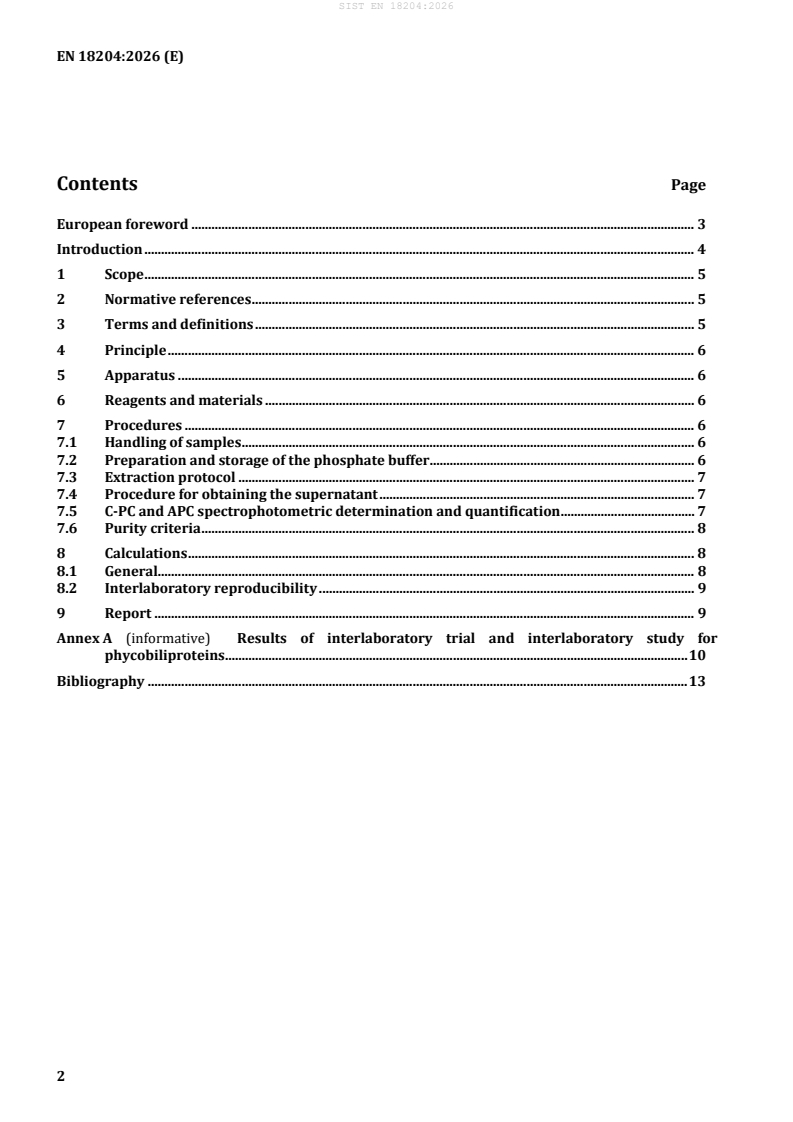
Contents Page
European foreword . 3
Introduction . 4
1 Scope . 5
2 Normative references . 5
3 Terms and definitions . 5
4 Principle . 6
5 Apparatus . 6
6 Reagents and materials . 6
7 Procedures . 6
7.1 Handling of samples . 6
7.2 Preparation and storage of the phosphate buffer . 6
7.3 Extraction protocol . 7
7.4 Procedure for obtaining the supernatant . 7
7.5 C-PC and APC spectrophotometric determination and quantification . 7
7.6 Purity criteria . 8
8 Calculations . 8
8.1 General. 8
8.2 Interlaboratory reproducibility . 9
9 Report . 9
Annex A (informative) Results of interlaboratory trial and interlaboratory study for
phycobiliproteins . 10
Bibliography . 13
European foreword
This document (EN 18204:2026) has been prepared by Technical Committee CEN/TC 454 “Algae and
algae products”, the secretariat of which is held by NEN.
This European Standard shall be given the status of a national standard, either by publication of an
identical text or by endorsement, at the latest by November 2026, and conflicting national standards shall
be withdrawn at the latest by November 2026.
Attention is drawn to the possibility that some of the elements of this document may be the subject of
patent rights. CEN shall not be held responsible for identifying any or all such patent rights.
This document has been prepared under a standardization request addressed to CEN by the European
Commission. The Standing Committee of the EFTA States subsequently approves these requests for its
Member States.
Any feedback and questions on this document should be directed to the users’ national standards body.
A complete listing of these bodies can be found on the CEN website.
According to the CEN-CENELEC Internal Regulations, the national standards organisations of the
following countries are bound to implement this European Standard: Austria, Belgium, Bulgaria, Croatia,
Cyprus, Czech Republic, Denmark, Estonia, Finland, France, Germany, Greece, Hungary, Iceland, Ireland,
Italy, Latvia, Lithuania, Luxembourg, Malta, Netherlands, Norway, Poland, Portugal, Republic of North
Macedonia, Romania, Serbia, Slovakia, Slovenia, Spain, Sweden, Switzerland, Türkiye and the United
Kingdom.
Introduction
This document has been prepared by the experts of CEN/TC 454 'Algae and algae products'.
The European Committee for Standardization (CEN) was requested by the European Commission (EC) to
draft European standards or European standardization deliverables to support the implementation of
Article 3 of Directive 2009/28/EC for algae and algae products.
This request, presented as Mandate M/547, also contributes to the Communication on “Innovating for
Sustainable Growth: A Bio economy for Europe”.
The former working group CEN Technical Board Working Group 218 “Algae”, was created in 2016 to
develop a work programme as part of this Mandate. The technical committee CEN/TC 454 'Algae and
algae products' was established to carry out the work programme that will prepare a series of standards.
The interest in algae and algae products has increased significantly in Europe as a valuable source
including but not limited to carbohydrates, proteins, lipids, and several pigments. These materials are
suitable for use in a wide range of applications from food and feed purposes to other sectors, such as
textile, cosmetics, biopolymers, biofuel and fertilizer/biostimulants. Standardization was identified as
having an important role in order to promote the use of algae and algae products.
The work of CEN/TC 454 should improve the reliability of the supply chain, thereby improving the
confidence of industry and consumers in algae and algae products and will promote and support
commercialisation of the European algae industry.
1 Scope
This document specifies the extraction and determination procedures for the phycobiliproteins C-
phycocyanin (C-PC) and the complementary pigment allophycocyanin (APC) from dry samples of species
belonging to the genus Arthrospira (Cyanobacteria, Cyanoprokaryota or blue-green algae) (nowadays
referred to Limnospira, [1]), and commercially known as Spirulina. This document enables laboratories
analysing Arthrospira samples to report accurate C-PC and APC concentrations and yields.
2 Normative references
The following documents are referred to in the text in such a way that some or all of their content
constitutes requirements of this document. For dated references, only the edition cited applies. For
undated references, the latest edition of the referenced document (including any amendments) applies.
EN 17399, Algae and algae products — Vocabulary
EN 17605, Algae and algae products — Methods of sampling and analysis — Sample treatment
3 Terms and definitions
For the purposes of this document, the terms and definitions given in EN 17399 and the following apply.
ISO and IEC maintain terminology databases for use in standardization at the following addresses:
— ISO Online browsing platform: available at https://www.iso.org/obp/
— IEC Electropedia: available at https://www.electropedia.org/
3.1
phycobiliproteins
PBP
water soluble pigments present in cyanobacteria and certain algae groups such as glaucophytes,
cryptomonads, and red algae (Rhodophytes) used for capturing light
Note 1 to entry: Phycobiliproteins capture light energy, which is then passed on to chlorophylls during
photosynthesis. Phycobiliproteins are formed of a complex between proteins and covalently bound phycobilins that
act as chromophores (the light-capturing part). They are most important constituents of the phycobilisomes.
3.2
phycocyanin
C-PC
blue-green phycobilin pigment found in cyanobacteria, glaucophytes, cryptomonads, and red algae
Note 1 to entry: Nomenclature for phycocyanin specifically obtained from cyanobacteria is identified as C-PC.
3.3
allophycocyanin
APC
type of phycobilin photosynthetic accessory pigment found in cyanobacteria, glaucophytes,
cryptomonads, and red algae
4 Principle
Phycobiliproteins (PBP) like C-PC and APC can be extracted from dried biomass by vortexing this with a
phosphate buffer solution. The C-PC and APC concentration can be spectrophotometrically determined
and calculated in the resulting supernatant.
5 Apparatus
5.1 Analytical balance, with an accuracy of 0,1 mg
5.2 Vortex
5.3 Magnetic stirrer
5.4 Centrifuge, over 5 000 × g, preferably with temperature operation mode at 4 °C
5.5 UV-VIS Spectrophotometer, for 1 cm cuvettes
6 Reagents and materials
6.1 Phosphate buffer (0,1 M) plus NaCl (0,15 M) at a pH of 6,8
6.2 Stock solutions
6.2.1 0,2 M solution of monobasic sodium phosphate (24,0 g of NaH PO in 1 000 ml distilled water)
2 4
6.2.2 0,2 M solution o
...