

SIST EN 14941:2006
(Main)Copper and copper alloys - Determination of cobalt content - FAAS method
General Information
- Abstract
This European Standard specifies a flame atomic absorption spectrometric method (FAAS) for the determination of the cobalt content of copper and copper alloys in the form of unwrought, wrought and cast products.
The method is applicable to products having cobalt mass fractions between 0,010 % and 3,0 %.
- Status
- Published
- Publication Date
- 31-Aug-2006
- Technical Committee
- INEK - Nonferrous metals
- Current Stage
- 6060 - National Implementation/Publication (Adopted Project)
- Start Date
- 01-Sep-2006
- Due Date
- 01-Sep-2006
- Completion Date
- 01-Sep-2006


Overview
EN 14941:2006 is a CEN European Standard that specifies a flame atomic absorption spectrometric (FAAS) method for the determination of cobalt content in copper and copper alloys (unwrought, wrought and cast). The procedure covers sample dissolution, preparation of calibration standards and spectrometric measurement (absorbance at 240.7 nm) and is applicable to cobalt mass fractions from 0.010 % to 3.0 %.
Key topics and technical requirements
- Scope and applicability: Designed for copper and copper alloys in various product forms; applicable cobalt range 0.010–3.0 %.
- Principle: Dissolve a test portion in hydrochloric/nitric acid mixture, dilute, add matrix-matching reagents and aspirate the solution into an air/acetylene flame for FAAS measurement at 240.7 nm using a cobalt hollow‑cathode lamp.
- Sample & test portion: Sampling follows ISO 1811-1 / ISO 1811-2; test samples should be fine drillings, chips or millings (max thickness 0.5 mm). Typical test portion mass is 1.000 g (±0.001 g).
- Reagents and standards: Uses analytical-grade HCl and HNO3, cobalt stock and working standard solutions, lanthanum(III) chloride solution, and a cobalt-free copper base solution to match matrix effects in calibration.
- Calibration: Matrix-matched calibration curves are required (series of standards with added copper and lanthanum). Calibration may use an eight‑point series or a bracketing method; copper concentration and acidity of calibration solutions must mirror the test solution.
- Measurement & calculation: Result calculation uses either the calibration curve or a bracketing interpolation formula, with dilution factors and sample mass accounted for to express cobalt mass fraction (%) in the sample.
- Quality & precision: Precision and validation information are provided; method validation and repeatability/reproducibility assessments follow ISO 5725 guidance.
Applications and users
- Quality control and compositional analysis in metallurgy, copper‑alloy manufacturing and foundries.
- Independent testing laboratories performing chemical composition certification of copper alloys.
- Regulatory and conformity testing where accurate cobalt quantification is required (e.g., material specifications, trade standards).
- R&D labs developing or characterizing copper‑based materials where cobalt level needs to be monitored.
Benefits: relatively fast, established FAAS technique; good for routine cobalt monitoring within the specified range; matrix-matching reduces bias from copper or major alloying elements.
Related standards
- ISO 1811-1, ISO 1811-2 - sampling and sample preparation for copper and copper alloys
- ISO 5725-1 / ISO 5725-2 / ISO 5725-3 - accuracy, repeatability and reproducibility of measurement methods
- CEN/TC 133 - committee responsible for copper and copper alloys standards
Keywords: EN 14941:2006, cobalt determination, FAAS method, copper and copper alloys, flame atomic absorption spectrometry, cobalt content analysis, calibration curve, sample preparation.
Relations
- Effective Date
- 28-Jan-2026
- Effective Date
- 28-Jan-2026
Get Certified
Connect with accredited certification bodies for this standard

Element Materials Technology
Materials testing and product certification.

Inštitut za kovinske materiale in tehnologije
Institute of Metals and Technology. Materials testing, metallurgical analysis, NDT.
Sponsored listings
Frequently Asked Questions
SIST EN 14941:2006 is a standard published by the Slovenian Institute for Standardization (SIST). Its full title is "Copper and copper alloys - Determination of cobalt content - FAAS method". This standard covers: This European Standard specifies a flame atomic absorption spectrometric method (FAAS) for the determination of the cobalt content of copper and copper alloys in the form of unwrought, wrought and cast products. The method is applicable to products having cobalt mass fractions between 0,010 % and 3,0 %.
This European Standard specifies a flame atomic absorption spectrometric method (FAAS) for the determination of the cobalt content of copper and copper alloys in the form of unwrought, wrought and cast products. The method is applicable to products having cobalt mass fractions between 0,010 % and 3,0 %.
SIST EN 14941:2006 is classified under the following ICS (International Classification for Standards) categories: 77.120.30 - Copper and copper alloys. The ICS classification helps identify the subject area and facilitates finding related standards.
SIST EN 14941:2006 has the following relationships with other standards: It is inter standard links to SIST EN 12492:2000, SIST EN 960:1996. Understanding these relationships helps ensure you are using the most current and applicable version of the standard.
SIST EN 14941:2006 is available in PDF format for immediate download after purchase. The document can be added to your cart and obtained through the secure checkout process. Digital delivery ensures instant access to the complete standard document.
Standards Content (Sample)
2003-01.Slovenski inštitut za standardizacijo. Razmnoževanje celote ali delov tega standarda ni dovoljeno.Copper and copper alloys - Determination of cobalt content - FAAS methodCuivre et alliages de cuivre - Dosage du cobalt - Méthode par spectrométrie d'absorption atomique dans la flamme (SAAF)Kupfer und Kupferlegierungen - Bestimmung des Cobaltgehaltes - Flammenatomabsorptionsspektrometrisches Verfahren (FAAS)Ta slovenski standard je istoveten z:EN 14941:2006SIST EN 14941:2006en77.120.30ICS:SLOVENSKI
STANDARDSIST EN 14941:200601-september-2006
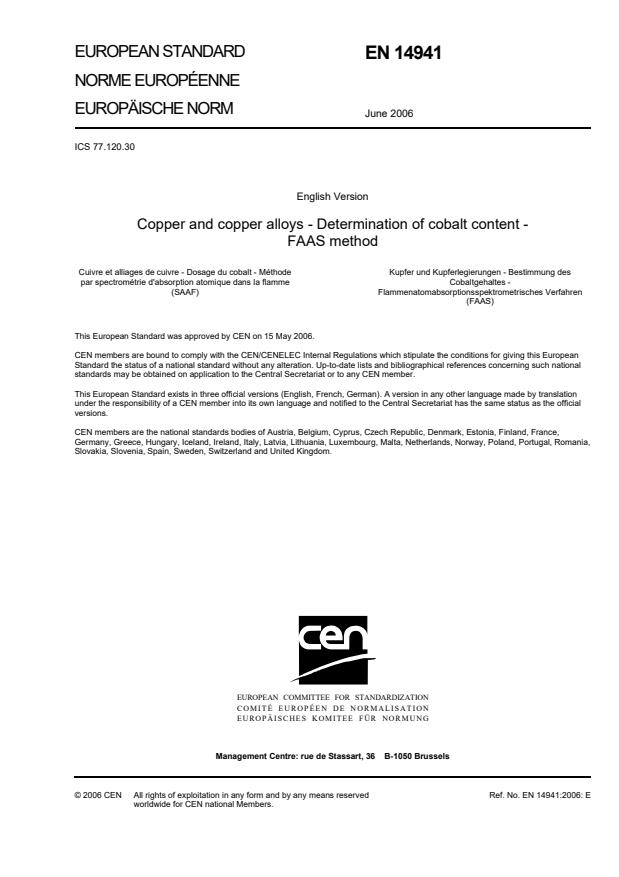
EUROPEAN STANDARDNORME EUROPÉENNEEUROPÄISCHE NORMEN 14941June 2006ICS 77.120.30 English VersionCopper and copper alloys - Determination of cobalt content -FAAS methodCuivre et alliages de cuivre - Dosage du cobalt - Méthodepar spectrométrie d'absorption atomique dans la flamme(SAAF)Kupfer und Kupferlegierungen - Bestimmung desCobaltgehaltes -Flammenatomabsorptionsspektrometrisches Verfahren(FAAS)This European Standard was approved by CEN on 15 May 2006.CEN members are bound to comply with the CEN/CENELEC Internal Regulations which stipulate the conditions for giving this EuropeanStandard the status of a national standard without any alteration. Up-to-date lists and bibliographical references concerning such nationalstandards may be obtained on application to the Central Secretariat or to any CEN member.This European Standard exists in three official versions (English, French, German). A version in any other language made by translationunder the responsibility of a CEN member into its own language and notified to the Central Secretariat has the same status as the officialversions.CEN members are the national standards bodies of Austria, Belgium, Cyprus, Czech Republic, Denmark, Estonia, Finland, France,Germany, Greece, Hungary, Iceland, Ireland, Italy, Latvia, Lithuania, Luxembourg, Malta, Netherlands, Norway, Poland, Portugal, Romania,Slovakia, Slovenia, Spain, Sweden, Switzerland and United Kingdom.EUROPEAN COMMITTEE FOR STANDARDIZATIONCOMITÉ EUROPÉEN DE NORMALISATIONEUROPÄISCHES KOMITEE FÜR NORMUNGManagement Centre: rue de Stassart, 36
B-1050 Brussels© 2006 CENAll rights of exploitation in any form and by any means reservedworldwide for CEN national Members.Ref. No. EN 14941:2006: E
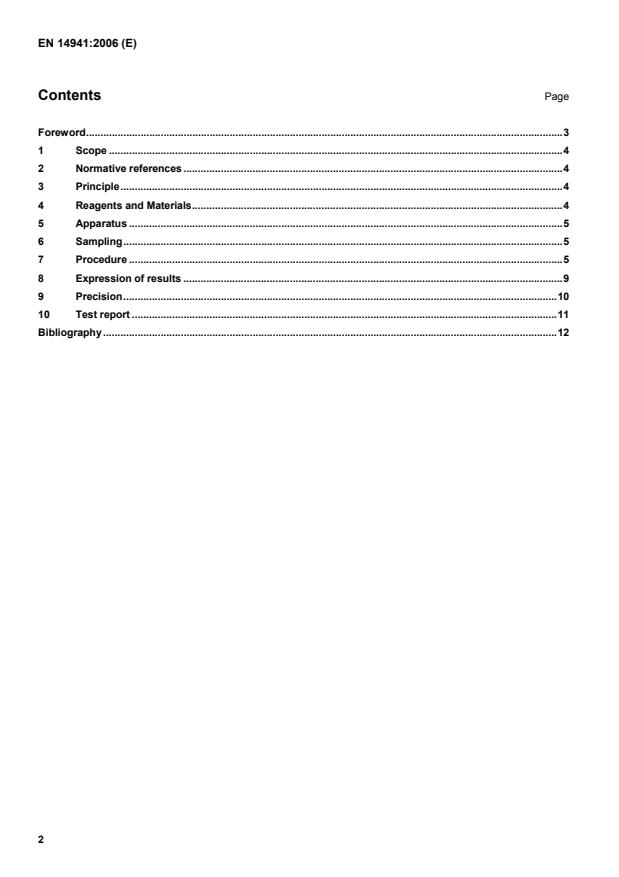
Contents Page Foreword.3 1 Scope.4 2 Normative references.4 3 Principle.4 4 Reagents and Materials.4 5 Apparatus.5 6 Sampling.5 7 Procedure.5 8 Expression of results.9 9 Precision.10 10 Test report.11 Bibliography.12
3 Foreword This document (EN 14941:2006) has been prepared by Technical Committee CEN/TC 133 “Copper and copper al-loys”, the secretariat of which is held by DIN. This European Standard shall be given the status of a national standard, either by publication of an identical text or by endorsement, at the latest by December 2006, and conflicting national standards shall be withdrawn at the latest by December 2006 Within its programme of work, Technical Committee CEN/TC 133 requested CEN/TC 133/WG 10 "Methods of analysis" to prepare the following standard: EN 14941, Copper and copper alloys — Determination of cobalt content — FAAS method According to the CEN/CENELEC Internal Regulations, the national standards organizations of the following coun-tries are bound to implement this European Standard: Austria, Belgium, Cyprus, Czech Republic, Denmark, Esto-nia, Finland, France, Germany, Greece, Hungary, Iceland, Ireland, Italy, Latvia, Lithuania, Luxembourg, Malta, Netherlands, Norway, Poland, Portugal, Romania, Slovakia, Slovenia, Spain, Sweden, Switzerland and United Kingdom.
1 Scope This European Standard specifies a flame atomic absorption spectrometric method (FAAS) for the determination of the cobalt content of copper and copper alloys in the form of unwrought, wrought and cast products. The method is applicable to products having cobalt mass fractions between 0,010 % and 3,0 %. 2 Normative references The following referenced documents are indispensable for the application of this document. For dated references, only the edition cited applies. For undated references, the latest edition of the referenced document (including any amendments) applies. ISO 1811-1, Copper and copper alloys — Selection and preparation of samples for chemical analysis — Part 1: Sampling of cast unwrought products ISO 1811-2, Copper and copper alloys — Selection and preparation of samples for chemical analysis — Part 2: Sampling of wrought products and castings NOTE Informative references to documents used in the preparation of this standard, and cited at the appropriate places in the text, are listed in the Bibliography. 3 Principle Dissolution of a test portion in hydrochloric-nitric acid mixture followed, after suitable dilution, by aspiration into an air/acetylene flame of an atomic absorption spectrometer. Measurement of the absorption of the 240,7 nm line emitted by a cobalt hollow-cathode lamp. 4 Reagents and Materials 4.1 General During the analysis, use only reagents of recognized analytical grade and only distilled water or water of equivalent purity. 4.2 Hydrochloric acid, HCl (ρ = 1,19 g/ml). 4.3 Nitric acid, HNO3 (ρ = 1,40 g/ml). 4.4 Nitric acid solution, 1 + 1 Dilute 100 ml of nitric acid (4.3), in 100 ml of water. 4.5 Cobalt stock solution, 1,000 g/l Co Weigh (1 ± 0,001) g of cobalt (Co ≥ 99,9 %) and transfer it into a 250 ml beaker. Add 20 ml of nitric acid solution (4.4), cover and heat gently until the cobalt is completely dissolved. Boil the solution for a few minutes to expel ni-trous fumes. Cool to room temperature, transfer the solution quantitatively into a 1 000 ml one-mark volumetric flask, dilute to the mark with water and mix well. 1 ml of this solution contains 1,000 mg of Co.
5 4.6 Cobalt standard solution, 0,100 g/l Co Using a pipette, transfer 25,0 ml of cobalt stock solution (4.5) into a 250 ml one-mark volumetric flask. Dilute to the mark with water and mix well. Prepare the solution immediately prior to use. 1 ml of this solution contains 0,100 mg of Co. 4.7 Lanthanum(III) chloride solution (100 g/l) Dissolve 100 g of lanthanum(III) chloride (LaCl3 · 7H2O) in a 600 ml beaker with water and transfer the solution quantitatively into a 1 000 ml one-mark volumetric flask. Dilute to the mark with water and mix well. 4.8 Copper base solution, 20 g/l Cu Weigh 10,0 g cobalt-free copper (Co ≤ 0,000 2 %) and transfer it into a 600 ml beaker. Add 200 ml of hydrochloric acid (4.2) and, cautiously, 200 ml of nitric acid solution (4.4). Heat until the copper is dissolved and then boil until nitrous fumes have been expelled. Cool to room temperature and transfer the solution quantitatively into a 500 ml one-mark volumetric flask, dilute to the mark with water and mix well. 5 Apparatus 5.1 Ordinary laboratory apparatus. 5.2 Atomic absorption spectrometer, fitted with an air/acetylene burner. 5.3 Cobalt hollow-cathode lamp. 6 Sampling Sampling shall be carried out in accordance with ISO 1811-1 or ISO 1811-2, as appropriate. Test samples shall be in the form of fine drillings, chips or millings with a maximum thickness of 0,5 mm. 7 Procedure 7.1 Preparation of the test portion solution 7.1.1 Test portion Weigh (1 ± 0,001) g of the test sample. 7.1.2 Test portion solution Transfer the test portion (7.1.1) into a 250 ml beaker and cover with a watch glass. Add 20 ml of hydrochloric acid (4.2) and 20 ml of nitric acid solution (4.4). Heat gently until the test portion is completely dissolved, then continue heating to the boiling point until the nitrous fumes have been expelled. Wash the cover and the sides of the beaker with water and allow to cool. Transfer the solution to a 100 ml one-mark volumetric flask, add 10 ml of lantha-num(III) chloride solution (4.7), dilute to the mark with water and mix well. Select an aliquot portion from the test portion solution according to the expected cobalt mass fraction and prepare a dilution in a volumetric flask as indicated in Table 1. Add lanthanum(III) chloride solution as shown in Table 1.
Table 1 — Dilution
Aliquot of Lanthanum(III)- Final volume
Cobalt mass the test portio
...