

SIST EN 301 489-4 V3.1.1:2017
(Main)ElectroMagnetic Compatibility (EMC) standard for radio equipment and services - Part 4: Specific conditions for fixed radio links and ancillary equipment - Harmonised Standard covering the essential requirements of article 3.1(b) of the Directive 2014/53/EU
General Information
- Abstract
The present document specifies technical characteristics and methods of measurement for Analogue and Digital Fixed
Radio Links operating as fixed Point-to-Point, and Point-to-Multipoint systems as defined in annex B, including the
associated ancillary equipment.
NOTE: Technical specifications related to the antenna port of the radio equipment are not included in the present
document. Such technical specifications are found in the relevant product standards for the effective use
of the radio spectrum.
In case of differences (for instance concerning special conditions, definitions, abbreviations) between the present
document and ETSI EN 301 489-1 [1], the provisions of the present document take precedence.
The processing and protection switch, (de)modulator, transmitter, receiver, RF filters, branching networks, feeders are
covered by the present document. The multiplexing and/or de-multiplexing elements are covered if they form part of the
transmitter, receiver and/or transceiver.
The environmental classification and the emission and immunity requirements used in the present document are as
stated in ETSI EN 301 489-1 [1], except for any special conditions included in the present document.
The present document covers the essential requirements of article 3.1(b) of Directive 2014/53/EU under the conditions
identified in annex A.
- Status
- Published
- Public Enquiry End Date
- 30-Jun-2016
- Publication Date
- 27-Feb-2017
- Technical Committee
- MOC - Mobile Communications
- Current Stage
- 6060 - National Implementation/Publication (Adopted Project)
- Start Date
- 14-Feb-2017
- Due Date
- 21-Apr-2017
- Completion Date
- 28-Feb-2017
Buy Documents
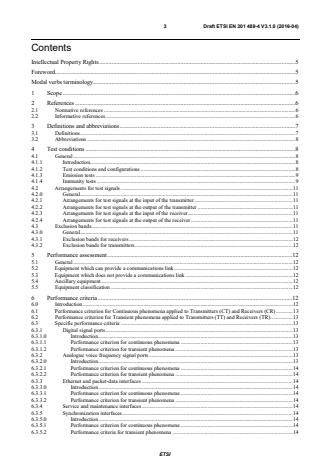
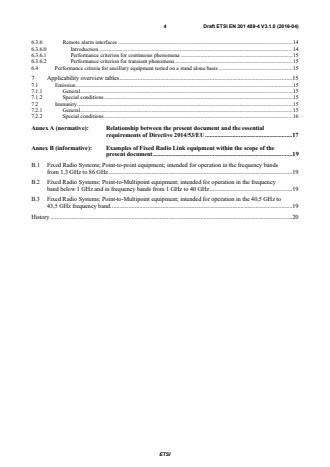
ETSI EN 301 489-4 V3.1.0 (2016-04) - ElectroMagnetic Compatibility (EMC) standard for radio equipment and services; Part 4: Specific conditions for fixed radio links and ancillary equipment. Harmonised Standard covering the essential requirements of article 3.1(b) of the Directive 2014/53/EU
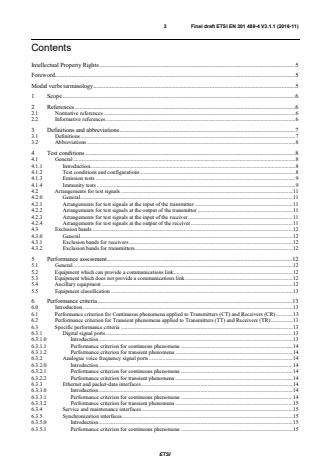
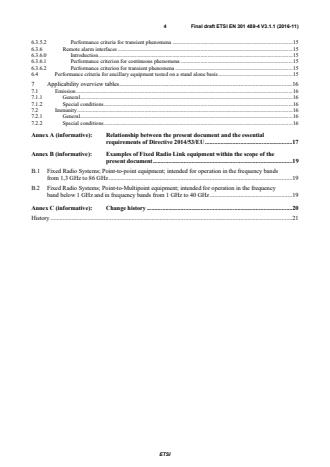
ETSI EN 301 489-4 V3.1.1 (2016-11) - ElectroMagnetic Compatibility (EMC) standard for radio equipment and services; Part 4: Specific conditions for fixed radio links and ancillary equipment; Harmonised Standard covering the essential requirements of article 3.1(b) of Directive 2014/53/EU
ETSI EN 301 489-4 V3.1.1 (2017-02) - Part 4: Specific conditions for fixed radio links and ancillary equipment; Part 4: Specific conditions for fixed radio links and ancillary equipment; Harmonised Standard covering the essential requirements of article 3.1(b) of Directive 2014/53/EU

Overview
SIST EN 301 489-4 V3.1.1:2017 specifies the essential requirements and test methods for assessing Electromagnetic Compatibility (EMC) of analogue and digital fixed radio links and their ancillary equipment. This harmonized European standard supports the essential requirements set out in article 3.1(b) of Directive 2014/53/EU (Radio Equipment Directive). It applies to fixed point-to-point and point-to-multipoint radio systems used for the wireless transmission of data and voice communications, as well as their associated ancillary devices such as transmitters, receivers, modulators, demodulators, RF filters, branching networks, and protection switches.
This standard is designed to ensure that fixed radio equipment continues to operate effectively in an electromagnetic environment and does not interfere with the operation of other equipment. It is intended for manufacturers, conformity assessment bodies, and organizations dealing with the deployment and certification of radio communication infrastructure.
Key Topics
- Scope and Applicability: Covers technical characteristics and EMC test methods for analogue and digital fixed radio links, operating in both point-to-point and point-to-multipoint topologies, including ancillary equipment. Specifications relating to antennas are referenced in separate product standards.
- Components Covered: Includes transmitters, receivers, (de)modulators, protection switches, RF filters, branching networks, and feeders. Multiplexing/demultiplexing elements are included if they are integrated.
- Test Methods: Defines emission and immunity test conditions as detailed in ETSI EN 301 489-1, with modifications specific to fixed radio equipment.
- Performance Criteria: Establishes requirements for the maintenance of communication links under continuous and transient electromagnetic exposures. Includes criteria for digital, analogue, Ethernet, and packet-data interfaces.
- Environmental Considerations: Adopts the environmental classification and emission/immunity requirements from the base standard, unless special provisions are specified.
- Conformity Assessment: Offers a presumption of conformity with the essential EMC requirements of Directive 2014/53/EU when the standard is properly applied.
Applications
Implementing SIST EN 301 489-4 V3.1.1:2017 is critical for:
- Manufacturers of Fixed Radio Equipment: Ensuring compliance with legal EMC requirements within the European Union.
- System Integrators: Guaranteeing reliable performance of fixed wireless infrastructure for telecom operators, internet service providers, and enterprise networks.
- Certification and Testing Laboratories: Conducting accredited EMC testing according to harmonized European standards, forming part of the CE marking process.
- Network Operators: Minimizing the risk of radio interference, service disruptions, and ensuring the coexistence of new and existing fixed radio systems.
- Ancillary Equipment Suppliers: Certifying that supporting hardware such as switches, filters, and multiplexers also meet EMC requirements when used in combination with radio equipment.
Related Standards
For comprehensive compliance and robust system design, the following related standards should also be considered:
- ETSI EN 301 489-1: Common technical requirements for EMC in radio equipment and services.
- Directive 2014/53/EU: Radio Equipment Directive - setting out the legal framework for EMC and health/safety across the EU.
- ETSI EN 302 217-2: Characteristics and requirements for point-to-point equipment and antennas.
- ETSI EN 302 326-2: Requirements for digital multipoint radio equipment.
- ITU-R F.1191 & F.746 Recommendations: Channel arrangements and emission limits for digital radio relay and fixed wireless systems.
By adhering to SIST EN 301 489-4 V3.1.1:2017, organizations can ensure high-quality, interference-resilient fixed radio links that are compliant with European EMC and regulatory mandates, fostering both reliability and market access.
Buy Documents
ETSI EN 301 489-4 V3.1.0 (2016-04) - ElectroMagnetic Compatibility (EMC) standard for radio equipment and services; Part 4: Specific conditions for fixed radio links and ancillary equipment. Harmonised Standard covering the essential requirements of article 3.1(b) of the Directive 2014/53/EU
ETSI EN 301 489-4 V3.1.1 (2016-11) - ElectroMagnetic Compatibility (EMC) standard for radio equipment and services; Part 4: Specific conditions for fixed radio links and ancillary equipment; Harmonised Standard covering the essential requirements of article 3.1(b) of Directive 2014/53/EU
ETSI EN 301 489-4 V3.1.1 (2017-02) - Part 4: Specific conditions for fixed radio links and ancillary equipment; Part 4: Specific conditions for fixed radio links and ancillary equipment; Harmonised Standard covering the essential requirements of article 3.1(b) of Directive 2014/53/EU
Get Certified
Connect with accredited certification bodies for this standard

ANCE
Mexican certification and testing association.

Intertek Slovenia
Intertek testing, inspection, and certification services in Slovenia.

LNE (Laboratoire National de Métrologie et d'Essais)
French national laboratory for metrology and testing.
Sponsored listings
Frequently Asked Questions
SIST EN 301 489-4 V3.1.1:2017 is a standard published by the Slovenian Institute for Standardization (SIST). Its full title is "ElectroMagnetic Compatibility (EMC) standard for radio equipment and services - Part 4: Specific conditions for fixed radio links and ancillary equipment - Harmonised Standard covering the essential requirements of article 3.1(b) of the Directive 2014/53/EU". This standard covers: The present document specifies technical characteristics and methods of measurement for Analogue and Digital Fixed Radio Links operating as fixed Point-to-Point, and Point-to-Multipoint systems as defined in annex B, including the associated ancillary equipment. NOTE: Technical specifications related to the antenna port of the radio equipment are not included in the present document. Such technical specifications are found in the relevant product standards for the effective use of the radio spectrum. In case of differences (for instance concerning special conditions, definitions, abbreviations) between the present document and ETSI EN 301 489-1 [1], the provisions of the present document take precedence. The processing and protection switch, (de)modulator, transmitter, receiver, RF filters, branching networks, feeders are covered by the present document. The multiplexing and/or de-multiplexing elements are covered if they form part of the transmitter, receiver and/or transceiver. The environmental classification and the emission and immunity requirements used in the present document are as stated in ETSI EN 301 489-1 [1], except for any special conditions included in the present document. The present document covers the essential requirements of article 3.1(b) of Directive 2014/53/EU under the conditions identified in annex A.
The present document specifies technical characteristics and methods of measurement for Analogue and Digital Fixed Radio Links operating as fixed Point-to-Point, and Point-to-Multipoint systems as defined in annex B, including the associated ancillary equipment. NOTE: Technical specifications related to the antenna port of the radio equipment are not included in the present document. Such technical specifications are found in the relevant product standards for the effective use of the radio spectrum. In case of differences (for instance concerning special conditions, definitions, abbreviations) between the present document and ETSI EN 301 489-1 [1], the provisions of the present document take precedence. The processing and protection switch, (de)modulator, transmitter, receiver, RF filters, branching networks, feeders are covered by the present document. The multiplexing and/or de-multiplexing elements are covered if they form part of the transmitter, receiver and/or transceiver. The environmental classification and the emission and immunity requirements used in the present document are as stated in ETSI EN 301 489-1 [1], except for any special conditions included in the present document. The present document covers the essential requirements of article 3.1(b) of Directive 2014/53/EU under the conditions identified in annex A.
SIST EN 301 489-4 V3.1.1:2017 is classified under the following ICS (International Classification for Standards) categories: 33.060.20 - Receiving and transmitting equipment; 33.100.01 - Electromagnetic compatibility in general. The ICS classification helps identify the subject area and facilitates finding related standards.
SIST EN 301 489-4 V3.1.1:2017 is available in PDF format for immediate download after purchase. The document can be added to your cart and obtained through the secure checkout process. Digital delivery ensures instant access to the complete standard document.
Standards Content (Sample)
Draft ETSI EN 301 489-4 V3.1.0 (2016-04)
HARMONISED EUROPEAN STANDARD
ElectroMagnetic Compatibility (EMC)
standard for radio equipment and services;
Part 4: Specific conditions for fixed radio links
and ancillary equipment;
Harmonised Standard covering the essential requirements
of article 3.1(b) of the Directive 2014/53/EU
2 Draft ETSI EN 301 489-4 V3.1.0 (2016-04)
Reference
REN/ERM-EMC-340
Keywords
EMC, FWA, Harmonised standard, point-to-point,
radio, regulation, RLL, WLL
ETSI
650 Route des Lucioles
F-06921 Sophia Antipolis Cedex - FRANCE
Tel.: +33 4 92 94 42 00 Fax: +33 4 93 65 47 16
Siret N° 348 623 562 00017 - NAF 742 C
Association à but non lucratif enregistrée à la
Sous-Préfecture de Grasse (06) N° 7803/88
Important notice
The present document can be downloaded from:
http://www.etsi.org/standards-search
The present document may be made available in electronic versions and/or in print. The content of any electronic and/or
print versions of the present document shall not be modified without the prior written authorization of ETSI. In case of any
existing or perceived difference in contents between such versions and/or in print, the only prevailing document is the
print of the Portable Document Format (PDF) version kept on a specific network drive within ETSI Secretariat.
Users of the present document should be aware that the document may be subject to revision or change of status.
Information on the current status of this and other ETSI documents is available at
https://portal.etsi.org/TB/ETSIDeliverableStatus.aspx
If you find errors in the present document, please send your comment to one of the following services:
https://portal.etsi.org/People/CommiteeSupportStaff.aspx
Copyright Notification
No part may be reproduced or utilized in any form or by any means, electronic or mechanical, including photocopying
and microfilm except as authorized by written permission of ETSI.
The content of the PDF version shall not be modified without the written authorization of ETSI.
The copyright and the foregoing restriction extend to reproduction in all media.
© European Telecommunications Standards Institute 2016.
All rights reserved.
TM TM TM
DECT , PLUGTESTS , UMTS and the ETSI logo are Trade Marks of ETSI registered for the benefit of its Members.
TM
3GPP and LTE™ are Trade Marks of ETSI registered for the benefit of its Members and
of the 3GPP Organizational Partners.
GSM® and the GSM logo are Trade Marks registered and owned by the GSM Association.
ETSI
3 Draft ETSI EN 301 489-4 V3.1.0 (2016-04)
Contents
Intellectual Property Rights . 5
Foreword . 5
Modal verbs terminology . 5
1 Scope . 6
2 References . 6
2.1 Normative references . 6
2.2 Informative references . 6
3 Definitions and abbreviations . 7
3.1 Definitions . 7
3.2 Abbreviations . 8
4 Test conditions . 8
4.1 General . 8
4.1.1 Introduction. 8
4.1.2 Test conditions and configurations . 8
4.1.3 Emission tests . 9
4.1.4 Immunity tests . 9
4.2 Arrangements for test signals . 11
4.2.0 General . 11
4.2.1 Arrangements for test signals at the input of the transmitter . 11
4.2.2 Arrangements for test signals at the output of the transmitter . 11
4.2.3 Arrangements for test signals at the input of the receiver . 11
4.2.4 Arrangements for test signals at the output of the receiver . 11
4.3 Exclusion bands . 11
4.3.0 General . 11
4.3.1 Exclusion bands for receivers . 12
4.3.2 Exclusion bands for transmitters . 12
5 Performance assessment . 12
5.1 General . 12
5.2 Equipment which can provide a communications link . 12
5.3 Equipment which does not provide a communications link . 12
5.4 Ancillary equipment . 12
5.5 Equipment classification . 12
6 Performance criteria . 12
6.0 Introduction . 12
6.1 Performance criterion for Continuous phenomena applied to Transmitters (CT) and Receivers (CR) . 13
6.2 Performance criterion for Transient phenomena applied to Transmitters (TT) and Receivers (TR) . 13
6.3 Specific performance criteria . 13
6.3.1 Digital signal ports . 13
6.3.1.0 Introduction . 13
6.3.1.1 Performance criterion for continuous phenomena . 13
6.3.1.2 Performance criterion for transient phenomena . 13
6.3.2 Analogue voice frequency signal ports . 13
6.3.2.0 Introduction . 13
6.3.2.1 Performance criterion for continuous phenomena . 14
6.3.2.2 Performance criterion for transient phenomena . 14
6.3.3 Ethernet and packet-data interfaces . 14
6.3.3.0 Introduction . 14
6.3.3.1 Performance criterion for continuous phenomena . 14
6.3.3.2 Performance criterion for transient phenomena . 14
6.3.4 Service and maintenance interfaces . 14
6.3.5 Synchronization interfaces . 14
6.3.5.0 Introduction . 14
6.3.5.1 Performance criterion for continuous phenomena . 14
6.3.5.2 Performance criteria for transient phenomena . 14
ETSI
4 Draft ETSI EN 301 489-4 V3.1.0 (2016-04)
6.3.6 Remote alarm interfaces . 14
6.3.6.0 Introduction . 14
6.3.6.1 Performance criterion for continuous phenomena . 15
6.3.6.2 Performance criterion for transient phenomena . 15
6.4 Performance criteria for ancillary equipment tested on a stand alone basis . 15
7 Applicability overview tables . 15
7.1 Emission . 15
7.1.1 General . 15
7.1.2 Special conditions . 15
7.2 Immunity . 15
7.2.1 General . 15
7.2.2 Special conditions . 16
Annex A (normative): Relationship between the present document and the essential
requirements of Directive 2014/53/EU . 17
Annex B (informative): Examples of Fixed Radio Link equipment within the scope of the
present document . 19
B.1 Fixed Radio Systems; Point-to-point equipment; intended for operation in the frequency bands
from 1,3 GHz to 86 GHz . 19
B.2 Fixed Radio Systems; Point-to-Multipoint equipment; intended for operation in the frequency
band below 1 GHz and in frequency bands from 1 GHz to 40 GHz . 19
B.3 Fixed Radio Systems; Point-to-Multipoint equipment; intended for operation in the 40,5 GHz to
43,5 GHz frequency band . 19
History . 20
ETSI
5 Draft ETSI EN 301 489-4 V3.1.0 (2016-04)
Intellectual Property Rights
IPRs essential or potentially essential to the present document may have been declared to ETSI. The information
pertaining to these essential IPRs, if any, is publicly available for ETSI members and non-members, and can be found
in ETSI SR 000 314: "Intellectual Property Rights (IPRs); Essential, or potentially Essential, IPRs notified to ETSI in
respect of ETSI standards", which is available from the ETSI Secretariat. Latest updates are available on the ETSI Web
server (https://ipr.etsi.org/).
Pursuant to the ETSI IPR Policy, no investigation, including IPR searches, has been carried out by ETSI. No guarantee
can be given as to the existence of other IPRs not referenced in ETSI SR 000 314 (or the updates on the ETSI Web
server) which are, or may be, or may become, essential to the present document.
Foreword
This draft Harmonised European Standard (EN) has been produced by ETSI Technical Committee Electromagnetic
compatibility and Radio spectrum Matters (ERM), and is now submitted for the combined Public Enquiry and Vote
phase of the ETSI standards EN Approval Procedure.
The present document has been prepared under the Commission's standardisation request C(2015) 5376 final [i.11] to
provide one voluntary means of conforming to the essential requirements of Directive 2014/53/EU on the harmonisation
of the laws of the Member States relating to the making available on the market of radio equipment and repealing
Directive 1999/5/EC [i.1].
Once the present document is cited in the Official Journal of the European Union under that Directive, compliance with
the normative clauses of the present document given in table A.1 confers, within the limits of the scope of the present
document, a presumption of conformity with the corresponding essential requirements of that Directive and associated
EFTA regulations.
The present document is part 4 of a multi-part deliverable. Full details of the entire series can be found in part 1 [1].
National transposition dates
Date of adoption of this EN: 3 months after ETSI publication
Date of latest announcement of this EN (doa):
Date of latest publication of new National Standard
or endorsement of this EN (dop/e): 6 months after doa
Date of withdrawal of any conflicting National Standard (dow): 18 months after doa
Modal verbs terminology
In the present document "shall", "shall not", "should", "should not", "may", "need not", "will", "will not", "can" and
"cannot" are to be interpreted as described in clause 3.2 of the ETSI Drafting Rules (Verbal forms for the expression of
provisions).
"must" and "must not" are NOT allowed in ETSI deliverables except when used in direct citation.
ETSI
6 Draft ETSI EN 301 489-4 V3.1.0 (2016-04)
1 Scope
The present document, together with ETSI EN 301 489-1 [1], covers the assessment of Fixed Radio Links, and ancillary
equipment in respect of ElectroMagnetic Compatibility (EMC).
Technical specifications related to the antenna port of the radio equipment are not included in the present document.
Such technical specifications are found in the relevant product standards for the effective use of the radio spectrum.
The present document specifies the applicable test conditions, performance assessment and performance criteria for
Analogue and Digital Fixed Radio Links operating as fixed Point-to-Point, and Point-to-Multipoint systems as defined
in annex B, including the associated ancillary equipment.
In case of differences (for instance concerning special conditions, definitions, abbreviations) between the present
document and ETSI EN 301 489-1 [1], the provisions of the present document take precedence.
The processing and protection switch, (de)modulator, transmitter, receiver, RF filters, branching networks, feeders are
covered by the present document. The multiplexing and/or de-multiplexing elements are covered if they form part of the
transmitter, receiver and/or transceiver.
The environmental classification and the emission and immunity requirements used in the present document are as
stated in ETSI EN 301 489-1 [1], except for any special conditions included in the present document.
2 References
2.1 Normative references
References are either specific (identified by date of publication and/or edition number or version number) or
non-specific. For specific references, only the cited version applies. For non-specific references, the latest version of the
referenced document (including any amendments) applies.
Referenced documents which are not found to be publicly available in the expected location might be found at
http://docbox.etsi.org/Reference.
NOTE: While any hyperlinks included in this clause were valid at the time of publication, ETSI cannot guarantee
their long term validity.
The following referenced documents are necessary for the application of the present document.
[1] ETSI EN 301 489-1 (V2.1.0) (04-2016): "ElectroMagnetic Compatibility (EMC) standard for
radio equipment and services; Harmonised Standard covering the essential requirements of
article 3.1(b) of the Directive 2014/53/EU and the essential requirements of article 6 of the
Directive 2014/30/EU; Part 1: Common technical requirements".
2.2 Informative references
References are either specific (identified by date of publication and/or edition number or version number) or
non-specific. For specific references, only the cited version applies. For non-specific references, the latest version of the
referenced document (including any amendments) applies.
NOTE: While any hyperlinks included in this clause were valid at the time of publication, ETSI cannot guarantee
their long term validity.
The following referenced documents are not necessary for the application of the present document but they assist the
user with regard to a particular subject area.
[i.1] Directive 2014/53/EU of the European Parliament and of the Council of 16 April 2014 on the
harmonisation of the laws of the Member States relating to the making available on the market of
radio equipment and repealing Directive 1999/5/EC.
[i.2] Void.
ETSI
7 Draft ETSI EN 301 489-4 V3.1.0 (2016-04)
[i.3] Recommendation ITU-R F.1191-1: "Bandwidths and unwanted emissions of digital radio-relay
systems".
[i.4] Recommendation ITU-R F.746-3: "Radio-frequency channel arrangements for radio-relay
systems".
[i.5] ETSI EN 302 217-2: "Fixed Radio Systems; Characteristics and requirements for point-to-point
equipment and antennas; Part 2: Digital systems operating in frequency bands from 1,3 GHz to
86 GHz; Harmonised Standard covering the essential requirements of article 3.2 of the Directive
2014/53/EU".
[i.6] Void.
[i.7] ETSI EN 302 326-2: "Fixed Radio Systems; Multipoint Equipment and Antennas; Part 2:
Harmonized EN covering the essential requirements of article 3.2 of the R&TTE Directive for
Digital Multipoint Radio Equipment".
[i.8] ETSI EN 301 460-1: "Fixed Radio Systems; Point-to-multipoint equipment; Part 1:
Point-to-multipoint digital radio systems below 1 GHz - Common parameters".
[i.9] ETSI EN 301 997-1: "Transmission and Multiplexing (TM); Multipoint equipment; Radio
Equipment for use in Multimedia Wireless Systems (MWS) in the frequency band 40,5 GHz to
43,5 GHz; Part 1: General requirements".
[i.10] Void.
[i.11] Commission Implementing Decision C(2015) 5376 final of 4.8.2015 on a standardisation request
to the European Committee for Electrotechnical Standardisation and to the European
Telecommunications Standards Institute as regards radio equipment in support of
Directive 2014/53/EU of the European Parliament and of the Council.
3 Definitions and abbreviations
3.1 Definitions
For the purposes of the present document, the terms and definitions given in ETSI EN 301 489-1 [1], clause 3 and the
following apply:
Base Station (BS): alternative name for Central Station
Central Station (CS): which can be subdivided into two units:
• the exchange unit, also called Central Controller Station (CCS) - (interface to the local switch); and
• the radio unit, also called Central Radio Station (CRS) - (central base band/radio transceiver)
NOTE: In some deployments the term Base Station is also used in place of Central Station. For the purposes of
the present standard either terms are assumed and are completely interchangeable.
CHannel Separation (CHS): CHannel Separation (CHS) is taken as XS/2 for alternated frequency channel
arrangements according to Recommendation ITU-R F.1191-1 [i.3] and XS for co-channel and interleaved frequency
channel arrangements as defined by Recommendation ITU-R F.746-3 [i.4], XS is the radio-frequency separation
between the centre frequencies of adjacent radio-frequency channels on the same polarization and in the same direction
of transmission.
operating frequency range: range(s) of radio frequencies covered by the Equipment Under Test (EUT) without any
change of units
Repeater Station (RS): radio repeater outstations with or without subscriber interfaces
Terminal station (TS): outstations with subscriber interfaces
ETSI
8 Draft ETSI EN 301 489-4 V3.1.0 (2016-04)
3.2 Abbreviations
For the purposes of the present document, the abbreviations given in ETSI EN 301 489-1 [1], clause 3 and the following
apply:
BER Bit Error Ratio
BS Base Station
CCS Central Controller Station
CHS CHannel Separation
CR Continuous phenomena applied to Receivers
CRS Central Radio Station
CS Central Station
CT Continuous phenomena applied to Transmitters
RS Repeater Station
TR Transient phenomena applied to Receivers
TS Terminal Station
TT Transient phenomena applied to Transmitters
4 Test conditions
4.1 General
4.1.1 Introduction
For the purposes of the present document, the test conditions of ETSI EN 301 489-1 [1], clause 4, apply as appropriate.
Further product related test conditions for fixed radio links are specified in the present document.
For emission and immunity tests the test modulation, test arrangements, etc., as specified in the present document,
clauses 4.1.2 to 4.3.2, shall apply.
4.1.2 Test conditions and configurations
This clause defines the test conditions and configurations for the emission and immunity tests as follows:
• a transmitter shall, as a minimum, comprise the element between E' and A' of figure 1. Additionally the
transmitter may comprise any of the other elements from the transmitter chain shown in figure 1. If these
additional elements are part of the transmitter or system they shall also meet the requirements of the present
document;
Processing
Z'
G' F' E' A' Tx RF B' C' D'
Branching
& Protection
Multiplexing Modulator Transmitter Feeder
Network
Filter
Switch
NOTE 1: For the purposes of defining the reference point
...
Final draft ETSI EN 301 489-4 V3.1.1 (2016-11)
HARMONISED EUROPEAN STANDARD
ElectroMagnetic Compatibility (EMC)
standard for radio equipment and services;
Part 4: Specific conditions for fixed radio links
and ancillary equipment;
Harmonised Standard covering the essential requirements
of article 3.1(b) of Directive 2014/53/EU
2 Final draft ETSI EN 301 489-4 V3.1.1 (2016-11)
Reference
REN/ERM-EMC-340
Keywords
EMC, FWA, harmonised standard, point-to-point,
radio, regulation, RLL, WLL
ETSI
650 Route des Lucioles
F-06921 Sophia Antipolis Cedex - FRANCE
Tel.: +33 4 92 94 42 00 Fax: +33 4 93 65 47 16
Siret N° 348 623 562 00017 - NAF 742 C
Association à but non lucratif enregistrée à la
Sous-Préfecture de Grasse (06) N° 7803/88
Important notice
The present document can be downloaded from:
http://www.etsi.org/standards-search
The present document may be made available in electronic versions and/or in print. The content of any electronic and/or
print versions of the present document shall not be modified without the prior written authorization of ETSI. In case of any
existing or perceived difference in contents between such versions and/or in print, the only prevailing document is the
print of the Portable Document Format (PDF) version kept on a specific network drive within ETSI Secretariat.
Users of the present document should be aware that the document may be subject to revision or change of status.
Information on the current status of this and other ETSI documents is available at
https://portal.etsi.org/TB/ETSIDeliverableStatus.aspx
If you find errors in the present document, please send your comment to one of the following services:
https://portal.etsi.org/People/CommiteeSupportStaff.aspx
Copyright Notification
No part may be reproduced or utilized in any form or by any means, electronic or mechanical, including photocopying
and microfilm except as authorized by written permission of ETSI.
The content of the PDF version shall not be modified without the written authorization of ETSI.
The copyright and the foregoing restriction extend to reproduction in all media.
© European Telecommunications Standards Institute 2016.
All rights reserved.
TM TM TM
DECT , PLUGTESTS , UMTS and the ETSI logo are Trade Marks of ETSI registered for the benefit of its Members.
TM
3GPP and LTE™ are Trade Marks of ETSI registered for the benefit of its Members and
of the 3GPP Organizational Partners.
GSM® and the GSM logo are Trade Marks registered and owned by the GSM Association.
ETSI
3 Final draft ETSI EN 301 489-4 V3.1.1 (2016-11)
Contents
Intellectual Property Rights . 5
Foreword . 5
Modal verbs terminology . 5
1 Scope . 6
2 References . 6
2.1 Normative references . 6
2.2 Informative references . 6
3 Definitions and abbreviations . 7
3.1 Definitions . 7
3.2 Abbreviations . 8
4 Test conditions . 8
4.1 General . 8
4.1.1 Introduction. 8
4.1.2 Test conditions and configurations . 8
4.1.3 Emission tests . 9
4.1.4 Immunity tests . 9
4.2 Arrangements for test signals . 11
4.2.0 General . 11
4.2.1 Arrangements for test signals at the input of the transmitter . 11
4.2.2 Arrangements for test signals at the output of the transmitter . 11
4.2.3 Arrangements for test signals at the input of the receiver . 11
4.2.4 Arrangements for test signals at the output of the receiver . 11
4.3 Exclusion bands . 12
4.3.0 General . 12
4.3.1 Exclusion bands for receivers . 12
4.3.2 Exclusion bands for transmitters . 12
5 Performance assessment . 12
5.1 General . 12
5.2 Equipment which can provide a communications link . 12
5.3 Equipment which does not provide a communications link . 12
5.4 Ancillary equipment . 12
5.5 Equipment classification . 13
6 Performance criteria . 13
6.0 Introduction . 13
6.1 Performance criterion for Continuous phenomena applied to Transmitters (CT) and Receivers (CR) . 13
6.2 Performance criterion for Transient phenomena applied to Transmitters (TT) and Receivers (TR) . 13
6.3 Specific performance criteria . 13
6.3.1 Digital signal ports . 13
6.3.1.0 Introduction . 13
6.3.1.1 Performance criterion for continuous phenomena . 14
6.3.1.2 Performance criterion for transient phenomena . 14
6.3.2 Analogue voice frequency signal ports . 14
6.3.2.0 Introduction . 14
6.3.2.1 Performance criterion for continuous phenomena . 14
6.3.2.2 Performance criterion for transient phenomena . 14
6.3.3 Ethernet and packet-data interfaces . 14
6.3.3.0 Introduction . 14
6.3.3.1 Performance criterion for continuous phenomena . 14
6.3.3.2 Performance criterion for transient phenomena . 15
6.3.4 Service and maintenance interfaces . 15
6.3.5 Synchronization interfaces . 15
6.3.5.0 Introduction . 15
6.3.5.1 Performance criterion for continuous phenomena . 15
ETSI
4 Final draft ETSI EN 301 489-4 V3.1.1 (2016-11)
6.3.5.2 Performance criteria for transient phenomena . 15
6.3.6 Remote alarm interfaces . 15
6.3.6.0 Introduction . 15
6.3.6.1 Performance criterion for continuous phenomena . 15
6.3.6.2 Performance criterion for transient phenomena . 15
6.4 Performance criteria for ancillary equipment tested on a stand alone basis . 15
7 Applicability overview tables . 16
7.1 Emission . 16
7.1.1 General . 16
7.1.2 Special conditions . 16
7.2 Immunity . 16
7.2.1 General . 16
7.2.2 Special conditions . 16
Annex A (informative): Relationship between the present document and the essential
requirements of Directive 2014/53/EU . 17
Annex B (informative): Examples of Fixed Radio Link equipment within the scope of the
present document . 19
B.1 Fixed Radio Systems; Point-to-point equipment; intended for operation in the frequency bands
from 1,3 GHz to 86 GHz . 19
B.2 Fixed Radio Systems; Point-to-Multipoint equipment; intended for operation in the frequency
band below 1 GHz and in frequency bands from 1 GHz to 40 GHz . 19
Annex C (informative): Change history . 20
History . 21
ETSI
5 Final draft ETSI EN 301 489-4 V3.1.1 (2016-11)
Intellectual Property Rights
IPRs essential or potentially essential to the present document may have been declared to ETSI. The information
pertaining to these essential IPRs, if any, is publicly available for ETSI members and non-members, and can be found
in ETSI SR 000 314: "Intellectual Property Rights (IPRs); Essential, or potentially Essential, IPRs notified to ETSI in
respect of ETSI standards", which is available from the ETSI Secretariat. Latest updates are available on the ETSI Web
server (https://ipr.etsi.org/).
Pursuant to the ETSI IPR Policy, no investigation, including IPR searches, has been carried out by ETSI. No guarantee
can be given as to the existence of other IPRs not referenced in ETSI SR 000 314 (or the updates on the ETSI Web
server) which are, or may be, or may become, essential to the present document.
Foreword
This final draft Harmonised European Standard (EN) has been produced by ETSI Technical Committee
Electromagnetic compatibility and Radio spectrum Matters (ERM), and is now submitted for the Vote phase of the
ETSI standards EN Approval Procedure.
The present document has been prepared under the Commission's standardisation request C(2015) 5376 final [i.11] to
provide one voluntary means of conforming to the essential requirements of Directive 2014/53/EU on the harmonisation
of the laws of the Member States relating to the making available on the market of radio equipment and repealing
Directive 1999/5/EC [i.1].
Once the present document is cited in the Official Journal of the European Union under that Directive, compliance with
the normative clauses of the present document given in table A.1 confers, within the limits of the scope of the present
document, a presumption of conformity with the corresponding essential requirements of that Directive and associated
EFTA regulations.
The present document is part 4 of a multi-part deliverable. Full details of the entire series can be found in part 1 [1].
Proposed national transposition dates
Date of latest announcement of this EN (doa): 3 months after ETSI publication
Date of latest publication of new National Standard
or endorsement of this EN (dop/e): 6 months after doa
Date of withdrawal of any conflicting National Standard (dow): 18 months after doa
Modal verbs terminology
In the present document "shall", "shall not", "should", "should not", "may", "need not", "will", "will not", "can" and
"cannot" are to be interpreted as described in clause 3.2 of the ETSI Drafting Rules (Verbal forms for the expression of
provisions).
"must" and "must not" are NOT allowed in ETSI deliverables except when used in direct citation.
ETSI
6 Final draft ETSI EN 301 489-4 V3.1.1 (2016-11)
1 Scope
The present document specifies technical characteristics and methods of measurement for Analogue and Digital Fixed
Radio Links operating as fixed Point-to-Point, and Point-to-Multipoint systems as defined in annex B, including the
associated ancillary equipment.
NOTE: Technical specifications related to the antenna port of the radio equipment are not included in the present
document. Such technical specifications are found in the relevant product standards for the effective use
of the radio spectrum.
In case of differences (for instance concerning special conditions, definitions, abbreviations) between the present
document and ETSI EN 301 489-1 [1], the provisions of the present document take precedence.
The processing and protection switch, (de)modulator, transmitter, receiver, RF filters, branching networks, feeders are
covered by the present document. The multiplexing and/or de-multiplexing elements are covered if they form part of the
transmitter, receiver and/or transceiver.
The environmental classification and the emission and immunity requirements used in the present document are as
stated in ETSI EN 301 489-1 [1], except for any special conditions included in the present document.
The present document covers the essential requirements of article 3.1(b) of Directive 2014/53/EU under the conditions
identified in annex A.
2 References
2.1 Normative references
References are specific, identified by date of publication and/or edition number or version number. Only the cited
version applies.
Referenced documents which are not found to be publicly available in the expected location might be found at
http://docbox.etsi.org/Reference.
NOTE: While any hyperlinks included in this clause were valid at the time of publication, ETSI cannot guarantee
their long term validity.
The following referenced documents are necessary for the application of the present document.
[1] ETSI EN 301 489-1 (V2.1.1) (11-2016): "ElectroMagnetic Compatibility (EMC) standard for
radio equipment and services; Harmonised Standard covering the essential requirements of
article 3.1(b) of Directive 2014/53/EU and the essential requirements of article 6 of
Directive 2014/30/EU; Part 1: Common technical requirements".
2.2 Informative references
References are either specific (identified by date of publication and/or edition number or version number) or
non-specific. For specific references, only the cited version applies. For non-specific references, the latest version of the
referenced document (including any amendments) applies.
NOTE: While any hyperlinks included in this clause were valid at the time of publication, ETSI cannot guarantee
their long term validity.
The following referenced documents are not necessary for the application of the present document but they assist the
user with regard to a particular subject area.
[i.1] Directive 2014/53/EU of the European Parliament and of the Council of 16 April 2014 on the
harmonisation of the laws of the Member States relating to the making available on the market of
radio equipment and repealing Directive 1999/5/EC.
[i.2] Void.
ETSI
7 Final draft ETSI EN 301 489-4 V3.1.1 (2016-11)
[i.3] Recommendation ITU-R F.1191-1: "Bandwidths and unwanted emissions of digital radio-relay
systems".
[i.4] Recommendation ITU-R F.746-3: "Radio-frequency channel arrangements for radio-relay
systems".
[i.5] ETSI EN 302 217-2: "Fixed Radio Systems; Characteristics and requirements for point-to-point
equipment and antennas; Part 2: Digital systems operating in frequency bands from 1,3 GHz to
86 GHz; Harmonised Standard covering the essential requirements of article 3.2 of Directive
2014/53/EU".
[i.6] Void.
[i.7] ETSI EN 302 326-2: "Fixed Radio Systems; Multipoint Equipment and Antennas; Part 2:
Harmonized EN covering the essential requirements of article 3.2 of the R&TTE Directive for
Digital Multipoint Radio Equipment".
[i.8] Void.
[i.9] Void.
[i.10] Void.
[i.11] Commission Implementing Decision C(2015) 5376 final of 4.8.2015 on a standardisation request
to the European Committee for Electrotechnical Standardisation and to the European
Telecommunications Standards Institute as regards radio equipment in support of Directive
2014/53/EU of the European Parliament and of the Council.
3 Definitions and abbreviations
3.1 Definitions
For the purposes of the present document, the terms and definitions given in ETSI EN 301 489-1 [1] and the following
apply:
Base Station (BS): alternative name for Central Station
Central Station (CS): which can be subdivided into two units:
• the exchange unit, also called Central Controller Station (CCS) - (interface to the local switch); and
• the radio unit, also called Central Radio Station (CRS) - (central base band/radio transceiver)
NOTE: In some deployments the term Base Station is also used in place of Central Station. For the purposes of
the present standard either terms are assumed and are completely interchangeable.
CHannel Separation (CHS): CHannel Separation (CHS) is taken as XS/2 for alternated frequency channel
arrangements according to Recommendation ITU-R F.1191-1 [i.3] and XS for co-channel and interleaved frequency
channel arrangements as defined by Recommendation ITU-R F.746-3 [i.4], XS is the radio-frequency separation
between the centre frequencies of adjacent radio-frequency channels on the same polarization and in the same direction
of transmission.
operating frequency range: range(s) of radio frequencies covered by the Equipment Under Test (EUT) without any
change of units
Repeater Station (RS): radio repeater outstations with or without subscriber interfaces
Terminal station (TS): outstations with subscriber interfaces
ETSI
8 Final draft ETSI EN 301 489-4 V3.1.1 (2016-11)
3.2 Abbreviations
For the purposes of the present document, the abbreviations given in ETSI EN 301 489-1 [1] and the following apply:
BER Bit Error Ratio
BS Base Station
CCS Central Controller Station
CHS CHannel Separation
CR Continuous phenomena applied to Receivers
CRS Central Radio Station
CS Central Station
CT Continuous phenomena applied to Transmitters
RS Repeater Station
TR Transient phenomena applied to Receivers
TS Terminal Station
TT Transient phenomena applied to Transmitters
4 Test conditions
4.1 General
4.1.1 Introduction
For the purposes of the present document, the test conditions of ETSI EN 301 489-1 [1], clause 4, apply as appropriate.
Further product related test conditions for fixed radio links are specified in the present document.
For emission and immunity tests the test modulation, test arrangements, etc., as specified in the present document,
clauses 4.1.2 to 4.3.2, shall apply.
4.1.2 Test conditions and configurations
This clause defines the test conditions and configurations for the emission and immunity tests as follows:
• a transmitter shall, as a minimum, comprise the element between E' and A' of figure 1. Additionally the
transmitter may comprise any of the other elements from the transmitter chain shown in figure 1. If these
additional elements are part of the transmitter or system they shall also meet the requirements of the present
document;
Processing
Z'
G' F' E' A' B' C' D'
Tx RF
Branching
Multiplexing & Protection Modulator Transmitter Feeder
Network
Filter
Switch
NOTE 1: For the purposes of defining the reference points, the branching network (B' to C') does not include a
hybrid.
NOTE 2: Points B' and C' may coincide, dependent on the equipment configuration.
Figure 1: Elements of a transmitter
• a receiver shall, as a minimum, comprise the element between A and E of figure 2. Additionally the receiver
may comprise any of the other elements from the receiver chain shown in figure 2. If these additional elements
are part of the receiver or system they
...
HARMONISED EUROPEAN STANDARD
ElectroMagnetic Compatibility (EMC)
standard for radio equipment and services;
Part 4: Specific conditions for fixed radio links
and ancillary equipment;
Harmonised Standard covering the essential requirements
of article 3.1(b) of Directive 2014/53/EU
2 ETSI EN 301 489-4 V3.1.1 (2017-02)
Reference
REN/ERM-EMC-340
Keywords
EMC, FWA, harmonised standard, point-to-point,
radio, regulation, RLL, WLL
ETSI
650 Route des Lucioles
F-06921 Sophia Antipolis Cedex - FRANCE
Tel.: +33 4 92 94 42 00 Fax: +33 4 93 65 47 16
Siret N° 348 623 562 00017 - NAF 742 C
Association à but non lucratif enregistrée à la
Sous-Préfecture de Grasse (06) N° 7803/88
Important notice
The present document can be downloaded from:
http://www.etsi.org/standards-search
The present document may be made available in electronic versions and/or in print. The content of any electronic and/or
print versions of the present document shall not be modified without the prior written authorization of ETSI. In case of any
existing or perceived difference in contents between such versions and/or in print, the only prevailing document is the
print of the Portable Document Format (PDF) version kept on a specific network drive within ETSI Secretariat.
Users of the present document should be aware that the document may be subject to revision or change of status.
Information on the current status of this and other ETSI documents is available at
https://portal.etsi.org/TB/ETSIDeliverableStatus.aspx
If you find errors in the present document, please send your comment to one of the following services:
https://portal.etsi.org/People/CommiteeSupportStaff.aspx
Copyright Notification
No part may be reproduced or utilized in any form or by any means, electronic or mechanical, including photocopying
and microfilm except as authorized by written permission of ETSI.
The content of the PDF version shall not be modified without the written authorization of ETSI.
The copyright and the foregoing restriction extend to reproduction in all media.
© European Telecommunications Standards Institute 2017.
All rights reserved.
TM TM TM
DECT , PLUGTESTS , UMTS and the ETSI logo are Trade Marks of ETSI registered for the benefit of its Members.
TM
3GPP and LTE™ are Trade Marks of ETSI registered for the benefit of its Members and
of the 3GPP Organizational Partners.
GSM® and the GSM logo are Trade Marks registered and owned by the GSM Association.
ETSI
3 ETSI EN 301 489-4 V3.1.1 (2017-02)
Contents
Intellectual Property Rights . 5
Foreword . 5
Modal verbs terminology . 5
1 Scope . 6
2 References . 6
2.1 Normative references . 6
2.2 Informative references . 6
3 Definitions and abbreviations . 7
3.1 Definitions . 7
3.2 Abbreviations . 8
4 Test conditions . 8
4.1 General . 8
4.1.1 Introduction. 8
4.1.2 Test conditions and configurations . 8
4.1.3 Emission tests . 9
4.1.4 Immunity tests . 9
4.2 Arrangements for test signals . 11
4.2.0 General . 11
4.2.1 Arrangements for test signals at the input of the transmitter . 11
4.2.2 Arrangements for test signals at the output of the transmitter . 11
4.2.3 Arrangements for test signals at the input of the receiver . 11
4.2.4 Arrangements for test signals at the output of the receiver . 11
4.3 Exclusion bands . 12
4.3.0 General . 12
4.3.1 Exclusion bands for receivers . 12
4.3.2 Exclusion bands for transmitters . 12
5 Performance assessment . 12
5.1 General . 12
5.2 Equipment which can provide a communications link . 12
5.3 Equipment which does not provide a communications link . 12
5.4 Ancillary equipment . 12
5.5 Equipment classification . 12
6 Performance criteria . 13
6.0 Introduction . 13
6.1 Performance criterion for Continuous phenomena applied to Transmitters (CT) and Receivers (CR) . 13
6.2 Performance criterion for Transient phenomena applied to Transmitters (TT) and Receivers (TR) . 13
6.3 Specific performance criteria . 13
6.3.1 Digital signal ports . 13
6.3.1.0 Introduction . 13
6.3.1.1 Performance criterion for continuous phenomena . 13
6.3.1.2 Performance criterion for transient phenomena . 14
6.3.2 Analogue voice frequency signal ports . 14
6.3.2.0 Introduction . 14
6.3.2.1 Performance criterion for continuous phenomena . 14
6.3.2.2 Performance criterion for transient phenomena . 14
6.3.3 Ethernet and packet-data interfaces . 14
6.3.3.0 Introduction . 14
6.3.3.1 Performance criterion for continuous phenomena . 14
6.3.3.2 Performance criterion for transient phenomena . 14
6.3.4 Service and maintenance interfaces . 14
6.3.5 Synchronization interfaces . 15
6.3.5.0 Introduction . 15
6.3.5.1 Performance criterion for continuous phenomena . 15
ETSI
4 ETSI EN 301 489-4 V3.1.1 (2017-02)
6.3.5.2 Performance criteria for transient phenomena . 15
6.3.6 Remote alarm interfaces . 15
6.3.6.0 Introduction . 15
6.3.6.1 Performance criterion for continuous phenomena . 15
6.3.6.2 Performance criterion for transient phenomena . 15
6.4 Performance criteria for ancillary equipment tested on a stand alone basis . 15
7 Applicability overview tables . 15
7.1 Emission . 15
7.1.1 General . 15
7.1.2 Special conditions . 16
7.2 Immunity . 16
7.2.1 General . 16
7.2.2 Special conditions . 16
Annex A (informative): Relationship between the present document and the essential
requirements of Directive 2014/53/EU . 17
Annex B (informative): Examples of Fixed Radio Link equipment within the scope of the
present document . 19
B.1 Fixed Radio Systems; Point-to-point equipment; intended for operation in the frequency bands
from 1,3 GHz to 86 GHz . 19
B.2 Fixed Radio Systems; Point-to-Multipoint equipment; intended for operation in the frequency
band below 1 GHz and in frequency bands from 1 GHz to 40 GHz . 19
Annex C (informative): Change history . 20
History . 21
ETSI
5 ETSI EN 301 489-4 V3.1.1 (2017-02)
Intellectual Property Rights
IPRs essential or potentially essential to the present document may have been declared to ETSI. The information
pertaining to these essential IPRs, if any, is publicly available for ETSI members and non-members, and can be found
in ETSI SR 000 314: "Intellectual Property Rights (IPRs); Essential, or potentially Essential, IPRs notified to ETSI in
respect of ETSI standards", which is available from the ETSI Secretariat. Latest updates are available on the ETSI Web
server (https://ipr.etsi.org/).
Pursuant to the ETSI IPR Policy, no investigation, including IPR searches, has been carried out by ETSI. No guarantee
can be given as to the existence of other IPRs not referenced in ETSI SR 000 314 (or the updates on the ETSI Web
server) which are, or may be, or may become, essential to the present document.
Foreword
This Harmonised European Standard (EN) has been produced by ETSI Technical Committee Electromagnetic
compatibility and Radio spectrum Matters (ERM).
The present document has been prepared under the Commission's standardisation request C(2015) 5376 final [i.11] to
provide one voluntary means of conforming to the essential requirements of Directive 2014/53/EU on the harmonisation
of the laws of the Member States relating to the making available on the market of radio equipment and repealing
Directive 1999/5/EC [i.1].
Once the present document is cited in the Official Journal of the European Union under that Directive, compliance with
the normative clauses of the present document given in table A.1 confers, within the limits of the scope of the present
document, a presumption of conformity with the corresponding essential requirements of that Directive and associated
EFTA regulations.
The present document is part 4 of a multi-part deliverable. Full details of the entire series can be found in part 1 [1].
National transposition dates
Date of adoption of this EN: 23 January 2017
Date of latest announcement of this EN (doa): 30 April 2017
Date of latest publication of new National Standard
or endorsement of this EN (dop/e): 31 October 2017
Date of withdrawal of any conflicting National Standard (dow): 31 October 2018
Modal verbs terminology
In the present document "shall", "shall not", "should", "should not", "may", "need not", "will", "will not", "can" and
"cannot" are to be interpreted as described in clause 3.2 of the ETSI Drafting Rules (Verbal forms for the expression of
provisions).
"must" and "must not" are NOT allowed in ETSI deliverables except when used in direct citation.
ETSI
6 ETSI EN 301 489-4 V3.1.1 (2017-02)
1 Scope
The present document specifies technical characteristics and methods of measurement for Analogue and Digital Fixed
Radio Links operating as fixed Point-to-Point, and Point-to-Multipoint systems as defined in annex B, including the
associated ancillary equipment.
NOTE: Technical specifications related to the antenna port of the radio equipment are not included in the present
document. Such technical specifications are found in the relevant product standards for the effective use
of the radio spectrum.
In case of differences (for instance concerning special conditions, definitions, abbreviations) between the present
document and ETSI EN 301 489-1 [1], the provisions of the present document take precedence.
The processing and protection switch, (de)modulator, transmitter, receiver, RF filters, branching networks, feeders are
covered by the present document. The multiplexing and/or de-multiplexing elements are covered if they form part of the
transmitter, receiver and/or transceiver.
The environmental classification and the emission and immunity requirements used in the present document are as
stated in ETSI EN 301 489-1 [1], except for any special conditions included in the present document.
The present document covers the essential requirements of article 3.1(b) of Directive 2014/53/EU under the conditions
identified in annex A.
2 References
2.1 Normative references
References are specific, identified by date of publication and/or edition number or version number. Only the cited
version applies.
Referenced documents which are not found to be publicly available in the expected location might be found at
http://docbox.etsi.org/Reference.
NOTE: While any hyperlinks included in this clause were valid at the time of publication, ETSI cannot guarantee
their long term validity.
The following referenced documents are necessary for the application of the present document.
[1] ETSI EN 301 489-1 (V2.1.1) (02-2017): "ElectroMagnetic Compatibility (EMC) standard for
radio equipment and services; Part 1: Common technical requirements; Harmonised Standard
covering the essential requirements of article 3.1(b) of Directive 2014/53/EU and the essential
requirements of article 6 of Directive 2014/30/EU".
2.2 Informative references
References are either specific (identified by date of publication and/or edition number or version number) or
non-specific. For specific references, only the cited version applies. For non-specific references, the latest version of the
referenced document (including any amendments) applies.
NOTE: While any hyperlinks included in this clause were valid at the time of publication, ETSI cannot guarantee
their long term validity.
The following referenced documents are not necessary for the application of the present document but they assist the
user with regard to a particular subject area.
[i.1] Directive 2014/53/EU of the European Parliament and of the Council of 16 April 2014 on the
harmonisation of the laws of the Member States relating to the making available on the market of
radio equipment and repealing Directive 1999/5/EC.
[i.2] Void.
ETSI
7 ETSI EN 301 489-4 V3.1.1 (2017-02)
[i.3] Recommendation ITU-R F.1191-1: "Bandwidths and unwanted emissions of digital radio-relay
systems".
[i.4] Recommendation ITU-R F.746-3: "Radio-frequency channel arrangements for radio-relay
systems".
[i.5] ETSI EN 302 217-2: "Fixed Radio Systems; Characteristics and requirements for point-to-point
equipment and antennas; Part 2: Digital systems operating in frequency bands from 1,3 GHz to
86 GHz; Harmonised Standard covering the essential requirements of article 3.2 of Directive
2014/53/EU".
[i.6] Void.
[i.7] ETSI EN 302 326-2: "Fixed Radio Systems; Multipoint Equipment and Antennas; Part 2:
Harmonized EN covering the essential requirements of article 3.2 of the R&TTE Directive for
Digital Multipoint Radio Equipment".
[i.8] Void.
[i.9] Void.
[i.10] Void.
[i.11] Commission Implementing Decision C(2015) 5376 final of 4.8.2015 on a standardisation request
to the European Committee for Electrotechnical Standardisation and to the European
Telecommunications Standards Institute as regards radio equipment in support of Directive
2014/53/EU of the European Parliament and of the Council.
3 Definitions and abbreviations
3.1 Definitions
For the purposes of the present document, the terms and definitions given in ETSI EN 301 489-1 [1] and the following
apply:
Base Station (BS): alternative name for Central Station
Central Station (CS): which can be subdivided into two units:
• the exchange unit, also called Central Controller Station (CCS) - (interface to the local switch); and
• the radio unit, also called Central Radio Station (CRS) - (central base band/radio transceiver)
NOTE: In some deployments the term Base Station is also used in place of Central Station. For the purposes of
the present standard either terms are assumed and are completely interchangeable.
CHannel Separation (CHS): CHannel Separation (CHS) is taken as XS/2 for alternated frequency channel
arrangements according to Recommendation ITU-R F.1191-1 [i.3] and XS for co-channel and interleaved frequency
channel arrangements as defined by Recommendation ITU-R F.746-3 [i.4], XS is the radio-frequency separation
between the centre frequencies of adjacent radio-frequency channels on the same polarization and in the same direction
of transmission.
operating frequency range: range(s) of radio frequencies covered by the Equipment Under Test (EUT) without any
change of units
Repeater Station (RS): radio repeater outstations with or without subscriber interfaces
Terminal station (TS): outstations with subscriber interfaces
ETSI
8 ETSI EN 301 489-4 V3.1.1 (2017-02)
3.2 Abbreviations
For the purposes of the present document, the abbreviations given in ETSI EN 301 489-1 [1] and the following apply:
BER Bit Error Ratio
BS Base Station
CCS Central Controller Station
CHS CHannel Separation
CR Continuous phenomena applied to Receivers
CRS Central Radio Station
CS Central Station
CT Continuous phenomena applied to Transmitters
RS Repeater Station
TR Transient phenomena applied to Receivers
TS Terminal Station
TT Transient phenomena applied to Transmitters
4 Test conditions
4.1 General
4.1.1 Introduction
For the purposes of the present document, the test conditions of ETSI EN 301 489-1 [1], clause 4, apply as appropriate.
Further product related test conditions for fixed radio links are specified in the present document.
For emission and immunity tests the test modulation, test arrangements, etc., as specified in the present document,
clauses 4.1.2 to 4.3.2, shall apply.
4.1.2 Test conditions and configurations
This clause defines the test conditions and configurations for the emission and immunity tests as follows:
• a transmitter shall, as a minimum, comprise the element between E' and A' of figure 1. Additionally the
transmitter may comprise any of the other elements from the transmitter chain shown in figure 1. If these
additional elements are part of the transmitter or system they shall also meet the requirements of the present
document;
Processing
Z'
G' F' E' A' B' C' D'
Tx RF
Branching
Multiplexing & Protection Modulator Transmitter Feeder
Network
Filter
Switch
NOTE 1: For the purposes of defining the reference points, the branching network (B' to C') does not include a
hybrid.
NOTE 2: Points B' and C' may coincide, dependent on the equipment configuration.
Figure 1: Elements of a transmitter
• a receiver shall, as a minimum, comprise the element between A and E of figure 2. Additionally the receiver
may comprise any of the other elements from the receiver chain shown in figure 2. If these additional elements
are part of the receiver or system they shall also meet the requirem
...
2003-01.Slovenski inštitut za standardizacijo. Razmnoževanje celote ali delov tega standarda ni dovoljeno.LUHNWLYH(8ElectroMagnetic Compatibility (EMC) standard for radio equipment and services - Part 4: Specific conditions for fixed radio links and ancillary equipment - Harmonised Standard covering the essential requirements of article 3.1(b) of the Directive 2014/53/EU33.100.01Elektromagnetna združljivost na splošnoElectromagnetic compatibility in general33.060.20Sprejemna in oddajna opremaReceiving and transmitting equipmentICS:Ta slovenski standard je istoveten z:ETSI EN 301 489-4 V3.1.1 (2017-02)SIST EN 301 489-4 V3.1.1:2017en01-april-2017SIST EN 301 489-4 V3.1.1:2017SLOVENSKI
STANDARD
HARMONISED EUROPEAN STANDARD SIST EN 301 489-4 V3.1.1:2017
ETSI ETSI EN 301 489-4 V3.1.1 (2017-02) 2
Reference REN/ERM-EMC-340 Keywords EMC, FWA, harmonised standard, point-to-point, radio, regulation, RLL, WLL ETSI 650 Route des Lucioles F-06921 Sophia Antipolis Cedex - FRANCE
Tel.: +33 4 92 94 42 00
Fax: +33 4 93 65 47 16
Siret N° 348 623 562 00017 - NAF 742 C Association à but non lucratif enregistrée à la Sous-Préfecture de Grasse (06) N° 7803/88
Important notice The present document can be downloaded from: http://www.etsi.org/standards-search The present document may be made available in electronic versions and/or in print. The content of any electronic and/or print versions of the present document shall not be modified without the prior written authorization of ETSI. In case of any existing or perceived difference in contents between such versions and/or in print, the only prevailing document is the print of the Portable Document Format (PDF) version kept on a specific network drive within ETSI Secretariat. Users of the present document should be aware that the document may be subject to revision or change of status. Information on the current status of this and other ETSI documents is available at https://portal.etsi.org/TB/ETSIDeliverableStatus.aspx If you find errors in the present document, please send your comment to one of the following services: https://portal.etsi.org/People/CommiteeSupportStaff.aspx Copyright Notification No part may be reproduced or utilized in any form or by any means, electronic or mechanical, including photocopying and microfilm except as authorized by written permission of ETSI. The content of the PDF version shall not be modified without the written authorization of ETSI. The copyright and the foregoing restriction extend to reproduction in all media.
© European Telecommunications Standards Institute 2017. All rights reserved.
DECTTM, PLUGTESTSTM, UMTSTM and the ETSI logo are Trade Marks of ETSI registered for the benefit of its Members. 3GPPTM and LTE™ are Trade Marks of ETSI registered for the benefit of its Members and of the 3GPP Organizational Partners. GSM® and the GSM logo are Trade Marks registered and owned by the GSM Association. SIST EN 301 489-4 V3.1.1:2017
ETSI ETSI EN 301 489-4 V3.1.1 (2017-02) 3 Contents Intellectual Property Rights . 5 Foreword . 5 Modal verbs terminology . 5 1 Scope . 6 2 References . 6 2.1 Normative references . 6 2.2 Informative references . 6 3 Definitions and abbreviations . 7 3.1 Definitions . 7 3.2 Abbreviations . 8 4 Test conditions . 8 4.1 General . 8 4.1.1 Introduction. 8 4.1.2 Test conditions and configurations . 8 4.1.3 Emission tests . 9 4.1.4 Immunity tests . 9 4.2 Arrangements for test signals . 11 4.2.0 General . 11 4.2.1 Arrangements for test signals at the input of the transmitter . 11 4.2.2 Arrangements for test signals at the output of the transmitter . 11 4.2.3 Arrangements for test signals at the input of the receiver . 11 4.2.4 Arrangements for test signals at the output of the receiver . 11 4.3 Exclusion bands . 12 4.3.0 General . 12 4.3.1 Exclusion bands for receivers . 12 4.3.2 Exclusion bands for transmitters . 12 5 Performance assessment . 12 5.1 General . 12 5.2 Equipment which can provide a communications link . 12 5.3 Equipment which does not provide a communications link . 12 5.4 Ancillary equipment . 12 5.5 Equipment classification . 12 6 Performance criteria . 13 6.0 Introduction . 13 6.1 Performance criterion for Continuous phenomena applied to Transmitters (CT) and Receivers (CR) . 13 6.2 Performance criterion for Transient phenomena applied to Transmitters (TT) and Receivers (TR) . 13 6.3 Specific performance criteria . 13 6.3.1 Digital signal ports . 13 6.3.1.0 Introduction . 13 6.3.1.1 Performance criterion for continuous phenomena . 13 6.3.1.2 Performance criterion for transient phenomena . 14 6.3.2 Analogue voice frequency signal ports . 14 6.3.2.0 Introduction . 14 6.3.2.1 Performance criterion for continuous phenomena . 14 6.3.2.2 Performance criterion for transient phenomena . 14 6.3.3 Ethernet and packet-data interfaces . 14 6.3.3.0 Introduction . 14 6.3.3.1 Performance criterion for continuous phenomena . 14 6.3.3.2 Performance criterion for transient phenomena . 14 6.3.4 Service and maintenance interfaces . 14 6.3.5 Synchronization interfaces . 15 6.3.5.0 Introduction . 15 6.3.5.1 Performance criterion for continuous phenomena . 15 SIST EN 301 489-4 V3.1.1:2017
ETSI ETSI EN 301 489-4 V3.1.1 (2017-02) 4 6.3.5.2 Performance criteria for transient phenomena . 15 6.3.6 Remote alarm interfaces . 15 6.3.6.0 Introduction . 15 6.3.6.1 Performance criterion for continuous phenomena . 15 6.3.6.2 Performance criterion for transient phenomena . 15 6.4 Performance criteria for ancillary equipment tested on a stand alone basis . 15 7 Applicability overview tables . 15 7.1 Emission . 15 7.1.1 General . 15 7.1.2 Special conditions . 16 7.2 Immunity . 16 7.2.1 General . 16 7.2.2 Special conditions . 16 Annex A (informative): Relationship between the present document and the essential requirements of Directive 2014/53/EU . 17 Annex B (informative): Examples of Fixed Radio Link equipment within the scope of the present document . 19 B.1 Fixed Radio Systems; Point-to-point equipment; intended for operation in the frequency bands from 1,3 GHz to 86 GHz . 19 B.2 Fixed Radio Systems; Point-to-Multipoint equipment; intended for operation in the frequency band below 1 GHz and in frequency bands from 1 GHz to 40 GHz . 19 Annex C (informative): Change history . 20 History . 21
ETSI ETSI EN 301 489-4 V3.1.1 (2017-02) 5 Intellectual Property Rights IPRs essential or potentially essential to the present document may have been declared to ETSI. The information pertaining to these essential IPRs, if any, is publicly available for ETSI members and non-members, and can be found in ETSI SR 000 314: "Intellectual Property Rights (IPRs); Essential, or potentially Essential, IPRs notified to ETSI in respect of ETSI standards", which is available from the ETSI Secretariat. Latest updates are available on the ETSI Web server (https://ipr.etsi.org/). Pursuant to the ETSI IPR Policy, no investigation, including IPR searches, has been carried out by ETSI. No guarantee can be given as to the existence of other IPRs not referenced in ETSI SR 000 314 (or the updates on the ETSI Web server) which are, or may be, or may become, essential to the present document. Foreword This Harmonised European Standard (EN) has been produced by ETSI Technical Committee Electromagnetic compatibility and Radio spectrum Matters (ERM). The present document has been prepared under the Commission's standardisation request C(2015) 5376 final [i.11] to provide one voluntary means of conforming to the essential requirements of Directive 2014/53/EU on the harmonisation of the laws of the Member States relating to the making available on the market of radio equipment and repealing Directive 1999/5/EC [i.1]. Once the present document is cited in the Official Journal of the European Union under that Directive, compliance with the normative clauses of the present document given in table A.1 confers, within the limits of the scope of the present document, a presumption of conformity with the corresponding essential requirements of that Directive and associated EFTA regulations. The present document is part 4 of a multi-part deliverable. Full details of the entire series can be found in part 1 [1].
National transposition dates Date of adoption of this EN: 23 January 2017 Date of latest announcement of this EN (doa): 30 April 2017 Date of latest publication of new National Standard or endorsement of this EN (dop/e):
31 October 2017 Date of withdrawal of any conflicting National Standard (dow): 31 October 2018
Modal verbs terminology In the present document "shall", "shall not", "should", "should not", "may", "need not", "will", "will not", "can" and "cannot" are to be interpreted as described in clause 3.2 of the ETSI Drafting Rules (Verbal forms for the expression of provisions). "must" and "must not" are NOT allowed in ETSI deliverables except when used in direct citation. SIST EN 301 489-4 V3.1.1:2017
ETSI ETSI EN 301 489-4 V3.1.1 (2017-02) 6 1 Scope The present document specifies technical characteristics and methods of measurement for Analogue and Digital Fixed Radio Links operating as fixed Point-to-Point, and Point-to-Multipoint systems as defined in annex B, including the associated ancillary equipment. NOTE: Technical specifications related to the antenna port of the radio equipment are not included in the present document. Such technical specifications are found in the relevant product standards for the effective use of the radio spectrum. In case of differences (for instance concerning special conditions, definitions, abbreviations) between the present document and ETSI EN 301 489-1 [1], the provisions of the present document take precedence. The processing and protection switch, (de)modulator, transmitter, receiver, RF filters, branching networks, feeders are covered by the present document. The multiplexing and/or de-multiplexing elements are covered if they form part of the transmitter, receiver and/or transceiver. The environmental classification and the emission and immunity requirements used in the present document are as stated in ETSI EN 301 489-1 [1], except for any special conditions included in the present document. The present document covers the essential requirements of article 3.1(b) of Directive 2014/53/EU under the conditions identified in annex A. 2 References 2.1 Normative references References are specific, identified by date of publication and/or edition number or version number. Only the cited version applies. Referenced documents which are not found to be publicly available in the expected location might be found at http://docbox.etsi.org/Reference. NOTE: While any hyperlinks included in this clause were valid at the time of publication, ETSI cannot guarantee their long term validity. The following referenced documents are necessary for the application of the present document. [1] ETSI EN 301 489-1 (V2.1.1) (02-2017): "ElectroMagnetic Compatibility (EMC) standard for radio equipment and services; Part 1: Common technical requirements; Harmonised Standard covering the essential requirements of article 3.1(b) of Directive 2014/53/EU and the essential requirements of article 6 of Directive 2014/30/EU". 2.2 Informative references References are either specific (identified by date of publication and/or edition number or version number) or non-specific. For specific references, only the cited version applies. For non-specific references, the latest version of the referenced document (including any amendments) applies. NOTE: While any hyperlinks included in this clause were valid at the time of publication, ETSI cannot guarantee their long term validity. The following referenced documents are not necessary for the application of the present document but they assist the user with regard to a particular subject area. [i.1] Directive 2014/53/EU of the European Parliament and of the Council of 16 April 2014 on the harmonisation of the laws of the Member States relating to the making available on the market of radio equipment and repealing Directive 1999/5/EC. [i.2] Void. SIST EN 301 489-4 V3.1.1:2017
ETSI ETSI EN 301 489-4 V3.1.1 (2017-02) 7 [i.3] Recommendation ITU-R F.1191-1: "Bandwidths and unwanted emissions of digital radio-relay systems". [i.4] Recommendation ITU-R F.746-3: "Radio-frequency channel arrangements for radio-relay systems". [i.5] ETSI EN 302 217-2: "Fixed Radio Systems; Characteristics and requirements for point-to-point equipment and antennas; Part 2: Digital systems operating in frequency bands from 1,3 GHz to 86 GHz; Harmonised Standard covering the essential requirements of article 3.2 of Directive 2014/53/EU". [i.6] Void. [i.7] ETSI EN 302 326-2: "Fixed Radio Systems; Multipoint Equipment and Antennas; Part 2: Harmonized EN covering the essential requirements of article 3.2 of the R&TTE Directive for Digital Multipoint Radio Equipment". [i.8] Void. [i.9] Void. [i.10] Void. [i.11] Commission Implementing Decision C(2015) 5376 final of 4.8.2015 on a standardisation request to the European Committee for Electrotechnical Standardisation and to the European Telecommunications Standards Institute as regards radio equipment in support of Directive 2014/53/EU of the European Parliament and of the Council. 3 Definitions and abbreviations 3.1 Definitions For the purposes of the present document, the terms and definitions given in ETSI EN 301 489-1 [1] and the following apply: Base Station (BS): alternative name for Central Station Central Station (CS): which can be subdivided into two units: • the exchange unit, also called Central Controller Station (CCS) - (interface to the local switch); and • the radio unit, also called Central Radio Station (CRS) - (central base band/radio transceiver) NOTE: In some deployments the term Base Station is also used in place of Central Station. For the purposes of the present standard either terms are assumed and are completely interchangeable. CHannel Separation (CHS): CHannel Separation (CHS) is taken as XS/2 for alternated frequency channel arrangements according to Recommendation ITU-R F.1191-1 [i.3] and XS for co-channel and interleaved frequency channel arrangements as defined by Recommendation ITU-R F.746-3 [i.4], XS is the radio-frequency separation between the centre frequencies of adjacent radio-frequency channels on the same polarization and in the same direction of transmission. operating frequency range: range(s) of radio frequencies covered by the Equipment Under Test (EUT) without any change of units Repeater Station (RS): radio repeater outstations with or without subscriber interfaces Terminal station (TS): outstations with subscriber interfaces SIST EN 301 489-4 V3.1.1:2017
ETSI ETSI EN 301 489-4 V3.1.1 (2017-02) 8 3.2 Abbreviations For the purposes of the present document, the abbreviations given in ETSI EN 301 489-1 [1] and the following apply: BER Bit Error Ratio BS Base Station CCS Central Controller Station CHS CHannel Separation CR Continuous phenomena applied to Receivers CRS Central Radio Station CS Central Station CT Continuous phenomena applied to Transmitters RS Repeater Station TR Transient phenomena applied to Receivers TS Terminal Station TT Transient phenomena applied to Transmitters 4 Test conditions 4.1 General 4.1.1 Introduction For the purposes of the present document, the test conditions of ETSI EN 301 489-1 [1], clause 4, apply as appropriate. Further product related test conditions for fixed radio links are specified in the present document. For emission and immunity tests the test modulation, test arrangements, etc., as specified in the present document, clauses 4.1.2 to 4.3.2, shall apply. 4.1.2 Test conditions and configurations This clause defines the test conditions and configurations for the emission and immunity tests as follows: • a transmitter shall, as a minimum, comprise the element between E' and A' of figure 1. Additionally the transmitter may comprise any of the other elements from the transmitter chain shown in figure 1. If these additional elements are part of the transmitter or system they shall also meet the requirements of the present document; MultiplexingProcessing
& Protection
SwitchModulator Transmitter Tx RFFilterBranchingNetwork FeederZ'G'F'E'A'B'C'D
...