

SIST EN 50363-3:2006
(Main)Insulating, sheathing and covering materials for low voltage energy cables -- Part 3: PVC insulating compounds
- Abstract
This part of EN 50363 specifies the requirements for the physical properties of the PVC insulating compounds given in Table 1. The relevant test methods are given in EN 60811 series and EN 50395.
- Status
- Published
- Publication Date
- 30-Apr-2006
- Technical Committee
- IEKA - Electric cables
- Current Stage
- 6060 - National Implementation/Publication (Adopted Project)
- Start Date
- 01-May-2006
- Due Date
- 01-May-2006
- Completion Date
- 01-May-2006
- Directive
- 2006/95/EC - Directive 2006/95/EC of the European Parliament and of the Council of 12 December 2006 on the harmonisation of the laws of Member States relating to electrical equipment designed for use within certain voltage limits (codified version)OJ Ref: C 348/03 OJ Date: 28-Nov-2013
2014/35/EU - Directive 2014/35/EU of the European Parliament and of the Council of 26 February 2014 on the harmonisation of the laws of the Member States relating to the making available on the market of electrical equipment designed for use within certain voltage limitsOJ Ref: C 249/03, UMIK 13.6.2025 OJ Date: 08-Jul-2016
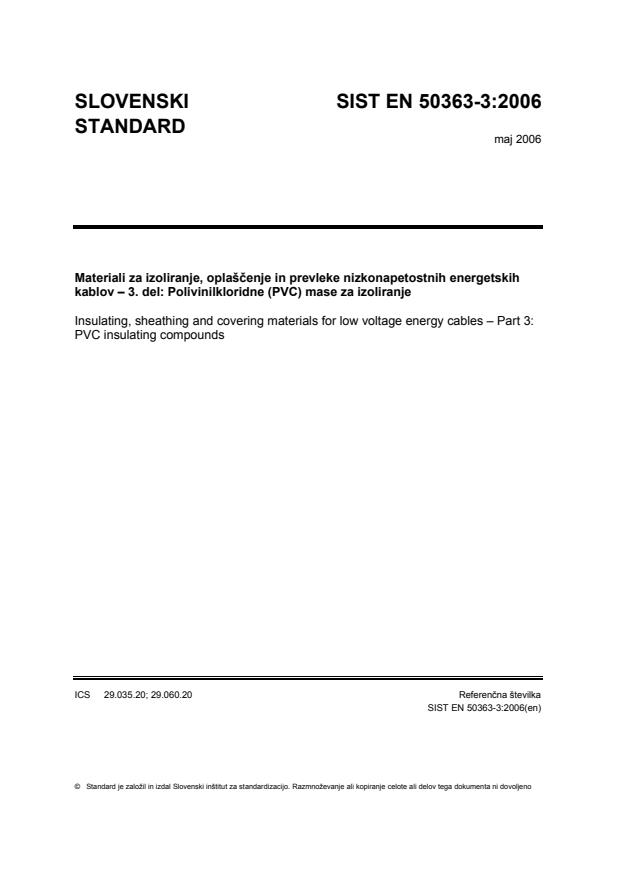

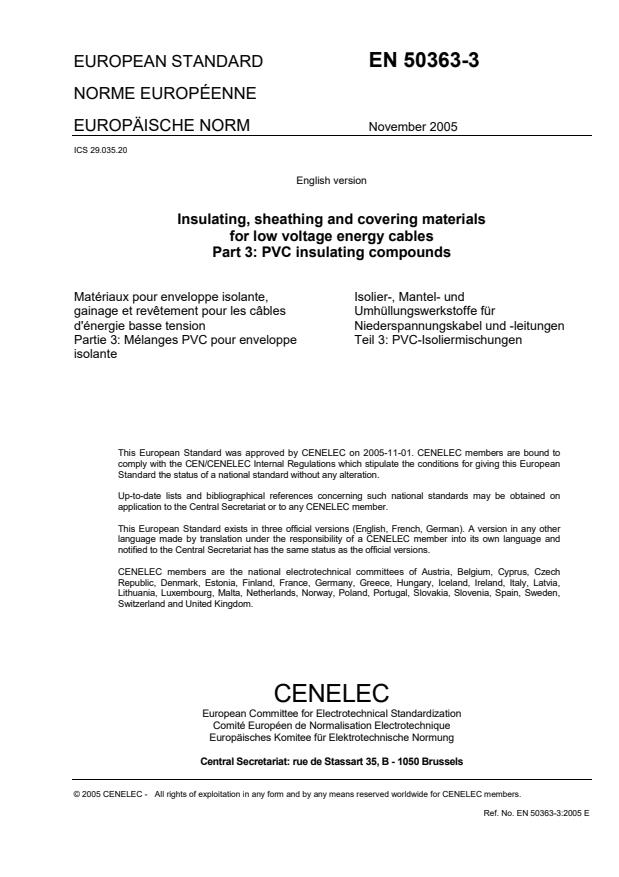
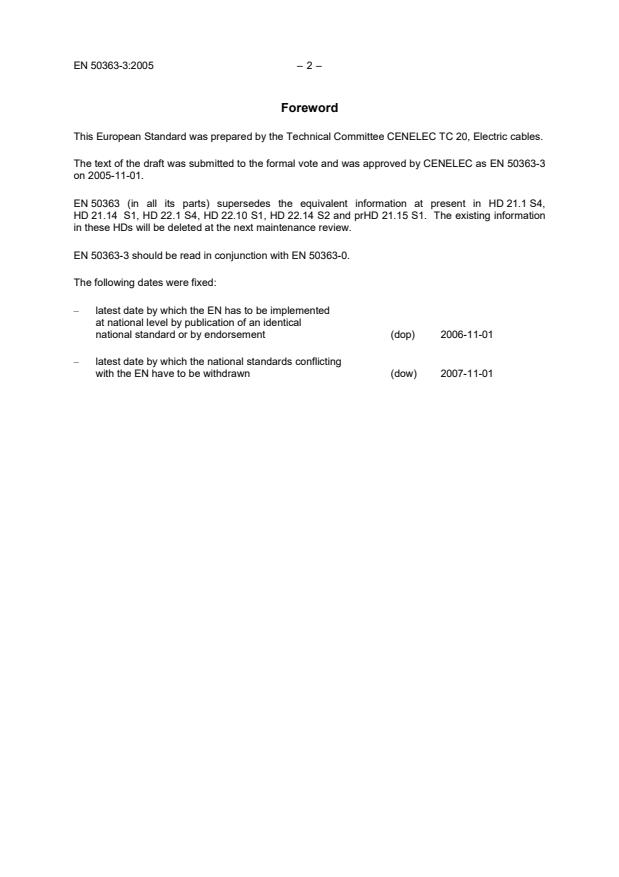
SIST EN 50363-3:2006 is the Slovenian adoption of EN 50363-3 from the European Committee for Electrotechnical Standardization (CENELEC). It specifies the physical property requirements for PVC insulating compounds used in low voltage energy cables, and it points users to the EN 60811 series and EN 50395 for the test methods. It is aimed at cable manufacturers, compound suppliers, test laboratories and specifiers who need to select or verify PVC insulation materials.
What does SIST EN 50363-3:2006 specify?
SIST EN 50363-3:2006 covers the PVC insulating compounds listed in Table 1 and the physical property requirements in Table 2. The standard is meant to be read together with EN 50363-0, which provides the common framework for this series.
The document is organized into four clauses:
- Clause 1 - scope
- Clause 2 - normative references
- Clause 3 - definitions
- Clause 4 - properties
Table 1 classifies the compound types TI 1 to TI 5 by intended use and maximum operating temperature. Table 2 gives the test programme and acceptance criteria for each type.
What are the key requirements of SIST EN 50363-3:2006?
Type classification
SIST EN 50363-3:2006 identifies five PVC insulating compound types, TI 1 to TI 5. The types cover general purpose, flexible, heat resistant, low-temperature installation, and general purpose flexible lower-temperature use. In practice, this lets the user match the compound to the cable's service conditions before testing begins.
Mechanical properties before and after ageing
Clause 4 requires each compound to meet tensile strength and elongation at break limits before ageing and after ageing in an air oven. The ageing test also checks how much the material's properties change after heat exposure. For a buyer or quality manager, this is the key check that the insulation keeps its mechanical performance over time.
Mass loss and thermal behaviour
Table 2 includes a loss of mass test after ageing, plus a heat shock test. These checks matter because they show whether the compound loses too much material under heat and whether it cracks when exposed to hot conditions. The table also includes a minimum thermal stability requirement at elevated temperature for one of the compound types.
Deformation under heat
SIST EN 50363-3:2006 includes a pressure test at high temperature. The result is limited by the depth of indentation, so the compound must resist excessive softening and deformation. In practice, this helps confirm that the insulation will keep its shape during processing and service.
Low-temperature performance
Table 2 specifies bending and elongation tests at low temperature. These tests show whether the compound stays flexible enough to be installed and handled in cold conditions without breaking. That is particularly relevant for cables laid or bent in low-temperature environments.
Electrical insulation performance
The standard also requires an insulation resistance test using EN 50395. This links the material specification to electrical performance, not only mechanical performance. For cable design and quality control, it confirms that the compound still functions as an insulating material.
What terms does SIST EN 50363-3:2006 define?
SIST EN 50363-3:2006 uses the definitions from EN 50363-0, and its main in-document terms are the compound types in Table 1.
- PVC - polyvinyl chloride, the insulating compound family covered by this part.
- TI 1 - a general purpose compound type.
- TI 2 - a flexible compound type, including transparent versions.
- TI 3 - a heat resistant compound type.
- TI 4 - a type intended for installation at low temperatures.
- TI 5 - a general purpose flexible type for lower-temperature use.
Who uses SIST EN 50363-3:2006?
SIST EN 50363-3:2006 is used by manufacturers of low voltage energy cables, suppliers of insulating compounds, and laboratories that test cable materials. It is also useful for quality assurance teams and buyers who need to specify a PVC compound type and check that it meets the required ageing, cold, heat and electrical tests.
What changed in SIST EN 50363-3:2006 from the previous edition?
The foreword says that EN 50363, in all its parts, supersedes the equivalent information in HD 21.1 S4, HD 21.14 S1, HD 22.1 S4, HD 22.10 S1, HD 22.14 S2 and prHD 21.15 S1. It also states that the existing information in those HDs will be deleted at the next maintenance review.
Which standards are used with SIST EN 50363-3:2006?
- EN 50363-0 - provides the common clauses for normative references, definitions and related test information for this series.
- EN 60811 series - provides the physical test methods used for the compound property checks.
- EN 50395 - provides the insulation resistance test used in Table 2.
What does the SIST EN 50363-3:2006 document contain?
SIST EN 50363-3:2006 contains the scope, the reference to common EN 50363-0 clauses, and the property requirements for PVC insulating compounds. Table 1 gives the compound types and their intended applications, while Table 2 sets out the test programme and acceptance criteria.
The test programme covers mechanical properties, ageing, loss of mass, heat shock, pressure at high temperature, low-temperature bending, low-temperature elongation, thermal stability and insulation resistance. The document uses methods from EN 60811 and EN 50395 so that the material checks are tied to standard cable test procedures.
Relations
- Referred By
SIST EN 50214:2024 - Flat flexible cables - Effective Date
- 03-Feb-2026
- Effective Date
- 03-Feb-2026
- Effective Date
- 01-May-2011
Get Certified
Connect with accredited certification bodies for this standard

IMQ S.p.A. (Certification)
Italian electrical product certification.

SLG Prüf- und Zertifizierungs GmbH
German testing and certification body.

UL Solutions
Global safety science company with testing, inspection and certification.
Sponsored listings
Frequently Asked Questions
SIST EN 50363-3:2006 is a standard published by the Slovenian Institute for Standardization (SIST). Its full title is "Insulating, sheathing and covering materials for low voltage energy cables -- Part 3: PVC insulating compounds". This standard covers: This part of EN 50363 specifies the requirements for the physical properties of the PVC insulating compounds given in Table 1. The relevant test methods are given in EN 60811 series and EN 50395.
This part of EN 50363 specifies the requirements for the physical properties of the PVC insulating compounds given in Table 1. The relevant test methods are given in EN 60811 series and EN 50395.
SIST EN 50363-3:2006 is classified under the following ICS (International Classification for Standards) categories: 29.035.20 - Plastics and rubber insulating materials; 29.060.20 - Cables. The ICS classification helps identify the subject area and facilitates finding related standards.
SIST EN 50363-3:2006 has the following relationships with other standards: It is inter standard links to SIST EN 50214:2024, SIST EN 50143:2009, SIST EN 50363-3:2006/A1:2011. Understanding these relationships helps ensure you are using the most current and applicable version of the standard.
SIST EN 50363-3:2006 is associated with the following European legislation: EU Directives/Regulations: 2006/95/EC, 2014/35/EU, 73/23/EEC. When a standard is cited in the Official Journal of the European Union, products manufactured in conformity with it benefit from a presumption of conformity with the essential requirements of the corresponding EU directive or regulation.
SIST EN 50363-3:2006 is available in PDF format for immediate download after purchase. The document can be added to your cart and obtained through the secure checkout process. Digital delivery ensures instant access to the complete standard document.
Standards Content (Sample)
SLOVENSKI SIST EN 50363-3:2006
STANDARD
maj 2006
Materiali za izoliranje, oplaščenje in prevleke nizkonapetostnih energetskih
kablov – 3. del: Polivinilkloridne (PVC) mase za izoliranje
Insulating, sheathing and covering materials for low voltage energy cables – Part 3:
PVC insulating compounds
ICS 29.035.20; 29.060.20 Referenčna številka
© Standard je založil in izdal Slovenski inštitut za standardizacijo. Razmnoževanje ali kopiranje celote ali delov tega dokumenta ni dovoljeno
EUROPEAN STANDARD EN 50363-3
NORME EUROPÉENNE
EUROPÄISCHE NORM November 2005
ICS 29.035.20
English version
Insulating, sheathing and covering materials
for low voltage energy cables
Part 3: PVC insulating compounds
Matériaux pour enveloppe isolante, Isolier-, Mantel- und
gainage et revêtement pour les câbles Umhüllungswerkstoffe für
d'énergie basse tension Niederspannungskabel und -leitungen
Partie 3: Mélanges PVC pour enveloppe Teil 3: PVC-Isoliermischungen
isolante
This European Standard was approved by CENELEC on 2005-11-01. CENELEC members are bound to
comply with the CEN/CENELEC Internal Regulations which stipulate the conditions for giving this European
Standard the status of a national standard without any alteration.
Up-to-date lists and bibliographical references concerning such national standards may be obtained on
application to the Central Secretariat or to any CENELEC member.
This European Standard exists in three official versions (English, French, German). A version in any other
language made by translation under the responsibility of a CENELEC member into its own language and
notified to the Central Secretariat has the same status as the official versions.
CENELEC members are the national electrotechnical committees of Austria, Belgium, Cyprus, Czech
Republic, Denmark, Estonia, Finland, France, Germany, Greece, Hungary, Iceland, Ireland, Italy, Latvia,
Lithuania, Luxembourg, Malta, Netherlands, Norway, Poland, Portugal, Slovakia, Slovenia, Spain, Sweden,
Switzerland and United Kingdom.
CENELEC
European Committee for Electrotechnical Standardization
Comité Européen de Normalisation Electrotechnique
Europäisches Komitee für Elektrotechnische Normung
Central Secretariat: rue de Stassart 35, B - 1050 Brussels
© 2005 CENELEC - All rights of exploitation in any form and by any means reserved worldwide for CENELEC members.
Ref. No. EN 50363-3:2005 E
Foreword
This European Standard was prepared by the Technical Committee CENELEC TC 20, Electric cables.
The text of the draft was submitted to the formal vote and was approved by CENELEC as EN 50363-3
on 2005-11-01.
EN 50363 (in all its parts) supersedes the equivalent information at present in HD 21.1 S4,
HD 21.14 S1, HD 22.1 S4, HD 22.10 S1, HD 22.14 S2 and prHD 21.15 S1. The existing information
in these HDs will be deleted at the next maintenance review.
EN 50363-3 should be read in conjunction with EN 50363-0.
The following dates were fixed:
– latest date by which the EN has to be implemented
at national level by publication of an identical
national standard or by endorsement (dop) 2006-11-01
– latest date by which the national standards conflicting
with the EN have to be withdrawn (dow) 2007-11-01
– 3 – EN 50363-3:2005
Contents
1 Scope.4
2 Normative references.4
3 Definitions.4
4 Properties.4
Table 1 – Types of PVC insulating compound .4
Table 2 – Requirements for the tests for PVC insulating compounds .5
1 Scope
This part of EN 50363 specifies the requirements for the physical properties of the PV
...