

SIST EN IEC 62327:2019
(Main)Radiation protection instrumentation - Hand-held instruments for the detection and identification of radionuclides and for the estimation of ambient dose equivalent rate from photon radiation (IEC 62327:2017)
General Information
- Abstract
This standard applies to hand-held instruments used to detect and identify radionuclides and radioactive material, to estimate ambient dose equivalent rate from photon radiation, and optionally, to detect neutron radiation. They are commonly known as radionuclide identification devices or RIDs.
This standard does not cover laboratory type, high-resolution photon spectrometers, or instruments covered by IEC 60846-1 (Portable workplace and environmental meters and monitors), IEC 60846-2 (photon dose (rate) meters) or IEC 61005 (neutron dose equivalent (rate) meters).
- Status
- Published
- Publication Date
- 04-Nov-2019
- Technical Committee
- I09 - Imaginarni 09
- Current Stage
- 6060 - National Implementation/Publication (Adopted Project)
- Start Date
- 23-Oct-2019
- Due Date
- 28-Dec-2019
- Completion Date
- 05-Nov-2019

Overview
EN IEC 62327:2019 (CLC) is the European adoption of IEC 62327 (Edition 2.0, 2017). It defines requirements and test methods for hand‑held radiation protection instruments-commonly called radionuclide identification devices (RIDs)-used to detect and identify radionuclides, estimate ambient dose equivalent rate from photon (gamma/X‑ray) radiation, and optionally detect neutron radiation. The standard applies to portable, fieldable devices and explicitly excludes laboratory high‑resolution spectrometers and instruments covered by IEC 60846‑1, IEC 60846‑2 or IEC 61005.
Key topics and technical requirements
EN IEC 62327:2019 covers both functional and environmental/mechanical criteria, including:
Detector and measurement requirements
- Procedures for estimating ambient dose equivalent rate from photon radiation
- Gamma source localization and over‑range behavior
- Optional neutron detection and neutron indication in mixed fields
- Radionuclide identification algorithms, libraries and performance for single and mixed sources
Performance validation and test methods
- General test procedures, statistical considerations and functionality checks
- Stabilization time, personal protection alarm behavior, and battery performance tests
- Communication interface and data reporting requirements
Environmental and EMC requirements
- Temperature, temperature shock, humidity, dust and moisture protection
- Vibration, mechanical shock and impact (microphonics)
- Electromagnetic compatibility (references to IEC 61000 series)
Marking, documentation and data format
- Required labels, user information and data output formatting for detection/identification results
Applications and who uses this standard
EN IEC 62327:2019 is relevant to organizations and professionals involved in radiation detection, safety and emergency response:
- Manufacturers and designers of portable radiation detectors and RIDs for product design, compliance testing and declaration of conformity
- Test laboratories and certification bodies conducting type‑approval, performance verification and environmental testing
- Procurement officers in nuclear, medical, industrial and security sectors evaluating hand‑held instruments
- Radiation protection officers, first responders, customs and border security personnel who operate or specify instruments for field detection, identification and radiological monitoring
- Regulatory authorities and emergency planners defining operational requirements and acceptance criteria for field equipment
Related standards
- IEC 60846‑1 / EN 60846‑1 - portable workplace and environmental dose (rate) meters
- IEC 60846‑2 / EN 60846‑2 - high‑range beta/photon portable dose meters
- IEC 61005 - neutron dose equivalent (rate) meters
- IEC 60068 series - environmental testing methods (temperature, shock, vibration)
- IEC 61000‑4 series - EMC immunity tests
- IEC 62706, IEC 62755 - related radiation instrument performance and data formats
EN IEC 62327:2019 is a practical reference for ensuring reliable field performance, interoperability and safety of hand‑held radionuclide detection and identification equipment. Keywords: radiation protection instrumentation, radionuclide identification devices, ambient dose equivalent rate, hand‑held instruments, EN IEC 62327:2019.
Relations
- Effective Date
- 22-Oct-2019
- Effective Date
- 03-Feb-2026
- Effective Date
- 03-Feb-2026
- Effective Date
- 03-Feb-2026
- Effective Date
- 03-Feb-2026
- Effective Date
- 03-Feb-2026
- Effective Date
- 03-Feb-2026
- Effective Date
- 03-Feb-2026
- Effective Date
- 03-Feb-2026
- Effective Date
- 03-Feb-2026
- Effective Date
- 03-Feb-2026
- Effective Date
- 03-Feb-2026
- Effective Date
- 03-Feb-2026
- Effective Date
- 03-Feb-2026
- Refers
SIST EN 60068-2-27:2009 - Environmental testing -- Part 2-27: Tests - Test Ea and guidance: Shock - Effective Date
- 03-Feb-2026
Get Certified
Connect with accredited certification bodies for this standard

CIS Institut d.o.o.
Personal Protective Equipment (PPE) certification body. Notified Body NB-2890 for EU Regulation 2016/425 PPE.

Kiwa BDA Testing
Building and construction product certification.
Kmetijski inštitut Slovenije
Agricultural Institute of Slovenia. Soil testing, plant health, agricultural product analysis.
Sponsored listings
Frequently Asked Questions
SIST EN IEC 62327:2019 is a standard published by the Slovenian Institute for Standardization (SIST). Its full title is "Radiation protection instrumentation - Hand-held instruments for the detection and identification of radionuclides and for the estimation of ambient dose equivalent rate from photon radiation (IEC 62327:2017)". This standard covers: This standard applies to hand-held instruments used to detect and identify radionuclides and radioactive material, to estimate ambient dose equivalent rate from photon radiation, and optionally, to detect neutron radiation. They are commonly known as radionuclide identification devices or RIDs. This standard does not cover laboratory type, high-resolution photon spectrometers, or instruments covered by IEC 60846-1 (Portable workplace and environmental meters and monitors), IEC 60846-2 (photon dose (rate) meters) or IEC 61005 (neutron dose equivalent (rate) meters).
This standard applies to hand-held instruments used to detect and identify radionuclides and radioactive material, to estimate ambient dose equivalent rate from photon radiation, and optionally, to detect neutron radiation. They are commonly known as radionuclide identification devices or RIDs. This standard does not cover laboratory type, high-resolution photon spectrometers, or instruments covered by IEC 60846-1 (Portable workplace and environmental meters and monitors), IEC 60846-2 (photon dose (rate) meters) or IEC 61005 (neutron dose equivalent (rate) meters).
SIST EN IEC 62327:2019 is classified under the following ICS (International Classification for Standards) categories: 13.280 - Radiation protection. The ICS classification helps identify the subject area and facilitates finding related standards.
SIST EN IEC 62327:2019 has the following relationships with other standards: It is inter standard links to SIST EN 62327:2011, SIST EN IEC 60068-2-14:2024, SIST EN 61000-4-3:2006, SIST EN 60846-1:2014, SIST EN IEC 60068-2-1:2026, SIST EN 61005:2017, SIST EN 61000-4-2:2009, SIST EN IEC 60068-2-2:2026, SIST EN 60068-2-66:2001, SIST EN 61000-4-6:2014, SIST EN 60846-2:2018, SIST EN 61000-4-8:2010, SIST EN 60068-2-18:2017, SIST EN 60068-2-68:2001, SIST EN 60068-2-27:2009. Understanding these relationships helps ensure you are using the most current and applicable version of the standard.
SIST EN IEC 62327:2019 is available in PDF format for immediate download after purchase. The document can be added to your cart and obtained through the secure checkout process. Digital delivery ensures instant access to the complete standard document.
Standards Content (Sample)
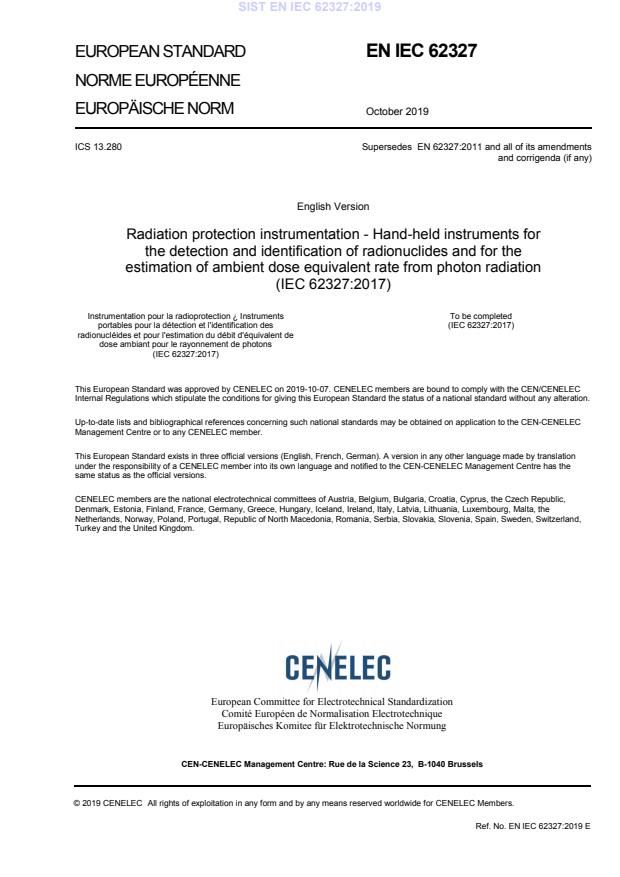
SLOVENSKI STANDARD
01-december-2019
Nadomešča:
SIST EN 62327:2011
Instrumenti za zaščito pred sevanjem - Ročni instrumenti za odkrivanje in
prepoznavanje radionuklidov in za prikaz stopnje ekvivalentne doze v prostoru
zaradi fotonskega sevanja (IEC 62327:2017)
Radiation protection instrumentation - Hand-held instruments for the detection and
identification of radionuclides and for the estimation of ambient dose equivalent rate from
photon radiation (IEC 62327:2017)
Instrumentation pour la radioprotection Instruments portables pour la détection et
l'identification des radionucléides et pour l'estimation du débit d'équivalent de dose
ambiant pour le rayonnement de photons (IEC 62327:2017)
Ta slovenski standard je istoveten z: EN IEC 62327:2019
ICS:
13.280 Varstvo pred sevanjem Radiation protection
2003-01.Slovenski inštitut za standardizacijo. Razmnoževanje celote ali delov tega standarda ni dovoljeno.
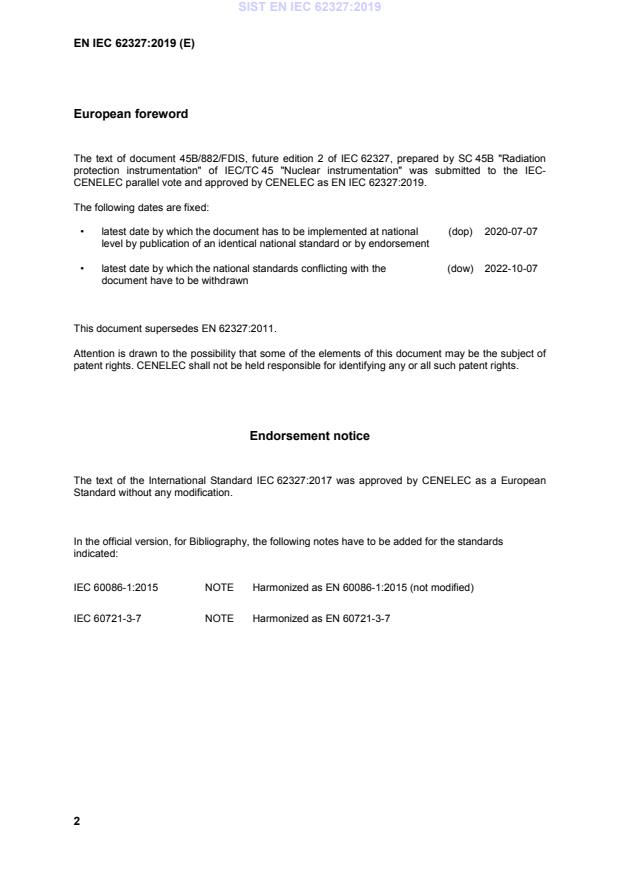
EUROPEAN STANDARD EN IEC 62327
NORME EUROPÉENNE
EUROPÄISCHE NORM
October 2019
ICS 13.280 Supersedes EN 62327:2011 and all of its amendments
and corrigenda (if any)
English Version
Radiation protection instrumentation - Hand-held instruments for
the detection and identification of radionuclides and for the
estimation of ambient dose equivalent rate from photon radiation
(IEC 62327:2017)
Instrumentation pour la radioprotection ¿ Instruments To be completed
portables pour la détection et l'identification des (IEC 62327:2017)
radionucléides et pour l'estimation du débit d'équivalent de
dose ambiant pour le rayonnement de photons
(IEC 62327:2017)
This European Standard was approved by CENELEC on 2019-10-07. CENELEC members are bound to comply with the CEN/CENELEC
Internal Regulations which stipulate the conditions for giving this European Standard the status of a national standard without any alteration.
Up-to-date lists and bibliographical references concerning such national standards may be obtained on application to the CEN-CENELEC
Management Centre or to any CENELEC member.
This European Standard exists in three official versions (English, French, German). A version in any other language made by translation
under the responsibility of a CENELEC member into its own language and notified to the CEN-CENELEC Management Centre has the
same status as the official versions.
CENELEC members are the national electrotechnical committees of Austria, Belgium, Bulgaria, Croatia, Cyprus, the Czech Republic,
Denmark, Estonia, Finland, France, Germany, Greece, Hungary, Iceland, Ireland, Italy, Latvia, Lithuania, Luxembourg, Malta, the
Netherlands, Norway, Poland, Portugal, Republic of North Macedonia, Romania, Serbia, Slovakia, Slovenia, Spain, Sweden, Switzerland,
Turkey and the United Kingdom.
European Committee for Electrotechnical Standardization
Comité Européen de Normalisation Electrotechnique
Europäisches Komitee für Elektrotechnische Normung
CEN-CENELEC Management Centre: Rue de la Science 23, B-1040 Brussels
© 2019 CENELEC All rights of exploitation in any form and by any means reserved worldwide for CENELEC Members.
Ref. No. EN IEC 62327:2019 E
European foreword
The text of document 45B/882/FDIS, future edition 2 of IEC 62327, prepared by SC 45B "Radiation
protection instrumentation" of IEC/TC 45 "Nuclear instrumentation" was submitted to the IEC-
CENELEC parallel vote and approved by CENELEC as EN IEC 62327:2019.
The following dates are fixed:
• latest date by which the document has to be implemented at national (dop) 2020-07-07
level by publication of an identical national standard or by endorsement
• latest date by which the national standards conflicting with the (dow) 2022-10-07
document have to be withdrawn
This document supersedes EN 62327:2011.
Attention is drawn to the possibility that some of the elements of this document may be the subject of
patent rights. CENELEC shall not be held responsible for identifying any or all such patent rights.
Endorsement notice
The text of the International Standard IEC 62327:2017 was approved by CENELEC as a European
Standard without any modification.
In the official version, for Bibliography, the following notes have to be added for the standards
indicated:
IEC 60086-1:2015 NOTE Harmonized as EN 60086-1:2015 (not modified)
IEC 60721-3-7 NOTE Harmonized as EN 60721-3-7
Annex ZA
(normative)
Normative references to international publications
with their corresponding European publications
The following documents are referred to in the text in such a way that some or all of their content
constitutes requirements of this document. For dated references, only the edition cited applies. For
undated references, the latest edition of the referenced document (including any amendments)
applies.
NOTE 1 Where an International Publication has been modified by common modifications, indicated by (mod), the relevant
EN/HD applies.
NOTE 2 Up-to-date information on the latest versions of the European Standards listed in this annex is available here:
www.cenelec.eu.
Publication Year Title EN/HD Year
IEC 60050-395 2014 International Electrotechnical Vocabulary - - -
Part 395: Nuclear instrumentation: Physical
phenomena, basic concepts, instruments,
systems, equipment and detectors
IEC 60068-2-1 - Environmental testing - Part 2-1: Tests - EN 60068-2-1 -
Test A: Cold
IEC 60068-2-2 - Environmental testing - Part 2-2: Tests - EN 60068-2-2 -
Test B: Dry heat
IEC 60068-2-11 - Basic environmental testing procedures - EN 60068-2-11 -
Part 2-11: Tests - Test Ka: Salt mist
IEC 60068-2-14 - Environmental testing - Part 2-14: Tests - EN 60068-2-14 -
Test N: Change of temperature
IEC 60068-2-18 - EN 60068-2-18 -
IEC 60068-2-27 2008 Environmental testing - Part 2-27: Tests - EN 60068-2-27 2009
Test Ea and guidance: Shock
IEC 60068-2-64 - Environmental testing - Part 2-64: Tests - EN 60068-2-64 -
Test Fh: Vibration, broadband random and
guidance
IEC 60068-2-66 - Environmental testing - Part 2: Test EN 60068-2-66 -
methods - Test Cx: Damp heat, steady
state (unsaturated pressurized vapour)
IEC 60068-2-68 - Environmental testing - Part 2-68: Tests - EN 60068-2-68 -
Test L: Dust and sand
IEC 60529 - Degrees of protection provided by - -
enclosures (IP Code)
IEC 60846-1 (mod) - Radiation protection instrumentation - EN 60846-1 -
Ambient and/or directional dose equivalent
(rate) meters and/or monitors for beta, X
and gamma radiation - Part 1: Portable
workplace and environmental meters and
monitors
IEC 60846-2 (mod) - Radiation protection instrumentation - EN 60846-2 -
Ambient and/or directional dose equivalent
(rate) meters and/or monitors for beta, X
and gamma radiation - Part 2: High range
beta and photon dose and dose rate
portable instruments for emergency
radiation protection purposes
Publication Year Title EN/HD Year
IEC 61000-4-2 2008 Electromagnetic compatibility (EMC) - PartE N 61000-4-2 2009
4-2: Testing and measurement techniques
- Electrostatic discharge immunity test
IEC 61000-4-3 2006 Electromagnetic compatibility (EMC) - PartE N 61000-4-3 2006
4-3 : Testing and measurement techniques
- Radiated, radio-frequency,
electromagnetic field immunity test
IEC 61000-4-6 2013 Electromagnetic compatibility (EMC) - PartE N 61000-4-6 2014
4-6: Testing and measurement techniques
- Immunity to conducted disturbances,
induced by radio-frequency fields
IEC 61000-4-8 2009 Electromagnetic compatibility (EMC) - PartE N 61000-4-8 2010
4-8: Testing and measurement techniques
- Power frequency magnetic field immunity
test
IEC 61005 (mod) - EN 61005 -
IEC 61187 (mod) - Electrical and electronic measuring EN 61187 -
equipment - Documentation
+EN 1995
61187:1994/corrige
ndum Mar. 1995
IEC 62706 - Radiation protection instrumentation - - -
Environmental, electromagnetic and
mechanical performance requirements
IEC 62755 - Radiation protection instrumentation - Data - -
format for radiation instruments used in the
detection of illicit trafficking of radioactive
materials
IEC 62327 ®
Edition 2.0 2017-12
INTERNATIONAL
STANDARD
Radiation protection instrumentation – Hand-held instruments for the detection
and identification of radionuclides and for the estimation of ambient dose
equivalent rate from photon radiation
INTERNATIONAL
ELECTROTECHNICAL
COMMISSION
ICS 13.280 ISBN 978-2-8322-5182-9
– 2 – IEC 62327:2017 © IEC 2017
CONTENTS
FOREWORD . 5
INTRODUCTION . 7
1 Scope . 8
2 Normative references . 8
3 Terms and definitions, abbreviated terms and symbols, quantities and units . 9
3.1 Terms and definitions . 9
3.2 Abbreviated terms and symbols . 11
3.3 Quantities and units . 12
4 General characteristics and requirements . 12
4.1 General . 12
4.2 Radiation detectors . 12
4.3 Personal protection alarm . 12
4.3.1 Requirements . 12
4.3.2 Method of test. 12
4.4 Stabilization time . 13
4.4.1 Requirements . 13
4.4.2 Method of test. 13
4.5 Power supplies – battery . 13
4.5.1 Requirements . 13
4.5.2 Method of test. 13
4.6 Markings . 14
4.7 Communication interface. 14
4.7.1 Requirements . 14
4.7.2 Method of test. 14
4.8 Data . 14
4.8.1 Requirements . 14
4.8.2 Method of test. 15
5 General test procedures . 15
5.1 Nature of test . 15
5.2 Statistical fluctuations . 15
5.3 Standard test conditions . 15
5.4 Functionality test . 16
5.4.1 General . 16
5.4.2 Pre-test measurements . 16
5.4.3 Intermediate measurements. 16
5.4.4 Post-test measurements . 16
6 Radiation detection requirements . 17
6.1 Ambient dose equivalent rate . 17
6.1.1 Requirements . 17
6.1.2 Method of test. 17
6.2 Gamma source localization . 17
6.2.1 Requirements . 17
6.2.2 Method of test. 17
6.3 Over-range characteristics for ambient dose equivalent rate . 18
6.3.1 Requirements . 18
6.3.2 Method of test. 18
IEC 62327:2017 © IEC 2017 – 3 –
6.4 Neutron detection . 18
6.4.1 Requirements . 18
6.4.2 Method of test. 19
6.5 Neutron indication in the presence of photons . 19
6.5.1 Requirements . 19
6.5.2 Method of test. 19
6.6 Radionuclide identification . 20
6.6.1 Radionuclide identification library . 20
6.6.2 Identification results . 20
6.6.3 Radionuclide and radioactive material identification . 21
6.6.4 Identification of mixed radioactive materials . 22
7 Environmental requirements . 23
7.1 General . 23
7.2 Ambient temperature. 23
7.2.1 Requirements . 23
7.2.2 Method of test. 23
7.3 Temperature shock . 23
7.3.1 Requirements . 23
7.3.2 Method of test. 24
7.4 Relative humidity . 24
7.4.1 Requirements . 24
7.4.2 Method of test. 24
7.5 Low/high temperature start-up . 24
7.5.1 Requirements . 24
7.5.2 Method of test. 25
7.6 Moisture and dust protection . 25
7.6.1 Requirements . 25
7.6.2 Method of test – dust . 25
7.6.3 Method of test – moisture . 25
8 Mechanical requirements . 26
8.1 General . 26
8.2 Vibration . 26
8.2.1 Requirements . 26
8.2.2 Method of test. 26
8.3 Mechanical shock . 26
8.3.1 Requirements . 26
8.3.2 Method of test. 26
8.4 Impact (microphonics) . 26
8.4.1 Requirements . 26
8.4.2 Method of test. 27
9 Electromagnetic requirements . 27
9.1 General . 27
9.2 Electrostatic Discharge (ESD) . 27
9.2.1 Requirements . 27
9.2.2 Method of test. 27
9.3 Radio Frequency (RF) . 27
9.3.1 Requirements . 27
9.3.2 Method of test. 27
9.4 Radiated RF emissions . 28
– 4 – IEC 62327:2017 © IEC 2017
9.4.1 Requirements . 28
9.4.2 Method of test. 28
9.5 Conducted disturbances. 28
9.5.1 Requirements . 28
9.5.2 Method of test. 29
9.6 Magnetic fields . 29
9.6.1 Requirements . 29
9.6.2 Method of test. 29
10 Documentation . 29
10.1 Operation and maintenance manual . 29
10.2 Test certificate . 30
10.3 Declaration of conformity . 30
Bibliography . 33
Table 1 – IEC standards concerning instruments for the detection of illicit trafficking of
radioactive material . 7
Table 2 – Standard test conditions . 15
Table 3 – Test result analysis . 17
Table 4 – Radionuclide library . 20
Table 5 – Guidance regarding identification performance . 22
Table 6 – List of likely daughters and possible impurities . 22
Table 7 – Emission frequency limits . 28
Table 8 – Summary of performance requirements . 31
IEC 62327:2017 © IEC 2017 – 5 –
INTERNATIONAL ELECTROTECHNICAL COMMISSION
____________
RADIATION PROTECTION INSTRUMENTATION –
HAND-HELD INSTRUMENTS FOR THE DETECTION AND IDENTIFICATION
OF RADIONUCLIDES AND FOR THE ESTIMATION OF AMBIENT DOSE
EQUIVALENT RATE FROM PHOTON RADIATION
FOREWORD
1) The International Electrotechnical Commission (IEC) is a worldwide organization for standardization comprising
all national electrotechnical committees (IEC National Committees). The object of IEC is to promote
international co-operation on all questions concerning standardization in the electrical and electronic fields. To
this end and in addition to other activities, IEC publishes International Standards, Technical Specifications,
Technical Reports, Publicly Available Specifications (PAS) and Guides (hereafter referred to as “IEC
Publication(s)”). Their preparation is entrusted to technical committees; any IEC National Committee interested
in the subject dealt with may participate in this preparatory work. International, governmental and non-
governmental organizations liaising with the IEC also participate in this preparation. IEC collaborates closely
with the International Organization for Standardization (ISO) in accordance with conditions determined by
agreement between the two organizations.
2) The formal decisions or agreements of IEC on technical matters express, as nearly as possible, an international
consensus of opinion on the relevant subjects since each technical committee has representation from all
interested IEC National Committees.
3) IEC Publications have the form of recommendations for international use and are accepted by IEC National
Committees in that sense. While all reasonable efforts are made to ensure that the technical content of IEC
Publications is accurate, IEC cannot be held responsible for the way in which they are used or for any
misinterpretation by any end user.
4) In order to promote international uniformity, IEC National Committees undertake to apply IEC Publications
transparently to the maximum extent possible in their national and regional publications. Any divergence
between any IEC Publication and the corresponding national or regional publication shall be clearly indicated in
the latter.
5) IEC itself does not provide any attestation of conformity. Independent certification bodies provide conformity
assessment services and, in some areas, access to IEC marks of conformity. IEC is not responsible for any
services carried out by independent certification bodies.
6) All users should ensure that they have the latest edition of this publication.
7) No liability shall attach to IEC or its directors, employees, servants or agents including individual experts and
members of its technical committees and IEC National Committees for any personal injury, property damage or
other damage of any nature whatsoever, whether direct or indirect, or for costs (including legal fees) and
expenses arising out of the publication, use of, or reliance upon, this IEC Publication or any other IEC
Publications.
8) Attention is drawn to the Normative references cited in this publication. Use of the referenced publications is
indispensable for the correct application of this publication.
9) Attention is drawn to the possibility that some of the elements of this IEC Publication may be the subject of
patent rights. IEC shall not be held responsible for identifying any or all such patent rights.
International Standard IEC 62327 has been prepared by subcommittee 45B: Radiation
protection instrumentation, of IEC technical committee 45: Nuclear instrumentation.
This second edition cancels and replaces the first edition of IEC 62327, issued in 2006. It
constitutes a technical revision.
This edition includes the following significant technical changes with respect to the previous
edition:
a) addition of detailed methods of test;
b) revised identification test acceptance criteria for environmental tests;
c) changed format to match SC 45B template.
– 6 – IEC 62327:2017 © IEC 2017
The text of this International Standard is based on the following documents:
FDIS Report on voting
45B/882/FDIS 45B/887/RVD
Full information on the voting for the approval of this International Standard can be found in
the report on voting indicated in the above table.
This document has been drafted in accordance with the ISO/IEC Directives, Part 2.
The committee has decided that the contents of this document will remain unchanged until the
stability date indicated on the IEC website under "http://webstore.iec.ch" in the data related to
the specific document. At this date, the document will be
• reconfirmed,
• withdrawn,
• replaced by a revised edition, or
• amended.
A bilingual version of this publication may be issued at a later date.
IEC 62327:2017 © IEC 2017 – 7 –
INTRODUCTION
Illicit and inadvertent movement of radioactive materials in the form of radiation sources and
contaminated metallurgical scrap has become a problem of increasing importance.
Radioactive sources out of regulatory control, so-called “orphan sources”, have frequently
caused serious radiation exposures and widespread contamination. Although illicit trafficking
in nuclear and other radioactive materials is not a new phenomenon, concern about a nuclear
“black market” has increased in the last few years particularly in view of its terrorist potential.
In response to the technical policy of the International Atomic Energy Agency (IAEA), the
World Customs Organization (WCO) and the International Criminal Police Organization
(Interpol) related to the detection and identification of special nuclear materials and security
trends, nuclear instrumentation companies are developing and manufacturing radiation
instrumentation to assist in the detection of illicit movement of radioactive and special nuclear
materials. This type of instrumentation is widely used for security purposes at nuclear
facilities, border control checkpoints, and international seaports and airports. However, to
ensure that measurement results made at different locations are consistent, it is imperative
that radiation instrumentation be designed to rigorous specifications based upon agreed
performance requirements stated in this document. IEC standards have also been developed
to address personal radiation detectors, radiation portal monitors, highly sensitive gamma and
neutron detection systems, spectrometric personal radiation detectors, and backpack-based
radiation detection and identification systems. Table 1 below contains a list of those
standards.
Table 1 – IEC standards concerning instruments for the detection
of illicit trafficking of radioactive material
Type of IEC
Title of the standard
instrumentation number
Radiation protection instrumentation – Alarming Personal Radiation Devices
(PRDs) for the detection of illicit trafficking of radioactive material
Radiation protection instrumentation – Spectroscopy-Based Alarming Personal
Body-worn 62618
Radiation Devices (SPRD) for detection of illicit trafficking of radioactive material
Radiation protection instrumentation – Backpack-type radiation detector (BRD) for
detection of illicit trafficking of radioactive material
Radiation protection instrumentation – Hand-held instruments for the detection and
62327 identification of radionuclides and for the estimation of ambient dose equivalent
rate from photon radiation
Portable or
Radiation protection instrumentation – Highly sensitive hand-held instruments for
hand-held 62533
photon detection of radioactive material
Radiation protection instrumentation – Highly sensitive hand-held instruments for
neutron detection of radioactive material
Radiation protection instrumentation – Installed radiation portal monitors (RPMs)
for the detection of illicit trafficking of radioactive and nuclear materials
Portal
Radiation protection instrumentation – Spectroscopy-based portal monitors used
for the detection and identification of illicit trafficking of radioactive material
Radiation protection instrumentation – Data format for radiation instruments used
Data format 62755
in the detection of illicit trafficking of radioactive materials
– 8 – IEC 62327:2017 © IEC 2017
RADIATION PROTECTION INSTRUMENTATION –
HAND-HELD INSTRUMENTS FOR THE DETECTION AND IDENTIFICATION
OF RADIONUCLIDES AND FOR THE ESTIMATION OF AMBIENT DOSE
EQUIVALENT RATE FROM PHOTON RADIATION
1 Scope
This document applies to hand-held instruments used to detect and identify radionuclides and
radioactive material, to estimate ambient dose equivalent rate from photon radiation, and
optionally, to detect neutron radiation. They are commonly known as radionuclide
identification devices or RIDs.
This document specifies general characteristics, general test procedures, radiation
characteristics, as well as electrical, mechanical, safety, and environmental characteristics.
This document does not cover laboratory type, high-resolution photon spectrometers, or
instruments covered by IEC 60846-1 (Portable workplace and environmental meters and
monitors), IEC 60846-2 (photon dose (rate) meters) or IEC 61005 (neutron dose equivalent
(rate) meters).
Table 8 provides a summary of requirements and relevant clauses.
2 Normative references
The following documents are referred to in the text in such a way that some or all of their
content constitutes requirements of this document. For dated references, only the edition
cited applies. For undated references, the latest edition of the referenced document (including
any amendments) applies.
IEC 60050-395:2014, International Electrotechnical Vocabulary (IEV) – Part 395: Nuclear
instrumentation: physical phenomena, basic concepts, instruments, systems, equipment and
detectors
IEC 60068-2-1, Environmental testing – Part 2-1: Tests – Test A: Cold
IEC 60068-2-2, Environmental testing – Part 2-2: Tests – Test B: Dry heat
IEC 60068-2-11, Basic environmental testing procedures – Part 2 -11: Tests – Test Ka: Salt
mist
IEC 60068-2-14, Environmental testing – Part 2-14: Tests – Test N: Change of temperature
IEC 60068-2-18, Environmental testing – Part 2-18: Tests – Test R and guidance: Water
IEC 60068-2-27:2008, Environmental testing – Part 2-27: Tests – Test Ea and guidance:
Shock
IEC 60068-2-64, Environmental testing – Part 2-64: Tests – Test Fh: Vibration, broadband
random and guidance
IEC 60068-2-66, Environmental testing – Part 2-66: Test methods – Test Cx: Damp heat,
steady state (unsaturated pressurized vapour)
IEC 62327:2017 © IEC 2017 – 9 –
IEC 60068-2-68, Environmental testing – Part 2-68: Tests – Test L: Dust and sand
IEC 60529, Degrees of protection provided by enclosures (IP Code)
IEC 60846-1, Radiation protection instrumentation – Ambient and/or directional dose
equivalent (rate) meters and/or monitors for beta, X and gamma radiation – Part 1: Portable
workplace and environmental meters and monitors
IEC 60846-2, Radiation protection instrumentation – Ambient and/or directional dose
equivalent (rate) meters and/or monitors for beta, X and gamma radiation – Part 2: High range
beta and photon dose and dose rate portable instruments for emergency radiation protection
purposes
IEC 61000-4-2:2008, Electromagnetic compatibility (EMC) – Part 4-2: Testing and
measurement techniques – Electrostatic discharge immunity test
IEC 61000-4-3:2006, Electromagnetic compatibility (EMC) – Part 4-3: Testing and
measurement techniques – Radiated, radio-frequency, electromagnetic field immunity test
IEC 61000-4-3:2006/AMD1:2007
IEC 61000-4-3:2006/AMD2:2010
IEC 61000-4-6:2013, Electromagnetic compatibility (EMC) – Part 4-6: Testing and
measurement techniques – Immunity to conducted disturbances, induced by radio-frequency
fields
IEC 61000-4-8:2009, Electromagnetic compatibility (EMC) – Part 4-8: Testing and
measurement techniques – Power frequency magnetic field immunity test
IEC 61005, Radiation protection instrumentation – Neutron ambient dose equivalent (rate)
meters
IEC 61187, Electrical and electronic measuring equipment – Documentation
IEC 62706, Radiation protection instrumentation – Environmental, electromagnetic and
mechanical performance requirements
IEC 62755, Radiation protection instrumentation – Data format for radiation instruments used
in the detection of illicit trafficking of radioactive materials
3 Terms and definitions, abbreviated terms and symbols, quantities and units
3.1 Terms and definitions
For the purposes of this document, the following terms and definitions, as well as those given
in IEC 60050-395 apply.
ISO and IEC maintain terminological databases for use in standardization at the following
addresses:
• IEC Electropedia: available at http://www.electropedia.org/
• ISO Online browsing platform: available at http://www.iso.org/obp
3.1.1
acceptance test
contractual test to prove to the customer that a device meets certain conditions of its
specification
– 10 – IEC 62327:2017 © IEC 2017
3.1.2
alarm
audible, visual, or other signal activated when the reading exceeds a pre-set value or falls
outside a pre-set range
3.1.3
ambient dose equivalent (rate)
dose equivalent (rate) at a point in a radiation field, produced by the corresponding aligned
and expanded field, in the ICRU sphere at a depth d, on the radius opposing the direction of
the aligned field
Note 1 to entry: This definition does not include the notes that are part of definition IEC 60050-395:2014,
395-05-43.
3.1.4
background
radiation field in which there are no external sources present other than those in the natural
radiation field at the location of the measurements
3.1.5
coefficient of variation
ratio of the standard deviation s to the arithmetic mean of a set of n measurements x given
i
by the following formula:
3.1.6
confidence indicator
typically a numeric value assigned to a radionuclide identification result as to whether the
identified radionuclide is present
3.1.7
conventionally true value
best estimate of the true value of a radiation field or source used for testing or calibration of
equipment
3.1.8
error of indication
difference between the indicated value ν of a quantity and the conventionally true value, CTV,
of that quantity at the point of measurement
3.1.9
integration time
length of time used for collection of data to obtain a result
3.1.10
reference point
location marked on the instrument or described in the manual, used to establish radiation
source-to-instrument distances and orientation for calibration or test purposes
3.1.11
relative intrinsic error
ε
REL
difference between the instrument’s reading, M, and the conventionally true value, CTV, of the
quantity being measured divided by the conventionally true value when subjected to a
specified reference quantity under specified reference conditions as given by the formula:
IEC 62327:2017 © IEC 2017 – 11 –
M− CTV
ε =
REL
CTV
3.1.12
restricted mode
operating mode used to access spectral data and to control the parameters that can affect the
result of a measurement (for example: radionuclide library, routine function control, calibration
parameters, alarm thresholds, etc.)
Note 1 to entry: May also be called expert mode.
Note 2 to entry: Access to this mode should be limited through password protection or other similar methods.
3.1.13
routine mode
operating mode that includes detection and identification of radionuclides, and estimation of
the ambient dose equivalent rate
Note 1 to entry: May also be called easy mode.
3.1.14
stabilization time
duration, measured from the initial application of power, required for an instrument to indicate
that it is operational
3.1.15
type test
conformity test on one or more specimens of a product representative of the production
3.1.16
uncertainty
parameter, associated with the result of a measurement, that characterizes the dispersion of
the values that could reasonably be attributed to the measurand
Note 1 to entry: Uncertainty of measurement comprises, in general, many components. Some of these
components may be evaluated from statistical distribution of the results of series of measurements and can be
characterized by experimental standard deviations. The other components, which can also be characterized by
experimental standard deviations, are evaluated from assumed probability distributions based on experience or
other information.
Note 2 to entry: It is understood that the result of the measurement is the best estimate of the value of the
measurand and that all components of uncertainty, including those arising from systematic effects, such as
components associated with corrections and reference standards, contribute to the dispersion.
3.2 Abbreviated terms and symbols
COV coefficient of variation
ESD electrostatic discharge
DU depleted uranium
HEU highly enriched uranium
ICRU International Commission on Radiation Units
lx lux
NORM naturally occurring radioactive material
RF radio frequency
RGPu reactor grade plutonium
RH relative humidity
RID radionuclide identification device
WGPu weapons grade plutonium
– 12 – IEC 62327:2017 © IEC 2017
3.3 Quantities and units
In this document, units of the International System (SI) are used . The definitions of radiation
quantities are given in IEC 60050-395.
The following units may also be used:
–19
– for energy: electron-volt (symbol: eV), 1 eV = 1,602 x 10 J;
– for time: years (symbol: y), days (symbol: d), hours (symbol: h), minutes (symbol: min);
– for temperature: degrees Celsius (symbol: ºC), 0 ºC = 273,15 K.
Multiples and submultiples of SI units will be used, when practicable, according to the SI
system.
4 General characteristics and requirements
4.1 General
RIDs are used for the detection, localization, and identification of radioactive material and for
estimation of the ambient dose equivalent rate. They are hand-held, battery-powered
instruments most commonly used for the detection and identification of illicit trafficking of
radioactive material. They typically measure the photon energy spectrum and identify the
radionuclide by comparison with an internal radionuclide library. RIDs may also detect
neutrons.
The following are important design features:
– a display that is readable in low light (< 150 lx) and bright light (> 10 000 lx) conditions,
– user friendly controls, a menu structure that is simple and easy to follow, restricted access
to critical operating parameters, and switches and other controls that minimize or prevent
inadvertent operation.
NOTE During the development of this document, a desire for a RID to provide a simple user display for
identification results was noted. The display discussed would provide identification results in the form of, for
example, a green or red display to indicate that the radionuclide(s) identified was either not of interest or of
possible interest, respectively. At the time of this revision, no specific functional requirements had been
established. Requirements for the capability may be part of future revisions of this document.
4.2 Radiation detectors
RIDs may use multiple detectors to detect gamma radiation, identify radionuclides, and detect
neutrons.
4.3 Personal protection alarm
4.3.1 Requirements
An alarm shall be provided to alert the user that the ambient gamma dose equivalent rate is
above a threshold level. The alarm threshold shall be adjustable through the restricted mode.
The alarm shall be both audible and visual with an "acknowledge" or other similar control to
silence the audible function. It shall not be possible to deactivate both audible and visual
indicators at the same time.
4.3.2 Method of test
a) Following the instructions provided by the manufacturer, set the personal protection alarm
–1
to activate at for example, 10 µSv h .
___________
th
International Bureau of Weights and Measures: The International System of Units, 8 edition, 2006.
IEC 62327:2017 © IEC 2017 – 13 –
b) Expose the RI
...