

SIST EN 71-8:2026
(Main)Safety of toys - Part 8: Activity toys for domestic use
- Abstract
This document specifies requirements and test methods for activity toys.
This document also specifies requirements for:
- separately sold accessories for, and components of activity toys;
- separately sold swing elements that are ready for use on or in combination with an activity toy;
- construction packages for activity toys including components used to build activity toys in accordance with a scheduled building instruction.
The scope of this document excludes:
- playground equipment intended for public use dealt with in the EN 1176 series;
- bow-mounted rocking activity toys such as rocking horses and similar toys, which are covered by specific requirements in EN 71-1;
- toy pools with maximum depth of water over 400 mm measured, between the overflow level and the deepest point within the pool;
NOTE 1 For information regarding the classification of pools as toys see European Commission guidance document No. 8 on the application of the Directive 2009/48/EC on the safety of toys - Pools [1].
- pools with maximum depth of water over 400 mm measured, between the overflow level and the deepest point within the pool, without play elements covered e.g. by the EN 16582 series or EN 16927.
NOTE 2 There is an enhanced risk of drowning in pools where the depth of water is in excess of 400 mm.
- toy slides designed to be used in conjunction with domestic in-ground swimming pools;
- trampolines for domestic use dealt with in EN 71-14;
- powered blowers used to continuously inflate inflatable activity toys.
NOTE 3 Powered blowers used to continuously inflate inflatable activity toys are considered to be a household appliance and covered by requirements given in EN 60335-2-80.
See also Clause A.1.
- Status
- Published
- Public Enquiry End Date
- 01-Nov-2024
- Publication Date
- 18-Jun-2026
- Technical Committee
- OTR - Child use and care article
- Current Stage
- 6060 - National Implementation/Publication (Adopted Project)
- Start Date
- 10-Jun-2026
- Due Date
- 15-Aug-2026
- Completion Date
- 19-Jun-2026
- Mandate
- M/589 Amd 1 - M/589 AMD 1

SIST EN 71-8:2026 is the Slovenian national standard identical to EN 71-8:2026, published by SIST. It specifies safety requirements and test methods for activity toys for domestic use, including separately sold accessories and components, swing elements sold ready for use, and construction packages for building activity toys. It is aimed at manufacturers, importers, test laboratories, quality teams, and buyers who need to judge whether a toy or kit belongs in this part of EN 71.
What does SIST EN 71-8:2026 specify?
SIST EN 71-8:2026 covers the safety of activity toys for use at home. The document also applies to separately sold accessories and components, separately sold swing elements ready to use on or with an activity toy, and construction packages that include parts and instructions for building an activity toy.
The scope excludes public playground equipment, bow-mounted rocking activity toys such as rocking horses, larger toy pools and similar pools without play elements, toy slides for domestic in-ground swimming pools, domestic trampolines, and powered blowers used to inflate constant-air toys. The document is organized into six main clauses: scope, normative references, terms and definitions, requirements, warnings/markings/instructions, and test methods.
| Annex | What it covers |
|---|---|
| Annex A | Rationale for the scope, requirements, warnings, and test methods |
| Annex ZA | Relationship with Directive 2009/48/EC |
What are the key requirements of SIST EN 71-8:2026?
General design, strength, and layout
Clause 4.1 sets the basic safety expectations for all activity toys. It covers assembly, static strength, maximum height, corners and edges, protruding parts, rope and suspension diameter, and water accumulation. In practice, this means the toy must be designed so that normal use, climbing, swinging, or loading does not create avoidable hazards such as weak joints, sharp contact points, snagging parts, or trapped water.
Clause 6.1 then sets the user loading used for stability and strength tests. If the instructions for use allow more users than the table in Clause 6.1, the toy is tested at the higher stated load. For a buyer or designer, this means the user limit in the instructions is not just a label issue - it affects how the toy is verified.
Access, barriers, and fall protection
Clause 4.2 covers barriers, handrails, ladders, and similar means of access. These parts are there to help children climb safely and to reduce fall risk when they move onto platforms or other elevated areas. Clause 6.4 gives the dynamic strength test for barriers and handrails, so the access parts are checked under realistic loading, not only by visual inspection.
Clause 4.4 deals with stability for activity toys other than slides, swings, toys with crossbeams, and seesaws. Clause 6.2 provides the stability tests. The practical point is that the toy must stay upright when children climb, move, or shift their weight.
Entrapment hazards
Clause 4.3 addresses head and neck entrapment, clothing and hair entrapment, feet entrapment, and finger entrapment. This is one of the central safety parts of the standard because the main hazard is not only falling, but also becoming trapped in openings, gaps, or moving parts. Clause 6.5 gives the probe-based head and neck entrapment tests, and Clause 6.6 gives the toggle test used for clothing and hair hazards.
For users, this means openings must be checked in the way a child actually interacts with the toy during use, including forced movement. Annex A explains why some openings are acceptable and why adjacent structures, such as slides next to swings, need special attention.
Slides, swings, seesaws, carousels, and rocking activity toys
Clause 4.5 covers slides, including stability, retaining sides, and the starting, sliding, and run-out sections. Clause 6.7 measures slide inclination and dimensions. In practice, the slide geometry must support safe movement and controlled exit at the end of the slide.
Clause 4.6 covers swings. It includes stability of the swing structure, static strength of crossbeams, swing devices and suspension connectors, clearances between adjacent swing devices and structures, lateral stability, ground clearance, impact characteristics, geometry, and falling protection for double seats. Clauses 6.8 and 6.9 support this with measurement of rope and suspension diameter and the swing impact test. This matters because swing design must control both structural failure and impact injury.
Clause 4.7 covers seesaws, with requirements for stability, seat or stand height, restraint of motion, pinching and crushing hazards, and hand supports. Clause 4.8 covers carousels and rocking activity toys and sets stability expectations and a limit on free height of fall. For users, these clauses are about keeping moving toys stable and preventing unexpected overturning or dangerous pinch points.
Paddling pools and inflatable activity toys
Clause 4.9 covers paddling pools, including static strength for non-inflatable walls and requirements for pools with inflatable walls. Clause 6.10 is the load test for non-inflatable walls. Clause 5.2 adds the special warning and mandatory action sign for paddling pools, which matters because drowning risk is part of the product hazard profile.
Clause 4.10 covers inflatable activity toys. It addresses anchorage, connection tubes for continuous inflation, containment, safe collapse, and body entrapment gaps. Clauses 6.12 and 6.13 provide the anchor strength test and the deflation test. Annex A explains that these requirements are meant to keep the toy from being lifted by wind and to control what happens if the toy loses air or support.
Warnings, instructions, and maintenance
Clause 5 requires age, weight, height, and indoor or outdoor use warnings where appropriate, plus the clear warning “Only for domestic use.” Clause 5.2 adds specific information for paddling pools, and Clause 5.3 adds warnings for inflatable activity toys. Clause 5.4 requires assembly and installation instructions, and Clause 5.5 requires maintenance instructions.
For users, this is the part that turns the toy into a usable product: the warnings must be visible before purchase, the assembly instructions must allow correct installation, and the maintenance instructions must tell the owner what to check over time so the toy does not become unsafe in service.
What terms does SIST EN 71-8:2026 define?
- Activity toy - A toy for domestic use where the support structure stays stationary while the child climbs, swings, slides, rocks, spins, paddles, crawls, creeps, or combines these actions.
- Anchor - A device used to fix an activity toy to the standing surface.
- Barrier - A device intended to stop a child from falling and from passing beneath.
- Free height of fall - The greatest vertical distance from the intended body support to the impact area below.
- Free space - The space in, on, or around the toy that can be occupied during forced movement such as swinging or sliding.
- Inflatable activity toy - An activity toy made of flexible material and inflated by air, used to play on or in, excluding paddling pools and toys for use on or in water.
- Paddling pool - A toy pool with a maximum water depth of 400 mm measured between the overflow level and the deepest point.
- Swing - A structure with a crossbeam, suspension connectors, and a swing device with a swing element and means of suspension.
Who uses SIST EN 71-8:2026?
SIST EN 71-8:2026 is used by toy manufacturers, designers, importers, test houses, conformity assessment teams, and quality managers who need to design, verify, label, or buy activity toys for domestic use. It is also used by people preparing assembly, installation, and maintenance instructions, because the document links product safety to how the toy is set up and maintained in the home.
The standard is especially relevant for swings, slides, climbing frames, paddling pools, inflatable toys, carousels, rocking toys, and related accessories or kits sold separately.
What changed in SIST EN 71-8:2026 from the previous edition?
SIST EN 71-8:2026 supersedes EN 71-8:2018. The changes stated in the document are:
- The scope was revised so inflatable activity toys are included.
- New terms were added for constant-air inflatable activity toy, contained-air inflatable activity toy, grasp, grip, and inflatable activity toy.
- Clause 4.1.6, Clause 4.2.2, Clause 4.3, and Clause 4.6.4 were revised.
- Clause 4.10 on inflatable activity toys was added.
- Clause 5.4 on assembly and installation instructions was slightly revised.
- Clause 6.7 was retitled and expanded with an additional measurement method for slide dimensions.
- Clause 6.8 on rope and suspension diameter was revised.
- Clause 6.12 on inflatable activity toy anchors and Clause 6.13 on deflation were added.
- Annex A was revised with new and updated rationales, including for inflatable activity toys and falling hazards.
Which standards are used with SIST EN 71-8:2026?
| Standard | What it contributes |
|---|---|
| EN 71-1:2026 | Mechanical and physical properties; used alongside this part for hazards such as sharp edges, small parts, and related toy safety checks |
| EN ISO 7010:2020 | The registered safety sign system used for the paddling pool mandatory action sign |
| EN ISO 21920-2:2022 | Terms, definitions, and surface texture parameters used in the rope measurement context |
| EN 71-14:2025 | Related part for trampolines for domestic use, which are excluded from this part |
| EN 1176 series | Public playground equipment standards used as the comparison point for excluded public-use equipment |
| EN 16582 series and EN 16927 | Standards for domestic pools and mini-pools, used for larger pools excluded from this part |
| EN 14960-1, EN 14960-2, EN 14960-3 | Related standards for inflatable play equipment |
| EN 60335-2-80 | Household appliance safety for fans, relevant to powered blowers used with constant-air inflatable toys |
What does the SIST EN 71-8:2026 document contain?
SIST EN 71-8:2026 contains requirement clauses, warning and instruction clauses, and a full set of test methods for the main toy types covered by the standard. It includes Table 6 for user loading, Figures 1 to 4 and 9 to 39 for grips, swings, slides, probes, fixtures, and anchorage arrangements, and several step-by-step procedures for stability, strength, entrapment, rope diameter, impact, anchor strength, and deflation tests.
Annex A gives the reasoning behind the design choices, and Annex ZA maps the clauses to Directive 2009/48/EC.
Relations
- Effective Date
- 01-Jul-2026
- Effective Date
- 01-Apr-2026
- Effective Date
- 25-Feb-2026
- Effective Date
- 11-Feb-2026
- Effective Date
- 02-Jun-2026
- Effective Date
- 04-Feb-2026
- Effective Date
- 04-Feb-2026
- Effective Date
- 04-Feb-2026
- Effective Date
- 04-Feb-2026
- Effective Date
- 04-Feb-2026
Frequently Asked Questions
SIST EN 71-8:2026 is a standard published by the Slovenian Institute for Standardization (SIST). Its full title is "Safety of toys - Part 8: Activity toys for domestic use". This standard covers: This document specifies requirements and test methods for activity toys. This document also specifies requirements for: - separately sold accessories for, and components of activity toys; - separately sold swing elements that are ready for use on or in combination with an activity toy; - construction packages for activity toys including components used to build activity toys in accordance with a scheduled building instruction. The scope of this document excludes: - playground equipment intended for public use dealt with in the EN 1176 series; - bow-mounted rocking activity toys such as rocking horses and similar toys, which are covered by specific requirements in EN 71-1; - toy pools with maximum depth of water over 400 mm measured, between the overflow level and the deepest point within the pool; NOTE 1 For information regarding the classification of pools as toys see European Commission guidance document No. 8 on the application of the Directive 2009/48/EC on the safety of toys - Pools [1]. - pools with maximum depth of water over 400 mm measured, between the overflow level and the deepest point within the pool, without play elements covered e.g. by the EN 16582 series or EN 16927. NOTE 2 There is an enhanced risk of drowning in pools where the depth of water is in excess of 400 mm. - toy slides designed to be used in conjunction with domestic in-ground swimming pools; - trampolines for domestic use dealt with in EN 71-14; - powered blowers used to continuously inflate inflatable activity toys. NOTE 3 Powered blowers used to continuously inflate inflatable activity toys are considered to be a household appliance and covered by requirements given in EN 60335-2-80. See also Clause A.1.
This document specifies requirements and test methods for activity toys. This document also specifies requirements for: - separately sold accessories for, and components of activity toys; - separately sold swing elements that are ready for use on or in combination with an activity toy; - construction packages for activity toys including components used to build activity toys in accordance with a scheduled building instruction. The scope of this document excludes: - playground equipment intended for public use dealt with in the EN 1176 series; - bow-mounted rocking activity toys such as rocking horses and similar toys, which are covered by specific requirements in EN 71-1; - toy pools with maximum depth of water over 400 mm measured, between the overflow level and the deepest point within the pool; NOTE 1 For information regarding the classification of pools as toys see European Commission guidance document No. 8 on the application of the Directive 2009/48/EC on the safety of toys - Pools [1]. - pools with maximum depth of water over 400 mm measured, between the overflow level and the deepest point within the pool, without play elements covered e.g. by the EN 16582 series or EN 16927. NOTE 2 There is an enhanced risk of drowning in pools where the depth of water is in excess of 400 mm. - toy slides designed to be used in conjunction with domestic in-ground swimming pools; - trampolines for domestic use dealt with in EN 71-14; - powered blowers used to continuously inflate inflatable activity toys. NOTE 3 Powered blowers used to continuously inflate inflatable activity toys are considered to be a household appliance and covered by requirements given in EN 60335-2-80. See also Clause A.1.
SIST EN 71-8:2026 is classified under the following ICS (International Classification for Standards) categories: 97.200.50 - Toys. The ICS classification helps identify the subject area and facilitates finding related standards.
SIST EN 71-8:2026 has the following relationships with other standards: It is inter standard links to SIST EN 71-8:2018, SIST EN ISO 21920-2:2022, SIST EN 71-1:2026, SIST EN ISO 7010:2020, SIST-V CEN/CLC Guide 14:2009, SIST EN 71-1:2015, SIST EN 71-1:2015+A1:2018, SIST EN 71-1:2011+A2:2014, SIST EN 71-1:2011+A3:2014, SIST EN 71-1:2011. Understanding these relationships helps ensure you are using the most current and applicable version of the standard.
SIST EN 71-8:2026 is associated with the following European legislation: EU Directives/Regulations: 2009/48/EC; Standardization Mandates: M/589, M/589 Amd 1. When a standard is cited in the Official Journal of the European Union, products manufactured in conformity with it benefit from a presumption of conformity with the essential requirements of the corresponding EU directive or regulation.
SIST EN 71-8:2026 is available in PDF format for immediate download after purchase. The document can be added to your cart and obtained through the secure checkout process. Digital delivery ensures instant access to the complete standard document.
Standards Content (Sample)
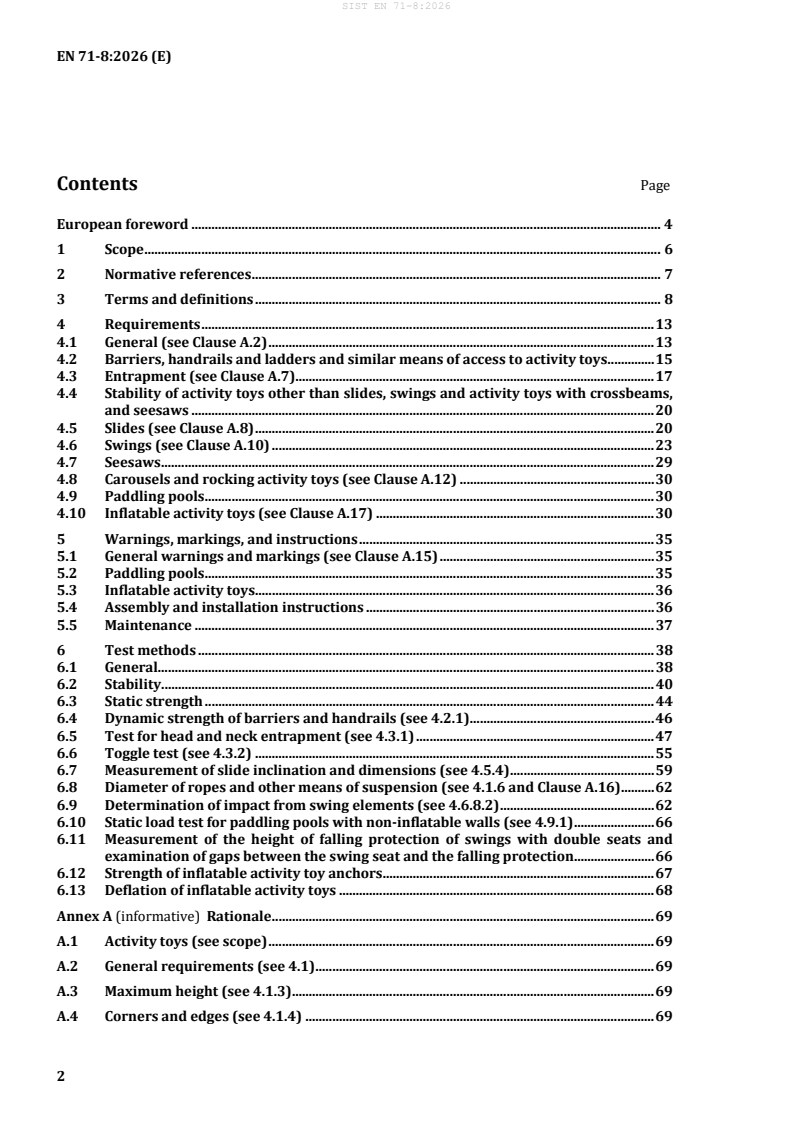
Contents
- 1 Scope
- 2 Normative references
- 3 Terms and definitions
- 3.1 activity toy
- 3.2 anchor
- 3.3 attachment slide
- 3.4 barrier
- 3.5 collapse
- 3.6 constant-air inflatable activity toy
- 3.7 contained-air inflatable activity toy
- 3.8 crossbeam
- 3.9 declined plane
- 3.10 entrapment
- 3.11 exposed edge
- 3.12 forced movement
- 3.13 free height of fall
- 3.14 free space
- 3.15 grasp
- 3.16 grip
- 3.17 handrail
- 3.18 inflatable activity toy
- 3.19 paddling pool
- 3.20 platform
- 3.21 resilient material
- 3.22 slide
- 3.23 suspension connector
- 3.24 swing
- 4 Requirements
- 4.1 General (see Clause A.2)
- 4.2 Barriers, handrails and ladders and similar means of access to activity toys
- 4.3 Entrapment (see Clause A.7)
- 4.5 Slides (see Clause A.8)
- 1 Sliding surface
- 2 Retaining side
- 4.6 Swings (see Clause A.10)
- 4.7 Seesaws
- 4.8 Carousels and rocking activity toys (see Clause A.12)
- 4.9 Paddling pools
- 4.10 Inflatable activity toys (see Clause A.17)
- 5 Warnings, markings, and instructions
- 5.1 General warnings and markings (see Clause A.15)
- 5.2 Paddling pools
- 5.3 Inflatable activity toys
- 5.4 Assembly and installation instructions
- 5.5 Maintenance
- 6 Test methods
- 6.1 General
- 6.2 Stability
- 6.3 Static strength
- 6.4 Dynamic strength of barriers and handrails (see 4.2.1)
- 6.5 Test for head and neck entrapment (see 4.3.1)
- 6.6 Toggle test (see 4.3.2)
- 6.7 Measurement of slide inclination and dimensions (see 4.5.4)
- 6.8 Diameter of ropes and other means of suspension (see 4.1.6 and Clause A.16)
- 6.9 Determination of impact from swing elements (see 4.6.8.2)
- 6.10 Static load test for paddling pools with non-inflatable walls (see 4.9.1)
- 6.11 Measurement of the height of falling protection of swings with double seats and
- 6.12 Strength of inflatable activity toy anchors
- 6.13 Deflation of inflatable activity toys
- Annex A
- Annex ZA
- Bibliography
1 Scope
This document specifies requirements and test methods for activity toys. This document also specifies requirements for:
- separately sold accessories for, and components of activity toys;
- separately sold swing elements that are ready for use on or in combination with an activity toy;
- construction packages for activity toys including components used to build activity toys in accordance with a scheduled building instruction.
The scope of this document excludes:
- playground equipment intended for public use dealt with in the EN 1176 series; - bow-mounted rocking activity toys such as rocking horses and similar toys, which are covered by specific requirements in EN 71-1; - toy pools with maximum depth of water over 400 mm measured, between the overflow level and the deepest point within the pool; NOTE 1 For information regarding the classification of pools as toys see European Commission guidance document No. 8 on the application of the Directive 2009/48/EC on the safety of toys – Pools [1]. - pools with maximum depth of water over 400 mm measured, between the overflow level and the deepest point within the pool, without play elements covered e.g. by the EN 16582 series or EN 16927.
NOTE 2 There is an enhanced risk of drowning in pools where the depth of water is in excess of 400 mm. - toy slides designed to be used in conjunction with domestic in-ground swimming pools; - trampolines for domestic use dealt with in EN 71-14; - powered blowers used to continuously inflate inflatable activity toys. NOTE 3 Powered blowers used to continuously inflate inflatable activity toys are considered to be a household appliance and covered by requirements given in EN 60335-2-80. See also Clause A.1.
2 Normative references
The following documents are referred to in the text in such a way that some or all of their content constitutes requirements of this document. For dated references, only the edition cited applies. For undated references, the latest edition of the referenced document (including any amendments) applies. EN 71-1:2026, Safety of toys — Part 1: Mechanical and physical properties EN ISO 7010:2020, Graphical symbols — Safety colours and safety signs — Registered safety signs (ISO 7010:2019, Corrected version 2020-06) EN ISO 21920-2:2022, Geometrical product specifications (GPS) — Surface texture: Profile — Part 2:
Terms, definitions and surface texture parameters (ISO 21920-2:2021, Corrected version 2022-06)
SIST EN 71-8:2026 EN 71-8:2026 (E)
3 Terms and definitions
For the purposes of this document, the following terms and definitions apply. ISO and IEC maintain terminology databases for use in standardization at the following addresses:
- ISO Online browsing platform: available at https://www.iso.org/obp/
- IEC Electropedia: available at https://www.electropedia.org/
3.1 activity toy
toy for domestic use, in which the support structure remains stationary while the activity is taking place and which is intended for the performance by a child of any of the following activities: climbing, jumping, swinging, sliding, rocking, spinning, paddling, crawling and creeping, or any combination thereof Note 1 to entry: Examples of such toys are swings, slides, carousels, climbing frames, rigid playhouses, paddling pools and inflatable activity toys. In contrast, ride-on toys are not considered as activity toys.
3.2 anchor
device used to fix an activity toy to the standing surface
3.3 attachment slide
slide for which access to the starting section is possible only by passing via another activity toy or parts of an activity toy Note 1 to entry: Such activity toys include climbing nets, bridges, platforms, inclined planes, other climbing devices. [SOURCE: EN 1176-3:2017, 3.3; modified — “equipment” has been replaced by “activity toy”]
3.4 barrier
device intended to prevent the user from falling and from passing beneath [SOURCE: EN 1176-1:2017+A1:2023, 3.24]
3.5 collapse
sudden or unexpected folding of a structure [SOURCE: EN 71-1:2026, 3.12]
3.6 constant-air inflatable activity toy
inflatable activity toy, relying on a continuous supply of air to maintain its shape
3.7 contained-air inflatable activity toy
inflatable activity toy that is inflated by filling with air which is contained with a closure(s) in order to maintain its shape
SIST EN 71-8:2026 EN 71-8:2026 (E)
3.8 crossbeam
bar or beam which forms a main load bearing part of certain activity toys (see Figure 4)
3.9 declined plane
surface which could be used for gliding downward in a sitting or lying position
3.10 entrapment
hazard presented by a situation in which a body, part of a body, or clothing is entrapped
3.11 exposed edge
edge intended to be touched and/or gripped by a child during the use of an activity toy Note 1 to entry: Exposed edges are commonly found on doors, windows, shutters, ladders, steps, handrails, retaining sides for slides and seats.
3.12 forced movement
movement of the user caused by the activity toy (e.g. swinging, sliding, carousel rotation etc.) which, once started, cannot be totally controlled by the user Note 1 to entry: Falls are not considered forced movement as they are not imposed on the user by the activity toy but occur for other reasons.
[SOURCE: EN 1176-1:2017+A1:2023, 3.34, modified — An original Note 2 to entry is not reproduced here and “equipment” has been replaced by “activity toy”.]
3.13 free height of fall
greatest vertical distance from the clearly intended body support to the impact area below [SOURCE: EN 1176-1:2017+A1:2023, 3.7, modified — An original Note 1 to entry is not reproduced here.]
3.14 free space
space in, on or around the activity toy that can be occupied by a user undergoing a forced movement caused by use of the activity toy (e.g. swinging, sliding, rocking, revolving) Note 1 to entry: The definition of free space does not include the three-dimensional space in which a falling movement takes place.
3.15 grasp
holding of the hand round part of the circumference of a support Note 1 to entry: See Figure 1.
SIST EN 71-8:2026 EN 71-8:2026 (E)
Figure 1 — Grasp [SOURCE: EN 1176-1:2017+A1:2023, 3.17]
3.16 grip
holding of the hand round the entire circumference of a support Note 1 to entry: See Figure 2.
Figure 2 — Grip [SOURCE: EN 1176-1:2017+A1:2023, 3.16]
3.17 handrail
rail intended to assist the user to balance [SOURCE: EN 1176-1:2017+A1:2023, 3.22]
3.18 inflatable activity toy
activity toy, with a structure made of flexible material, inflated by air, intended for children to play on or in, excluding paddling pools and toys intended to be used on or in water EXAMPLE Bouncy castle, inflatable slides (see Figure 3).
Note 1 to entry: There are two types of inflatable activity toys: contained-air inflatable activity toys and constant-air inflatable activity toys.
SIST EN 71-8:2026 EN 71-8:2026 (E) Note 2 to entry: Inflatable activity toys can also include a paddling pool element.
Figure 3 — Examples of inflatable activity toys
3.19 paddling pool
toy pool with a maximum depth of water of 400 mm measured between the overflow level and the deepest point within the pool Note 1 to entry: Examples of typical paddling pools can be found in the European Commission Guidance Document No. 8 on the application of the Directive 2009/48/EC on the safety of toys – Pools [1].
3.20 platform
raised surface where one or more users can stand without the need of hand support Note 1 to entry: The classification of a platform will vary depending on the function of the activity toy. Surfaces where the user is only able to stand with the aid of hand supports are not classified as platforms. Exclusion of surfaces from the definition can be achieved by a number of means, e.g.:
- reducing the surface area to restrict free movement and encourage holding on;
- incline the surface to encourage holding on;
- introducing movement to the surface to encourage holding on. [SOURCE: EN 1176-1:2017+A1:2023, 3.21, modified — The wording of the Note 1 to entry was modified.]
3.21 resilient material
material which is capable of regaining its original shape, position or absorbing shock after bending, stretching, compression, impact or other actions
3.22 slide
structure with inclined surface(s) on which the user slides in a defined track Note 1 to entry: Inclined planes, designed primarily for other purposes, such as roofs, do not constitute slides.
3.23 suspension connector
device which forms the direct contact between a crossbeam and the means of suspension (see Figure 4)
3.24 swing
structure incorporating a crossbeam, suspension connectors and a swing device with swing element, suspension coupling and means of suspension
SIST EN 71-8:2026 EN 71-8:2026 (E) Note 1 to entry: Examples of swings are shown in Figure 4.
a) Example of a flat seat
b) Example of a gondola Key 1 swing device 2 crossbeam 3 upper suspension connector 4 upper suspension coupling 5 lower suspension connector 6 lower suspension coupling 7 means of suspension 8 swing element (e.g. seat, rings, bar, gondola) NOTE A swing device can include one or more footrests. Footrests are considered as parts of the swing elements.
Figure 4 — Diagrammatic representation of examples of swings
SIST EN 71-8:2026 EN 71-8:2026 (E)
4 Requirements
4.1 General (see Clause A.2)
4.1.1 Assembly
Activity toys shall be assembled using self-locking fasteners which, to avoid unintentional disassembling due to dynamic forces during use, may include spring washers and/or self-locking nuts. NOTE Self-tapping screws are considered as self-locking fasteners. Smooth nails are not considered as selflocking fasteners.
4.1.2 Static strength
Activity toys other than swings and paddling pools, when tested in accordance with 6.3.2 (strength of activity toys other than swings and paddling pools), shall not collapse such that they do not continue to comply with the relevant requirements of EN 71-1:2026.
NOTE Static strength requirements for swings are given in 4.6.2 and for paddling pools in 4.9.1.
4.1.3 Maximum height (see Clause A.3)
When measured from the ground, there shall be no part of the activity toy where the child is able to climb, sit or stand above a height of 2 500 mm.
4.1.4 Corners and edges (see Clause A.4)
Exposed edges shall be rounded.
Corners and exposed edges on moving parts shall have a minimum radius of 3 mm. This requirement does not apply to swing elements with a mass of 1 000 g or less, the corners and edges of which shall be rounded.
4.1.5 Protruding parts
The requirements in 4.1.5 apply to protruding parts situated on accessible moving parts and in places where the user is running, sliding, climbing, sitting or lying down. There shall be no protruding nails, projecting wire rope terminations or components. Protruding bolt threads within any accessible part of the activity toy shall be permanently covered, e.g. dome headed nuts. Nuts and bolt heads that project less than 8 mm shall be free from burrs. NOTE 1 Figure 5 shows examples of protection for nuts and bolts. Protruding parts within the space occupied by the user that protrude more than 8 mm, and which are not shielded by adjacent areas that are not more than 25 mm from the end of the projecting part, shall be rounded off. The minimum radius of the curve shall be 3 mm.
NOTE 2 This requirement is intended only to prevent injuries caused by unintended contact with components. Protruding parts with a radius less than 3 mm may be in other accessible parts of the activity toy only if they are not sharp in accordance with EN 71-1:2026, 8.11 and 8.12.
SIST EN 71-8:2026 EN 71-8:2026 (E) Dimensions in millimetres
a) Examples of protection for nuts and bolts
b) Examples of permissible parts Figure 5 — Examples of protection for nuts and bolts
4.1.6 Diameter of ropes and other flexible means of suspension (see Clause A.16)
When measured in accordance with 6.8 (diameter of ropes and other means of suspension), ropes and other flexible means of suspension shall have dimensions in accordance with Table 1. Table 1 — Dimension of ropes and other flexible means of suspension Ropes fixed at both ends Diameter between 16 mm and 45 mm Ropes used in climbing nets and Diameter between 10 mm and 45 mm ladders Free-hanging ropes fixed at Diameter between 25 mm and 45 mm upper end Means of suspension for swing Ropes with circular section Minimum diameter 10 mm elements Chains Minimum diameter 10 mm
Straps or similar means of Minimum cross section 40 mm suspension and minimum circumference 60 mm
4.1.7 Water accumulation (see Clause A.14)
Except when intended for water play, all parts of activity toys should be designed so that they do not accumulate water which could produce drowning hazard.
SIST EN 71-8:2026 EN 71-8:2026 (E)
4.2 Barriers, handrails and ladders and similar means of access to activity toys
4.2.1 Barriers and handrails preventing a child from falling down (see 6.5.1, Clause A.5)
Any platform 1 000 mm or more from the ground shall be equipped with a barrier on all sides that face outwards from the toy.
The openings between the surface of the platform and the lower edge of the barrier, and the openings in the barrier, shall not allow the passage of probe C (see Figure 22) and probe E (see Figure 24), except for entrance and exit openings necessary for each play element. Probe C and probe E shall be applied in accordance with 6.5.1, (head and neck entrapment in accessible completely bound openings). Openings to give access to slides, climbing structures and ladders are allowed. The minimum height of the barrier shall be 600 mm.
For barriers with an uneven top design, a ruler of (200 ± 5) mm shall be used for measuring minimum height. Place the ruler horizontally on top of the barrier. Measure the vertical distance between the platform and the bottom of the ruler. The distance shall in no place be less than 600 mm. NOTE Special requirements apply to slides (see 4.5.3 retaining sides for slides and 4.5.4 starting, sliding and run-out sections on slides).
After testing in accordance with 6.4 (dynamic strength of barriers and handrails), no part of the barrier or handrail shall collapse so that the toy does not comply with the relevant requirements of EN 71-1:2026.
4.2.2 Ladders and similar means of access to activity toys (see Clause A.6)
The requirements in 4.2.2 do not apply to activity toys with a platform height of 600 mm or less. Ladders and similar means of access to activity toys shall comply with the following requirements:
a) any opening shall comply with 4.3.1 (head and neck entrapment); b) where a ladder or a stair is used, the lateral width of the tread or rung shall be 240 mm or more [see Figure 6 a)]; c) the distance between the upper surfaces of the treads or rungs shall not exceed 310 mm when measured vertically as indicated in Figure 6 b). This requirement does not apply to the vertical distance between the ground and the upper surface of the first step; d) the surface of the tread shall not be slippery. This can be achieved by corrugation of the steps or by the use of non-slippery types of materials; e) when ladders are provided with rungs, the cross-sectional dimension of the rungs shall be not less than 16 mm and not more than 45 mm; f) the depth of treads on closed step ladders shall be 120 mm or more [see Figures 6 c) and 6 d)]; g) the inclination for ladders that are fixed to a toy shall be between 55° and 90° to the horizontal; h) Ladders any part of which reaches a height of 1 200 mm or more from the ground shall be provided with handrails from a height of not more than 600 mm from the ground to the top of the platform or starting section [see Figure 6 a)].
This requirement does not apply to ladders with rungs or stiles if their cross sections comply with the requirements of grip or grasp:
SIST EN 71-8:2026 EN 71-8:2026 (E) - the cross-section of any support designed to be gripped for support of full body weight (see 3.16 and Figure 2) shall have a dimension of not less than 16 mm and not more than 45 mm in any direction, when measured across its centre, or - the cross-section of any support designed to be grasped (see 3.15 and Figure 1) shall have a width not exceeding 60 mm.
Dimensions in millimetres
a) Dimensions of ladders
b) Details of a step ladder
c) Details of closed stairs
SIST EN 71-8:2026 EN 71-8:2026 (E)
d) Details of a closed ladder Figure 6 — Ladders
4.3 Entrapment (see Clause A.7)
4.3.1 Entrapment of head and neck
Activity toys shall be constructed so that any openings do not create head and neck entrapment hazards either by head first or feet first passage.
Hazardous situations in which this type of entrapment can be encountered include the following:
- completely bound openings through which a user can slide feet first or head first;
- partially bound or V-shaped openings;
- other openings (e.g. shearing or moving openings).
a) Accessible completely bound openings with a lower edge more than 600 mm above ground, or above any other surface which is of such a size that it will support a child, shall be tested in accordance with 6.5.1 (head and neck entrapment in accessible completely bound openings). Probe C (see Figure 22) or probe E (see Figure 24) shall not pass through any opening unless it also allows the passage of the large head probe D (see Figure 23).
b) Accessible completely bound openings, that allow the free passage of probe C (see Figure 22), when tested in accordance with 6.5.1 (head and neck entrapment in accessible completely bound openings) shall have no parts that converge in the downward direction at an angle of less than 60° if the lower edge is 600 mm or more above the ground (V-shaped opening).
c) Partially bound and V-shaped openings with an entrance at 600 mm or more above the ground, or above any other surface which is of such a size that it will support a child, shall be constructed so that either:
1) the opening is not accessible as defined in Figure 27 (method of insertion of the “B” portion of probe F), when tested in accordance with 6.5.2.3 a) (head and neck entrapment in partially bound and V-shaped openings); or 2) if the opening is accessible at a position of 600 mm or more above ground when tested in accordance with 6.5.2.3 a) (head and neck entrapment in partially bound and V-shaped openings), depending on the angular orientation range of the opening (see Figure 25, checking all insertion angles to determine range), it shall conform to the following:
SIST EN 71-8:2026 EN 71-8:2026 (E) i. Range 1: (probe F [see Figure 26] centre line ± 45° from vertical); when the probe F apex contacts the base of the opening, the depth of the opening shall be less than the length of probe F to the underside of the shoulder section.
ii. Range 2: (probe F centre line from horizontal to +45°); when the probe F apex contacts the base of the opening, the depth of the opening shall be less than the ‘A’ portion of probe F. If the depth of the opening is greater than the ‘A’ portion of probe F all parts of the opening above the ‘A’ portion shall also allow insertion of the shoulder section of probe F or probe D (see Figure 23).
iii. Range 3: No probe test requirements.
d) Non-rigid members (for example ropes) shall not overlap if, by doing so, they create openings that do not conform to the requirements for completely bound openings. e) Openings between flexible parts of suspended bridges and any rigid side members shall not be less than 230 mm in diameter under the most onerous condition of loading. Both loaded and unloaded situations shall be considered.
...